Showing posts with label Thyreophora. Show all posts

Thursday, August 28, 2025

[Paleontology • 2025] Spicomellus afer • Extreme Armour in the World’s Oldest Ankylosaur


Spicomellus afer
Maidment, Strachan, Ouarhache, Scheyer, Brown, Fernandez, Johanson, Raven & Barrett, 2021

in Maidment, Ouarhache, Ech-charay, Oussou, Boumir, El Khanchoufi, ..., Barrett et Butler, 2025. 

Abstract
The armoured ankylosaurian dinosaurs are best known from Late Cretaceous Northern Hemisphere ecosystems, but their early evolution in the Early–Middle Jurassic is shrouded in mystery due to a poor fossil record. Spicomellus afer was suggested to be the world’s oldest ankylosaur and the first from Africa, but was based on only a single partial rib from the Middle Jurassic of Morocco. Here we describe a new, much more complete specimen that confirms the ankylosaurian affinities of Spicomellus, and demonstrates that it has uniquely elaborate dermal armour unlike that of any other vertebrate, extant or extinct. The presence of ‘handle’ vertebrae in the tail of Spicomellus indicates that it possessed a tail weapon, overturning current understanding of tail club evolution in ankylosaurs, as these structures were previously thought to have evolved only in the Early Cretaceous. This ornate armour may have functioned for display as well as defence, and a later reduction to simpler armour with less extravagant osteoderms in Late Cretaceous taxa might indicate a shift towards a primarily defensive function, perhaps in response to increased predation pressures or a switch to combative courtship displays.


Spicomellus afer Maidment, Strachan, Ouarhache, Scheyer, Brown, Fernandez, Johanson, Raven & Barrett, 2021


Susannah C. R. Maidment, Driss Ouarhache, Kawtar Ech-charay, Ahmed Oussou, Khadija Boumir, Abdessalam El Khanchoufi, Alison Park, Luke E. Meade, D. Cary Woodruff, Simon Wills, Mike Smith, Paul M. Barrett and Richard J. Butler. 2025. Extreme Armour in the World’s Oldest Ankylosaur. Nature. DOI: doi.org/10.1038/s41586-025-09453-6 [27 August 2025]


Monday, November 11, 2024

[Paleontology • 2024] Huaxiazhoulong shouwen • A New ankylosaurid Dinosaur (Ankylosauria: Ankylosauridae) from the Upper Cretaceous of Jiangxi Province, southern China


Huaxiazhoulong shouwen 
Zhu, Wu, You, Jia, Chen, Yao, Zheng & Xu, 2024 
 
artwork by YE Jianhao

ABSTRACT
Huaxiazhoulong shouwen gen. et sp. nov. is a new ankylosaurid recovered from the Upper Cretaceous Tangbian Formation of Jiangxi Province, southern China. Huaxiazhoulong shouwen can be diagnosed on the basis of three autapomorphies (the middle shaft and distal end of the ischium are expanded; the ratio of width of distal end to minimum shaft width is greater than 3 in humerus, the maximum length of femur to humerus length ratio is about 1.45) and a unique combination of characters (the centra of anterior caudal vertebrae in anterior view is heart-shaped; the dorsal surface of scapula is straight; the scapulocoracoid has a large medial brace; the humeral head and deltopectoral crest are separated by a distinct notch anteriorly). The phylogenetic analysis shows that Huaxiazhoulong shouwen is an early member of Ankylosauridae.

KEYWORDS: Ankylosauria, Upper Cretaceous, Tangbian Formation, Jiangxi Province, Huaxiazhoulong shouwen


Huaxiazhoulong shouwen gen. et sp. nov.


Ziheng Zhu, Jie Wu, Yue You, Yingli Jia, Chujiao Chen, Xi Yao, Wenjie Zheng and Xing Xu. 2024. A New ankylosaurid Dinosaur from the Upper Cretaceous of Jiangxi Province, southern China. Historical Biology: An International Journal of PaleobiologyDOI: doi.org/10.1080/08912963.2024.2417208  

Saturday, June 22, 2024

[Paleontology • 2024] A Comprehensive Phylogenetic Analysis on early Ornithischian Evolution


 A Comprehensive Phylogenetic Analysis on early Ornithischian Evolution

in Fonseca, Reid, Venner, Duncan, Garcia & Müller, 2024.

Abstract
Resolving the evolutionary relationships of early diverging (‘basal’) ornithischian dinosaurs is a challenging topic in palaeontology, with multiple competing hypotheses on the phylogenetic relationships of heterodontosaurids, ‘hypsilophodontids’, and other early-diverging forms. These hypotheses cannot be directly compared because they are derived from differently constructed datasets (i.e. distinct samples of taxa and characters). This study aims to address these issues by revising and combining the distinct datasets into a single analysis in order to create the most comprehensive dataset for the investigation of the phylogenetic relationships of early-diverging ornithischians. A diphyletic model of Dinosauria is supported, with silesaurs nesting as members of Ornithischia. Heterodontosauridae is resolved as a clade of non-genasaurian ornithischians, rejecting a potential relationship with Marginocephalia. ‘Hypsilophodontid’ taxa span the neornithischian and ornithopod stem, with Thescelosauridae as the sister taxon to Cerapoda. A more restricted Ornithopoda is composed of five main clades: Hypsilophodontidae, Rhabdodontomorpha, Elasmaria, Dryosauridae and Ankylopollexia. Hypsilophodontidae is a valid clade, reduced to two European Barremian taxa. Rhabdodontomorpha does not contain Muttaburrasaurus as originally proposed, but instead expands to include a North American clade formed by ConvolosaurusIani and Tenontosaurus. Elasmaria contains all non-dryomorph Gondwanan ornithopods, with its members possessing multiple distinct body plans. New results and comparison with previous studies suggest that some members of Dryosauridae are not ‘true dryosaurids’ but various early euiguanodontians that may be more closely related to either Elasmaria or Ankylopollexia. Results group most ‘hypsilophodontids’ in larger clades, significantly reducing the number and extension of ghost lineages throughout all of Neornithischia. These clades also show a degree of endemism, with different lineages present at different continents in the Late Cretaceous. This new phylogenetic analysis unifying previous works will provide a framework for future studies on origins and relations of early diverging ornithischians, and attempting to find stability among the different competing hypotheses.

Keywords: Silesauridae, Heterodontosauridae, Thyreophora, Neornithischia, Ornithopoda, Marginocephalia


André O. Fonseca, Iain J. Reid, Alexander Venner, Ruairidh J. Duncan, Mauricio S. Garcia and Rodrigo T. Müller. 2024. A Comprehensive Phylogenetic Analysis on early Ornithischian Evolution. Journal of Systematic Palaeontology. 22(1); 2346577. DOI: 10.1080/14772019.2024.2346577 


Monday, April 1, 2024

[Paleontology • 2024] Thyreosaurus atlasicus • A New stegosaurian dinosaur (Ornithischia: Thyreophora) with A remarkable dermal armour from the Middle Jurassic of North Africa


Thyreosaurus atlasicus
Zafaty, Oukassou, Riguetti, Company, Bendrioua, Tabuce, Charrière & Pereda-Suberbiola, 2024

 
Highlights: 
Thyreosaurus atlasicus, a new stegosaur from the Middle Jurassic of North Africa is presented.
• The new taxon is characterised by an asymetric bizarre dermal armour, unique among stegosaurs.
Thyreosaurus is closely related to Dacentrurus among Dacentrurinae.
• The discovery is important in understanding the evolutionary history of thyreophorans.

Abstract
In recent years the Middle Atlas of Morocco has become an area of interest for the study of dinosaurs in northern Africa. The Boulahfa locality, near Boulemane, has produced a diverse dinosaur assemblage from the Middle Jurassic of the El Mers Group. Fossil remains of sauropods and thyreophorans, such as ankylosaurs (Spicomellus) and stegosaurs (Adratiklit), have been reported thus far in this region. Here, we describe a new partial thyreophoran skeleton found in the gray marls of the El Mers III Formation (Bathonian-? Callovian), which mainly consists of disarticulated dorsal vertebrae and ribs, and associated dermal armour elements. Axial characters (e.g., elongated pedicels of the dorsal neural arches; upturned transverse processes and dorsal ribs with straight axes suggesting a narrow ribcage) indicate that the specimen belongs to a medium to large-sized stegosaur. The dorsal vertebrae show differences with those of Adratiklit, whose material has been found at the same stratigraphic levels. Thyreosaurus atlasicus gen. et sp. nov. is characterized by a remarkable dermal armour, which consists of thick (up to 4 cm) subovate to subrectangular-shaped osteoderms. The asymmetrical texture of their sides, one roughly ornamented with small pits and fiber bundles, the other with a well-marked cross-hatched pattern, is clearly different from that observed to date in other stegosaurs (and ankylosaurs). The bone histology of these osteoderms is reminiscent of that of stegosaur tail spines. It is interpreted that these osteoderms were arranged in a recumbent position over the body of the animal, instead of an erect position. The holotype corresponds to an adult individual who did not reach its maximum body size (estimated body length 6 m). The phylogenetic analysis suggests that Thyreosaurus is closely related to Dacentrurus within Dacentrurinae. The recent discoveries of Adratiklit and Thyreosaurus provide insight into the early evolution of stegosaurs in the Middle Jurassic of Africa.


Thyreosaurus atlasicus gen. et sp. nov.


Omar Zafaty, Mostafa Oukassou, Facundo Riguetti, Julio Company, Saad Bendrioua, Rodolphe Tabuce, André Charrière and Xabier Pereda-Suberbiola. 2024. A New stegosaurian dinosaur (Ornithischia: Thyreophora) with A remarkable dermal armour from the Middle Jurassic of North Africa. Gondwana Research. In Press. DOI: 10.1016/j.gr.2024.03.009

Sunday, February 25, 2024

[Paleontology • 2024] Datai yingliangis • A New Armored Dinosaur (Ankylosauria: Ankylosauridae) with double cheek horns from the early Late Cretaceous of southeastern China


Datai yingliangis
Xing, Niu, Mallon & Miyashita, 2024

Reconstruction by Kaitlin T. Lindblad twitter.com/Crocodontist

ABSTRACT
Ankylosaurines are the iconic armoured dinosaurs that characterize terrestrial vertebrate faunas in the Late Cretaceous of Asia and Laramidia (western North America). The earliest members of this clade are known from the early Late Cretaceous (Cenomanian–Santonian) times of Asia, but little consensus has emerged as to how they are related to the anatomically derived and chronologically younger forms. In southeastern China, the Cretaceous red sand beds crop out across basins from Zhejiang to Guandong provinces. However, the horizons corresponding to the early Late Cretaceous stages remain poorly sampled. Here, we report the first definitive vertebrate skeleton — let alone that of an armoured dinosaur — from the Coniacian/Turonian Ganzhou Formation, Datai yinliangis gen. et sp. nov. Despite the immature ontogenetic status of the type materials, D. yingliangis can be diagnosed with autapomorphic traits in the cranial caputegulae (such as double horns on the quadratojugal) and extensive gular osteoderms. Morphologically, it is intermediate between the chronologically older ankylosaurids from Asia (e.g., Crichtonpelta and Jinyunpelta) and derived post-Cenomanian ankylosaurines (e.g., Pinacosaurus). Phylogenetic analyses broadly corroborate this assessment. The new taxon either falls in the grade of Asian ankylosaurines proximal to the lineages of derived forms or forms a sister lineage to Pinacosaurus. Based on these insights, Datai makes a significant addition to the early Late Cretaceous vertebrate fauna from southeastern China and highlights the future potential in this region for improved understanding of the origin and early evolution of ankylosaurines.

Keywords: Ankylosauria, Ankylosaurinae, Zhoutian Formation, Guanzhou Group


The type specimens of Datai yingliangis gen. et ap. nov. (individual lying on top: YLSNHM 01003; individual on bottom: YLSNHM 01002, holotype) prepared and reconstructed in situ. The head, cervical, and thoracic regions of the specimens were discovered and extracted from a single block.


Dinosauria Owen, 1842
Ornithischia Seeley, 1887
Thyreophora Nopcsa, 1915
Ankylosauria Osborn, 1923
Ankylosauridae Brown, 1906

Datai gen. nov.

Etymology: 'Datai,' a composite of the last character (syllable) each from tongda (to understand/to be sensible) and antai (stable) in Chinese Pinyin.

Datai yingliangis sp. nov.

Diagnosis: An ankylosaurine with dual jugal/quadratojugal horns. This taxon is also distinguished from all other ankylosaurines with a unique combination of the following characters: protruded premaxilla such that prenarial portion is longer than infranarial portion (also present in Zhongyuansaurus luoyangensis), distinct 'postfrontal' caputegulum (also in Pinacosaurus mephistocephalus and Talarurus plicatospineus), well-developed supraorbitals forming no lacrimal incisure or postorbital peak (potentially controlled ontogenetically), parasagittaly projecting squamosal horn (also in Scolosaurus cutleri/Oohkotokia horneri), nuchal horn (also in Ankylosaurus magniventris, Euoplocephalus tutus, Nodocephaosaurus kirtlandensis, Zuul crurivastator), and polygonal, monotypic gular osteoderms covering the interman-dibular region and the entire throat (polymorphic gular osteoderms occur in Jinyunpelta sinensis).

Type locality and horizon: Zhoutian Formation, Ganzhou Group (Turonian–early Coniacian; Upper Cretaceous; 96–90 Ma).

Etymology: 'yingliangis', in recognition of the Yingliang Group. The Yingliang Stone Natural History Museum is operated as a public museum by the philanthropic program of the founder (Liang Liu) of the Yingliang Group, and the type specimens are curated in this museum in Shuitou, Fujiang, China.


Lida Xing, Kecheng Niu, Jordan Mallon and Tetsuto Miyashita. 2024. A New Armored Dinosaur with double cheek horns from the early Late Cretaceous of southeastern China. Vertebrate Anatomy Morphology Palaeontology. 11. DOI: 10.18435/vamp29396

Thursday, September 21, 2023

[Paleontology • 2023] Moyenisauropus lusitanicusThe First Dinosaurs in Iberia: A New Dinosaur Tracksite from the Sinemurian (Lower Jurassic) of Portugal


Moyenisauropus lusitanicus 
 Figueiredo, de Carvalho, Cunha, Duarte, Fonseca, Monteiro & Forte, 2023

Artwork: Alexandre Fonseca twitter.com/lex_fonseca_ 

ABSTRACT
Dinosaur fossils from the Lower Jurassic are very scarce in the Iberian Peninsula, which lacks a dinosaur track record. This study reports a new ichnosite from this age, at the Alvaiázere Municipality (Lusitanian Basin, Portugal) with several well-defined dinosaur and other archosaurs tracks. Seventeen tracks were identified at the top sedimentary surface of a fine-grained dolostone bed belonging to the Coimbra Formation (Sinemurian, Lower Jurassic). Therefore, the tracksite could have an age of ~196 to 194 Ma, based in the stratigraphic position of the tracksite in the Coimbra Formation succession. The ichnological comparison allows us to ascribe these tracks to Moyenisauropus and Batrachopus ichnogenera. The dinosaur tracks are assigned to the new ichnospecies Moyenisauropus lusitanicus isp. nov. The trackmaker could be a basal thyreophoran dinosaur related to Emausaurus or Scelidosaurus, and the presence of a manus-pes pair track set verifies that these tracks were made by a quadrupedal gait. The crocodylomorph trackmaker could be a teleosaurid. The analysed bioturbated fine-grained dolostone bed was deposited in very shallow subtidal to intertidal, carbonate lagoonal (?) environment. The evidence provided here indicates the presence of crocodylomorphs and thyreophoran dinosaurs in a tropical coastal wetland carbonate system developed during the Early Jurassic in the Lusitanian Basin (Atlantic western margin of Iberia).

KEYWORDS: Ornithischian tracks, dinosaurs, crocodylomorphs, Coimbra Formation, Sinemurian, Lusitanian Basin


 Moyenisauropus lusitanicus isp. nov.


Silvério D. Figueiredo, Carlos Neto de Carvalho, Pedro P. Cunha, Luís V. Duarte, Alexandre Fonseca, Cláudio Monteiro and João Forte. 2023. The First Dinosaurs in Iberia: A New Dinosaur Tracksite from the Sinemurian (Lower Jurassic) of Portugal. Historical Biology: An International Journal of Paleobiology. DOI: 10.1080/08912963.2023.2256751  


Thursday, December 8, 2022

[Paleontology • 2022] Zuul crurivastator • Palaeopathological Evidence for Intraspecific Combat in Ankylosaurid Dinosaurs


Zuul crurivastator Arbour & Evans, 2017

in Arbour, Zanno & Evans, 2022. 

Abstract
Ankylosaurid dinosaurs were heavily armoured herbivores with tails modified into club-like weapons. These tail clubs have widely been considered defensive adaptations wielded against predatory theropod dinosaurs. Here we argue instead that ankylosaurid tail clubs were sexually selected structures used primarily for intraspecific combat. We found pathological osteoderms (armour plates) in the holotype specimen of Zuul crurivastator, which are localized to the flanks in the hip region rather than distributed randomly across the body, consistent with injuries inflicted by lateral tail-swinging and ritualized combat. We failed to find convincing evidence for predation as a key selective pressure in the evolution of the tail club. High variation in tail club size through time, and delayed ontogenetic growth of the tail club further support the sexual selection hypothesis. There is little doubt that the tail club could have been used in defence when needed, but our results suggest that sexual selection drove the evolution of this impressive weapon. This changes the prevailing view of ankylosaurs, suggesting they were behaviorally complex animals that likely engaged in ritualized combat for social dominance as in other ornithischian dinosaurs and mammals.

Keywords: Dinosauria, Ankylosauria, sexual selection, animal weaponry


Victoria M. Arbour, Lindsay E. Zanno and David C. Evans. 2022. Palaeopathological Evidence for Intraspecific Combat in Ankylosaurid Dinosaurs. Biol. Lett. 18: 20220404. DOI: 10.1098/rsbl.2022.0404
 

Friday, December 2, 2022

[Paleontology • 2022] Patagopelta cristata • A New Small-bodied Ankylosaurian Dinosaur (Ornithischia: Nodosauridae) from the Upper Cretaceous of North Patagonia (Río Negro Province, Argentina)


Patagopelta cristata 
 Riguetti, Pereda-Suberbiola, Ponce, Salgado, Apesteguía, Rozadilla Arbour, 2022
 
 facebook.com: Sebastián Apesteguía 
illustration by Gabriel Dìaz Yantèn
 
Abstract
The most representative ankylosaurian remains from Argentina have been found in sediments of the Allen Formation (Campanian–Maastrichtian) in Salitral Moreno, Río Negro Province. Several authors have discussed the identity and history of these remains. In this study, we review all published material along with some new remains in order to summarize all the knowledge about these ankylosaurs. Previously published material includes a tooth, dorsal and anterior caudal vertebrae, a femur and several osteoderms. The new remains include synsacral and caudal elements, a partial femur and osteoderms. The anatomy of the tooth, the synsacrum, the mid-caudal vertebra, the femur and the osteoderms, and the histology of the post-cervical osteoderms, support a nodosaurid identification, as proposed in previous descriptions of the Salitral Moreno material. Patagopelta cristata gen. et sp. nov. is a new nodosaurid ankylosaur characterized by the presence of unique cervical half-ring and femoral anatomies, including high-crested lateral osteoderms in the half rings and a strongly developed muscular crest in the anterior surface of the femur. The ∼2 m body length estimated for Patagopelta is very small for an ankylosaur, comparable with the dwarf nodosaurid Struthiosaurus. We recovered Patagopelta within Nodosaurinae, related to nodosaurids from the ‘mid’-Cretaceous of North America, contrasting the previous topologies that related this material with Panoplosaurini (Late Cretaceous North American nodosaurids). These results support a palaeobiogeographical context in which the nodosaurids from Salitral Moreno, Argentina, are part of the allochthonous fauna that migrated into South America during the late Campanian as part of the First American Biotic Interchange.
 
Keywords: Patagopelta, Nodosauridae Late Cretaceous, Salitral Moreno, Patagonia, Gondwana


 Patagopelta cristata gen. et sp. nov.

 
Facundo Riguetti, Xabier Pereda-Suberbiola, Denis Ponce, Leonardo Salgado, Sebastián Apesteguía, Sebastián Rozadilla... 2022. A New Small-bodied Ankylosaurian Dinosaur from the Upper Cretaceous of North Patagonia (Río Negro Province, Argentina). Journal of Systematic Palaeontology. 20(1): 2137441. DOI: 10.1080/14772019.2022.2137441 

Tuesday, August 16, 2022

[Paleontology • 2022] Jakapil kaniukura • A New Cretaceous Thyreophoran (Ornithischia: Thyreophora) from Patagonia supports A South American Lineage of Armoured Dinosaurs


 Jakapil kaniukura
Riguetti, Apesteguía & Pereda-Suberbiola, 2022

Illustration by Gabriel Díaz Yantén twitter.com/PaleoGDY

Abstract
The early evolution of thyreophoran dinosaurs is thought to have occurred primarily in northern continents since most evidence comes from the Lower and Middle Jurassic of Europe and North America. The diversification into stegosaurs and ankylosaurs is obscured by a patchy fossil record comprising only a handful of fragmentary fossils, most with uncertain phylogenetic affinities. Here we report the discovery of a new armoured dinosaur from the early Late Cretaceous of Argentina, recovered phylogenetically using various datasets either as a basal thyreophoran or a stem ankylosaur, closely related to Scelidosaurus. It bears unusual anatomical features showing that several traits traditionally associated with the heavy Cretaceous thyreophorans did not occur universally. Jakapil kaniukura gen. et sp. nov. is the first definitive thyreophoran species from the Argentinian Patagonia. Unlike most thyreophorans, it seems to show a bipedal stance, as in Scutellosaurus. Jakapil also shows that early thyreophorans had a much broader geographic distribution than previously thought. It is a member of an ancient basal thyreophoran lineage that survived until the Late Cretaceous in South America.


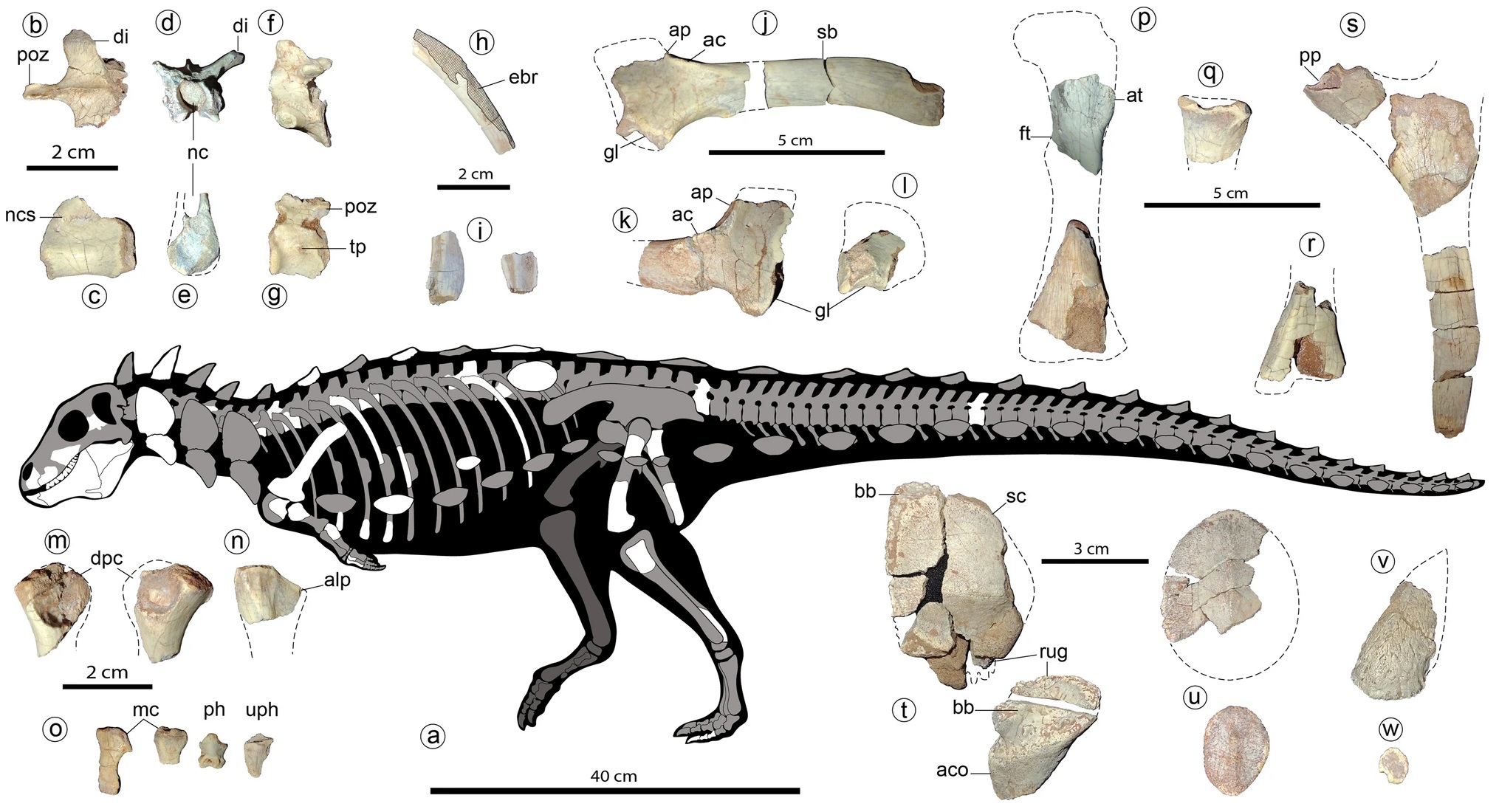
Holotype of Jakapil kaniukura (MPCA-PV-630), postcranial bones.
Speculative silhouette showing preserved elements (a);
osteoderm distribution is speculative and partial to show non-osteodermal elements); dorsal vertebra elements in dorsal (b), right lateral (c) and anterior (d,e) views; sacral vertebra in left lateral view (f); mid-caudal vertebra in left lateral view (g); fragment of the mid-shaft of a dorsal rib in posterior view (the enlarged, broken posterior edge is highlighted (h); expanded distal ends of two dorsal ribs (i); left scapula in lateral view (j); right scapula in lateral view (k); right coracoid in lateral view (l); left and right humeri in anterior view (m); probable right ulna in lateral view (n); metacarpals, non-ungual and ungual phalanx in dorsal views (o); left femur elements in anterior view (p); proximal end of the right fibula in lateral view (q); distal end of the left tibia in anterior view (r); ischial elements in side view (s); cervical osteoderms in dorsal view (t), flat scutes in dorsal view (u), spine-like osteoderm in side view (v) and ossicle in dorsal view (w).
ac acromial crest, aco asymmetrical cervical osteoderm, alp anterolateral process, ap acromial process, at anterior trochanter, bb basal bone, ebr expanded broken rib edge, di diapophysis, dpc deltopectoral crest, ft fourth trochanter, gl glenoid, mc metacarpals, nc neural canal, ncs neurocentral suture, ph non-ungual phalanx, pp pubic peduncle, poz postzygapophyses, rug marginal rugosities, sb scapular blade, sc scute, tp transverse process, uph ungual phalanx.

Systematic paleontology

Dinosauria Owen, 1842 
Ornithischia Seeley, 1887 
Thyreophora Nopcsa, 1915 

Jakapil kaniukura gen. et sp. nov. 

Diagnosis: Jakapil differs from all other thyreophorans in having: a large, ventral crest on the posterior half of the lower jaw, which is composed of the dentary, the angular and the splenial (medially hidden by the crest); a dorsomedially directed process in the short retroarticular process; leaf-shaped tooth crowns with a prominent mesial edge on their labial surface; maxillary and dentary tooth crowns differ from each other in their apical contour, the former being pointed and strongly asymmetrical, and the latter slightly curved distally with a more rounded and less asymmetrical contour; elongated (articular surface almost or completely beyond the posterior centrum face) and slender (width of less than a half postzygapophyses length) postzygapophyses in dorsal vertebrae; a strongly reduced humerus relative to the femur (proximal humeral width smaller than distal femoral width, see Supplementary Information), with a deep proximal fossa distally delimited by a curved ridge; a very large fibula relative to the femur (anteroposterior length of the proximal end almost comparable to the distal width of the femur); flattened and thin disk-like postcranial osteoderms.

Locality and horizon: Upper beds of the Candeleros Formation, early Late Cretaceous (Cenomanian, ~ 94–97 My, see16, and references therein), locality of Cerro Policía, Río Negro Province, North Patagonia, Argentina (Suppl. Fig. 1).

Etymology: The genus, Jakapil (Ja-Kapïl: shield bearer), comes from the ‘gananah iahish’, Puelchean or northern Tehuelchean language. The specific epithet, comprising kaniu (crest) and kura (stone), refers to the diagnostic ventral crest of the mandible, and comes from the Mapudungun language. These languages, currently spoken by more than 200,000 people, have been combined as a tribute to both of the coexisting native populations of North Patagonia, South America.


Facundo J. Riguetti, Sebastián Apesteguía and Xabier Pereda-Suberbiola. 2022. A New Cretaceous Thyreophoran from Patagonia supports A South American Lineage of Armoured Dinosaurs. Scientific Reports. 12: 11621. DOI: 10.1038/s41598-022-15535-6
Researchgate.net/publication/362643937_A_new_Cretaceous_thyreophoran_from_Patagonia


Friday, March 4, 2022

[Paleontology • 2022] Bashanosaurus primitivus • New Stegosaurs (Ornithischia, Stegosauria) from the Middle Jurassic Lower Member of the Shaximiao Formation of Chongqing, China


Bashanosaurus primitivus
Dai, Li, Maidment, Wei, Zhou, Hu, Ma, Wang, Hu & Peng, 2022

 
ABSTRACT
Stegosaurs are a major clade of ornithischian dinosaurs, yet because of their fragmentary fossil record, their interrelationships and early evolution are poorly understood. Here, we describe a new stegosaur, Bashanosaurus primitivus, gen. et sp. nov., and some other indeterminate stegosaur materials. We provide new U-Pb detrital zircon ages for horizons bounding the holotypic quarry in the Lower Member of the Shaximiao Formation, Yunyang, Chongqing Municipality, China, which indicate a Middle Jurassic (Bajocian) age. Bashanosaurus represents the earliest record of stegosaurs in Asia and one of the earliest records of this clade in the world. The dorsal vertebrae, scapula, coracoid, femur, and plates of Bashanosaurus primitivus possess several unique characters among Stegosauria, including the elevation of the parapophyses of dorsal vertebrae on stalks at the base of the transverse processes, a flared distal end of the scapula, and a small acromial process. Among armored dinosaurs (thyreophorans), these features are reminiscent of the basally branching taxon Scelidosaurus, indicating that Bashanosaurus possesses a unique mosaic of plesiomorphic thyreophoran and derived stegosaur features. Phylogenetic analysis shows that Bashanosaurus primitivus is the earliest-diverging stegosaur, along with Chungkingosaurus, from the Upper Member of the Shaximiao Formation, consistent with the early age of the taxon.


DINOSAURIA Owen, 1842
ORNITHISCHIA Seeley, 1887
STEGOSAURIA Marsh, 1877

BASHANOSAURUS PRIMITIVUS, gen. et sp. nov.

Diagnosis—Bashanosaurus primitivus differs from all other stegosaurs by possession of the following autapomorphies: (1) the parapophyses of dorsal vertebrae are elevated on stalks at the base of the transverse process and are clearly visible in anterior and posterior views; (2) the scapula blade is slender and flares distally; (3) the acromial process of the scapula is small, triangular and poorly developed; (4) the 4th trochanter of the femur is positioned below the middle of the shaft; (5) the bases of plates are strongly convex and transversely thickened, and are separated from the anterior/posterior margins of the plates by a distinct groove.

Etymology—The generic name “Bashan” refers to the ancient name of Chongqing, and the specific name “primitivus” indicates that this newly named species represents the earliest-diverging stegosaur.

...

 CONCLUSIONS: 
Bashanosaurus primitivus is the earliest record of Stegosauria in Asia and represents one of the earliest records of this clade from anywhere in the world. Geochronological data and analysis support a Middle Jurassic (Bajocian) age for the Shaximiao Formation in the vicinity of Pu’an Township, China. Phylogenetic analysis indicates that Bashanosaurus primitivus is the earliest-diverging stegosaur along with Chungkingosaurus supporting an Asian origin for Stegosauria based on currently available data.

 
Dai Hui, Li Ning, Susannah C. R. Maidment, Wei Guangbiao, Zhou Yuxuan, Hu Xufeng, Ma Qingyu, Wang Xunqian, Hu Haiqian and Peng Guangzhao. 2022. New Stegosaurs from the Middle Jurassic Lower Member of the Shaximiao Formation of Chongqing, China. Journal of Vertebrate Paleontology.   e1995737. DOI: 10.1080/02724634.2021.1995737 

Friday, December 3, 2021

[Paleontology • 2021] Stegouros elengassen • Bizarre Tail Weaponry in A Transitional Ankylosaur (Thyreophora: Parankylosauria clade nov.) from Subantarctic Chile


Stegouros elengassen 
Soto-Acuña, Vargas, Kaluza, Leppe, Botelho, Palma-Liberona, Gutstein, Fernández, Ortiz, Milla, Aravena, Manríquez, Alarcón-Muñoz, Pino, Trevisan, Mansilla, Hinojosa, Muñoz-Walther & Rubilar-Rogers, 2021

Illustration: Luis Pérez López 

Abstract
Armoured dinosaurs are well known for forms that evolved specialized tail weapons: paired tail spikes in stegosaurs, and heavy tail clubs in advanced ankylosaurs. Armoured dinosaurs from southern Gondwana are rare and enigmatic, but likely include the earliest branches of Ankylosauria. Here, we describe a mostly complete, semiarticulated skeleton of a small (about 2m) armoured dinosaur from the late Cretaceous of Magallanes in southernmost Chile, a region biogeographically related to West Antarctica. Stegouros elengassen gen. et sp. nov. evolved a large tail weapon unlike any dinosaur: A flat, frond-like structure formed by 7 pairs of laterally projecting osteoderms encasing the distal half of the tail. Stegouros shows ankylosaurian cranial characters, but a largely primitive postcranial skeleton, with some stegosaur-like characters. Phylogenetic analyses placed Stegouros in Ankylosauria, and specifically related to Kunbarrasaurus from Australia and Antarctopelta from Antarctica, forming a clade of Gondwanan ankylosaurs that split earliest from all other ankylosaurs. Large osteoderms and specialized tail vertebrae in Antarctopelta suggest it had a tail weapon similar to Stegouros. We propose a new clade, the Parankylosauria, to include the first ancestor of Stegouros but not Ankylosaurus, and all descendants of that ancestor.

KEYWORDS: dinosaurs, tail weapons, anylosaurus, stegosaurus


Dinosauria Owen, 1842 
Ornithischia Seeley, 1887 
 
Thyreophora Nopcsa 1928 
Ankylosauria Osborn, 1923 

Parankylosauria clade nov. 

Stegouros elengassen gen. et sp. nov. 

Etimology— Stegouros, after the Greek stego (roof) and the Greek uros (tail) in reference to the covered tailelengassen, after an armoured beast in the mythology of the local Aónik’enk people.

Locality and horizon—Río de las Chinas Valley, Estancia Cerro Guido, Magallanes Region, Chilean Patagonia (51°S). Lower section of Dorotea Formation (upper Campanian – lower Maastrichtian), between 71.7 ± 1.2 Ma and 74.9 ± 2.1 Ma10,11 (Supplementary Information section 2, Supplementary Fig. 2).

Armoured dinosaurs are the only amniotes to have evolved three different specialized tail weapons in Stegosauria, Stegouros and Ankylosaurinae.


Sergio Soto-Acuña, Alexander Vargas, Jonatan Kaluza, Marcelo Leppe, Joao Botelho, José Palma-Liberona, Carolina Gutstein, Roy Fernández, Hector Ortiz, Verónica Milla, Bárbara Aravena, Leslie Manríquez, Jhonatan Alarcón-Muñoz, Juan Pino, Christine Trevisan, Héctor Mansilla, Luis Hinojosa, Vicente Muñoz-Walther and David Rubilar-Rogers. 2021. Bizarre Tail Weaponry in A Transitional Ankylosaur from Subantarctic Chile. Nature. DOI: 10.1038/s41586-021-04147-1