Showing posts with label Author: E. Buffetaut. Show all posts

Monday, August 19, 2024

[Paleontology • 2024] Caletodraco cottardi • A New Furileusaurian Abelisaurid (Theropoda: Abelisauridae) from the Cenomanian Chalk of Normandy (North-Western France)


Caletodraco cottardi
Buffetaut, Tong, Girard, Hoyez & Párraga, 2024
 

Abstract
An articulated group of skeletal elements comprising a sacrum, both ilia and a first caudal vertebra, plus an isolated tooth found in immediate proximity to the bones, from the lower Cenomanian Chalk at Saint-Jouin-Bruneval (Seine-Maritime, Normandy, France) is described and attributed to a new genus and species of abelisaurid theropod, Caletodraco cottardi, on the basis of several characters of the sacrum and pelvis. The peculiar shape of the transverse process of the first caudal vertebra shows that Caletodraco cottardi differs from majungasaurine abelisaurids previously described from Europe, such as Arcovenator escotae, and belongs to the Furileusauria, a group of derived abelisaurids hitherto recognized only from South America. The presence of a furileusaurian abelisaurid in the Cenomanian of Normandy suggests that the biogeographical history of the Abelisauridae in Europe was more complex than hitherto admitted. Several previously described European abelisaurids, such as the Albian Genusaurus sisteronis, may in fact belong to the Furileusauria.

Keywords: Dinosauria; Theropoda; Abelisauridae; Cenomanian; Normandy

  Holotype specimen of Caletodraco cottardi, MHNH 2024.1.1., in dorsal (A,A’), left lateral (B,B’) and ventral (C,C’) views, with explanatory drawings. Front is at left.
Abbreviations: ai: anterior wing of ilium; bf: brevis fossa; cv: centrum of first caudal vertebra; d: depression; dmi: dorsal margin of ilium; li: left ilium; ns: fused neural spines of sacral vertebrae; pdp: posterodorsal process of ilium; s: sacrum; tpc: transverse process of first caudal vertebra; tps: transverse processes of sacral vertebrae.

Dinosauria Owen, 1842
Theropoda Marsh, 1881

Ceratosauria Marsh, 1884
Abelisauridae Bonaparte and Novas, 1985
Brachyrostra Canale et al., 2009
Furileusauria Filippi et al., 2016

Caletodraco cottardi, n.g., n.sp.

Diagnosis: a large abelisaurid theropod showing furileusaurian characteristics, including a straight dorsal margin of the ilium and a distally expanded and crescent-shaped tip of the dorsally orientated transverse process of the first caudal vertebra, with a convex distal margin, differing from previously known furileusaurians by the following autapomorphy: distinctive shape of the transverse process, with a short anterior spine and a rounded and expanded fan-shaped semicircular posterodistal margin.

Locus typicuscliffs along the English Channel at Saint-Jouin-Bruneval, Seine-Maritime, Normandy (NW France).
 
Derivatio nominis: genus name from the Caleti (or Caletes), a Celtic tribe that inhabited the Pays de Caux [Streiff. 1952]), the part of Normandy on the coast of which the fossil was found, and draco, Latin for dragon. The species is dedicated to Mr Nicolas Cottard, who discovered the specimen in the course of his systematic research on the stratigraphy and paleontology of the Chalk of Normandy and donated it to the Muséum d’histoire naturelle du Havre.


Conclusions: 
The discovery of Caletodraco cottardi shows that dinosaur remains, although exceedingly rare, do occur in the Chalk of the Anglo-Paris basin and that a careful search for fossil vertebrates in these marine formations can yield surprising and important results. The new taxon leads to a reassessment of the fossil record of abelisaurids in Europe, showing that, contrary to what could previously be assumed, majungasaurines were not the only abelisaurid subgroup present in that geographical area, since Caletodraco cottardi apparently belongs to the Furileusauria, a highly derived clade of Abelisauridae. C. cottardi is one of the earliest known Furileusauria and its occurrence in Europe leads to reconsider the biogeographical history of this group of theropods, hitherto known from South America.


 Eric Buffetaut , Haiyan Tong, Jérôme Girard, Bernard Hoyez and Javier Párraga. 2024. Caletodraco cottardi: A New Furileusaurian Abelisaurid (Dinosauria: Theropoda) from the Cenomanian Chalk of Normandy (North-Western France). Foss. Stud. 2(3), 177-195; DOI: 10.3390/fossils2030009

Thursday, July 13, 2023

[Paleontology • 2023] Minimocursor phunoiensis • A New Basal Neornithischian Dinosaur from the Phu Kradung Formation (Upper Jurassic) of Northeastern Thailand


Minimocursor phunoiensis  
Manitkoon, Deesri, Khalloufi, Nonsrirach, Suteethorn, Chanthasit, Boonla & Buffetaut, 2023

มินิโมเคอร์เซอร์ ภูน้อยเอนซิส  ||  DOI: 10.3390/d15070851
Drawings by Wongwech Chowchuvech and Sita Manitkoon. 

Abstract
An exceptional articulated skeleton of a new basal neornithischian dinosaur, Minimocursor phunoiensis gen. et sp. nov., was discovered in the Late Jurassic Phu Kradung Formation at the Phu Noi locality, Kalasin Province, Thailand, a highly productive non-marine fossil vertebrate locality of the Khorat Plateau. It is one of the best-preserved dinosaurs ever found in Southeast Asia. Minimocursor phunoiensis gen. et sp. nov. shows a combination of both plesiomorphic and apomorphic characters resembling those of Late Jurassic to Early Cretaceous small-bodied ornithischians from China: a low subtriangular boss is projected laterally on the surface of the jugal, the brevis shelf of the ilium is visible in lateral view along its entire length, a distinct supraacetabular flange is present on the pubic peduncle of the ilium, the prepubis tip extends beyond the distal end of the preacetabular process of the ilium, and the manus digit formula is ?-3-4-3-2. The phylogenetic analysis shows that this dinosaur is among the most basal neornithischians. This study provides a better understanding of the early evolution and taxonomic diversity of ornithischians in Southeast Asia.

Keywords: ornithischia; Southeast Asia; Khorat Plateau; Late Jurassic; Minimocursor phunoiensis


Skull of Minimocursor phunoiensis gen. et sp. nov. based on PRC 150 in left lateral view. Outline reconstruction of the skull (A); outline reconstruction of the skull with photos of the jugal (reversed), surangular, and angular (B); right jugal (C); and left surangular and angular (D). Scale bars: 1 cm.

Left dentary (PRC 149) referred to Minimocursor phunoiensis gen. et sp. nov. from Phu Noi locality in labial (A), dorsal (B), and lingual views (C). Dentary teeth in labial (D) and lingual (E) views.

Holotype of Minimocursor phunoiensis gen. et sp. nov., PRC 150, in left lateral view.
Photograph (A) and interpretative drawing (B).

Reconstruction of Minimocursor phunoiensis gen. et sp. nov. (PRC 150) in left lateral view (except reversed images of the right jugal). Recovered elements of the holotype shown in white (A); holotype with referred materials, which are not to scale, shown in light purple (B); and life restoration (C).
Drawings by Wongwech Chowchuvech (A, B) and Sita Manitkoon (B).


Systematic Palaeontology

Dinosauria Owen, 1842 
Ornithischia Seeley, 1888  
Neornithischia Cooper, 1985  
 
Minimocursor gen. nov.
 
Minimocursor phunoiensis gen. et sp. nov.

Diagnosis. Ornithischian dinosaur distinguished by a unique combination of plesiomorphic and apomorphic characters resembling those of basal neornithischians: jugal posterior process bifurcated distally (present in Lesothosaurus, Jeholosaurus, Psittacosaurus, and some early thyreophorans including Emausaurus and Scelidosaurus); a low flattened subtriangular boss projects laterally on the surface of the jugal (report in Changchunsaurus, and some early ornithischians including Manidens and Lioceratops); the pre-caudal axial skeleton is composed of 15 dorsals and 5 sacrals (presente in Lesothosaurus, Agilisaurus and Hexinlusaurus); the brevis shelf of the ilium is visible in lateral view along its entire length (present in Agilisaurus, Sanxiasaurus and Lesothosaurus); a distinct supraacetabular flange is present on the pubic peduncle of the ilium (present in Agilisaurus, Sanxiasaurus, and some early thyreophorans including Scutellosaurus and Scelidosaurus).

Type locality and horizon. Phu Noi locality (a small hill as the Thai name indicates), Ban Din Chi Sub-district, Kham Muang District, Kalasin Province, Thailand; Upper Jurassic Phu Kradung Formation, Khorat Group. This locality is part of the Kalasin Geopark area.

Etymology. The generic name is from the Latin ‘minimus’, ‘the smallest’, referring to the holotype individual, which is smaller than any other neornithischians from the site, combined with the suffix ‘-cursor’, the Latin word for runner. The specific epithet is derived from the excavation site, Phu Noi.

Articulated dorsal vertebrae of Minimocursor phunoiensis gen. et sp. nov., PRC 150, with close-up on the ossified tendons, under UV light.

Locality map and stratigraphy of Phu Noi locality, which has yielded the holotype of Minimocursor phunoiensis gen. et sp. nov. Map of Thailand, showing the location of Bangkok and Kalasin Province (A); map of Khorat Plateau, showing the distribution of the Lower Phu Kradung Formation and the location of Phu Noi locality (red star) (B); stratigraphic column of Phu Noi (modified from [26]) (C); photograph of the excavation site in 2023 (D).


Palaeoenvironmental interpretation of the Late Jurassic Phu Kradung Formation of northeastern Thailand, including
hybodont indet. with egg capsules (A), Acrodus kalasinensis (B), ptycholepid indet. (C), Isanichthys lertboosi (D), Ferganoceratodus annekempae (E), brachyopid indet. (F), Phunoichelys thirakupti (G), Kalasinemys prasarttongosothi (H), Indosinosuchus potamosiamensis (I), mamenchisaurid indet. (J), metriacanthosaurid indet. (K), stegosaur indet. (L), Minimocursor phunoiensis (M), and rhamphorhynchoid indet. (N).
 Drawing by Sakka Weerataweemat.

Conclusions
The Phu Noi locality contains a wealth of specimens and has yielded an exceptionally articulated skeleton, which represents one of the best-preserved dinosaurs ever found in Southeast Asia. This is the earliest record of neornithischians in Southeast Asia, and the first dinosaur taxon named from the Phu Kradung Formation of Thailand. This finding increases diversity and helps to elucidate the evolution of basal neornithischian dinosaurs in this region. Many of the remaining bones are still under preparation, including another skull. These unpublished specimens may provide a better understanding of the biology of Minimocursor phunoiensis gen. et sp. nov. in the future.
This study also provides new palaeontological data to illustrate the palaeoecosystem to the general public, as well as improving the academic value of the Kalasin Geopark.


  Sita Manitkoon, Uthumporn Deesri, Bouziane Khalloufi, Thanit Nonsrirach, Varavudh Suteethorn, Phornphen Chanthasit,Wansiri Boonla and Eric Buffetaut. 2023. A New Basal Neornithischian Dinosaur from the Phu Kradung Formation (Upper Jurassic) of Northeastern Thailand. Diversity. 15(7), 851. DOI: 10.3390/d15070851
  facebook.com/PaleoToon/posts/787863516672516
 (This article belongs to the Collection Feature Papers in Phylogeny and Evolution)


Friday, February 17, 2023

[Paleontology • 2023] The First Fossil Coelacanth from Thailand (Cretaceous, Phu Kradung Formation)


A left angular (PRC 160)
Mawsoniidae indeterminate

in Cavin, Tong, Buffetaut, Wongko, Suteethorn & Deesri, 2023. 

Abstract
Mawsoniidae is a family of coelacanths restricted to the Mesozoic. During the Cretaceous, mawsoniids were mainly represented by the Mawsonia/Axelrodichthy complex, long known to be from western Gondwana only (South America and Africa). This apparent biogeographical distribution then faded following the discovery of representatives in the Late Cretaceous of Laurasia (Europe and North America). We report here the presence, in the Lower Cretaceous site of Kham Phok, NE Thailand, of an angular bone referred to the Mawsonia/Axelrodichthys complex. A comparison with angulars referring to both genera found in various regions of the world between the Late Jurassic and the Late Cretaceous indicated that the distinctions between these genera, and even more so between their constituent species, are unclear. This discovery is further confirmation of the very slow morphological evolution within this lineage, which may explain why their evolutionary history appears to be disconnected, at least in part, from their geographical distribution over time.

Keywords: Actinistia; Mawsoniidae; paleobiogeography; angular; Khorat Plateau; Early Cretaceous; AxelrodichthysMawsonia

 Systematic Paleontology
Actinistia Cope, 1871 
Latimerioidei Schultze, 1993 
Mawsoniidae Schultze, 1993  

Mawsoniidae indeterminate

Referred material: A left angular associated with a dermal skull bone (supraorbital?) (PRC 160) from the Kham Phok fossil site.

Locality and horizon: Kham Phok, Khamcha-i district, Mukdahan Province, upper part of the Phu Kradung Formation, basal Cretaceous.

 Comparison in labial (a–k) and lingual (a’–k’) views between left angular PRC 160, Kham Phok locality ((g), framed in red), and other angulars referred to the Mawsonia/Axelrodichthys complex, discovered in various parts of the world dated between the Late Jurassic and the Late Cretaceous (red spots). Remark: Specimens i and j, figured by Cupello et al. [2016] and Batista et al. [2019] are both from a formation called Missão Velha and Brejo Santo, respectively, with an uncertain age of the Late Jurassic or Late Cretaceous. (a) A. megadromos, Southern France, terminal Cretaceous (inverted); (b) M. sp., USA, Woodbine Fm. (inverted); (c), A. lavocati, Northern Africa, ‘Continental Intercalaire’; (d) A. araripensis, Brazil, Santana Fm. (inverted); (e) M. gigas, Brazil, Marfim Fm.; (f) M. gigas, Brazil, Sanfranciscana Fm. (inverted); (h) mawsoniid indet., UK, Kimmeridge Clay; (i) mawsoniid indet., Brazil, MissãoVelha/Brejo Santo Fm.; (j) M. gigas, Brazil, MissãoVelha/Brejo Santo Fm. (inverted); (k) M. gigas, Brazil, Taruarembó Fm. Data from Cavin et al. (2021). Orange spots indicate other mawsoniid remains, not detailed here. The main anatomical structures are figured with colored areas.
Abbreviations: a.f, adductor fossa (blue); con.Part, contact surface with prearticular (red); gr.VII.m.ext groove for external mandibular ramus of VII (green); l.f, longitudinal fossa (orange); m.s.c, mandibular sensory canal (yellow); sut.p.Co, sutural contact surface with principal coronoid (purple); sut.De: sutural surface for dentary (pink); sut.Spl: sutural surface for splenial (grey).

Conclusions: 
The discovery of a mawsoniid coelacanth in the Lower Cretaceous of Thailand is an important new addition to the already rich vertebrate assemblages of the Phu Kradung Formation and, more generally, the Jurassic–Early Cretaceous assemblages of the Khorat Group. On a global scale and on the scale of tens of millions of years, this new occurrence blurs the palaeobiogeographical model previously proposed for this clade. It questions both the vicariance and dispersal events previously proposed to explain the observed distribution. The recognition of the coelacanths as forming a slowly evolving clade, in particular the mawsoniid clade, can explain the disconnection between the phylogenetic pattern and the paleobiogeographical framework, whereas such a connection is normally expected in biogeographical studies. One way to test this scenario is (1) to attempt to build a stronger phylogeny based on a re-study of known and hopefully new material and (2) to better decipher the Cenozoic evolutionary history of the extant coelacanth, Latimeria, which shows a split of species between 30 and 40 million years ago associated with almost no morphological differentiation and therefore represents a good model to better understand the Cretaceous mawsoniid case.


 Lionel Cavin, Haiyan Tong, Eric Buffetaut, Kamonlak Wongko, Varavudh Suteethorn  and Uthumporn Deesri. 2023. The First Fossil Coelacanth from Thailand. Diversity. 15(2), 286. DOI: 10.3390/d15020286  (This article belongs to the Special Issue Evolution and Diversity of Fishes in Deep Time)

Sunday, May 12, 2019

[Paleontology • 2019] Mystriosuchus steinbergeri Description and Phylogenetic Placement of A New Marine Species of Phytosaur (Archosauriformes: Phytosauria) from the Late Triassic of Austria


Mystriosuchus steinbergeri 
Butler, Jones, Buffetaut, Mandl, Scheyer & Schultz, 2019

Abstract
Phytosaurs are a group of carnivorous, semi-aquatic archosaurian reptiles that attained an almost global distribution during the Late Triassic. We here describe a new species of the phytosaur genus Mystriosuchus from the Norian Dachstein Limestone of Austria, from a marine lagoonal depositional environment. The new Austrian material comprises remains of at least four individuals of similar size (c. 4 m in total length) found in association but disarticulated, and includes one complete and two partial skulls and postcrania. All of these specimens apparently represent a single taxon, which is distinguished by numerous anatomical features from the two previously named Mystriosuchus species. Maximum parsimony analysis of a comprehensive morphological dataset provides strong statistical support for the phylogenetic position of the new Austrian taxon in Mystriosuchus, as the sister taxon to a clade comprising M. planirostris and M. westphali. Histological analysis suggests that the Austrian phytosaur specimens represent individuals that were at least eight years old at time of death, but which had not yet reached skeletal maturity. Taphonomic and palaeoenvironmental data suggest that these phytosaurs were living in the marine lagoon in which they were preserved, providing the strongest evidence to date of marine adaptations in phytosaurs.

Keywords: bone histology, fossils, marine adaptations, morphology, phylogeny, reptiles

Figure 5. Holotype skull of Mystriosuchus steinbergeri sp. nov. (NHMW 1986/0024/0001)
 in right lateral (A), posterior (B), medial cross-sectional (C), dorsal (D) and ventral (E) views.

Figure 1. Photographs taken in 1982 during the collection of the type and referred material of Mystriosuchus steinbergeri sp. nov. A, the type locality. The five figures in the centre of the photograph are clustered around the excavation site. B, the excavation team, including from left-to-right, Johann Segl, Sepp Steinberger, Georg Sverak and Walter Prenner. Georg Sverak is using the pneumatic hammer to drill a hole for a wedge used to split the blocks of limestone for removal. C, Georg Sverak and Walter Prenner in front of their tent. D, photograph of the block, as originally excavated, including the holotype skull (NHMW 1986/0024/0001; bottom right of photograph) and paratype mandible (NHMW 1986/0024/0002; top middle of photograph) in close association.

Life reconstruction of Mystriosuchus steinbergeri sp. nov. in the Dachstein Limestone depositional environment.
Illustration: Mark Witton.

SYSTEMATIC PALAEONTOLOGY 

Archosauriformes Gauthier, 1986 
Phytosauria Jaeger, 1828
Parasuchidae Lydekker, 1885 sensu Kammerer et al., 2015 
Mystriosuchinae Huene, 1915 sensu Kammerer et al., 2015 
Leptosuchomorpha Stocker, 2010 sensu Jones & Butler, 2018 
Mystriosuchini Huene, 1915 sensu Jones & Butler, 2018 

Mystriosuchus Fraas, 1896

Mystriosuchus steinbergeri sp. nov.

Etymology: The species is named for Sepp Steinberger, who discovered and helped collect the holotype and referred specimens.


Richard J. Butler, Andrew S. Jones, Eric Buffetaut, Gerhard W. Mandl, Torsten M. Scheyer and Ortwin Schultz. 2019. Description and Phylogenetic Placement of A New Marine Species of Phytosaur (Archosauriformes: Phytosauria) from the Late Triassic of Austria. Zoological Journal of the Linnean Society. zlz014. DOI:  10.1093/zoolinnean/zlz014  

Thursday, October 27, 2016

[Paleontology • 2009] Basilochelys macrobios ‘เต่าทรงพระเจริญ’ • A Large Cryptodiran Turtle from the Phu Kradung Formation (latest Jurassic-earliest Cretaceous) of the Khorat Plateau, Northeastern Thailand


Basilochelys macrobios  
Tong, Claude, Naksri, Suteethorn, Buffetaut, Khansubha, Wongko, & Yuangdetkla, 2009 

 ‘บาซิโลเชลิส มาโครไบออส - เต่าทรงพระเจริญ’  ||  MNRE.go.th 
  DOI: 10.1144/SP315.12

Abstract
 A large cryptodiran turtle, Basilochelys macrobios n. gen. n. sp. is described from the latest Jurassic–earliest Cretaceous Phu Kradung Formation of NE Thailand, on the basis of skull, shell and other postcranial elements. Basilochelys presents a combination of primitive and derived characters. The derived characters include sculptured skull roof and shell surface; deeply embedded canalis caroticus internus; foramen posterius canalis carotici interni completely surrounded by pterygoid; neural formula of 6 > 4 < 6 < 6 < 6 < 6; anteroposteriorly expanded eleventh and twelfth marginal scutes extending onto the suprapygal and costal plates; narrow vertebral scutes; plastron sutured to the carapace, with large and wide anterior and posterior lobes, long and narrow bridge, very narrow axillary and inguinal notch; wide entoplastron; humeropectoral sulcus located on the posterior part of the entoplastron; anal notch absent. This taxon is placed in Trionychoidae and considered as the most basal member of that group.


Systematic palaeontology
Megaorder Cryptodira Cope
Parvorder Eucryptodira Gaffney

Epifamily Trionychoidae Fitzinger (fide Meylan & Gaffney 1989)

Genus Basilochelys new genus


Type species. Basilochelys macrobios sp. nov.

Etymology. Basileus: Greek, kingchelys: Greek, turtle. In honour of His Majesty King Bhumibol of Thailand; Macrobios: Greek, long life. In honour of His Majesty King Rama IX’s eightieth birthday.

Holotype. A nearly complete carapace articulated with a partial plastron, pelvic girdle and a cervical vertebra (MD8-2, collection of the Sirindhorn Museum, Phu Kum Khao, Sahatsakhan, Kalasin Province, Thailand).

Type locality. Kham Phok, Mukdahan Province, Khorat Plateau, NE Thailand.

Horizon. Phu Kradung Formation, terminal Jurassic–basal Cretaceous.


Conclusion: The large turtles from the terminal Jurassic–earliest Cretaceous Phu Kradung Formation of the Khorat Group, NE Thailand, described herein represent anew genus and new species of Eucryptodira, Basilochelys macrobios n. gen. n. sp. This taxon is placed in Trionychoidae and considered as the most basal member of that group. The combination of primitive and derived characters of Basilochelys suggests that the group Trionychoidae may have originated from xinjiangchelyids and their close relatives. Siamochelys from the Middle Jurassic of the southern peninsula of Thailand may represent the sister taxon of Trionychoidae, because of its ligamentous carapace–plastron attachment, sculptured shell surface and wide entoplastron. These new discoveries add significantly to the still poorly known turtle fauna from the Late Jurassic–Early Cretaceous of SE Asia and provide important information about the origin and early evolution of modern cryptodiran turtles.


Haiyan Tong, Julien Claude, Wilailuck Naksri, Varavudh Suteethorn, Eric Buffetaut, Sasidhorn Khansubha, Kamonrak Wongko and Phisit Yuangdetkla. 2009.  Basilochelys macrobios n. gen. and n. sp., A Large Cryptodiran Turtle from the Phu Kradung Formation (latest Jurassic-earliest Cretaceous) of the Khorat Plateau, NE Thailand. In: Buffetaut, E.; Cuny, G.; Le Loeuff, J. & Suteethorn, V. (eds.). Late Palaeozoic and Mesozoic Ecosystems in SE Asia. Geological Society, London, Special Publications. 315: 229-243.  DOI: 10.1144/SP315.12

เต่าทรงพระเจริญ ‘บาซิโลเชลิส มาโครไบออส Basilochelys macrobios n. gen. and n. sp., a large cryptodiran turtle from the Phu Kradung Formation ซึ่งผู้ศึกษาตั้งใจให้ชื่อเพื่อ เฉลิมพระเกียรติพระบาทสมเด็จพระปรมินทรมหาภูมิพลอดุลยเดช ในวโรกาสมหามงคลเฉลิมพระชนพรรษา 80 พรรษา
ต้นตระกูลเต่าน้ำจืดชนิดใหม่โลก อายุ150ล้านปี แถมพบกระดูกไดโนเสาร์"ซอโรพอด"สมบูรณ์สุดในโลก

       อธิบดีกรมทรัพยากรธรณี ยังเปิดเผยถึงการค้นพบฟอสซิลของสัตว์โบราณหลายชนิดกระจายอยู่ตามผิวหน้าหินเนินเขาเล็กๆ ประกอบไปด้วย ฟอสซิลจระเข้ ปลาเลปิโดเทส กระดูกไดโนเสาร์ และฟอสซิลเต่าขนาดใหญ่คู่หนึ่งอยู่ใกล้ๆกัน แหล่งฟอสซิลเต่ายักษ์คู่อยู่ในพื้นที่บ้านคำพอก อ.หนองสูง จ.มุกดาหาร ขนาดของเต่าตัวที่ 1 ยาว 96 ซม. ตัวที่ 2 ยาว 90 ซม. กว้าง 80 ซม.โดยคณะผู้วิจัยไทย-ฝรั่งเศล นำโดย ดร.ไฮยั่น ตง ได้ทำการอนุรักษ์ตัวอย่างเต่า และศึกษาวิจัยรายละเอียดจนพบลักษณะของหัวกะโหลก กระดองหลัง กระดองท้อง กระดูกคอ กระดูกสันหลัง กระดูกซี่โครง กระดูกขาหน้า และขาหลังที่ชัดเจนระบุว่าเป็นเต่าชนิดใหม่ สกุลใหม่ จึงได้ส่งพิมพ์ในวารสาร Geological Society, London, Special Publications ในปี 2552 โดยตั้งชื่อว่า "Basilochelys macrobios” เพื่อเฉลิมพระเกียรติพระบาทสมเด็จพระปรมินทรมหาภูมิพลอดุลยเดช ในวโรกาสมหามงคลเฉลิมพระชนมพรรษา 80 พรรษา โดยชื่อเป็นภาษากรีก มีความหมายว่า "ขอให้พระมหากษัตริย์ไทยทรงมีพระชนมายุยิ่งยืนนาน”

Saturday, February 20, 2016

[Paleontology • 2012] Gavialis from the Pleistocene of Thailand and Its Relevance for Drainage Connections from India to Java


Figure 4. Skull and mandible of Gavialis cf. bengawanicus from the Early Pleistocene of Khok Sung (Nakhon Ratchasima Province, Thailand).
A, right lateral view (mirrored for comparison) of DMR-KS-03-25-23. B, line drawing from the left lateral view of the posterior portion of the skull of DMR-KS-201202-1. C, left lateral view of skull of DMR-KS-201202-1. D, E, G, mandible of DMR-KS-201202-1 left lateral (D), occlusal (E), and ventral (G) views. F, incomplete dentaries (DMR-KS-05-06-22-1) in occlusal view; H, detail of the dentition in lateral view as seen on the maxillary fragment DMR-KS-05-03-08-37.
Abbreviations: asan, anterior tip of surangular; asp, anterior tip of splenial; ec, ectopterygoid; exo, exoccipital; fr, frontal; j, jugal; l, lacrimal; ltf, lower temporal fenestra; mx, maxilla; on, otic notch; or, orbit; pfr, prefrontal; po, postorbital; q, quadrate; qj, quadratojugal; sq, squamosal.  || DOI: 10.1371/journal.pone.0044541


Abstract 
Background
The genus Gavialis comprises a single living but endangered species, G. gangeticus, as well as fossil species recorded in the Miocene to Pleistocene deposits of the Indian subcontinent. The genus is also represented in the Pleistocene deposits of Java by the species G. bengawanicus, which was recently recognized to be valid. Surprisingly, no detailed report of the genus exists between these two provinces and the recent evolutionary history of Gavialis is not understood.

Methodology/Principal Findings
We report new material consisting of skull and mandibular remains of Gavialis from the Early Pleistocene of Khok Sung, Nakhon Ratchasima Province, northeastern Thailand. The Gavialis material described herein is attributed to Gavialis cf. bengawanicus and sheds new light on the occurrence of the genus in mainland SE Asia.

Conclusions/Significance
Comparison of this new material with other species referred to the genus Gavialis led us to preliminary restrict the content of the genus to three species, namely G. gangeticus Gmelin, G. bengawanicus Dubois and G. lewisi Lull. The occurrence of G. cf. bengawanicus in Thailand allows us to propose a scenario for the dispersal of Gavialis from Indo-Pakistan to Indonesia, thus bridging a geographical gap between these two provinces. Dispersal by sea appears a less likely possibility than dispersal through fluvial drainages.


Figure 12. Hypothetic dispersal route of Gavialis spp. from their ancestral habitat in Indo-Pakistan toward SE Asia through the East Himalayan syntaxis.
Definitive isolation of Gavialis population is represented by the mountain barriers separating the Salween and Chao Phraya basins and may have taken place during the latest Pliocene–earliest Pleistocene. 1, Ganges Delta; 2, Bhramapoutre Basin; 3, Irrawaddy Basin; 4, Salween Basin; 5, Chao Phraya Basin; 6, Chi and Mun rivers Basin; 7, Mekong Delta. Stars indicate the Early Pleistocene records of Gavialis in SE Asia (Khok Sung, Thailand and Java, Indonesia).


Jeremy E. Martin, Eric Buffetaut, Wilailuck Naksri, Komsorn Lauprasert and Julien Claude. 2012. Gavialis from the Pleistocene of Thailand and Its Relevance for Drainage Connections from India to Java. PLoS ONE. 7(9): e44541. DOI: 10.1371/journal.pone.0044541

Wednesday, February 3, 2016

[Paleontology • 2009] Kinnareemimus khonkaenensis | กินรีไมมัส ขอนแก่นเอนซิส • An Early 'Ostrich Dinosaur' (Theropoda: Ornithomimosauria) from the Early Cretaceous Sao Khua Formation of NE Thailand


Kinnareemimus khonkaenensis
Buffetaut, Suteethorn & Tong, 2009
Illustration: N. Puttapipat himmapaan.wordpress.com

Abstract
Postcranial remains of a small theropod dinosaur, including vertebrae, incomplete pubes, tibiae, an incomplete fibula, metatarsals and phalanges, from the Early Cretaceous Sao Khua Formation of Phu Wiang, Khon Kaen Province, NE Thailand, are described as a new taxon of ornithomimosaur, Kinnareemimus khonkaenensis, gen. et sp. nov. This early ‘ostrich dinosaur’ is characterized by a fairly advanced metatarsus, in which metatarsal III, although still visible proximally between metatarsals II and IV in cranial view, is markedly ‘pinched’ more distally and becomes triangular in cross-section. The condition of its metatarsus shows that Kinnareemimus khonkaenensis is more derived than the geologically younger primitive ornithomimosaurs Harpymimus and Garudimimus, but less derived than Archaeornithomimus. Its occurrence in the Early Cretaceous of Thailand suggests that advanced ornithomimosaurs may have originated in Asia.


Buffetaut, E., Suteethorn, V. and Tong, H. 2009. An Early 'Ostrich Dinosaur' (Theropoda: Ornithomimosauria) from the Early Cretaceous Sao Khua Formation of NE Thailand. 229-243, IN E. Buffetaut, G. Cuny, J. Le Loeuff & V. Suteethorn (eds.), Late Palaeozoic and Mesozoic Ecosystems in SE Asia. Geological Society, London, Special Publications 315: 229-243. doi:  10.1144/SP315.16


Thursday, January 7, 2016

[Paleontology • 2016] Morphofunctional Analysis of the Quadrate of Spinosauridae (Dinosauria: Theropoda) and the Presence of Spinosaurus and a Second Spinosaurine Taxon in the Cenomanian of North Africa


two species of Spinosaurinae, and ascribed to Spinosaurus aegyptiacus and ?Sigilmassasaurus brevicollis from the Cenomanian of North Africa

Abstract

Six quadrate bones, of which two almost certainly come from the Kem Kem beds (Cenomanian, Upper Cretaceous) of south-eastern Morocco, are determined to be from juvenile and adult individuals of Spinosaurinae based on phylogenetic, geometric morphometric, and phylogenetic morphometric analyses. Their morphology indicates two morphotypes evidencing the presence of two spinosaurine taxa ascribed to Spinosaurus aegyptiacus and ?Sigilmassasaurus brevicollis in the Cenomanian of North Africa, casting doubt on the accuracy of some recent skeletal reconstructions which may be based on elements from several distinct species. Morphofunctional analysis of the mandibular articulation of the quadrate has shown that the jaw mechanics was peculiar in Spinosauridae. In mature spinosaurids, the posterior parts of the two mandibular rami displaced laterally when the jaw was depressed due to a lateromedially oriented intercondylar sulcus of the quadrate. Such lateral movement of the mandibular ramus was possible due to a movable mandibular symphysis in spinosaurids, allowing the pharynx to be widened. Similar jaw mechanics also occur in some pterosaurs and living pelecanids which are both adapted to capture and swallow large prey items. Spinosauridae, which were engaged, at least partially, in a piscivorous lifestyle, were able to consume large fish and may have occasionally fed on other prey such as pterosaurs and juvenile dinosaurs.


Systematic Paleontology

Dinosauria Owen, 1842 
Saurischia Seeley, 1887 

Theropoda Marsh, 1881 

Tetanurae Gauthier, 1986 
Megalosauroidea (Fitzinger, 1843) Walker 1964 

Spinosauridae Stromer, 1915 
Spinosaurinae (Stromer, 1915) Sereno et al., 1998 

Description: The six isolated quadrates from the Kem Kem beds of Morocco clearly belong to two morphotypes (Figs 2–4) based on the size and outline of the quadrate foramen, shape of the mandibular articulation, and outline, surface, and orientation of the quadratojugal contacts. Measurements taken on each quadrate (Fig 5A–5D) are provided in Table 1.

Spinosaurus Stromer, 1915 

Spinosaurus aegyptiacus Stromer, 1915 


?Sigilmassasaurus Russel, 1996 

?Sigilmassasaurus brevicollis Russel, 1996 

Spinosaurus aegyptiacus and ?Sigilmassasaurus brevicollis

Conclusion

The description and identification of six isolated quadrates, among which two most probably come from the Kem Kem beds of Morocco, provide additional information on the Cenomanian dinosaur fauna of North Africa. Based on cladistic, geometric morphometric, and phylogenetic morphometric analyses, two morphotypes have been successfully identified as belonging to two species of Spinosaurinae, and ascribed to Spinosaurus aegyptiacus and ?Sigilmassasaurus brevicollis. This study provides the first convincing evidence of two spinosaurine taxa in the Cenomanian of North Africa based on cranial material, casting doubt on the recent reconstruction of a quadrupedal Spinosaurus which may be based on individuals belonging to two different species of Spinosaurinae.

Ontogenetic changes occurring in the spinosaurid quadrates include the suture of the quadrate and quadratojugal, delimitation of the mandibular condyles and squamosal capitulum, and development of a ventral projection of the dorsal quadratojugal contact and a second quadrate ridge ventral to the quadrate head. Based on the quadrate proportions and estimated skull length of Baryonyx and Spinosaurus, quadrates of mature individuals from Morocco belong to animals with a skull length of no more than 120 cm. This suggests that very large forms of Spinosaurus may have been rare in the Kem Kem assemblages.

Morphofunctional analysis of the spinosaurid quadrates has revealed peculiar jaw mechanics in these specialized theropods. An helicoidal and strongly lateromedially oriented joint of the jaw articulation allowed the lateral displacement of the mandibular ramus when the lower jaw was depressed. This lateral movement of the ramus was possible due to a movable mandibular symphysis as the dentaries were joined by connective tissues, and allowed the pharynx to be widened. A similar jaw articulation was convergently present in pterosaurs and particularly pelecanids which also have a mandibular symphysis restricted to the anterior extremity of the mandible. Spinosauridae, which are considered to be semi-aquatic and partially piscivorous animals, were able to swallow large prey such as fish in the same way as pelecanids.


Fig 15. Jaw mechanics in the spinosaurid Spinosaurus.
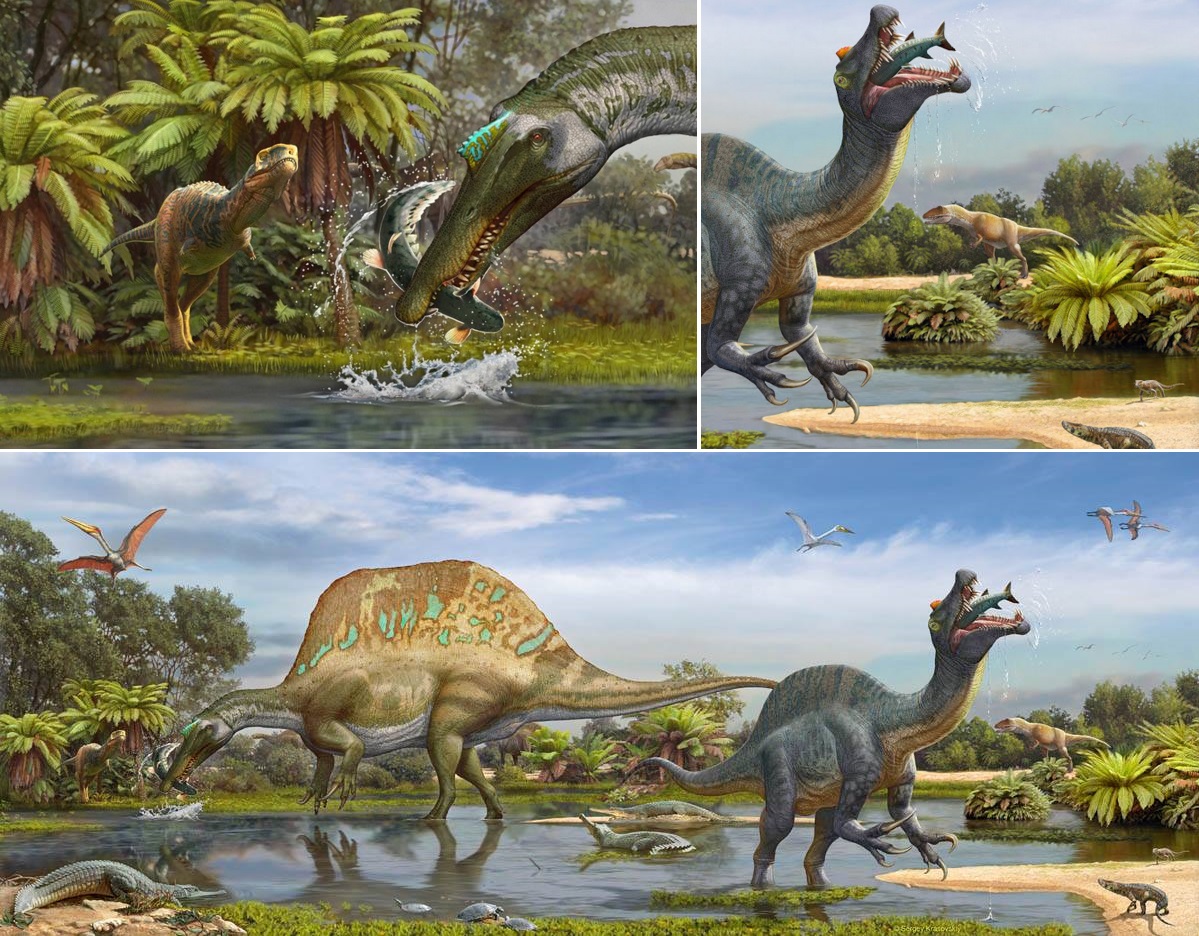
AD, Mandibular articulation; and F, G, skull in A, C, F–G, lateral; and B, D, anterior views; when A–B, F, the mouth is closed; and C–D, G, fully open, illustrating the lateral movement (in red) of the mandibular ramus for a 45° rotation of the lower jaw (courtesy of Jaime A. Headden); E, skeletal reconstruction of Spinosaurus aegyptiacus by Ibrahim et al. [22]) in swimming position in lateral view with a human (1.8 m) as a scale (modified from Ibrahim et al. [22]). This model is based on spinosaurid cranial and postcranial remains (colored in red) from the Albian-Cenomanian of Northern Africa which possibly belong to two spinosaurine taxa (see also Evers et al. [27]); H, reconstruction of a semi-aquatic Spinosaurus in fishing position (i.e., jaws wide open) in anterolateral view (courtesy of Jason Poole).
Abbreviations: an, angular; ar, articular; d, dentary; ecc, ectocondyle; enc, entocondyle; j, jugal; m, maxilla; n, nasal; p, parietal; pm, premaxilla; po, postorbital; pt, pterygoid; ptf, pterygoid flange; q, quadrate; qf, quadrate foramen; qj, quadratojugal; retp, retroarticular process of the articular; sa, surangular; sq, squamosal.
DOI: 10.1371/journal.pone.0144695

Christophe Hendrickx , Octávio Mateus and Eric Buffetaut. 2016. Morphofunctional Analysis of the Quadrate of Spinosauridae (Dinosauria: Theropoda) and the Presence of Spinosaurus and a Second Spinosaurine Taxon in the Cenomanian of North Africa.
 PLoS ONE. 11(1): e0144695.  DOI: 10.1371/journal.pone.0144695

Friday, August 8, 2014

[Paleontology • 2014] 'เต่าภูน้อย' ภูน้อยเซลีส ธีรคุปติ | Phunoichelys thirakhupti • A New Primitive Eucryptodiran Turtle from the Upper Jurassic Phu Kradung Formation of the Khorat Plateau, Northeastern Thailand


Figure 1. Phunoichelys thirakhupti gen. et sp. nov. from the Phu Kradung Formation (latest Jurassic) of Phu Noi Locality, NE Thailand.
(a–c) PRC 230 (holotype), shell in dorsal (a, b) views, and detail of ornamentation on carapace (c);
(g–m) PRC 232, (g–i) right costal 1 (PRC232-1) in dorsal (g, h) and ventral (i) views; (j, k) left costal 4 (PRC232-5), (l, m) left costal 6 (PRC232-6).
Scale bar = 5 cm for (a), (b), (d), (e) and (g–m), 1 cm for (c) and (f).
Figure 3. Reconstruction of the shell of Phunoichelys thirakhupti gen. et sp. nov. from the Phu Kradung Formation (latest Jurassic) of Phu Noi Locality, NE Thailand. (a) Carapace in dorsal view; (b) plastron in ventral view.


Abstract
A new genus and new species of primitive eucryptodiran turtle, Phunoichelys thirakhupti gen. et sp. nov., is described on the basis of shell remains from the lower part of the Phu Kradung Formation, at Phu Noi locality, Kalasin Province, NE Thailand. It is assigned to Xinjiangchelyidae on the basis of the marginals covering the lateral end of the costals and the anal scutes invading the hypoplastra. The new taxon is further characterized by a low and rounded carapace without a cervical notch; the whole carapace and plastron covered with a clear ornamentation consisting of tiny irregular vermiculated furrows; a complete neural series that reaches the suprapygal; a very wide and short cervical scute; relatively wide vertebral scutes; and a long first thoracic rib that extends along the full width of the first costal. The sutured plastron/carapace connection and the marginals covering the lateral end of the second to seventh costals suggest that the turtles from Phu Noi may be related to some primitive xinjiangchelyids from the Sichuan Basin. The discovery of a xinjiangchelyid turtle in the lower part of the Phu Kradung Formation supports a Late Jurassic age for that part of the formation.

Keywords: Testudines; Eucryptodira; Xinjiangchelyidae; Phunoichelys thirakhupti; Late Jurassic; Phu Kradung Formation; NE Thailand

Figure 3. Reconstruction of the shell of Phunoichelys thirakhupti gen. et sp. nov. from the Phu Kradung Formation (latest Jurassic) of Phu Noi Locality, NE Thailand. (a) Carapace in dorsal view; (b) plastron in ventral view.


Haiyan Tong, Wilailuck Naksri, Eric Buffetaut, Varavudh Suteethorn, Suravech Suteethorn, Uthumporn Deesri, Saitong Sila, Phornphen Chanthasit and Julien Claude. 2014. A New Primitive Eucryptodiran Turtle from the Upper Jurassic Phu Kradung Formation of the Khorat Plateau, NE Thailand. Geological Magazine. in press. doi: dx.doi.org/10.1017/S0016756814000223

A xinjiangchelyid eucryptodiran. The type species is Phunoichelys thirakhupti box.com