Showing posts with label Titanosauria. Show all posts

Thursday, April 23, 2026

[Paleontology • 2026] Phosphatotitan khouribgaensis • A Titanosaurian Sauropod with South American Affinities (Lognkosauria: Argentinosauridae) from the Late Maastrichtian of Morocco and Evidence for Dinosaur Endemism in Africa


Phosphatotitan khouribgaensis
Longrich, Pérez-Moreno, Díez Díaz, Pereda-Suberbiola, Bardet & Jalil, 2026

Artwork by Andrey Atuchin facebook.com/AndreyAtuchin

Abstract
The latest Cretaceous saw the final diversification of dinosaurs before the K/Pg extinction. Discussions of end-Cretaceous dinosaur diversity have focused on well-sampled faunas from Laurasia; far less is known about dinosaurian faunas of the Southern Hemisphere, especially Africa. The late Maastrichtian Phosphates of Morocco provide a rare window into African dinosaur diversity. Abelisaurids, lambeosaurines, and titanosaurian sauropods are known. However, no diagnostic titanosaur remains have been recovered, leaving the affinities of these sauropods unclear. We describe Phosphatotitan khouribgaensis gen. et sp. nov., a new titanosaur from the Maastrichtian of Sidi Chennane, Khouribga Province. Phosphatotitan is represented by dorsal, sacral, and caudal vertebrae, and the pelvis. The new species differs from titanosaurs described from the Cretaceous of Africa and Europe but resembles South American Lognkosauria, and especially Patagotitan, in having short dorsal and caudal centra, expanded dorsal and caudal neural spines, and a broad pubis. Its small size relative to other Lognkosauria (3.5–4 tonnes) suggests a lineage selected for small size. The close relationships of Morocco’s titanosaurs and abelisaurids to South American species may reflect a wide distribution of these clades prior to the opening of the South Atlantic and the separation of Africa and South America ~100 Ma, while a complex pattern of oceanic dispersal may explain the presence of distinct saltasauroid lineages worldwide. The latest Cretaceous Gondwanan dinosaur faunas were highly endemic due to a combination of continental fragmentation, extinction, and dispersal, creating high endemism in southern continents and within Africa, suggesting that Maastrichtian dinosaur diversity is underestimated.

Keywords: Dinosauria; Sauropoda; Titanosauria; Argentinosauria; Upper Cretaceous; biogeography; Gondwana


Phosphatotitan khouribgaensis gen. et sp. nov.


 Nicholas R. Longrich, Agustín Pérez-Moreno, Verónica Díez Díaz, Xabier Pereda-Suberbiola, Nathalie Bardet and Nour-Eddine Jalil. 2026. A Titanosaurian Sauropod with South American Affinities (Lognkosauria: Argentinosauridae) from the Late Maastrichtian of Morocco and Evidence for Dinosaur Endemism in Africa. Diversity. 18(5); 241. DOI: doi.org/10.3390/d18050241 [22 April 2026]

Wednesday, January 14, 2026

[Paleontology • 2026] Yeneen houssayi gen. et sp. nov. and An overview of the Sauropod titanosaurian Diversity from Cerro Overo – La Invernada Area (Bajo de la Carpa Formation, Santonian)


Yeneen houssayi 
Filippi, Bellardini, Carballido, Méndez & Garrido, 2026

Illustration: Gabriel Lío

ABSTRACT
The fossil record of titanosaur sauropods for the Upper Cretaceous of the Neuquén Basin is remarkably extensive. However, for the Bajo de la Carpa Formation (Santonian) only five nominate species are recorded (Rinconsaurus caudamirus, Bonitasaura salgadoi, Traukutitan eocaudata, Overosaurus paradasorum, and Inawentu oslatus), the latter two coming from the Cerro Overo-La Invernada (CO-LI) area. Here we present a new titanosaur sauropod from La Invernada, Yeneen houssayi gen. et sp. nov. (MAU-Pv-LI-538). The new species is characterised by a series of distinctive features in dorsal, sacral and caudal vertebrae. Phylogenetic analysis indicates that Yeneen is closely related to Narambuenatitan and Overosaurus, as a basal member of an unnominated clade (called ‘Clade A’) of derived non-lithostrotian saltasauroids. The evidence provided by the Cerro Overo – La Invernada sauropod titanosaur fauna suggests that, during the Santonian, species diversity was relatively high and that at least two lineages coexisted: Collossosauria and Saltasauroidea. This finding makes the CO-LI area the one with the greatest diversity of titanosaurs for the Santonian of the Neuquén basin (as it is also for abelisaurid theropods), which makes it an exceptional area to understand the evolution of dinosaur faunas for this period.

KEYWORDS: Titanosauria, diversity, upper Cretaceous, Neuquen Basin, Gondwana

Systematic Paleontology
Dinosauria Owen, 1842
Saurischia Seeley, 1888

Sauropoda Marsh, 1878
Titanosauriformes Salgado, Coria and Calvo, Citation1997

Somphospondyli Wilson and Sereno, 1998
Titanosauria Bonaparte and Coria, Citation1993


Yeneen houssayi gen. et sp. nov.

Derivation name: Yeneen, is known in the Tehuelche (Aonikenk) Culture as a spirit or entity related to winter, cold and winter nature in general, alluding to the La Invernada, a Spanish word that refers to the site where the cattle spend the winter. The specific epithet, houssayi, is in honour of Dr. Bernardo Alberto Houssay, Nobel Laureate in Medicine and member of the commission that promoted the creation of CONICET (Consejo Nacional de Investigaciones Científicas y Técnicas, Argentina).


L. S. Filippi, F. Bellardini, J. l. Carballido, A. H. Méndez and A. C. Garrido. 2026. Yeneen houssayi gen. et sp. nov. and An overview of the Sauropod titanosaurian Diversity from Cerro Overo – La Invernada area (Bajo de la Carpa Formation, Santonian), North Patagonia, Argentina. Historical Biology: An International Journal of Paleobiology. DOI: doi.org/10.1080/08912963.2025.2584707 [12 Jan 2026]


Friday, March 7, 2025

[Paleontology • 2024] Chadititan calvoi • New Fossiliferous Locality from the Anacleto Formation (Late Cretaceous, Campanian) from northern Patagonia, with the Description of A New titanosaur


Chadititan calvoi
Agnolin, Motta, Marsá, Rolando, Herrera, Chimento, Rozadilla, Brizzon-Egli, Cerroni, Panzeri, Bogan, Casadio, Sterli, Miquel, Martínez, Perez, Pol & Novas, 2024

Artwork by Gabriel Lio.

Abstract 
Here we describe a new fossil invertebrate and vertebrate assemblage from a previously unknown locality of the Anacleto Formation (Campanian, Upper Cretaceous), near General Roca city, Río Negro Province, Argentina. The specimens were found in a single fossiliferous layer, which yielded bivalves and gastropods, including the first fossil record of the terrestrial clade Megalomastomatidae and the first undoubted record for the terrestrial subulinid Leptinaria. Vertebrates are represented by fishes (lepisosteids, percomorphs, and the dipnoan Metaceratodus kaopen), chelid turtles, a single crocodyliform scute, an indeterminate pterosaur, an incomplete meridiolestidan mammalian jaw, and abelisaurid and rinconsaurian titanosaur dinosaurs. The latter is represented by several individuals of a small and gracile-limbed form. The phylogenetic analysis recovers a monophyletic Rinconsauria including the new taxon, plus Rinconsaurus, Pitekunsaurus, Overosaurus, and Muyelensaurus. The new titanosaur indicates that rinconsaurians were characterized by a body shape that was different from other titanosaurs, with brachiosaur-like posture, gracile limbs, and protonic tail. The faunistic assemblage is characterized by the abundance, but low diversity, of chelid turtles and a very low number of crocodyliforms. This taxonomic composition is reminiscent of other faunal assemblages of the latest Cretaceous of northern Patagonia, but differs markedly from Campanian assemblages known from North America and Europe.

Key words: Campanian, Argentina, Titanosauria, Rinconsauria, Chelidae, Gastropoda


SAUROPODA Marsh, 1878 
TITANOSAURIA Bonaparte & Coria, 1993 
RINCONSAURIA Calvo, González Riga & Porfiri, 2007 

Chadititan calvoi nov. gen. et sp. 

Derivation of the name. Chadi, from the Mapundungum, meaning salt; the specific epithet honors the late Jorge O. Calvo (1962–2023) a great colleague that recently passed away, who described several titanosaurs and coined the name Rinconsauria.


Federico Agnolin, Matías Motta, Jordi García Marsá, Mauro Aranciaga Rolando, Gerardo Alvarez Herrera, Nicolás Chimento, Sebastián Rozadilla, Federico Brizzon-Egli, Mauricio Cerroni, Karen Panzeri, Sergio Bogan, Silvio Casadio, Juliana Sterli, Sergio Miquel, Sergio Martínez, Leandro Perez, Diego Pol and Fernando Novas. 2024. New Fossiliferous Locality from the Anacleto Formation (Late Cretaceous, Campanian) from northern Patagonia, with the Description of A New titanosaur.  Revista del Museo Argentino de Ciencias Naturales. 26(2); 217–259. DOI: 10.22179/REVMACN.26.885

Thursday, September 5, 2024

[Paleontology • 2024] Qunkasaura pintiquiniestra • A Spanish saltasauroid Titanosaur reveals Europe as a Melting Pot of Endemic and Immigrant Sauropods in the Late Cretaceous


Qunkasaura pintiquiniestra
Mocho, Escaso, Marcos-Fernández, Páramo, Sanz, Vidal & Ortega, 2024. 


Abstract
A new lithostrotian titanosaurQunkasaura pintiquiniestra gen. et sp. nov., is described based on a single partial skeleton from the late Campanian-early Maastrichtian fossil-site of Lo Hueco (Cuenca, Spain). This new taxon is supported by an exclusive combination of characters that highlights strong convergences with members of the South American Aeolosaurini. Qunkasaura allows to reorganise the complex phylogenetic relationships of the increasingly diverse finicretaceous sauropods of Europe. Phylogenetic analyses places Qunkasaura within Saltasauridae and possibly Opisthocoelicaudiinae, together with Abditosaurus. A new clade is established, Lohuecosauria, including Saltasaurus, Lohuecotitan, their most recent common ancestor and all its descendants. Two distinct Ibero-Armorican Campanian-Maastrichtian saltasauroid lineages are recognised: (i) Lirainosaurinae that is exclusive from Europe, and (ii) a saltasaurid lineage with possible opisthocoelicaudiine affinities, with a Laurasian distribution. Lirainosaurinae was a relict lineage including possible dwarf forms that evolved in isolation after reaching Europe before the Late Cretaceous through the Apulian route. The occurrence of opisthocoelicaudiines in Europe may be the result of a Late Cretaceous interchange between Europe and Asia. No evidence of insular dwarfism is found in the Ibero-Armorican opisthocoelicaudiines suggesting that they may have been newcomers to the area that arrived before the ‘Maastrichtian Dinosaur Turnover’ in southwestern Europe.


Qunkasaura pintiquiniestra


Pedro Mocho, Fernando Escaso, Fátima Marcos-Fernández, Adrián Páramo, José Luis Sanz, Daniel Vidal and Francisco Ortega. 2024. A Spanish saltasauroid Titanosaur reveals Europe as a Melting Pot of Endemic and Immigrant Sauropods in the Late Cretaceous. Communications Biology. 7: 1016. DOI: doi.org/10.1038/s42003-024-06653-0


Saturday, August 3, 2024

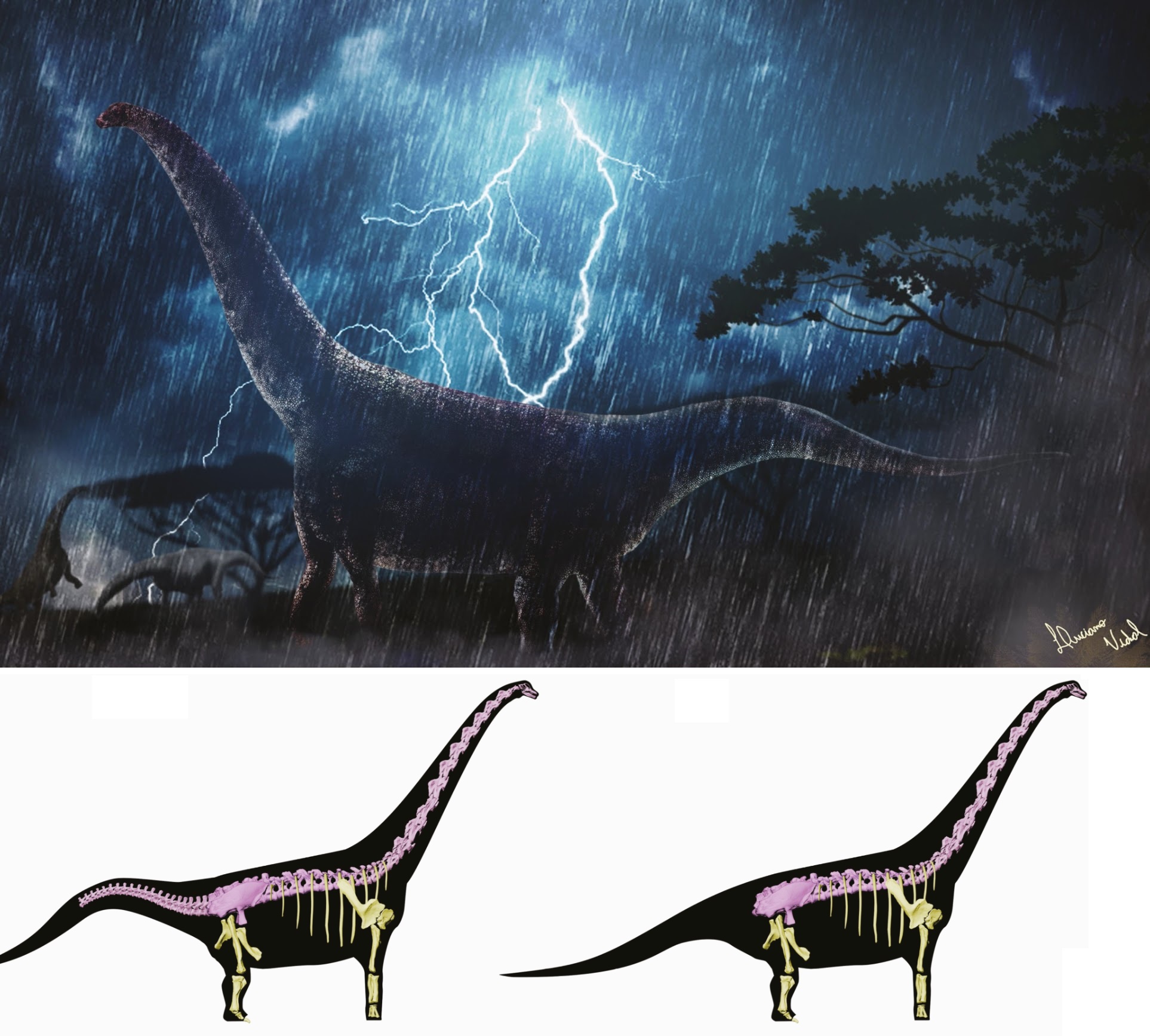
[Paleontology • 2024] The Axial Biomechanics of Trigonosaurus pricei (Neosauropoda: Titanosauria) and the importance of the cervical–dorsal region to Sauropod high-browser Feeding Strategy


Trigonosaurus pricei  

in Vidal, Bergqvist, Candeiro, Bandeira, ... et Pereira. 2024. 

Abstract
Trigonosaurus pricei is a small to medium-sized sauropod dinosaur (Sauropoda: Titanosauria) from the Late Cretaceous Bauru Group of Brazil that is known from a significant amount of recovered axial elements [four cervical vertebrae, 10 dorsal vertebrae, sacrum (MCT 1488-R), and 10 caudal vertebrae (MCT 1719-R)]. In this biomechanical work, we approach the hypothesis of the cartilaginous neutral pose and the range of motion of the axial series of Trigonosaurus. The results show that this sauropod could be capable of high elevation of the neck resulting from morphological adaptations of the cervicodorsal region on dorsal (D) vertebrae D2 and D3 (e.g. postzygapophyses of D2 positioned over the vertebral centrum and prezygapophyses of D3 over the anterior vertebral centrum). This implies that D2 articulates (cartilaginous neutral posture) with D3 only at a strong dorsally directed angle, resulting in a shift in the direction of the neck to a more elevated posture. Furthermore, the tail attributed to Trigonosaurus as a paratype could be oriented in the horizontal ‘direction’ and presented a sigmoidal ‘shape’. This work contributes generally to the understanding of variation in the body plan of sauropods and, more specifically, to the feeding strategy of small and medium-sized titanosaurs from semi-arid regions of Gondwana.

vertebrate palaeontology, Suropodomorpha, biomechanics, palaeoecology


Trigonosaurus pricei 


 Luciano S Vidal, Lílian P Bergqvist, Carlos R A Candeiro, Kamila L N Bandeira, Sandra Tavares, Stephen L Brusatte and Paulo V L G C Pereira. 2024. The Axial Biomechanics of Trigonosaurus pricei (Neosauropoda: Titanosauria) and the importance of the cervical–dorsal region to Sauropod high-browser Feeding Strategy. Zoological Journal of the Linnean Society. 201(3); zlae087. DOI: doi.org/10.1093/zoolinnean/zlae087


Tuesday, April 16, 2024

[Paleontology • 2024] Titanomachya gimenezi • A New titanosaur (Sauropoda: Titanosauria) from the La Colonia Formation (Campanian-Maastrichtian), Chubut Province, Argentina


Titanomachya gimenezi
Pérez-Moreno, Salgado, Carballido, Otero & Pol, 2024


 ABSTRACT
Knowledge of the Campanian-Maastrichtian titanosaurian sauropods from southern South America has increased markedly in recent years. Several taxa have been reported from northern Patagonia, as well as few taxa from southern Patagonia that were described in the last years. However, titanosaurs from the end-Cretaceous of Central Patagonia are poorly known. Here we report the associated remains of a new species of a titanosaurian sauropod from the La Colonia Formation found in northern Chubut Province. Titanomachya gimenezi gen. et sp. nov. is represented by a caudal vertebra and appendicular elements. Titanomachya, is interpreted as a member of Lithostrotia, sharing derived features with saltasaurids and bearing unique characteristics in the astragalus. The astragalus morphology of Titanomachya display an intermediate form between Colossosauria and Saltasauroidea, allowing articulation between zeugopodium and autopodium with contributions from both the tibia and fibula. The type specimen is a small-sized adult, estimated at 5.8–9.8 tons. Comparative analyses reveal distinct sauropod faunas in different Patagonian regions and Brazilian formations during the Campanian – Maastrichtian. In northern Patagonia, aeolosaurines and saltasaurines predominate, while in southern Patagonia predominate colossosaurians and other large titanosaurs. The less well-known sauropod fauna from central Patagonia includes aeolosaurines, eutitanosaurs, and the addition of small-bodied saltasauroids such as Titanomachya.

KEYWORDS: Titanomachya, Saltasauridae, phylogeny, osteology, Patagonia, Upper Cretaceous


 Skeletal reconstruction of Titanomachya gimenezi. Preserved bones shown in light blue.
Reconstruction by Gabriel Lio.

Systematic palaeontology
DINOSAURIA Owen, 1842
SAUROPODA Marsh, Citation1878
NEOSAUROPODA Bonaparte, Citation1986

TITANOSAURIFORMES Salgado, Coria, and Calvo, Citation1997
TITANOSAURIA Bonaparte and Coria, Citation1993

TITANOMACHYA GIMENEZI gen. et sp. nov.

Derivation of name: The Titanomachy, in Greek mythology, is the battle fought by the Olympians against the Titans, in which the latter are defeated. Titanomachya honours that battle since it comes from the time when the titanosaurs became extinct. The specific epithet gimenezi is in honour of the late Dr. Olga Giménez, who was the first female palaeontologist that studied the dinosaurs from Chubut Province.


Agustín Pérez-Moreno, Leonardo Salgado, José L. Carballido, Alejandro Otero and Diego Pol. 2024. A new titanosaur from the La Colonia Formation (Campanian-Maastrichtian), Chubut Province, Argentina. Historical Biology: An International Journal of Paleobiology. DOI: 10.1080/08912963.2024.2332997 


Tuesday, February 6, 2024

[Paleontology • 2024] Gandititan cavocaudatus • A New titanosaurian Sauropod (Sauropoda: Titanosauria) from the Late Cretaceous of southern China


Gandititan cavocaudatus 
Han, Yang, Lou, Sullivan, Xu, Qiu, Liu, Yu, Wu, Ke, Xu, Hu & Lu, 2024

 
Abstract
Large quadrupedal sauropod dinosaurs of the group Titanosauria were globally distributed in the Late Cretaceous. Many titanosaurian species have been discovered in eastern Asia, but most of them are controversial and represented by poorly preserved remains. Here, we describe a new titanosaur, Gandititan cavocaudatus gen. et sp. nov., based on a partial skeleton recovered from the lower Upper Cretaceous of Ganxian County, Ganzhou City, southern China, and comprising six articulated cervical vertebrae, two partial dorsal vertebrae, and a complete sacrum preserved in articulation with the first 17 caudal vertebrae and part of the right pelvis. Gandititan can be diagnosed on the basis of the following autapomorphies: long and narrow fossae present on the dorsal and ventral parts of the lateral surfaces of the cervical centra, sacral neural spines forming a dorsal platform with wave-shaped lateral margins, anteriormost six caudal vertebrae with bifurcated neural spines, the presence of prominent triangular flanges on the transverse processes of the anteriormost caudal vertebrae, a pair of slit-like foramina present on the ventral surface of each anterior caudal centrum, lateral surfaces of neural arches strongly excavated, additional spinoprezygapophyseal laminae present, and a prominent lamina extending horizontally between the bases of the pre- and postzygapophyses in some anterior caudal vertebrae. An expanded phylogenetic analysis places Gandititan as the sister taxon to Abdarainurus, within a clade of non-lithostrotian titanosaurs that also includes the Chinese titanosaurs Dongyangosaurus, Baotianmansaurus and Huabeisaurus, as well as the Argentine titanosaur Andesaurus. Such results imply the possible existence of a previously unrecognized group of titanosaurs in eastern Asia, and potential dispersal of titanosaurs between Asia and South America during the mid-Cretaceous.
 
Keywords: Titanosauria, Sauropoda, Upper Cretaceous, southern China


Fenglu Han, Ling Yang, Fasheng Lou, Corwin Sullivan, Xing Xu, Wenjiang Qiu, Hanfeng Liu, Juan Yu, Rui Wu, Yuzheng Ke, Mengyuan Xu, Jinfeng Hu and Pikun Lu. 2024. A New titanosaurian Sauropod, Gandititan cavocaudatus gen. et sp. nov., from the Late Cretaceous of southern China. Journal of Systematic Palaeontology. 22(1); 2293038. DOI: 10.1080/14772019.2023.2293038 

Wednesday, November 1, 2023

[Paleontology • 2023] Inawentu oslatus • A Rebbachisaurid-mimicking Titanosaur and Evidence of A Late Cretaceous Faunal Disturbance Event in South-West Gondwana


Inawentu oslatus
Filippi, Valieri, Gallina, Méndez, Gianechini & Garrido, 2023

Artwork: Gabriel Lio  facebook.com/GabrielLio3

Abstract
The evolution of ecosystems during the late Mesozoic on the southern landmasses is complex and still poorly known. Starting from a single vicariant Laurasian-Gondwanan scenario, the paleobiogeographic and biostratigraphic models have become more complex, including vicariant, dispersal, and local extinctions as major drivers of changes in the Cretaceous ecosystems during the isolation and posterior fragmentation of Gondwana. However, the direct effects of replacement and the adaptive evolution of terrestrial vertebrates to fill vacant ecological niches after disruptive ecological events have been poorly discussed. Here, we provide a preliminary description of a nearly complete new titanosaurian sauropod from the Upper Cretaceous of Patagonia, Inawentu oslatus gen. et sp. nov., that shows remarkable convergent anatomical traits with rebbachisaurid sauropods. A phylogenetic analysis recovers it within a not previously recovered titanosaurian subclade, named Clade A, which would be endemic to the Upper Cretaceous of South America. The convergent evolution between rebbachisaurids and Clade A members is interpreted as the result of the same ecological niche exploitation. The biostratigraphic scenario during the Late Cretaceous of South America leads to interpret rapid speciation of the titanosaurs because of filling the empty ecological niche left by the extinction of the rebbachisaurids, an idea concordant with a regional disturbance event of the ecosystems in this continent between 90 and 85 Ma....


Inawentu oslatus gen. et sp. nov.


Leonardo S. Filippi, Rubén D. Juárez Valieri, Pablo A. Gallina, Ariel H. Méndez, Federico A. Gianechini and Alberto C. Garrido. 2023. A Rebbachisaurid-mimicking Titanosaur and Evidence of A Late Cretaceous Faunal Disturbance Event in South-West Gondwana. Cretaceous Research. In Press, 105754. DOI: 10.1016/j.cretres.2023.105754

Friday, July 21, 2023

[Paleontology • 2023] Igai semkhu • A New titanosaurian (Dinosauria: Sauropoda) from the Upper Cretaceous (Campanian) Quseir Formation of the Kharga Oasis, Egypt


 Igai semkhu
Gorscak, Lamanna, Schwarz, Díez Díaz, Salem, Sallam & Wiechmann, 2023


ABSTRACT
Dinosaur fossils from the latest Cretaceous (Campanian–Maastrichtian) of Africa and the Arabian Peninsula are rare. Most discoveries to date have consisted of limited fossils that have precluded detailed phylogenetic and paleobiogeographic interpretations. Fortunately, recent discoveries such as the informative Egyptian titanosaurian sauropod dinosaur Mansourasaurus shahinae are beginning to address these long-standing issues. Here we describe an associated partial postcranial skeleton of a new titanosaurian taxon from the Upper Cretaceous (Campanian) Quseir Formation of the Kharga Oasis, Western Desert of Egypt. Consisting of five dorsal vertebrae and 12 appendicular elements, Igai semkhu gen. et sp. nov. constitutes one of the most informative dinosaurs yet recovered from the latest Cretaceous of Afro-Arabia. The relatively gracile limb bones and differences in the coracoid and metatarsal I preclude referral of the new specimen to Mansourasaurus. Both model-based Bayesian tip-dating and parsimony-based phylogenetic analyses support the affinities of Igai semkhu with other Late Cretaceous Afro-Eurasian titanosaurs (e.g., Mansourasaurus, Lirainosaurus astibiae, Opisthocoelicaudia skarzynskii), a conclusion supported by posterior dorsal vertebrae that lack a postzygodiapophyseal lamina, for example. Igai semkhu strengthens the hypothesis that northern Africa and Eurasia shared closely related terrestrial tetrapod faunas at the end of the Cretaceous and further differentiates this fauna from penecontemporaneous assemblages elsewhere in Africa, such as the Galula Formation in Tanzania, that exhibit more traditional Gondwanan assemblages. At present, the specific paleobiogeographic signal appears to vary between different dinosaur groups, suggesting that Afro-Arabian Cretaceous biotas may have experienced evolutionary and paleobiogeographic histories that were more complex than previously appreciated.


DINOSAURIA Owen, 1842

SAUROPODA Marsh, 1878
TITANOSAURIA Bonaparte and Coria, 1993
LITHOSTROTIA Upchurch et al., 2004

Location of discovery and quarry map of Igai semkhu (Vb-621–640).
A, map of Egypt showing the location of the town of Baris in the Kharga Oasis region, denoted by orange star (modified from Sallam et al., Citation2018:fig. 1a); B, satellite image from Google Earth Pro of the research area south of Baris with approximate quarry location indicated by orange star; C, quarry map showing disposition of skeletal elements in situ with currently missing and/or obliterated elements in gray, modified from Wiechmann (Citation1999b:17); and D, skeletal silhouette (reversed and modified from Sallam et al., Citation2018:fig. 1c) with elements described in the current study shown in orange.
Abbreviations: cor, coracoid; dv, dorsal vertebra; fib, fibula; mtc I, metacarpal I; mtc IV, metacarpal IV; mtc V, metacarpal V; mtt I, metatarsal I; mtt II, metatarsal II; pub, pubis; tib, tibia; ul, ulna.
 
 IGAI SEMKHU gen. et sp. nov.

Diagnosis— Characters supporting Igai semkhu as a titanosaurian sauropod dinosaur: dorsal vertebrae lacking hyposphene-hypantrum articulations; and ulna with prominent olecranon process. Autapomorphic characters of Igai semkhu: metacarpal V with proximomedial and distomedial tubercles; reduced cnemial crest of the tibia (does not exceed anterior margin of distal end of the tibia); and distal groove along dorsal margins of metatarsals I and II.

Etymology— Igai” is the name of the enigmatic “lord of the oasis” deity that was venerated by inhabitants of the Dakhla and Kharga oases (and surrounding regions) in Egypt from roughly the Old Kingdom to the Late Period. The species epithet “semkhu” is the perfect passive singular participle, “the forgotten,” of “semekh,” the ancient Egyptian verb “to forget.” Collectively, “the forgotten lord of the oasis” alludes to both the relatively recent emergence of latest Cretaceous non-marine vertebrate fossils from continental Africa (particularly Egypt) and the lengthy and complicated history of the holotypic specimen (see above).


Eric Gorscak, Matthew C. Lamanna, Daniela Schwarz, Verónica Díez Díaz, Belal S. Salem, Hesham M. Sallam and Marc Filip Wiechmann. 2023. A New titanosaurian (Dinosauria: Sauropoda) from the Upper Cretaceous (Campanian) Quseir Formation of the Kharga Oasis, Egypt. Journal of Vertebrate Paleontology.  e2199810. DOI: 10.1080/02724634.2023.2199810  

Monday, March 6, 2023

[Paleontology • 2023] Chucarosaurus diripienda • A New Giant Titanosaur (Sauropoda: Titanosauria: Colossosauria) from the Upper Cretaceous of Northwestern Patagonia, Argentina


Chucarosaurus diripienda 
 Agnolin, Gonzalez Riga, Aranciaga Rolando, Rozadilla, Motta, Chimento & Novas, 2023


Abstract
Chucarosaurus diripienda gen. et sp. nov. is a new and large titanosaurian sauropod from the Neuquén Basin, Rio Negro Province, Patagonia. The specimen was discovered in the Upper Cretaceous strata of the Huincul Formation (middle Cenomanian–lower Turonian). It includes appendicular and relatively slender elements, with a femoral total length of about 1.9 m long. This taxon shows a unique combination of characters indicating that appendicular bones such as the femur, ischium and tibia, show a remarkable morphological variety, greater than previously described, and are morphologically informative as source of phylogenetic data. A cladistic phylogenetic analysis placed Chucarosaurus well nested within the Colossosauria clade.

 Keywords: Chucarosaurus, Sauropods, Colossosauria, Neuquén Basin, Cenomanian–Turonian, Patagonia, Argentina


Dinosauria Owen 1842
Saurischia Seeley 1887
Sauropoda Marsh, 1878

Titanosauria Bonaparte and Coria, 1993
Colossosauria Gonzalez Riga, Lamanna, Otero, Ortiz David, Kellner, and Ibiricu, 2019 

Chucarosaurus diripienda gen. et sp. nov. 

 Etymology. Chucaro, from the native language Quechua, also used for the gauchos (people who live in the countryside of Argentina), Mapundungum, meaning hard and indomitable animalsaurus, from the Latin, reptile; diripienda, from the Latin, meaning scrambled.


Federico L. Agnolin, Bernardo J. Gonzalez Riga, Alexis M. Aranciaga Rolando, Sebastián Rozadilla, Matías J. Motta, Nicolás R. Chimento and Fernando E. Novas. 2023. A New Giant Titanosaur (Dinosauria, Sauropoda) from the Upper Cretaceous of Northwestern Patagonia, Argentina. Cretaceous Research. 146, 105487. DOI: 10.1016/j.cretres.2023.105487