Showing posts with label Columbidae. Show all posts

Friday, February 2, 2024

[Ornithology • 2024] Species Status and Phylogenetic Relationships of the enigmatic Negros Fruit Dove Ptilinopus arcanus (Aves: Columbidae)


Negros Fruit Dove  Ptilinopus arcanus  

in Nash, Harrington, Zyskowski, Near & Prum, 2024. 

Abstract
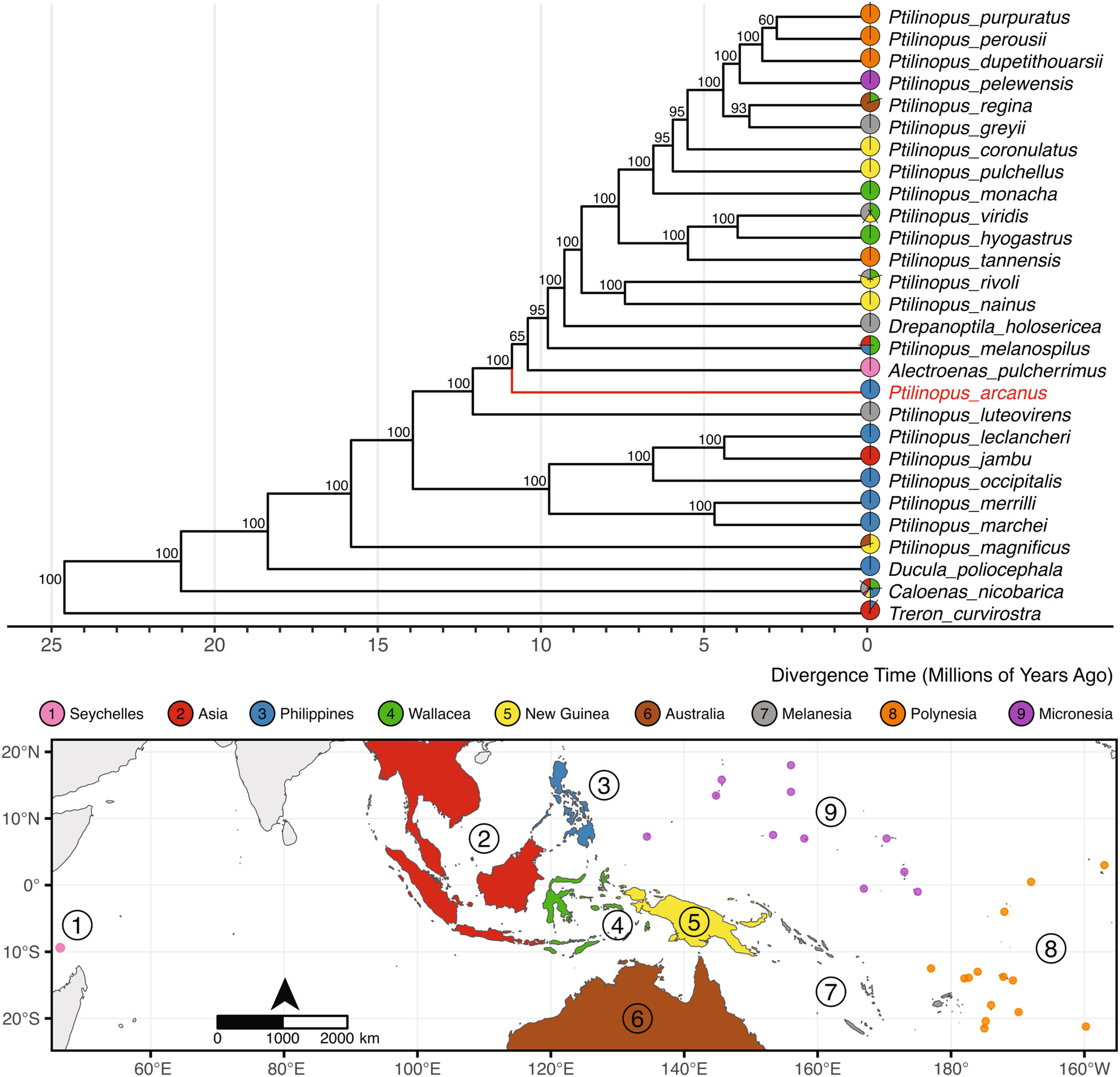
The Negros Fruit Dove Ptilinopus arcanus is an enigmatic bird known only from a single specimen collected on Negros Island, Philippines, in 1953. We extracted and sequenced ultra-conserved elements from historical toe-pad samples of the type specimen of P. arcanus and 27 other species of ptilinopine doves to investigate the species status and phylogenetic relationships of this taxon. We establish that P. arcanus represents a valid species, resolve its phylogenetic position at the base of the radiation of ‘core’ Ptilinopus fruit doves, and estimate that P. arcanus diverged from its most recent common ancestor several million years before Negros Island emerged from the seafloor. We also perform an ancestral range reconstruction to evaluate the effect of different altitudinal preferences on the putative historical range of this species, and we discuss how these findings can inform future efforts to relocate and potentially conserve this species.

Keywords: ancestral range reconstruction, historical DNA, Negros Fruit Dove, Philippines, phylogeny, Ptilinopus arcanus, ultra-conserved elements


John A. Nash, Richard C. Harrington, Kristof Zyskowski, Thomas J. Near and Richard O. Prum. 2024. Species Status and Phylogenetic Relationships of the enigmatic Negros Fruit Dove (Ptilinopus arcanus). Ibis. DOI: 10.1111/ibi.13305

Tuesday, November 30, 2021

[Ornithology • 2022] Population Connectivity Across A highly Fragmented Distribution: Phylogeography of the Chalcophaps Doves (Aves, Columbidae)


Phylogeography of the Chalcophaps Doves

in DeRaad, Manthey, Ostrow, ... et Moyle, 2021.

Highlights: 
• Phylogenetic reconstruction supports current taxonomy.
• Discordant nuclear and mitochondrial ancestry near contact zone.
• Isolation by distance and hierarchical population structure within clades.
• Low overall diversity despite a large and fragmented geographic distribution.

Abstract
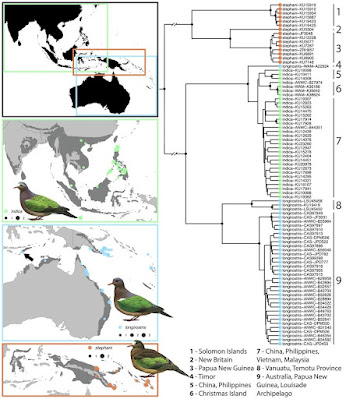
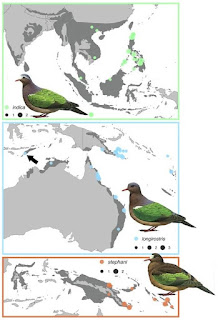
Chalcophaps is a morphologically conserved genus of ground-walking doves distributed from India to mainland China, south to Australia, and across the western Pacific to Vanuatu. Here, we reconstruct the evolutionary history of this genus using DNA sequence data from two nuclear genes and one mitochondrial gene, sampled from throughout the geographic range of Chalcophaps. We find support for three major evolutionary lineages in our phylogenetic reconstruction, each corresponding to the three currently recognized Chalcophaps species. Despite this general concordance, we identify discordant mitochondrial and nuclear ancestries in the subspecies C. longirostris timorensis, raising further questions about the evolutionary history of this Timor endemic population. Within each of the three species, we find evidence for isolation by distance or hierarchical population structure, indicating an important role for geography in the diversification of this genus. Despite being distributed broadly across a highly fragmented geographic region known as a hotspot for avian diversification, the Chalcophaps doves show modest levels of phenotypic and genetic diversity, a pattern potentially explained by strong population connectivity owing to high overwater dispersal capability.
  
 Keywords: Phylogeography, Evolution, Isolation by distance, Mitonuclear discordance, Phylogenetics, Chalcophaps


 Devon A. DeRaad, Joseph D. Manthey, Emily N. Ostrow, Lucas H. DeCicco, Michael J. Andersen, Peter A. Hosner, Hannah T. Shult, Leo Joseph, John P. Dumbacher and Robert G.. Moyle. 2021. Population Connectivity Across A highly Fragmented Distribution: Phylogeography of the Chalcophaps Doves.  Molecular Phylogenetics and Evolution. 166; 107333. DOI: 10.1016/j.ympev.2021.107333 
Emerald Dove

Monday, February 15, 2021

[Ornithology • 2020] Tongoenas burleyi • A New Genus and Species of Pigeon (Aves, Columbidae) from the Kingdom of Tonga, with An Evaluation of Hindlimb Osteology of Columbids from Oceania


Tongoenas burleyi 
Steadman & Takano, 2020
 

Abstract
The region from New Guinea through Oceania sustains the world’s most diverse set of columbids. We describe osteological characters of the hindlimb (femur, tibiotarsus, tarsometatarsus) that divide the Papuan-Oceanic pigeons and doves into three groups based on functional morphology: “arboreal” (Hemiphaga, Ducula, Ptilinopus, Drepanoptila, Gymnophaps), “intermediate” (Columba, Macropygia, Reinwardtoena), and “terrestrial” (Gallicolumba [includes Alopecoenas], Trugon, Microgoura, Goura, Chalcophaps, Geopelia, Henicophaps, Caloenas, Didunculus, Otidiphaps). The arboreal and terrestrial groups are each distinctive osteologically, especially in the tibiotarsus and tarsometatarsus, which are short relative to the femur in the arboreal group, and long relative to the femur in the terrestrial group. The intermediate pigeons are more similar to arboreal than to terrestrial pigeons, but nonetheless fit in neither group. To estimate the phylogenetic relationships among or within these three groups is somewhat tentative using hindlimb osteology alone, although all five genera of arboreal pigeons have independent molecular evidence of relatedness, as do most of the genera of terrestrial pigeons.

                Using the hindlimb and other osteological data as a framework, we describe a new extinct genus and species of pigeon, Tongoenas burleyi, from Holocene archaeological and Pleistocene paleontological sites on six islands (Foa, Lifuka, `Uiha, Ha`afeva, Tongatapu, and `Eua) in the Kingdom of Tonga. Tongoenas was a large-sized member of the “arboreal” pigeon group, with osteological characters that relate it to DuculaGymnophaps, and Hemiphaga (generally canopy frugivores) rather than with the “terrestrial” pigeons (more ground-dwelling and granivorous) such as Gallicolumba, Trugon, Microgoura, Goura, etc. (others listed above). Among volant columbids, living or extinct, only the species of Goura (from New Guinea) are larger than Tongoenas. From most of the same prehistoric sites, we also report new material of the nearly as large, extinct pigeon Ducula shutleri Worthy & Burley, recently described from islands in the Vava`u Group of Tonga. Thus, D. shutleri also was widespread in Tonga before human impact. The prehistoric anthropogenic loss in Tonga of Tongoenas burleyi, Ducula shutleri, and other columbids undoubtedly had a negative impact on the dispersal regimes of Tongan forest trees. At first human contact about 2850 years ago, at least nine species of columbids in six genera inhabited the Tongan islands, where only four species in three genera exist today.

Keywords: Aves, Columbids, pigeons, doves, fossils, osteology, biogeography, extinction, Tonga, Oceania


Systematic Paleontology
Order Columbiformes
Family Columbidae

Tongoenas burleyi new genus and species

 Etymology. The name Tongoenas derives from combining Tonga (a Polynesian name for the island group where the pigeon once lived) with the Greek word oenas (feminine; a wild pigeon; Brown 1956:278). The species name burleyi is to honor archaeologist David V. Burley, whose many excavations of prehistoric sites in Tonga, including most of the sites that have produced specimens of Tongoenas, have yielded abundant materials of great cultural and biological importance.


David W. Steadman and Oona M. Takano. 2020. A New Genus and Species of Pigeon (Aves, Columbidae) from the Kingdom of Tonga, with An Evaluation of Hindlimb Osteology of Columbids from Oceania. Zootaxa. 4810(3); 401–420. DOI: 10.11646/zootaxa.4810.3.1

 Giant, fruit-gulping pigeon eaten into extinction on Pacific islands


Monday, December 4, 2017

[Ornithology • 2018] Recovering the Evolutionary History of Crowned Pigeons (Columbidae: Goura): implications for the Biogeography and Conservation of New Guinean Lowland Birds


Goura cristata 

Bruxaux, Gabrielli, Ashari, et al. 2018

Highlights
• A phylogenetic analysis of crowned pigeons (Goura) is presented.
• Mitochondrial and nuclear DNA analyses resolved Goura into 4 monophyletic groups.
• Species formerly considered as subspecies are not each other's closest relatives.
• Dating suggests diversification of Goura within New Guinea since the Late Miocene.
• The biogeographic origin of the Goura lineage remains elusive.

Abstract
Assessing the relative contributions of immigration and diversification into the buildup of species diversity is key to understanding the role of historical processes in driving biogeographical and diversification patterns in species-rich regions. Here, we investigated how colonization, in situ speciation, and extinction history may have generated the present-day distribution and diversity of Goura crowned pigeons (Columbidae), a group of large forest-dwelling pigeons comprising four recognized species that are all endemic to New Guinea. We used a comprehensive geographical and taxonomic sampling based mostly on historical museum samples, and shallow shotgun sequencing, to generate complete mitogenomes, nuclear ribosomal clusters and independent nuclear conserved DNA elements. We used these datasets independently to reconstruct molecular phylogenies. Divergence time estimates were obtained using mitochondrial data only. All analyses revealed similar genetic divisions within the genus Goura and recovered as monophyletic groups the four species currently recognized, providing support for recent taxonomic changes based on differences in plumage characters. These four species are grouped into two pairs of strongly supported sister species, which were previously not recognized as close relatives: Goura sclaterii with Goura cristata, and Goura victoria with Goura scheepmakeri. While the geographical origin of the Goura lineage remains elusive, the crown age of 5.73 Ma is consistent with present-day species diversity being the result of a recent diversification within New Guinea. Although the orogeny of New Guinea's central cordillera must have played a role in driving diversification in Goura, cross-barrier dispersal seems more likely than vicariance to explain the speciation events having led to the four current species. Our results also have important conservation implications. Future assessments of the conservation status of Goura species should consider threat levels following the taxonomic revision proposed by del Hoyo and Collar (HBW and BirdLife International illustrated checklist of the birds of the world 1: non-passerines, 2014), which we show to be fully supported by genomic data. In particular, distinguishing G. sclaterii from G. scheepmakeri seems to be particularly relevant.

Keywords: New Guinea; Goura; Crowned pigeons; Molecular phylogeny; Biogeography


Jade Bruxaux, Maëva Gabrielli, Hidayat Ashari, Robert Prŷs-Jones, Leo Joseph, Borja Milá, Guillaume Besnard and Christophe Thébaud. 2018. Recovering the Evolutionary History of Crowned Pigeons (Columbidae: Goura): implications for the Biogeography and Conservation of New Guinean Lowland Birds. Molecular Phylogenetics and Evolution. In Press.  DOI:  10.1016/j.ympev.2017.11.022