Showing posts with label Sisoridae. Show all posts

Tuesday, August 25, 2026

[Ichthyology • 2026] Glyptothorax jiwanae • A New Species of the Sisorid Catfish Genus Glyptothorax (Siluriformes: Sisoridae) from Nepal


 Glyptothorax jiwanae
Haggard, Ng, Edds & Conway, 2026


Abstract
Glyptothorax jiwanae, new species, is described in this study based on 42 specimens, 41–133 mm SL, from Nepal. It is distinguished from congeners by a combination of characters, including presence of longitudinal striae on the gular region, presence of adhesive papillae on the lower lip, premaxillary teeth hidden when the mouth is closed, nasal barbel reaching posterior to eye, skin flaps along the posterior edges of the maxillary and inner and outer mandibular barbels extending for half or less of barbel length, round eye, thoracic adhesive apparatus (TAA) consisting only of longitudinally oriented striae, an elongate, oval depression within the medial pit of the TAA, finely tuberculate skin, pelvic origin at a vertical through or slightly anterior to the base of the last dorsal-fin ray, length of adipose-fin base 14.9–18.4% SL, i,7,8,i caudal-fin rays, caudal-fin lobes approximately equal in length, and slightly asymmetrical procurrent rays.

 Glyptothorax jiwanae, KU 28638, holotype, 55.4 mm SL, Nepal, Rautahat/Sarlahi, Bagmati River. Scale bar = 5 mm.

Glyptothorax jiwanae, new species 

Etymology.— This species is named after Dr. Jiwan Shrestha, for her pioneering work on elucidating the ichthyofaunal diversity of Nepal. A noun in the genitive.

 
Angela Haggard, Heok Hee Ng, David R. Edds and Kevin W. Conway. 2026. A New Species of the Sisorid Catfish Genus Glyptothorax from Nepal (Siluriformes: Sisoridae). Ichthyology & Herpetology. 114(3):439-450. DOI: doi.org/10.1643/i2025050 [20 August 2026]

Wednesday, March 11, 2026

[Ichthyology • 2026] Oreichthys elianae & Glyptothorax sentimereni • New Species (Teleostei: Sisoridae, Cyprinidae) from Nagaland, Northeast India

 
Oreichthys elianae  &
Glyptothorax sentimereni

 Praveenraj & Vijayakrishnan, 2026

Abstract
Two new species of fishes are described from the tributaries of the Brahmaputra River in Nagaland, Northeast India. Glyptothorax sentimereni, described from the Dikhu River, is distinguished from congeners in having the following combination of characters: ventral surfaces of pectoral spine and first pelvic-fin ray with plicae, serrated posterior edge of dorsal-fin spine, thoracic adhesive apparatus completely encinctured by striae, length of dorsal-fin spine 13.7–16.1% SL, body depth at anus 17.1–19.6% SL, length of dorsal-fin base 12.0–13.1% SL, post-adipose distance 20.8–22.2% SL, head depth 16.5–17.0% SL and dorsal-to-adipose distance 21.8–23.5% SL. Oreichthys elianae, described from the Tsurang River, is distinguished from its congeners by a combination of characters that include 19+1 scales (with 5 pored scales) in longitudinal series, ½3/1/2½ scales in transverse row, 9 predorsal scales, 14–15 pores on cheek, a black spot on the caudal-fin base, and reddish fins.

Pisces, Brahmaputra River, Cypriniformes, Diversity, endemic fish, Siluriformes
 
Glyptothorax sentimereni, a rheophilic torrent catfish from the Dikhu River, Nagaland


Oreichthys elianae, from the Tsurang River in Mokokchung, loses its coloration immediately under stress


Jayasimhan PRAVEENRAJ and Balaji VIJAYAKRISHNAN. 2026. New Species of the Genera Glyptothorax (Teleostei: Sisoridae) and Oreichthys (Teleostei: Cyprinidae) from Nagaland, Northeast India.  Zootaxa. 5763(2); 255-267. DOI: doi.org/10.11646/zootaxa.5763.2.5 [2026-03-03]

Tuesday, January 6, 2026

[Ichthyology • 2026] Glyptothorax pulcher • A New Species (Siluriformes: Sisoridae) from the upper Pearl River of Yunnan and Guangxi, southwest China


Glyptothorax pulcher  Zeng, Lin, Jiang & Chen, 

in Zeng, Lin, Yang, Pu, Jiang et Chen, 2026.
美丽纹胸鮡  ||  DOI: doi.org/10.3897/zse.102.167142 

Abstract
A new species of the genus Glyptothorax, Glyptothorax pulcher sp. nov. is described from the Tuoniang River, the Pearl River Basin, in south-eastern Yunnan Province and western Guangxi Zhuang Autonomous Region, China. This new species most closely resembles G. quadriocellatus in overall morphology, including similar outline appearance, skin tubercles and colour pattern. It can be distinguished from its congeners that are found in east of the Red River in China by the following combination of characteristics: distinctive colour pattern, skin with sparse soft tubercules, dorsal surface of head smooth, thoracic adhesive apparatus (TAA) broad (length of 1–1.2 times its width, width of TAA 12.0–14.3% SL), adipose-fin base short (11.7–15.4% SL), caudal peduncle deep and short (13.7–17.5% SL in length, 10.3–12.3% SL in depth). Its validity is further confirmed by molecular phylogenetic analysis, based on mitochondrial COI and Cyt b gene sequences, indicating it forms a sister group with G. pallozonum. The estimated K2P genetic distances between the new species and G. pallozonum range from 5.7% to 6.0%. In addition, phylogenetic evidence also suggests that G. zhujiangensis not be a valid species, but rather a junior synonym of G. pallozonum in this study.

Key Words: COI, Cyt b, morphological differentiation, phylogeny, Tuoniang River

Living view of Glyptothorax pulcher sp. nov., holotype. KIZ2025000024, 83.5 mm SL.
 
 Glyptothorax pulcher Zeng, Lin, Jiang & Chen, sp. nov.
 
Diagnosis. Glyptothorax pulcher can be distinguished from its congeners distributed in the adjacent water systems of the Pearl River by the following combination of characteristics: distinctive colour pattern, skin with sparse tubercules, soft and similar in texture to skin, dorsal surface of head smooth, TAA broad (length of 1–1.2 times its width, width of TAA12.0–14.3% SL), adipose-fin base short (11.7–15.4% SL), caudal peduncle deep and short (13.7–17.5% SL in length, 10.3–12.3% SL in depth).

Etymology. The epithet name “pulcher” consists of the Latin “pulcher”, meaning beautiful, referring to the species’ attractive colour pattern. Suggested common name in Chinese is 美丽纹胸鮡 (Chinese Pinyin: mei li wen xiong zhao).


 Yu-Yang Zeng, Feng Lin, Hong-Fu Yang, Xin-Rui Pu, Wan-Sheng Jiang, Xiao-Yong Chen. 2026. Glyptothorax pulcher (Siluriformes, Sisoridae), A New Species from the upper Pearl River of Yunnan and Guangxi, southwest China. Zoosystematics and Evolution. 102(1): 17-26.  DOI: doi.org/10.3897/zse.102.167142 

Thursday, December 11, 2025

[Ichthyology • 2025] Glaridoglanis verruciloba • A New glyptosternine catfish (Siluriformes: Sisoridae) from the Zayul River in southeastern Tibet, China


Glaridoglanis verruciloba  Gong, 

in Gong, Wang, Liu & Li, 2025 
疣叶凿齿鮡  ||  DOI: doi.org/10.3897/zookeys.1262.172819

Abstract
Glaridoglanis verruciloba sp. nov. is described from the Zayul River in southeastern Tibet, China. It has long been misidentified as G. andersonii. This new species is diagnosed by the following combination of characters: an enlarged lower lip bearing 4–7 verruciform lobes on the central-posterior margin; an anus situated close to the origin of the anal fin; the ventral surface at the base of maxillary barbels densely covered with striae; 11 branched pectoral-fin rays; 5–6 branched anal-fin rays; and relatively short mandibular barbels. Molecular phylogenetic analyses of mitochondrial cytochrome b sequences further supported the validity of this new species, which is within a well-supported clade with substantial genetic divergence from G. andersonii.

Key words: Cytochrome b gene, Glyptosterninae, morphological comparison, phylogenetic analysis, taxonomy

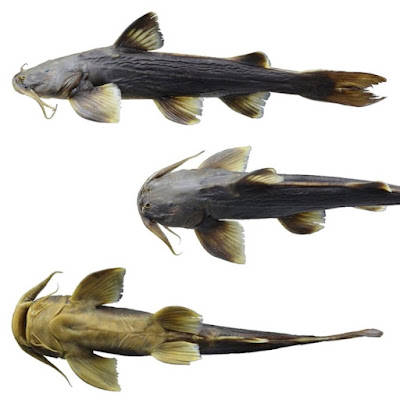
Dorsal, lateral, and ventral views of Glaridoglanis verruciloba sp. nov., holotype, IPBX F202504001, 147.8 mm SL.

 Glaridoglanis verruciloba Gong, sp. nov.

Diagnosis. Glaridoglanis verruciloba sp. nov. can be distinguished from its two congeneric species by the following combination of characters: enlarged lower lip bearing 4–7 verruciform lobes on the central-posterior margin; anus close to the anal-fin origin; ventral surface at the base of maxillary barbels densely covered with striae; 11 branched pectoral-fin rays; 5–6 branched anal-fin rays; head relatively short (HL 19.1–21.7% of SL); and mandibular barbels relatively short (inner mandibular barbel length 13.9–17.7% and outer mandibular barbel length 29.1–36.4% of HL).

Etymology. The specific epithet is derived from the Latin verruca (= wart) and lobus (= lobe), referring to the verruciform lobes on the central-posterior margin of lower lip. As Glaridoglanis is feminine (fide Kottelat 2013), the specific epithet is treated accordingly. The Chinese common name of this species is 疣叶凿齿鮡 (Yóu yè záo chǐ zhào), which literally means “wart-lobed chiseled-tooth catfish”.

Type locality of Glaridoglanis verruciloba sp. nov.:
a mountain stream flowing into the Sangqu River, the eastern branch of the upper Zayul River (upper left); paratype locality: a mountain stream flowing into the Gongrigabu River, the western branch of the upper Zayul River (right); the mainstem of Gongrigabu River (lower left); and a living specimen (approx. 140 mm SL) photographed in an aquarium.


 Zheng Gong, Huanshan Wang, Yanchao Liu and Jianchuan Li. 2025. Glaridoglanis verruciloba sp. nov., A New glyptosternine catfish (Siluriformes, Sisoridae) from the Zayul River in southeastern Tibet, China. ZooKeys 1262: 289-301. DOI: doi.org/10.3897/zookeys.1262.172819

Tuesday, June 24, 2025

[Ichthyology • 2025] Bagarius protos & B. dolichonema • A Taxonomic Review of Bagarius Catfish (Siluriformes: Sisoridae) in the Salween and Irrawaddy Rivers, with Descriptions of Two New Species from China and Myanmar


Bagarius protos B. dolichonema
Zeng & Chen,

in Zeng, Pu, Lei, Oo et Chen, 2025.

Abstract
The genus Bagarius is a group of large, benthic, predatory catfishes found in South and Southeast Asia. Two new species of Bagarius, B. protos Zeng & Chen, sp. nov., and B. dolichonema Zeng & Chen, sp. nov., are described from the Salween River Basin, Yunnan Province, China, and Irrawaddy River Basin, Myanmar, respectively. Bagarius protos and B. dolichonema both differ from B. vegrandis and B. suchus in their large size and the adipose-fin origin being nearly vertical to the anal-fin origin. Bagarius protos most closely resembles B. lica and B. rutilus in overall morphology but can be distinguished from B. lica by the absence of the brow ridge formed by the lateral margin of the frontal and from B. rutilus by the dark yellow (instead of orange) coloration of the fins in life. It further differs from two other congeners in its short filamentous extensions of the pectoral-fin spine. Bagarius dolichonema is morphologically and genetically most similar to B. bagarius; it can be distinguished from B. bagarius by strong dorsal spines slightly flattened immediately anterior to the adipose fin, distally slender neural spines of the 4th–6th vertebrae, and shorter filamentous extensions of the pectoral-fin spine. This new species further differs from three other congeners by its longer filamentous extensions of the pectoral-fin spine and weak notches in the anterodorsal margin of the first dorsal pterygiophores. Molecular phylogeny based on the cytochrome c oxidase subunit I (COI) gene also confirms the validity of these two new species. The estimated K2P genetic distances between B. protos and congenerics range from 8.0% to 12.6%, and between B. dolichonema and congenerics range from 5.7% to 12.1%.

Key Words: Cryptic species, phylogeny, Southeast Asia, taxonomy

Living specimens of Bagarius protos sp. nov., paratype. KIZ202410548, 324 mm SL.

 Bagarius protos Zeng & Chen, sp. nov.

Diagnosis. Bagarius protos can be distinguished from congeners by having the following combination of characteristics: eye small (5–8% HL), lateral margin of frontal straight, not forming brow ridge, strongly notched in antero-dorsal margin of the first dorsal-fin pterygiophore, dorsal spine strong (width 10.6–14.4 times its length), filamentous extensions of pectoral-fin spine reaching posterior of anal-fin base, neural spines of 4th–6th vertebrae immediately anterior to adipose fin distally slender, adipose-fin origin at vertical through or very slightly posterior to anal-fin origin, caudal peduncle deep (4.2–5.1% SL).

Etymology. The epithet name “protos” consists of the Greek “protos,” meaning original (at first), referring to the species being in the most primitive position in the phylogenetic tree of genus Bagarius. The suggested common name in Chinese is 原魾 (Pinyin: yuan pi).

Fresh specimens of Bagarius dolichonema sp. nov., paratype, KIZ2024010542, 193.9 mm SL, photo by Tao Qin.
 Bagarius dolichonema
Zeng & Chen, sp. nov.

Diagnosis. Bagarius dolichonema can be distinguished from congeners by the following combination of characteristics: lateral margin of frontal straight, not forming brow ridge, dorsal spine strong (width 9.9–14.1 times its length), weakly notched antero-dorsal margin on pterygiophore of first dorsal-fin, filamentous extensions of pectoral-fin spine beyond posterior of pelvic-fin base and some reaching anus, neural spines of 4th–6th vertebrae immediately anterior to adipose fin distally slightly flattened, adipose-fin origin at vertical through or very slightly posterior to anal-fin origin, caudal peduncle slender (3.8–4.6% SL).

Etymology. The epithet name “dolichonema” comes from the Greek adjective “dolikhos,” meaning long, and the noun “nēma,” meaning thread or yarn, which refers to the length of filamentous extensions with pectoral-fin spines and caudal fins that are the longest in congeners except for B. bagarius. The suggested common name in Chinese is 长丝魾 (Pinyin: chang si pi).


Yu-Yang Zeng, Xin-Rui Pu, Hao-Tian Lei, Thaung Naing Oo and Xiao-Yong Chen. 2025. A Taxonomic Review of Bagarius Catfish (Siluriformes, Sisoridae) in the Salween and Irrawaddy Rivers, with Descriptions of Two New Species from China and Myanmar. Zoosystematics and Evolution. 101(3): 1123-1136. DOI: doi.org/10.3897/zse.101.145776

Monday, December 16, 2024

[Ichthyology • 2023] Glyptothorax irroratus • A New Species of rheophilic catfish (Siluriformes: Sisoridae) from the Mekong River drainage


Glyptothorax irroratus
Ng a& Kottelat, 2023 

 
ABSTRACT
Glyptothorax irroratus, a new species of sisorid catfish from the Mekong River drainage in Laos and China, is described. It differs from its Indochinese congeners in having both large and small tubercles arranged irregularly on the lateral surfaces of the body and by combinations of colour pattern, morphometry (with particular regards to the eye, body depth, adipose fin and caudal peduncle) and thoracic adhesive apparatus morphology.
 
KEYWORDS: Sisoroidea, Sisorinae, Bagariini, Mekong River


Glyptothorax irroratus sp. nov.

Etymology: The Latin adjective irroratus (-us, -a, -um) means covered with dew; in zoology used to mean besprinkled with drops or particles. This is used in allusion to the irregular tuberculation on the sides of the body and caudal peduncle.


Heok Hee Ng and Maurice Kottelat. 2023. Glyptothorax irroratus, A New Species of rheophilic catfish from the Mekong River drainage (Actinopterygii: Siluriformes: Sisoridae). Journal of Natural History. 57(5-8); 358-371. DOI: doi.org/10.1080/00222933.2023.2186278 

Monday, September 2, 2024

[Ichthyology • 2024] Glyptothorax pongoensis • A New Species of rheophilic catfish (Siluriformes: Sisoridae) from the Brahmaputra River drainage, Nagaland, India


Glyptothorax pongoensis
 Tenali, Singh, Pratap, Phom, Ratnaraju & Kosygin, 2024
  

ABSTRACT
Glyptothorax pongoensis, sp. n. is described from the Yongmon River in Nagaland, India. The new species can be distinguished from its congeners in the Indian subcontinent by the following combination of characters: an ovate-shaped thoracic adhesive apparatus with skin ridges present over the entire apparatus, including the subulate-shaped median depression; presence of plicae on the ventral surface of the pectoral fin spine and the first ray of the pelvic fin; W-shaped anterior nuchal plate element; dorsal-fin origin nearer to the snout tip than to the origin of the adipose fin; posterior margin of dorsal spine rugose with 4–5 ridges, tuberculate skin, and nasal barbel not reaching eye when adpressed.

KEYWORDS: Siluriformes, Pongo Forest, Nagaland


Glyptothorax pongoensis

 
Diamond Rajakumar Tenali, Pratima Singh, Gudabandi Vijaya Pratap, Nyamkham Phom, Maka Ratnaraju and Laishram Kosygin. 2024. Glyptothorax pongoensis, A New Species of rheophilic catfish (Sisoridae) from the Brahmaputra River drainage, Nagaland, India. Journal of Natural History. 58(37-40); 1377-1391. DOI: doi.org/10.1080/00222933.2024.2385137
  facebook.com/FishInTheNews/posts/925655959583909

Saturday, April 6, 2024

[Ichthyology • 2024] Glyptothorax medogensis, G. rara & Parachiloglanis immaculata • Taxonomic Revision of the Sisoridae Fishes (Osteichthyes: Siluriformes) of the lower Yarlung Tsangpo River, with Descriptions of Three New Species and One New Record in China


 Glyptothorax medogensis  Chen & He,
Glyptothorax rara Chen & He, 
Parachiloglanis immaculata Chen & He, 

in Chen, Tan, Lin, Zhang, Wang et He, 2024. 

Abstract 
Based on morphological and molecular phylogenetic methods, a taxonomic revision was conducted on 400specimens of sisorid catfishes collected from the lower Yarlung Tsangpo River druing 2019—2023. Detailed examination, combined with historical records, revealed the presence of six genera and ten species of sisorids in the lower Yarlung Tsangpo River, including Glyptosternon maculatum; Glyptothorax cavia, G. cf. gracilis, G. medogensis Chen & He sp. nov.G. rara Chen & He sp. nov.Pseudecheneis sirenica, Creteuchiloglanis kamengensis; Exostoma tibetanum, E. tenuicaudatum, and Parachiloglanis immaculata Chen & He sp. nov.. The new species G. medogensis was previously misidentified as G. annandalei Hora 1923. It can be distinguished from its congeners in the Yarlung Tsangpo-Brahmaputra basin by the following combination of characters: ventral surface of the simple rays of the paired fins plaited; occipital process separated from anterior nuchal plate element; ventral-fin origin below the vertical from the posterior end of the dorsal-fin base; tip of ventral fin separated from the commencement of the anal fin; slender and shallow caudal peduncle with a depth 6.5%—8.0% SL and a length 18.8%—22.5% SL; and shorter snout length with 43.5%—49.6% HL. The new species G. rara can be distinguished from its congeners in the Yarlung Tsangpo-Brahmaputra basin by the following combination of characters: non-plaited ventral surface of pectoral spine and first pelvic-fin ray; a heart shaped thoracic adhesive apparatus extending anteriorly onto the gular region, posteriorly ending about two thirds the pectoral-fin base; ridges of skin radiate from the posteromedial extent of apparatus forming a slight depressed area and posteriorly open; longer maxillary barbel, extending beyond the end of pectoral-fin base, and reaching the posterior half of pectoral fin; broad pectoral spine, serrated anteriorly with 8serrae; nasal barbel reaching anterior margin of the eye when adpressed; and a shallow nocth on anterior margin of the lower jaw. The new species Parachiloglanis immaculata was previously misidentified as Parachiloglanis hodgarti. It can be distinguished from its congeners by the following combination of characters: absence of lip fold or post-labial fold; lunate tooth patch on the upper jaw, posterolaterally arched, extending longer laterally than anteroposteriorly, width laterally about twice anteroposteriorly; nearly fused tooth patches on the lower jaw, gap invisible; gill-openings restricted to the sides of the head and extending to about one third the pectoral-fin base; pectoral fin with 16—17 rays; long and low adipose fin, ending with a discrete notch; semilunate caudal fin; presence of a punctate lateral line with small white coloration spots around the lateral-line pores; and absence of conspicuous blotch, spot, or stripe on the body and fins. G. cavia is a new record species in China. Pseudecheneis sirenica was previously misidentified as Pseudecheneis sulcata (McClelland 1842), and its name is revised herein. Morphological characters of each species were described, and a key to the genus and species of the Sisoridae in the lower Yarlung Tsangpo River was provided. 

Keywords: Xizang, Himalaya, Sisoridae, Revision, Morphological character, New species 

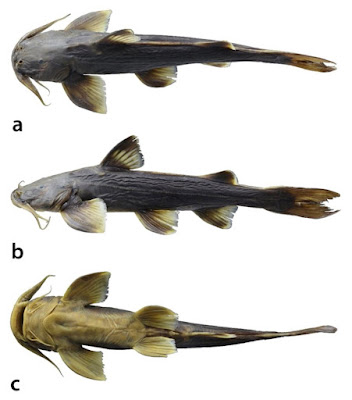
Top – the holotype of Parachiloglanis immaculata sp. nov., holotype (IHB西 工 河 20220401, 84.1 mm SL)
Middle (A & B) – the holotype of Glyptothorax rara sp. nov., (IHB2009037, 138.2 mm SL)
Bottom – the holotype of Glyptothorax medogensis sp. nov., (IHB15035193, 222.0 mm SL)


CHEN Yong-Xia, TAN Hui-Min, LIN Peng-Cheng, ZHANG Chi, WANG Lin and HE De-Kui. 2024. Taxonomic Revision of the Sisoridae (Osteichthyes: Siluriformes) Fishes of the lower Yarlung Tsangpo River, with Descriptions of Three New Species and One New Record in China [雅鲁藏布江下游鮡科鱼类分类整理及三新种和中国一新纪录种]. ACTA HYDROBIOLOGICA SINICA. DOI: 10.7541/2024.2024.0002

Monday, July 31, 2023

[Ichthyology • 2023] Glyptothorax sardashtensis • A New Species of Torrent Catfish (Teleostei: Sisoridae) from the upper Lesser Zab drainage in Iran


Glyptothorax sardashtensis
 Jokar, Kamangar, Ghaderi & Freyhof, 2023

 
Abstract
Glyptothorax sardashtensis, new species, from the upper Lesser Zab in Iran, is distinguished from its congeners in the Persian Gulf basin by: a plain flank without black or brown blotches; a wide and round anterior margin of the medial pit in the thoracic adhesive apparatus; few, short median striae in the thoracic adhesive apparatus; three yellowish blotches arranged in a crescent-shaped arch on the nuchal plate in front of the dorsal-fin origin; no tubercles on the head and flank; and a short adipose fin. The new species is also distinguished by a minimum K2P sequence divergence of 2.16% in the mtDNA-COI barcode region from G. daemon and G. galaxias, its closest relatives. Glyptothorax kurdistanicus is re-discovered close to its type locality.

Keywords: Pisces, Cytochrome c oxidase I, Freshwater fish, Middle East, Taxonomy


Milad Jokar, Barzan Bahrami Kamangar, Edris Ghaderi and Jörg Freyhof. 2023. Glyptothorax sardashtensis, A New Species of Torrent Catfish from the upper Lesser Zab drainage in Iran (Teleostei: Sisoridae). Zootaxa. 5254(4); 476-492. DOI: 10.11646/zootaxa.5254.4.2 


Friday, June 23, 2023

[Ichthyology • 2023] Pseudolaguvia permaris • A New Catfish (Siluriformes: Sisoridae) from the Eastern Ghats of India


Pseudolaguvia permaris
 Vijayakrishnan, Praveenraj & Mishra, 2023


Abstract
Pseudolaguvia permaris, a new sisorid catfish is described from the Mahanadi River basin in Odisha, India. The new species can be distinguished from congeners in having the following combination of characters: serrated anterior margin of dorsal-fin spine, thoracic adhesive apparatus not extending beyond base of last pectoral-fin ray, caudal peduncle depth 8.6–10.2% SL, body depth at anus 15.3–20.2% SL, adipose-fin base length 13.6–18.1% SL, dorsal to adipose distance 11.4–14.4% SL, length of pectoral-fin spine 19.3–28.0% SL, length of dorsal-fin spine 16.5–20.4% SL, head width 21.6–25.9% SL and indistinct, creamish bands on the body.

Keywords: Pisces, Siluriformes, Sisoroidea, Odisha, Mahanadi River, biogeography


Balaji Vijayakrishnan, Jayasimhan Praveenraj and Abhisek Mishra. 2023. Pseudolaguvia permaris, A New Catfish from the Eastern Ghats of India (Teleostei: Sisoridae). Zootaxa. 5297(2); 271-281. DOI: 10.11646/zootaxa.5297.2.6 

Sunday, March 12, 2023

[Ichthyology • 2023] Euchiloglanis nami • A New Species of Euchiloglanis Regan, 1907 (Siluriformes: Sisoridae) from Vietnam


Euchiloglanis nami  
 Tran, Nguyen, Dang, Nguyen & Nguyen, 2023


Abstract
 A new species of sisorid catfish of the genus Euchiloglanis is described from the Gam River, a tributary of the Red River in northern Vietnam. Euchiloglanis nami sp. n. differs from all the species placed in Euchiloglanis and Chimarrichthys by having elongated papilae on the ventral part of maxillary barbell. Euchiloglanis nami is distinguished from E. longibarbatus by having a wider premaxillary tooth band without indentation and the tip of the maxillary barbell reaching pectoral fin origin. The new species differs from E. davidi and E. kishinouyei by the depth of the caudal peduncle equal to 20.26–27.40 % of the caudalpeduncle length. It also differs from E. dorsoarcus by the anal-fin position being closer to the caudal-fin base than to the pelvic fin. From E. phongthoensis, it differs by the distance from the adipose-fin origin to the dorsal-fin insertion close to 50 % of the length of the adipose-fin base. In addition, E. nami differs from E. longus by having a wider premaxillary tooth band without indentation, shorter caudal peduncle (20.7 % SL), higher caudal peduncle depth (5.0 % SL), shorter distance between dorsal-fin insertion to adiposefin origin (14.8 % SL), shorter distance from snout to adipose-fin origin (57.4 % SL), shorter pelvic fins length (15.9 % SL) reaching the anus or a little beyond anus, longer adipose-fin base length (33.2 % SL) and narrower interorbital width (24.6 % SL). The new species is the first record of the genus Euchiloglanis in the Gam-Lo River system and is the third species in the genus from Vietnam. 

Key words: Euchiloglanis nami sp. n., new species, Glyptosterminae, Black River, Gam River

Euchiloglanis nami sp. n., HNUE-F00283, holotype, 142.3 mm SL; Phia Oac-Phia Den National Park; Cao Bang Prov., Vietnam. Dorsal, ventral and lateral views. Scale bar 10 mm.

Euchiloglanis nami sp. n., HNUE-F00283, holotype, 142.3 mm SL; Phia Oac-Phia Den National Park; Cao Bang Prov., Vietnam. Dorsal, ventral and lateral views.   Scale bar 10 mm.
Ventral profile of the head part of the holotype.
Ventral view of premaxillary tooth band of Euchiloglanis nami 
collected from the Gam River of the Red River, northern Vietnam.

Euchiloglanis nami sp. n.
 
Diagnosis. Euchiloglanis nami sp. n. can be distinguished from congeners by the following unique combination of characteristics: D. i, 6; A. i, 4; P. i, 15–16; C. 16; wider premaxillary tooth band without indentation (Fig. 4); elongate and threadlike maxillary barbell with pointed tip reaching to pectoral fin origin; elongated papilae ventral part of maxillary barbell; anal-fin origin closer to caudalfin base than to pelvic-fin insertion; distance from adipose-fin origin to dorsal-fin insertion close to 50% of length of adipose-fin base; depth of caudal peduncle equal to 20.26–27.40% of length of caudal peduncle; shorter dorsal-fin insertion to adipose-fin origin (12.05–15.90% SL); shorter caudal-fin length (11.53–13.42% SL); longer adipose-fin base length (31.81–35.74% SL); adipose fin not connected with caudal-fin base; pelvic fins reaching anus or a little beyond anus; narrower interorbital width (20.97– 29.45% HL).

Etymology. The specific name is in honour of the young ichthyologist and our best friend Mr. Chu Hoang Nam. The species name is a noun in genitive case. 


Hau Duc Tran, Duc Huu Nguyen, Huong Thanh Thi Dang, Huy Quang Nguyen and Nga Thi Nguyen. 2023. A New Species of Euchiloglanis Regan, 1907 (Actinopterygii: Sisoridae) from Vietnam. ACTA ZOOLOGICA BULGARICA [Acta Zool. Bulg.]. in press

Wednesday, July 6, 2022

[Ichthyology • 2022] Glaridoglanis ramosa • A New Glyptosternine Catfish (Siluriformes: Sisoridae) from Myanmar


Glaridoglanis ramosa
Ng & Kottelat, 2022


Abstract
Glaridoglanis ramosa, new species, is described from a cryptorheic basin in northern Shan State, Myanmar. The new species can be distinguished from G. andersonii, the sole congener, in having fewer vertebrae (39–40 vs. 42–44), more branched pectoral-fin rays (13–14 vs. 8–10), a longer maxillary barbel (reaching beyond proximal half vs. not more than proximal third of first pectoral-fin element; 87–101% head length vs. 75–79), a shorter pelvic fin (10.8–16.3% standard length vs. 18.0–22.4) and dorsal-to-adipose distance (7.1–11.7% standard length vs. 17.5–20.0), absence (vs. presence) of a thin, pale midlateral stripe, and an adipose fin that is strongly incised (vs. without incision or with a weak incision) at the posterior extremity of its base. We also investigated the taxonomic status of Glyptosternon malaisei, and conclude that it is a junior subjective synonym of Glaridoglanis andersonii.


Glaridoglanis ramosa, new species


Heok Hee Ng and Maurice Kottelat. 2022. A New Glyptosternine Catfish from Myanmar (Actinopterygii: Siluriformes: Sisoridae). Ichthyology & Herpetology. 110(2); 262-267. DOI: 10.1643/i2021056 [10 May 2022]

Friday, December 17, 2021

[Ichthyology • 2021] Pseudolaguvia vespa • A New Sisorid Catfish of the Genus Pseudolaguvia (Siluriformes: Erethistidae) from Nagaland, north-eastern India


Pseudolaguvia vespa
Praveenraj, Vijayakrishnan, Lima & Gurumayum, 2021


Abstract
Pseudolaguvia vespa, new species, is described from the Tsücha River, Mokokchung district, Nagaland, India. The new species can be distinguished from congeners in having the following combination of characters: length of dorsal-fin spine 12.3–16.8% SL, a smooth anterior edge of the dorsal-fin spine, caudal peduncle depth 9.0–10.5% SL, body depth at anus 15.6–17.7% SL, caudal fin length 20.7–24.5% SL, pectoral fin length 20.1–24.1% SL, interorbital distance 22.7–28.1% SL, thoracic adhesive apparatus extending to midway between base of last pectoral-fin ray and pelvic-fin origin, and live specimens with two irregular, chrome-yellow bands on the body.

Keywords: Pisces, Siluriformes, Sisoridae, Tsücha River, Brahmaputra River, Nagaland


Pseudolaguvia vespa, new species

 
 Jayasimhan Praveenraj, Balaji Vijayakrishnan, Akum Lima and Shantabala Devi Gurumayum. 2021. A New Sisorid Catfish of the Genus Pseudolaguvia (Teleostei: Sisoridae) from Nagaland, north-eastern India. Zootaxa. 5082(1); 77-86. DOI: 10.11646/zootaxa.5082.1.7


Saturday, October 16, 2021

[Ichthyology • 2021] Glyptothorax rupiri • A New Species of Glyptothorax (Siluriformes: Sisoridae) from the Brahmaputra River Basin, Arunachal Pradesh, India


Glyptothorax rupiri
Kosygin, Singh & Rath, 2021


Abstract
Glyptothorax rupiri, a new sisorid catfish, is described from the Brahmaputra River basin in Arunachal Pradesh, northeast India. It differs from its congeners in the Indian subcontinent by the following combination of characters: the presence of plicae on the ventral surface of the pectoral spine and first pelvic-fin ray; a posteriorly serrated dorsal-fin spine, its length 11.3–12.2% SL; body depth at anus 11.2–13.4% SL; a thoracic adhesive apparatus longer than broad, with a V-shaped median depression which opens posteriorly; an arrow-shaped anterior nuchal plate element; adipose-fin base length 10.9–12.6% SL; nasal barbel not reaching anterior orbital margin; 14–18 serrae on posterior margin of the pectoral-fin spine; body with two longitudinal pale-cream stripes; densely tuberculated skin; and the presence of numerous tubercles on the dorsal surface of pectoral and pelvic-fin rays.
 
Keywords: Pisces, Sisoridae, Glyptothorax rupiri, new species, India


Laishram Kosygin, Pratima Singh and Shibananda Rath. 2021. A New Species of Glyptothorax (Teleostei: Sisoridae) from the Brahmaputra River Basin, Arunachal Pradesh, India.  Zootaxa. 5023(2); 239-250. DOI: 10.11646/zootaxa.5023.2.4

Friday, May 28, 2021

[Ichthyology • 2021] The Glyptothorax Catfishes (Teleostei: Sisoridae) of the Euphrates and Tigris with the Description of A New Species


Glyptothorax kurdistanicus (Berg, 1931)

in Freyhof, Kaya, et al., 2021.

Abstract
The Glyptothorax species inhabiting the Euphrates and Tigris drainages are reviewed and six species are recognised, one of which is described herein as new species. Glyptothorax armeniacus is endemic to headwater streams in the Euphrates drainage. Glyptothorax kurdistanicus is endemic to the upper Tigris downstream to the Lesser Zab drainage. Glyptothorax cous and G. steindachneri are riverine species widespread in both the Euphrates and Tigris drainages. Glyptothorax silviae is endemic to Iran. Glyptothorax daemon, new species, from the Greater Zab and Yanarsu in the upper Tigris drainage, is distinguished by having the thoracic adhesive apparatus strongly elevated, 1.1–1.2 times longer than wide, without tubercles on the head, well developed anteromedial striae, the medial pit without striae, and a short adipose fin. Glyptothorax daemon is separated into two mitochondrial lineages, externally indistinguishable and separated by a minimum K2P distance of 2.0% in the DNA barcode region. These lineages are paraphyletic in our analysis indicating past introgressive hybridisation with G. cous. All six species are diagnosed and all, except unstudied Gsteindachneri, form distinct mitochondrial clades with between 1.2% and 3.4% minimum K2P distance between them. Species from the Euphrates and Tigris form a monophyletic mitochondrial group separated from 53 other Glyptothorax species studied from India and areas further east.

Keywords: Pisces, freshwater fish, taxonomy, Cytochrome oxidase I, Middle East


Glyptothorax kurdistanicus (Berg, 1931)


 Jörg Freyhof, Cüneyt Kaya, Younis Sabir Abdullah and Matthias F. Geiger. 2021. The Glyptothorax Catfishes of the Euphrates and Tigris with the Description of A New Species (Teleostei: Sisoridae). Zootaxa. 4969(3); 453–491. DOI: 10.11646/zootaxa.4969.3.2

Sunday, February 7, 2021

[Ichthyology • 2021] Bagarius vegrandis | ปลาแค้วัว • A New Species of Sisorid Catfish from Indochina (Siluriformes: Sisoridae), with Notes on the Identity of Bagarius bagarius


Bagarius vegrandis 
Ng & Kottelat, 2021

ปลาแค้วัว  || DOI: 10.11646/zootaxa.4926.1.9 
photo: Nonn Panitvong facebook.com/ThaiFishBook 

Abstract
Bagarius vegrandis, new species, is described from the Chao Phraya and Mekong river drainages. It differs from congeners in having a small maximum body size (to 220 mm SL vs. 520–1400 mm SL) and the adipose-fin origin markedly posterior to (vs. at vertical through or very slightly posterior to) the anal-fin origin. It further differs from congeners in having the following unique combination of characters: ovoid unculiferous plaques on dorsal surface of head, lateral margin of frontal not significantly deflected dorsally, eye diameter 11–15% HL, interorbital distance 23–28% HL, head width 18.3–22.3% SL, head depth 11.1–14.1% SL, filamentous extensions to first pectoral-fin element reaching to anus, dorsal spine width 10.6–13.9 times in its length, body depth at anus 8.7–12.0% SL, neural spines of the 4–6 vertebrae immediately anterior to adipose fin distally flattened but not forming series of prominent bumps along dorsal midline, length of adipose-fin base 10.8–13.0% SL, caudal-peduncle length 19.0–22.4% SL, caudal-peduncle depth 3.2–4.2% SL, 19–20 preanal vertebrae, and 39–40 total vertebrae. Bagarius bagarius (Hamilton, 1822) is demonstrated to be a species restricted to the Indian subcontinent (with Bagrus yarrelli Sykes, 1839, Pimelodus platespogon Valenciennes, in Jacquemont, 1839 and Pimelodus carnaticus Jerdon, 1849 as junior subjective synonyms) and Bagarius lica Volz, 1903 resurrected from synonymy with B. yarrelli as a valid species from Southeast Asia.

Keywords: Pisces, taxonomy, morphology, species delimitation, Southeast Asia

Bagarius vegrandis Ng & Kottelat, 2021
photo: Nonn Panitvong


Heok Hee Ng and Maurice Kottelat. 2021. Description of Bagarius vegrandis, A New Species of Sisorid Catfish from Indochina (Actinopterygii: Siluriformes), with Notes on the Identity of Bagarius bagarius.  Zootaxa. 4926(1); 134–146. DOI: 10.11646/zootaxa.4926.1.9

ปลาแค้ (หรือแข้) ประเทศไทยมี 4 ชนิด
 1. แค้วัว Bagarius vegrandis พบในลุ่มเจ้าพระยาและโขง 
2. แค้หัวแบน Bagarius suchus พบในเจ้าพระยาและโขง 
3. แค้ยักษ์ Bagarius lica ทุกลุ่มน้ำยกเว้นสาละวิน 
4. แค้ยักษ์สาละวิน Bagarius sp. Salween พบเฉพาะในสาละวิน