Showing posts with label Agaricomycetes. Show all posts

Wednesday, August 26, 2026

[Fungi • 2026] Agrocybe himalayensis (Strophariaceae) • A New Species from Indian Himalaya


Agrocybe himalayensis Choudhary, Uniyal & Y.P.Sharma,

in Choudhary, Sharma et Uniyal, 2026. 

Abstract
A new species, Agrocybe himalayensis (Strophariaceae), from Uttarakhand Himalaya, India, is described based on macro- and micro-morphological characters and molecular phylogenetic analyses. This species is characterised by its pale-orange to yellow-brown pileus with distinct umbo, wavy cream margin, crowded pale-salmon to fleshy brown lamellae (often anastomosing), and ellipsoid basidiospores 8.7–11.4 × 6.6–7.8 μm. A phylogenetic tree, line drawings and photographs are provided, as is a table of morphological characters of the new and closely related species. 

Keywords: nrITS, Phylogeny, Strophariaceae, Uttarakhand

Macro- and micromorphological images of Agrocybe himalayensis Choudhary, Uniyal & Y.P.Sharma, sp. nov.
A and B, Fresh basidiomata in the field and basecamp; C, basidiospores; D, basidia; E–G, pleurocystidia; H, cheilocystidia; I, pileocystidia.
Scale bars: A, 10 mm; C–I, 10 μm. All images of the holotype, S. Choudhary, P. Uniyal & Y.P. Sharma 2139, taken by Priyanka Uniyal and Shikha Choudhary.

Agrocybe himalayensis Choudhary, Uniyal & Y.P.Sharma, sp. nov.

Agrocybe himalayensis differs from its closely allied species A.putaminum by its large basidiomata (80mm vs 60mm in A.putaminum), velvety to smooth pale-orange to yellow-brown pileus (vs glabrous, wrinkled, yellow brown), distinct umbo (vs slight umbo), margin not clearly demarcated, wavy, cream (vs inflexed to deflexed – sometimes wrinkled and reflexed, and light brown). It also differs in its crowded, pale-salmon to fleshy brown lamellae often anastomosing (vs well spaced, pale yellow decurrent and toothed), stipe without any velar remnants (vs strongly fibrillose to dark-brown granulose-flocculose), presence of large basidiospores 8.7–11.4 × 6.6–7.8 μm (vs 11.7–13.8 × 7.5–8.5 μm) and with pleurocystidia 26–45.5 × 11.4–18 μm (vs 38.9–56.9 × 13–27 μm) and cheilocystidia 24.5–32.6 × 7.9–14.3 μm (vs 44–63 × 11–14 μm).


S. Choudhary, Y. P. Sharma, P. Uniyal. 2026. AGROCYBE HIMALAYENSIS (STROPHARIACEAE), A NEW SPECIES from INDIAN HIMALAYA. EDINBURGH JOURNAL OF BOTANY. 83, 3599. DOI: doi.org/10.24823/ejb.2026.3599 [2026-08-25]

Saturday, May 30, 2026

[Funga • 2024] Hydnum cremeum, H. roseotangerinum, L. subalpina, ... (Agaricomycetes: Hydnaceae) • New Contributions on Species Diversity of Genus Hydnum and Lentaria s.l. in China


Hydnum cremeum  L.P. Tang, L.J. Su & T.J. Yu,  
H. flavosquamosum L.P. Tang & L.J. Su, 
H.roseoalbum L.P. Tang, L.J. Su & W.H. Zhang, 
H. roseotangerinum L.P. Tang & L.J. Su, 

in Su, Yu, Xue, Zhang, Xu, Xia, Li, Lei, Dong, Zhang et Tang, 2024. 
 
Abstract
Southwest China is extremely rich in fungal resources, and a large number of new taxa have been discovered in recent years. In the present study, we examined 26 specimens of the genera Hydnum and Lentaria sensu lato, most of which were obtained in Yunnan Province. Through ITS-nrLSU-tef1 phylogenetic analysis, combined with morphological studies and geographic analyses, five new species were described, viz. Hydnum cremeum, H. flavoquamosumH. roseoalbumH. roseotangerinum, and L. subalpina. Furthermore, we also supplied new information on some known species, including host plants and new distribution records. We re-examined the holotype sequences of two known taxa, H. flabellatum and H. pallidomarginatum, treating H. flabellatum as a synonym of H. pallidomarginatum. Additionally, a key to Lentaria s.l. in China was provided.

Keywords: taxonomy; species delimitation; coralloid fungi; edible mushroom; spinous fungi 

Macroscopic and microscopic features of Hydnum cremeum. (a–c) Basidiomata, (a,c) from MHKMU TJ Yu 197, Holotype; (b) from MHKMU WH Zhang 599; (d) Basidiospores; (e) Basidia and Basidioles; (f) Pileipellis. Bars (d) = 10 μm; (e) = 20 μm; (f) = 50 μm.
Macroscopic and microscopic features of Hydnum flavosquamosum from MHKMU LP Tang 3454 (Holotype). (a–c) Basidiomata; (d) Basidiospores; (e) Basidia and Basidioles; (f) Pileipellis. Bars (d) = 10 μm; (e) = 20 μm; (f) = 50 μm. 
 Macroscopic and microscopic features of Hydnum roseotangerinum from MHKMU LP Tang 3458 (Holotype). (a,b) Basidiomata; (c) Basidiospores; (d) Basidioles; (e) Basidia; (f) Pileipellis. Bars (c) = 10 μm; (d,e) = 20 μm; (f) = 50 μm.


Hydnum cremeum L.P. Tang, L.J. Su & T.J. Yu sp. nov.  
奶油齿菌

Etymology—Latin ‘cremeum’ = cream, refers to the color of basidiomata.
Diagnosis—Distinct from other species within Hydnum mainly by its small basidiomata with a warm cream to yellowish white pileus, globose to subglobose basidiospores, and occurrence in subalpine mixed forests.


Hydnum flavosquamosum L.P. Tang & L.J. Su sp. nov.  
黄鳞齿菌
Etymology—Latin ‘flavo’ = yellow, ‘squamosum’ = scaly, refers to the pileus covering with yellowish brown scales.
Diagnosis—Distinct from other species within Hydnum mainly by its light yellow to light brownish-orange pileus with slightly dark scales, context becoming pale brownish on exposure, adnexed, spines, subglobose to broadly ellipsoid (Q = 1.05–1.23) basidiospores, and erectly arranged hyphae in pileipellis.


Hydnum roseoalbum L.P. Tang, L.J. Su & W.H. Zhang sp. nov. 
粉白齿菌

Etymology—Latin ‘roseo’ = pink, ‘album’ = white, refers to the color of its spines. 
Diagnosis—Distinct from other species within Hydnum by its creamy to whitish pileus, pale pink spines, five-spored basidia, globose basidiospores, erectly arranged hyphae in pileipellis, and occurrence in subalpine broad-leaved forests.


Hydnum roseotangerinum L.P. Tang & L.J. Su sp. nov. 
粉橙齿菌

Etymology—Latin ‘roseo’ = pink, ‘tangerinum’ = orange, refers to the color of spines.
Diagnosis—Distinct from other species within Hydnum by its brownish orange pileus, pinkish orange spines, globose to subglobose, sometimes broadly ellipsoid basidiospores, and occurrence in mixed subalpine forests.


Lentaria subalpina L.P. Tang, L.J. Su & T.J. Yu sp. nov.  
亚高山木瑚菌

Etymology—The Latin ‘subalpina’ refers to this species growing in subalpine forests.
Diagnosis—Distinct from other Lentaria species mainly due to the grayish orange to brownish orange basidiomata, sometimes carbonized, black branch apices, elongated ellipsoid to cylindrical basidiospores (9.0–11.0 × 4.8–5.7 μm), and growing in dead branches of Abies or Picea in subalpine forests.


 Linjie Su, Taijie Yu, Rou Xue, Wenhao Zhang, Chang Xu, Xing Xia, Jia Li, Hanchi Lei, Yang Dong, Guoli Zhang and Liping Tang. 2024. New Contributions on Species Diversity of Genus Hydnum and Lentaria s.l. in China. J. Fungi. 10(12), 824; DOI: doi.org/10.3390/jof10120824 [27 November 2024]

[Funga • 2025] Gymnopus sinobrevipes, G. flavoalbus & G. yunnanensis (Agaricomycetes: Agaricales: Omphalotaceae) • Species Diversity of Gymnopus Section Levipedes in Southwestern China, with a Description of Three New Species


(a–c) Gymnopus flavoalbus ((a,b) Holotype, KUN-HKAS144470, (c) KUN-HKAS144471);
(d–f) G. sinobrevipes ((d,e) Holotype, KUN-HKAS108042, (f) KUN-HKAS108101);
(g–i) G. yunnanensis ((g,h): Holotype, KUN-HKAS108570, (i) KUN-HKAS108610).
W.C. Feng, Y.Y. Cui and Q. Cai, 

in Feng, Li, Cui et Cai. 2025.
Bars = 2 cm.
 
Abstract
Species of Gymnopus sect. Levipedes are challenging to delimitate due to the morphological similarity among different taxa. In this study, morphological characteristics, molecular phylogenetic data, and ecological traits were integrated to investigate the species diversity of this section of southwestern China. A total of 17 species were documented in the region, including three new species, namely G. sinobrevipes, G. flavoalbus, G. yunnanensis, and two species new to the studied area—G. bicolor and G. ocior. Detailed descriptions and illustrations of the three new species are presented, along with comparisons to closely related or morphologically similar species. The remaining species included five that were originally described from southwestern China, four that were first identified from Europe, two from the Republic of Korea, and one from North America. Six of these species, originally described outside of China, currently lack molecular evidence to support their distributions in southwestern China. Finally, 11 species with morphological and molecular evidence were recognized in southwestern China. A key to these species is also provided.

Keywords: Agaricales; Omphalotaceae; phylogeny; morphology; three new taxa; taxonomy

 Basidiomata of novel species in Gymnopus sect. Levipedes from southwestern China.
(a–c) G. flavoalbus ((a,b) Holotype, KUN-HKAS144470, (c) KUN-HKAS144471);
 (d–f) G. sinobrevipes ((d,e) Holotype, KUN-HKAS108042, (f) KUN-HKAS108101);
 (g–i) G. yunnanensis ((g,h): Holotype, KUN-HKAS108570, (i) KUN-HKAS108610).
Bars = 2 cm.

Gymnopus flavoalbus W.C. Feng, Y.Y. Cui and Q. Cai, sp. nov. 

Etymology: Referring to the pale yellow center and whitish margin of the pileus.

Diagnosis: Similar to G. macropus Halling, but differs by its light-colored pileus, furcate cheilocystidia, and pileipellis with broadly clavate to spherical terminal cells without pigments.


Gymnopus sinobrevipes W.C. Feng, Y.Y. Cui and Q. Cai, sp. nov. 

Etymology: Referring to the species from China and having short stipe.

Diagnosis: Similar to G. tiliicola J.J. Hu, B. Zhang, and Yu Li, but differs in its smaller pileus and cheilocystidia with knobs.


Gymnopus yunnanensis W.C. Feng, Y.Y. Cui and Q. Cai, sp. nov. 

Etymology: Referring to the locality, Yunnan Province, China, where the holotype was collected.

Diagnosis: Similar to G. dryophiloides, but differs in its oblong to subcylindrical basidiospores and the absence of rhizomorphs at the stipe base.


 Wei-Chao Feng, Xiao-Yan Li, Yang-Yang Cui and Qing Cai. 2025. Species Diversity of Gymnopus Section Levipedes in Southwestern China, with a Description of Three New Species. J. Fungi. 11(2), 88; DOI: doi.org/10.3390/jof11020088 [23 January 2025]

Tuesday, April 28, 2026

[Fungi • 2026] Leucoinocybe danxiashanensis & L. haizhuensis (Basidiomycota: Agaricales) • Two mycenoid Species from southern China


[A-B] Leucoinocybe danxiashanensis Ming Zhang, T.H. Li & Xiang L. Chen,
[C-D] L. haizhuensis Ming Zhang, C.X. Fan & W.X. Xia,

in Xia, Wang, Chen, Sun, Fan, Li, Deng, Yue et Zhang, 2026. 

Abstract
Two new species of Leucoinocybe from southern China are described, illustrated, and compared with phenotypically similar and phylogenetically related species. Morphologically, L. danxiashanensis sp. nov. is characterized by its mycenoid basidiomata, light brown to brownish orange pileus with faintly yellow striations, decurrent lamellae, abundant lageniform to obclavate and thin-walled cystidia on pileus and stipe surface, and broadly ellipsoid to subamygdaliform basidiospores; and L. haizhuensis sp. nov. is characterized by its mycenoid basidiomata, brown, light brown to yellowish white pileus with pubescent, 2-spored basidia, ovoid, diverse cheilocystidia and elliptical to broadly elliptical basidiospores. Phylogenetic analyses based on sequences of the nuclear ribosomal large subunit (nrLSU) and the nuclear ribosomal internal transcribed spacer (nrITS) supported them as two distinct species of Leucoinocybe.

Key words: Mycenoid, new taxon, phylogeny, Porotheleaceae, taxonomy

Basidiomata of Leucoinocybe danxiashanensis. A. Collection GDGM 80114 (holotype); B. Collection GDGM 80184. Scale bars: 10 mm (A, B). 
Basidiomata of Leucoinocybe haizhuensis. A, B. Collection GDGM 102360 (holotype); C. Collection GDGM 95340; D. Collection GDGM 99420. Scale bars: 10 mm (A–D).

Leucoinocybe danxiashanensis Ming Zhang, T.H. Li & Xiang L. Chen, sp. nov.

Leucoinocybe haizhuensis Ming Zhang, C.X. Fan & W.X. Xia, sp. nov.


 Wen-Xiao Xia, Chao-Qun Wang, Xiang-Lian Chen, Rui-Hua Sun, Cun-Xiang Fan, Tai-Hui Li, Wang-Qiu Deng, Hai-Mei Yue and Ming Zhang. 2026. Two mycenoid Species of Leucoinocybe (Agaricales, Basidiomycota) from southern China.  MycoKeys. 129: 325-343. DOI: doi.org/10.3897/mycokeys.129.174720  [12 Mar 2026]

Tuesday, March 31, 2026

[Funga • 2025] Hydnellum hangzhouense (Agaricomycetes: Thelephorales) • Morphology and Molecular Phylogeny reveal One New Species from Eastern China


Hydnellum hangzhouense X.P. Fan, Y.F. Sun & B.K. Cui, 

in Fan, Song, Xu, Sun et Cui, 2025. 

Abstract
As ectomycorrhizal fungi, the species in Hydnellum can form a mutualistic symbiosis with plant roots to promote the restoration of forest vegetation and the stability of forest ecosystems. Some Hydnellum fungi also have edible and medicinal values generating considerable economic benefits. In this study, a new species of Hydnellum collected from Hangzhou, eastern China, was described by utilizing morphological and phylogenetic analyses. Morphologically, Hydnellum hangzhouense was characterized by its light-colored and relatively thick pileus, simple septated generative hyphae, and subglobose to ellipsoid basidiospores. The phylogenetic analysis was conducted based on the combined sequences dataset (ITS + nLSU + nSSU + rpb2). The results indicated that H. hangzhouense formed an independent lineage which is closely related to H. crassipileatum and H. chocolatum. The detailed description, illustrations and phylogenetic tree for demonstrating the taxonomic positions of H. hangzhouense were provided.

Key words: macrofungi, multi-gene phylogeny, novel species, stipitate hydnoids, taxonomy, Fungi

Basidiomata of Hydnellum hangzhouense (Holotype, Wu 1679).
 Scale bars: 2 cm.

Microscopic structures of Hydnellum hangzhouense (Holotype, Wu 1679).
 A) Basidiospores. B) Hyphae from context. C) Basidia and basidioles. D) Hyphae from spines. E) Hyphae from the inner layer of stipe. F) Hyphae from the surface layer of stipe.

Hydnellum hangzhouense X.P. Fan, Y.F. Sun & B.K. Cui sp. nov.
 

XIANG-PING FAN, CHANG-GE SONG, YI-HUA XU, YI-FEI SUN and BAO-KAI CUI. 2025. Morphology and Molecular Phylogeny reveal One New Species of Hydnellum (Thelephorales) from Eastern China.  Phytotaxa. 711(1); 43-60. DOI: doi.org/10.11646/phytotaxa.711.1.3 [2025-07-22] 

[Fungi • 2026] Leucocoprinus roseus (Basidiomycota: Agaricaceae)Molecular Phylogenetic and Morphological Analyses revealed A New Species from Punjab, Pakistan


Leucocoprinus roseus W. Akram, Saba & Asif,  

in Akram, Saba, Asif, Nawaz, F. Ullah, Samen, Maula et M. Ullah, 2026. 
 
Abstract
In this article, we describe a new fungal species, Leucocoprinus roseus, collected in Canal View Park, District Mandi Bahauddin, Punjab, Pakistan. The species is proposed as new based on detailed morphological observations and molecular phylogenetic analysis using nuclear ribosomal DNA internal transcribed spacer (nrITS) sequences. In a phylogenetic reconstruction, L. roseus forms a distinct clade clearly separated from related taxa. It is characterized by small basidiomata, a plano-convex pileus with dark red center becoming pale reddish toward the margins, center covered with squarrose scales, broadly ellipsoid amygdaliform basidiospores and versiform cheilocystidia. A comprehensive description, illustrations, and results of the phylogenetic analysis are provided, along with a comparison with morphologically and genetically related species.

Keywords: molecular phylogeny, Mandi Bahauddin, nrITS, saprotrophic, taxonomy

Macro–Morphological features (a–f) Fresh field pictures of basidiomata of Leucocoprinus roseus.
Photos by: Muhammad Asif and Wajahat Akram.

Leucocoprinus roseus W. Akram, Saba & Asif sp. nov. 

 
Wajahat Akram, Malka Saba, Muhammad Asif, Ayesha Nawaz, Fahim Ullah, Warda Samen, Fazli Maula and Mohsin Ullah. 2026. Molecular Phylogenetic and Morphological Analyses revealed A New Species, Leucocoprinus roseus (Agaricaceae, Basidiomycota), from Punjab, Pakistan. Nordic Journal of Botany.  DOI: doi.org/10.1002/njb.05015 [28 January 2026]

Saturday, January 31, 2026

[Funga • 2025] Phaeoclavulina aurea & P. fulva (Agaricomycetes: Gomphaceae) • Two New Species from North China based on morphological and phylogenetic analysis


[A–C] Phaeoclavulina aurea; [D–F] P. fulva  
Y. Gao, X. Tong, & C.L. Hou, 

in Tong, Gao, Wang, Zhou et Hou, 2025.  

Abstract
Two new species, Phaeoclavulina aurea and P. fulva, were discovered and described from North China. Identification was based on morphological observations combined with phylogenetic analysis of nrITS–nrLSU sequences. Phaeoclavulina aurea is characterized by its pale yellow to golden yellow basidiomata, brownish black coloration with dark tips at maturity, and basidiospores bearing truncate spines. Phaeoclavulina fulva is distinguished by its dirty orange basidiomata, pale yellow stipe surface, and basidiospores ornamented with rounded warts. This study enriches the species diversity of Phaeoclavulina in North China.

Key words: Clavarioid fungi, new taxa, systematics, taxonomy

Morphology of Basidiomata.
A–C. Phaeoclavulina aurea (A, B. BJM 344955 holotype; C. BJTC L007);
D–F. Phaeoclavulina fulva (D. BJTC C274 holotype; E. BJTC ZH0015; F. BJTC ZH1138).
Scale bars: 1 cm.

 Phaeoclavulina aurea Y. Gao, X. Tong, & C.L. Hou, sp. nov.

Etymology. The epithet “aurea” refers to the yellow to golden yellow basidiomata.


 Phaeoclavulina fulva Y. Gao, X. Tong, & C.L. Hou, sp. nov.

Etymology. The epithet “fulvus” refers to the dirty orange to yellowish-brown basidiomata.


 Xin Tong, Yue Gao, Hai-Qi Wang, Hao Zhou and Cheng-Lin Hou. 2025. Two New Species of Phaeoclavulina (Gomphaceae, Gomphales) from North China based on morphological and phylogenetic analysis. MycoKeys. 120: 157-172. DOI: doi.org/10.3897/mycokeys.120.138950 [29 Jul 2025]

Wednesday, December 31, 2025

[Fungi • 2020] Leucoagaricus callainitinctus • A New Species of Leucoagaricus section Piloselli (Agaricaceae) from tropical India


Leucoagaricus callainitinctus K.P.D. Latha, K.N.A. Raj & Manim.,

in Deepna Latha, Anil Raj et Manimohan, 2020.

Abstract
An interesting species of lepiotaceous fungi, Leucoagaricus callainitinctus sp. nov., is described from Kerala State, India based on morphology and molecular phylogeny. This species is distinguished by basidiocarps that turn dark turquoise on bruising/handling or reacting with NH4OH. A phylogenetic study was conducted based on Maximum likelihood analysis of nrITS sequences. In the phylogram, the new species nested as a distinct lineage in a group, which consisted predominantly of members of section Piloselli of the genus Leucoagaricus. A comprehensive description, photographs of the basidiocarps and the microscopic structures, comparisons with phenetically similar and phylogenetically related species and a phylogram showing the placement of the new species are provided.

Agaricales, Basidiomycota, lepiotoid fungi, phylogeny, taxonomy, Fungi

Leucoagaricus callainitinctus (CAL 1799, holotype).
A-B, D. Basidiocarps in their natural habitat; C. Basidiocarps showing their partial veil; E. Lamellae turning green when reacting with 10 % NH 4 OH.
Scale bars: A = 5 mm, B-E = 10 mm. Photos by: K. N. Anil Raj

Leucoagaricus callainitinctus sp. nov.


K. P. DEEPNA LATHA, K. N. ANIL RAJ and Patinjareveettil MANIMOHAN. 2020. Leucoagaricus callainitinctus—A New Species of Leucoagaricus section Piloselli (Agaricaceae) from tropical India. Phytotaxa. 442(2); 111–120. DOI: doi.org/10.11646/phytotaxa.442.2.6 

Saturday, July 12, 2025

[Funga • 2025] Lentinus saisamorniae (Polyporales: Polyporaceae) • A New edible macrofungus from northern Thailand


Lentinus saisamorniae  Kumla & N. Suwannar.,

in Kumla, Kaewnunta et Suwannarach, 2025. 
เห็ดขอนขาวสายสมร  ||  DOI: doi.org/10.11646/phytotaxa.705.2.2 
 
Abstract
A new edible Lentinus species, described herein as L. saisamorniae, was collected from local markets and natural habitats in northern Thailand between 2019 and 2021. This species is characterized by its small to medium-sized basidiomata, white to yellowish-white pileus, broadly ellipsoid to elongate-shaped basidiospores, dimitic hyphal system, and hyphal pegs. Nonetheless, its longer basidia and smaller basidiospores make it distinguishable from L. cladopus. A molecular phylogenetic analysis of the combined internal transcribed spacer (ITS) large subunit (nrLSU) of nuclear ribosomal DNA, and RNA polymerase II large subunit (rpb1) sequences supported the monophyly of L. saisamorniae as a distinct lineage within the genus Lentinus. Therefore, this new species was introduced based on both morphological characteristics and molecular phylogeny. A full description, illustrations, color photographs, and a phylogenetic tree to show the placement of L. saisamorniae are provided. Comparisons between the new species and morphologically similar and related species are discussed.

Edible fungus, lentinoid fungus, phylogeny, saprotrophic fungus, taxonomy, tropical area, Fungi


Jaturong KUMLA, Atsadawat KAEWNUNTA and Nakarin SUWANNARACH. 2025. Lentinus saisamorniae (Polyporaceae, Polyporales), A New edible macrofungus from northern Thailand. Phytotaxa. 705(2); 149-161. DOI: doi.org/10.11646/phytotaxa.705.2.2 [2025-06-13]


Thursday, May 1, 2025

[Funga • 2025] Xerocomus garhwalensis & X. rishikeshinus • Two New Species of Xerocomus (Boletales: Boletaceae) from the Indian Himalaya


Xerocomus garhwalensis & X. rishikeshinus
A. Nautiyal, M. Ben Hassine Ben Ali & S. L. Stephenson,

in Nautiyal, Ben Hassine Ben Ali, Kannan, Rawat, Krishnamurthy et Stephenson, 2025. 

Abstract 
Xerocomus garhwalensis and Xerocomus rishikeshinus (Boletales, Basidiomycota) are described as species new to science from specimens collected in the Himalayas of northwestern India. Both were found in forests dominated by banj oak (Quercus leucotrichophora A. Camus), and they presumably form ectomycorrhizal associations with this tree species. Xerocomus has been variously defined morphologically, and a number of the species now assigned to the genus are sometimes considered to be members of the genus Boletus. The two new species were placed in Xerocomus largely on the basis of DNA sequence data, which are still rather limited for the assemblage of macrofungi present in northwestern India. 

Keywords – banj oak – Basidiomycota – Boletaceae – ectomycorrhizal fungi – new taxa

Xerocomus garhwalensis. A. Sporocarps as observed in the field. B. Single sporocarp.
Xerocomus rishikeshinus. A. Sporocarps as observed in the field. B. Two sporocarps showing the tube surface.

Xerocomus garhwalensis A. Nautiyal, M. Ben Hassine Ben Ali & S. L. Stephenson, sp. nov. 

Etymology – the name refers to the region (Garhwal) in India where the type specimen was collected.


Xerocomus rishikeshinus A. Nautiyal, M. Ben Hassine Ben Ali & S. L. Stephenson, sp. nov. 

Etymology – the name refers to the largest city (Rishikesh) near the site in India where the specimen was collected. 

 
Nautiyal A., Ben Hassine Ben Ali M., Kannan R, Rawat G.S., Krishnamurthy R. and Stephenson S.L. 2025. Two New Species of Xerocomus (Boletales) from the Indian Himalaya. Asian Journal of Mycology. 8(1), 3–11.  
https://www.asianjournalofmycology.org/pdf/AJOM_8_1_2.pdf
https://x.com/wii_india/status/1917107576443179467

Wednesday, February 26, 2025

[Funga • 2020] Pseudosperma citrinostipes (Agaricomycetes: Inocybaceae) • A New Species associated with Keteleeria from southwestern China


Pseudosperma citrinostipes  Y.G. Fan & W.J. Yu,

Yu, Chang, Qin, Zeng, Wang et Fan, 2020. 

Abstract
Pseudosperma citrinostipes sp. nov. from southwestern China is described and illustrated based on morphological, ecological, and molecular data. The new species is characterized by a medium-sized slender habit, straw yellow to golden yellow pileus, crowded lamellae without olive tinges, an equal stipe with lemon yellow to golden fibrils, large ellipsoid to subphaseoliform basidiospores, subfusiform to lageniform cheilocystidia, and the presence of caulocystidia at the stipe apex. Phylogenetically, P. citrinostipes is placed in the P. rimosum complex and is sister to the rest of the taxa of the species complex.

Keywords: Agaricomycetes, cryptic species, taxonomy, Yunnan province

Basidiomata of Pseudosperma citrinostipes.
 a-b. FCAS3504. c., e. and h. FHMU3150 (holotype). d., f. and g. FCAS3503.
bars = 10 mm. photos by Y.G. Fan.

Pseudosperma citrinostipes sp. nov. 


Wen-Jie YU, Cheng CHANG, Li-Wu QIN, Nian-Kai ZENG, Shao-Xian WANG and Yu-Guang FAN. 2020. Pseudosperma citrinostipes (Inocybaceae), A New Species associated with Keteleeria from southwestern China. Phytotaxa. 450(1); 8-16. DOI: doi.org/10.11646/phytotaxa.450.1.2  

Thursday, January 30, 2025

[Funga • 2024] Aureoboletus wusangongii (Boletales: Boletaceae) • A New bolete from subtropical China


Aureoboletus wusangongii  N.K. Zeng, H.Z. Qin, W.F. Lin & L.G. Hu, 
 
in Qin, Zhong, Lin, Hu, Chen, Liang et Zeng, 2024.

Abstract
Aureoboletus wusangongii (Boletaceae, Boletales) from Zhejiang, subtropical China, is described as new based on morphological and phylogenetic evidence. An illustrated morphological description as well as comparisons with related species are presented. Additionally, a key to the accepted species of Aureoboletus in China is provided.

molecular phylogeny, morphology, new taxon, taxonomy, Fungi


Aureoboletus wusangongii N.K. Zeng, H.Z. Qin, W.F. Lin & L.G. Hu, sp. nov.  

Diagnosis: Differs from other species of Aureoboletus by a stipe with distinctly coarse-lacerate reticulations, large basidiospores with longitudinal ridges, and subcutis pileipellis.

Etymology: Latin “wusangongii” is in honor of Wu Sangong, the originator of shiitake mushroom, who was the founder of the world's "cutting flowers" cultivation technique.


Hua-Zhi QIN, Qiao-Wen ZHONG, Wen-Fei LIN, Li-Gui HU, Xiao-Long CHEN, Zhi-Qun LIANG and Nian-Kai ZENG. 2024. Aureoboletus wusangongii (Boletaceae, Boletales), A New bolete from subtropical China.  Phytotaxa. 674(2); 199-217. DOI: doi.org/10.11646/phytotaxa.674.2.3 

Monday, January 27, 2025

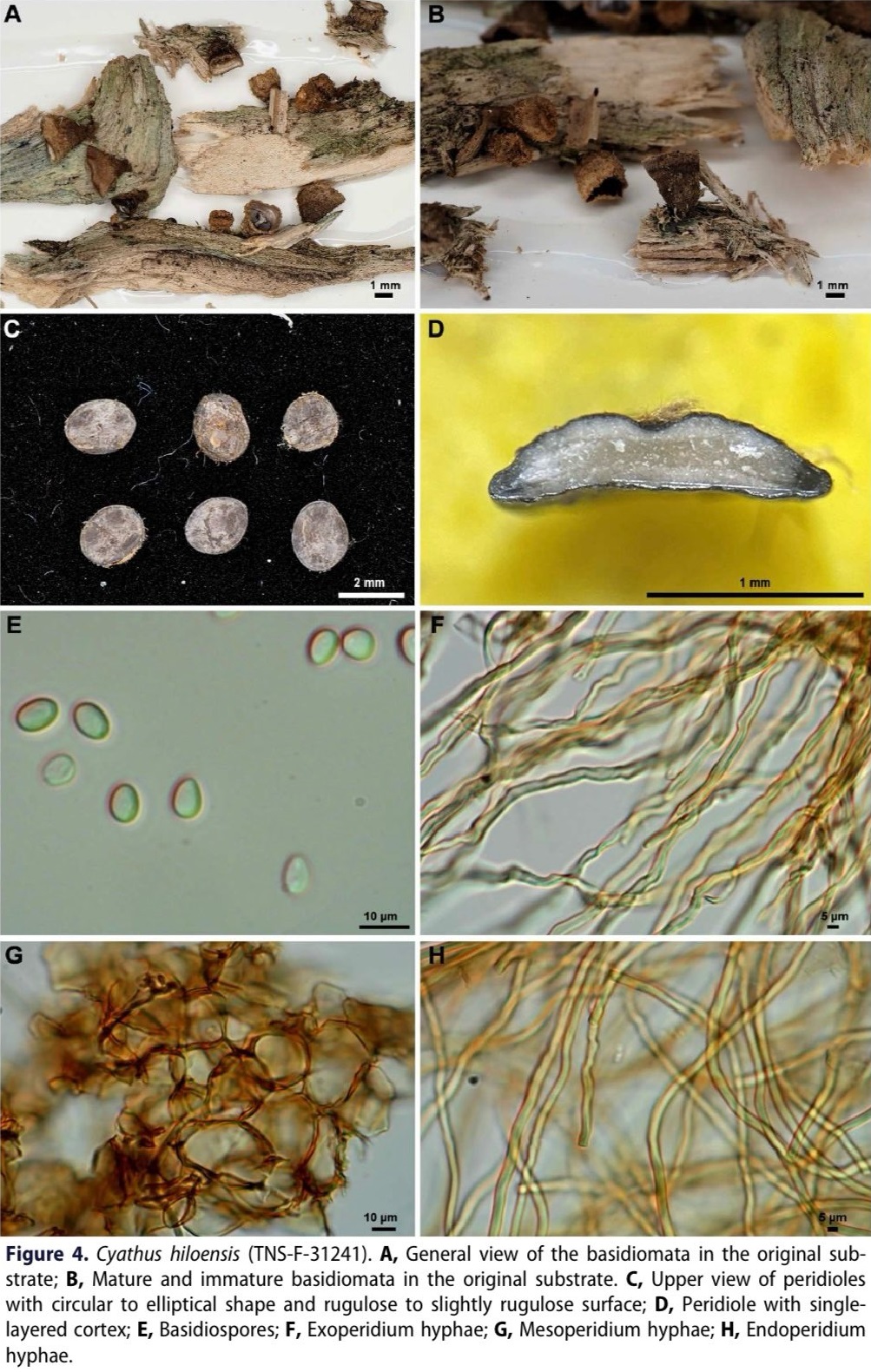
[Funga • 2025] Cyathus hiloensis (Basidiomycota: Nidulariaceae) • A new species in the Hawaiian Archipelago


Cyathus hiloensis  

in Góis, da Cruz, Baseia et Hosaka, 2025. 

ABSTRACT
This study focuses on expanding knowledge of Cyathus species in the Hawaiian archipelago through the description of a newly discovered species from Hilo, the largest town in Hawaii County. Based on morphological and molecular data, Cyathus hiloensis is proposed as new taxon within the pallidum group. A comprehensive description of its distinguishing features is provided, along with a detailed comparison to closely related taxa.

KEYWORDS: Biodiversity, Hawaiian archipelago, Pacific Ocean, taxonomy, systematic


Jefferson dos S. Góis, Rhudson H.S.F. da Cruz, Iuri G. Baseia and Kentaro Hosaka. 2025. A new species Cyathus hiloensis (Nidulariaceae, Basidiomycota) in the Hawaiian Archipelago. New Zealand Journal of Botany. DOI: doi.org/10.1080/0028825X.2025.2454602  


Monday, January 20, 2025

[PaleoOrnithology • 2025] DNA and Spores from Coprolites reveal that Colourful Truffle-like Fungi endemic to New Zealand were consumed by extinct Moa Megalapteryx didinus (Dinornithiformes)


upland moa Megalapteryx didinus (Owen, 1883)
(c) Gallacea scleroderma*, 
(d) Gallacea sp. ‘Nelson Lakes’*, 
(e) Rossbeevera pachydermis*, 
(f) Russula macrocystidiata*,

in Boast, Wood, Cooper, Bolstridge, Perry et Wilmshurst, 2025. 
 
Abstract
Mycovores (animals that consume fungi) are important for fungal spore dispersal, including ectomycorrhizal (ECM) fungi symbiotic with forest-forming trees. As such, fungi and their symbionts may be impacted by mycovore extinction. New Zealand (NZ) has a diversity of unusual, colourful, endemic sequestrate (truffle-like) fungi, most of which are ECM. As NZ lacks native land mammals (except bats), and sequestrate fungi are typically drab and mammal-dispersed, NZ’s sequestrate fungi are hypothesized to be adapted for bird dispersal. However, there is little direct evidence for this hypothesis, as 41% of NZ’s native land bird species became extinct since initial human settlement in the thirteenth century. Here, we report ancient DNA and spores from the inside of two coprolites of NZ’s extinct, endemic upland moa (Megalapteryx didinus) that reveal consumption and likely dispersal of ECM fungi, including at least one colourful sequestrate species. Contemporary data from NZ show that birds rarely consume fungi and that the introduced mammals preferentially consume exotic fungi. NZ’s endemic sequestrate fungi could therefore be dispersal limited compared with fungi that co-evolved with mammalian dispersers. NZ’s fungal communities may thus be undergoing a gradual species turnover following avian mycovore extinction and the establishment of mammalian mycovores, potentially affecting forest resilience and facilitating invasion by exotic tree taxa.

Keywords: evolutionary anachronism, moa, New Zealand, extinction, ancient DNA, mycophagy

(a) Upland moa skeleton, (b) HC coprolite X17/11/33,
and (c–h) examples of fungi identified from aDNA (* denotes taxa with congruent spore evidence):
(c) Gallacea scleroderma*, (d) Gallacea sp. ‘Nelson Lakes’*, 
(e) Rossbeevera pachydermis*, (f) Russula macrocystidiata*,
(g) Cortinarius sp. ‘Blyth Track’, (h) Cortinarius violaceovolvatus.
Photo credits: (a) Wikimedia Commons, (b) Alexander P. Boast, (c–h) Noah Siegel.


Alexander P. Boast, Jamie R. Wood, Jerry Cooper, Nic Bolstridge, George L. W. Perry and Janet M. Wilmshurst. 2025. DNA and Spores from Coprolites reveal that Colourful Truffle-like Fungi endemic to New Zealand were consumed by extinct Moa (Dinornithiformes). Biol. Lett. 2120; 240440. DOI: doi.org/10.1098/rsbl.2024.0440  


Sunday, December 15, 2024

[Funga • 2024] Cyathus magnipilosus (Basidiomycota: Nidulariaceae) • A New Species from Kalimantan, Borneo


Cyathus magnipilosus

in Góis, Cruz, Baseia et Hosaka, 2024. 
 
Abstract
In this study, we present the first new species of Cyathus from Indonesia. Cyathus magnipilosus is characterized by having light-colored basidiomata, an exoperidium with long tomentum, single-layered cortex, black peridioles with a smooth surface and elongated basidiospores. The new species is presented with morphological illustrated description, and phylogenetic analyses using ITS and LSU sequences. Cyathus magnipilosus fits in the pallidum group, based on recent classifications. Comparative analyses with related taxa and a detailed discussion are provided as well as an identification key to the known species of Cyathus in the pallidum group for the world.

biodiversity, bird's nest fungi, new taxa, phylogeny, systematics, Fungi


Jefferson Dos Santos GÓIS, Rhudson Henrique Santos Ferreira da CRUZ, Iuri Goulart BASEIA and Kentaro HOSAKA. 2024. A New Species of Cyathus (Nidulariaceae, Basidiomycota) from Kalimantan, Borneo.  Phytotaxa. 677(1); 66-76. DOI: doi.org/10.11646/phytotaxa.677.1.3