Showing posts with label Recircumscription. Show all posts

Tuesday, March 3, 2026

[Botany • 2025] Axinaea filandiensis (Melastomataceae: Merianieae) • A New Species from Colombia, and Comments on the Circumscription of Axinaea and groups in Meriania


 Axinaea filandiensis Humberto Mend. & W. Vargas,  
  
 in Mendoza Cifuentes et Vargas, 2025.

Abstract
Background and Aims: Axinaea is a predominantly Andean genus, with one species found in the mountains of Costa Rica and Panama. It is similar to Meriania, and the only feature that separates them from each other is the shape of the dorsal connective of the anther. The discovery of a new species, described here, with anther connective characters intermediate between the two genera, raised the need to improve the circumscription of Axinaea and document variation within Meriania, aspects that are addressed in this paper.

Methods: A new species of Axinaea is described from collections deposited in the UDBC herbarium of the Distrital University of Bogotá. The degree of threat is evaluated and the need for conserving the species is described. In addition, various groups within Meriania, including Axinaea, are summarized, and a unique set of characters for Axinaea is proposed.

Key results: Axinaea filandiensis sp. nov. is characterized by its 4-merous flowers, isomorphous stamens with blue anthers and globose-ellipsoid dorsal connectives. It is known only from the type locality and its conservation status is proposed as Critically Endangered (CR). Seven groups are described in Meriania, including Axinaea, and a unique set of characters is proposed for the latter genus, considering non-nectariferous flowers, cucullate corolla, isomorphic or slightly dimorphic stamens, anthers with the vascular bundle of the connective tissue directed backwards, and inappendiculate and globose to globose-elliptic connective. According to this circumscription, one species described in Meriania (M. rubrifolia) establishes its position within Axinaea.

Conclusions: Axinaea filandiensis represents a critically endangered species that requires urgent conservation action. The unique set of characters established in this paper clarifies the separation between Axinaea and Meriania. It is proposed to maintain both genera separate, considering that Meriania is an artificial group that should be split into several genera.

Keywords: Andes, stamens, sub-Andean forest, taxonomy

Living plants of Axinaea filandiensis Humberto Mend. & W. Vargas.
A. flowering branch; B. detail of stem and inflorescence; C. floral buds; D. open flower.
Photos from Vargas 17591 (UDBC)
 

Humberto Mendoza Cifuentes and William G. Vargas. 2025. Axinaea filandiensis (Melastomataceae, Merianieae), A New Species from Colombia, and Comments on the Circumscription of Axinaea and groups in MerianiaActa Botanica Mexicana. (132); DOI: doi.org/10.21829/abm132.2025.2421 
 

Sunday, July 27, 2025

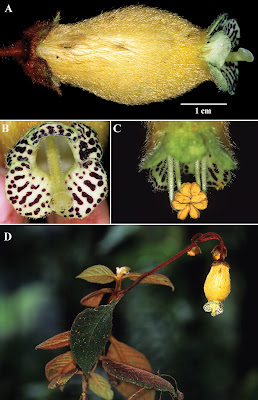
[Botany • 2025] Columnea flavohirsuta (Gesneriaceae) • A New Species from the Chocó Biogeographic Region, and an Update on Some Columnea Circumscriptions


Columnea flavohirsuta J. L. Clark, 

in Clark, Clavijo et Skog, 2025. 

Abstract
Recent field expeditions in the Chocó Biogeographic Region on the western Andean slopes of northwestern South America, as well as ongoing herbarium research, have led to the discovery of a new species of Columnea L. (Gesneriaceae) and prompted circumscriptions to be updated for some Columnea species. A new species, Columnea flavohirsuta J. L. Clark, is described and differentiated from a complex of morphologically similar species including C. minutiflora L. P. Kvist & L. E. Skog and C. herthae Mansf. The name C. parviflora C. V. Morton is recognized as a heterotypic synonym of C. herthae. The name C. tenensis (Wiehler) B. D. Morley is recognized as a heterotypic synonym of C. illepida H. E. Moore. The name C. reticulata Amaya-Márquez, L. E. Skog & G. E. González is recognized as a heterotypic synonym of C. purpureovittata (Wiehler) B. D. Morley. The taxonomic history of these species is discussed, and field images are provided to serve as aids for identification and a guide for future systematic studies of Columnea.

Keywords: Chocó Biogeographic Region, Colombia, Columnea, Ecuador, taxonomy

Field images of Columnea flavohirsuta J. L. Clark.
—A, B. Lateral views of flowers. —C. Mature fruit. —D. Ab-axial view of leaf blade. —E. Habit.
 A, J. L. Clark et al. 17206; B, J. L. Clark et al. 13429; C, J. L. Clark et al. 10432; D, J. L.Clark et al. 17206; E, J. L. Clark et al. 13429. Photos by John L. Clark. 

Columnea flavohirsuta J. L. Clark, sp. nov.


John L. Clark, Laura Clavijo and Laurence E. Skog. 2025. Columnea flavohirsuta (Gesneriaceae), A New Species from the Chocó Biogeographic Region, and an Update on Some Columnea Circumscriptions. Novon, A Journal for Botanical Nomenclature. 33; 71 - 82. DOI: doi.org/10.3417/2025989

Monday, February 28, 2022

[Botany • 2021] New Circumscriptions Add Two northern Andean Species to Kohleria (Gesneriaceae)


Kohleria andina (Fritsch) J.L. Clark & Jost, 

in Clark & Jost, 2021. 

Abstract
Recent studies of type specimens and exploratory research expeditions in the northern Andes have resulted in an updated circumscription and recognition for two species of Kohleria (Gesneriaceae) in Ecuador and Colombia. A change in the rank from a variety to species is recognized for Kohleria anisophylla (Fritsch) Wiehler. The combination Kohleria andina (Fritsch) J.L. Clark & Jost, comb. nov. is provided here and a lectotype is designated. The updated circumscriptions of these two species are supported by morphology and geographic distribution. The presence of an epiphytic habit for Kohleria is discussed. Field images based on recent expeditions are provided to support the circumscriptions presented here.

Keywords: Colombia, Ecuador, Gesneriaceae, Kohleria, taxonomy


Kohleria andina (Fritsch) J.L. Clark & Jost
A lateral view of flower B female phase of mature flower C male phase of mature flower D habit
(A–D Clark et al. 7750). Photos by J.L. Clark.

New generic placement requires new combination and lectotypification for Kohleria andina

Kohleria andina (Fritsch) J.L. Clark & Jost, comb. nov.


Revised species circumscription for Kohleria anisophylla

Kohleria anisophylla (Fritsch) Wiehler


 John L. Clark and Lou Jost. 2021. New Circumscriptions Add Two northern Andean Species to Kohleria (Gesneriaceae). PhytoKeys. 179: 99-110. DOI: 10.3897/phytokeys.179.65990

Resumen: Los estudios recientes de las colecciones tipo y las expediciones exploratorias en el norte de los Andes han dado como resultado la actualización en la circunscripción y reconocimiento de dos especies de Kohleria (Gesneriaceae) en Ecuador y Colombia. Se reconoce el cambio de rango de variedad a especie para Kohleria anisophylla (Fritsch) Wiehler. Se presenta la nueva combinación Kohleria andina (Fritsch) J.L. Clark & Jost, comb. nov. con la designación de su lectotipo. La circunscripción actualizada de estas dos especies está soportada por caracteres morfológicos y distribución geográfica. Se discute la presencia del hábito epífito en Kohleria. Se presentan imágenes obtenidas en las expediciones de campo para soportar las circunscripciones propuestas aquí.

Tuesday, March 30, 2021

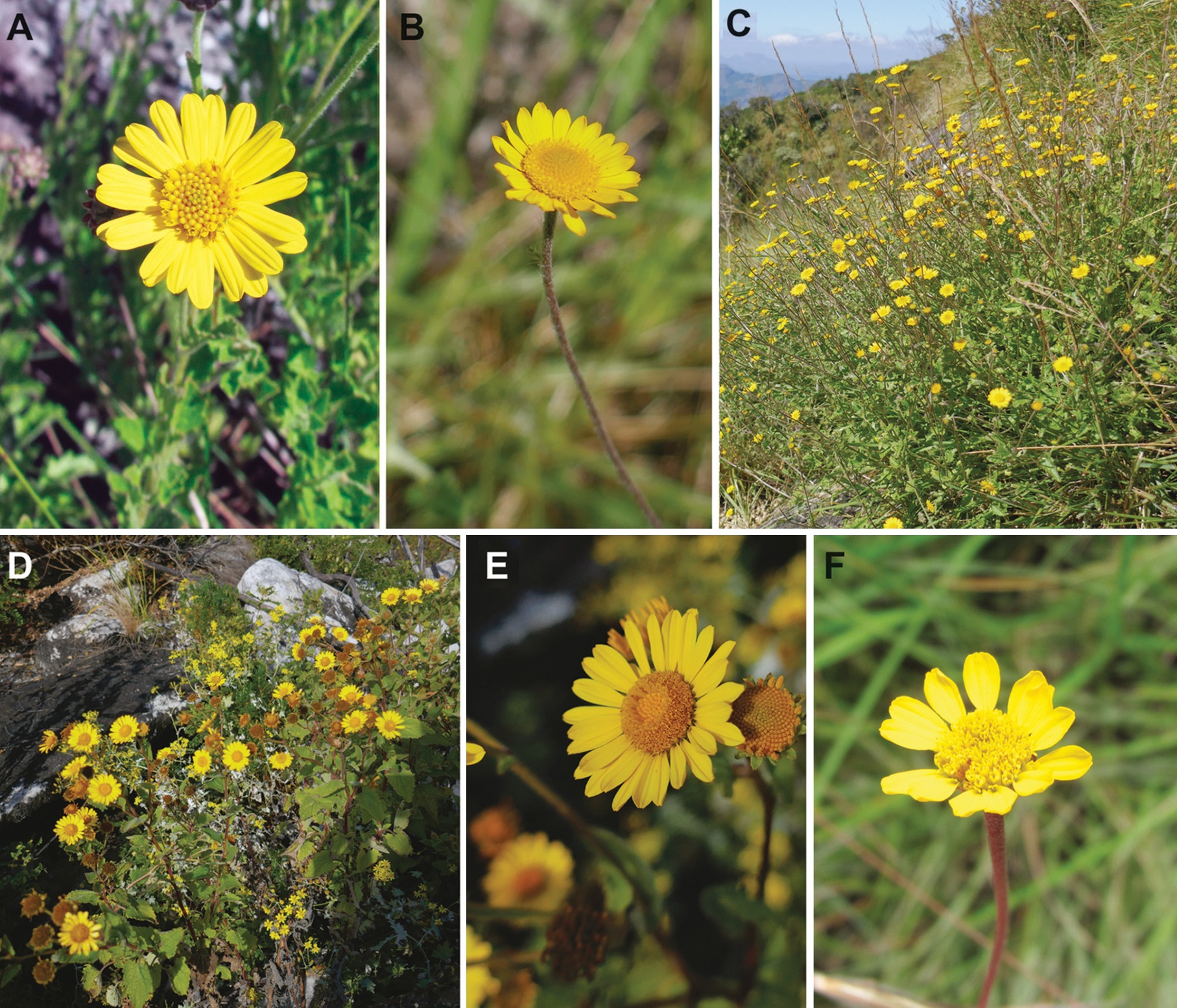
[Botany • 2021] Phylogeny of Anisopappus (Asteraceae: Athroismeae) with Species Circumscriptions revisited


A, Anisopappus paucidentatus from Chimanimani mountains, Mozambique;
 B & C, Anisopappus lastii subsp. lastii from Pico Muli, Mozambique;
D & E, Anisopappus buchwaldii subsp. iodotrichus from Serra Choa, Mozambique;
 F, Anisopappus davyi from Mutinodo Wilderness, Zambia.

in Bengtson, Osborne & Anderberg, 2021. 
— Photos by Jo Osborne, B & C taken during an expedition to Mt. Lico and Pico Muli in Mozambique organized by Julian Bayliss.

Abstract
Anisopappus (Asteraceae: Athroismeae) is a genus with its main distribution in Africa (one species also in Asia), currently considered to include around 21 species. A molecular phylogenetic study of Anisopappus is presented for the first time, based on plastid (ndhF, trnL‐trnF, trnQ‐rps16) and nuclear (ETS, ITS) data. Anisopappus is confirmed to be monophyletic, and species interrelationships are resolved. The results differ from earlier treatments based on morphology, and the phylogenetic analyses reveal a need for changes in species circumscriptions as compared to those of the most recent treatment. Consequently, many taxa currently treated as synonyms are here shown to represent separate species indicating that the genus includes well over 40 species. Distribution patterns now emerge where several clades are found to consist of species restricted to a particular geographical region. The Anisopappus of Madagascar, many of which were earlier placed in synonymy with species found on the African continent, are here shown to be endemic, and the results reveal a need for further studies of that group.

Keywords: Anisopappus, Asteraceae, Athroismeae, Compositae, molecular phylogenetics, taxonomy

 
Representatives of Anisopappus.
A, Anisopappus paucidentatus from Chimanimani mountains, Mozambique; capitula ca 2.2 cm diam.; B & C, Anisopappus lastii subsp. lastii from Pico Muli, Mozambique; capitula ca 1.6 cm diam.;
D & E, Anisopappus buchwaldii subsp. iodotrichus from Serra Choa, Mozambique; capitula ca 2.8 cm diam.; F, Anisopappus davyi from Mutinodo Wilderness, Zambia; capitula ca 1.8 cm diam.

— Photos by Jo Osborne, B & C taken during an expedition to Mt. Lico and Pico Muli in Mozambique organized by Julian Bayliss.


Conclusions: 
The study presents a first molecular phylogenetic study of the genus Anisopappus that aims at resolving the relationships between the different taxa and testing earlier classifications of species delimitations. The results show the synonymization and classification of Ortiz & al. (1996; Ortiz, 2005), where a large number of species were synonymized under Anisopappus chinensis, to be largely unsupported, and instead support the classification of Wild (1964) to a major extent. The results reveal a need for changes in species circumscriptions. The number of species is here shown to be well over 40 rather than the 21 recognized prior to this study (Bengtson & al., 2017). Almost all species that were recognized prior to the revision by Ortiz & al. (1996) are resurrected. Several new species have recently been discovered, and yet more may be found as the taxa from Madagascar are studied in detail. Additionally, a few of the species recognized by Wild (1964) are here shown to consist of more than one morphologically similar taxon. Closely related species are often found in the same area, and several clades show a distinct geographical pattern with species limited to a particular region. Most of the taxa found on Madagascar form a Malagasy endemic clade, and the study reveals a need for further studies of the group.


Annika Bengtson, Jo Osborne and Arne A. Anderberg. 2021. Phylogeny of Anisopappus with Species Circumscriptions revisited (Asteraceae: Athroismeae). Taxon. DOI: 10.1002/tax.12448
 

Wednesday, July 31, 2019

[Botany • 2019] Recircumscription and Revision of the Genus Vanoverberghia (Zingiberaceae)


Vanoverberghia sepulchrei Merr. 

Vanoverberghia diversifolia Elmer.
Vanoverberghia sasakiana Funak. & H.Ohashi.

in Docot, Banag, Tandang, et al., 2019. 

The genus Vanoverberghia currently includes three species namely V. sepulchrei and V. rubrobracteata from the Philippines and V. sasakiana from Taiwan. New material targeting the Alpinia eubractea clade of the tribe Alpinieae was used to test the monophyly of Vanoverberghia. A combined analysis of the ITS and trnK/matK regions reveals that these three species form a strongly supported monophyletic clade with Alpinia diversifolia and Alpinia vanoverberghii. The morphological descriptions of all species were updated after examining recent collections and comparing with types and protologues. The original description of A. diversifolia did not include information on the flowers which are described here. The morphology of A. diversifolia and A. vanoverberghii is for most parts in accordance with the previous perception of the genus but a few characters are added and a recircumscription of Vanoverberghia is subsequently provided here. Vanoverberghia diversifolia is reinstated and A. vanoverberghii is combined in Vanoverberghia. Furthermore, collections from northern Luzon documents the presence of V. sasakiana and all species of Vanoverberghia thus occur in the Philippines. A key to the five species is provided including a comprehensive taxonomic revision and designation of three lectotypes.

Keywords: Alpinia; ITS; Lanyu; Luzon; new species record; trnK/matK

Vanoverberghia diversifolia Elmer.

Photo: D.N. Tandang.

Vanoverberghia rubrobracteata Docot & Ambida.

Photo: R.V.A. Docot.

Vanoverberghia sasakiana Funak. & H.Ohashi.

Photo: S.-W. Chung.

Vanoverberghia sepulchrei Merr.
 Photo: R.V.A. Docot.


 R.V.A. Docot, C.I. Banag, D.N. Tandang, H. Funakoshi and A.D. Poulsen. 2019. Recircumscription and Revision of the Genus Vanoverberghia (Zingiberaceae). Blumea. 64; 140–157.  DOI: 10.3767/blumea.2019.64.02.05  
J.H.B. Ambida, A.M.A. Alviar, P.S.A. Co, F.G.M. Concepcion, C.I. Banag and R.V.A. Docot. 2018. A New Species of Vanoverberghia (Zingiberaceae) from the Philippines.  Blumea - Biodiversity, Evolution and Biogeography of Plant. DOI:  10.3767/blumea.2018.63.02.07

Tuesday, July 18, 2017

[Botany • 2017] Recircumscription and Taxonomic Revision of Siderasis, with Comments on the Systematics of Subtribe Dichorisandrinae (Commelinaceae)


Abstract
A new circumscription and a total of six microendemic species, four of them new to science, are herein presented for Siderasis, based on field and herbaria studies, and cultivated material. We provide an identification key to the species and a distribution map, description, comments, conservation assessment, and illustration for each species. Also, we present an emended key to the genera of subtribe Dichorisandrinae, and comments on the morphology and systematics of the subtribe.

Keywords: Atlantic Forest, Brazil, Commelinales, Neotropical flora, spiderwort, Tradescantieae


Figure 1. Floral morphology of subtribe Dichorisandrinae s.l.
ASiderasis Raf. emend M.Pell. & Faden: Sfuscata (Lodd.) H.E.Moore S. albofasciata M.Pell. S. zorzanellii M.Pell. & Faden.
DDichorisandra J.C.Mikan: Dacaulis Cogn. Dhexandra (Aubl.) C.B.Clarke Dthyrsiflora J.C.Mikan D. paranaënsis D.Maia et alDnana Aona & M.C.E.Amaral I D. incurva Mart. J Dpenduliflora Kunth K Dsagittata Aona & M.C.E.Amaral L Dradicalis Nees & Mart.
Cochliostema odoratissimum Lem. Geogenanthus rhizanthus (Ule) G.Brückn. Plowmanianthus panamensis Faden & C.R.Hardy.
Photographs A–B, D–G, J by M.O.O. Pellegrini, C by J.P.F. Zorzanelli, H by V. Bittrich, I by G.H. Shimizu, K by J.L. Costa-Lima, L by M.A.N. Coelho, M by R. Moran, N by D. Scherberich, and O by C.R. Hardy. 

Siderasis Raf., Fl. Tellur. 3: 67. 1837, emend. M.Pell. & Faden

Pyrrheima Hassk., Flora 52: 366. 1869, nom. illeg. Type species (designated here).
 Ploddigesii Hassk., nomilleg. [≡ S. fuscata (Lodd.) H.E.Moore].

Type species: Siderasis acaulis Raf. [≡ Sfuscata (Lodd.) H.E.Moore].

Etymology: Siderasis was named in allusion to the peculiar red to bright-red hairs that cover almost the entire plant, but especially the leaves. However, only S. fuscata possesses the aforementioned hairs, and all of the remaining species possess leaf blades covered by hyaline to light brown, rarely rusty hairs.

Habitat, distribution and ecology: Siderasis is endemic to the Atlantic Forest domain in coastal Brazil, occurring in the states of Bahia, Espírito Santo, and Rio de Janeiro (Fig. 2). More specifically, Siderasis is restricted to the Central Corridor of the Atlantic Forest, growing in remnants of semideciduous forests associated with inselbergs, between 90–1350 m above sea level. The genus is composed exclusively by microendemic species distributed in very small and fragmented subpopulations, susceptible to deforestation and illegal collection of specimens for ornamental purposes.

....

1. Siderasis albofasciata M.Pell., Nordic J. Bot. 35(1): 30. 2017.

Etymology: The epithet means “white-striped”, making reference to the thin and always present, white to silver stripe along the midvein of this species’ leaves.

Distribution and habitat: Siderasis albofasciata is known exclusively from the municipalities of Santa Teresa and Fundão, state of Espírito Santo (Fig. 2). It occurs in the understory of evergreen forests, in shady areas with shallow and rocky soil, with great leaf-litter accumulation.


Figure 7. Siderasis almeidae M.Pell. & Faden. A habit, showing a fertile rosette B detail of the elongated aerial stem, showing the rusty internodes and leaf-sheaths C detail of the lanate indumentum on the abaxial side of the leaf blade D detail of the hispid indumentum on the adaxial side of the leaf blade E detail of the inflorescence, showing the contracted cincinnus and some floral buds F front view of a flower, showing the fleshy and internally purple sepals, and the lanate ovary. Photographs A, F by M.A.N. Coelho, remaining photographs by M.O.O. Pellegrini. 

2. Siderasis almeidae M.Pell. & Faden, sp. nov.

Diagnosis: Similar to S. fuscata due to its rusty indumentum in the leaves, lilac to purple rhomboid petals and white anthers. Also, similar to S. albofasciata due to its sessile to subpetiolate leaves, blades adaxially hispid and abaxially lanate, present bracteoles, and purple filaments and style. Nevertheless, Siderasis almeidae is peculiar in lacking terminal tubers in the roots, subterraneous stems, and having aerial stems elongate and trailing in the leaf litter, leaves entirely green, fleshy showy sepals, and a densely lanate ovary.

Etymology: The epithet honors Brazilian botanist Rafael Felipe de Almeida, a prominent specialist in Malpighiaceae, contributor in the studies of Commelinaceae, husband of the first author, and co-collector of the holotype, for his unmeasurable support in the field and in my research.

Distribution and habitat: Siderasis almeidae is confined to the municipalities of Itamarajú and Prado, Bahia (Fig. 2). It occurs in the “mata higrófila” vegetation with emerging rocky formations, in shady and moist areas. In the type locality, the subpopulations were found growing in great accumulations of leaf litter, among dense clusters of Marantaceae. The area is greatly disturbed, and within private property.


3. Siderasis fuscata (Lodd.) H.E.Moore, Baileya 4: 28. 1956.

Etymology: The epithet “fuscata” means dark-colored, in allusion to the red to bright red hairs that cover almost the entire plant, in opposition to the normally hyaline hairs in most Commelinaceae.

Distribution and habitat: Siderasis fuscata is endemic to the municipalities of Rio de Janeiro (with several localities inside Floresta da Tijuca) and Niterói (with just one locality, Alto Mourão), in the Rio de Janeiro state (Fig. 2). It occurs in the vegetation on hillsides (mata de encosta) near the littoral, in shady areas with shallow and rocky soil.


Figure 9. Siderasis medusoides M.Pell. & Faden. A habit, showing a fertile rosette B detail of the synflorescence, showing the elongated and tangled cincinni C front view of a flower, showing small ants near the flower center D detail of the capsule. Photographs by P. Fiaschi. 

4. Siderasis medusoides M.Pell. & Faden, sp. nov.


Diagnosis: Similar to S. almeidae due to its sessile to subpetiolate, entirely green leaves, present bracteoles, sessile flowers, purple filaments and style combined with white anthers, and oblongoid to broadly oblongoid capsules. Siderasis medusoides is distinct due to its membranous leaves, elongate and tangled cincinni, small flowers, and purple to dark blue and elliptic to narrowly obovate or spatulate petals.

Etymology: The epithet alludes to the extremely elongated cincinni, common in mature individuals of this species, due to their resemblance to the snakes that composed the hair of Medusa, one of the three Gorgon sisters from Greek mythology.

Distribution and habitat: Siderasis medusoides is known from the municipalities of Marilândia and Santa Leopoldina, in the state of Espírito Santo (Fig. 2). It grows in lowland Atlantic Forest, in shady and moist areas with great leaf litter accumulation, 90–550 m above the sea level.


5. Siderasis spectabilis M.Pell. & Faden, sp. nov.

Diagnosis: Very distinctive due to its vining habit, distichously-alternate leaves, blades asymmetric at base, main florescence a many-branched thyrse, with alternate cincinni, flowers zygomorphic, bisexual or staminate, stamens unequal, curved upwards, sigmoid filaments, and capsules globose and shallowly foveolate. It can be differentiated from S. zorzanellii by its membranous and velutine leaves, inflorescences always terminal in the secondary branches, petals dark mauve to vinaceous, rarely light pink or white, with margins ciliate with non-moniliform hairs.

Etymology: The epithet means “admirable, remarkable, spectacular”, in allusion to its distinctive growth form, small flowers with a peculiar coloration, and the unique petal margins ciliate with non-moniliform hairs.

Distribution and habitat: Siderasis spectabilis is confined to the type locality, in the native vegetation of the Horto Santos Lima (currently the headquarters of the Desengano State Park), in Santa Maria Madalena, state of Rio de Janeiro (Fig. 2). Nothing is known about this species habitat, since the original labels give no information on the area and all field expeditions to recollect this plant have been unsuccessful.


6. Siderasis zorzanellii M.Pell. & Faden, sp. nov.

Diagnosis: Similar to S. spectabilis due to its vining habit, distichously-alternate leaves, blades asymmetric at base, main florescence a many-branched thyrse, with alternate cincinni, flowers bisexual or staminate, zygomorphic, stamens unequal, curved upwards and sigmoid filaments. It can be differentiated from by its chartaceous and sparsely velutine leaves, inflorescences axillary in the primary branches or terminal in the secondary branches, and petals white with glabrous margins.

Etymology: The epithet honors the collector of the type specimens, João Paulo Fernandes Zorzanelli, Brazilian botanist and dear friend of the authors. JPFZ is an active and prominent collector in the state of Espírito Santo, with collections currently focused on Serra do Valentim, the type locality of S. zorzanellii.

Distribution and habitat: Siderasis zorzanellii is confined to the municipality of Iúna, Espírito Santo (Fig. 2). It occurs in the “Floresta Ombrófila Densa Montana” vegetation, at 1200–1350 m above the sea level, generally near disturbed sites, being less frequent in well-preserved areas. This could be related to its climbing habit and the need of more sunlight exposure then the rosette species of the genus. This pattern is common in other liana and vine groups, such as Bignoniaceae, Malpighiaceae, and Sapindaceae (Acevedo-Rodríguez, pers. comm.), especially evident in big families such as Asteraceae, where the primarily climbing genus Mikania Willd. is almost exclusively found at the edge of forests, along trails, and in disturbed areas (Oliveira 2015).


Final remarks
The present work adds four new species to Siderasis, along with the addition of new morphological characters that help clarify the circumscription of the group. Siderasis Raf. emend. M.Pell. & Faden may be uniquely characterized as comprising small perennial rosette herbs or robust perennial vines, with shoots determinate or indeterminate, leaves spirally- or distichously-alternate. The inflorescences are terminal or axillary, either a many-branched thyrse with alternate cincinni or reduced to a solitary cincinnus, cincinni always several-flowered. The flowers are chasmogamous, bisexual or male, actinomorphic or zygomorphic, and petals with glabrous margins or ciliated with non-moniliform hairs. The androecium is composed of 6 fertile stamens, filaments straight or sigmoid, anthers dorsifixed and extrorsely rimose, anther sacs semicircular, divergent, connectives expanded and quadrangular. In the gynoecium, the stigma is annular-truncate or annular-capitate, marginally papillate with unicellular papillae restricted to the margin of the stigmatic regions. Also, similar to Dichorisandra, the capsules are thick-walled, and the seeds are arillate, biseriate to partially uniseriate, with semidorsal or semilateral embryotega, and a C-shaped hilum. All species accepted by us are easily diagnosed by a unique and constant combination of morphological character states. Furthermore, each species can be easily separated based on their geographical distribution, since they are microendemics, with non-overlapping distribution areas (Fig. 2).

As indicated by several systematic studies in Commelinaceae (Evans et al. 2000, 2003; Hardy 2001; Wade et al. 2006; Zuiderveen et al. 2011; Hertweck and Pires 2014) and by the morphological evidence presented here and by Pellegrini (2017), the need to recircumscribe subtribe Dichorisandrinae is pressing. Aside from the cytological character of x=19 large chromosomes described by Jones and Jopling (1972) and hypothesized by Faden and Hunt (1991), no macro or micromorphological synapomorphies were found so far for subtribe Dichorisandrinae in its current circumscription. On the other hand, if subtribe Dichorisandrinae is recircumscribed to exclusively contain Dichorisandra and Siderasis, Dichorisandrinae s.s. can be easily morphologically characterized by its thick-walled capsules, the biseriate to partially uniseriate arillate seeds, semidorsal to semilateral embryotega, and C-shaped hilum. The lineage composed by Geogenanthus (Cochliostema+Plowmanianthus) needs to be formally recognized as a subtribe, and can be easily circumscribed by its petals with marginally fringed with moniliform hairs, and anthers sacs curved to spirally-coiled and appressed to each other. Phylogenetic studies using both nuclear and chloroplast sequences seem promising in elucidating phylogenetic incongruences in Commelinaceae (e.g. Burns et al. 2011). However, most phylogenetic in the family so far completely disregard morphological data, with the exception of Evans et al. (2000, 2003). Studies focusing on the systematics and recircumscription of Dichorisandrinae are currently being conducted, combining morphological and molecular data (Pellegrini et al., in prep.), and should shed some light on the evolution of the reproductive biology in the family.


 Marco O.O. Pellegrini and Robert B. Faden. 2017. Recircumscription and Taxonomic Revision of Siderasis, with Comments on the Systematics of Subtribe Dichorisandrinae (Commelinaceae).  PhytoKeys. 83; 1-41.   DOI: 10.3897/phytokeys.83.13490


Friday, May 19, 2017

[Botany • 2017] A Revision and Recircumscription of Begonia Section Pilderia including One New Species, Begonia tepuiensis


Begonia tepuiensis Moonlight & Jara  

Abstract

Novel phylogenetic data is used to show that the poorly-known species Begonia glandulifera and Begonia mariannensis form a clade with Begonia buddleiifolia, the type species of Begonia section Pilderia. A unique combination of characters is identified in this group and used to re-circumscribe the section to include these species, and two morphologically similar species: Begonia jenmanii, and Begonia humillianaA new species is described herein as Begonia tepuiensis sp. nov. from a single tepui in the Amazonas State of Venezuela. A full taxonomic revision and key to the species of Begonia section Pilderia is presented and we assign all species to IUCN Red List categories.

Keywords: Andes, Begonia section Pilderia, Neotropics, Phylogeny, Guyana Shield, Trinidad and Tobago, Eudicots


Begonia section Pilderia (Klotzsch) A.DC. 
 Distribution:— Colombia, Ecuador, Guyana, Perú, Trinidad and Tobago, Venezuela. 

1. Begonia buddleiifolia A.DC. (1859)
2. Begonia glandulifera Griseb. (1860) 
3. Begonia humillima L.B.Sm. & Wassh. (1973)  
4. Begonia jenmanii Tutin (1940) 
5. Begonia mariannensis Wassh. & T. McClellan (1995) 

6. Begonia tepuiensis Moonlight & Jara spec. nov.

Etymology:— The genus Begonia is relatively poorly known from the tepuis of northern Amazonia. We name this species B. tepuiensis as it is only the third Begonia species described exclusively from tepuis after B. steyermarkii L.B.Sm. & B.G.Schub and B. nubicola L.B.Sm. & B.G.Schub.


FIGURE 6. Begonia tepuiensis Moonlight & Jara. 
A. Habit, flowering top; B. Habit, shoot with rooting nodes; C. Female flower (side view); D. Stigma (front view); E. Stigma (back view); F. Bract; G. Detail of leaf hairs, upper lamina; H. Detail of leaf hairs, lower lamina. 

Drawn from type collection R.S. Cowen & J.J. Wurdack 31443 by Claire Banks. 


P.W. Moonlight and A. Jara-Muñoz. 2017. A Revision and Recircumscription of Begonia Section Pilderia including One New Species. Phytotaxa. 307(1); 1-22.  DOI: 10.11646/phytotaxa.307.1.1.

Resumen: Se usaron nuevos datos filogenéticos para mostrar que las especies pobremente conocidas: Begonia glandulifera y Begonia mariannensis forman un clado con Begonia buddleiifolia, la especie tipo de Begonia sección Pilderia. Se identificaron una combinación única de caracteres en este grupo, que fueron usados para re-circunscribir la sección incluyendo estas especies, y dos especies morfológicamente similares: Begonia jenmanii y Begonia humilliana. Se describe una nueva especieBegonia tepuiensis sp. nov. de un tepui en el estado Amazonas de Venezuela. Se presenta también una revisión taxonómica completa y una clave para las especies de Begonia sección Pilderia y asignamos todas las especies a categorías de la Lista Roja de la UICN.