Showing posts with label Carphodactylidae. Show all posts

Friday, April 7, 2023

[Herpetology • 2022] Nephrurus eromanga • Plio–Pleistocene Vicariance across Arid Australia in the ‘Spiny Knob-tailed Geckos’ (Carphodactylidae: Nephrurus asper group), with the Description of A New Species from western Queensland


Nephrurus eromanga
 Oliver, Donnellan & Gunn, 2022 


Abstract
Across Australia’s monsoon tropics and vast arid zone isolated regions or ‘islands’ of upland or rocky habitat are home to disjunct populations of many taxa of plants and animals. Comparative analyses of lineages that occur across these habitat islands provide opportunities to understand when and how environmental change drove isolation and diversification across arid Australia. Here we present an analysis of mitochondrial genetic diversity across disjunct populations of geckos in the Nephrurus asper group. Dating analyses suggest that disjunct and genetically divergent populations spanning the northern half of Australia diverged through the Plio–Pleistocene. Based on the timing of divergence and current habitat associations we hypothesise that species in this lineage were isolated by the expansion of unsuitable arid-zone habitats from the late Pliocene onwards. Across most areas, these barriers appear to be sandy or stony deserts. However, in eastern Australia genetically divergent populations are separated by grassland on flat vertisol-dominated soils (‘blacksoils’), suggesting that these habitats also expanded during the late Pliocene aridification. Finally, we show that western Queensland populations formerly referred to N. asper are genetically divergent and diagnosable on the basis of colour pattern and, herein, recognise these populations as a distinct species. 

Keywords: aridification, biogeography, blacksoil, Nephrurus eromanga sp. nov, refugia, sandy deserts, stony deserts, vicariance, gecko.
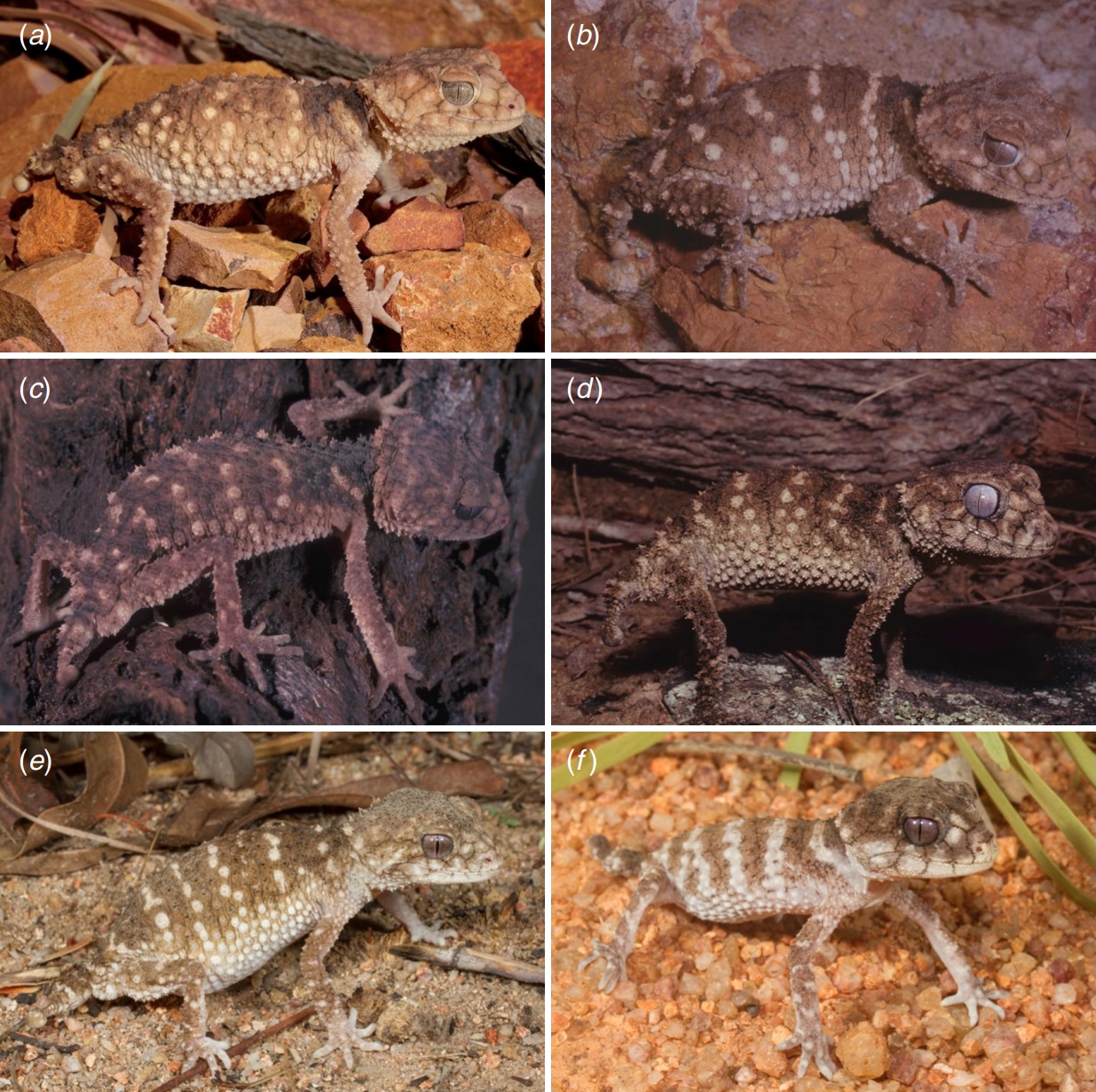

Photographs of examples of Nephrurus asper East and West showing variation in colour pattern in life: 

(a) N. asper West from Noonbah Station; (b) N. asper West from South Galway Range Station;

(c) N. asper West from Cork Station; (d) N. asper East from Moura;
(e) N. asper East from Almaden; and (f ) N. asper East from Hervey’s Range.

Photographs: (a) Angus Emmott, (b) Queensland Museum, (c, d) Steve Wilson, (e, f ) Chris Jolly.


Nephrurus eromanga
(a) from West from Noonbah Station; (b) from West from South Galway Range Station.

Nephrurus eromanga Oliver, Donnellan & Gunn, sp. nov. 
(Eromanga Basin Knob-Tail Gecko)

Diagnosis: Nephrurus eromanga, sp. nov. can be distinguished from other taxa in the N. asper group by the following combination of characters: moderately large size (maximum SVL males ~105 mm, females ~114 mm); fawn to mid-brown (reddish in life) dorsal colouration on dorsal and lateral surfaces of head, torso and limbs; narrow to wide pale dorsal crossbands or broken series of blotches; dark-brown saddle on the nape, which extends posterior to the forelimbs and contrasts strongly with the base colouration on the back the head and remainder of torso; digits lacking dark-brown or grey bands or flecks; and basal scales surrounding each tubercle uniform in height and less than half the height of the scale they enclose. 

Etymology: Named after the Eromanga Basin, a Mesozoic sedimentary basin in inland eastern Australia that entirely circumscribes the distribution of the species. The name Eromanga is in turn derived from the small town of Eromanga (at which this species does not occur). Eromanga is used as a noun in apposition.

  habitat for Nephrurus eromanga, sp. nov. in western Queensland, Australia:
(a) Beal Range, South Galway Station;
 The species is typically found associated with scree habitats on and around mesas.
Photographs: (a) Steve Wilson 

 
Paul M. Oliver, Stephen C. Donnellan  and Bee F. Gunn. 2022. Plio–Pleistocene Vicariance across Arid Australia in the ‘Spiny Knob-tailed Geckos’ (Nephrurus asper group), with the Description of A New Species from western Queensland. Australian Journal of Zoology. 69(6); 216-228. DOI: 10.1071/ZO22008

Understanding the diversity of some of Queensland’s oddest lizards


Tuesday, February 21, 2023

[Herpetology • 2023] Phyllurus fimbriatus • A New Species of Phyllurus Leaf-tailed Gecko (Lacertilia: Carphodactylidae) from Scawfell Island, mid-east Queensland, Australia


Phyllurus fimbriatus  
Hoskin, 2023

Photos: Edward Evans & Conrad Hoskin.
  
Abstract
A recent targeted reptile survey of Scawfell Island, in the South Cumberland Group, revealed a species of Phyllurus gecko that could not be morphologically assigned to any described species. Here I describe this as a new species, Phyllurus fimbriatus sp. nov., based on differences in a number of morphometric and scalation traits from congeners. Phyllurus fimbriatus sp. nov. is restricted to deeply-piled boulder habitat under rainforest canopy on Scawfell Island, approximately 50 km offshore from Mackay in mid-east Queensland. A survey in rocky, rainforest habitat on nearby Carlisle Island failed to find the species, and other nearby islands appear to lack sufficiently deep rock outcropping to support the species. Phyllurus fimbriatus sp. nov. is known from two small patches of habitat on Scawfell Island, but it is common within these, and is likely to be found in other suitable habitat patches on the island. Based on assessment of imagery, the total area of habitat occupied may be < 1 km2. The island is protected within South Cumberland National Park, but fire encroachment from adjacent dry sclerophyll habitats, climate change, competition from introduced Asian House Geckos (Hemidactylus frenatus Duméril & Bibron, 1836), and poaching are potential threats.

Keywords: Phyllurus fimbriatus, sp. nov., leaf-tailed gecko, rainforest, boulder-field, Reptilia


Holotype of Phyllurus fimbriatus sp. nov. (QM J97578).
Photo: Edward Evans.

Phyllurus fimbriatus sp. nov. in life:
 (A) adult female with original tail; (B) juvenile with original tail;
(C) adult female with regenerated tail; (D) adult male of unusual colouration, with regenerated tail.
Photos: Conrad Hoskin.

Habitat of Phyllurus fimbriatus sp. nov. on Scawfell Island. Photo: Conrad Hoskin.

Phyllurus fimbriatus sp. nov.

Diagnosis. Distinguished from congeners by the following characters: large size (SVL to 113 mm); obviously flared original and regenerated tail; rostral scale partially divided by a single groove; body and tail surfaces with small tubercles, with larger spinose tubercles largely restricted to margins of original tail; anterior-most white band on original tail V-shaped or notched, and spanning full width of tail; ventral surfaces immaculate. 

Etymology. The species name fimbriatus is Latin for ‘fringed’, referring to the restriction of spines on the original tail to a fringe along the outer edge.


Conrad J. Hoskin. 2023. A New Species of Phyllurus Leaf-tailed Gecko (Lacertilia: Carphodactylidae) from Scawfell Island, mid-east Queensland, Australia. Zootaxa. 5244(3)233-243. DOI: 10.11646/zootaxa.5244.3.2

Monday, April 1, 2019

[Herpetology • 2019] Phyllurus pinnaclensis • A New Species of Phyllurus Leaf-tailed Gecko (Lacertilia: Carphodactylidae) from The Pinnacles, north-east Australia


Phyllurus pinnaclensis
Hoskin, Bertola & Higgie, 2019


Abstract
Recent surveys of rocky rainforest in the Townsville region have found additional populations of Phyllurus geckos. One of these populations was discovered at The Pinnacles, an isolated area of habitat in between the distributions of P. gulbaru and P. amnicola. Genetic and morphological data shows that this population is most similar to P. gulbaru Hoskin, Couper & Schneider, 2003 but divergent in a number of traits. Here we describe this population as a new speciesPhyllurus pinnaclensis sp. nov., based on genetic divergence and differences in a number of morphometric and scalation traits from other populations of Phyllurus. Phyllurus pinnaclensis sp. nov. appears to be restricted to a few small areas of deeply layered rock with associated dry rainforest. This habitat is fire-sensitive and increased frequency and intensity of fires (due to late season burns and high fuel loads of invasive grasses) threatens to reduce and fragment these dry rainforest patches. Other threats include potential future invasion of the habitat by introduced Asian House Geckos (Hemidactylus frenatus Duméril & Bibron, 1836) and illegal collecting. Given the very small and fragmented distribution and potential reduction in habitat area due to fire, P. pinnaclensis sp. nov. warrants a Critically Endangered listing. Resolving the distributional change of dry rainforest in the Townsville region in recent decades, particularly in regards to fire, is key to resolving the status of this and other locally threatened taxa that depend on this habitat.

Keywords: Reptilia, Phyllurus pinnaclensis sp. nov., leaf-tailed gecko, rainforest, boulder-field


Phyllurus pinnaclensis


Conrad J. Hoskin, Lorenzo V. Bertola and Megan Higgie. 2019. A New Species of Phyllurus leaf-tailed Gecko (Lacertilia: Carphodactylidae) from The Pinnacles, north-east Australia. Zootaxa. 4576(1); 127–139.  DOI:  10.11646/zootaxa.4576.1.6

Monday, October 7, 2013

[Herpetology • 2013] Saltuarius eximius • A Spectacular new Leaf-tailed Gecko (Carphodactylidae) from the Melville Range, Cape York Peninsula in north-east Queensland, north-east Australia


Saltuarius eximius Hoskin & Couper 2013
Cape Melville Leaf-tailed Gecko

Abstract
Leaf-tailed geckos are a distinctive group of carphodactyline geckos of rainforests and rocky habitats of eastern Australia. Three genera are recognized: Phyllurus (9 species), Saltuarius (6 species) and Orraya (1 species). Leaf-tailed geckos have been the subject of much survey and taxonomic work because they are large, impressive geckos and generally have highly localized distributions. The six species comprising Saltuarius are distributed in rock outcrops and rainforests along the ranges from northern New South Wales to the Wet Tropics region of north-east Queensland. Here we report the discovery of a new Saltuarius species at Cape Melville, a rainforest outlier on Cape York Peninsula in north-east Queensland.
 The new species is assigned to Saltuarius based on morphological and genetic data. Saltuarius eximius sp. nov. is highly distinct from all congeners in many aspects of morphology. It has a very long slender form, with relatively longer limbs, longer body, narrower body and narrower neck than all congeners. It also has a highly distinct head that is relatively smaller than that of all other Saltuarius, with very large eyes that are grey rather than patterned. The tail is large but with a relatively short attenuated tip. Saltuarius eximius sp. nov. appears to be highly localized to upland rainforest associated with boulder habitat in the Cape Melville Range. The unusual elongate form and large eyes of S. eximius sp. nov. likely reflect adaptation to deep boulder habitat. Two other new vertebrate species (a skink and a frog) were discovered in the rainforest 
and boulder-fields of Cape Melville during recent surveys, bringing the number of vertebrates known to be endemic to the Cape Melville Range to six (three frogs, two skinks and one gecko).

Key words: Saltuarius eximius, Orraya, Cape York, boulder-field, rainforest, lithorefugia


Etymology. Eximius; from the Latin meaning exceptional, extraordinary, exquisite. In recognition of the particularly fine form and distinctiveness of this species. The species epithet is treated as a noun in apposition.


Conrad J. Hoskin & Patrick Couper. 2013. A Spectacular new Leaf-tailed Gecko (Carphodactylidae: Saltuarius) from the Melville Range, north-east Australia. Zootaxa. 3717(4): 543–558.