Showing posts with label Desert: Gobi. Show all posts

Tuesday, September 16, 2025

[Paleontology • 2025] Gobiazhdarcho tsogtbaatari & Tsogtopteryx mongoliensis • Azhdarchid Pterosaur Diversity in the Bayanshiree Formation, Upper Cretaceous of the Gobi Desert, Mongolia


 The coexistence between Gobiazhdarcho tsogtbaatari and Tsogtopteryx mongoliensis in the Bayanshiree paleoenvironment.
Pêgas, Zhou​ & Kobayashi, 2025
  
Artwork by Zhao Chuang. 

Abstract 
Pterosaur remains are very rare in Mongolian Mesozoic deposits, in stark contrast with the great abundance of dinosaur fossils in the region. This contribution presents a reassessment of the azhdarchid pterosaur remains from the Bayanshiree Formation’s “upper beds” (Turonian–Santonian), represented by two specimens coming from two distinct localities: the Burkhant and the Bayshin Tsav azhdarchids. These specimens, collected by the Japanese−Mongolian Joint Paleontological Expedition and originally described in 2009, have been previously interpreted as indeterminate azhdarchids. Under the light of current knowledge on the morphological diversity of azhdarchid cervical vertebrae, as well as on the taxonomic and phylogenetic signals these skeletal elements carry, we herein identify diagnostic features and reassess the phylogenetic affinities of the Bayanshiree azhdarchids in further detail. Our results suggest that the Burkhant azhdarchid, hereby named Gobiazhdarcho tsogtbaatari gen. et sp. nov., represents a medium-sized (3.0–3.5 meters in wingspan) basal member of a Quetzalcoatlus-Arambourgiania lineage. The Bayshin Tsav azhdarchid, Tsogtopteryx mongoliensis gen. et sp. nov., is recovered as a basal member of a Hatzegopteryx-lineage and, surprisingly, seems to represent a small form under 2 m in wingspan. Our results shed fresh light on the diversity and phylogeny of azhdarchid pterosaurs, and reinforce the reoccurring pattern of coexistence between multiple, differently-sized azhdarchid species from a same deposit.

Life restoration of the Bayanshiree azhdarchids. The coexistence between Gobiazhdarcho tsogtbaatari and Tsogtopteryx mongoliensis in the Bayanshiree paleoenvironment, with a group of Gobihadros mongoliensis nearby.
Artwork by Zhao Chuang. 

 Gobiazhdarcho tsogtbaatari gen. et sp. nov. 
 Tsogtopteryx mongoliensis gen. et sp. nov.

 
R. V. Pêgas, Xuanyu Zhou​ and Yoshitsugu Kobayashi. 2025. Azhdarchid Pterosaur Diversity in the Bayanshiree Formation, Upper Cretaceous of the Gobi Desert, Mongolia. PeerJ 13:e19711. DOI: doi.org/10.7717/peerj.19711 [September 16, 2025]

Wednesday, April 9, 2025

[PaleoMammalogy • 2025] Ravjaa ishiii • New Late Cretaceous zhelestid mammal (Eutheria: Zhelestidae) from the Bayanshiree Formation, Mongolia


Ravjaa ishiii 
Okoshi, Takasaki, Chiba, Natori, Saneyoshi, Takahashi, Kodaira, Hayashi, Ishigaki, Mainbayar & Tsogtbaatar, 2025


Numerous exquisitely preserved mammal fossils unearthed from Upper Cretaceous strata in the Gobi Desert of Mongolia have played a key role in understanding Mesozoic mammalian evolution. These splendid mammal fossils have been recovered mainly from the Baruungoyot and Djadokhta formations, but only two fragmentary remains of mammals have been collected from the underlying Bayanshiree Formation. Here we report a new species of Zhelestidae, Ravjaa ishiii gen. et sp. nov., based on a new mammal specimen recently discovered from the Bayanshiree Formation at the Bayan Shiree locality. The new specimen is represented by a well-preserved partial right dentary with the distal portion of an ultimate premolar and the first to the third molars. The gross observation and the phylogenetic analyses demonstrate zhelestid affinities: the subequally tall protoconid and metaconid, closely approximated hypoconulid and entoconid. Zhelestidae was widely distributed from Eurasia to North America in the Late Cretaceous but has not previously been recovered in the abundant Late Cretaceous mammalian fauna of Mongolia. This species represents the first zhelestid from the Mongolian Upper Cretaceous strata and contributes to further understanding of their paleobiogeographic and ecological insights.

Key words: Mammalia, Eutheria, Cretaceous, Bayanshiree Formation, Mongolia.


. Holotype of the zhelestid eutherian mammal Ravjaa ishiii gen. et sp. nov. (MPC-M 100s/001) from the Upper Cretaceous Bayanshiree Formation, Dornogovi, Mongolia.
Right mandible in labial (A), occlusal (B) and lingual (C) views.
Photographs (A1–C1) and 3D model (A2–C2) produced from a CT scan.
 
Mammalia Linnaeus, 1758 
Theria Parker and Haswell, 1897 
Eutheria Gill, 1872 
Zhelestidae Nessov, 1985a 

Genus Ravjaa nov. 

 Etymology: Derived from the 5th Noyon Khutugt lama of the Gobi, Dulduityn Danzanravjaa, the famous Buddhist scholar who was deeply respected by people in the Dornogobi region, where this specimen was unearthed. Given that the genus name “Ravjaa” originates from the personal name of a male figure, it should be considered masculine. 

Ravjaa ishiii sp. nov. 

Etymology: In honor of Ken-ichi Ishii, the director of Hayashibara Museum of Natural Sciences, Okayama, Japan, for his leading role in the Japanese team of the Mongolia-Japan joint expedition, which tremendously contributes to Mongolian paleontology. Holotype: MPC-M 100s/001, partial right dentary with a distal portion of the ultimate premolar, damaged m1, and well-preserved m2–3. 

Type locality: Bayan Shiree, located approximately 25 km southwest of Dzüünbayan, Dornogovi, Mongolia. 

Type horizon: Cenomanian–Santonian, Upper Cretaceous, Bayanshiree Formation. 

Diagnosis.—A zhelestid eutherian that differs from all other zhelestids in: the faint coronoid crest of the dentary with the shallow masseteric fossa, the concave dorsal alveolar margin of the dentary, the complete absence of the labial mandibular foramen, and the significantly high m2 crown that reaches approximately 70% of the height of the horizontal ramus directly below it on labial view.


Tsukasa Okoshi, Ryuji Takasaki, Kentaro Chiba, Masahito Natori, Mototaka Saneyoshi, Akio Takahashi, Shota Kodaira, Shoji Hayashi, Shinobu Ishigaki, Buuvei Mainbayar, and Khishigjav Tsogtbaatar. 2025. New Late Cretaceous zhelestid mammal from the Bayanshiree Formation, Mongolia. Acta Palaeontologica Polonica. 70 (1); 193-203. DOI: doi.org/10.4202/app.01213.2024

Saturday, April 20, 2024

[Herpetology • 2024] Phrynocephalus kangsuensisSpecies Divergence in Valleys: the Phylogeny of Phrynocephalus forsythii complex (Squamata: Agamidae) and Description of A New Species


Phrynocephalus kangsuensis
Liang & Shi, 2024
  

Abstract 
Background: Geographic isolation caused by high-altitude valleys promotes the formation of geographic segregation of species, leading to species differentiation. The subgenus Oreosaura contains viviparous species from the Tibetan Plateau and the vicinity of the Tarim Basin, which can be divided into three species complexes according to their geographical distribution: Phrynocephalus vlangalii, Phrynocephalus theobaldi, and Phrynocephalus forsythii. However, molecular data for the P. forsythii complex are limited and the diversity of this species complex has been greatly underestimated. Therefore, this study aimed to explore the species diversity of Oreosaura and species differentiation within the P. forsythii complex.

Methods: We analysed the species diversity of Oreosaura by combining previous data, constructed a phylogenetic tree of the subgenus based on cytochrome c oxidase subunit I and 16S sequences, and estimated the divergence time.

Results: The results suggest significant genetic differences between the Tarim Basin populations and adjacent mountain valley populations of the P. forsythii complex and that the combination of deep valley landscapes in the high mountains and ice-age events have contributed to the differentiation of the viviparous toad-headed agama lizard, which is a key factor in the phylogenetics of the P. forsythii complex. Furthermore, we identified a population collected from Wuqia County, Xinjiang, as a new species, Phrynocephalus kangsuensis sp. nov. The results will provide data for phylogenetic studies following the P. forsythii complex and help demonstrate that valleys promote the formation of Phrynocephalus species.

Pictures of Phrynocephalus kangsuensis sp. nov.
CX09246 and CX09247.

Phrynocephalus kangsuensis sp. nov.

Diagnosis: No axillary spots, two nasal scales, upper nasal scale bulging, nostril opening between two nasal scales; three inter-nasal scales, middle one largest, and bulging. Five to seven pairs of orange-red spots along the centre of the dorsal spine and a distinct orange-red spot on the dorsal surface of the caudal base. Dark transverse stripes on the dorsal surface of the tail, white ventral surface of the tail, and black tip.


Qianru Liang and Lei Shi​. 2024. Species Divergence in Valleys: the Phylogeny of Phrynocephalus forsythii complex and Description of A New Species. PeerJ. 12:e17175. DOI: 10.7717/peerj.17175
 

Friday, April 19, 2019

[Paleontology • 2019] Gobihadros mongoliensis • A New Hadrosauroid (Dinosauria: Ornithopoda) from the Late Cretaceous Baynshire Formation of the Gobi Desert (Mongolia)


Gobihadros mongoliensis

Tsogtbaatar, Weishampel, Evans & Watabe, 2019

Abstract
A new genus and species of non-hadrosaurid hadrosauroid, Gobihadros mongoliensis, is described from a virtually complete and undeformed skull and postcranial skeleton, as well as extensive referred material, collected from the Baynshire Formation (Cenomanian-Santonian) of the central and eastern Gobi Desert, Mongolia. Gobihadros mongoliensis is the first non-hadrosaurid hadrosauroid from the Late Cretaceous of central Asia known from a complete, articulated skull and skeleton. The material reveals the skeletal anatomy of a proximate sister taxon to Hadrosauridae in remarkable detail. Gobihadros is similar to Bactrosaurus johnsoni and Gilmoreosaurus mongoliensis, but can be distinguished from them in several autapomorphic traits, including the maximum number (three) of functional dentary teeth per tooth position, a premaxillary oral margin with a ‘double-layer morphology’, and a sigmoidal dorsal outline of the ilium with a well-developed, fan-shaped posterior process. All of these characters in Gobihadros are inferred to be convergent in Hadrosauridae. Phylogenetic analysis positions Gobihadros mongoliensis as a Bactrosaurus-grade hadrosauromorph hadrosauroid. Its relationship with Maastrichtian hadrosaurids from Asia (e.g., Saurolophus angustirostris, Kerberosaurus manakini, Wulagasaurus dongi, Kundurosaurus nagornyi) are sufficiently distant to indicate that these latter taxa owe their distribution to migration from North America across Beringia, rather than having a common Asian origin with Go. mongoliensis.


Fig 2. Skull and mandible of Gobihadros mongoliensis.
 Skull and mandible (MPC-D100/763) in left lateral (A), dorsal (B), ventral (C), and posterior (D) views.
Abbreviations: an, angular; ar, articular; at, atlas; atr, atlantal rib; ax, axis; boc, basioccipital; bsp, basisphenoid; cop, coronoid process; c3, 3rd cervical vertebra; d, dentary; exo, exoccipital; f, frontal; gl, glenoid for the lateral quadrate condyle; hy, hyoid; j, jugal; l, lacrimal; mx, maxilla; n, nasal; p, parietal; pa, palpebral; pat, proatlas; pd, predentary; pf, prefrontal; pl, palatine; pm, premaxilla; po, postorbital; poc, paroccipital process; pt, pterygoid; q, quadrate; qj, quadratojugal; rap, retroarticular process; s, surangular; scl, sclerotic ring; soc, supraoccipital; sq, squamosal; v, vomer.


Fig 33. Skeletal reconstructions of Gobihadros mongoliensis.
 Skull (MPC-D100/763) of Gobihadros mongoliensis in left lateral (A), anterior (B), dorsal (C), and posterior (D) views.
Schematic reconstruction of the skeleton of Gobihadros mongoliensis (E) in lateral view.

Abbreviations: an, angular; boc, basioccipital; bsp, basisphenoid; d, dentary; exo, exoccipital; f, frontal; fm, foramen magnum; hy, hyoid; j, jugal; l, lacrimal; mx, maxilla; n, nasal; p, parietal; pa, palpebral; pd, predentary; pf, prefrontal; pm, premaxilla; po, postorbital; pt, pterygoid; q, quadrate; qj, quadratojugal; s, surangular; soc, supraoccipital; sq, squamosal.

Systematic Palaeontology
ORNITHISCHIA Seeley, 1887 
ORNITHOPODA Marsh, 1881 [42]

IGUANODONTIA sensu Sereno, 1998  
HADROSAUROIDEA sensu Sereno 1998  

Gobihadros nov. gen. 

Gobihadros mongoliensis nov. sp.

Etymology. Hadrosauroid from the Gobi Desert of Mongolia.

Holotype. MPC-D100/746, a complete, nearly articulated skeleton from sub-locality I of Bayshin Tsav.

Locality and horizon. Bayshin Tsav (South Gobi Aimag); Khoorai Tsav (South Gobi Aimag); Khongil Tsav (East Gobi Aimag); Baynshire Formation (Cenomanian-Santonian), Upper Cretaceous.

Diagnosis. Small hadrosauroid that differs from all other non-hadrosaurid hadrosauroids (including Bactrosaurus and Gilmoreosaurus) in the presence of a premaxilla with a ‘double-layer’ oral margin and up to three functional teeth in the dentary tooth row (both convergent in Hadrosauridae). Gobihadros differs from Bactrosaurus johnsoni, Probactrosaurus gobiensis, Eolambia caroljonesi, Claosaurus agilis, Tethyshadros insularis, in the sigmoidal dorsal outline of the ilium and the greater lateral expression of the supracetabular crest. Gobihadros differs from T. insularis, Plesiohadros djaktaensis, and Hadrosauridae in the possession of a spike-like manus digit 1.

Fig 34. Schematic depicting the limb proportions of Gobihadros mongoliensis relative to other iguanodontians. The forelimbs of several iguanodontians on the left scaled to a generalized hindlimb on the right, following [Norman, 1980], to show differences in limb proportions. The phalangeal formula of the manus occurs below each forelimb of the corresponding taxon. Modified from Figure 81 of [Norman, 1980].


Khishigjav Tsogtbaatar, David B. Weishampel, David C. Evans and Mahito Watabe. 2019. A New Hadrosauroid (Dinosauria: Ornithopoda) from the Late Cretaceous Baynshire Formation of the Gobi Desert (Mongolia). PLoS ONE. 14(4): e0208480.  DOI: 10.1371/journal.pone.0208480


Thursday, February 7, 2019

[Paleontology • 2019] Gobiraptor minutus • A New Baby Oviraptorid Dinosaur (Dinosauria: Theropoda) from the Upper Cretaceous Nemegt Formation of Mongolia


Gobiraptor minutus 
Lee, Lee, Chinsamy, Lü, Barsbold & Tsogtbaatar, 2019


Abstract
Recent discoveries of new oviraptorosaurs revealed their high diversity from the Cretaceous Period in Asia and North America. Particularly, at the family level, oviraptorids are among the most diverse theropod dinosaurs in the Late Cretaceous of Mongolia and China. A new oviraptorid dinosaur Gobiraptor minutus gen. et sp. nov. from the Upper Cretaceous Nemegt Formation is described here based on a single holotype specimen that includes incomplete cranial and postcranial elements. The most prominent characters of Gobiraptor are its thickened rostrodorsal end of the mandibular symphysis and a rudimentary lingual shelf on each side of the dentary. Each lingual shelf is lined with small occlusal foramina and demarcated by a weakly developed lingual ridge. This mandibular morphology of Gobiraptor is unique among oviraptorids and likely to be linked to a specialized diet that probably included hard materials, such as seeds or bivalves. The osteohistology of the femur of the holotype specimen indicates that the individual was fairly young at the time of its death. Phylogenetic analysis recovers Gobiraptor as a derived oviraptorid close to three taxa from the Ganzhou region in southern China, but rather distantly related to other Nemegt oviraptorids which, as the results of recent studies, are also not closely related to each other. Gobiraptor increases diversity of oviraptorids in the Nemegt Formation and its presence confirms the successful adaptation of oviraptorids to a mesic environment.

Fig 4. Postcranial elements of the holotype specimen (MPC-D 102/111) of Gobiraptor minutus gen. et sp. nov.
 (A) Skeletal reconstruction in left lateral view (missing and damaged portions of the bones in gray). (B) Left ilium in lateral view. (C) Proximal caudal vertebrae in left lateral view with close-up of the infraprezygapophyses. (D) Chevron in cranial view. (E-F) Right scapula in dorsal (E) and lateral (F) views. (G) Last sacral and the two proximalmost caudals in left lateral view. (H) Right pubis in medial view. (I) Right ischium in lateral view. (J) Right femur in distal view. (K) Left metatarsus and distal tarsals in proximal view. (L) Right femur in cranial view. (M-N) Left metatarsus in lateral (M) and dorsal (N) views. 

Abbreviations: acr, acromion process; ant, antitrochanter; ch, chevron; cv, caudal vertebra(e); diprf, dorsal infraprezygapophyseal fossa; dt, distal tarsal(s); fct, cranial trochanter of femur; fh, femoral head; gl, glenoid fossa; idf, infradiapophyseal fossa; lc, lateral condyle; mc, medial condyle; mep, medial epicondyle; miprf, middle infraprezygapophyseal fossa; mt II, metatarsal II; mt IV, metatarsal IV; mt V, metatarsal V; ns, neural spine; obp, obturator process; pra, preacetabular process; pup, pubic peduncle; sprf, supraprezygapophyseal fossa; sv, sacral vertebra; tfc, tibiofibular crest; tp, transverse process; viprf, ventral infraprezygapophyseal fossa. Scale bars equal 10 cm in (A); 1 cm in (B-N).

Systematic paleontology

Dinosauria Owen, 1842
Theropoda Marsh, 1881
Maniraptora Gauthier, 1986

Oviraptorosauria Barsbold, 1976
Oviraptoridae Barsbold, 1976

Gobiraptor minutus gen. et sp. nov.

Etymology: The generic name Gobiraptor is a combination of ‘Gobi’ which refers to the Gobi Desert where the holotype specimen was found and ‘raptor’ which is Latin for thief. The specific name ‘minutus’ is Latin for small and refers to the small size of the holotype specimen.

Holotype: The holotype specimen (MPC-D 102/111) (Figs 2–4, S2 and S3 Figs) consists of mostly incomplete cranial and postcranial elements including ventral parts of the premaxillae and maxillae, a tip of the right jugal, fused vomer, parts of articulated pterygoids and ectopterygoids, incomplete right palatine, central part of the left postorbital, partial right quadrate and quadratojugal, incomplete lower jaw, with most of its elements broken, the last sacral vertebra which is articulated with the two proximalmost caudal vertebrae, articulated but incomplete proximal caudal vertebrae, fragments of chevrons, partial right scapula and humerus, incomplete pelvic girdles, nearly complete both femora, complete left metatarsus with distal tarsals 3 and 4, incomplete left pedal digits I, III, and IV, and several unidentified fragments. MPC-D 102/111 was also found with other theropod skeletons including postcranial elements of alvarezsaurids and larger oviraptorids.


Type locality and horizon: Altan Uul III, Ömnögovi Province, Mongolia (Fig 1, S1 Fig). Upper Cretaceous Nemegt Formation.

Diagnosis: Gobiraptor minutus is an oviraptorid dinosaur diagnosed by the following unique set of characteristics (autapomorphies are marked with an asterisk): a flat articular surface for the quadratojugal on the quadrate*; rostrocaudally elongate dentary rostral to the external mandibular fenestra; extremely thickened rostrodorsal end of the mandibular symphysis with a caudal expansion of its dorsal surface *; a rudimentary lingual triturating shelf on each dentary bearing small occlusal foramina*; a weakly developed lingual ridge on each lingual shelf*; absence of any prominent symphyseal ventral process of the dentary; coronoid bone present; the rostral end of the coronoid bone wedging into the ventral surface of the dorsal ramus of the dentary*; cranial trochanter of the femur separated from the greater trochanter with a distinct furrow between them.
....


Conclusions: 
Gobiraptor minutus gen. et sp. nov. is a new derived oviraptorid represented by an incomplete skeleton including both cranial and postcranial elements. Gobiraptor is primarily distinguished from other oviraptorids by its dentary with the extremely thickened rostrodorsal end of the mandibular symphysis, lingual ridges and lingual shelves bearing occlusal foramina. The unique morphology of the mandible of Gobiraptor is probably closely related to a crushing-related feeding style and a specialized diet, which may have incorporated hard seeds or shelled organisms. Although Gobiraptor was recovered from the Nemegt Formation, its phylogenetic position showed a close relationship with three Ganzhou oviraptorids. The distant relationships among the Nemegt oviraptorids on the phylogenetic tree were reaffirmed in this study. Therefore, it is highly unlikely that the evolution of these unusually diverse animals was facilitated by a simple sympatric speciation. The presence of Gobiraptor in the Nemegt Formation, together with occurrences of other oviraptorids, also indicates that abundant oviraptorids lived in mesic environments and they were one of the most diverse and successful groups of dinosaurs in the Nemegt region.


 Sungjin Lee, Yuong-Nam Lee , Anusuya Chinsamy, Junchang Lü†, Rinchen Barsbold and Khishigjav Tsogtbaatar. 2019. A New Baby Oviraptorid Dinosaur (Dinosauria: Theropoda) from the Upper Cretaceous Nemegt Formation of Mongolia.  PLoS ONE. 14(2): e0210867. DOI: 10.1371/journal.pone.0210867

New oviraptorosaur species discovered in Mongolia phys.org/news/2019-02-oviraptorosaur-species-mongolia.html via @physorg_com


Sunday, February 18, 2018

[Paleontology • 2018] The Nemegt Basin — One of the Best Field Laboratories for Interpreting Late Cretaceous Terrestrial Ecosystems


A herd of Saurolophus angustirostris moves along a river bank after a storm in the Cretaceous Nemegt Basin. The feet of the large herbivores sink into the soft sediment crushing the skull of a Tarbosaurus bataar that was lying in the mud.

 Illustration based on specimen MPC-D107/05 collected at the Nemegt locality (Nemegt Formation) and discovered by J.Ed. Horton. Artwork by Davide Bonadonna.


in 
Fanti, Bell, Currie & Tsogtbaatar, 2018. 
  Palaeogeography, Palaeoclimatology, Palaeoecology. 494

Highlights
• The Nemegt Basin is perhaps the most important fossil-bearing region of Mongolia.
• The unique fossils of Mongolia have sparked an explosion of illegal fossil poaching in the country.
• We introduce multidisciplinary methodologies to understand the Cretaceous Nemegt ecosystem.
• We discuss biotic response to local and large-scale Nemegt paleocological dynamics.

 Keywords: Mongolia, Late Cretaceous, Paleoecology, Stratigraphy, Vertebrate paleontology

Fig. 1: A herd of Saurolophus angustirostris moves along a river bank after a storm in the Cretaceous Nemegt Basin. The feet of the large herbivores sink into the soft sediment crushing the skull of a Tarbosaurus bataar that was lying in the mud. Illustration based on specimen MPC-D107/05 collected at the Nemegt locality (Nemegt Formation) and discovered by J.Ed. Horton.
Artwork by Davide Bonadonna. 

  Federico Fanti, Phil R. Bell, Philip J. Currie and Khishigjav Tsogtbaatar. 2018. The Nemegt Basin — One of the Best Field Laboratories for Interpreting Late Cretaceous Terrestrial Ecosystems [Dedicated to Ryszard Gradziński, Ivan Antonovĭc Efremov, and Demchig Badamgarav whose pioneer work unraveled the unique Late Cretaceous Nemegt ecosystems.]. [in Federico Fanti, Phil Bell, Philip Currie and Khishigjav Tsogtbaatar (eds.). 2018. The Late Cretaceous Nemegt Ecosystem: Diversity, Ecology, and Geological Signature.Palaeogeography, Palaeoclimatology, Palaeoecology. 494; 1-4. DOI: 10.1016/j.palaeo.2017.07.014 
ResearchGate.net/publication/318444365_The_Nemegt_Basin


Friday, June 10, 2016

[Entomology • 2016] Three New Species of Dzhanokmenia (Hymenoptera: Eulophidae) from Xinjiang Uyghur Autonomous Region of China; D. muleica, D. karamayica & D. gobica


Dzhanokmenia gobica 
Li, Wang & Zhu, 2016
DOI:  
10.11646/zootaxa.4121.4.5  

Abstract

Three new species of Dzhanokmenia Kostjukov (Hymenoptera: Eulophidae: Tetrastichinae), D. muleica Li, Wang & Hu sp. n., D. karamayica Li, Wang & Zhu sp. n. and D. gobica Li, Wang & Zhu sp. n. from Xinjiang Uyghur Autonomous Region of China are described and illustrated. A key to all known species of the genus is provided.

Keywords: Hymenoptera, Chalcidoidea, taxonomy, desert, Junggar Basin, Palearctic


Qin Li, Chao Wang, Hong-Ying Hu, Viktor V. Kostjukov, John La Salle and Chao-Dong Zhu. 2016. Descriptions of Three New Species of Dzhanokmenia (Hymenoptera: Eulophidae) from China. Zootaxa. 4121(4)   DOI:  10.11646/zootaxa.4121.4.5

Wednesday, October 29, 2014

[Paleontology • 2014] Zaraapelta nomadis • The Ankylosaurid Dinosaurs of the Upper Cretaceous Baruungoyot and Nemegt formations of Mongolia


Life restoration of Zaraapelta nomadis
Illustration: Danielle Dufault | DOI: 10.1111/zoj.12185

Abstract
The discovery of a new ankylosaurid skull with some unusual features from the Baruungoyot Formation of Mongolia prompted a systematic review of ankylosaurid specimens from the Baruungoyot and Nemegt formations. Dyoplosaurus giganteus was found to possess no diagnostic features and is regarded as a nomen dubium. The holotype of Tarchia kielanae (previously synonymized with Tarchia gigantea) has one autapomorphy, an accessory postorbital ossification with surrounding furrow, and Tar. kielanae is here considered a valid species, making the combination Tar. gigantea unnecessary. An accessory postorbital ossification is also found in the holotype of Minotaurasaurus ramachandrani, and this species is here considered a junior synonym of Tar. kielanae. The newly described skull from the Baruungoyot Formation forms the holotype of a new genus and species, Zaraapelta nomadis gen. et sp. nov., diagnosed by unusual bilayered ornamentation on the squamosal horn and extensive postocular ornamentation. Two distinct tail club handle morphotypes are present in the Nemegt Formation and probably represent two different species. However, it is impossible to assign either tail club morphotype to the single valid species from the formation, Saichania chulsanensis, because of a lack of overlapping material. A revised phylogenetic analysis including newly identified characters found Zaraapelta nomadis to be most closely related to Tar. kielanae.  

Keywords: Ankylosauria; Ankylosauridae; Campanian; Dinosauria; Gobi Desert; Maastrichtian


skull of Zaraapelta nomadis.
photo: Jessica Tansey


Zaraapelta nomadis gen. et sp. nov.
Holotype: MPC D100/1338, a partial skull missing the rostrum.

Etymology: Zaraapelta nomadisзараа (Mongolian) hedgehog, in reference to the spiky appearance of the skull, and pelta (Latin), a small shield, in reference to the osteoderms found on all ankylosaurs; nomadis, from nomas (Latin), nomad, in reference to Mongolian travel company Nomadic Expeditions, which has facilitated many years of palaeontological fieldwork in the Gobi Desert.

Holotype locality and horizon: 43°28.345′N, 99°51.032′E (WGS 84), Hermiin Tsav, Gobi Desert, Mongolia; Baruungoyot Formation (Mid−Upper Campanian, Jerzykiewicz, 2000).

Diagnosis: Ankylosaurine ankylosaurid with bulbous cranial ornamentation. Unlike other ankylosaurs, squamosal horn has unique smooth-textured keel offset from the rest of the squamosal horn by a distinct and abrupt change to a granular texture; elaborate pattern of postocular caputegulae covering entire postocular region between squamosal and quadratojugal horns, with more postocular caputegulae than Ano. lambei, Sa. chulsanensis, or Tar. kielanae.


Victoria M. Arbour, Philip J. Currie and Demchig Badamgarav. 2014. The Ankylosaurid Dinosaurs of the Upper Cretaceous Baruungoyot and Nemegt formations of Mongolia. Zoological Journal of the Linnean Society. 


 Mongolian armoured dinosaur with spiky helmet shows Gobi Desert was hotspot for ankylosaur diversity.

Monday, January 14, 2013

[Paleontology • 2004] Rinchenia mongoliensis | originally Oviraptor mongoliensis Barsbold, 1986 • Mongolian oviraptorid dinosaur from the late Cretaceous Period


Genus: Rinchenia Osmólska, Currie & Barsbold, 2004 

Species: Rinchenia mongoliensis (Barsbold, 1986) 
Synonyms Oviraptor mongoliensis Barsbold, 1986

Rinchenia is a genus of Mongolian oviraptorid dinosaur from the late Cretaceous Period. The type (and only known) species, Rinchenia mongoliensis, was originally classified as a species within the genus Oviraptor (named Oviraptor mongoliensis by Rinchen Barsbold in 1986), but a re-examination by Barsbold in 1997 found differences significant enough to warrant a separate genus. 
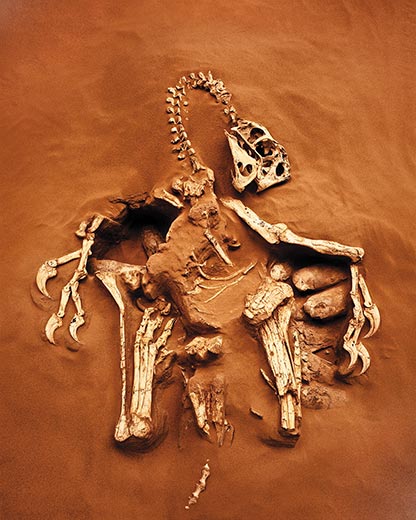
The name Rinchenia was coined for this new genus by Barsbold in 1997, though he did not describe it in detail, and the name remained a nomen nudum until used by Osmólska et al. in 2004.


Osmólska, H., Currie, P. J., and Barsbold, R. 2004. "Oviraptorosauria." In: Weishampel, D.B., Dodson, P., and Osmólska, H. (eds.), The Dinosauria, Second Edition. California University Press, 165-183.

[Paleontology • 2001] Khaan mckennai • A new oviraptorids (Theropoda: Oviraptorosauria), upper Cretaceous Djadokhta Formation, Ukhaa Tolgod, Mongolia


Khaan mckennai Clark, Norell, & Barsbold, 2001

oviraptorid dinosaur that was found in the Djadochta Formation of Mongolia and lived in the Late Cretaceous Period (Campanian), 75 million years ago.

The genus name is derived from Mongol khaan, "lord" or "ruler". The specific name honours the paleontologist Malcolm Carnegie McKenna.


Clark, J.M., Norell, M.A., & Barsbold, R. 2001. Two new oviraptorids (Theropoda: Oviraptorosauria), upper Cretaceous Djadokhta Formation, Ukhaa Tolgod, Mongolia. Journal of Vertebrate Paleontology 21(2): 209-213.

[Paleontology • 2001] Citipati osmolskae | 'Lord of the Funeral Pyre' • A new oviraptorids (Theropoda: Oviraptorosauria), upper Cretaceous Djadokhta Formation, Ukhaa Tolgod, Mongolia

reconstructed Citipati fossil from Mongolia with 20 eggs


 the skeleton of the Dinosaur Citipati preserved on a nest of eggs.
The eggs are arrayed in a circle under the skeleton and are about 18cm long.
Credit: Nature (December 1995) http://dx.doi.org/10.1038/378774a0

Egg Cetera #2: The answer to the riddle of which came first

Citipati osmolskae with chicks 


Citipati (Hindi, meaning 'funeral pyre lord') is a genus of oviraptorid theropod dinosaur from the Late Cretaceous Period of what is now Mongolia (specifically, the Djadokhta Formation of Ukhaa Tolgod, in the Gobi Desert). It is one of the best-known oviraptorids, thanks to a number of well-preserved skeletons, including several specimens found in brooding positions atop nests of eggs. These nesting specimens have helped to solidify the link between non-avian dinosaurs and birds.

Citipati osmolskae


Clark, J.M., Norell, M.A., & Barsbold, R. 2001. Two new oviraptorids (Theropoda: Oviraptorosauria), upper Cretaceous Djadokhta Formation, Ukhaa Tolgod, Mongolia. Journal of Vertebrate Paleontology 21(2): 209-213.

Sunday, September 9, 2012

[Paleontology • 2007] มหากาฬ | Mahakala omnogovae • A basal dromaeosaurid from the Upper Cretaceous of Ömnögov, Mongolia; and Size Evolution preceding Avian Flight


Fossil evidence for changes in dinosaurs near the lineage leading to birds and the origin of flight has been sparse. A dinosaur from Mongolia represents the basal divergence within Dromaeosauridae. The taxon's small body size and phylogenetic position imply that extreme miniaturization was ancestral for Paraves (the clade including Avialae, Troodontidae, and Dromaeosauridae), phylogenetically earlier than where flight evolution is strongly inferred. In contrast to the sustained small body sizes among avialans throughout the Cretaceous Period, the two dinosaurian lineages most closely related to birds, dromaeosaurids and troodontids, underwent four independent events of gigantism, and in some lineages size increased by nearly three orders of magnitude. Thus, change in theropod body size leading to flight's origin was not unidirectional.


Artist's conception of Mahakala omnogovae
Remains of a petite dinosaur reveal that some of the ancestors of birds had already shrunk in size before flight evolved.


Turner, Alan H.; Pol, Diego; Clarke, Julia A.; Erickson, Gregory M.; and Norell, Mark. 2007. A basal dromaeosaurid and size evolution preceding avian flight. Science. 317 (5843): 1378–1381. doi:10.1126/science.1144066