Showing posts with label Permian. Show all posts

Thursday, September 3, 2026

[PaleoIchthyology • 2026] Nazaria limnica • A New deep bodied ray-finned fish (Osteichthyes: Actinopterygii) from the Permian Pedra do Fogo Formation (Northeastern Brazil) and its phylogenetic and paleogeographic affinities


Nazaria limnica
Richter, Cisneros, Kammerer, Pardo, Marsicano, Fröbisch, Smith & Angielczyk, 2026

Artwork by Juan C. Cisneros & Martha Richter

ABSTRACT
A deep bodied ray-finned fish is reported from Cisuralian lacustrine deposits of the Parnaíba Basin. Its ecological niche and systematic affinities are discussed, considering the paleogeographic distribution of selected Permo-Carboniferous deep bodied fishes from several separate sedimentary successions of western Gondwana. The occurrence of deep bodied fishes in the Parnaíba Basin mirrors the presence of a similarly shaped but less derived and distantly related taxon, Paranaichthys longianalis from the late Permian of the Paraná Basin of southern Brazil. The new taxon’s unique combination of characters includes an elongated pectoral fin; posteriorly inclined suspensorium; deep flank scales ornamented with fine vertical striae, tiny mandibular teeth and palatal crushing dental plates. It shares with Guildayichthys and Discoserra two preopercular bones, a supraorbital, and marginal teeth on the lower jaw. Phylogenetic analyses were performed based on two datasets. Dataset 1 included 53 characters coded for 26 deep bodied and fusiform fish fossils from Brazil, North America, China, South Africa, and Australia, with results indicating that is most closely related to the North American order Guildayichthyformes, known from marine rocks of Pennsylvanian age. Dataset 2 included 119 taxa coded for 293 characters. The two analyses place the new taxon as the sister group of a clade comprised of Blourugia and Paranaichthys. However, the results of the study of both datasets show a high degree of uncertainty about the interrelationships between the new taxon and other deep bodied Paleozoic fish species.

SYSTEMATIC PALEONTOLOGY
OSTEICHTHYES Huxley, 1880
ACTINOPTERYGII Cope, 1887

NAZARIA, gen. nov.
 
Etymology—Named after the municipality of Nazária in the State of Piauí, where the fossils were collected.

NAZARIA LIMNICA, gen. et sp. nov.

Etymology—Derives from the Greek epithet limne (‘lake’) a reference to the lacustrine paleoenvironment where the fishes lived.

Nazaria limnica, MAP PV1029 (holotype).
A, part; B, counterpart (reversed). The caudal and anal fins are not preserved in the holotype.
Abbreviations: vrs, ventral ridge scales.

Nazaria limnica, MAP PV1029 (holotype).
A, skull and anterior part of the trunk (dorsal crest not figured here); B, identification of skull bones as preserved in A and, augmented drawing of one of the anteriormost trunk scales, showing its vertical ornamental ridges and dorsal of the peg-and-socket articulation system. The hatched lines indicate uncertain bone boundaries.
Abbreviations: An, angular; a.In, anterior infraorbital; br, branchiostegal rays; Cl, cleithrum; Cla, clavicle; De, dentary; Dro, dorsal rostral; Dsp, dermosphenotic; Ent?, impression of an entopterygoid?; Ex, extrascapulars; Fr, frontal; Ju, jugal; mt, mandibular teeth; Mx, maxilla; Na, nasal; Op, operculum; Pa, parietal; Pmx-ant, premaxilla-antorbital; Pop1, preoperculum 1; Pop2, preoperculum 2; Psp, post-spiracular; Sco, scapulocoracoid; So, suborbitals; Sop, suboperculum; St, supratemporal; Su, supraorbital; Vo, vomer; VRo, ventral rostral.

 Nazaria limnica, MAP PV1029 (holotype).
A, detail of the mouth and surrounding region; B, details of the dentition.
 Abbreviations: maxt?, possible maxillary crushing teeth; mt, mandibular marginal teeth; Mx, maxilla; Vo, vomer (vomerine tooth plate).

Tentative reconstruction of the skull pattern and anteriormost flank scales of Nazaria limnica, based on MAP PV1029 (holotype), after rearrangement of some taphonomically dislocated bones (jugal, lachrymal and ventral preopercular). Short, dotted lines represent inferred bone limits (preoperculum, suboperculum, and ventral limit of the suprachleithrum). The inset features the skull sensorial line pattern.
Abbreviations: An, angular; a.In, anterior infraorbital; app, anterior process of parasphenoid; asp, posterior ascending process of parasphenoid; br, branchiostegal rays; Cl, cleithrum; Cla, clavicle; Dro, dorsal rostral; Dsp, dermosphenotic; Ent?, impression of an entopterygoid?; Ex, extrascapulars; Fr, frontal; Ju, jugal; Mx, maxilla; Na, nasal; Op, operculum; P1, pectoral fin; Pa, parietal; Par, parasphenoid; Pmx-ant, premaxilla-antorbital; Pop1, preoperculum 1; Pop2, preoperculum 2; Psp, post-spiracular; Sco, scapulocoracoid; So, suborbitals; Sop, suboperculum; sr, sclerotic ring; St, supratemporal; Su, supraorbital; Vo, vomer; Vro, ventral rostral.


Life reconstruction of Nazaria limnica, based on a composite rendering of characters observed on either the holotype, the paratype or both.
Art by Juan C. Cisneros based on Martha Richter reconstruction.

 
Martha Richter, Juan C. Cisneros, Christian F. Kammerer, Jason D. Pardo, Claudia A. Marsicano, Jörg Fröbisch, Roger M. H. Smith and Kenneth D. Angielczyk. 2026. A New deep bodied ray-finned fish (Osteichthyes/Actinopterygii) from the Permian Pedra do Fogo Formation (Northeastern Brazil) and its phylogenetic and paleogeographic affinities. Journal of Vertebrate Paleontology. e2697805. DOI: doi.org/10.1080/02724634.2026.2697805 [26 Aug 2026]

Tuesday, March 31, 2026

[Paleontology • 2026] Labyrinth Morphology of Eunotosaurus africanus in the Context of Semicircular Canal Shape Variation across Amniotes


 Eunotosaurus africanus with in-set labyrinth

in Evers, Panigot, Petermann, Rubidge, Bever et Lyson, 2026.
Life reconstruction by Andrey Atuchin.

Abstract
The Middle Permian reptile Eunotosaurus africanus is a key taxon for understanding reptile evolution because it has been proposed to be one of the earliest stem turtles, but it could alternatively represent an early sauropsid. Alternative evolutionary interpretations are based on morphological character observations, and comparative anatomy of previously undocumented body parts may yield novel character evidence. Based on a previously unreported specimen of Eunotosaurus africanus, we provide descriptions of its inner ear anatomy, which we compare to a diversity of amniotes including turtles, millerettids and novel segmentations of Youngina capensis and Champsosaurus lindoei. The inner ear of Eunotosaurus africanus has plesiomorphic neodiapsid inner ear features that contrast with turtle ear morphology, including a radius of curvature of the anterior semicircular canal (ASC) that is larger than that of the posterior semicircular canal (PSC), narrow intercanal angles, slender vertical semicircular canals, and a bend in the central section of the PSC. Eunotosaurus africanus shares with turtles a large common crus cross-section and a thickened lateral semicircular canal. We provide a landmark-based comparison of amniote labyrinth shapes, which shows principal differences in the semicircular canals of birds, mammals and turtles as end members of a gradient of semicircular canal geometries. Other extant amniote groups (crocodiles, lepidosaurs), fossil lineages (e.g. sauropterygians, captorhinids, millerettids, younginiforms, varanopids, Eunotosaurus africanus) and stem lineages of extant groups (e.g. pterosaurs, non-avian dinosaurs, phytosaurs, other extinct pseudosuchians, mosasaurs, ‘pelycosaurs’, dicynodonts) show semicircular canal geometries that are generally intermediate between extreme shapes of birds, mammals and turtles, so that the entire morphospace shows gradational morphologies. The observed variation provides evidence of convergent evolution of labyrinth features, but also suggests phylogenetic signal is widespread in labyrinth morphology and that bird, mammal, and turtle labyrinth shapes may have evolved from a plesiomorphic shape that was retained in many reptilian stem lineages.

Keywords: neuroanatomy, inner ears, emicircular canal geometry, amniote phylogeny, turtle origins

Photographs of Eunotosaurus africanus (BP/1/7852). A, dorsal view. B, ventral view. Arabic numerals indicate position of vertebra or rib. Note that the spacing between pre- and postzygapophyses of dorsal vertebra seven in A demonstrates the elongate vertebral centra.
Abbreviations: cor, coracoid; cra, cranium; cvs, cervical vertebral series; d, dorsal vertebra; hu, humerus; icl, interclavicle; man, mandible; poz, postzygapophysis; prz, prezygapophysis; sc, scapula; tr, thoracic rib.


  Life reconstruction of Eunotosaurus africanus with in-set labyrinth
reconstruction by Andrey Atuchin.

 
Serjoscha W. Evers, Eldon Panigot, Holger Petermann, Bruce S. Rubidge, Gabriel S. Bever and Tyler R. Lyson. 2026. Labyrinth Morphology of Eunotosaurus africanus in the Context of Semicircular Canal Shape Variation across Amniotes. Journal of Systematic Palaeontology. 24(1); 2634330. DOI: doi.org/10.1080/14772019.2026.2634330   [30 Mar 2026]

Tuesday, March 10, 2026

[Paleontology • 2026] Tanyka amnicola • An aberrant Stem Tetrapod from the early Permian of Brazil


Tanyka amnicola
 Pardo, Marsicano, Smith, Cisneros, Angielczyk, Fröbisch, Kammerer & Richter, 2026
 
Illustration by Vitor Silva

Abstract
Early evolutionary history of tetrapods is typically divided into two major phases: an initial diversification of archaic stem tetrapod groups, and a sudden replacement by temnospondyl amphibians and amniotes following a late Carboniferous dry interval termed the Carboniferous Rainforest Collapse (CRC). However, the degree to which this scenario applies to the early tetrapods of Gondwana is uncertain. Here, we report Tanyka amnicola, gen. et sp. nov., an archaic stem tetrapod from the early Permian of Brazil characterized by strong torsion of the mandibular ramus and a remarkable battery of enlarged denticles on a strongly arched coronoid. The new taxon is assigned to the tetrapod stem based on the presence of a denticulate adsymphyseal and elevated hook-like glenoid surface without a postglenoid area. Phylogenetic analysis shows affinities between this species and stem tetrapods more proximal to the tetrapod crown group, particularly Eucritta and the Laurussian baphetids. This is the second stem tetrapod group known to have survived until the end of the early Permian in Gondwana despite local extirpation in Laurussia, implying that current hypotheses of Carboniferous tetrapod turnover are oversimplified. The unique jaw morphology suggests adaptations to either specialized processing of small invertebrates or consumption of some plant material, demonstrating that stem tetrapods continued to explore new niche space into the Permian of Gondwana.

Keywords: Permian, Tetrapoda, palaeobiogeography

Holotype jaw of Tanyka amnicola, MAP-PV 662.
(a) MAP-PV 662 in dorsal view; (b) interpretive drawing of MAP-PV 662 in dorsal view;
(c) MAP-PV 662 in ventral view; (d) interpretive drawing of MAP-PV 662 in ventral view.
adsym, adsymphyseal; an, angular; ar, articular; c1, first coronoid; c2, second coronoid; c3, third coronoid; ct, foramen for chorda tympani; d, dentary; laf, lateral angular flange; Mf, Meckelian fenestra; par, prearticular; pMf, pre-Meckelian foramina; pspl, postsplenial, sa, surangular; sfp, symphyseal fang pair of dentary; spl, splenial.

Tetrapodamorpha Ahlberg, 1991

Tanyka amnicola gen. et sp. nov.

Holotype. MAP-PV 662, nearly complete left mandible. Accessioned at Museu de Arqueologia e Paleontologia (MAP) at Universidade Federal do Piauí, Teresina, Brazil.

Type locality and horizon. Pedra de Fogo riverbank, MAP locality PB 156, south of Pastos Bons, Maranhão, lower Pedra de Fogo Formation, early Permian.

 
Etymology. Guarani: tañykã, meaning ‘jaw’ or ‘chin’, and Latin: amnicola, meaning ‘living in or next to the river’ the latter being a reference both to the river bed in Pastos Bons where the holotype was found and also to the presumed aquatic habits of the stem tetrapod.

Diagnosis. Stem tetrapod of moderate size. Adsymphyseal and all coronoids covered in a thickly ankylosed and arched denticle pad much wider than the tooth row. Occlusal surface of jaw, including coronoid denticle plate, faces more labially than dorsally when jaw is in neutral position. Ventral margin of jaw ramus wider than dentary-coronoid area. Angular with prominent sculptured flange. Prearticular braces articular medially with a large triangular process. Meckelian foramen small (less than one-third the depth of the prearticular).

Jaw rotation during mandibular adduction in Tanyka.
(a) Jaw in closed position, lateral view; (b) jaw in closed position, anterior view;
(c) jaw in open position, lateral view; (d) jaw in open position, anterior view.
General skull shape speculative, based on Baphetes

Illustration showing Tanyka amnicola in life, eating underwater plants.
 Artwork: Vitor Silva
 

Jason D. Pardo; Claudia A. Marsicano; Roger Smith; Juan Carlos Cisneros; Kenneth D. Angielczyk; Jörg Fröbisch; Christian F. Kammerer; Martha Richter. 2026. An aberrant Stem Tetrapod from the early Permian of Brazil. Proc Biol Sci. 293 (2066): 20252106. DOI: doi.org/10.1098/rspb.2025.2106 [04 Mar 2026]
  

Saturday, June 14, 2025

[Paleontology • 2025] Yinshanosaurus angustus • The Tetrapod Fauna of the upper Permian Naobaogou Formation of China: A New mid-sized pareiasaur and its implications for the phylogenetic relationships of pareiasaurs


Yinshanosaurus angustus
Yi & Liu, 2025 


Abstract
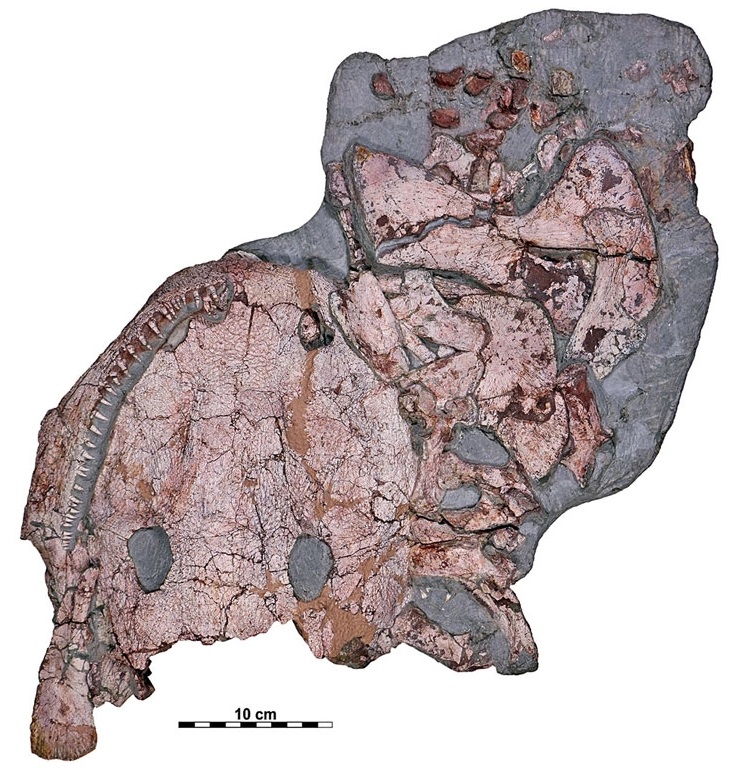
Pareiasauria are a specialized clade of herbivorous tetrapods that existed throughout Pangaea during the middle–late Permian period. The phylogenetic relationships of Chinese pareiasaur species have remained controversial for several decades, primarily due to the poor preservation of the known specimens. For example, until the report of Shihtienfenia completus in 2019, no complete skull had been documented for Chinese pareiasaurs. The present study describes a mid-sized pareiasaur, Yinshanosaurus angustus gen. et sp. nov., based on a nearly complete skull and an articulated partial postcranial skeleton collected from the Naobaogou Formation in 2018. It presents several significant new morphological features such as the narrowest skull of all pareiasaurs, with skull length more than twice skull width at the lateral edges of the cheeks (quadratojugals), a forked nasal posterior projection, a notch on the tabular posterior margin, and a unique combination of characters: U-shaped paraoccipital process, snout as wide as high, long frontal with a length-to-width ratio greater than 2.0, and maxillary teeth oriented vertically. Although the phylogenetic framework of pareiasaurs still requires further refinement, the current analysis yields three distinct phylogenetic positions for the Chinese pareiasaurs and establishes a new clade including S. completus and Y. angustus.

Keywords: late Permian, Naobaogou Formation, Pareiasauria, phylogeny


Yinshanosaurus angustus gen. et sp. nov.


Jian Yi and Jun Liu. 2025. The Tetrapod Fauna of the upper Permian Naobaogou Formation of China: A New mid-sized pareiasaur Yinshanosaurus angustus and its implications for the phylogenetic relationships of pareiasaurs. Papers in Palaeontology. 11(3); e70020. DOI: doi.org/10.1002/spp2.70020 [04 June 2025]

Wednesday, May 28, 2025

[Paleontology • 2025] The neodiapsid Thadeosaurus colcanapi (Diapsida: Tangasauridae) from the upper Permian of Madagascar


Thadeosaurus colcanapi Carroll 1981 (Madagascar, upper Permian),
life reconstruction in riparian environment rich in Glossopteris

in Buffa, Jalil, Falconnet et Vincent, 2025.
Reconstruction by S. Fernandez (MNHN)

Abstract
The enigmatic neodiapsid Thadeosaurus colcanapi (Lower Sakamena Formation, southwestern Madagascar), sole species of the genus Thadeosaurus, is revised here. The attribution of 12 of the 21 referred specimens is confirmed, spanning all ontogenetic stages, and the anatomy of Thadeosaurus is redescribed in detail with comments on ontogenetical differences. This new anatomical information is included in an expanded phylogenetical dataset tailored to examine the relationships of Permo-Triassic diapsids. A stem-saurian neodiapsid position is confirmed here for all ‘younginiforms’, which are here recovered paraphyletic, with Youngina representing an earlier-diverging taxon. However, this topology is extremely labile, and the monophyly or paraphyly of ‘younginiforms’ could not be unequivocally supported. In contrast, our analyses provide good support for a monophyletic Tangasauridae including all other ‘younginiforms’. Thadeosaurus is here recovered as a member of the Tangasauridae and as the sister-group to the putative semi-aquatic Tangasaurinae with a moderate degree of support, despite the large amounts of missing data in lesser-known tangasaurids partially obscuring our understanding of tangasaurid interrelationships. Last, Thadeosaurus is considered to have inhabited a nearshore, probably riparian, environment, although it remains unclear whether it was semi-aquatic or fully terrestrial. Further examinations of lesser-known tangasaurids, as well as a novel morphotype identified here in the Lower Sakamena Formation of Madagascar, could provide new evidence to deepen our understanding of the evolution and palaeoecology of the Tangasauridae.

Keywords: Tangasauridae, Thadeosaurus, phylogeny, Neodiapsida, late Permian, Madagascar


Thadeosaurus colcanapi Carroll 1981 (Madagascar, upper Permian), holotype MNHN.F.MAP360a, b.
A, MNHN.F.MAP360a, dorsal surface of individual preserved as a natural mould. B, silicone cast of A.
C, MNHN.F.MAP360b, ventral surface of individual preserved as a natural mould. D, silicone cast of C.
Scale bars represent 5 cm.

Thadeosaurus colcanapi Carroll 1981 (Madagascar, upper Permian), late subadult (MNHN.F.MAP349a) and adult (MNHN.F.MAP318a, MNHN.F.MAP341) specimens.
A, MNHN.F.MAP349a, ventral surface of individual preserved as a natural mould. B, silicone cast of A.
 C, MNHN.F.MAP318a, ventral surface of individual preserved as a natural mould; note the presence of a Glossopteris leaf overlying the left hindlimb of the individual. D, silicone cast of C.
E, MNHN.F.MAP341, ventral surface of individual preserved as a natural mould. F, silicone cast of E.
Scale bars represent 5 cm.

SYSTEMATIC PALAEONTOLOGY
REPTILIA Laurenti 1768 sensu Modesto & Anderson 2004
DIAPSIDA Osborn 1903
NEOREPTILIA Ford & Benson 2020
NEODIAPSIDA Benton 1985 sensu Reisz et al. (2011a)

Family TANGASAURIDAE Piveteau 1926

Genus Thadeosaurus Carroll 1981
 
Thadeosaurus colcanapi Carroll 1981

Diagnosis: 
Differs from other tangasaurids in the following combination of characters (states indicated in brackets, and ‘*’ indicating unambiguous apomorphies recovered in Analysis U2): transverse flange of pterygoid edentulous (138:0)*; basipterygoid processes oriented laterally (166:1)*; ribs fused to costal facets in posterior dorsal vertebrae (273:1); ectepicondylar foramen fully enclosed by well-developed supinator process (319:2; shared with Hovasaurus boulei); proximal margin of entepicondyle roughly perpendicular to main axis of bone, resulting in angular entepicondyle (323:1; shared with Tangasaurinae); bulbous rugosity on supra-acetabular crest immediately dorsal to acetabulum (352:2)*; internal trochanter convergent with proximal femoral head (360:0)*; epipophyses above postzygapophyses of dorsal vertebrae (406:1)*; caudal pleurapophyses laterally expanded (409:1; shared with Tangasaurinae); pisiform notched distally (419:1)*.
...


Thadeosaurus colcanapi Carroll 1981 (Madagascar, upper Permian), life reconstruction in riparian environment rich in Glossopteris (a leaf of which is present on MNHN.F.MAP318a)
Reconstruction by S. Fernandez (MNHN)


Valentin Buffa, Nour-Eddine Jalil, Jocelyn Falconnet and Peggy Vincent. 2025. The neodiapsid Thadeosaurus colcanapi from the upper Permian of Madagascar. Papers in Palaeontology.  11(2); e70008. DOI: doi.org/10.1002/spp2.70008 [23 March 2025]
  x.com/ThePalAss/status/1904203598285672569

Wednesday, March 5, 2025

[Paleontology • 2025] The Ecology and Geography of Temnospondyl Recovery after the Permian–Triassic Mass Extinction


 Temnospondyls of the Triassic.

in Mehmood, Singh, Elsler et Benton, 2025. 
artwork by Mark P. Witton  

Abstract
One of the mysteries of the Permian–Triassic mass extinction was the subsequent success of temnospondyls. Temnospondyls were key early tetrapods in the Carboniferous and Permian and hardly seem to be ideal pioneers in a tough post-extinction world. Did they survive because of some unusual adaptations or by occupying some limited part of the world? We explore temnospondyl success in the Triassic by comparing their functional ecomorphology and palaeogeographic distributions. We find that Early Triassic temnospondyls exhibited all skull sizes and shapes, reflecting a wide diversity of feeding modes: abundant parabolic-snouted forms, and less common longirostrine (long-snouted) and insectivorous (short-skulled) forms. In fact, morphospace occupation by temnospondyls increased dramatically from Late Permian to Early Triassic, and then decreased in the Middle Triassic, but without emphasis on one feeding mode or another. Nor is there any evidence for unusual patterns of evolution: Temnospondyli and subclade Trematosauria follow an Ornstein–Uhlenbeck evolutionary model, suggesting evolution towards a common skull shape. Metoposauroidea, Brachyopoidea and basal Stereospondyli evolved by the stasis model. Further, these Early Triassic temnospondyls did not occupy a limited part of the world; they show temperate distributions, but with some specimens in equatorial regions, contradicting the idea of a permanently impermeable tropical dead zone.

Keywords: geometric morphometrics, ecological function, temnspondyli, Triassic, Permian–Triassic mass extinction

 Temnospondyls of the Triassic.
(a) simplified phylogeny of the temnospondyl clades investigated here, with two paraphyletic assemblages, ’basal temnos’ and basal ’stereos’. Amphibamiformes are a clade within Dissorophoidea, comprising Micropholidae and Lissamphibia. Branches stemming from coloured nodes depict subclades of this node.
(b) three functional groupings based on skull morphology: large parabolic skulls characteristic of generalists such as extant crocodilians; generalist insectivore with short and wide skulls as in modern frogs; and longirostrine, adapted for fast, weak bites usually in fish eating, as in modern gharials.
Abbreviations: Stereo., Sterospondyli; Temno., Temnospondyli.
Silhouette images from Phylopic (https://www.phylopic.org: Dmitry Bogdanov (Metoposaurus, Lydekkerina, Batrachosuchus, Pelorocephalus, Trematosaurus) all CC0 3.0; Steven Traver (Dendrobates) CC0 1.0). Nix Draws Stuff/Nix illustration (Eryops) CC0 4.0. Silhouette images from Wikimedia Commons (https://commons.wikimedia.org: Smokeybjb (Eolydekkerina magna, Deltasaurus kimberleyensis); Nobu Tamura (Gerrothorax BW and Wetlugasaurus BW) all CC0 3.0). Vector graphics: Mike Prince (Gharial) CC0 2.0; Momotarou, 2012 (Andrias japonicus) CC0 3.0; CDC (African Dwarf Frog) Public Domain. Skull Graphics vectorized by AM; Aphaneramma [Fortuny, et al. 2018]; Cyclotosaurus [Schoch & Milner, 2014] and Triadobatrachus [Ascarrunz, et al. 2016].


  Mastodonsaurus vs. Jaxtasuchus

artwork by Mark P. Witton  


Aamir Mehmood, Suresh A. Singh, Armin Elsler and Michael J. Benton. 2025. The Ecology and Geography of Temnospondyl Recovery after the Permian–Triassic Mass Extinction. R. Soc. Open Sci. 12: 241200. DOI: doi.org/10.1098/rsos.241200 [05 March 2025]

Amphibians bounce-back from Earth’s greatest mass extinction

Ancient frog relatives survived the aftermath of the largest mass extinction of species by feeding on freshwater prey that evaded terrestrial predators, University of Bristol academics have found.
In the study, published today in the journal Royal Society Open Science, their findings suggest the amphibians’ success lay in their generalist feeding ecology, enabling them to feed on a wide variety of prey despite the array of environmental changes happening all around them through the Triassic.
...

Saturday, December 21, 2024

[Paleontology • 2024] Early–middle Permian Mediterranean gorgonopsian suggests an equatorial origin of therapsids

a gorgonopsian from the island of Mallorca, western Mediterranean

in Matamales-Andreu, Kammerer, Angielczyk, Simões, Mujal, Galobart et Fortuny, 2024.  
Reconstruction by Henry Sutherland Sharpe

Abstract
Therapsids were a dominant component of middle–late Permian terrestrial ecosystems worldwide, eventually giving rise to mammals during the early Mesozoic. However, little is currently known about the time and place of origin of Therapsida. Here we describe a definitive therapsid from the lower–?middle Permian palaeotropics, a partial skeleton of a gorgonopsian from the island of Mallorca, western Mediterranean. This specimen represents, to our knowledge, the oldest gorgonopsian record worldwide, and possibly the oldest known therapsid. Using emerging relaxed clock models, we provide a quantitative timeline for the origin and early diversification of therapsids, indicating a long ghost lineage leading to the evolutionary radiation of all major therapsid clades within less than 10 Myr, in the aftermath of Olson’s Extinction. Our findings place this unambiguous early therapsid in an ancient summer wet biome of equatorial Pangaea, thus suggesting that the group originated in tropical rather than temperate regions.

Systematic palaeontology
Synapsida Osborn, 190313
Therapsida Broom, 190514

Gorgonopsia Seeley, 189415
Gorgonopsia indet.

Most relevant elements of DA21/17-01-01 and silhouette showing their positions


 Life reconstruction of the gorgonopsian from Mallorca in a floodplain setting.
Reconstruction by Henry Sutherland Sharpe


 Rafel Matamales-Andreu, Christian F. Kammerer, Kenneth D. Angielczyk, Tiago R. Simões, Eudald Mujal, Àngel Galobart and Josep Fortuny. 2024. Early–middle Permian Mediterranean gorgonopsian suggests an equatorial origin of therapsids. Nature Communications. 15: 10346. DOI: doi.org/10.1038/s41467-024-54425-5  

Saturday, August 3, 2024

[Paleontology • 2024] Cranial Anatomy and Phylogenetic Affinities of Bolosaurus major, with new information on the unique bolosaurid feeding apparatus and evolution of the impedance-matching ear


Bolosaurus major

in Jenkins, Foster, Napoli, Meyer, Bever et Bhullar, 2024. 

Abstract
Resolving the phylogenetic relationships of early amniotes, in particular stem reptiles, remains a difficult problem. Three-dimensional morphological analysis of well-preserved stem-reptile specimens can reveal important anatomical data and clarify regions of phylogeny. Here, we present the first thorough description of the unusual early Permian stem reptile Bolosaurus major, including the first comprehensive description of a bolosaurid braincase. We describe previously obscured details of the palate, allowing for insight into bolosaurid feeding mechanics. Aspects of the rostrum, palate, mandible, and neurocranium suggest that B. major had a particularly strong bite. We additionally found B. major has a surprisingly slender stapes, similar to that of the middle Permian stem reptile Macroleter poezicus, which may suggest enhanced hearing abilities compared to other Paleozoic amniotes (e.g., captorhinids). We incorporated our new anatomical information into a large phylogenetic matrix (150 OTUs, 590 characters) to explore the relationship of Bolosauridae among stem reptiles. Our analyses generally recovered a paraphyletic “Parareptilia,” and found Bolosauridae to diverge after Captorhinidae + Araeoscelidia. We also included B. major within a smaller matrix (10 OTUs, 27 characters) designed to explore the interrelationships of Bolosauridae and found all species of Bolosaurus to be monophyletic. While reptile relationships still require further investigation, our phylogeny suggests repeated evolution of impedance-matching ears in Paleozoic stem reptiles.

Keywords: amniote, fossil, hearing, Paleozoic, reptile


Kelsey M. Jenkins, William Foster, James G. Napoli, Dalton L. Meyer, Gabriel S. Bever and Bhart-Anjan S. Bhullar. 2024. Cranial Anatomy and Phylogenetic Affinities of Bolosaurus major, with new information on the unique bolosaurid feeding apparatus and evolution of the impedance-matching ear. The Anatomical Record. DOI: doi.org/10.1002/ar.25546 

Thursday, July 4, 2024

[Paleontology • 2024] Gaiasia jennyae • Giant stem Tetrapod was Apex Predator in Gondwanan late Palaeozoic Ice Age


Gaiasia jennyae
Marsicano, Pardo, Smith, Mancuso, Gaetano & Mocke, 2024


Abstract
Current hypotheses of early tetrapod evolution posit close ecological and biogeographic ties to the extensive coal-producing wetlands of the Carboniferous palaeoequator with rapid replacement of archaic tetrapod groups by relatives of modern amniotes and lissamphibians in the late Carboniferous (about 307 million years ago). These hypotheses draw on a tetrapod fossil record that is almost entirely restricted to palaeoequatorial Pangea (Laurussia). Here we describe a new giant stem tetrapod, Gaiasia jennyae, from high-palaeolatitude (about 55° S) early Permian-aged (about 280 million years ago) deposits in Namibia that challenges this scenario. Gaiasia is represented by several large, semi-articulated skeletons characterized by a weakly ossified skull with a loosely articulated palate dominated by a broad diamond-shaped parasphenoid, a posteriorly projecting occiput, and enlarged, interlocking dentary and coronoid fangs. Phylogenetic analysis resolves Gaiasia within the tetrapod stem group as the sister taxon of the Carboniferous Colosteidae from Euramerica. Gaiasia is larger than all previously described digited stem tetrapods and provides evidence that continental tetrapods were well established in the cold-temperate latitudes of Gondwana during the final phases of the Carboniferous–Permian deglaciation. This points to a more global distribution of continental tetrapods during the Carboniferous–Permian transition and indicates that previous hypotheses of global tetrapod faunal turnover and dispersal at this time must be reconsidered.


Claudia A. Marsicano, Jason D. Pardo, Roger M. H. Smith, Adriana C. Mancuso, Leandro C. Gaetano  and Helke Mocke. 2024. Giant stem Tetrapod was Apex Predator in Gondwanan late Palaeozoic ice age. Nature.  DOI: 10.1038/s41586-024-07572-0


Tuesday, January 16, 2024

[Paleontology • 2024] Stenokranio boldi • A New eryopid temnospondyl (Temnospondyli: Eryopidae) from the Carboniferous–Permian Boundary of Germany


Stenokranio boldi
 Werneburg, Witzmann, Rinehart, Fischer & Voigt, 2024


Abstract
A new eryopid temnospondyl, Stenokranio boldi n. gen. n. sp. is described based on well-preserved cranial and postcranial material from fluvio-lacustrine deposits of the Permo-Carboniferous (Gzhelian/Asselian) Remigiusberg Formation at the Remigiusberg quarry near Kusel, Saar–Nahe Basin, southwest Germany. The new taxon is characterized by three autapomorphies within the Eryopidae: (1) the relatively narrow posterior skull table, therefore nearly parallel lateral margins of the skull; (2) the short postparietals and tabulars; and (3) the wide ectopterygoid. Phylogenetic analysis reveals a monophyletic Eryopidae with the basal taxa Osteophorus, Glaukerpeton, and Onchiodon labyrinthicus forming a polytomy. Actinodon may be either a basal eryopid or a stereospondylomorph, and the genus Onchiodon is not monophyletic. Stenokranio n. gen. is found as a more derived eryopid forming the sister taxon to Eryops. Stenokranio n. gen. was among the largest predators of the Saar–Nahe Basin. Its semiaquatic lifestyle enabled Stenokranio n. gen. to browse riverbanks and lake shorelines for prey, but most likely it fed on aquatic vertebrates. Stenokranio n. gen. was part of a faunal assemblage of aquatic, semiaquatic, and fully terrestrial vertebrates, such as sarcopterygian and actinopterygian fishes, xenacanthid sharks, a dvinosaurian temnospondyl, different “lepospondyls”, diadectomorphs, and synapsids. This is in general accordance with the vertebrate community from the Permo-Carboniferous of North America and from the early Permian localities of Manebach (Thuringian Forest Basin) and Niederhäslich (Döhlen Basin). It is notable that the occurrence of Stenokranio n. gen. and other eryopids in these localities excluded the presence of other large temnospondyls such as Sclerocephalus. However, a previously described isolated eryopid mandible from the Remigiusberg locality differs from that of Stenokranio n. gen. in several characters, implying that probably two different eryopid taxa lived at the same locality.
 
Stenokranio boldi n. gen. n. sp., skull with mandibles and anterior postcranial skeleton, paratype NHMMZ/LS PW 2019/5022.
Dorsal skull roof with left mandible, shoulder girdle, and anterior axial skeleton

Systematic paleontology

Tetrapoda Jaekel, 1909
Amphibia Linneaus, 1758
Temnospondyli von Zittel, 1888
Eryopidae Cope, 1882

Stenokranio new genus
 
Etymology: Greek στενός (stenos) for narrow, κρανίο (kranio) for skull.

Stenokranio boldi new species

Etymology: The species name honors the late Rudolf Bold from Rammelsbach near Kusel who found the holotype and only known specimen of the Remigiusberg sphenacodontid Cryptovenator hirschbergeri Fröbisch et al., 2011, in 2002.


Ralf Werneburg, Florian Witzmann, Larry Rinehart, Jan Fischer and Sebastian Voigt. 2024. A New eryopid temnospondyl from the Carboniferous–Permian Boundary of Germany. Journal of Paleontology. FirstView. pp. 1 - 31. DOI: 10.1017/jpa.2023.58


Wednesday, October 25, 2023

[Paleontology • 2023] Samsarasuchus pamelae • A New archosauriform Species (Archosauriformes: Proterosuchidae) from the Panchet Formation of India and the Diversification of Proterosuchidae after the end-Permian Mass Extinction


Samsarasuchus pamelae 
Ezcurra, Bandyopadhyay, Sengupta, Sen, Sennikov, Sookias, Nesbitt & Butler, 2023

artwork: Gabriel Lio

Abstract
Proterosuchidae represents the oldest substantial diversification of Archosauromorpha and plays a key role in understanding the biotic recovery after the end-Permian mass extinction. Proterosuchidae was long treated as a wastebasket taxon, but recent revisions have reduced its taxonomic content to five valid species from the latest Permian of Russia and the earliest Triassic (Induan) of South Africa and China. In addition to these occurrences, several isolated proterosuchid bones have been reported from the Induan Panchet Formation of India for over 150 years. Following the re-study of historical specimens and newly collected material from this unit, we erect the new proterosuchid species Samsarasuchus pamelae, which is represented by most of the presacral vertebral column. We also describe cf. proterosuchid and proterosuchid cranial, girdle and limb bones that are not referred to Samsarasuchus pamelae. Phylogenetic analyses recovered Samsarasuchus pamelae within the new proterosuchid clade Chasmatosuchinae. The taxonomic diversity of Proterosuchidae is substantially expanded here, with at least 11 nominal species and several currently unnamed specimens, and a biogeographical range encompassing present-day South Africa, China, Russia, India, Brazil, Uruguay and Australia. This indicates a broader taxonomic, phylogenetic and biogeographic diversification of Proterosuchidae than previously thought in the aftermath of the end-Permian mass extinction.

Keywords: phylogeny, biogeography, Proterosuchidae, Archosauromorpha, Induan, Mesozoic
 

Diapsida Osborn, 1903
Archosauromorpha von Huene, 1946
Archosauriformes Gauthier, Kluge & Rowe, 1988
Proterosuchidae von Huene, 1908 sensu Ezcurra, Butler & Gower, 2013

Chasmatosuchinae nov.
 
 Phylogenetic definition: The most inclusive clade containing Chasmatosuchus rossicus von Huene, 1940, but not Proterosuchus fergusi Broom, 1903, ‘Chasmatosaurus’ yuani Young, 1936, Proterosuchus alexanderi (Hoffman, 1965), Proterosuchus goweri Ezcurra & Butler, 2015, Erythrosuchus africanus Broom, 1905, or Alligator mississippiensis Daudin, 1802. This is a maximum clade definition.

   Composition: The composition is based on the reference phylogeny. Chasmatosuchinae includes Chasmatosuchus rossicus, Jaikosuchus magnus, Samsarasuchus pamelae, Archosaurus rossicus, Gamosaurus lozovskii, Tsylmosuchus spp., Vonhuenia friedrichi and indeterminate specimens from the Arcadia Formation and Bulgo Sandstone of the Sydney Basin of Australia and the Sanga do Cabral Formation of Brazil.

 Diagnosis: Chasmatosuchines differ from other proterosuchids in the presence of anterior–middle and sometimes posterior postaxial cervical vertebrae with distally restricted transverse expansion of the neural spines (not mammillary process); third to eighth or ninth presacral vertebrae with diagonal, anterodorsally-to-posteroventrally oriented ridge that reaches the base of the prezygapophysis and is not connected to the diapophysis on the lateral surface of the neural arch; fourth to eight presacral vertebrae with posterior expansion of the dorsal portion of the neural spine, resulting in a posterodorsally tilted posterior margin set at an angle higher than 15° with respect to the anterior margin of the neural spine in lateral view; ninth presacral centrum with a ventral keel and anterior caudal vertebrae with surface lateral to the base of the neural spine with a very deep fossa, well-defined laterally and that transversely constricts the anterior half of the neural spine.

  Geographical and stratigraphic occurrence of specimens of Samsarasuchus pamelae gen. et sp. nov. and Panchet cf. proterosuchid and proterosuchid specimens.
(a) Gondwana basins of peninsular India showing the studied area of the Damodar Basin, which has yielded specimens of Samsarasuchus pamelae; (b) geological map showing the location of the Deoli locality that yielded Samsarasuchus pamelae bones discovered by the 2015 fieldtrip; (c) composite stratigraphic column of the Panchet Formation, including the occurrence of the Samsarasuchus pamelae bones discovered by the 2015 fieldtrip; (d) general overview of the sandstones of the Deoli locality on the shore of the Damodar River (January 2015); and (e) close up of the holotype of Samsarasuchus pamelae (ISIR 1091) as found in the field.


Samsarasuchus pamelae gen. et sp. nov.

Diagnosis: Samsarasuchus pamelae is a chasmatosuchine proterosuchid that differs from other non-archosaurian archosauriforms in the following autapomorphies (among non-archosaurian archosauriforms) present in its holotype (ninth cervical vertebra): posteriormost cervical vertebra (ninth cervical vertebra) with two pairs (i.e. four in total) of mammillary processes on the neural spine; and posteriormost cervical vertebra (ninth cervical vertebra) with dorsolaterally oriented mammillary processes on the anterior region of the neural spine. In addition, the holotype of Samsarasuchus pamelae and the other postaxial cervical and anterior–middle dorsal vertebrae referred to this species share the following unique combination of character states that allow the species to be distinguished from other non-erythrosuchid, non-eucrocopod archosauriform nominal species: third cervical to anterior dorsal vertebrae ....

Etymology: The genetic epithet is formed by the Sanskrit word ‘Saṁsāra’ (Samsara) that in Hinduism is related to the cycle of re-birth, existence and death, and ‘Σοῦχος’ (Suchus), which is the name of the Egyptian crocodile-headed deity Sebek or Sobek in ancient Greek, referring to the re-birth of ecosystems after the end-Permian mass extinction and the most common ending (-suchus) of archosauromorph genera. The specific epithet is for the first name of the British palaeontologist Pamela Lamplugh Robinson (1919–1994) in honour of her contributions to Indian vertebrate palaeontology and especially for having prompted a renewed interest in the vertebrate palaeontology of the Panchet Formation in the 1960s after a long gap in research since the end of the ninteenth century. In addition, Pamela Robinson led the fieldtrip that resulted in the discovery of several referred specimens of this new proterosuchid species (NHMUK collection).


Martín D. Ezcurra, Saswati Bandyopadhyay, Dhurjati P. Sengupta, Kasturi Sen, Andrey G. Sennikov, Roland B. Sookias, Sterling J. Nesbitt and Richard J. Butler. 2023. A New archosauriform Species from the Panchet Formation of India and the Diversification of Proterosuchidae after the end-Permian Mass Extinction. R. Soc. open sci. 10230387. DOI: 10.1098/rsos.230387