Showing posts with label Lamniformes. Show all posts

Sunday, November 23, 2025

[PaleoIchthyology • 2025] Pseudocorax heteroserratus • Pseudocorax (Chondrichthyes: Lamniformes: Pseudocoracidae) in the Upper Maastrichtian Phosphates of Khouribga Province, Morocco


Pseudocorax heteroserratus
Egli, Goode, Rempert & Rego, 2025


Abstract
A new species of Pseudocorax (Lamniformes, Pseudocoracidae), Pseudocorax heteroserratus n. sp., is described from the upper Maastrichtian phosphates of Morocco. This novel taxon is recognized by a large sample of isolated teeth collected from the upper Couche III layer at the Sidi Chennane quarry in the Oulad Abdoun Basin, Khouribga Province, Morocco. P. heteroserratus is differentiated from other Pseudocorax species by bearing a mesiodistally elongated tooth base, broad crown, and highly variable serrations. The variability in number and extent of serrations along the carinae ranges from completely absent to fully serrated and finely to coarsely serrated, raising speculation on broader Pseudocorax phylogenetics and as to whether the genesis of serrations within Pseudocorax occurred in a singular progressive event or rather from two distinct events. The morphological variability within the new species highlights the importance of large sample sizes in selachian odontological studies using isolated teeth.

Systematic paleontology
Class Chondrichthyes Huxley, Reference Huxley, 1880
Subclass Elasmobranchii Bonaparte, Reference Bonaparte, 1838

Cohort Euselachii Hay, Reference Hay, 1902
Subcohort Neoselachii Compagno, Reference Compagno, 1977

Order Lamniformes Berg, Reference Berg, 1958
Family Pseudocoracidae Cappetta, Reference Cappetta, 2012

Genus Pseudocorax Priem, Reference Priem, 1897

Type species: Pseudocorax affinis (Münster in Agassiz, Reference Agassiz1843), from the upper Maastrichtian, Netherlands.

 Upper anterior Pseudocorax heteroserratus n. sp. 
 (1–5) MMNS VP-12820 (holotype), upper left anterior tooth in (1) lingual, (2) basal, (3) apical, (4) profile, and (5) labial views.
(6–10) MMNS VP-12827.01, upper left anterior tooth in (6) lingual, (7) basal, (8) apical, (9) profile, and (10) labial views. Scale bars = 5 mm.

Pseudocorax heteroserratus new species 

Diagnosis: Crown and tooth base mesiodistally expanded, especially along upper and lower jaw anterior teeth. Mesial shoulder generally more prominent along basal crown, extending further apically. Variable serrations, from absent to full and coarse to fine, regardless of jaw position or potential ontogenetic stage. Deep basal margin on tooth base with variable tooth base lobe morphology.

Occurrence: Upper Couche III layer of the Oulad Abdoun Basin, Sidi Chennane quarry, near Oued Zem, Khouribga Province, Morocco.
 
Etymology: “Hetero-”, Latin for “different”, and “serratus” for “serrations,” highlighting the variability in the presence and size of serrations along the crown.

 Upper lateroposterior Pseudocorax heteroserratus n. sp. teeth.
(1–5) MMNS VP-12823 (paratype), upper left lateroposterior tooth in (1) lingual, (2) basal, (3) apical, (4) profile, and (5) labial views. (6–10) MMNS VP-12827.05, (?) upper right lateroposterior tooth in (6) lingual, (7) basal, (8) apical, (9) profile, and (10) labial views.
(11–15) MMNS VP- 12827,06, (?) upper left lateroposterior tooth in (11) lingual, (12) basal, (13) apical, (14) profile, and (15) labial views. (16–20) MMNS VP-12827.07, upper left lateroposterior tooth in (16) lingual, (17) basal, (18) apical, (19) profile, and (20) labial views.
(21–25) MMNS VP-12827.08, upper right lateroposterior tooth in (21) lingual, (22) basal, (23) apical, (24) profile, and (25) labial views. (26–30) MMNS VP-12827.09, upper left lateroposterior tooth in (26) lingual, (27) basal, (28) apical, (29) profile, and (30) labial. Scale bars = 5 mm.


Hunter Chase Egli, Benjamin Goode, Trevor Rempert and Christopher Rego. 2025. Pseudocorax (Chondrichthyes, Lamniformes, Pseudocoracidae) in the Upper Maastrichtian phosphates of Khouribga Province, Morocco. Journal of Paleontology. Journal of Paleontology. DOI: doi.org/10.1017/jpa.2025.10183  [21 November 2025]
 
Non-technical Summary: A new species of extinct shark, Pseudocorax heteroserratus n. sp., has been identified through isolated teeth from fossil-rich Cretaceous rock in Morocco. Unlike previously known Pseudocorax species, this new species is distinguishable through its broad crown, elongated tooth base, and unusually variable serrations. These serrations range from unserrated to coarsely serrated and provide new insights into Pseudocorax evolutionary history. It raises the question of whether serrations in this lineage evolved gradually in a continuous process or from multiple independent origins. The findings of this study emphasize how large sample sizes of shark teeth are critical in palaeoichthyology, especially when species are known only from their teeth.

Thursday, October 16, 2025

[PaleoIchthyology • 2026] A large lamniform shark from the Aptian of Villa de Leiva (Boyacá, Colombia), based on the first Lower Cretaceous shark specimen preserving both teeth and vertebrae


 Protolamna ricaurtei  

in Benavides-Cabra, Páramo-Fonseca, Narváez-Rincón et Pomar, 2026. 
artwork by Renzo Garavito x.com/R_o_XIII

Highlights: 
• Protolamna ricaurtei was a gigantic lamniform shark that lived during the Early Cretaceous.
• Not all macrophagous lamniform sharks with large bodies have large teeth.
• Protolamna ricaurtei was a relatively slow but active swimmer who fed on small preys.

Abstract
We describe a new specimen of a lamniform shark from the upper Aptian of the Arcillolitas abigarradas Member of the Paja Formation of Villa de Leiva (Colombia). It represents the first lamniform shark specimen from the Lower Cretaceous with both teeth and vertebrae preserved. The specimen consists of several disarticulated but well-preserved teeth and well-preserved partially articulated vertebral centra, denticles and soft tissues. We refer the specimen to Protolamna ricaurtei, a species recently erected from a specimen found in the same formation. It is a lamniform shark characterized by proportionally small tearing-type teeth with small triangular main cusp, two pairs of small triangular lateral cusplets, and massive bilobated roots. The specimen represents a mature individual to be 6.65 m in total length, making it the oldest record of a gigantic lamniform. This specimen is the first evidence that not all macrophagous lamniforms follow the linear function relating crown height to total body length. Our taphonomic analysis indicates that the specimen must have rapidly reached an anoxic bottom, with low benthic activity, gentle currents, and with microbial mats that facilitated the rapid phosphatization of the soft tissues. Based on the preserved anatomy, we propose that Protolamna ricaurtei was a relatively slow but active swimmer feeding in tropical near-shore areas over small preys such as bony fishes, small sharks, squids, and crustaceans.

the taphonomic history of specimen CFSTA090318, from its sinking and burial to its fossilization, along with the remains of an associated turtle.
artwork by Renzo Garavito x.com/R_o_XIII

Protolamna ricaurtei 


Cristian D. Benavides-Cabra, María E. Páramo-Fonseca, José A. Narváez-Rincón and Daniel E. Pomar. 2026. A large lamniform shark from the Aptian of Villa de Leiva (Boyacá, Colombia), based on the first Lower Cretaceous shark specimen preserving both teeth and vertebrae. Cretaceous Research. 178, 106211. DOI: doi.org/10.1016/j.cretres.2025.106211 

Thursday, April 25, 2024

[PaleoIchthyology • 2024] Exceptionally preserved Shark Fossils from Mexico elucidate the Long-standing Enigma of the Cretaceous Elasmobranch Ptychodus (Lamniformes: Ptychodontidae)


 Ptychodus Agassiz, 1834

in Vullo, Villalobos-Segura, Amadori, Kriwet, Frey, González, Gutiérrez, Ifrim, Stinnesbeck et Stinnesbeck, 2024.
 
Abstract
The fossil fish Ptychodus Agassiz, 1834, characterized by a highly distinctive grinding dentition and an estimated gigantic body size (up to around 10 m), has remained one of the most enigmatic extinct elasmobranchs (i.e. sharks, skates and rays) for nearly two centuries. This widespread Cretaceous taxon is common in Albian to Campanian deposits from almost all continents. However, specimens mostly consist of isolated teeth or more or less complete dentitions, whereas cranial and post-cranial skeletal elements are very rare. Here we describe newly discovered material from the early Late Cretaceous of Mexico, including complete articulated specimens with preserved body outline, which reveals crucial information on the anatomy and systematic position of Ptychodus. Our phylogenetic and ecomorphological analyses indicate that ptychodontids were high-speed (tachypelagic) durophagous lamniforms (mackerel sharks), which occupied a specialized predatory niche previously unknown in fossil and extant elasmobranchs. Our results support the view that lamniforms were ecomorphologically highly diverse and represented the dominant group of sharks in Cretaceous marine ecosystems. Ptychodus may have fed predominantly on nektonic hard-shelled prey items such as ammonites and sea turtles rather than on benthic invertebrates, and its extinction during the Campanian, well before the end-Cretaceous crisis, might have been related to competition with emerging blunt-toothed globidensine and prognathodontine mosasaurs.

Keywords: Chondrichthyes, Lamniformes, Ptychodontidae, ecomorphology, Late Cretaceous, Vallecillo fossil Lagerstätte


Romain Vullo, Eduardo Villalobos-Segura, Manuel Amadori, Jürgen Kriwet, Eberhard Frey, Margarito A. González González, José M. Padilla Gutiérrez, Christina Ifrim, Eva S. Stinnesbeck and Wolfgang Stinnesbeck. 2024. Exceptionally preserved Shark Fossils from Mexico elucidate the Long-standing Enigma of the Cretaceous Elasmobranch Ptychodus.  Proc. R. Soc. B. 291: 20240262. DOI: 10.1098/rspb.2024.0262


Thursday, August 18, 2022

[PaleoIchthyology • 2022] The Extinct Shark Otodus megalodon was A Transoceanic Superpredator: Inferences from 3D Modeling


Otodus megalodon   

in Cooper, Hutchinson, Bernvi, et al. 2022. 

Abstract
Although shark teeth are abundant in the fossil record, their bodies are rarely preserved. Thus, our understanding of the anatomy of the extinct Otodus megalodon remains rudimentary. We used an exceptionally well-preserved fossil to create the first three-dimensional model of the body of this giant shark and used it to infer its movement and feeding ecology. We estimate that an adult O. megalodon could cruise at faster absolute speeds than any shark species today and fully consume prey the size of modern apex predators. A dietary preference for large prey potentially enabled O. megalodon to minimize competition and provided a constant source of energy to fuel prolonged migrations without further feeding. Together, our results suggest that O. megalodon played an important ecological role as a transoceanic superpredator. Hence, its extinction likely had large impacts on global nutrient transfer and trophic food webs.


Jack A. Cooper, John R. Hutchinson, David C. Bernvi, Geremy Cliff, Rory P. Wilson, Matt L. Dicken, Jan Menzel, Stephen Wroe, et al. 2022. The Extinct Shark Otodus megalodon was A Transoceanic Superpredator: Inferences from 3D Modeling.  SCIENCE ADVANCES. 8(33); DOI: 10.1126/sciadv.abm9424
 twitter.com/PimientoGroup/status/1559964642595803136

Thursday, October 7, 2021

[PaleoIchthyology • 2021] Feeding Ecology has shaped the Evolution of Modern Sharks


in Bazzi, Campione, ... et Ahlberg, 2021. 

Highlights: 
• Shark tooth morphologies track changing habitats and resource availability
• Tooth shape correlates with diet in extant shark species
• Declines in lamniform disparity can be linked with dietary “specialization”
• Modern lamniforms are more disparate than coeval carcharhiniforms

Summary
Sharks are iconic predators in today’s oceans, yet their modern diversity has ancient origins. In particular, present hypotheses suggest that a combination of mass extinction, global climate change, and competition has regulated the community structure of dominant mackerel (Lamniformes) and ground (Carcharhiniformes) sharks over the last 66 million years. However, while these scenarios advocate an interplay of major abiotic and biotic events, the precise drivers remain obscure. Here, we focus on the role of feeding ecology using a geometric morphometric analysis of 3,837 fossil and extant shark teeth. Our results reveal that morphological segregation rather than competition has characterized lamniform and carcharhiniform evolution. Moreover, although lamniforms suffered a long-term disparity decline potentially linked to dietary “specialization,” their recent disparity rivals that of “generalist” carcharhiniforms. We further confirm that low eustatic sea levels impacted lamniform disparity across the end-Cretaceous mass extinction. Adaptations to changing prey availability and the proliferation of coral reef habitats during the Paleogene also likely facilitated carcharhiniform dispersals and cladogenesis, underpinning their current taxonomic dominance. Ultimately, we posit that trophic partitioning and resource utilization shaped past shark ecology and represent critical determinants for their future species survivorship.
 
Keywords: Lamniformes, Carcharhiniformes, geometric morphometrics, dental disparity, feeding ecology, environmental change, ecomorphology


Lamniformes and Carcharhiniformes across the last 83 million years.
Illustration: José Vitor Silva


 Mohamad Bazzi, Nicolás E. Campione, Benjamin P. Kear, Catalina Pimiento and Per E. Ahlberg. 2021. Feeding Ecology has shaped the Evolution of Modern Sharks. Current Biology. In Press. DOI: 10.1016/j.cub.2021.09.028

In brief: Bazzi et al. analyze the evolution of lamniform and carcharhiniform shark over the last 83 Ma. These closely related clades are shown to have undergone marked morphological segregation, with a combination of habitat change, prey availability, and feeding strategies influencing their community composition, diversity, and ecology over time.


Friday, March 19, 2021

[PaleoIchthyology • 2021] Aquilolamna milarcae • Manta-like Planktivorous Sharks (Lamniformes: Aquilolamnidae) in Late Cretaceous Oceans


 Aquilolamna milarcae feeding on plankton in the Gulf of Mexico 93 million years ago.
 This newly described group of Late Cretaceous sharks (Aquilolamnidae) occupied the same ecological niche as Cenozoic devil and manta rays (Mobulidae), indicating that "winged" suspension feeders evolved independently in two distinct lineages of cartilaginous fishes before and after the end-Cretaceous crisis. 

 Vullo, Frey, Ifrim, González González, Stinnesbeck & Stinnesbeck, 2021
Illustration: Oscar Sanisidro

Abstract
The ecomorphological diversity of extinct elasmobranchs is incompletely known. Here, we describe Aquilolamna milarcae, a bizarre probable planktivorous shark from early Late Cretaceous open marine deposits in Mexico. Aquilolamna, tentatively assigned to Lamniformes, is characterized by hypertrophied, slender pectoral fins. This previously unknown body plan represents an unexpected evolutionary experimentation with underwater flight among sharks, more than 30 million years before the rise of manta and devil rays (Mobulidae), and shows that winglike pectoral fins have evolved independently in two distantly related clades of filter-feeding elasmobranchs. This newly described group of highly specialized long-winged sharks (Aquilolamnidae) displays an aquilopelagic-like ecomorphotype and may have occupied, in late Mesozoic seas, the ecological niche filled by mobulids and other batoids after the Cretaceous–Paleogene boundary.


Romain Vullo, Eberhard Frey, Christina Ifrim, Margarito A. González González, Eva S. Stinnesbeck and Wolfgang Stinnesbeck. 2021. Manta-like Planktivorous Sharks in Late Cretaceous Oceans. Science. 371(6535); 1253-1256. DOI: 10.1126/science.abc1490

Artist's view of three eagle sharks (Aquilolamna milarcae) feeding on plankton in the Gulf of Mexico 93 million years ago. This newly described group of Late Cretaceous sharks (Aquilolamnidae) occupied the same ecological niche as Cenozoic devil and manta rays (Mobulidae), indicating that "winged" suspension feeders evolved independently in two distinct lineages of cartilaginous fishes before and after the end-Cretaceous crisis.
Illustration: Oscar Sanisidro
 
A soaring shark
Modern sharks occupy marine ecosystems across the world but display little morphological diversity, being mostly streamlined predators. Vullo et al. describe a new species of shark from the late Cretaceous that shows that the lack of current variation is not due to limited morphological “exploration” in the past. Specifically, Aquilolamna milarcae displays many features similar to modern manta rays, notably long, slender fins and a mouth seemingly adapted to filter feeding, suggesting that it was planktivorous. This finding indicates both that elasmobranchs evolutionarily experimented with other forms and that the planktivorous “soarers” emerged in this group at least 30 million years earlier than previously recognized.
 

Wednesday, November 27, 2019

[PaleoIchthyology • 2019] Cretodus houghtonorum • A New Large Late Cretaceous Lamniform Shark from North America, with Comments on the Taxonomy, Paleoecology, and Evolution of the Genus Cretodus


  Cretodus houghtonorum
Shimada & Everhart, 2019


ABSTRACT
We describe a partial skeleton of the Late Cretaceous shark, Cretodus, collected from the Blue Hill Shale (middle Turonian) in north-central Kansas, U.S.A. It consists of 134 disarticulated teeth, 61 vertebrae, 23 placoid scales, and fragments of calcified cartilage. The scale morphology suggests that Cretodus was a rather sluggish shark, and the vertebral morphology affirms its placement into Lamniformes. With a strong tendency towards monognathic heterodonty, the dental morphology indicates that the specimen belongs to a new species, Cretodus houghtonorum, sp. nov., increasing the total known species of Cretodus to five. The five species can be divided into three distinct groups: the longiplicatus/semiplicatus-grade, gigantea/houghtonorum-grade, and crassidens-grade. Cretodus, that successively evolved by broadening the tooth crown. The individual of C. houghtonorum, sp. nov., is estimated to be about 515 cm in total length (TL). Our vertebra-based growth analysis suggests that the shark was about 118 cm TL at birth and that the species had an estimated maximum growth length of 684 cm TL. The large size at birth indicates that the intrauterine cannibalism behavior of embryos seen in extant lamniforms had already evolved by the Late Cretaceous. Where C. houghtonorum, sp. nov., preferred nearshore environments, the specimen co-occurred with isolated teeth of Squalicorax and fragments of two dorsal fin spines of a hybodont shark, circumstantially indicating that the individual of Cretodus fed on the much smaller hybodont and was scavenged by Squalicorax.


SYSTEMATIC PALEONTOLOGY

Class CHONDRICHTHYES Huxley, 1880
Subclass ELASMOBRANCHII Bonaparte, 1838

Cohort EUSELACHII Hay, 1902
Subcohort NEOSELACHII Compagno, 1977

Order LAMNIFORMES Berg, 1958

Family PSEUDOSCAPANORHYNCHIDAE Herman, 1979

Included Genera— Cretodus Sokolov, 1965; Eoptolamna, Kriwet, Klug, Canudo, and Cuenca-Bescos, 2008a; Leptostyrax Williston, 1900; Protolamna Cappetta, 1980; Pseudoscapanorhynchus Herman, 1977.

Genus CRETODUS Sokolov, 1965

Included Species— Cretodus crassidens (Dixon, 1850); C. gigantea (Case, 2001); C. houghtonorum, sp. nov. (this study); C. longiplicatus Werner, 1989; C. semiplicatus (Agassiz, 1843).


CRETODUS HOUGHTONORUM, sp. nov.

    Lamna semiplicata Agassiz, 1843: Cappetta, 1973:506, figs. 3.7, 3.7’.
    Odontaspis macrota Agassiz, 1843: Edward, 1976:67, fig. 1d–h.
    Cretodus semiplicatus (Agassiz, 1843): Wolberg, 1985a:10, figs. 3.10–3.21; Wolberg, 1985b:4, fig. 3f, g, j.
    Cretodus crassidens (Dixon, 1850): Welton and Farish, 1993:98, 1a, b, 2, two leftmost teeth on row ‘a’ and third tooth from the left on row ‘b’ on p. 99 (others on pp. 98–99 questionable).
    Cretodus semiplicatus (Agassiz, 1843): Williamson et al., 1993:figs. 5.6–5.8.
    Cretodus crassidens (Dixon, 1850): Cappetta and Case, 1999:21, fig. 2a–h; Cicimurri, 2004a:9–10, fig. 5e; Shimada, 2006b:166, figs. 3b, 4d; Becker et al., 2010:255, 257, figs. 5.6–5.9, 6.1?
    Cretodus sp.: Shimada et al., 2010a:fig. 4c.
    Cretodus crassidens: Bice and Shimada, 2016:177, fig. 3h (not 3g); Ouroumova et al., 2016: fig. 2l.

Diagnosis— Cretodus differing from all other known species of the genus by having teeth with moderately wide principal cusp, small lateral cusplets relative to principal cusp in tall, erect teeth, ‘V’-shaped crown base, relatively narrow tooth neck on lingual face, ‘V’-shaped basal root concavity, and short root lobes.

Etymology— The species name, houghtonorum, is in honor of Keith and Deborah Houghton, the owners of the land where the Cretodus specimen was found and who kindly donated the specimen to FHSM for the purpose of this present study.


Kenshu Shimada and Michael J. Everhart. 2019. A New Large Late Cretaceous Lamniform Shark from North America, with Comments on the Taxonomy, Paleoecology, and Evolution of the Genus Cretodus. Journal of Vertebrate Paleontology. e1673399. DOI: 10.1080/02724634.2019.1673399

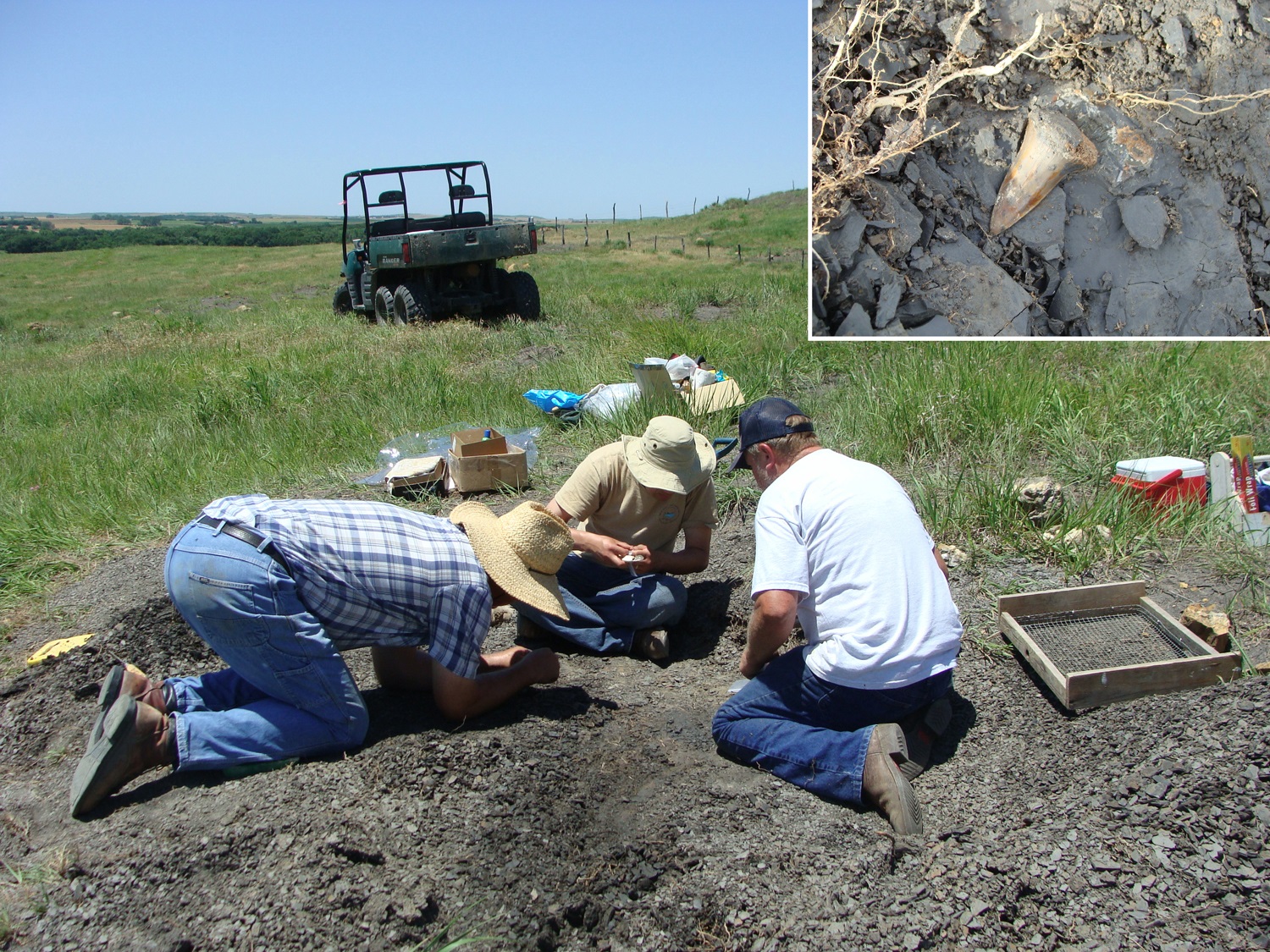
Dinosaur-era shark fossil discovered in Kansas; researchers name it Cretodus houghtonorum
Fossil dig leads to unexpected discovery of 91-million-year-old shark new to science  phys.org/news/2019-11-fossil-unexpected-discovery-million-year-old-shark.html 

Tuesday, April 23, 2019

[Ichthyology / Behaviour • 2019] Cryptic Habitat Use of White Sharks Carcharodon carcharias in Kelp Forest revealed by Animal-borne Video


a white shark Carcharodon carcharias 
encountering Cape fur seals Arctocephalus pusillus pusillus in kelp canopy. 


in Jewell, Gleiss, Jorgensen, et al., 2019.

Abstract
Traditional forms of marine wildlife research are often restricted to coarse telemetry or surface-based observations, limiting information on fine-scale behaviours such as predator–prey events and interactions with habitat features. We use contemporary animal-attached cameras with motion sensing dataloggers, to reveal novel behaviours by white sharks, Carcharodon carcharias, within areas of kelp forest in South Africa. All white sharks tagged in this study spent time adjacent to kelp forests, with several moving throughout densely kelp-covered areas, navigating through channels and pushing directly through stipes and fronds. We found that activity and turning rates significantly increased within kelp forest. Over 28 h of video data revealed that white shark encounters with Cape fur seals, Arctocephalus pusillus pusillus, occurred exclusively within kelp forests, with seals displaying predator evasion behaviour during those encounters. Uniquely, we reveal the use of kelp forest habitat by white sharks, previously assumed inaccessible to these large predators.

Keywords: biologging, animal-borne video and environmental data collection systems (AVEDs), foraging, camera tags


Figure 2. Still-picture frames of a white shark encountering Cape fur seals in kelp canopy. (a) AVED footage of a white shark (Shark 5) encountering Cape fur seals. (b) The seals respond to the shark's presence by hunkering to the sea floor and blowing bubble streams as the shark passes overhead or swimming further into the kelp. (c) The shark swims through the bubbles, (d) then through kelp. (e) The shark pursues the seals, making contact with dense kelp fronds at several points and pushing through them. (f) At least three Cape fur seals (indicated by red arrows) are seen taking refuge in the canopy area of the kelp forest fronds and successfully avoiding the white shark.


Oliver J. D. Jewell , Adrian C. Gleiss , Salvador J. Jorgensen , Samantha Andrzejaczek , Jerry H. Moxley , Stephen J. Beatty , Martin Wikelski , Barbara A. Block  and Taylor K. Chapple. 2019. Cryptic Habitat Use of White Sharks in Kelp Forest revealed by Animal-borne Video.  Biology Letters.  DOI: 10.1098/rsbl.2019.0085  
Shark's-Eye-View Video Captures Epic Seal Chase Through Kelp Forest shar.es/amT4vE via @LiveScience


Monday, August 6, 2018

[PaleoIchthyology • 2018] Static Dental Disparity and Morphological Turnover in Sharks across the End-Cretaceous Mass Extinction


in Bazzi, Kear, Blom,et al., 2018.

Highlights: 
• Shark teeth reveal morphological turnover during the end-Cretaceous mass extinction
• Fossil shark dental disparity is decoupled from taxonomic richness
 • Cretaceous–Palaeogene shark disparity was nearly static unlike other marine predators
• Prey availability and trophic cascades may have initiated Cenozoic shark radiations

Summary
The Cretaceous–Palaeogene (K–Pg) mass extinction profoundly altered vertebrate ecosystems and prompted the radiation of many extant clades. Sharks (Selachimorpha) were one of the few larger-bodied marine predators that survived the K–Pg event and are represented by an almost-continuous dental fossil record. However, the precise dynamics of their transition through this interval remain uncertain. Here, we apply 2D geometric morphometrics to reconstruct global and regional dental morphospace variation among Lamniformes (Mackerel sharks) and Carcharhiniformes (Ground sharks). These clades are prevalent predators in today’s oceans, and were geographically widespread during the late Cretaceous–early Palaeogene. Our results reveal a decoupling of morphological disparity and taxonomic richness. Indeed, shark disparity was nearly static across the K–Pg extinction, in contrast to abrupt declines among other higher-trophic-level marine predators. Nevertheless, specific patterns indicate that an asymmetric extinction occurred among lamniforms possessing low-crowned/triangular teeth and that a subsequent proliferation of carcharhiniforms with similar tooth morphologies took place during the early Paleocene. This compositional shift in post-Mesozoic shark lineages hints at a profound and persistent K–Pg signature evident in the heterogeneity of modern shark communities. Moreover, such wholesale lineage turnover coincided with the loss of many cephalopod and pelagic amniote groups, as well as the explosive radiation of middle trophic-level teleost fishes. We hypothesize that a combination of prey availability and post-extinction trophic cascades favored extant shark antecedents and laid the foundation for their extensive diversification later in the Cenozoic.

Keywords: K–Pg Boundary, Geometric Morphometrics, Sharks, Lamniformes, Carcharhiniformes, Macroevolution, Mass extinction, Teeth, Disparity


Late Maastrichtian marine assemblage.
 Illustration: Julius Csotonyi 


 Mohamad Bazzi, Benjamin P. Kear, Henning Blom, Per E. Ahlberg and Nicolás E.Campione. 2018. Static Dental Disparity and Morphological Turnover in Sharks across the End-Cretaceous Mass Extinction. Current Biology. In Press.  DOI: 10.1016/j.cub.2018.05.093

Friday, July 29, 2016

[PaleoIchthyology • 2015] Pseudomegachasma gen. nov. • A New Clade of Putative Plankton-Feeding Sharks from the Upper Cretaceous of Russia and the United States


FIGURE 7. Stratigraphic distributions of elasmobranch families that contain planktivorous forms and highlighting Johnlongia and Pseudomegachasma, gen. nov., as well as Megachasma applegatei and M. pelagios to show parallel evolution and convergence of ‘megachasmid tooth pattern’ from ‘odontaspidid tooth pattern’ in each clade (*, excludes other odontaspidid taxa outside of this particular clade, i.e., Johnlonginae, subfam. nov.; stratigraphic data based on Friedman et al., 2010:fig. 3; Cappetta, 2012; Shimada et al., 2014). Sources of illustrated teeth (left, labial view; right, profile view; not to scale): Johnlongia (SSU 155/93 in this study; cf. Fig. 2 A, C); Pseudomegachasma , gen. nov. (Shimada, 2007:fig. 1B, C; see also Fig. 4A, E in this study); Megachasma applegatei (Shimada et al., 2014:fig. 3B, C); and M. pelagios (Taylor et al., 1983:fig. 8A, C).
 Shimada, Popov, Siversson, Welton & Long, 2015
 
  DOI: 10.1080/02724634.2015.981335 

ABSTRACT
Eorhincodon casei from Russia and Megachasma comanchensis from the United States are two Cretaceous taxa initially described as putative planktivorous elasmobranchs, but the type specimens of these two taxa were subsequently reinterpreted to represent taphonomically abraded teeth of an odontaspidid, Johnlongia Siverson (Lamniformes: Odontaspididae). Here, we redescribe the type materials of ‘E. casei’ and ‘M. comanchensis’ and describe additional specimens of these species from other Late Cretaceous localities in Russia and the United States. These specimens demonstrate that (1) the two fossil taxa are valid species; (2) they warrant the establishment of a new genus of presumed planktivorous sharks, Pseudomegachasma, gen. nov., to accommodate the two species; and (3) the new genus is sister to Johnlongia and together constitute a new subfamily Johnlonginae, subfam. nov., tentatively placed in the family Odontaspididae sensu stricto. This taxonomic placement indicates that the putative planktivorous clade was derived from a presumed piscivorous form (Johnlongia), with an implication that Pseudomegachasma, gen. nov., evolved a plankton-eating habit independent of the four known planktivorous elasmobranch clades (Rhincodontidae, Megachasmidae, Cetorhinidae, and Mobulidae). It also indicates that planktivorous diets evolved independently at least three times in the order Lamniformes (i.e., Megachasmidae, Cetorhinidae, and Odontaspididae), and more significantly, Pseudomegachasma, gen. nov., would represent the oldest known plankton-feeding elasmobranch in the fossil record. The present fossil record suggests that Pseudomegachasma, gen. nov., evolved in a relatively shallow-water environment in Russia in the early Cenomanian or earlier and subsequently migrated to the North American Western Interior Seaway by the mid-Cenomanian.

Today’s giant filter feeding elasmobranchs. From top left Whale Shark Rhincodon typus, [photo by Werner Mischler]; Basking Shark Cetorhinus maximus, Doug Perrine; Reef Manta Manta alfredi, Kristy Cole, Underwater Escapades; Megamouth Shark Megachasma pelagios, Wikimedia Commons.

 Kenshu Shimada, Evgeny V. Popov, Mikael Siversson, Bruce J. Welton and Douglas J. Long. 2015. A New Clade of Putative Plankton-Feeding Sharks from the Upper Cretaceous of Russia and the United States. Journal of Vertebrate Paleontology. 35(5); e981335.  DOI: 10.1080/02724634.2015.981335
ResearchGate.net/publication/281332658_A_new_clade_of_putative_plankton-feeding_sharks_from_the_Upper_Cretaceous_of_Russia_and_the_United_States


Pseudomegachasma, a newly discovered prehistoric #shark—with a giant mouth http://grnpc.org/Ig2Fx 
“False Megamouth” Shark Pioneered the Plankton-Feeding Lifestyle  phenomena.nationalgeographic.com/2015/09/17/false-megamouth-shark-pioneered-the-plankton-feeding-lifestyle/
Before Giant Plankton-Feeding Sharks, there were Giant Plankton-Feeding Sharks.  deepseanews.com/2015/09/before-giant-plankton-feeding-sharks-there-were-giant-plankton-feeding-sharks/ via @deepseanews