Showing posts with label Pleurodira. Show all posts

Thursday, November 20, 2025

[Paleontology • 2025] Shakiremys colombiana • Mosaic Morphology in Podocnemididae (Pleurodira) revealed by A New turtle from the Middle Miocene La Venta Biome, Colombia


 Shakiremys colombiana  
 Cadena, Leal-Amaya, A. Vanegas-Vanegas, R. D. Vanegas-Vanegas & Guevara-Serrano, 2025
  
Illustration by Juan Giraldo

Abstract
A new genus and species of podocnemidid turtle, Shakiremys colombiana, is described here from the Middle Miocene La Venta Biome, located in south-central Colombia. The new taxon is represented by two specimens: one consisting of a complete skull and articulated shell, and the other of an articulated shell only. Shakiremys colombiana is distinguished from other podocnemidids by the following combination of features: intermediate roofing of the temporal emargination; a jugal retracted from the orbital margin; a flatter, more rectangular carapace outline; peripherals 2 with a short, protruding anteromedial margin; vertebral scute 1 narrower than the others and not reaching peripherals 1; the gular scute reaching the pectorals and completely separating the humerals; and anterior plastral lobe margin almost straight. It also has an additional mosaic of characteristics found in Podocnemidinae, Erymnochelyinae and Peltocephalinae. A phylogenetic analysis recovered Sh. colombiana as the basalmost member of a large clade that includes both Erymnochelyinae and Peltocephalinae. Additionally, computed tomography was used to reconstruct and compare the neuroanatomical features of Sh. colombiana with other podocnemidids. The mosaic traits observed in Sh. colombiana are interpreted as advantageous for a broader dietary and ecological spectrum, potentially including an omnivorous diet, and the ability to thrive in various aquatic environments, ranging from blackwater to whitewater habitats. This ecological versatility may have offered a competitive advantage for Sh. colombiana within the diverse palaeoecosystem of La Venta, where multiple podocnemidid and chelid turtle species coexisted.

Keywords: turtle, pleurodire, Miocene, South America, La Victoria Formation


SYSTEMATIC PALAEONTOLOGY

TESTUDINES Batsch 1788 sensu Joyce et al. 2020 
PLEURODIRA Cope 1864 sensu Joyce et al. 2020 
PELOMEDUSOIDES Broin 1988 sensu Joyce et al. 2021 
PAN-PODOCNEMIDIDAE Joyce et al. 2004 sensu Joyce et al. 2021 
PODOCNEMIDIDAE Cope 1868 sensu Joyce et al. 2021 

Genus Shakiremys nov.
 
Derivation of name: In honour of Shakira, a Colombian singer who has inspired generations with her music and dance; music that has accompanied the first author's fieldwork for decades. Shakira also serves as an example of uniqueness, much like the fossil turtle described herein.


Shakiremys colombiana sp. nov.
 
Derivation of name: From Colombia, the country where the species was discovered.

Holotype: VPPLT-1730, complete skull (Figs 2, 3A−C, 4A−B) and articulated shell (carapace and plastron) (Figs 5, 6), belonging to a single individual (Fig. 1D).
 

Palaeoartist's reconstruction of the podocnemidid Shakiremys colombiana gen. et sp. nov. and the fluvial ecosystem.
Illustration by Juan Giraldo.

 
Edwin-Alberto Cadena, David E. Leal-Amaya, Andrés Vanegas-Vanegas, Rubén D. Vanegas-Vanegas, Lino J. E. Guevara-Serrano. 2025. Mosaic Morphology in Podocnemididae revealed by A New turtle from the Middle Miocene La Venta Biome, Colombia. Papers in Palaeontology. DOI: doi.org/10.1002/spp2.70051 [17 November 2025]


Sunday, December 22, 2024

[Paleontology • 2024] Baalemys mansillai • A New chelid Turtle with an ornamented bony shell (Pleurodira: Chelidae) from the Portezuelo Formation (Upper Cretaceous) of Patagonia, Argentina


Baalemys mansillai 
Sarda & Maniel, 2024
 

ABSTRACT
We describe Baalemys mansillai gen. et sp. nov. a chelid turtle, based on an articulated shell from the Portezuelo Formation of the Baal locality, northern shore of Barreales lake, Neuquén Province, Argentina. Baalemys mansillai gen. et sp. nov. is distinguished from other chelids by its oval shape, moderate size, distinctive granulated ornamentation, narrow nuchal plate, first hexagonal neural with short posterolateral margins, a second neural plate that is a regular hexagon, and a posterior lobe that is longer than both the anterior lobe and the bridge. This unique combination of features supports the establishment of a new genus and species. Baalemys mansillai gen. et sp. nov was discovered in the Baal locality with sauropod dinosaurs, theropod dinosaurs, crocodiles, pelomedusoid turtles and other genera of chelids; a similar biota was identified in other localities of the Portezuelo Formation. The identification of Baalemys mansillai gen. et sp. nov. significantly adds to our knowledge of the diversity of pleurodiran turtles from the Portezuelo Formation, the Neuquén Basin, and the broader Patagonian region.

KEYWORDS: Chelidae, Pleurodira, Cretaceous, Portezuelo Formation, Turtles


 Baalemys mansillai gen. et sp. nov.


M. Sarda and I.J Maniel. 2024. A New chelid Turtle with an ornamented bony shell (Pleurodira: Chelidae) from the Portezuelo Formation (Upper Cretaceous) of Patagonia, Argentina. Historical Biology: An International Journal of Paleobiology. DOI: doi.org/10.1080/08912963.2024.2437832  
 

Wednesday, March 13, 2024

[Paleontology • 2024] Peltocephalus maturinThe Latest Freshwater Giants: A New Peltocephalus (Pleurodira: Podocnemididae) Turtle from the Late Pleistocene of the Brazilian Amazon


Peltocephalus maturin 
Ferreira, Nascimento, Cadena, Cozzuol, Farina, Pacheco, Rizzutto & Langer, 2024

artwork by Júlia d'Oliveira
 
Abstract
Overkill of large mammals is recognized as a key driver of Pleistocene megafaunal extinctions in the Americas and Australia. While this phenomenon primarily affected mega-mammals, its impact on large Quaternary reptiles has been debated. Freshwater turtles, due to the scarcity of giant forms in the Quaternary record, have been largely neglected in such discussions. Here we present a new giant podocnemidid turtle, Peltocephalus maturin sp. nov., from the Late Pleistocene Rio Madeira Formation in the Brazilian Amazon, that challenges this assumption. Morphological and phylogenetic analyses of the holotype, a massive partial lower jaw, reveal close affinities to extant Amazonian species and suggest an omnivorous diet. Body size regressions indicate Pe. maturin possibly reached about 180 cm in carapace length and is among the largest freshwater turtles ever found. This finding presents the latest known occurrence of giant freshwater turtles, hinting at coexistence with early human inhabitants in the Amazon.


 Peltocephalus maturin sp. nov.: photographs (a), outlines (b) and 3D renderings (c) of the dentary MERO.PV.H 007,
and 3D renderings of Pe. dumerilianus lower jaw (d) in left lateral (left), dorsal (centre) and ventral (right) views.
 Abbreviations: cor.s, suture to the coronoid; fai, foramen alveolare inferius; lar, labial ridge; lir, lingual ridge; mir, midline ridge; orr, orthogonal ridge; pos.s, suture with the posterior bone; trs, triturating surface; rha, rhamphotheca posterior limit; scm, sulcus cartilagini meckeli; syf, symphyseal fossa; syh, symphyseal hook; syp, symphyseal pits.
 
 Systematic palaeontology
Testudines Batsch, 1788  
Pleurodira Cope, 1864 

Podocnemididae Cope, 1868 

Peltocephalus Dumeril and Bribon, 1835

Peltocephalus maturin sp. nov.

Diagnosis: Peltocephalus maturin is assigned to Pelomedusoides based on its fused dentaries and to Peltocephalus by the symphyseal hook higher than the coronoid process, the lingual platform and a small fossa with two pits on the posterior surface of the symphysis. It differs from Podocnemis spp. in its straight, instead of curved, labial and lingual ridges, U-shaped midline outline of the lingual ridges, well-developed symphyseal hook, transverse posterior (lingual) platform ventral to the triturating surface and the symphyseal fossa; from Erymnochelys madagascariensis by two pits in the symphyseal fossa, instead of one; from both Podocnemis spp. and E. madagascariensis in its dorsoventrally—instead of posteroventrally—sloping posterior limit of the rhamphotheca. Peltocephalus maturin can be distinguished from Pe. dumerilianus based on its much greater size, labial ridge higher than the lingual, symphyseal ridge separating left and right triturating surfaces (all these shared with Stupendemys geographica), and secondary ridge orthogonal to the long axis of the triturating surface, separating anterior and posterior triturating areas (autapomorphy). Peltocephalus maturin can be differentiated from S. geographica by narrow instead of expanded triturating surfaces, upcurved pointed symphyseal hook and sharp but not protruding and anteriorly V-shaped lingual ridges, instead of protruding and U-shaped.

Etymology: Maturin refers to the giant turtle that vomited out the universe in Stephen King's stories, which in turn was inspired by the character Stephen Maturin who, in the book H.M.S. Surprise of Patrick O'Brian's Aubrey-Maturin series, names a giant tortoise.


G. S. Ferreira, E. R. Nascimento, E. A. Cadena, M. A. Cozzuol, B. M. Farina, M. L. A. F. Pacheco, M. A. Rizzutto and M. C. Langer. 2024. The Latest Freshwater Giants: A New Peltocephalus (Pleurodira: Podocnemididae) Turtle from the Late Pleistocene of the Brazilian Amazon. Biol. Lett. 2020240010. DOI: 10.1098/rsbl.2024.0010 

Wednesday, July 26, 2023

[Paleontology • 2023] Khargachelys caironensis • The First Side-Necked Turtle (Pleurodira: Bothremydidae) from the Campanian (Late Cretaceous) of Egypt


Khargachelys caironensis 
AbdelGawad, Pérez-García, Hirayama, Mohesn, Tantawy & El-Kheir, 2023


Abstract
The Quseir Formation is an Upper Cretaceous (Campanian) deposit in the Kharga oasis of the Southwestern Desert (Egypt). This formation comprises a clastic sequence of bioturbated mudstone and sandstone intercalations, including rare scattered and fragmented vertebrate remains such as shark teeth, dinosaur remains, and turtle plates. These deposits indicate a supratidal marsh environment. A complete shell of a turtle discovered from the Quseir Formation, at the Kharga oasis, is attributed here to Bothremydini (Pleurodira, Bothremydidae), and determined as a new taxon: Khargachelys caironensis gen. et sp. nov. This form represents the only Bothremydini member currently identified in the Campanian record not only of Egypt but also of North Africa. Therefore, it helps fill the missing evolutionary gap from the Late Cretaceous pleurodires in Egypt and in North Africa.

Keywords: Campanian; Quseir Formation; Kharga; Bothremydini; Khargachelys caironensis gen. et sp. nov


  NVP005, the shell of the bothremydid turtle Khargachelys caironensis gen. et sp. nov., from the Campanian age of Kharga Oasis, South Western Desert, Egypt, in dorsal (A,A’) and ventral (B,B’) views.

Systematic Paleontology
Testudines Batsch, 1788 
Pleurodira Cope, 1864 
Pelomedusoides Cope, 1868 

Bothremydidae Baur, 1891 
Bothremydini Gaffney, Tong and Meylan, 2006  

Khargachelys caironensis gen. et sp. nov
 
Holotype: NVP005, complete carapace and plastron.

Type locality and horizon: Qarn Gennah (Kharga oasis); Quseir Formation; Campanian age.

Diagnosis: Member of Bothemydini that differs from the other representatives of this clade by the following character combination: long shell close to 60 cm in length; oval-shaped carapace, reaching its widest point at the fifth peripherals; narrow and shallow nuchal emargination; seven neurals; almost as long and wide as the first pair of peripherals; first vertebral scute being the widest of the vertebral series; second to the fourth vertebrals noticeably longer than wide; first pair of marginals overlapping half the lateral nuchal margins; anterior margin of the plastron reaching the anterior carapace edge; anterior plastral lobe wider than the posterior one; twice as wide as long entoplastron; entoplastron width equivalent to almost half the anterior plastral lobe width; extragulars overlapping the entoplastron; humero-pectoral sulcus located behind the epiplastra, showing a relatively long distance between them; pectoral scutes overlapping the anterior region of the mesoplastra.


Description: The carapace is almost complete but partially broken (Figure 2). The damaged and crushed parts are due to the pressure from the overlying sediments. The carapace is estimated to be about 580 mm long and 430 mm wide. The height of the carapace cannot ...

Etymology:Kharga” honors Kharga Oasis, where the specimen was collected; “chelys” is Greek for, turtle; “caironensis” honors Cairo, the capital city of Egypt, and honors Cairo University.


Conclusions:
The described turtle shell here, from the Quseir Formation of Kharga Oasis, in the South Western Desert (Egypt), represents the first record of Bothremydidae (Pleurodira) from the Campanian age in Egypt and in Africa. The Campanian deposits in the Kharga area indicate a supratidal marsh environment, concordant with the occurrence of such aquatic turtles. The specimen is attributed to a new genus and species of Bothremydini, Khargachelys caironensis gen. et sp. nov. This specimen brings new data to the poorly known diversity of turtles from the Late Cretaceous of Egypt.
The restricted brackish water environments and the gradual shallow shelf together with fossils such as freshwater gastropods and palynofloras, support indications of the ability of Bothremydidae to reside in different environments, such as freshwater and coastlines. The diversity of the paleoenvironments of the Bothremydidae enabled them to reach a wide distribution in both the northern and southern continents during the Late Cretaceous, along the coastlines of the Atlantic Ocean, breaking the barriers of the vicariance pattern of evolution.


 Mohamed AbdelGawad, Adán Pérez-García, Ren Hirayama, Sara Mohesn, Abdel-Aziz Tantawy and Gebely Abu El-Kheir. 2023. The First Side-Necked Turtle (Pleurodira, Bothremydidae) from the Campanian (Late Cretaceous) of Egypt. Diversity. 15(2); 284. DOI: 10.3390/d15020284
 (This article belongs to the Special Issue Fossil Reptiles and Associated Faunal Record)

Friday, February 24, 2023

[Paleontology • 2023] Podocnemis tatacoensis • A New Fossil Turtle Ends the Controversy on the Occurrence of the extant Genus Podocnemis Wagler, 1830 (Pleurodira: Podocnemididae) at the Miocene Fauna of La Venta, Colombia


Podocnemis tatacoensis 
Cadena & Vanegas, 2023

digital painting by Juan Giraldo Pepper 

The estimate divergence time for extant taxa based on molecules usually exceed the age of their oldest fossil evidence; a situation that turtles do not scape. An extant genus with this situation, and thus having a controversial oldest record is Podocnemis Wagler, 1830. Here we present a new fossil turtle that constitutes a new species for this genus and represents its oldest so far known record, from the Miocene (Serravallian) of La Tatacoa Desert, Colombia. The new taxon named Podocnemis tatacoensis n. sp. shares with all extant members of Podocnemis a nuchal bone wider than long; lateral musk foramina at the hyoplastron-peripherals (except P. sextuberculata Cornalia, 1849), pectoral scales do not contact mesoplastra, but do contact entoplastron and epiplastra. We explored the phylogenetic position of P. tatacoensis n. sp. finding support for its inclusion as part of Podocnemis clade, particularly in a clade composed by the extant P. unifilis Troschel, 1848, suggesting a potential closer relationship of the new fossil taxon with this taxon.

KEYWORDS: Podocnemididae, Podocnemis, Colombia, Neogene, Turtles, new species


Podocnemis tatacoensis n. sp.


Edwin-Alberto CADENA and Rubén Dario VANEGAS. 2023. A New Fossil Turtle Ends the Controversy on the Occurrence of the extant Genus Podocnemis Wagler, 1830 at the Miocene Fauna of La Venta, Colombia.   GEODIVERSITAS. 45(3); 127-138. sciencepress.MNHN.fr/en/periodiques/Geodiversitas/45/3
[This article is a part of the thematic issue Neotropical palaeontology: the Miocene La Venta biome]

Saturday, December 24, 2022

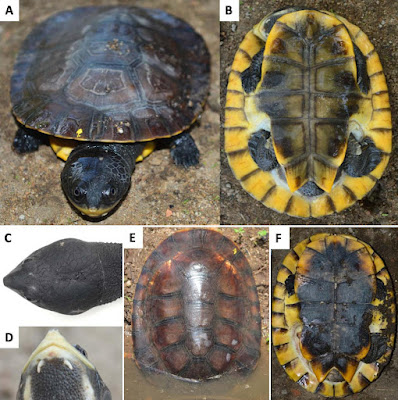
[Herpetology • 2022] Mesoclemmys sabiniparaensis • A New South American Freshwater Turtle of the Genus Mesoclemmys (Testudines: Pleurodira: Chelidae) from the Brazilian Amazon


Mesoclemmys sabiniparaensis 
 Cunha, Sampaio, Carneiro, Vogt, Mittermeier, Rhodin & Andrade, 2022

 
ABSTRACT
We describe a new species of small chelid turtle from perennial streams in the Araguaia River subbasin near Serra das Andorinhas State Park, São Geraldo do Araguaia, Pará, Brazil. It is morphologically distinct and the smallest known member of the genus Mesoclemmys, with an average straight-line carapace length (CL) of 144 mm and maximum recorded CL of 170 mm. The species has a moderate head width of approximately 20% of CL. The carapace and dorsal soft parts are blackish, the plastron is light brownish yellow with a blackish brown central plastral figure, and the ventral soft parts are pale yellow. It has the largest femoral scutes of any Mesoclemmys and its plastral contact formula is Intergular > Anal > Humeral > Femoral > Abdominal > Pectoral > Gular. We describe the shell and skull morphology of the new species and performed genetic analysis using mitochondrial DNA (cytochrome c oxidase, subunits I [COI] and 16S) to build a phylogenetic tree for the genus, which placed the new species as sister to M. vanderhaegei.


Mesoclemmys sabiniparaensis 


Fábio A.G. Cunha, Iracilda Sampaio, Jeferson Carneiro, Richard C. Vogt, Russell A. Mittermeier, Anders G.J. Rhodin and Marcelo C. Andrade. 2022. A New South American Freshwater Turtle of the Genus Mesoclemmys from the Brazilian Amazon (Testudines: Pleurodira: Chelidae).  Chelonian Conservation and Biology. DOI: 10.2744/CCB-1524.1


Friday, March 11, 2022

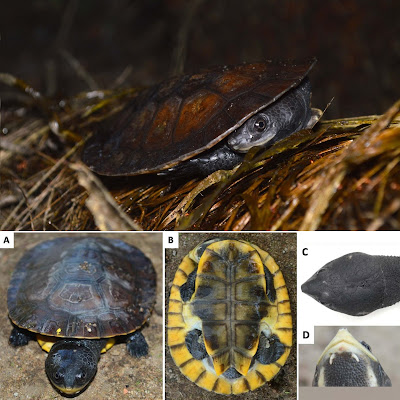
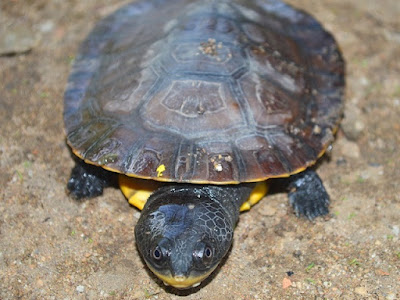
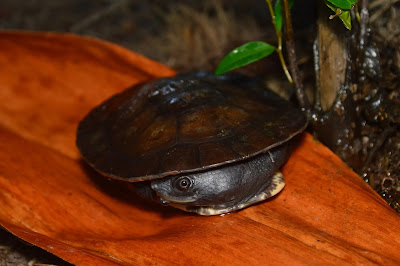
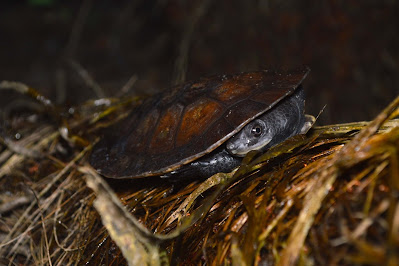
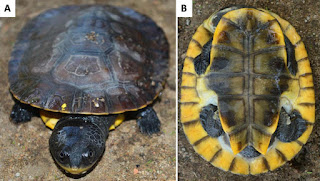
[Herpetology • 2021] Mesoclemmys jurutiensis • A New Species of Amazon Freshwater Toad-Headed Turtle in the Genus Mesoclemmys (Testudines: Pleurodira: Chelidae) from Brazil


Mesoclemmys jurutiensis
Cunha, Sampaio, Carneiro & Vogt, 2021

 
Abstract
We describe a new extant species of freshwater turtle from Brazil: Mesoclemmys sp. nov., a medium-sized toad-headed turtle (mean carapace length = 189.5 ± 25.8 mm), which to date has only been found in the Brazilian Amazon Basin, western Pará State, Central Amazon, and the lower Amazonas River Basin. It is easily distinguished from its sympatric congeners by differences in body size, head size, carapace shape, and coloration. The head is triangular and completely black, with large red eyes positioned anteriorly and a pair of long, light yellow barbels positioned anteriorly close the mandible. The carapace is oval and colored dark reddish brown. The plastron is black in the central region and burnt-yellow along the edges and ventral aspects of the marginal scutes and bridge, with dark seams. The plastral formula is 3-5-7-4-1-6-2. The new species inhabits temporary rainwater ponds under closed-canopy rainforest and has a known geographic range of 2183 km2. Sequences of fragment mitochondrial DNA (cytochrome c oxidase subunit I and 16S) of the new species were determined and compared with the available GenBank sequences. Our phylogenetic results indicate that the specimens represent a divergent taxon within Mesoclemmys and a robust analysis of morphological data corroborates the existence of a new distinct species of Mesoclemmys, described herein.


Mesoclemmys jurutiensis
 

Fábio A.G. Cunha, Iracilda Sampaio, Jeferson Carneiro and Richard C. Vogt. 2021. A New Species of Amazon Freshwater Toad-Headed Turtle in the Genus Mesoclemmys (Testudines: Pleurodira: Chelidae) from Brazil. Chelonian Conservation and Biology. 20(2)- 151-166. DOI: 10.2744/CCB-1448.1

Nova espécie de tartaruga de água doce foi descoberta no oeste do Pará
Nome da nova espécie, Mesoclemmys jurutiensis, homenageia o município onde foi encontrada, Juruti. Pesquisa contou com a ajuda dos ribeirinhos da comunidade


Thursday, December 16, 2021

[Paleontology • 2021] Sindhochelys ragei • First Report of A Bothremydid Turtle (Pleurodira: Bothremydidae) from the early Paleocene of Pakistan, Systematic and Palaeobiogeographic Implications


 Sindhochelys ragei
 Lapparent De Broin, Métais, Bartolini, Brohi, Lashari, Marivaux, Merle, Warar & Solangi, 2021


We report the discovery of remains of a large chelonian from the base of the early Paleocene Khadro Formation exposed in the Ranikot Fort area (Ranikot Group, Sindh Province, Southern Pakistan). This formation already yielded the snake Gigantophis Andrews, 1901, studied by our friend Jean-Claude Rage. The chelonian specimens consist of a large carapace and a shell fragment of Bothremydidae, a family of Gondwanan origin. A new genus and species, Sindhochelys ragei n. gen., n. sp. is identified from the first specimen and named in honor of Jean-Claude Rage. It is the first report of a Bothremydidae in Southern Pakistan. Its affinities with Cretaceous and Paleocene representatives of the family are discussed. The association of characters such as the shape of the shell, anterior plastral scute pattern and strongly marked decoration characterize the taxon and, despite some similarities, allows excluding close phylogenetic affinities with Taphrosphyini and Carteremys group; other well-documented bothremydids are also excluded. The shell fragment, also strongly decorated, is left undetermined. The discovery of two new littoral bothremydid specimens in the early Paleocene of Pakistan fills a geographic and stratigraphic gap in our knowledge of the family, which is known since the continental early Cretaceous of Africa, diversifying in the world up to the Miocene deposits of the Neotethys. A particular diversification during the Maastrichtian-Paleocene is recognized along the neotethyan coasts, and occasional dispersals across this ocean were possible. Sindhochelys ragei n. gen., n. sp. may have colonized the Indian subcontinent by this time, or may represent an older diversification before the Gondwana breakup.

KEYWORDS: Bothremydidae, Southern Pakistan, geology, Pelomedusoides, Gondwana, Neotethys, new genus, new species


Sindhochelys ragei n. gen., n. sp.


France de Lapparent De Broin, Grégoire Métais, Annachiara Bartolini, Imdad Ali Brohi, Rafiq A. Lashari, Laurent Marivaux, Didier Merle, Mashooque Ali Warar and Sarfraz H. Solangi. 2021. First  Report of A Bothremydid Turtle, Sindhochelys ragei n. gen., n. sp., from the early Paleocene of Pakistan, Systematic and Palaeobiogeographic Implications. GEODIVERSITAS. 43(25); 1341-1363. [This article is a part of the thematic issue Memorial Jean-Claude Rage: A life of paleo-herpetologist]

Monday, May 24, 2021

[Paleontology • 2021] Pleurochayah appalachius • An early Bothremydid (Pleurodira: Bothremydidae) from the Arlington Archosaur Site of Texas


Pleurochayah appalachius 
Adrian, Smith, Noto & Grossman, 2021


Abstract
Four turtle taxa are previously documented from the Cenomanian Arlington Archosaur Site (AAS) of the Lewisville Formation (Woodbine Group) in Texas. Herein, we describe a new side-necked turtle (Pleurodira), Pleurochayah appalachius gen. et sp. nov., which is a basal member of the Bothremydidae. Pleurochayah appalachius gen. et sp. nov. shares synapomorphic characters with other bothremydids, including shared traits with Kurmademydini and Cearachelyini, but has a unique combination of skull and shell traits. The new taxon is significant because it is the oldest crown pleurodiran turtle from North America and Laurasia, predating bothremynines Algorachelus peregrinus and Paiutemys tibert from Europe and North America respectively. This discovery also documents the oldest evidence of dispersal of crown Pleurodira from Gondwana to Laurasia. Pleurochayah appalachius gen. et sp. nov. is compared to previously described fossil pleurodires, placed in a modified phylogenetic analysis of pelomedusoid turtles, and discussed in the context of pleurodiran distribution in the mid-Cretaceous. Its unique combination of characters demonstrates marine adaptation and dispersal capability among basal bothremydids.

DMNH 2013-07-1782, a partial skull and type specimen of Pleurochayah appalachius gen. et sp. nov.
(a) Dorsal photograph, (b) dorsal drawing, (c) left lateral photograph, (d) left lateral drawing, (e) ventral photograph, (f) ventral drawing, (g) right lateral photograph, (h) right lateral drawing, (i) posterior photograph, and (j) posterior drawing.
bo basioccipital, bs basisphenoid, cm condylus mandibularis, co condylus occipitalis, cs crista supraoccipitalis, ex exoccipital, fjp foramen jugulare posterius, fnt foramen nervi trigeminale, fp fossa pterygoidea, fpcci foramen posterius canalis caroticus internus, fr frontal, fst foramen stapediotemporale, ica incisura columella auris, iof interorbital foramen, mx maxilla, op opisthotic, or orbit, pa parietal, pal palatine, pf prefrontal, pm premaxilla, po postorbital, pr prootic, pt pterygoid, qu quadrate, so supraoccipital, sq squamosal, to tympanic opening, tb tuberculum basioccipitale, XII nervi hypoglossi. Red lines indicate visible sutures. Figure created with Adobe Creative Cloud (Adobe Inc.).

Carapacial specimens of Pleurochayah appalachius gen. et sp. nov., from the Cenomanian (Upper Cretaceous) Arlington Archosaur Site (Lewisville Fm, Woodbine Gp).
(a) Dorsal photograph, (b) dorsal drawing, (c) ventral photograph, and (d) ventral drawing of DMNH 2013-07-0683, neural 3. (e) Dorsal photograph, (f) dorsal drawing, (g) ventral photograph, and (h) ventral drawing of DMNH 2013-07-1998, pygal. (i) Dorsal photograph, (j) dorsal drawing, (k) ventral photograph, and (l) ventral drawing of DMNH 2013-07-0517, left costal 1. (m) Dorsal photograph, (n) dorsal drawing, (o) ventral photograph, and (p) ventral drawing of DMNH 2013-07-1999, left costal 5. (q) Dorsal photograph, (r) dorsal drawing, (s) ventral photograph, and (t) ventral drawing of DMNH 2013-07-1320, partial cf. right costal 3. (u) Dorsal photograph, (v) dorsal drawing, (w) ventral photograph, and (x) ventral drawing of DMNH 2013-07-0557, partial cf. right costal 3. (y) Dorsal photograph, (z) dorsal drawing, (aa) ventral photograph, and (ab) ventral drawing of DMNH 2013-07-1405, left costal 6. (ac) Dorsal photograph, (ad) dorsal drawing, (ae) ventral photograph, and (af) ventral drawing of DMNH 2013-07-0525, partial cf. left costal 4. (ag) Dorsal photograph, (ah) dorsal drawing, (ai) ventral photograph, and (aj) ventral drawing of DMNH 2013-07-1320, partial cf. right costal 4. (ak) Dorsal photograph, (al) dorsal drawing, (am) ventral photograph, (an) ventral drawing, (ao) posterior photograph, and (ap) posterior drawing of DMNH 2013-07-0673, right peripheral 7. (aq) Dorsal photograph, (ar) dorsal drawing, (as) ventral photograph, and (at) ventral drawing of DMNH 2013-07-1279, left peripheral 9. All parts of figure to same scale. Figure created with Adobe Creative Cloud (Adobe Inc.).

Systematic paleontology
Pleurodira Cope, 18653
Pelomedusoides Broin, 1988

Bothremydidae Baur, 18913
 
Pleurochayah appalachius sp. nov.  

Type locality and horizon: Cenomanian, Upper Cretaceous. Lewisville Fm, Woodbine Gp (Fig. 1). The Arlington Archosaur Site, city of Arlington, Tarrant County, Texas. Exact locality data are on file at the Perot Museum of Nature and Science, Dallas, Texas.

Etymology: Pleuro” is Greek for “side”, with “Cha’yah” for “turtle” in the language of the Caddo, a Native American tribe that inhabited much of the Gulf Coast of North America. Species name refers to Appalachia, the region comprising eastern North America.


Geographical position of the type localities (red circles) of known fossil crown pleurodires in Laurasia and northern Gondwana during and prior to the Cenomanian (Upper Cretaceous). Modified from global Mollweide projection at 96.6 Ma by Scotese87. Colors of taxon text corresponds with clades at bottom left. Alb Albian, Apt–Alb Aptian/Albian, Brm Barremian, Cen Cenomanian. Figure created with Adobe Creative Cloud (Adobe Inc.).

Conclusions
The current study places Pleurochayah appalachius gen. et sp. nov. at the base of the Bothremydidae, in an unresolved polytomy with the members of Kurmademydini (Fig. 6). It is the oldest known crown pleurodire and bothremydid from North America. This study also extends the geographic range of basal bothremydids to North America, which is significant since they were previously known only from South America prior to the Cenomanian (Fig. 9). Pleurochayah applachius gen. et sp. nov. is known from the lower middle Cenomanian, predating Algorachelus peregrinus in the uppermost middle-lowermost upper Cenomanian, and Pauitemys tibert in the uppermost Cenomanian, making it the oldest known pleurodire from North America and Laurasia. It is likely that bothremydid dispersals to North America during or prior to the Cenomanian were influenced by the vicariant event of the opening of the central Atlantic, and the periodic connection of the Western Interior Seaway to the Gulf of Mexico. However, allopatric speciation may be responsible for the multiple-continent distribution of basal bothremydids, as demonstrated for other late Early Cretaceous pelomedusoid clades. Recent discoveries of new bothremydid taxa in Central America suggest additional insight into circum-Carribbean pleurodiran migrations may be possible.


Brent Adrian, Heather F. Smith, Christopher R. Noto and Aryeh Grossman. 2021. An early Bothremydid from the Arlington Archosaur Site of Texas. Scientific Reports. 11, 9555. DOI: 10.1038/s41598-021-88905-1

Friday, May 7, 2021

[Paleontology • 2021] Sahonachelys mailakavava • A New Pelomedusoid Turtle (Pleurodira: Sahonachelyidae) from the Late Cretaceous of Madagascar provides Evidence for Convergent Evolution of Specialized Suction Feeding among Pleurodires


 Sahonachelys mailakavava
Joyce, Rollot, Evers, Lyson, Rahantarisoa & Krause, 2021

 Artwork by Andrey Atuchin.

Abstract
The Maevarano Formation in northwestern Madagascar has yielded a series of exceptional fossils over the course of the last three decades that provide important insights into the evolution of insular ecosystems during the latest Cretaceous (Maastrichtian). We here describe a new genus and species of pelomedusoid turtle from this formation, Sahonachelys mailakavava, based on a nearly complete skeleton. A phylogenetic analysis suggests close affinities of Sahonachelys mailakavava with the coeval Madagascan Sokatra antitra. These two taxa are the only known representatives of the newly recognized clade Sahonachelyidae, which is sister to the speciose clade formed by Bothremydidae and Podocnemidoidae. A close relationship with coeval Indian turtles of the clade Kurmademydini is notably absent. A functional assessment suggests that Sahonachelys mailakavava was a specialized suction feeder that preyed upon small-bodied invertebrates and vertebrates. This is a unique feeding strategy among crown pelomedusoids that is convergent upon that documented in numerous other clades of turtles and that highlights the distinct evolutionary pathways taken by Madagascan vertebrates.

Keywords: Maastrichtian, Maevarano Formation, Sahonachelyidae, Pleurodira, Late Cretaceous, Testudines 

Figure 1. (a) Outcrop map of Late Cretaceous and Palaeocene strata in the Mahajanga Basin of northwestern Madagascar (see inset at lower right). The location of the Berivotra Study Area is highlighted by the rectangle. The holotype specimen of  Sahonachelys mailakavava gen. et sp. nov. (UA 10581) was recovered from locality MAD05-38 in the Anembalemba Member of the Maevarano Formation (see stratigraphic relations in inset at upper left), which is of latest Cretaceous (Maastrichtian) age.
(b) Locality MAD05-38, type locality of  Sahonachelys mailakavava, view looking north-northwest.
(c) Close-up view of quarry face at locality MAD05-38 showing longitudinal cross-section of UA 10581 above (white arrow, caudal end of specimen to the right) and large fragments of specimen in foreground (black arrows).


Systematic palaeontology

Testudines Batsch, 1788 
Pleurodira Cope, 1865 
Pelomedusoides Broin, 1988 

Sahonachelyidae new clade name

Registration number. The clade name Sahonachelyidae is registered at RegNum with the number 570.

Definition. The largest extinct clade containing Sahonachelys mailakavava gen. et sp. nov.

Composition. Sahonachelyidae is currently hypothesized to consist of Sahonachelys mailakavava and Sokatra antitra, two extinct turtles from the Maastrichtian of Madagascar.


Figure 3. Sahonachelys mailakavava gen. et sp. nov., UA 10581, holotype, Late Cretaceous (Maastrichtian), Mahajanga Basin, Maevarano Formation, Madagascar. Photograph of skull with hyoid in (a) dorsal, (b) ventral and (c) left lateral views.

Figure 5. Sahonachelys mailakavava gen. et sp. nov., UA 10581, holotype, Late Cretaceous (Maastrichtian), Mahajanga Basin, Maevarano Formation, Madagascar. Three-dimensionally rendered model and line drawing of skull in (a) right lateral, (b) left lateral, (c) posterior and (d) anterior views.

ap, antrum postoticum; bs, basisphenoid; ex, exoccipital; fnh, foramen nervi hypoglossi; fpo, foramen postoticum; fr, frontal; ica, incisura columella auris; ju, jugal; mx, maxilla; op, opisthotic; pa, parietal; pal, palatine; pcf, precolumellar fossa; pf, prefrontal; pm, premaxilla; po, postorbital; pop, posterior opening of antrum postoticum; pp, posterior process of the maxilla; pt, pterygoid; qj, quadratojugal; qu, quadrate; so, supraoccipital; sq, squamosal.


Figure 9. Sahonachelys mailakavava gen. et sp. nov., UA 10581, holotype, Late Cretaceous (Maastrichtian), Mahajanga Basin, Maevarano Formation, Madagascar. Photograph and line drawing of shell in (a) dorsal and (b) ventral views. The lone Roman numerals indicate the neurals.
 Ab, abdominal scute; An, Anal scute; co, costal; Eg, extragular scute; ent, entoplastron; epi, epiplastron; Fe, femoral scute; Gu, gular scute; Hu, humeral scute; hyo, hyoplastron; hyp, hypoplastron; mdf, musk duct foramen; Ma, marginal scute; mes, mesoplastron; nu, nuchal; Pe, pectoral scute; per, peripheral; Pl, pleural; py, pygal; sp, suprapygal; Ve, vertebral scute; xi, xiphiplastron.


Sahonachelys mailakavava gen. et sp. nov.

Type locality. Locality MAD05-38, Berivotra Study Area, approximately 35 km southeast of the city of Mahajanga, Boeny Region, Madagascar. GPS coordinates are archived at the Denver Museum of Nature & Science and the University of Antananarivo and are available to qualified researchers.

Type stratum. Anembalemba Member, Maevarano Formation, dated to the Late Cretaceous (Maastrichtian, see §2 Geological setting).
 
Etymology. The name Sahonachelys mailakavava combines the Malagasy words ‘sahona' (pronounced sah-WHO-nah) for frog, ‘mailaka' (pronounced my-LAH-kah) for quick, ‘vava' (pronounced VAH-vah) for mouth, and the Greek word ‘chelys' for turtle to mean ‘quick-mouthed frog turtle’ in allusion to the frog-like appearance of the skull and its inferred quick mode of suction feeding.

Diagnosis. Sahonachelys mailakavava gen. et sp. nov. can be diagnosed as a member of Pan-Pelomedusoides by presence of midline contact of prefrontals; presence of processus trochlearis pterygoidei; contact of postorbital with palatine resulting in formation of expanded septum orbito-temporale; involvement of prootic and/or quadrate in formation of foramen posterius canalis carotici interni; the absence of nasals, vomer and splenial; low-domed, oval shell; sutural contact of pelvis with shell; the absence of cervical scutes; reduction in neural count resulting in midline contact of posterior costals; broad plastron; equidimensional mesoplastra; single, median gular; and cervical column consisting of procoelous vertebrae. The shell of S. mailakavava can be distinguished from those of all other pan-pelomedusoids by the presence of elongate gular that broadly crosses entoplastron and fully hinders midline contact of extragulars and humerals (also present in the kurmademydine Jainemys pisdurensis and the taphrosphyines Taphrosphys sulcatus and Ummulisani rutgersensis) in addition to broad contribution of enlarged extragulars to margin of anterior plastral lobe resulting in reduced contribution from gular. The cranium of S. mailakavava can be distinguished from those of all members of the clade formed by Podocnemidoidae and Bothremydidae by plesiomorphic retention of deep temporal emarginations that results in reduced or absent squamosal-quadratojugal and parietal-quadratojugal contacts, retention of clear exposure of prootic in ventral view, laterally open foramen jugulare posterius, and the absence of cavum pterygoidei or fossa pterygoidea. The cranium of S. mailakavava can be distinguished from those of all remaining, more basal-branching representatives of Pan-Pelomedusoides (i.e. Araripemydidae, Pelomedusidae and Atolchelys lepida), but resembles those of Sokatra antitra, Bothremydidae and Podocnemidoidae in derived presence of posterior enclosure of incisura columella auris by quadrate to exclusion of Eustachian tube; flooring of processus paroccipitalis by expanded sheet of bone formed by basisphenoid, quadrate and basioccipital; quadrate-exoccipital contact; reduced ventral exposure of prootic (the latter two characters also present in Araripemydidae); short basioccipital; and exclusion of basioccipital from occipital condyle (absent in Podocnemidoidae). Among pan-pelomedusoids, S. mailakavava uniquely resembles Sokatra antitra by the presence of an elongate posterior process of the maxilla; formation of deeply interfingered sutural contact between jugal and maxilla; reduced ventral process of quadratojugal; formation of foramen posterius canalis carotici interni by basisphenoid, quadrate and prootic; and strong forward inclination of processus articularis. These characteristics serve to diagnose the clade Sahonachelyidae. Sahonachelys mailakavava differs from Sokatra antitra by having a much flatter and broader cranium with more dorsally oriented orbits, presence of prefrontal-palatine contact, absence of parietal-palatine contact, presence of narrower triturating surfaces that lack lingual ridge, shorter midline contact between palatines, presence of distinct supramaxillary artery sulcus on ventral side of jugal, and exposure of prootic anterior and posterior to foramen posterius canalis carotici interni.

Figure 11. A reconstruction of Sahonachelys mailakavava gen. et sp. nov. preying upon young larvae of the giant Madagascan frog Beelzebufo ampinga using specialized suction feeding.
 Artwork by Andrey Atuchin.

Conclusion: 
We here describe a new species of pelomedusoid turtle, Sahonachelys mailakavava, based on a near-complete skeleton from the Maevarano Formation of northwestern Madagascar, which has been dated Late Cretaceous (Maastrichtian). The new species can easily be diagnosed relative to all other named pleurodires as it shows a large number of unique characters in both the shell and cranium. A phylogenetic analysis using weighted parsimony indicates that Sahonachelys mailakavava is sister to Sokatra antitra and that these coeval Madagascan turtles are the only known representatives of the newly recognized clade Sahonachelyidae. This clade is sister to the group formed by Bothremydidae and Podocnemidoidae within crown Pelomedusoides. The most conspicuous characteristic of this clade is the presence of an extended posterior process that is formed by the maxilla and protrudes deeply into the lower temporal emargination. A number of highly unusual morphological features suggest that Sahonachelys mailakavava was a specialized, aquatic, suction-feeding species that fed upon moving prey. The specialized feeding strategy further highlights the uniqueness of Late Cretaceous Madagascan faunas, as no other crown pelomedusoid is known to have developed this method of prey capture.


Walter G. Joyce, Yann Rollot, Serjoscha W. Evers, Tyler R. Lyson, Lydia J. Rahantarisoa and David W. Krause. 2021. A New Pelomedusoid Turtle, Sahonachelys mailakavava, from the Late Cretaceous of Madagascar provides Evidence for Convergent Evolution of Specialized Suction Feeding among Pleurodires. Royal Society Open Science. DOI: 10.1098/rsos.210098