Showing posts with label Trionychidae. Show all posts

Saturday, July 23, 2022

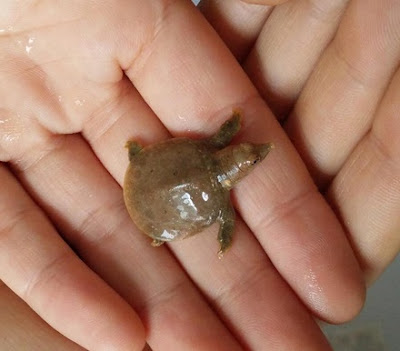
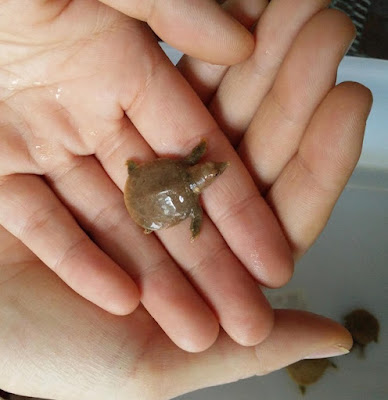
[Herpetology • 2022] Amyda ornata jongli • A New Subspecies of the Asiatic Softshell Turtle Amyda ornata (Gray, 1861) (Testudines: Trionychidae) from Its northern Distribution Range


Amyda ornata jongli 
Praschag & Gemel, 2022

 Photos: Peter Praschag.

Abstract
We describe a new subspecies of Amyda ornata (Gray, 1861) from the southeastern parts of Bangladesh (Chittagong hill tracts), adjacent regions of north-eastern India (Mizoram, Assam and Tripura) and Myanmar, based on morphological characteristics. The holotype comprises some skeletal elements held by the Natural History Museum of Vienna; the five paratypes consist of living specimens in the private collection of PP “Turtle Island” (a turtle conservation zoo in Graz, Austria). After the genetic identity had been determined in a previous investigation, the morphological description was carried out by examining living specimens and photo documents; and additionally, by evaluating the computed tomography of further living animals with exact location data.

Amyda ornata jongli ssp. nov. differs from the other Amyda ornata subspecies mainly by its relatively compact and stout head in subadults and adults, its paler, greyish and less contrasting colouration missing distinct bright yellow pigments, ochre-coloured irises, and the existence of more distinct tubercles in the neck region and in the posterior section of the carapace than both other subspecies of Amyda ornata. The tubercles along the front of the carapace protrude clearly in subadult and adult specimens. This softshell turtle is heavily exploited within its limited distribution. Therefore, special comments on conservation aspects are given together with a final discussion on distribution and systematics.

Key Words: Amyda ornata jongli ssp. nov., Bangladesh, conservation, distribution, India, morphology, Myanmar, Reptilia, Testudines, Trionychidae, systematics


Tubercles are visible, protruding over the front of the carapace in the nuchal and back region in subadult and adult animals.
 Photo: Peter Praschag.

Lateral shot of the head of a living  Amyda ornata jongli ssp. nov. showing the ochre-coloured eyes and the shape of the head.
Photo: Peter Praschag.

Order: Testudines Batsch, 1788

Family: Trionychidae Gray, 1825
Subfamily: Trionychinae Gray, 1825

Genus: Amyda Schweigger in Geoffroy Saint-Hilaire, 1809

Species: Amyda ornata (Gray, 1861)

Subspecies: Amyda ornata magnapapulae Hoser, 2021 nomen rejectum according to Turtle Taxonomy Working Group (TTWG, 2021).

 Amyda ornata jongli ssp. nov.
 
Diagnosis on morphological base: 
The heads in subadults and adults are stout (see Figs 5, 7a), with a dome rising up steeply from the top of the proboscis to the top of the head, in the region of prefrontals and frontals (see Fig. 9). Compared to the two other subspecies of A. ornata, a broader distance between the eyes is seen in A. o. jongli (see Figs 3, 7b), although this relative distance varies depending on the ontogenetic stage of the specimen considered. Rather uniform pale and greyish colouration, carapace is olive greyish, bright yellow pigmentation missing (Fig. 6a–j). Yellow-greyish dots, and vermiculation on head and neck is faded and not distinctly marked, ochre-coloured irises, ring-shaped skin around eyes with indistinct light dots, no pronounced “zebra striped” pattern; carapace with (or sometimes without, but less common) distinct black strokes and blotches or irregular saddle-shaped dark colouration on carapace (see Fig. 9). Black pigmentation mostly in the form of square spots on the rear edge of the carapace and two or three stripes running sideways from the center line of the carapace (compare Fig. 6a–j of the paratypes). Distinct tubercles in nuchal and back region. Nuchal tubercles protrude in a round or pointed shape along the front edge of the carapace in subadult and adult specimens (Fig. 8). Juveniles with tubercles on carapace running concentric, not longitudinal. Plastron white (in juveniles) changing to yellowish-grey during growth, mottled with clouds of black pigments especially on the parts of underlying bony skeleton.

Derivatio nominis: The subspecies name jongli (noun in apposition) refers to the special term of local fishermen in Bangladesh who call this softshell turtle “jongli” in Bengali, deriving from “jangala” in Sanskrit. It means wild and ferocious, as the animals are powerful and struggle when captured. Simultaneously it means also “…coming from rivers of jungle woodlands”. Rahman et al. (2015) mention also the name “Tui-lip”, used by the Mro tribe. 
Suggested common names: English: “Northern Asiatic softshell turtle”. 
German: “Nördliche Knorpel-Weichschildkröte”.


Peter Praschag and Richard Gemel. 2022. A New Subspecies of the Asiatic Softshell Turtle Amyda ornata (Gray, 1861) from Its northern Distribution Range.  Herpetozoa. 35: 81-93.  DOI: 10.3897/herpetozoa.35.e86055

Friday, April 8, 2022

[Herpetology • 2022] Pelodiscus shipian • Disentangling the Pelodiscus axenaria complex (Testudines: Trionychidae), with the Description of A New Chinese Species and Neotype Designation for P. axenaria


Pelodiscus shipian 
Gong, Fritz, Vamberger, Gao & Farkas, 2022

Chinese Stone Slab Soft-shelled Turtle | 石片鳖 || DOI: 10.11646/zootaxa.5125.2.2

Abstract
We describe a new species from the Pelodiscus axenaria complex from Hunan and Jiangxi Provinces, China. Also, the application of the name P. axenaria (Zhou, Zhang & Fang, 1991) is clarified by designating a neotype for this species. Besides its genetic divergence, the new species differs from all other Pelodiscus species, including the two other taxa constituting the complex (P. axenaria, P. huangshanensis), in the following combination of morphological traits: (1) small adult size, <15 cm carapace length; (2) carapace distinctly keeled, more or less strongly tuberculated, usually olive clay-coloured and adorned with greenish black marbling; (3) plastron yellowish white, typically immaculate except for a blurred-edged blotch behind each axilla that does not extend to the entoplastron and some slight black suffusion along its anterior border; (4) underside of the leathery margin of the carapace with varying amounts of dark pigmentation; (5) head olive clay-coloured with numerous black splotches; (6) chin grey brown with pale stipples, throat dark grey, finely spotted with black; (7) neck with a wide yellow lateral band stretching from the tympanum posteriorly, which tends to fade with age; (8) entoplastron boomerang-shaped, the amount of bending of the transverse bar between the two posteriolaterally directed rami >90°.

Key words: China, genetics, morphology, Pelodiscus shipian sp. nov., phylogeny, soft-shelled turtle, taxonomy


Neotype of Pelodiscus axenaria (JNU 20210001, adult male, 128.7 mm CL) in life.

Pelodiscus axenaria (Zhou, Zhang & Fang, 1991)


One of the paratypes of Pelodiscus shipian sp. nov.  (JNU 20210002, adult female, 88.2 mm CL) in life.

Pelodiscus shipian sp. nov. 
Suggested English name: Chinese Stone Slab Soft-shelled Turtle
Suggested Chinese name: 石片鳖 (shi pian bie)

Diagnosis. Besides its genetic distinctiveness (Gong et al. 2018), Pelodiscus shipian sp. nov. differs from its congeners  by  the  following  combination  of  characters:  (1)  small  adult  size,  <15  cm  CL;  (2)  carapace  distinctly keeled, more or less strongly tuberculated, usually olive clay-coloured and adorned with greenish black marbling but sometimes much darker with obscure pattern; (3) plastron yellowish white, typically immaculate except for a blurred-edged blotch behind each axilla that does not extend to the entoplastron and a slight black suffusion along its anterior border; (4) underside of the leathery margin with varying amounts of dark pigmentation; (5) head olive clay-coloured with numerous black splotches; (6) chin grey brown with pale stipples, throat dark grey, finely spotted with black; (7) neck with a wide yellow lateral band stretching from the ear backwards, which tends to fade with age; (8) entoplastron boomerang-shaped, the amount of bending of the transverse bar between the two posteriolater-ally directed rami >90°.

Etymology. The name ‘shipian’ is the romanisation of 石片 (shi pian, Chinese for “slab”), derived from the local (Fengxin, Jiangxi) name of the species 石片鳖 (shi pian bie = stone slab soft-shelled turtle) that alludes to its resemblance to a flat stone. The suggested English common name refers to the same feature. The scientific species name is used as a noun in the nominative singular in apposition to the generic name (ICZN 1999: Article 11.9.1.2).


 Shiping Gong, Uwe Fritz, Melita Vamberger, Yangchun Gao and Balázs Farkas. 2022. Disentangling the Pelodiscus axenaria complex, with the Description of A New Chinese Species and Neotype Designation for P. axenaria (Zhou, Zhang & Fang, 1991). Zootaxa. 5125(2); 131-143. DOI: 10.11646/zootaxa.5125.2.2

Friday, April 1, 2022

[Paleontology • 2022] Jimemys glaebosus • A New Plastomenid Trionychid (Testudines: Pan-Trionychidae) from Milk River Formation of southern Alberta (Cretaceous: Santonian)


Jimemys glaebosus
 Edgar, Brinkman, Ryan & Evans, 2022


Abstract
The pre-Campanian trionychid fossil record in North America is composed of highly fragmentary specimens, which are often not identifiable beyond Pan-Trionychidae. Here, we describe a new species of plastomenid soft-shelled turtle based on a partial shell (ROM 56647) from the Santonian Milk River Formation of southern Alberta, estimated at approximately 84 Ma. This represents the oldest relatively complete shell of a trionychid from North America. Plastomenidae, a pan-trionychid clade known only from the fossil record, is classically characterized by the complete suturing of its posterior plastral bones along the midline, a crescent-shaped entoplastron, and enlarged costals VIII. ROM 56647 has a unique combination of plastomenid characters (i.e., mid-line contact of hypoplastra and xiphiplastra, anteroposteriorly long eighth costal) and apomorphies (an emarginate nuchal, enlarged tubercles on the carapace, a wide pygal notch with a straight anterior edge, and a fused hyo-hypoplastron) that allows us to identify it as a new taxon, Jimemys glaebosus gen. et sp. nov. Phylogenetic analysis places J. glaebosus within Plastomenidae as the sister taxon to a clade containing Plastomenus, Helopanoplia, and Hutchemys. This phylogenetic position implies that Aspideretoides foveatus Leidy, 1856, Atoposemys, and Gilmoremys, all of which are more basal within Plastomenidae, had ghost lineages extending at least to the Santonian. As the oldest pan-trionychid that is diagnostic to the species level in North America, J. glaebosus provides new insights into both the early evolution of trionychids in North America and the biodiversity of southern Alberta during a poorly sampled time in the Late Cretaceous of North America.


 Jimemys glaebosus gen. et sp. nov. 


Shauna C. Edgar, Don B. Brinkman, Michael J. Ryan and David C. Evans. 2022. A New Plastomenid Trionychid (Testudines: Pan-Trionychidae) from Milk River Formation of southern Alberta (Cretaceous: Santonian). Canadian Journal of Earth Sciences. DOI:  10.1139/cjes-2021-0040


Résumé: Le registre fossile des trionychidés pré-campaniens en Amérique du Nord est composé de spécimens très fragmentaires qu’il est souvent impossible d’identifier au-delà des pan-trionychidés. Nous décrivons une nouvelle espèce de tortue plastoménide à carapace molle à la lumière d’une carapace partielle (ROM 56647) provenant de la Formation santonienne de Milk River du sud de l’Alberta, d’un âge estimé d’environ 84 Ma, ce qui représente la carapace relativement complète la plus ancienne d’un trionychidé d’Amérique du Nord. Le clade pan-trionychide des plastoménidés, reconnu seulement dans le registre fossile, est traditionnellement caractérisé par la suture complète de ses os plastraux postérieurs le long de la médiane, un entoplastron en forme de croissant et des os costaux VIII de grandes dimensions. ROM 56647 présente une combinaison singulière de caractères de plastoménidés (c.-à-d., contact le long de la médiane d’hypoplastrons et de xiphiplastrons, longue dimension antéropostérieure du huitième costal) et d’apomorphies (nucal émarginé, grands tubercules sur la carapace, large échancrure pygale présentant une bordure antérieure rectilinéaire et hyo-hypoplastron fusionné) qui nous permet de l’identifier comme étant un nouveau taxon, Jimemys glaebosus gen. et sp. nov. L’analyse phylogénétique positionne J. glaebosus au sein des plastoménidés, en tant que taxon frère d’un clade comptant Plastomenus, Helopanoplia et Hutchemys. Cette position phylogénétique sous-entend que Aspideretoides foveatus Leidy, 1856, Atoposemys et Gilmoremys, qui occupent tous des positions plus basales au sein des plastoménidés, ont eu des lignées fantômes se prolongeant au moins jusqu’au Santonien. À titre de plus ancien pan-trionychidé pouvant être diagnostiqué jusqu’au niveau de l’espèce en Amérique du Nord, J. glaebosus fournit des renseignements utiles sur l’évolution précoce des trionychidés en Amérique du Nord, ainsi que sur la biodiversité du sud de l’Alberta durant une période peu échantillonnée du Crétacé tardif d’Amérique du Nord.

Tuesday, March 15, 2022

[Paleontology • 2022] Hutchemys walkerorum • A Softshell Turtle (Testudines: Trionychidae: Plastomeninae) from the uppermost Cretaceous (Maastrichtian) Hell Creek Formation, North Dakota, USA, with Implications for the Evolutionary Relationships of Plastomenines and Other Trionychids


 Hutchemys walkerorum 
 Jasinski, Heckert, Sailar, Lichtig, Lucas & Dodson, 2022

Illustration: Sergey Krasovskiy

Abstract
Plastomeninae, a clade of fossil turtles that has recently undergone significant revision, are currently known from the Late Cretaceous to the Eocene, with some genera known to survive the end-Cretaceous mass extinction (e.g., Hutchemys). Only one taxon survives past the Paleocene into the Eocene (Plastomenus thomasii). Despite the majority of Hutchemys being known from the Paleocene, only a single species is known from the Cretaceous. Here we describe Hutchemys walkerorum sp. nov. from the Upper Cretaceous of North Dakota. This new species can be assigned to Hutchemys by fading surface sculpturing of the carapace and distally split costals and distinguished from other Hutchemys species by several features, including aspects of the nuchal, costals, and placement of a carapacial constriction. The new species represents the second species of Hutchemys known from the Cretaceous, and potentially provides a direct anagenetic evolutionary lineage to H. tetanetron. It represents a third plastomenine evolutionary lineage present in the Hell Creek fauna of North Dakota, with Gilmoremeys lancensis and Helopanoplia distincta. A phylogenetic analysis recovers H. walkerorum among other Hutchemys species in a monophyletic group of derived plastomenines (Plastomenini clade nov.) and recovers a basal clade of trionychids (Kuhnemydinae subfam. nov.), along with Chitrainae subfam. nov., Cyclanorbinae, and Trionychinae. Trionychids likely originated in Asia during the middle-late Early Cretaceous, while plastomenines, an exclusively North American clade, evolved in, or prior to, the Campanian. Plastomenines were at their peak diversity in the Maastrichtian through the Paleocene, with complete extinction of the clade occurring by the Lutetian (Eocene).


 Hutchemys walkerorum sp. nov.


Steven E. Jasinski, Andrew B. Heckert, Ciara Sailar, Asher J. Lichtig, Spencer G. Lucas and Peter Dodson. 2022. A Softshell Turtle (Testudines: Trionychidae: Plastomeninae) from the uppermost Cretaceous (Maastrichtian) Hell Creek Formation, North Dakota, USA, with Implications for the Evolutionary Relationships of Plastomenines and Other Trionychids. Cretaceous Research. In Press, 105172. DOI: 10.1016/j.cretres.2022.105172

Thursday, January 13, 2022

[Herpetology • 2021] Pelodiscus huangshanensis • A New Species of the Genus Pelodiscus Fitzinger, 1835 (Testudines: Trionychidae) from Huangshan, Anhui, China


Pelodiscus huangshanensis Gong, Peng, Huang & Nie,

in Gong, Peng, Huang, Lin,... et Nie, 2021.
Huangshan soft-shelled turtle | 黄山马蹄鳖  ||  DOI: 10.11646/zootaxa.5060.1.7 

Abstract
A new species of the soft-shelled turtle genus Pelodiscus is described based on seven specimens from Huangshan, southern Anhui Province, China. The new species, Pelodiscus huangshanensis sp. nov., is distinguished from other species in the genus Pelodiscus by the following characteristics: (1) Small size (maximum carapace length of 101.16 mm and maximum body length of 190 mm); (2) keel high; (3) tiny yellowish-white spots on the throat; (4) no black pinstripes around the eyes; (5) white longitudinal bands on both sides of the neck in juveniles, absent in adults; (6) plastron yellowish-white, and only a dark patch on each side of the armpit; (7) many tubercles on the dorsal surface, but indistinct in the center; and (8) entoplastron “⌒” shaped. The phylogenetic relationships of the species in Pelodiscus were reconstructed using the sequences of cytochrome b (cyt b) and NADH dehydrogenase subunit 4 (ND4) genes. The new species formed a monophyletic clade with strong support. The uncorrected pairwise distances between the new species and other representatives of Pelodiscus ranged from 5.4% to 9.2% for cyt b and 4.1% to 7.6% for ND4. The new species brings the number of species of the genus Pelodiscus to six; five species are distributed in China, with three species endemic to China.

Key words: soft-shelled turtle, Pelodiscus huangshanensis sp. nov., phylogeny, taxonomy, morphology


Pelodiscus huangshanensis sp. nov. Gong, Peng, Huang & Nie, 2021
Suggested English name: Huangshan soft-shelled turtle
Suggested Chinese name: 黄山马蹄鳖 (Huáng Shān Mǎ tí Biē)


Yan-An Gong, Li-Fang Peng, Song Huang, Yan-Feng Lin, Ru-Yi Huang, Yu-Hao Xu, Dian-Cheng Yang and Liu-Wang Nie. 2021. A New Species of the Genus Pelodiscus Fitzinger, 1835 (Testudines: Trionychidae) from Huangshan, Anhui, China. Zootaxa. 5060(1); 137-145. DOI: 10.11646/zootaxa.5060.1.7

Monday, June 21, 2021

[Paleontology • 2021] Plastomenus joycei • A New Plastomenid Trionychid Turtle (Testudines: Plastomenidae) from the earliest Paleocene (Danian) Denver Formation of south-central Colorado, U.S.A.


 Plastomenus joycei
Lyson, Petermann & Miller, 2021


ABSTRACT
North American soft-shelled turtles, including trionychines and plastomenids, are incredibly abundant in latest Cretaceous through earliest Paleocene sediments. Here we describe a new species of plastomenid turtle, Plastomenus joycei, based on a nearly complete early Danian skeleton from the Denver Formation in the Denver Basin, Colorado. Plastomenus joycei is differentiated from all other plastomenid turtles based on the presence of large eighth costals that are much longer than wide, sinusoidal raised ridges on the carapace, flat posterior edge of the carapace, spike-like epiplastra that lack callosities, a broad entoplastron that lacks a callosity, hyoplastra with two lateral processes, presence of metaplastically ossified hyoplastral shoulders (i.e., anteriorly protruding lappets), and a broad midline contact between the hypo- and xiphiplastra. Plastomenus joycei broadly resembles the Cretaceous Gilmoremys spp. and the Eocene Plastomenus thomasii and exhibits intermediate morphology between the two, most notably in the degree of ossification of the plastron. The increase in plastral ossification, as well as a decrease in overall size and an increase in the doming of the shell, co-occurs with the Cretaceous–Paleogene mass extinction and these morphological changes may be in response to an increase in mammalian predators during the early Paleogene. Plastomenus joycei is most commonly found in riverine sandstone sediments and is hypothesized to be a riverine turtle.


SYSTEMATIC PALEONTOLOGY

TESTUDINES Batsch, 1788 
(sensu Joyce, Parham, Anquetin, Claude, Danilov, Iverson, Kear, Lyson, Rabi, and Sterli, 2020)

PAN-TRIONYCHIDAE Joyce, Anquetin, Cadena, Claude, Danilov, Evers, Ferrera, Gentry, Georgalis, Lyson, Perez-Garcia, Rabi, Sterli, Vitek, and Parham, 2021

PLASTOMENIDAE Hay, 1908 
(sensu Joyce, Anquetin, Cadena, Claude, Danilov, Evers, Ferrera, Gentry, Georgalis, Lyson, Perez-Garcia, Rabi, Sterli, Vitek, and Parham, 2021)


PLASTOMENUS Cope, 1873
Type Species—Trionyx thomasii Cope, 1872.


PLASTOMENUS THOMASII (Cope, 1873)

PLASTOMENUS VEGETUS, nov. comb. (Gilmore, 1919) 


 Plastomenus joycei, sp. nov., DMNH EPV.95454, holotype, 
 ventral view. 


PLASTOMENUS JOYCEI, sp. nov. 
 
Etymology—The eponym ‘joycei’ is named in honor of W. G. Joyce, prominent turtle paleontologist and friend and colleague to T. R. Lyson.


Tyler R. Lyson, Holger Petermann and Ian M. Miller. 2021. A New Plastomenid Trionychid Turtle, Plastomenus joycei, sp. nov., from the earliest Paleocene (Danian) Denver Formation of south-central Colorado, U.S.A. Journal of Vertebrate Paleontology. e1913600. DOI: 10.1080/02724634.2021.1913600  


Wednesday, February 13, 2019

[Herpetology • 2019] Pelodiscus variegatus • A New Species of Pelodiscus (Testudines, Trionychidae) from northeastern Indochina


Pelodiscus variegatus
Farkas, Ziegler, Pham, Ong & Fritz, 2019

Photographs Thomas Ziegler. 

Abstract
A new, critically endangered species of softshell turtle, Pelodiscus variegatus sp. n. is described from north-central Vietnam and Hainan Island, China, distinguished by a unique set of genetic and morphological traits from all other congeners (P. axenaria, P. maackii, P. parviformis, P. sinensis, and unnamed genetic lineages). Morphologically, P. variegatus is characterized, among others, by its strong ventral ornamentation in all age classes.

Keywords: China, genetics, morphology, softshell turtles, Vietnam


Figure 2. Two paratypes of Pelodiscus variegatus sp. n. in life.
A, C MTD 44045, female, 75.2 mm PL B, D MTD 42834, female, 86.6 mm PL.
Photographs Thomas Ziegler. 

Pelodiscus variegatus sp. n.

Diagnosis: In the 12S rRNA gene, Pelodiscus variegatus differs from all other species and genetic lineages of Pelodiscus by the presence of cytosine (C) instead of thymine (T) at position 96 of the reference alignment (Suppl. material 1). In the cyt b gene, P. variegatus differs from all other species and genetic lineages of Pelodiscus by the presence of adenine (A) instead of cytosine (C) in position 130 and by the presence of thymine (T) instead of cytosine (C) in positions 204, 741, and 1081 of the reference alignment (Suppl. material 2). In the mtDNA fragment corresponding to the partial ND4 gene plus adjacent DNA coding for tRNAs, P. variegatus differs from all other species and genetic lineages of Pelodiscus by the presence of adenine (A) instead of guanine (G) in position 94 of the reference alignment (Suppl. material 3). These and further species-specific differences are shown in Tables 1–3.
....


Etymology: The specific epithet variegatus (spotted) is a Latin adjective in masculine gender alluding to the highly contrasting markings, especially the large plastral blotches, of the new species.

Figure 5. Habitat of Pelodiscus variegatus sp. n.: Song Rac Lake, Cam Xuyen District, Ha Tinh Province, Vietnam. Photograph An Vinh Ong. 

Figure 6. Currently known presence points of Pelodiscus species based on our own data as well as distribution maps published by the TTWG (2017) and Gong et al. (2018). Earlier records of P. sinensis from Hainan Island are referable to P. parviformis or Pelodiscus variegatus sp. n. (see Remarks).

Remarks: In addition to the characters used here for diagnosing P. variegatus, Gong et al. (2018) described some further genetic differences to other Pelodiscus species.

Fritz et al. (2010) suggested that the taxon now named Pelodiscus variegatus resembles P. parviformis, prompting the TTWG (2011, 2012, 2014, 2017) to identify the Pelodiscus records from Vietnam with the latter species. However, as explained in Gong et al. (2018), this is no longer tenable in the face of the genetic distinctness of the two species.

Traditionally, Chinese softshell turtles from Hainan were identified as P. sinensis (e.g., Pope 1935; Ernst and Barbour 1989; Ernst et al. 2000; TTWG 2011, 2012, 2014, 2017). However, the few old (early 20th century) museum specimens serving as record sources represent either P. variegatus (AMNH 28345, AMNH 30125, FMNH 6626, FMNH 6627, MVZ 23946, NMW 30219:1, NMW 30232:3) or P. parviformis (NMW 30232:1–2, NMW 30232:4–8). Thus, the native occurrence of P. sinensis sensu stricto on Hainan seems questionable, even though this species is now most likely bred there in local farms. We cannot exclude that also some of the presence points of P. sinensis from southwestern mainland China mapped by the TTWG (2017) refer to P. parviformis or P. variegatus (and in part perhaps to P. axenaria).

Conservation implications: 
While Pelodiscus sinensis is listed as “Vulnerable (VU)” by the IUCN Red List of Threatened Species (Asian Turtle Trade Working Group 2000), the conservation status of P. axenaria, P. maackii, P. parviformis, and now P. variegatus, remains unassessed, in spite of their proven genetic distinctness (Fritz et al. 2010; Yang et al. 2011; Gong et al. 2018). Given their restricted distributional ranges and the intense exploitation to which they are subjected, all these species would certainly classify for a higher category rating. In this vein, the most recent red list of Chinese vertebrates compiled by Jiang et al. (2016) proposed the conservation status of P. axenaria, P. parviformis and P. sinensis be upgraded to “Endangered (EN)” and indicated P. maackii to be “Data Deficient (DD).” Rhodin et al. (2018) suggested for P. parviformis “Critically Endangered (CR)” and for P. sinensis “Endangered (EN),” whereas P. axenaria and P. maackii were identified as “Data Deficient (DD).” Consequently, also P. variegatus, which was included in P. parviformis by Rhodin et al. (2018), should be classified as “Critically Endangered (CR).”


 Balázs Farkas, Thomas Ziegler, Cuong The Pham, An Vinh Ong and Uwe Fritz. 2019. A New Species of Pelodiscus from northeastern Indochina (Testudines, Trionychidae). ZooKeys. 824: 71-86. DOI: 10.3897/zookeys.824.31376

Sunday, October 30, 2016

[Paleontology • 2016] Palaeoamyda messeliana nov. comb. (Testudines, Pan-Trionychidae) from the Eocene Messel Pit and Geiseltal localities, Germany, Taxonomic and Phylogenetic insights


Figure 2: Palaeoamyda messeliana  SMF ME 1211. 
(A) articulated skeleton in dorsolateral view. (B) outline of the carapace and lateral plastral elements in dorsolateral view. (C) close-up of the right hindlimb. (D) close-up of the tail. (E) close-up of the right forelimb.
Abbreviations: co, costal bone; hyo, hyoplastron; hyp, hypoplastron; ne, neural bone; nu, nuchal bone.   

Abstract

Background
Abundant pan-trionychid (soft-shell) turtles specimens have been found in Eocene sequences of central Europe, particularly from two localities in Germany, the Messel Pit (a UNESCO World Natural Heritage Site) and Geiseltal, traditionally attributed to Trionyx messelianus or Rafetoides austriacus. Over the last two decades new specimens of this taxon from these two localities have been discovered and fully prepared. However, they have remained unstudied, as well as their phylogenetic position inside Pan-Trionychidae is unknown.

Results
Five new specimens of Palaeoamyda messeliana nov. comb. from Messel Pit and Geiseltal localities are fully described here. A revised diagnosis for the species is also presented here, together with its inclusion in a phylogenetic analysis of Pan-Trionychidae that shows that this species is sister to the extant Amyda cartilaginea, one of the most abundant pan-trionychid (soft-shell) turtles from Asia, both members of the clade Chitrini. The specimens described in here are among the best and most complete fossil pan-trionychid skeletons so far known.


Systematic Paleontology

TESTUDINES Batsch, 1788
CRYPTODIRA Cope, 1868

PAN-TRIONYCHIDAE Sensu Joyce, Parham & Gauthier, 2004

Palaeoamyda nov. gen.

Etymology: A fossil version of the extant genus Amyda, based on the important similarities between these two genera.

Type species: Palaeoamyda (orig. Trionyx) messeliana nov. comb. (Reinach, 1900).
Included species: Palaeoamyda messeliana nov. comb.

Diagnosis: Same as for the type species, Palaeoamyda messeliana nov. comb.


Palaeoamyda messeliana nov. comb. (Reinach, 1900)

Revised diagnosis: Palaeoamyda messeliana nov. comb., shares the following synapomorphies with Pan-Trionychidae: contribution of the jugal to the upper temporal emargination, loss of a contribution of the fused premaxilla to the external nares, absence of carapacial and plastral scutes, the absence of pygal bones, sculpturing pattern that covers all metaplastic portions of the shell bones, V-shape entoplastron. Palaeoamyda messeliana nov. comb. shares with Trionychinae the following synapomorphies: a nuchal bone at least three times wider than long, complete absence of peripheral bones, neural series always containing at least one reversal of neural orientation, and a short bridge. Inside Trionychinae (sensu Meylan, 1987), Palaeoamyda messeliana nov. comb. resembles members of Chitrini in particular Amyda cartilaginea by: having a hypoplastron having only one processus hypoplastrales medialis posterior, a pair of processus cardinus masculi anterior, and a very short processus hypoplastralis medialis anterior, a narrow and well developed metischial process of ischium, a very advanced temporal emargination reducing the area of exposure of parietals at the roof top of the skull. Differs from other chitrinins by the following plesiomorphies: costals 7 having a medial contact between each other for half of more of their total medial margin, a shallow medial notch at the anterior margin of nuchal, seven neurals, with the neural reversal of orientation at neural 6. Potential autapomorphies of Palaeoamyda messeliana nov. comb., suggested by Karl (1998) brachial horn II with several ossifications, triturating surface completely flat or with solid symphyseal notch, entoplastron having acute angle and being straight at symphysis.


Taxonomic history
Trionyx messelianus Reinach, 1900
Trionyx messelianus var. lepsiusi Harassowitz, 1919
Trionyx (Amyda) messelianus var. kochi Hummel, 1927 (new combination)
Rafetoides austriacus Karl, 1997 (junior synonym).


Localities and horizons: SMF ME specimens were collected in the Messel Pit, near Darmstadt, Germany, middle Eocene (early Lutetian, MP11, ∼47 Ma) (Lenz et al., 2015). WDC specimen was collected in Geiseltal locality, Saxony-Anhalt region, Germany. The age for this locality is middle Eocene Haubold & Hellmund (1998). However, not specific information about the horizon or any other details of the collection are known.


Edwin Cadena​. 2016. Palaeoamyda messeliana nov. comb. (Testudines, Pan-Trionychidae) from the Eocene Messel Pit and Geiseltal localities, Germany, Taxonomic and Phylogenetic insights.    PeerJ. 4:e2647. DOI: 10.7717/peerj.2647

Wednesday, March 9, 2016

[Herpetology • 2014] Phylogeography of the Asian Softshell Turtle Amyda cartilaginea (Boddaert, 1770): Evidence for A Species Complex


Fig. 3. Live Asian softshell turtles from the Great Sunda Islands.
Note in (A), (D) and (E) the saddle-shaped dark mark on the carapace.
(A) Amyda species (candidate species A?), juvenile, Loagan Bunut National Park, Sarawak, Malaysia (Borneo). Photo: Indraneil Das.
(B) Amyda cartilaginea cartilaginea (terminal clade 2), West Java, Indonesia (trade specimen). Yellow-spotted form of van Dijk (1992). Photo: Mark Auliya.
(C) Amyda species (not studied genetically). Rantauprapat, Sumatera Utara, Indonesia (northern Sumatra). Yellowspotted form of van Dijk (1992). Photo: Maren Gaulke.
(D) Amyda cartilaginea maculosa subsp. nov. (terminal clade 3), Balai Ringin, near Serian, Sarawak, Malaysia (Borneo). Photo: Indraneil Das.
(E) Amyda cartilaginea maculosa subsp. nov. (terminal clade 3), juvenile, Tanjung Lasa, Kapuas Hulu, West Kalimantan, Indonesia (Borneo). Note the different facial pattern compared to (A). Photo: Mark Auliya.

Fig. 4. Live Asian softshell turtles from Mainland Southeast Asia.
(A) Amyda ornata ornata (terminal clade 6), southern Vietnam or Cambodia. Arrow-headed form of van Dijk (1992). Note the smooth rear carapace. Photo: Timothy McCormack.
(B, C) Amyda ornata phayrei (terminal clade 5), Thailand. Note the different head colouration compared to A. o. ornata and the pronounced shell tubercles. Photos: Peter Praschag.
 (D, E) Amyda ornata subspecies (terminal clade 4), Chittagong Hills, Bangladesh. Note the pale shell colouration, the indistinct head pattern and the pronounced shell tubercles. Photos: Peter Praschag.

Abstract
Using up to 2456 bp mtDNA and up to 2716 bp nDNA of fresh samples and short sequences of three mitochondrial genes of historical museum material, we examine the phylogeography of Amyda cartilaginea. This data set provides evidence for the existence of deeply divergent genetic lineages which we interpret as three distinct species, two of which are polytypic. On the Great Sunda Islands, the distribution ranges of the two subspecies of Amyda cartilaginea (Boddaert, 1770) sensu stricto and of an undescribed species match palaeodrainage systems. Amyda cartilaginea cartilaginea occurs in the East Sunda palaeodrainage, with records in eastern Borneo and Java. Also a record from Sulawesi, most probably not representing a native population, refers to A. c. cartilaginea. In the North Sunda palaeodrainage (Sumatra, western Borneo) lives Amyda cartilaginea maculosa subsp. nov., which is described herein. One sample from the Baram river (Sarawak, Malaysia) is genetically highly distinct and represents a new species. We refrain from naming this taxon until more material becomes available for morphological characterization. For the continental populations, we resurrect the species Amyda ornata (Gray, 1861). We identify Asian softshell turtles from the Mekong drainage with the nominotypical subspecies, while the genetically distinct populations from Thailand and Myanmar are assigned to Amyda ornata phayrei (Theobald, 1868). Samples from Bangladesh are also genetically distinct and represent an undescribed subspecies and the first country record for Amyda.
Key words: Amyda cartilaginea cartilaginea; Amyda cartilaginea maculosa subsp. nov.; Amyda ornata ornata; Amyda ornata phayrei; Great Sunda Islands; Southeast Asia, Subspecies; Taxonomy; Testudines; Trionychidae.


Fig. 3. Live Asian softshell turtles from the Great Sunda Islands.
Note in (A), (D) and (E) the saddle-shaped dark mark on the carapace.
 (A) Amyda species (candidate species A?), juvenile, Loagan Bunut National Park, Sarawak, Malaysia (Borneo). Photo: Indraneil Das.
(B) Amyda cartilaginea cartilaginea (terminal clade 2), West Java, Indonesia (trade specimen). Yellow-spotted form of van Dijk (1992). Photo: Mark Auliya.
 (C) Amyda species (not studied genetically). Rantauprapat, Sumatera Utara, Indonesia (northern Sumatra). Yellowspotted form of van Dijk (1992). Photo: Maren Gaulke.
 (D) Amyda cartilaginea maculosa subsp. nov. (terminal clade 3), Balai Ringin, near Serian, Sarawak, Malaysia (Borneo). Photo: Indraneil Das.
(E) Amyda cartilaginea maculosa subsp. nov. (terminal clade 3), juvenile, Tanjung Lasa, Kapuas Hulu, West Kalimantan, Indonesia (Borneo). Note the different facial pattern compared to (A). Photo: Mark Auliya.

Fig. 4. Live Asian softshell turtles from Mainland Southeast Asia.
(A) Amyda ornata ornata (terminal clade 6), southern Vietnam or Cambodia. Arrow-headed form of van Dijk (1992). Note the smooth rear carapace. Photo: Timothy McCormack.
(B, C)
ตะพาบน้ำ | Amyda ornata phayrei (terminal clade 5), Thailand. Note the different head colouration compared to A. o. ornata and the pronounced shell tubercles. Photos: Peter Praschag.
(D, E) Amyda ornata subspecies (terminal clade 4), Chittagong Hills, Bangladesh. Note the pale shell colouration, the indistinct head pattern and the pronounced shell tubercles. Photos: Peter Praschag.

Uwe Fritz, Richard Gemel, Christian Kehlmaier, Melita Vamberger and Peter Praschag. 2014. Phylogeography of the Asian Softshell Turtle Amyda cartilaginea (Boddaert, 1770): Evidence for A Species Complex. Vertebrate Zoology. 64(2): 229–243. 


Sunday, September 13, 2015

[Herpetology • 2012] Molecular Phylogeny of the Softshell Turtle Genus Nilssonia revisited, with First Records of N. formosa for China and Wild-living N. nigricans for Bangladesh


Fig. 2. (A) Nilssonia formosa, juvenile (pet trade, Yangon, Myanmar), photo: P. Praschag; (B) N. gangetica (Brahmaputra clade), subadult (Biswanath Ghat, Assam, India), photo: P. Praschag; (C) N. gangetica (Brahmaputra clade), adult (Nagsankar Temple, east of Tezpur, Assam, India), photo: P. Praschag; (D) N. gangetica (Mahanadi clade), adult (Mahanadi River, Narsinghpur, Odisha, India), photo: P. Praschag; (E) N. hurum, juvenile (Subarnarekha River, Sibirpur, Odisha, India), photo: P. Praschag; (F) N. leithii, subadult (Supa River, Karnataka, India), photo: K. Vasudevan; (G) N. nigricans, juvenile (Jia Bhoroli River, Assam, India), photo: P. Praschag; (H) N. nigricans, subadult (Biswanath Ghat, Assam, India), photo: P. Praschag; (I) N. nigricans, adult (Tripura Sundari Temple, Udaipur, Tripura, India), photo: P. Praschag; (J, K) N. nigricans, unusually pale-coloured subadult (Manikchhari near Chittagong, Bangladesh), photos: S.M.A. Rashid.

Abstract

Based on 2354 bp of mitochondrial DNA (12S rRNA, ND4, cyt b) and 2573 bp of nuclear DNA (C-mos, ODC, R35), we re-examine the phylogenetic relationships of Nilssonia species. Individual and combined analyses of mitochondrial and nuclear DNA using Maximum Likelihood and Bayesian approaches confirm the monophyly of the genus. While mitochondrial data alone could not resolve the phylogenetic position of N. formosa, nuclear data support a sister group relationship of N. formosa and the remaining Nilssonia species. Combined analyses of mitochondrial and nuclear DNA suggest the following branching pattern, with N. formosa as the sister taxon of the remaining species: N. formosa + ((N. gangetica + N. leithii) + (N. hurum + N. nigricans)). Among the samples we studied is the first record of N. formosa for Yunnan, China, and the first record of wild-living N. nigricans for Bangladesh. In N. gangetica, each of the studied major river basins harbours a genetically distinct population, suggesting that at least three distinct management units should be distinguished: (1) Brahmaputra River; (2) Indus and Ganges Rivers plus Ganges Delta; and (3) Mahanadi River.

Key words: Reptilia, Testudines, Trionychidae, Asia, Bangladesh, China, India, Myanmar, Pakistan.


Fig. 2. (A) Nilssonia formosa, juvenile (pet trade, Yangon, Myanmar), photo: P. Praschag; (B) N. gangetica (Brahmaputra clade), subadult (Biswanath Ghat, Assam, India), photo: P. Praschag; (C) N. gangetica (Brahmaputra clade), adult (Nagsankar Temple, east of Tezpur, Assam, India), photo: P. Praschag; (D) N. gangetica (Mahanadi clade), adult (Mahanadi River, Narsinghpur, Odisha, India), photo: P. Praschag; (E) N. hurum, juvenile (Subarnarekha River, Sibirpur, Odisha, India), photo: P. Praschag; (F) N. leithii, subadult (Supa River, Karnataka, India), photo: K. Vasudevan; (G) N. nigricans, juvenile (Jia Bhoroli River, Assam, India), photo: P. Praschag; (H) N. nigricans, subadult (Biswanath Ghat, Assam, India), photo: P. Praschag; (I) N. nigricans, adult (Tripura Sundari Temple, Udaipur, Tripura, India), photo: P. Praschag; (J, K) N. nigricans, unusually pale-coloured subadult (Manikchhari near Chittagong, Bangladesh), photos: S.M.A. Rashid.


Nicole Liebing, Peter Praschag, Rupali Gosh, Karthikeyan Vasudevan, S.M.A. Rashid, Ding-qi Rao, Heiko Stuckas and Uwe Fritz. 2012. Molecular Phylogeny of the Softshell Turtle Genus Nilssonia revisited, with First Records of N. formosa for China and Wild-living N. nigricans for Bangladesh. 
Vertebrate Zoology. 62(2); 261–272. 


Das, I., Sirsi, S., Vasudevan, K., and Murthy, B.H.C.K. 2014. Nilssonia leithii (Gray 1872) – Leith’s Softshell Turtle. In: Rhodin, A.G.J., Pritchard, P.C.H., van Dijk, P.P., Saumure, R.A., Buhlmann, K.A., Iverson, J.B., and Mittermeier, R.A. (Eds.). Conservation Biology of Freshwater Turtles and Tortoises: A Compilation Project of the IUCN/SSC Tortoise and Freshwater Turtle Specialist Group. Chelonian Research Monographs. No. 5, pp. 075.1–5, doi: dx.doi.org/10.3854/crm.5.075.leithii.v1.2014, IUCN-TFTSG.org/cbftt/.

Monday, December 16, 2013

[Testudology • 2011] Rafetus vietnamensis Le, Le, Tran, Phan, Phan, Tran, Pham, Nguyen, Nong, Phan, Dinh, Truong and Ha, 2010 Another Invalid Name for an Invalid Species of SoftShell Turtle (Reptilia: Testudines: Trionychidae)


Ontogenetic Changes in head pattern of Rafetus swinhoei 

Abstract
The description of Rafetus vietnamensis Le et al., 2010 is reviewed. As the name was based on the same type material as Rafetus leloii Ha, 2000, we declare R. vietnamensis an objective synonym of R. leloii. Simultaneously, no characteristics presented by Le et al. distinguish their R. vietnamensis from Rafetus swinhoei (Gray, 1873), which confirms our view that they constitute the same biological entity.


Balázs Farkas, Minh Le, Truong Quang Nguyen. 2011. Rafetus vietnamensis Le, Le, Tran, Phan, Phan, Tran, Pham, Nguyen, Nong, Phan, Dinh, Truong and Ha, 2010 — Another Invalid Name for an Invalid Species of SoftShell Turtle (Reptilia: Testudines: Trionychidae). Russian Journal of Herpetology. 18(1):65-72.

Le T. B., Le Q. H., Tran M. L., Phan T. H., Phan M. T.,Tran T. T. H, Pham T. T., Nguyen D. T., Nong V. H.,Phan V. C., Dinh D. K., Truong N. H., and Ha D. D. 2010. Comparative morphological and DNA analysis of specimens of giant freshwater soft-shelled turtle in Viet-nam related to Hoan Kiem turtle, Tap chi Cong nghe Sinhhoc. (J. Biotechnol.), 8 (3A), 949 – 954.