Showing posts with label Silurian. Show all posts

Thursday, March 5, 2026

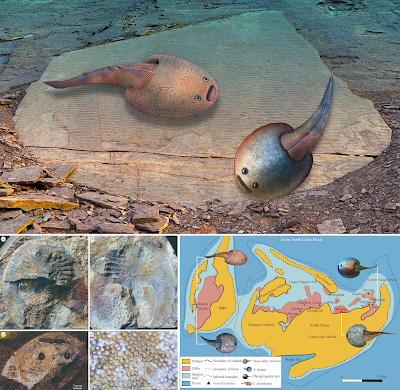
[PaleoIchthyology • 2026] Eosteus chongqingensis • The Oldest articulated Bony Fish from the early Silurian period


 Eosteus chongqingensis
Y.-A. Zhu, Chen, Li, Zhao, Zhou, Jia, Y.-L. Yu, H.-X. Yu, Wei, Ahlberg, Lu & M. Zhu, 2026

Life reconstruction by NICE PaleoVislab, IVPP

Abstract
Osteichthyans, comprising sarcopterygians and actinopterygians, dominate modern vertebrate biodiversity, yet their pre-Devonian fossil record remains scarce and fragmentary. The oldest articulated sarcopterygian and stem osteichthyan date to the late Silurian, whereas undisputed actinopterygian fossils in articulation appear only in the Middle Devonian. Here we report an articulated, near-complete osteichthyan from the early Silurian Chongqing Lagerstätte (approximately 436 million years ago), representing the oldest osteichthyan occurrence including microfossils. This tiny fish exhibits a fusiform, generalized osteichthyan body outline, with plesiomorphic osteichthyan characters, including the lack of lepidotrichia and the presence of serial median dorsal plates, pectoral and dorsal fin spines and an anal fin spine reported previously exclusively in stem chondrichthyans and one placoderm. It also displays features, such as a single dorsal fin and caudal fulcra, seen commonly in actinopterygians. Bayesian inference and the 50% majority rule consensus of the maximum-parsimony analysis place the new fish on the osteichthyan stem, whereas the strict consensus leaves its position unresolved within osteichthyans. This discovery increases Silurian osteichthyan diversity and further populates the osteichthyan stem group. The morphological disparity among early osteichthyans implies a more extensive Silurian to Early Devonian radiation of bony fishes than previous lines of evidence suggested.

Morphological evolution of early jawed vertebrates, showing the position of Eosteus and Megamastax among stem bony fishes. 


Eosteus chongqingensis

Life reconstruction of the oldest osteichthyan Eosteus chongqingensis.
 Credit: NICE PaleoVislab, IVPP


Life reconstruction of the biggest Silurian vertebrate Megamastax amblyodus.
Credit: Image by NICE PaleoVislab, IVPP

 
You-An Zhu, Yang Chen, Qiang Li, Wen-Jin Zhao, Zheng-Da Zhou, Lian-Tao Jia, Yi-Lun Yu, Han-Xin Yu, Guang-Biao Wei, Per E. Ahlberg, Jing Lu and Min Zhu. 2026. The Oldest articulated Bony Fish from the early Silurian period. Nature. 651; 128–134. DOI: doi.org/10.1038/s41586-026-10125-2 [04 March 2026]

Thursday, October 2, 2025

[Paleontology • 2025] Macromyzon siluricus • The First Leech Body Fossil predates estimated hirudinidan origins by 200 million years

 
Macromyzon siluricus 
de Carle​, Iwama, Wendruff, Babcock & Nanglu, 2025
 

Abstract
Clitellata is a major annelid clade comprising oligochaetes (e.g., earthworms) and hirudineans (e.g., leeches). Due to their scant fossil record, the origins of clitellates, particularly Hirudinea, are poorly known. Here, we describe the first leech body fossil, Macromyzon siluricus, gen. et sp. nov., from the Brandon Bridge Formation (Waukesha Lagerstätte). This fossil, which is preserved in exceptional detail, possesses several hirudinean soft-tissue synapomorphies–including a large sucker at the posterior end and sub-divided segments–and phylogenetic analyses resolve Macromyzon siluricus as a stem leech. Its age, 437.5–436.5 Ma, is consistent with early age estimates for the origin of clitellates, and predates molecular-clock-based estimates of hirudinidan origins by at least 200 million years. These findings suggest that the earliest true leeches were marine and that, contrary to prevailing hypotheses, were unlikely to have fed on vertebrate blood.

Macromyzon siluricus gen. et sp. nov. from the Lower Brandon Bridge Formation (Waukesha Lagerstätte), Silurian (Llandovery: Telychian), Waukesha, Wisconsin, USA.
(A) Holotype specimen UWGM 7056. (B) Schematic of the external morphology of Macromyzon siluricus based on the holotype. (C) Detail of the anterior region, dorsal view, showing sexannulate segments with annuli numbered; black arrows indicate putative tubercles. (D) Schematic of the anterior region showing tubercles in light grey and sexannulate segments with annuli numbered. (E) Schematic of segmentation pattern for M. siluricus. Green borders indicate extant Hirudinida introduced for comparison:
(F) Ventral view of Myxobdella sinanensis (Zoological Collection of Kyoto University, specimen KUZ Z1794); photo by T. Nakano. (G) Schematic of Haementeria lutzi (dorsal view) with inset showing the species’ segmentation pattern. This specimen is deposited in the collections of the Museum of Zoology of the University of São Paulo (MZUSP 0026).
Abbreviations: Ca, caudal sucker; S, segment; Tu, tubercles; Tu?, putative tubercles (metameric circular organs). White arrow indicates mid-body torsion, the point of torsion is shown in blue on schematics; breakage in the specimen is indicated in dark grey.

Phylogenetic analyses recover Macromyzon siluricus gen. et sp. nov. as a stem leech.
(C) Life reconstruction of Macromyzon siluricus. Illustration by E. K. Chan.

Phylum: Annelida, Lamarck 1809

Class: Clitellata, Michaelson 1919
Subclass: Hirudinea, Lamarck 1818

Genus: Macromyzon gen. nov.

 Macromyzon siluricus sp. nov.
 
Etymology: Macromyzon (gender: masculine), from Greek, makros, “large” + myzon, “sucker” in reference to the large caudal appendage. The specific epithet refers to the Silurian age of the fossil.
 
Locality: Waukesha Lime and Stone Company, west quarry, north of State Highway 164, Waukesha, Wisconsin, USA.

Stratigraphic occurrence: Lower part of the Brandon Bridge Formation (Silurian: Llandovery, Telychian; Mikulic & Kluessendorf, 1999).
 
Diagnosis: Hirudinean having a vermiform-sublanceolate shape, truncated anteriorly, width expanding toward posterior, reaching maximum width slightly anterior of margin. Posterior margin approximately twice the width of anterior margin. Body segmented, with regularly spaced, sexannulate divisions. Posterior terminates in a large caudal sucker. The genus is monospecific; the diagnosis applies to both genus and species.

 
Danielle de Carle​, Rafael Eiji Iwama, Andrew J. Wendruff, Loren E. Babcock and Karma Nanglu. 2025. The First Leech Body Fossil predates estimated hirudinidan origins by 200 million years. PeerJ. 13:e19962. DOI: doi.org/10.7717/peerj.19962 [October 1, 2025]

Tuesday, August 5, 2025

[Paleontology • 2025] Ciurcalimulus discobolus • The first Silurian horseshoe crab reveals details of the xiphosuran ground plan

 
 Ciurcalimulus discobolus
Lamsdell, 2025


Abstract
Horseshoe crabs are an ancient lineage with an evolutionary history stretching back 450 million years and are generally considered to be examples of ‘living fossils’ exhibiting slow rates of evolution. Despite this reputation, relatively little is known of the early evolution of the group, with only two species described from the Ordovician and a subsequent 80-million-year gap in their fossil record until xiphosurids appear in the Late Devonian. Furthermore, all described Ordovician species are assigned to a single genus, with their close phylogenetic relatedness rendering it unclear whether their morphology is representative of the horseshoe crab ground pattern or an independently derived condition. Here, a new species of horseshoe crab is described from the Silurian of Indiana, USA. The new species bridges the temporal gap in the xiphosuran fossil record and has an overall morphology similar to that of the Ordovician taxa. These new data provide critical information on the ancestral morphology of horseshoe crabs, showing that xiphosurids evolved from forms with a fused thoracetron exhibiting axial segment boundaries, and demonstrate the persistence of basal Xiphosura into the Silurian. Laser-stimulated fluorescence is also shown to be an effective method for studying and imaging arthropod fossils exhibiting challenging preservation.

Keywords: Ciurcalimulus, ground plan, horseshoe crab, laser stimulated fluorescence, Silurian, Xiphosura, Xiphosurida
 
 Ciurcalimulus discobolus gen. et sp. nov., holotype (YPM IP 548961).
(a) Imaged dry under polarized light, showing specimen relief. (b) Imaged immersed in ethanol under polarized light, providing greater contrast of the carbonized cuticle. (c) Interpretive drawing of specimen. Carbonized cuticle is shown in brown, damaged or incomplete margins by dashed lines.
 (d) Imaged under ultraviolet light, exhibiting fluorescence of both the carbonized cuticle and to a lesser extent the exfoliated regions of the fossil, affording the clearest view of the segment boundaries in the thoracetron axis. (e) Imaged under 447 nm blue laser, with carbonized cuticle and exfoliated regions again both fluorescing. The outline of the fossil is most readily apparent here as is the morphology of the cardiac lobe. (f) Imaged under 532 nm green laser, clearly showing the location of carbonized cuticle via strong fluorescence. Scale bars = 5 mm.

Arthropoda Gravenhorst, 1843 

Chelicerata Heymons, 1901 
Xiphosura Latreille, 1802 

Ciurcalimulus discobolus gen. et sp. nov.
 
Etymology. The genus is named for the late Sam Ciurca, a prolific collector and avocational palaeontologist who discovered the specimen in 1975. The species name refers to the ancient Greek sculpture by Myron in reference to the extremely rounded, discus-like form of the prosoma and thoracetron.

Holotype. YPM IP 548961 (Yale Peabody Museum, Invertebrate Paleontology), complete specimen in dorsal view preserving the prosomal carapace, thoracetron, postabdomen and telson (figures 1 and 2).


Diagnosis. Xiphosuran with semicircular prosomal carapace bearing curved genal spines that reach almost to thoracetron posterior; prosomal carapace bearing crescentic lateral eyes located centrimesially; prosomal cardiac lobe quadrate with rounded anterior, well expressed with margins defined by furrows; anterior two opisthosomal segments short and freely articulating; thoracetron semicircular, approximately equal in length to the prosomal carapace, comprising up to six fused body segments with segmental boundaries expressed axially; postabdomen comprising up to five free articulating segments including an elongated pretelson; telson equal in length to entire body, lanceolate in shape with bifurcate termination.


James C. Lamsdell. 2025. The first Silurian horseshoe crab reveals details of the xiphosuran ground plan. Proc. R. Soc. B. 292: 20250874. DOI: doi.org/10.1098/rspb.2025.0874  [18 June 2025]

Thursday, February 27, 2025

[PaleoIchthyology • 2021] Jiangxialepis retrospina • The Oldest eugaleaspiform (Galeaspida) from the Silurian Fentou Formation (Telychian, Llandovery) of Wuhan, South China


Jiangxialepis retrospina Liu, Huang, Zong & Gong, 2021; 

 interpretative drawings of A, Shuyu zhejiangensis Pan, 1986; B, Jiangxialepis retrospina gen. et sp. nov.; C, Meishanaspis lehmani Wang, 1991.


 Abstract
A new genus of Eugaleaspidiformes (Galeaspida, Agnatha), Jiangxialepis gen. nov., is described from the Llandovery (Silurian) Fentou Formation from Wuhan, Hubei, South China. The new genus belongs to the family Shuyuidae, as evidenced by the splayed posterior supraorbital canals, absence of ‘U’-shaped median dorsal canals, and three lateral transverse canals issuing from the infraorbital canals. The new genus possesses a middle dorsal spine, which is found in eugaleaspidiforms for the first time. Jiangxialepis differs from other genera of Shuyuidae based on the following characteristics: presence of a middle dorsal spine, the anterior end of the median dorsal opening slightly disrupting the rostral margin of the head shield, large oval orbital openings, pineal opening level with the centre of the orbital opening, and seven lateral transverse canals on each side. The new genus is the first discovery of a eugaleaspidiform in the Fentou Formation, which extends the age of eugaleaspiforms to the middle Telychian and illuminates the early morphological conditions of the Eugaleaspidiformes. Cladistic analysis shows that the new genus is the most primitive group of Eugaleaspidiformes (Shuyuidae) and forms a trichotomy with Shuyu and Meishanaspis. We interpret Jiangxialepis as a sub-demersal fish that lived in the brackish waters of an estuarine-deltaic environment.
 
Keywords: Jiangxialepis, Shuyuidae, Eugaleaspiformes, Fentou Formation, Silurian, Wuhan, South China

Photographs and interpretative drawing of Jiangxialepis retrospina gen. et sp. nov.
A, internal mould of a complete head shield, BGEG-JXD-07; B, external mould of a complete head shield, BGEG-JXD-06; C, external mould of an incomplete head shield, BGEG-JXD-01; D-F, interpretative drawings of A-C, respectively; G, external mould of an incomplete head shield, BGEG-JXD-04; H, interpretative drawing of G; I, synthetic restoration.
Abbreviations: c, corneal processes; dcm, dorsal commissure; ic, inner corneal processes; ldc, lateral dorsal canal; ifc, infraorbital canal; ltc a-c , a to c lateral transverse canal; ltc 1-4 , first to fourth lateral transverse canal; md.o, median dorsal opening; md.s, median dorsal spine; orb, orbital opening; pi, pineal opening; soc 2 , posterior supraorbital canal.

 Comparison of shuyuids. A, Shuyu zhejiangensis (Liu et al. 2015); B, Jiangxialepis retrospina gen. et sp. nov.; C, Meishanaspis lehmani (modified after Gai et al. 2005).

Jiangxialepis retrospina 
 
Reconstruction of the ecological environment for the middle Telychian galeaspids from Wuhan in South China.
1, Jiangxialepis; 2, Hanyangaspis; 3, algae; 4, lingulids; 5, eurypteri.


Yi-Long Liu, Lie-Bin Huang, Rui-Wen Zong and Yi-Ming Gong. 2021. The Oldest eugaleaspiform (Galeaspida) from the Silurian Fentou Formation (Telychian, Llandovery) of Wuhan, South China. Journal of Systematic Palaeontology. 19(4); 253-264. DOI: doi.org/10.1080/14772019.2021.1883755 

Monday, February 24, 2025

[PaleoIchthyology • 2024] Changxingaspis nianzhongi & C. gui • New Findings of Changxingaspis (Xiushuiaspidae: Galeaspida) from the Silurian of Tarim Basin and Zhejiang Province, China


Changxingaspis nianzhongi 
Li, Zhang, Lin, Zhu, Zhao, Tang, Shan & Gai, 2024


Abstract
New discovery of the early Silurian fossil fish Changxingaspis (Xiushuiaspidae, Galeaspida), Changxingaspis nianzhongi sp. nov. and C. gui, are described from the Tataertag Formation in Tarim Basin and the Kangshan Formation in Zhejiang Province, respectively. C. nianzhongi mainly differs from C. gui in the shape of the median dorsal opening that is transverse elliptic with a width/length ratio of about 3.0, the long lateral transverse canals extending to the lateral margin of the headshield, and the second lateral transverse canal with dichotomous branchings. Discovery of C. nianzhongi from the Tataertag Formation and C. gui from the Kangshan Formation provide direct evidence on the specific level for the correlation between these two formations, which further supports the Silurian fish-bearing red beds in northwest Zhejiang belonging to the Silurian Lower Red Beds (LRBs) rather than the Upper Red Beds (URBs). Additionally, as the first record of the Changxingaspis in Tarim Basin, it extends the paleogeographical distribution of this genus from the South China Block to the Tarim Block, providing new evidence to support faunal exchanges between these two blocks and the hypothesis of a united Tarim–South China Block during the early Silurian.

Keywords: vertebrate paleontology, Galeaspids, Changxingaspis, new taxon, Tataertag Formation, Kangshan Formation, Aeronian–Telychian, Tarim, Zhejiang


The paleogeographical distribution of Xiushuiaspidae on South China and Tarim blocks during the early Telychian, Llandovery, Silurian
(modified after Liu et al., 2023). 
Art credit: Yang Dinghua. 

Changxingaspis nianzhongi 


Xutong LI, Yumeng ZHANG, Xianghong LIN, Min ZHU, Wenjin ZHAO, Lizhou TANG, Xianren SHAN and Zhikun GAI. 2024. New Findings of Changxingaspis (Xiushuiaspidae, Galeaspida) from the Silurian of Tarim Basin and Zhejiang Province, China. Acta Geologica Sinica. 98(3); 531-540. DOI: doi.org/10.1111/1755-6724.15168

[PaleoIchthyology • 2023] Jiangxialepis rongi • The First Eugaleaspiforme Fish from the Silurian of the Tarim Basin reveals a close relationship between the Tarim and South China Blocks at 438 mya


Xiyuichthys zhangi [Xiushuiaspidae], Microphymaspis pani [Dayongaspidae], Platylomaspis serratus [Gumuaspidae], and
 Jiangxialepis rongi [Shuyuidae]  Liu, Shan, Lin, Shen, Liu, Zhang & Gai, 2023

 
Highlights: 
• The first Eugaleaspiforme fish, Jiangxialepis rongi sp. nov., is established.
• The Tataertag Formation can be correlated with the Qingshui Formation.
• Shuyuidae provided key evidence for the correlation of Silurian LRBs in China.
• 5 dispersal events between South China and Tarim blocks were recognized.
• South China and Tarim blocks should be closely related at 438 mya.

Abstract
The first Eugaleaspiforme fish, Jiangxialepis rongi sp. nov., from the lower Telychian (Llandovery, Silurian) Tataertag Formation in the Tarim Basin is described and its palaeogeographic significance is evaluated. The new species can be assigned to the family Shuyuidae and distinguished from J. retrospina and J. jiujiangensis by its comparatively broader headshield, ornamentation, and serrated margin of the headshield and median dorsal opening. The discovery of J. rongi provides direct fossil evidence for the correlation of lower Telychian marine red beds between the Tarim Basin and South China and expands our knowledge of the distribution of Eugaleaspiforme fish into the Tarim Basin. An analysis of galeaspid paleogeographic distribution within a phylogenetic framework reveals at least five galeaspid dispersal events between the blocks of South China and the Tarim Basin during the early Telychian age. This indicates that the South China and Tarim blocks were close enough to share the same shallow marine environment, and perhaps comprise a united Tarim-South China Block during the early Silurian.
  
Keywords: Silurian, Galeaspid, Tarim, South China, Biogeography

Xiyuichthys zhangi [Xiushuiaspidae], Microphymaspis pani [Dayongaspidae], Platylomaspis serratus [Gumuaspidae], and Jiangxialepis rongi [Shuyuidae] 

 Jiangxialepis rongi sp. nov.

 
Wenyu Liu, Xianren Shan, Xianghong Lin, Yiming Shen, Yuhang Liu, Zehao Zhang and Zhikun Gai. 2023. The First Eugaleaspiforme Fish from the Silurian of the Tarim Basin reveals a close relationship between the Tarim and South China Blocks at 438 mya. Palaeogeography, Palaeoclimatology, Palaeoecology. 628; 111774. DOI: doi.org/10.1016/j.palaeo.2023.111774

[PaleoIchthyology • 2023] Jiangxialepis jiujiangensis • A New Species of Jiangxialepis (Galeaspida) from the Lower Telychian (Silurian) of Jiangxi, China and its Biostratigraphic Significance


 Jiangxialepis jiujiangensis 
Shan, Zhao & Gai, 2023


Abstract
A new species of Shuyuidae (Eugaleaspiformes, Galeaspida), Jiangxialepis jiujiangensis sp. nov., is described from the lower Telychian (Llandovery, Silurian) Qingshui Formation in Jiujiang, Jiangxi Province, China. The new species differs from the type species J. retrospina from Wuhan, Hubei Province in its sharp and posteriorly positioned median dorsal spine and narrow spine-shaped inner cornual processes. The Silurian strata in Xiushui–Wuning area has provided a standard framework for the correlation of Silurian shallow marine red beds in South China. Thus, the finding of J. jiujiangensis from the Silurian Lower Red Beds (LRBs) in Jiangxi Province bears very important biostratigraphic significance. It can directly compare to Jiangxialepis retrospina from the Fentou Formation in Wuhan, Hubei Province in the genus level. This indicates that the age of the fish-bearing strata in Wuhan is most likely to be the early Telychian rather than middle Telychian as previously assumed.

Keywords: Galeaspids, Qingshui Formation, Lower Red Beds, Silurian, Jiangxi Province


Restoration of Jiangxialepis jiujiangensis sp. nov. and Jiangxialepis retrospina.
Art credit: Shi Aijuan.


Jiangxialepis jiujiangensis sp. nov.


Xianren Shan, Wenjin Zhao and Zhikun Gai. 2023. A New Species of Jiangxialepis (Galeaspida) from the Lower Telychian (Silurian) of Jiangxi and its Biostratigraphic Significance. Acta Geologica Sinica. DOI: doi.org/10.1111/1755-6724.15009
x.com/PDChina/status/1662658703215165442
https://news.sciencenet.cn/htmlpaper/2023/5/202351211301219581774.shtm


Monday, January 6, 2025

[PaleoIchthyology • 2024] Miaojiaaspis dichotomus • A New Genus of galeaspids (Eugaleaspiformes: Tujiaaspidae) from the early Silurian Chongqing Lagerstätte, China


Miaojiaaspis dichotomus 
Chen, Li, Zhou, Shan, Y.-A. Zhu, Wang, Wei & M. Zhu, 2024


The early Silurian Chongqing Lagerstätte (middle Telychian) yields exceptionally preserved articulated jawless and jawed fishes. Here, we describe a new eugaleaspiform (Galeaspida, jawless stem-Gnathostomata), Miaojiaaspis dichotomus gen. et sp. nov., from the Chongqing Lagerstätte in Xiushan, Chongqing, China. The new form resembles Tujiaaspis vividus in the short medial dorsal canal, and the presence of the branching ends of the lateral transverse canal. They differ in that T. vividus has highly developed subordinate branches of the sensory canals that form a reticulate sensory canal system, and the median dorsal opening is more elongated. Our phylogenetic analysis recovers M. dichotomus and T. vividus as a monophyletic clade (Tujiaaspidae fam. nov.), which is supported by two synapomorphies: the short medial dorsal canal, and the branching ends of the lateral transverse canal. Tujiaaspidae forms a trichotomy with Shuyuidae and a clade comprising Anjiaspis, Sinogaleaspidae, Yongdongaspidae, and the ‘eugaleaspid cluster’. The sensory canal patterns in galeaspids are compared to show the transformation sequence of the sensory canal system in Eugaleaspiformes.

Photographs (A, C) and interpretative drawings (B, D) of Miaojiaaspis dichotomus gen. et sp. nov. from Xiushan, Chongqing
A, B. an incomplete internal mold of the headshield with the trunk articulated, CIGMR V0125a; C, D. an incomplete external mold of the headshield with the trunk articulated, holotype, CIGMR V0125b

Subclass Galeaspida Tarlo, 1967
Order Eugaleaspiformes (Liu, 1965) Liu, 1980

Family Tujiaaspidae fam. nov.
Type genus Tujiaaspis Gai et al., 2022.

Referred genus Miaojiaaspis gen. nov.
Differential diagnosis Tujiaaspidae differs from other families of Eugaleaspiformes in the short medial dorsal canal, and the branching ends of the lateral transverse canal.

Remarks Our phylogenetic analysis shows that M. dichotomus and T. vividus form a monophyletic clade supported by two synapomorphies.


Genus Miaojiaaspis gen. nov.
Type species Miaojiaaspis dichotomus sp. nov.

Etymology From Miaojia, Pinyin for the Miao People, a minority ethnic group in China, which is one of the two main autonomous minority ethnic groups in Xiushan County, Chongqing, and aspis (Gr.), shield.

Differential diagnosis M. dichotomus differs from T. vividus in a more subtriangular headshield, no highly developed subordinate branches of sensory canals and a shorter median dorsal opening.

Miaojiaaspis dichotomus sp. nov.
Holotype An incomplete headshield with the trunk articulated, CIGMR V0125a, b (Figs. 2–3).
Referred specimens 8 complete headshields, CIGMR V0126–V0129, IVPP V28714–V28717 (Fig. 4).


Etymology From dichotomus (Latin), referring to the dichotomous ends of the lateral transverse canals.

Diagnosis Small-sized eugaleaspiform fish with a subtriangular headshield. Spine-shaped cornual and inner cornual processes caudo-laterally or caudally oriented. Longitudinal oval-like median dorsal opening. Pineal opening positioned behind the posterior margin of the orbits. Funnel-shaped supraorbital canals. Short medial dorsal canal. 


CHEN Yang, LI Qiang, ZHOU Zheng-Da, SHAN Xian-Ren, ZHU You-An, WANG Qian, WEI Guang-Biao, ZHU Min. 2024. A New Genus of galeaspids (jawless stem-Gnathostomata) from the early Silurian Chongqing Lagerstätte, China. Vertebrata Palasiatica. 62(4); 245-261.  DOI: 10.19615/j.cnki.2096-9899.240820 

Tuesday, November 7, 2023

[Paleontology • 2023] Rotaciurca superbus • A Silurian pseudocolonial pterobranch


Rotaciurca superbus
Briggs & Koch, 2023

 
Summary
Pterobranchs, a major group of the phylum Hemichordata, first appear in the fossil record during the Cambrian, and there are more than 600 fossil genera dominated by the mainly planktic graptolites of the Paleozoic, which are widely used as zone fossils for correlating sedimentary rock sequences. Pterobranchs are rare today; they are sessile marine forms represented by Rhabdopleura, which is considered the only living graptolite, and Cephalodiscus. Unlike their sister taxon, the colonial graptolites, cephalodiscids are pseudocolonial. Here, we describe a problematic fossil from the Silurian (Pridoli) Bertie Group of Ontario (420 mya), a sequence of near-shore sediments well known for its remarkably preserved diversity of eurypterids (sea scorpions).5 The fossil, Rotaciurca superbus, a new genus and species, was familiarly known as Ezekiel’s Wheel,5 with reference to the unusual circular arrangement of the tubes that compose it. The structure and arrangement of the tubes identify Rotaciurca as a pterobranch, and phylogenetic analysis groups it with the cephalodiscids. We place it in a new family Ezekielidae to distinguish it from Cephalodiscidae. A large structure associated with the tubes is interpreted as a float, which would distinguish Rotaciurca as the only known planktic cephalodiscid—thus cephalodiscids, like the graptolites, invaded the water column. This mode of life reflects the rarity of pseudocolonial macroinvertebrates in planktic ocean communities, a role occupied by the tunicates (Chordata) known as salps today. Our estimates of divergence times, the first using relaxed total-evidence clocks, date the origins of both hemichordates and pterobranchs to the earliest Cambrian (Fortunian).


 Derek E.G. Briggs and Nicolás Mongiardino Koch. 2023. A Silurian pseudocolonial pterobranch. Current Biology. In Press, DOI: 10.1016/j.cub.2023.10.024

The last turn of ‘Ezekiel’s Wheel’ honors a Yale-affiliated fossil hunter
Yale paleontologists have identified a “problematic” fossil as an ancient sea creature that lived in the plankton 420 million years ago.


Sunday, October 16, 2022

[PaleoIchthyology • 2022] Tujiaaspis vividus • Galeaspid Anatomy and the Origin of Vertebrate Paired Appendages


Tujiaaspis vividus
Gai, Li, Ferrón, Keating, Wang, Donoghue & Zhu, 2022


Abstract
Paired fins are a major innovation that evolved in the jawed vertebrate lineage after divergence from living jawless vertebrates. Extinct jawless armoured stem gnathostomes show a diversity of paired body-wall extensions, ranging from skeletal processes to simple flaps. By contrast, osteostracans (a sister group to jawed vertebrates) are interpreted to have the first true paired appendages in a pectoral position, with pelvic appendages evolving later in association with jaws. Here we show, on the basis of articulated remains of Tujiaaspis vividus from the Silurian period of China, that galeaspids (a sister group to both osteostracans and jawed vertebrates) possessed three unpaired dorsal fins, an approximately symmetrical hypochordal tail and a pair of continuous, branchial-to-caudal ventrolateral fins. The ventrolateral fins are similar to paired fin flaps in other stem gnathostomes, and specifically to the ventrolateral ridges of cephalaspid osteostracans that also possess differentiated pectoral fins. The ventrolateral fins are compatible with aspects of the fin-fold hypothesis for the origin of vertebrate paired appendages. Galeaspids have a precursor condition to osteostracans and jawed vertebrates in which paired fins arose initially as continuous pectoral–pelvic lateral fins that our computed fluid-dynamics experiments show passively generated lift. Only later in the stem lineage to osteostracans and jawed vertebrates did pectoral fins differentiate anteriorly. This later differentiation was followed by restriction of the remaining field of fin competence to a pelvic position, facilitating active propulsion and steering.


Systematic palaeontology
Class Galeaspida Tarlo, 1967
Order Eugaleaspidiformes Liu, 1980

Tujiaaspis vividus gen. et sp. nov.

Etymology. The genus name tujia, Pinyin for the Tujia people, a minority ethnic group in China, in reference to the two fossil sites located in Xiangxi Tujia, Miao Autonomous Prefecture, Hunan Province, and Xiushan Tujia, Miao Autonomous County, Chongqing Municipality; aspis (Gr.), shield; and species name vividus (L.), spiritedfull of life.

Holotype. A nearly complete fish accessioned as Institute of Vertebrate Paleontology and Paleoanthropology (IVPP) V26668 (Fig. 1).


Zhikun Gai, Qiang Li, Humberto G. Ferrón, Joseph N. Keating, Junqing Wang, Philip C. J. Donoghue and Min Zhu. 2022.  Galeaspid Anatomy and the Origin of Vertebrate Paired Appendages. Nature. 609, 959–963. DOI: 10.1038/s41586-022-04897-6
bristol.ac.uk/biology/news/2022/dead-fish-breathes-new-life-into-the-evolutionary-origin-of-fins-and-limbs.html

Thursday, October 6, 2022

[PaleoIchthyology • 2022] Xiushanosteus mirabilis & Shenacanthus vermiformis • The Oldest Complete Jawed Vertebrates from the early Silurian of China


Xiushanosteus mirabilis Zhu, Li, Ahlberg & Zhu, 
 
in Zhu, Li, Lu, Chen, ... Ahlberg et Zhu, 2022.

Abstract
Molecular studies suggest that the origin of jawed vertebrates was no later than the Late Ordovician period (around 450 million years ago (Ma)). Together with disarticulated micro-remains of putative chondrichthyans from the Ordovician and early Silurian period these analyses suggest an evolutionary proliferation of jawed vertebrates before, and immediately after, the end-Ordovician mass extinction. However, until now, the earliest complete fossils of jawed fishes for which a detailed reconstruction of their morphology was possible came from late Silurian assemblages (about 425 Ma). The dearth of articulated, whole-body fossils from before the late Silurian has long rendered the earliest history of jawed vertebrates obscure. Here we report a newly discovered Konservat-Lagerstätte, which is marked by the presence of diverse, well-preserved jawed fishes with complete bodies, from the early Silurian (Telychian age, around 436 Ma) of Chongqing, South China. The dominant species, a ‘placoderm’ or jawed stem gnathostome, which we name Xiushanosteus mirabilis gen. et sp. nov., combines characters from major placoderm subgroups and foreshadows the transformation of the skull roof pattern from the placoderm to the osteichthyan condition. The chondrichthyan Shenacanthus vermiformis gen. et sp. nov. exhibits extensive thoracic armour plates that were previously unknown in this lineage, and include a large median dorsal plate as in placoderms combined with a conventional chondrichthyan bauplan. Together, these species reveal a previously unseen diversification of jawed vertebrates in the early Silurian, and provide detailed insights into the whole-body morphology of the jawed vertebrates of this period.

Systematic palaeontology  
Gnathostomata Gegenbaur, 1874


Xiushanosteus mirabilis Zhu, Li, Ahlberg and Zhu gen. et sp. nov.

Etymology. Xiushan county, where the fossils were discovered, and osteus (Latin), bone; mirabilis (Latin), miracle, referring to the miraculous discovery of complete jawed vertebrates from the early Silurian.

Holotype. Institute of Vertebrate Paleontology and Paleoanthropology (IVPP) V300001, part and counterpart of a complete fish.

Referred material. A total of 20 individuals, catalogued as IVPP V300002–V300021.

Locality and horizon. Yongdong, Xiushan county, Chongqing, China; Huixingshao Formation, middle-to-late Telychian, Llandovery, Silurian, about 436 Ma (Extended Data Figs. 1 and 2 and Supplementary Information). The horizon yields fossils of diverse jawless and jawed fishes (Extended Data Fig. 3a–d), including the two taxa described here. The Lagerstätte features many head-to-tail fishes with fine details such as the complete fin web and possible vertebral column cartilage (Extended Data Fig. 3e). Furthermore, fossils of eurypterids (Fig. 1c,d) and phyllocarid crustaceans (Extended Data Fig. 3f), as well as algal fragments were also discovered alongside the fish fauna.


Chondrichthyes Huxley, 1880

Shenacanthus vermiformis Zhu, Li, Ahlberg and Zhu gen. et sp. nov.

Etymology. In honour of Congwen Shen, a distinguished writer who located his most famous story Border Town (Biancheng) at Hong’an Biancheng, close to the fossil site. Greek akantha, a thorn. Species name, Latin vermiformis, referring to the worm-like ornament on the median dorsal plates.

Holotype. IVPP V300000, the only known specimen of the genus and species, part and counterpart of a near-complete fish.

Locality and horizon. The same as for X. mirabilis.

Diagnosis. Small chondrichthyan, approximately 22 mm from the rostrum to the anal fin. Fusiform body shape; small cranium (~3.5 mm from the rostrum to the shoulder girdle) with blunt rostrum; dentition absent; branchial region posteriorly positioned in relation to the cranium; branchiostegal and hyoidean plates absent, shoulder girdle covered in large dermal plates both dorsally and ventrally, two median dorsal plates, the anterior one smaller and oblate, the posterior one larger and teardrop-shaped, with vermiform ornament; paddle-like pectoral fins lacking fin spine; Anal fin also lacking fin spine. Small, diamond-shaped scales. Small scutes or dermal plates with linear ornament along the dorsal and ventral midlines.

 
You-an Zhu, Qiang Li, Jing Lu, Yang Chen, Jianhua Wang, Zhikun Gai, Wenjin Zhao, Guangbiao Wei, Yilun Yu, Per E. Ahlberg and Min Zhu. 2022. The Oldest Complete Jawed Vertebrates from the early Silurian of China. Nature. 609; 954–958. DOI: 10.1038/s41586-022-05136-8
https://phys.org/news/2022-09-fish-fossil-china-oldest-teeth.html