Showing posts with label Central Africa. Show all posts

Thursday, March 12, 2026

[Mammalogy • 2026] Afronycteris rautenbachi • A New Species of African Pipistrelle-like Bat (Chiroptera: Vespertilionidae: Afronycteris)


Afronycteris rautenbachi
Kearney, de Vries & Markotter, 2026 


Abstract 
The taxonomy of the small, sub-Saharan, insectivorous bat, Afronycteris helios (Heller, 1912), has been unresolved for decades. The name A. cf. helios was introduced in the literature to recognise bats found in east and southern Africa that were like A. helios but had glands on the uropatagium. Cranio-dental morphology, bacular morphology, and molecular genetics (albeit the latter two being without representation of A. helios), provided evidence to formally describe “A. cf. helios”, which is currently known from Kenya, Mozambique, and South Africa. Bayesian analyses based on cytochrome oxidase b, cytochrome c oxidase subunit 1, and 12S rRNA confirm that it belongs to the genus Afronycteris with A. nanus (Peter, 1852) and A. helios. These analyses also revealed genetic, bacular, and cranio-dental morphological differences within A. nanus, which are described here. Pending a more thorough geographic analysis, including all existing synonyms, A. cf. nanus has been introduced to refer to bats that were smaller than A. nanus. Although co-occurring in north-eastern parts of South Africa, A. cf. nanus has a more westerly distribution extending to west Africa, relative to the more easterly distribution of A. nanus. Afronycteris sp. nov. showed at least a 6.9%, 3.4% and 2.9% nucleotide difference to its nearest relative based on cytochrome oxidase b, cytochrome c oxidase subunit 1, and 12S rRNA respectively. It is cranio-dentally smaller than A. helios, slightly smaller than A. nanus, and larger than A. cf. nanus, with a distinct baculum, and a unique pair of glands on the uropatagium.

Mammalia, molecular genetics, taxonomy, morphology, Afronycteris nanusAfronycteris helios, Kruger National Park

Lateral head and shoulder view of Afronycteris rautenbachi in the hand, of the holotype TM 48535 (left), and TM 48537 (right), both from South Africa, Limpopo province, Kruger National Park, Makuleka Contract Park.

Images of ears (above) and tragi (below) of  Afronycteris rautenbachi, TM 48537 (left) and A. cf. nanus TM 48572 (right), both from South Africa, Limpopo province, Kruger National Park, Makuleka Contract Park.

Dorsal ventral and lateral views of the cranium and a lateral view of the mandible of the holotype, TM 48535, of Afronycteris rautenbachi from South Africa, Limpopo province, Kruger National Park, Makuleka Contract Park. All images were scaled to the same size. Scale bar = 3 mm.

Afronycteris rautenbachi sp. nov.

Diagnosis. Afronycteris rautenbachi is a small Vespertilionidae and among the smallest of the Vespertilionini, being most similar in size and appearance to A. nanus, A. cf. nanus and A. helios. Afronycteris rautenbachi has a pair of glands on the uropatagium on either side of the tail, near the body (Figure 7).

Etymology. This species is named in honour of Igantius (“Naas”) L. Rautenbach (1942–2024) who was head of the mammal section at Ditsong National Museum of Natural History (formerly Transvaal Museum) from 1968 to 1991, and then the director of the museum from 1991 to 1999. He conducted extensive field research on southern African mammals, including the northern part of the Kruger National Park, which considerably increased the size of the museum collection. Over the years he managed various research collaborations that started with field collection and resulted in numerous publications. The proposed English common name is Kruger tail-gland bat.


Teresa KEARNEY, Marinda DE VRIES and Wanda MARKOTTER. 2026. Description of A New Species of African Pipistrelle-like Bat (Chiroptera: Vespertilionidae: Afronycteris). Zootaxa. 5768(1); 1-28. DOI: doi.org/10.11646/zootaxa.5768.1.1 [2026-03-09]


Wednesday, October 1, 2025

[Mammalogy • 2025] Pipistrellus etula • Taxonomic Revision of African pipistrelle-like Bats (Chiroptera: Vespertilionidae) with A New Species from the West Congolean Rainforest


Pipistrellus etula
Torrent, Juste, Garin, Aihartza, Dalton, Mamba, Tanshi, Powell, Padidar, Mudarra, Richards & Monadjem, 2025

Bioko pipistrelle  ||  DOI: doi.org/10.1093/zoolinnean/zlaf020 

Abstract
The taxonomic conundrum of pipistrelle-like or pipistrelloid bats remains one of the unsolved challenges posed by African Chiroptera. Historically, their cryptic morphology has led to a frequently confused classification and cast doubt on taxonomic arrangements at both genus and species levels. While molecular analyses and extensive reviews of specimens housed in collections worldwide have clarified many systematic relationships among pipistrelloid bats, some species still require validation, leaving gaps in our overall understanding of the systematics of the group. The Congo rainforest, one of Africa's least explored regions, remains underrepresented in systematic studies of pipistrelloid bats. In this study, we combine the use of two mitochondrial genes and cranial morphometric analyses to provide an updated perspective on African pipistrelloid bats, focusing on new material from Equatorial Guinea sampled over multiple years. We confirm the placement of Afmusciculus and Afcrassulus within the genus Afropipistrellus. The former was previously included in Hypsugo, while the latter lacked generic confirmation. Additionally, we describe a new species of Pipistrellus from Bioko Island, Central Africa, uncovered during systematic bat surveys in the region. Further surveys in the Congo rainforest are needed to unveil African bat diversity and its phylogenetic relationships fully.

Africa, baculum, Chiroptera, genus revision, Mammalia, mitochondrial DNA, morphometrics, systematics, taxonomy


Portrait of a Pipistrellus etula sp. nov. female captured in Basilé Peak, Bioko Island, Equatorial Guinea.
Photo by Gerard Carbonell.

Family Vespertilionidae Gray, 1821 
Tribe Pipistrellini Tate, 1942 

Genus Pipistrellus Kaup, 1829 

Pipistrellus etula Torrent et al., sp. nov. 
Bioko pipistrelle 

Etymology: etula’ means island or nation in the language of the original Bubi people of Bioko Island.


Laura Torrent, Javier Juste, Inazio Garin, Joxerra Aihartza, Desiré L Dalton, Mnqobi Mamba, Iroro Tanshi, Luke L Powell, Sara Padidar, Juan Luis Garcia Mudarra, Leigh Richards and Ara Monadjem. 2025. Taxonomic Revision of African pipistrelle-like Bats with A New Species from the West Congolean Rainforest. Zoological Journal of the Linnean Society. 204(2); zlaf020, DOI: doi.org/10.1093/zoolinnean/zlaf020  [13 June 2025]

Friday, September 5, 2025

[Botany • 2025] Uvariopsis niangadoumae (Annonaceae)Passion and Combat on a Floral Stage: A New Species from Monts de Cristal, Gabon, with Notes on its Unique Pollination Ecology


Uvariopsis niangadoumae  Couvreur & Dagallier,

in Couvreur, Niangadouma, Nguimbit, Paradis, Dagallier, Baudoin-Huit, Collin, Haran et Droissart, 2025. 

Abstract
Background and aims – Gabon is a major centre of biodiversity. We describe a new species from the tropical plant family Annonaceae: Uvariopsis niangadoumae sp. nov., known from a single population in the Monts de Cristal National Park.

Material and methods – Field work was conducted to collect plant specimens and observe floral visitors. Pollen samples were collected and prepared for microscopic analysis. The phylogenetic tree of Uvariopsis was reconstructed using a maximum likelihood method and based on hundreds of nuclear markers. Pollination biology was studied using a DIY camera trap (PICT) placed near a female flower to record floral visitors and their behaviour for one full day. Several flower visitors were collected and identified using DNA barcoding.

Key results – Uvariopsis niangadoumae is a tree reaching five metres tall, characterized by strong-scented leaves, few-flowered cauliflorous foul-smelling flowers, and large pollen grains shed in tetrads. The species is endemic to a small area within the Monts de Cristal National Park. Phylogenetic analysis places U. niangadoumae within the “large-leaved clade” species complex with now five taxa. Pollination is diurnal, and the primary pollinator is a rove beetle (Staphylinidae), which uses the female flowers as a mating site, with males fighting for control of the flower. The rove beetles might be attracted by a chemical cue, the foul scent of the flowers, and visual cues, with the inner part of the petals resembling mushrooms.

Conclusion – These results emphasize once again the importance of the Monts de Cristal National Park for biodiversity and highlight conservation concerns for the newly described species. The new species is monitored regularly, especially for fruiting individuals, to support ex situ propagation. The Kinguélé Aval project maintains a conservation nursery with 56 species, including 20 individuals of this new species.

Keywords: camera trap, hydrological dam, IUCN conservation, plant-insect interactions, saprocantharophily, Staphylinidae

Uvariopsis niangadoumae, detail of male and female flowers. 
A. Detail of inner side of female (left) and male (right) flowers, one petal removed. B. Detail of female flower, one petal removed. C. Detail of inner side of one female petal. D. Old female flower. E. Detail of sepals on male flower. F. Young male flower, not at anthesis yet. 
From Couvreur 1803. Photos by Thomas L.P. Couvreur. Scale bars: A–D = 0.5 cm.

Uvariopsis niangadoumae, natural habit and vegetative characters.
A. Habitat along a small stream. B. General view. C. Young leaves, light green, dropping. D. Detail of adaxial side of leaf base. E. Detail of abaxial side of leaf base.
From Couvreur 1803. Photos by Thomas L.P. Couvreur.

Uvariopsis niangadoumae, detail of fruits and flower visitors.
A. One monocarp. B. Longitudinal section of a single monocarp showing the seeds. C. Male flower with small Diptera visitors. D. Female flower with one large Staphylinidae beetle. F. Upper side of male flower covered with Crematogaster sp. ants. F. Male flower with large Staphylinidae beetle emerging covered in pollen.
 From Couvreur 1803. Photos by Thomas L.P. Couvreur. Scale bars: A, B = 1 cm.

 Uvariopsis niangadoumae Couvreur & Dagallier, sp. nov.
 
Diagnosis: Uvariopsis niangadoumae resembles U. korupensis in the shape and dimensions of its leaves and the overall size of the flowers. It differs by having strong scented leaves versus no clear scent in U. korupensis. Furthermore, U. niangadoumae bears no more than two, few-flowered inflorescences on small protrusions at the base of the trunk, whereas in U. korupensis the base of the trunk is densely covered with inflorescences. Flowers of U. niangadoumae have free petals with a length:width ratio between 1.3 and 1.7 vs fused at base and a l:w ratio between 2.2 and 7 in U. korupensis. Uvariopsis niangadoumae also has fewer carpels than U. korupensis (20–25 vs 25–120).

Etymology: This species is dedicated to the Gabonese botanist Raoul Niangadouma who participated in the (long and arduous) botanical inventories that led to the official recognition of the Monts de Cristal National Park. Raoul Niangadouma is also one of the collectors of the type specimen of this species.


 Thomas L.P. Couvreur, Raoul Niangadouma, Igor Nguimbit, Anne-Hélène Paradis, Léo-Paul M.J. Dagallier, Lola Baudoin-Huit, Myriam Collin, Julien M. Haran and Vincent Droissart. 2025. Passion and Combat on a Floral Stage: A New Species of Uvariopsis (Annonaceae) from Monts de Cristal, Gabon, with Notes on its Unique Pollination Ecology. Plant Ecology and Evolution. 158(2): 294-308. DOI: doi.org/10.5091/plecevo.152843

Sunday, August 17, 2025

[Ichthyology • 2025] Phylogenomics of African Labeo (Cypriniformes: Cyprinidae) emphasizing central African species


Live photographs of representative specimens of African Labeo species from the Congo and Lower Guinea ichthyofaunal provinces.
 a) Labeo nasus, b) Labeo falcipinnis, c) Labeo greenii, d) Labeo parvus,
e) Labeo weeksii, f) Labeo mbimbii, g) Labeo sp. 18, f) Labeo lukulae

Photos d, e, and g were taken in a photarium (photo tank) and the remaining photos were taken in plain air.
in Liyandja, Smith, Alter, Sidlauskas et Stiassny, 2025. 

Highlights: 
• A large-scale phylogenomic analysis of the genus Labeo using 2,697 UCEs is presented.
• The monophyly of African Labeo is supported, three main clades, & nine species groups are recovered.
• Interspecific relationships are well resolved & numerous previously unrecognized taxa identified.
• A time-calibrated tree & historical biogeography of the African Labeo are presented.
• Morphological synapomorphies are presented & discussed.

Abstract
Labeo constitutes the largest genus within the cyprinid tribe Labeonini with over 110 recognized species in Africa and Asia. The clade comprises a major component of the herbivore/detritivore guild with considerable socio-economic importance to artisanal and commercial fisheries. A pan-African distribution and wide variety of habitat occupancy make the group a model to investigate diversification patterns, eco-phenotypic variation, and biogeographical events underpinning their radiation at a continental scale. However, previous attempts to elucidate Labeo systematics using either molecular or morphological data have failed to produce congruent and robust results, and much taxonomic and nomenclatural confusion remains. Here we present the first phylogenomic analysis of the genus using 2,187 ultraconserved elements from 85 taxa, including 56 recognized species, 27 cryptic (candidate) species, and outgroups from the Asian Labeonini. Both concatenated and coalescence-based phylogenetic analyses strongly support monophyly of African Labeo and recover three major clades comprising at least nine species groups. Two main clades are pan-African, while the third is restricted to four ichthyofaunal provinces. With the single exception of the L. umbratus group, none of the previously proposed morphological groupings are resolved as monophyletic, suggesting rampant morphological convergence across the radiation. In this study, interspecific relationships are well resolved and time calibration results corroborate the key role of the Miocene in the radiation of African freshwater fishes. We identify numerous previously unrecognized taxa, and our study provides a much-needed framework for the taxonomic revision of Labeo, a task critical for the development of sound management of these important food fishes.
 
Keywords: African carps, Interspecific relationships, Ultraconserved elements (UCEs), Diversity, Classification (systematics)


Live photographs of representative specimens of African Labeo species from the Congo and Lower Guinea ichthyofaunal provinces.
 a) Labeo nasus, b) Labeo falcipinnis, c) Labeo greenii, d) Labeo parvus,
e) Labeo weeksii, f) Labeo mbimbii, g) Labeo sp. 18, f) Labeo lukulae.
Photos d, e, and g were taken in a photarium (photo tank) and the remaining photos were taken in plain air.


Tobit L.D. Liyandja, Brian T. Smith, S. Elizabeth Alter, Brian L. Sidlauskas and Melanie L.J. Stiassny. 2025. Phylogenomics of African Labeo (Cypriniformes: Cyprinidae) emphasizing central African species. Molecular Phylogenetics and Evolution. 108427. In Press. DOI: doi.org/10.1016/j.ympev.2025.108427 [5 August 2025]
 

Tuesday, July 8, 2025

[Entomology • 2025] Pterotiltus bioko • A New Species of Pterotiltus Karsch (Orthoptera: Acrididae: Oxyinae) from Equatorial Guinea


 Pterotiltus bioko Oumarou-Ngoute & Rowell, 

in Oumarou-Ngoute, Song, Mariño-Pérez, Woo, Linde et Rowell, 2025. 

Abstract
The genus Pterotiltus Karsch, 1893 currently contains 18 described species. The genus is distributed in West, Central, and East Africa from Ghana to the Congo basin as far as Western Uganda. Pterotiltus bioko sp. nov. is described from specimens recently collected on Bioko Island in Equatorial Guinea. A key to Pterotiltus species is provided.

Keywords: Caelifera, grasshopper, humid forest, new species, taxonomy, West-Central Africa

Habitus of Pterotiltus bioko sp. nov.
A. Male lateral view, road to Ureka, Reserva Cientifica de la Caldera de Luba, Bioko Island, 15-xii-2023; B. Male dorsal view, same data than A;
C. Female with red patches, lateral view, same data than A; D. Female with yellow patches, lateral view (maybe newly molted female), Pico Basile National Park, Bioko Island, 18-xii-2023;
E. Holotype, male for MfN, lateral view; F. Paratype, female for MfN, lateral view.

 Pterotiltus bioko Oumarou-Ngoute & Rowell, sp. nov.

Type locality.— Reserva Cientifica de la Caldera de Luba, Bioko Island, EQUATORIAL GUINEA.

Etymology.— Toponymic, referring to Bioko Island, Equatorial Guinea.


 Charly Oumarou-Ngoute, Hojun Song, Ricardo Mariño-Pérez, Brandon M. Woo, Jackson Linde and C.H.F. Rowell. 2025. A New Species of Pterotiltus Karsch (Orthoptera, Acrididae, Oxyinae) from Equatorial Guinea. Journal of Orthoptera Research. 34(2): 201-212. DOI: doi.org/10.3897/jor.34.141073

Monday, May 12, 2025

[Arachnida • 2024] Evarcha tsipikafotsy, E. vavannyangisy & Thyene volombavatanany • Three New Species of plexippine jumping spiders (Salticidae: Salticinae: Plexippini) from dry forest in Boeny Region, north-western Madagascar


[12-13] Evarcha tsipikafotsy,
[20-23] E. vavannyangisy 

 Murray, Escobar-Toledo & Pett, 2024 

Abstract
Despite being the most diverse family of spiders, Salticidae (jumping spiders) are poorly studied in Madagascar with only 47 of the total 105 species recorded in the last 100 years. Here, we describe three new species of Plexippini Simon, 1901 from dry forests in North-western Madagascar as part of an ongoing biomonitoring programme. This paper increases the number of species in the genus Evarcha Simon, 1902 from 93 to 95 and Thyene Simon, 1885 from 55 to 56. Additionally, we publish specimen records of Plexippus petersi (Karsch, 1878) from Madagascar for the first time. All new species are diagnosed and illustrated through photographs and drawings.

Key words: Afrotropics, discovery, Evarcha, new record, new species, taxonomy, Thyene
 
Evarcha tsipikafotsy sp. nov. in vivo images, male.
Photo credits: J.E.T.

Evarcha vavannyangisy sp. nov.
20–23 male holotype habitus 24, 25 male pedipalp 20 dorsal 21 lateral 22 frontal 23, 24 ventral 25 retrolateral. Scale bars: 1 mm (20–23); 0.5 mm (24, 25).


Evarcha tsipikafotsy sp. nov.
Evarcha vavannyangisy sp. nov.

 Thyene volombavatanany sp. nov.


 Katie I. Murray, Jaime Escobar-Toledo and Brogan L. Pett. 2024. Three New Species of plexippine jumping spiders (Salticidae, Salticinae, Plexippini) from dry forest in Boeny Region, north-western Madagascar. African Invertebrates. 65(2): 61-74. DOI: doi.org/10.3897/afrinvertebr.65.126810  

Tuesday, May 6, 2025

[Crustacea • 2025] Louisea cataracta • A New Species of Louisea Cumberlidge, 1994 (Brachyura: Potamonautidae: Liberonautinae), A Freshwater Crab from the Ekom-Nkam Waterfall, Cameroon


Louisea cataracta 
Ndongo, Rintelen, Clark & Cumberlidge, 2025  
     

 Abstract
A new species of Louisea Cumberlidge, 1994 (Brachyura: Potamonautidae: Liberonautinae) is described from the Nkam River below the Ekom Nkam Waterfalls, near Melong (5.06__°N, 10.03__°E), in the tropical rainforests of Cameroon. The new species is recognized by a unique combination of characters of the carapace, thoracic sternum, and male cheliped, and is supported as a separate lineage by a phylogenetic analysis of species of Louisea based on mtDNA (COI and 16S rRNA). Notes are provided on the ecology and the conservation of Louisea cataracta sp. nov..

Crustacea, Central Africa, taxonomy, Louisea cataracta n. sp., ecology, conservation 

 Louisea cataracta sp. nov.
A, Ekom-Nkam Waterfalls, the type locality. B, adult male holotype, CW 17.5 mm, Ekom-Nkam Waterfalls, Cameroon, ZMB Crust. 33410: whole animal, dorsal view. 

Louisea cataracta sp. nov. adult male holotype, CW 17.5 mm, Ekom-Nkam Waterfalls, Cameroon, ZMB Crust.33410:
A, carapace, frontal view; B, whole animal, dorsal view showing natural colour; C, cephalothorax, ventral view; D,carapace, dorsal view. 
 
Louisea cataracta n. sp.

Etymology. The species name, cataracta, is derived from the Latin for waterfall in reference to the Ekom Nkam waterfalls where the specimens were collected. The specific epithet is used as a Latin noun in apposition. 


Pierre A. Mvogo NDONGO, Thomas Von RINTELEN, Paul F. CLARK and Neil CUMBERLIDGE. 2025. A New Species of Louisea Cumberlidge, 1994, A Freshwater Crab from the Ekom-Nkam Waterfall, Cameroon (Brachyura: Potamonautidae: Liberonautinae).  Zootaxa. 5590(1); 113-123. DOI: doi.org/10.11646/zootaxa.5590.1.6 [2025-02-20]

Saturday, December 21, 2024

[Botany • 2024] Talbotiella couteronii (Leguminosae: Detarioideae) • A New gregarious Tree Species from Cameroon


Talbotiella couteronii  Sonké, M.Simo & Burgt,
 
in Sonké, Simo-Droissart, Bidault, Ngoula et van der Burgt. 2024. 

Abstract
Background and aims – For some time now, the forests of the Sanaga basin in Cameroon have been threatened by the construction of numerous hydroelectric dams. In anticipation to this construction work, botanical surveys were carried out, resulting in the discovery of many species new to science. One of these certainly belongs to the genus Talbotiella in Leguminosae.

Material and methods – This study is based on morphological observations on herbarium specimens, through detailed examination of 28 specimens of the new tree species as well as specimens of existing species of Talbotiella.

Key results – Talbotiella couteronii is described and illustrated. The new species resembles Talbotiella batesii but has fewer leaflets, 5–10 pairs; an inflorescence usually with fewer flowers, 5–12; and flowers with longer pedicels, 10–20 mm long. Talbotiella couteronii is endemic to Cameroon, where it is restricted to the middle Sanaga basin in the Central Region and the Littoral Region. It occurs gregariously in periodically flooded riverine forests. Talbotiella couteronii is preliminarily assessed as Endangered following the IUCN Red List categories and criteria. The genus Talbotiella now consists of 10 species; of which six species are endemic to Cameroon. A comparative table summarizes the main vegetative characteristics of the 10 species. This treatment also includes an update of the description of T. bakossiensis.

Keywords: Cameroon, conservation, Endangered species, IUCN Red List assessment


Talbotiella couteronii. A. Flowering branch. B. Infructescence with two pods; two seeds. C. Flower with a single bract, two bracteoles, four sepals and 10 stamens. D. Stipule. E. Leaflet lower side, with two glands. F. Leaf upper side, with nine pairs of leaflets.
A, E, F drawn from Sonké & Ngoula 7886 (K); B from Sonké & Ngoula 7889 (K); C from Sonké & Ngoula 7887 (K); D from Sonké & Ngoula 7888 (K). Drawing by Xander van der Burgt.

Talbotiella couteronii.
A. Opened flowers. B. Twig with inflorescences. C. Young leaves with stipules. D. Infructescence with two fruits. E. Immature fruits and five unripe seeds.
A from Sonké & Ngoula 7888; B from Sonké & Ngoula 7886; C from Sonké & Ngoula 7895; D, E from Sonké & Ngoula 7889.

Talbotiella couteronii Sonké, M.Simo & Burgt, sp. nov.
 
Diagnosis: This species closely resembles T. batesii, from which it differs by the number of bud scales (11–17 vs 3–5), narrower stipules (9–15 × 1–1.5 mm vs 13–15 × 2–2.5 mm) that are glabrous on both surfaces (vs pubescent outside along the midrib), usually fewer leaflets ((5–)6–9(–10) pairs vs 9–13 pairs), looser inflorescence with longer pedicels (10–20 mm vs 3–8.5 mm) and usually fewer flowers (5–12 vs 10–18), larger ovary (4–6 × 2–3 mm vs 1.5–3.5 × 1–1.3 mm), and larger seeds (14–21 × 10–15 × 2–3 mm vs 9–10 × 9–10 × 2–3 mm).

Etymology: This new species is named after Dr Pierre Couteron (Institut de Recherche pour le Développement, Montpellier, France) in recognition for his constant support to the first author.


 Bonaventure Sonké, Murielle Simo-Droissart, Ehoarn Bidault, Fernandez Ngoula, Xander M van der Burgt. 2024. Talbotiella couteronii (Leguminosae: Detarioideae), A New gregarious Tree Species from Cameroon. Plant Ecology and Evolution. 157(3): 407-416. DOI: doi.org/10.5091/plecevo.133256

Sunday, October 20, 2024

[Ichthyology • 2024] Enteromius cerinus & E. ruforum • Hidden Species Diversity in the Enteromius Cope, 1867 (Teleostei: Cyprinidae) from the Aruwimi Basin (Middle Congo) in the Okapi Wildlife Reserve (DR Congo)


Enteromius cerinus  &  E. ruforum
 Ilodiri, Huyghe, da Costa, Baba, Mizani & Vreven, 2024

 
Abstract
Two new African minnow species, Enteromius cerinus sp. nov. and Enteromius ruforum sp. nov., are described for science from the Angadiko River, a left-bank sub-affluent of first order of the Nepoko River, draining the north-eastern part of the Okapi Wildlife Reserve (OWR). Both new species belong to the group of Enteromius for which the last unbranched dorsal-fin ray is flexible and underrated. Within this morphological group, both are most similar to Enteromius kamolondoensis, especially in life colour pattern characteristics. However, Enteromius cerinus sp. nov. differs from E. kamolondoensis by its low number of circumpeduncular scales, 10–11 (vs. 12), low maximum body depth, 22.8%–25.7% standard length (Ls) (vs. 26.1%–30.0%), and long anterior and posterior barbel lengths, 32.6%–35.3% head length (LH) (vs. 23.6%–27.2%) and 41.6%–43.9% LH (vs. 30.3%–34.9%), respectively. Further, E. ruforum sp. nov. is also easily distinguished from E. kamolondoensis by its high maximum body depth, 30.6%–33.3% Ls (vs. 26.1%–30.0%), and small, isometric, eye diameter, 26.2%–28.0% LH (vs. 29.1%–31.9%). A barcoding study (mtDNA, cytochrome oxidase subunit I [COI]) revealed that specimens of both new species form lineages well differentiated from those of other available species. As such, (i) E. cerinus sp. nov. diverges from E. kamolondoensis by a K2P genetic distance (GD) of 10.3% and (ii) E. ruforum sp. nov. by a K2P GD of 11.2%. To the present day, the fish fauna of the left-bank sub-affluents of the Nepoko River, in general, remains poorly known or undocumented. Unfortunately, at the same time, multiple anthropogenic impacts are affecting this fauna, such as (i) the destruction of habitats along the river banks for agriculture and fishing and (ii) the use of illegal fishing practices, such as fishing with plant-based ichthyotoxins during ecopage, which is combined with dam building. As a result of the demographic growth, this ecopage results in overfishing and thus is threatening both new species in particular, but all other co-occurring fish species as well. Both new species, E. cerinus sp. nov. and E. ruforum sp. nov., should thus be considered Vulnerable (VU) according to IUCN criterion D2. It is therefore hoped that their discovery highlights the urgent need for a better protection and further in situ exploration of the reserve's freshwater (fish) biodiversity, in general, and that of those small sub-affluents, in particular.


Wilson Mayo Ilodiri, Charlotte E. T. Huyghe, Luis M. da Costa, Taylor Mambo Baba, Célestin Danadu Mizani and Emmanuel J. W. M. N. Vreven. 2024. Hidden Species Diversity in the Enteromius Cope, 1867 (Teleostei: Cyprinidae) from the Aruwimi Basin (Middle Congo) in the Okapi Wildlife Reserve (Democratic Republic of the Congo). Journal of Fish Biology. DOI: doi.org/10.1111/jfb.15883

Tuesday, June 4, 2024

[Herpetology • 2024] Rhampholeon bombayi, R. nalubaale, R. msitugrabensis, ... • Taxonomy of the Rhampholeon boulengeri Complex (Sauria: Chamaeleonidae): Five New Species from Central Africa’s Albertine Rift


Rhampholeon plumptrei
 Hughes, Behangana, Lukwago, Menegon, Dehling, Wagner, Tilbury, South, Kusamba & Greenbaum, 2024

 
Abstract
In a recent molecular study, the pygmy chameleon Rhampholeon boulengeri Steindachner, 1911 was shown to contain six genetically distinct, but phenotypically cryptic lineages. Phylogenetic analyses of genetic data demonstrated that several well-supported clades occurred in non-overlapping elevational ranges across the Albertine Rift in Central Africa. In order to resolve the taxonomy of the R. boulengeri complex, we examined the morphology of specimens representing all six genetic lineages, including the type specimens. Results supported the notion that the current taxonomy does not reflect species diversity and further uncovered the extent to which morphological differences were dissociated from genetic divergence in this complex. We formally describe five new species of Albertine Rift Rhampholeon, which reflects the species diversity more accurately within the region. All of the species are morphologically conserved and seem to exhibit a pattern of cryptic speciation similar to that observed in the genus and in other chameleon genera. Several of the new species are distributed in adjacent habitats, but occur in parapatry where they are separated by elevation, while species that overlap in elevation are allopatric. At least one of the new species exhibited bone fluorescence from its facial tubercles when examined under ultraviolet light, which is the first published account for the genus. Our results highlight the importance of investigating cryptic diversity using an integrative framework, especially for widespread species that look similar, and the description of these new species reinforces the Albertine Rift as one of the world’s richest biodiversity hotspots.

Reptilia, Biodiversity, Burundi, chameleon, Democratic Republic of the Congo, new species, reptile, Rwanda, Uganda


Rhampholeon bombayi (named or African explorer Sidi Mubarak Bombay)
Rhampholeon plumptrei (named for Andrew Plumptre)
Rhampholeon monteslunae (named for "Mountains of the Moon" aka Rwenzori Mountains)
R. msitugrabensis (named for Albertine Rift )
R. nalubaale (named for Luganda word for "godess")

 in Hughes, Tolley, Behangana, et al. 2018.  


Daniel F. Hughes, Mathias Behangana, Wilber Lukwago, Michele Menegon, J. Maximilian Dehling, Philipp Wagner, Colin R. Tilbury, Trisan South, Chifundera Kusamba and Eli Greenbaum. 2024. Taxonomy of the Rhampholeon boulengeri Complex (Sauria: Chamaeleonidae): Five New Species from Central Africa’s Albertine Rift.  Zootaxa. 5458(4); 451-494. DOI: 10.11646/zootaxa.5458.4.1
 x.com/AndyPlumptre/status/1796570211400990848

Daniel F. Hughes, Krystal A. Tolley, Mathias Behangana, Wilber Lukwago, Michele Menegon, J. Maximilian Dehling, Jan Stipala, Colin R. Tilbury, Arshad M. Khan and Chifundera Kusamba. 2018. Cryptic Diversity in Rhampholeon boulengeri (Sauria: Chamaeleonidae), A Pygmy Chameleon from the Albertine Rift Biodiversity Hotspot. Molecular Phylogenetics and Evolution. 122; 125-141. DOI: 10.1016/j.ympev.2017.11.015  

Monday, March 25, 2024

[Botany • 2024] Voacanga madureirae (Apocynaceae: Tabernaemontaneae) • A New Species from Atlantic Central Africa


Voacanga madureirae  Paiva, O.Lachenaud & Covelo,

in Lachenaud, Paiva, Covelo, Cheek et Onana. 2024. 
photos by Quentin Luke and Maria Do Céu Madureira.

Summary
A new species of Apocynaceae from Atlantic Central Africa, Voacanga madureirae Paiva, O.Lachenaud & Covelo, is mapped, described and illustrated. It occurs on the Gulf of Guinea islands of Príncipe (São Tomé and Príncipe) and Bioko (Equatorial Guinea) and in the highlands of western Cameroon. The new species differs from other African Voacanga by its calyx distinctly exceeding the corolla (vs shorter or at most equalling it). It is further separated from V. chalotiana Pierre ex Stapf by the presence of a row of colleters in the upper half of the calyx (not near the base) and from other Central African species by its syncarpous fruits and almost straight (not strongly twisted) corolla tube. It is assessed as Near Threatened according to IUCN criteria.

Key Words: Bioko, Cameroon, Equatorial Guinea, Gulf of Guinea islands, São Tomé and Príncipe, Tabernaemontaneae.

Voacanga madureirae. A flowers, Q. Luke 13274; B fruit, M. C. Madureira & Equipa Proj. Pagué III 87; C fruit cut in two halves, showing the inside, M. C. Madureira & M. Sebastião 3 MCM.
photos: A Quentin Luke, B – C Maria Do Céu Madureira.

Voacanga madureirae Paiva, O.Lachenaud & Covelo sp. nov. 

RECOGNITION. Voacanga madureirae is easily recognised by its syncarpous fruits, its almost straight (not strongly twisted) corolla tube, and its calyx distinctly exceeding the corolla and bearing inside a dense row of colleters in the upper half of the tube. The first two characters are also found in V. chalotiana Pierre ex Stapf, which, however, has a smaller calyx, bearing a row of colleters near the base and much exceeded by the corolla. All other Central African species of Voacanga have apocarpous fruits, strongly twisted corolla tubes and a corolla usually exceeding the calyx, or equalling it in V. diplochlamys K.Schum., which, however, has puberulous stems and inflorescence while these parts are glabrous in V. madureirae.


Olivier Lachenaud, Jorge Paiva, Filipe Covelo, Martin Cheek and Jean Michel Onana. 2024. Voacanga madureirae (Apocynaceae), A New Species from Atlantic Central Africa. Kew Bulletin. DOI: 10.1007/s12225-024-10179-3

Thursday, January 18, 2024

[Arachnida • 2024] Thiratoscirtus iyomii, T. kalisia & T. khonvoum • Three New Species of Thiratoscirtus (Araneae: Salticidae: Thiratoscirtinae) from Central African Rainforest


Thiratoscirtus iyomii
Pett, Iyomi & Mbende, 2024

 
Abstract
Three new species of Thiratoscirtus are described from Salonga National Park, D.R. Congo: Thiratoscirtus iyomii (♂♀), T. kalisia (♀) and T. khonvoum (♀). All species were caught on the forest floor during a rapid biodiversity inventory and represent the second report of spider collections from the largest protected tropical rainforest reserve in Africa.

Araneae, Salonga National Park, D.R. Congo, jumping spiders, leaf litter


Brogan L. Pett, Dieu Merci Mpongo Iyomi and Menard Mbende. 2024. Discovery of Three New Species of Thiratoscirtus (Araneae: Salticidae: Thiratoscirtinae) from Central African Rainforest.   Zootaxa. 5399(2); 155-162. DOI: 10.11646/zootaxa.5399.2.4

Tuesday, September 26, 2023

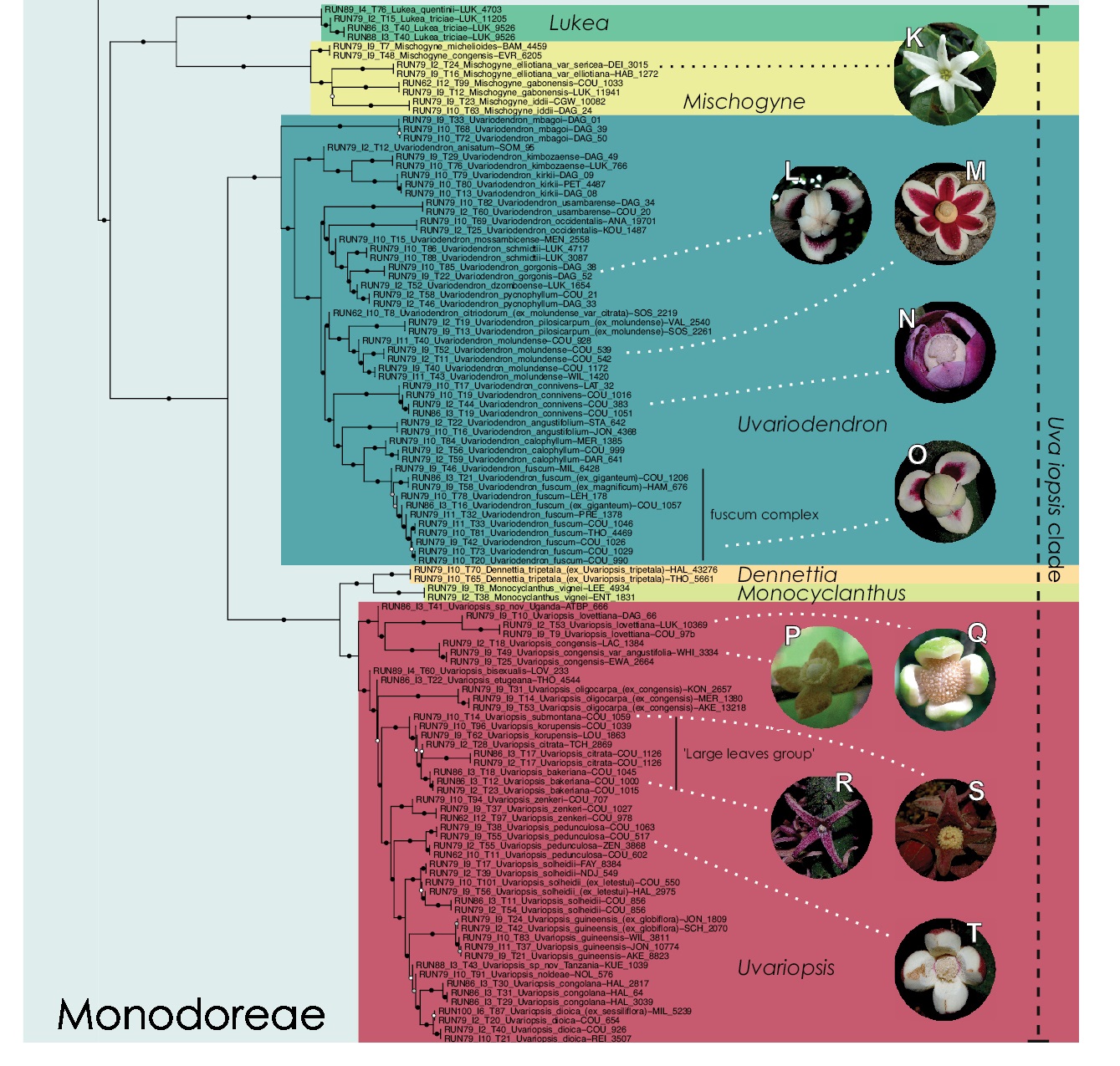
[Botany • 2023] Phylogenomic Inference of the African Tribe Monodoreae (Annonaceae) and Taxonomic Revision of Dennettia, Uvariodendron and Uvariopsis


flowers of K Mischogyne elliotana (no specimen associated) L Uvariodendron gorgonis (Dagallier 38) M Ud. molundense (Bidault 2222) N Ud. connivens (Couvreur 1016) O Ud. var. fuscum (Couvreur 990)
Uvariopsis congensis (Lachenaud 1384) Q Uplovettiana (Couvreur 97b) R Upbakeriana (Couvreur 1000) S Upsubmontana (Couvreur 627) T Uppedunculosa (Couvreur 878).

in Dagallier, Mbago, Couderc, Gaudeul, ... et Couvreur, 2023.

 Photos by Thomas Couvreur, Léo-Paul Dagallier, Carel Jongkind, Ehoarn Bidault & Olivier Lachenaud.

Abstract
Monodoreae (Annonaceae) is a tribe composed of 11 genera and 90 species restricted to the tropical African rain forests. All the genera are taxonomically well circumscribed except the species rich genera Uvariodendron and Uvariopsis which lack a recent taxonomic revision. Here, we used a robust phylogenomic approach, including all the 90 currently accepted species, with several specimens per species, and based on more than 300 Annonaceae-specific nuclear genes, to infer the phylogenetic tree of the Monodoreae and test the limits between the genera and species. We recover all the genera as monophyletic, except the genus Uvariopsis for which the species Uvariopsis tripetala falls outside this clade. We thus reinstate the monotypic genus Dennettia for its single species Dennettia tripetala. We also erect a new tribe, Ophrypetaleae trib. nov., to accommodate the genera Ophrypetalum and Sanrafaelia, as we recover them excluded from the Monodoreae tribe with good support. Below the genus level, the genera Isolona, Monodora, Uvariastrum, Uvariodendron and Uvariopsis show weakly supported nodes and phylogenetic conflicts, suggesting that population level processes of evolution might occur in these clades. Our results also support, at the molecular level, the description of several new species of Uvariodendron and Uvariopsis, as well as several new synonymies. Finally, we present a taxonomic revision of the genera DennettiaUvariodendron and Uvariopsis, which contain one, 18 and 17 species respectively. We provide a key to the 11 genera of the Monodoraeae and describe four new species to scienceUvariodendron kimbozaense Dagallier & Couvreur, sp. nov.Uvariodendron mossambicense Robson ex Dagallier & Couvreur, sp. nov.Uvariodendron pilosicarpum Dagallier & Couvreur, sp. nov. and Uvariopsis oligocarpa Dagallier & Couvreur, sp. nov., and provide provisional descriptions of three putatively new species. We also present lectotypifications and nomenclatural changes implying synonymies and new combinations (Uvariodendron citriodorum (Le Thomas) Dagallier & Couvreur, comb. et stat. nov., Uvariodendron fuscum var. magnificum (Verdc.) Dagallier & Couvreur, comb. et stat. nov., Uvariopsis congensis var. angustifolia Dagallier & Couvreur, var. nov., Uvariopsis guineensis var. globiflora (Keay) Dagallier & Couvreur, comb. et stat. nov., and Uvariopsis solheidii var. letestui (Pellegr.) Dagallier & Couvreur, comb. et stat. nov.).

Key words: conservation, evolution, new species, phylogeny, tropical rain forests


Ophrypetaleae tribe.
Ophrypetalum odoratum Diels  A trunk B young branch with leaves, upper side C flower and flower buds D flower, from below.
Sanrafaelia ruffonammari Verdc E trunk F young branch with leaves and flower buds G flower buds H flower, top view I flower, side view J fruit.
A, B Dagallier 54 C Couvreur 56 D Couvreur 82 E–J Dagallier 31. Photos A,,B, E–J Léo-Paul Dagallier C, ,D Thomas Couvreur.

Phylogenetic trees of the Monodoreae inferred with ASTRAL, based on 334 nuclear genes trees.
The branch support is given as local posterior probability (LPP) in three shades of greys. For the details on the specimens see Suppl. material 3.
Insets: flowers of A Ophrypetalum odoratum (Couvreur 82) B Sanrafaelia ruffonammari (Dagallier 31) C Asteranthe asterias (Dagallier 10) D Hexalobus crispiflorus (no specimen associated) E Uvariastrum zenkeri (no specimen associated) F Isolona hexaloba (no specimen associated) G I. cauliflora (Dagallier 44) H Monodora grandidieri (Dagallier 26) I M. myristica (living specimen at NY conservatory) J M. tenuifolia (Couvreur 1019)
Mischogyne elliotana (no specimen associated) L Uvariodendron gorgonis (Dagallier 38) M Ud. molundense (Bidault 2222) N Ud. connivens (Couvreur 1016) O Ud. var. fuscum (Couvreur 990) P Uvariopsis congensis (Lachenaud 1384) Q Uplovettiana (Couvreur 97b) R Upbakeriana (Couvreur 1000) S Upsubmontana (Couvreur 627) T Uppedunculosa (Couvreur 878).
 Photos CC BY-NC 4.0 A, D–F, J, N, O, Q–T Thomas Couvreur B, C, G–I, L Léo-Paul Dagallier K Carel Jongkind M Ehoarn Bidault P Olivier Lachenaud.

Uvariodendron fuscum (Benth.) R.E.Fr. var. fuscum
A leaf, lower side B apex of young branch with detail of petiole and leaf base, upper side, inset: detail of sparse pubescence on young branch C trunk with flower bud (top) and flower (bottom) D open flower E young fruit with unripe monocarps, one old petal remaining F flower semi-bottom view, showing bracts and sepals G detail of flower after anthesis, note the falling stamens and pollinator insects, inset: detail of Coleoptera full of pollen grains.
A, E, G Couvreur 1046 B, C Couvreur 1029 D, F Couvreur 990. Photos Thomas Couvreur.

Uvariodendron kimbozaense Dagallier & Couvreur
A habit B trunk with borne inflorescences C young inflorescence with flower buds D flower with one outer petal and the 3 inner petals torn or gnawed E young branch with leaves, lower side F young branch with leaves, upper side G detail of flower receptacle with stamens and stigmas, note the gleaming exudate on the stigmas and the hairs stuck on them H base of leaf, upper side, note the slightly raised midrib.
 A–H Dagallier 49 (type). Photos Léo-Paul Dagallier.

 
Léo-Paul M. J. Dagallier, Frank M. Mbago, Marie Couderc, Myriam Gaudeul, Aurélie Grall, Caroline Loup, Jan J. Wieringa, Bonaventure Sonké and Thomas L. P. Couvreur. 2023. Phylogenomic Inference of the African Tribe Monodoreae (Annonaceae) and Taxonomic Revision of DennettiaUvariodendron and UvariopsisPhytoKeys. 233: 1-200. DOI: 10.3897/phytokeys.233.103096

Résumé: La tribu des Monodoreae (Annonaceae) est composée de 11 genres et 90 espèces des forêts tropicales humides d’Afrique. Tout les genres sont taxonomiquement bien résolus, à part les genres Uvariodendron et Uvariopsis qui manquent d’une révision taxonomique récente. Ici, nous avons utilisé une approche phylogénomique robuste pour estimer l’arbre phylogénétique des Monodoreae, et tester les limites de genres et d’espèces. Pour cela, nous avons inclut les 90 espèces acceptées, et avons séquencé plus de 300 gènes. Tous les genres sont retrouvés monophylétiques, à part le genre Uvariopsis pour lequel l’espèce Uvariopsis tripetala se retrouve exclue. Nous rétablissons donc le genre monotypique Dennettia et son unique espèce Dennettia tripetala. Nous érigeons une nouvelle tribu, les Ophrypetaleae trib. nov.pour accueillir les genres Ophrypetalum et Sanrafaelia, car nous les retrouvons exclus de la tribu des Monodoreae avec un bon support. Au niveau infra-générique, les genres Isolona, Monodora, Uvariastrum, Uvariodendron et Uvariopsis montrent de faibles supports de noeuds et des conflits phylogénétiques, ce qui suggère que des processus d’évolution se déroulent au niveau des populations. Nos résultats soutiennent également, sur un plan moléculaire, la description de plusieurs nouvelles espèces d’Uvariodendron et d’Uvariopsis, de même que plusieurs synonymies. Enfin, nous présentons une révision taxonomique des genres Dennettia, Uvariodendron et Uvariopsis, qui contiennent respectivement un, 18 et 17 espèces. Nous fournissons une clé des 11 genres de Monodoreae, et décrivons quatre nouvelles espèces pour la science: Uvariodendron kimbozaense Dagallier & Couvreur, sp. nov.Uvariodendron mossambicense Robson ex Dagallier & Couvreur, sp. nov.Uvariodendron pilosicarpum Dagallier & Couvreur, sp. nov. et Uvariopsis oligocarpa Dagallier & Couvreur, sp. nov., et fournissons une description provisoire de trois autres potentielles. Nous effectuons des lectotypifications et des changements nomenclaturaux tels que des synonymies et des nouvelles combinaisons (Uvariodendron citriodorum (Le Thomas) Dagallier & Couvreur, comb. et stat. nov., Uvariodendron fuscum var. magnificum (Verdc.) Dagallier & Couvreur, comb. et stat. nov., Uvariopsis congensis var. angustifolia Dagallier & Couvreur, var. nov., Uvariopsis guineensis var. globiflora (Keay) Dagallier & Couvreur, comb. stat. nov., et Uvariopsis solheidii var. letestui (Pellegr.) Dagallier & Couvreur, comb. stat. nov.).