Showing posts with label QBG. Show all posts

Friday, October 11, 2024

[Botany • 2024] Chiloschista breviseta (Orchidaceae: Epidendroideae) • A New Species from Northern Thailand


Chiloschista breviseta Chanokkhun, Watthana & Schuit.,

in Chanokkhun, Muangsan, Suwanwaree, Malaiphis, Schuiteman et Watthana, 2024.
เอื้องพญาไร้ใบดอกขาว  ||  taiwania.NTU.edu.tw/abstract/2022 

Abstract
A new species, Chiloschista breviseta (Orchidaceae: Epidendroideae: Aeridinae) from Northern Thailand is described and illustrated, and notes on ecology and conservation status are provided. Chiloschista breviseta is morphologically similar to C. usneoides but differs in having much shorter seta on each side of the anther cap. Previous records of C. usneoides from Thailand refer to C. breviseta.

Keyword: Aeridinae, Chiloschista, Chiloschista usneoides, Chiloschista viridiflava, Flora of Thailand, new taxon

Chiloschista breviseta.
A. Habit. B. Flowers. front and side views. C. Dorsal sepal, petal and lateral sepal (from left to right). D. Labellum, front view and longitudinal half cut showing inside. E. Operculum. F. Pollinarium.
(Drawn by T. Chanokkhun).

Chiloschista breviseta.
 A. Inflorescence. B. Flowers. C. Dorsal sepal, petal and lateral sepal (from left to right). D. labellum, showing front, side and back views. E. Labellum with longitudinal half cut showing inside. F. Operculums. G. Pollinarium
 (Pictured by T. Chanokkhun).

Chiloschista breviseta Chanokkhun, Watthana & Schuit., sp. nov.

Diagnosis: Chiloschista breviseta is similar to C. usneoides in the largely white flower and the shorts accate lip with a rudimentary mid-lobe, but differs in having a short seta (<0.3 mm long) on each side of the anther cap (vs. a long, thread-like seta, >1.7 mm long) and in the Y-shaped callus apex (vs. T-shaped). It can be distinguished from C. viridiflava Seidenf. in having a glabrous abaxial surface of sepals and petal (vs. pubescent), margin of petals entire (vs. erose), and white sepals and petals, sometimes with a purplish pink median line abaxially (vs. pure pale green), and in having short setae (vs. setae > 1.9 mm long).

Etymology: From the Latin brevis, short, and seta, a bristle-like hair, referring to the short appendages on the anther cap, unlike the long wiry appendages seen in species like C. usneoides


Thotsaporn Chanokkhun, Nooduan Muangsan, Pongthep Suwanwaree, Rungtip Malaiphis, André Schuiteman and Santi Watthana. 2024. Chiloschista breviseta (Orchidaceae), A New Species from Thailand. Taiwania. 69(4);  449 - 453. DOI: 10.6165/tai.2024.69.449

Sunday, February 5, 2023

[Botany • 2023] Paris siamensis (Melanthiaceae) • Revision on the Genus Paris in Thailand, with A New Species from Luang Prabang Range


  Paris siamensis Ruchis., 

in Ruchisansakun, Sraphet, Yothawut, Thamanukornsri, Suksee, ... et Triwitayakorn, 2023.
ตีนฮุ้งดอยสยาม  ||  DOI: 10.3390/plants12030430 

 Abstract
The genus Paris is an important and confusing taxon due to high variation within species, and differences between species are sometimes difficult to delimit. Thus, the status of some taxa has changed over time. To clarify the status of Paris species for plant conservation and effective management of this genus in Thailand, we performed an intensive survey in northern Thailand, studied morphological characteristics, and constructed a molecular phylogenic tree, which we compared to recently published results of this genus. Our results indicate that there are two species in Thailand: P. yunnanensis and a new species, P. siamensis. Detailed descriptions, illustrations, and the phylogenetic position of these two species are provided here.

Keywords: Paris chinensis; Melanthiaceae; threatened species; cryptic taxa; Paris polyphylla

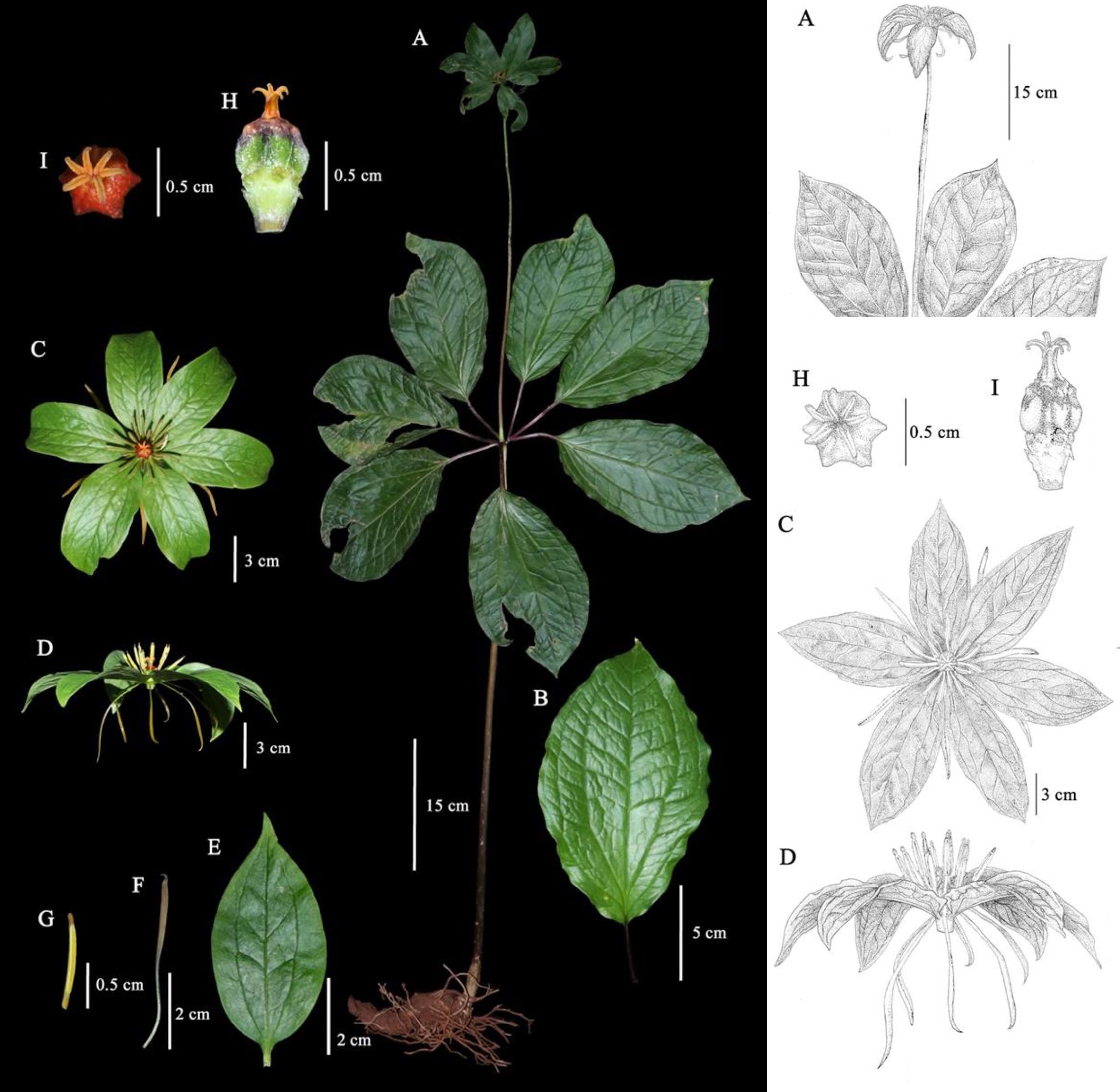
  Paris siamensis Ruchis.
(A) Plant, (B) Leaf, (C) Flower (front view), (D) Flower (lateral view), (E) Sepal, (F) Petal, (G) Stamen, (H) Pistil (front view), (I) Pistil (lateral view).
Drawn by Jeerapach Monthanom


  Paris siamensis Ruchis.
 (A) Habit, (B) Leaf, (C) Flower (front view), (D) Flower (lateral view), (E) Sepal, (F) Petal, (G) Stamen, (H) Pistil (front view), (I) Pistil (lateral view).

 Paris siamensis Ruchis. 

Paris siamensis is similar to P. liiana but differs in having petals below sepals (versus petals above sepals), stamen number (2.2–)2.8–3 times petal number (versus stamen number 2 times petal number), and anther length 8–10 mm long (versus anther 15–40 mm long). 

Distribution. To date, endemic to Nan province, Thailand (may be found in Laos), 1050–1216 m alt.

Vernacular name. Tin Hung Doi Siam (ตีนฮุ้งดอยสยาม), 
Tin Hung Doi (ตีนฮุ้งดอย).


Distributions of the Two Paris Species in Thailand
The distributions of the plants showed that this genus is specific to high-altitude habitats. The two species in Thailand were separated by lowland areas along the Nan river. Paris siamensis was found only in Luang Prabang Range, while P. yunnanensis was more widespread and found in the Phi Pan Nam Range, the Thong Chai Range, and the Daen Lao Range, which connects to the Shan plateau where the same species is found and is connected to the populations in China.
 
 
Saroj Ruchisansakun, Supajit Sraphet, Chatchai Yothawut, Chompunooch Thamanukornsri, Nawarat Suksee, Panida Kongsawadworakul, Nattaya Srisawad, Nicha Thawara, Puangpaka Umpunjun, Supaporn Rodpradit, Winai Sangkaew and Kanokporn Triwitayakorn. 2023. Revision on the Genus Paris in Thailand, with a New Species Paris siamensis. Plants. 12(3), 430. DOI: 10.3390/plants12030430  


Sunday, July 15, 2018

[Botany • 2018] Argyreia gyrobracteata เครือเศวตภูลังกา • Species Delimitation of Some Argyreia (Convolvulaceae) Using Phenetic Analyses: Insights from Leaf Anatomical Data Reveal A New Species from northeastern Thailand


Argyreia gyrobracteata Traiperm & Chitchak

in Chitchak, Traiperm, Staples, et al., 2018. 
เครือเศวตภูลังกา ||  DOI:  10.1139/cjb-2017-0108 

ABSTRACT
Argyreia Lour. is one of the most taxonomically complex genera of the morning glory family (Convolvulaceae). The number of named species is now 135, and new species are regularly being described. There are several species complexes that are morphologically similar and difficult to tell apart. Therefore, the aim of this study is to explore the species identification criteria for Argyreia, especially new sources for taxonomically informative characters. Ten accessions representing three morphologically similar Argyreia operational taxonomic units (OTUs) were collected and their anatomical characters were investigated using the leaf peeling technique and paraffin sectioning method. Anatomical character states were analyzed using two phenetic analysis methods: clustering analysis (CA) and principal component analysis (PCA). Three distinct clusters were clearly separated in both PCA and CA at the internal similarity coefficient of 0.48 with a high R-value of 0.89757. Nineteen effectively distinguishable character states were derived from the high loadings of the first two components. In conclusion, two of the separated groups were matched with known species, and the third separated group is here delineated as a new species. Therefore, a new species, Argyreia gyrobracteata Traiperm & Chitchak, is described and illustrated together with ecological data and a preliminary conservation assessment.

Keywords: cluster analysis, cryptic species, morphometrics, principal component analysis, species delimitation

Fig. 7. Argyreia gyrobracteata Traiperm & Chitchak sp. nov.:
 (A) flower in front view; (B) flower in side view; (C) interaction with an insect visitor, oriental carpenter bee (Xylocopa nasalis); (D) plant habit
(all photos taken by P. Rattanakrajang from live plants vouchered as P. Rattanakrajang et al. 104).

Argyreia gyrobracteata Traiperm & Chitchak, sp. nov. 

TYPE: Thailand. Ubon Ratchathani, Sirindhorn district, ..., in the edge of dipterocarp forest, August 2016, P. Rattanakrajang, N. Chitchak & P. Traiperm 110 (holotype BKF!; isotypes K!, QBG!)

DIAGNOSIS: The new species is similar to A. mekongensis in having a white campanulate corolla, but differs from that species by the linear-oblong to narrowly lanceolate bract shape (versus lanceolate or oblong-lanceolate), the curly or twisted bract orientation (versus falcate), the larger sepals, and the multicellular, uniseriate, villous trichomes restricted to a small, dense, triangular patch on the adaxial side of the filaments, above the insertion point of the filaments on the corolla tube (versus dispersed in a band 3–5 mm wide surrounding the free filament, above the insertion point on the corolla tube).
....

DISTRIBUTION: Known so far from discrete populations in two different districts within Ubon Ratchathani province, Thailand. One population is close to the border of Thailand–Laos and possibly A. gyrobracteata occurs across the border in Laos.

ETYMOLOGY: The specific epithet refers to the curly/twisted bracts of this species, which have not been observed in any other known species of Argyreia. 

 Natthaphong Chitchak, Paweena Traiperm, G. Staples, Pantamith Rattanakrajang and Pirada Sumanona. 2018. Species Delimitation of Some Argyreia (Convolvulaceae) Using Phenetic Analyses: Insights from Leaf Anatomical Data Reveal A New Species. Botany. 96(4); 217-233.  DOI:  10.1139/cjb-2017-0108 

Thursday, October 27, 2016

[Botany • 2016] Coelogyne ventrinigra | เอื้องนางพญาลิ้นดำ • A New Species (Orchidaceae) from Thailand


Coelogyne ventrinigra 
 de Vogel, Suksathan & Boonnuang 

เอื้องนางพญาลิ้นดำ |  ThaiForestBulletin

Figure 2. Coelogyne ventrinigra de Vogel, Suksathan & Boonnuang,
A. flowering plant in habitat; B. inflorescence; C. flower with brownish-black spots on labellum.

 Photos by H. Boonnuang.  |  ThaiForestBulletin 

ABSTRACT

Coelogyne ventrinigra, a new species from Umphang District, Tak Province, in the western part of Thailand, is described and illustrated.

KEYWORDS: Elatae; Conservation status


Etymology.— The epithet ventrinigra means ‘black belly’, from the Latin venter (belly), and nigra (black), referring to the blackish spots abaxially on the lip.

Vernacular.— Ueang nang phaya lin dam (เอื้องนางพญาลิ้นดำ).


กล้วยไม้ชนิดใหม่ของโลก ที่เพิ่งได้รับการตีพิมพ์เมื่อไม่กี่วันมานี้เอง หนึ่งในความภาคภูมิใจของประเทศไทย และหนึ่งในความภูมิใจของผมที่ได้เป็นหนึ่งในผู้ร่วมศึกษากล้วยไม้ชนิดนี้จนได้รับการตีพิมพ์เป็นชนิดใหม่ของโลก หลังจากใช้เวลาหลายปีในการจัดทำคำบรรยายและเรื่องราวต่าง ๆ มาวันนี้ผมเหมือนจะรู้สึกว่ากล้วยไม้ชนิดนี้เหมาะแก่การถวายต่อพระบาทสมเด็จพระเจ้าอยู่หัว รัชกาลที่ ๙ เหลือเกิน ไม่ใช่เพียงเพราะตีพิมพ์ในช่วงเวลาเดียวกัน ทว่าหลายอย่างเป็นความเหมาะเจาะอย่างยิ่ง
.
เราเจอกล้วยไม้ชนิดนี้ในช่วงเวลาที่สมเด็จพระเจ้าพี่นางเธอ เจ้าฟ้ากัลยาณิวัฒนา กรมหลวง นราธิวาสราชนครินทร์ สิ้นพระชนม์ ทว่ากว่าจะมาตีพิมพ์ได้สำเร็จก็เมื่อเวลาที่คนไทยทั้งประเทศร่ำให้น้ำตาเป็นสายเลือด ในช่วงที่พระบาทสมเด็จพระเจ้าอยู่หัว รัชกาลที่ ๙ สวรรคต นับเป็นกล้วยไม้ที่มีสีในช่วงเวลาแห่งความชอกช้ำเหลือเกิน เพราะทั้งดอกมีเพียงสีขาวและดำเท่านั้นเอง
.
ผมภูมิใจกับการค้นพบกล้วยไม้ไทยเสมอ ๆ ทว่าความภูมิใจใด ๆ หากแลกกับปาฎิหารย์แห่งชีวิตของพระองค์ท่านไว้ได้ผมจะแลกทั้งหมดครับ แต่ตอนนี้คงไม่ทันแล้วได้แต่ถวายความงดงามแห่งธรรมชาติชนิดนี้ไว้ว่าเป็นสิ่งที่คนไทยทั้งหมดได้ถวายงานรับใช้ใต้เบื้องพระยุคคลบาท...
.
ขอบคุณทุกท่านที่ช่วยเหลือจนกล้วยไม้ชนิดนี้ได้รับการตีพิมพ์ครับ หลวงพี่กมล เจ๊แมว แสงเดือน ถนอมวงศ์ธนา น้าเสก เสกสรร โตวิวัฒน์ ที่ร่วมทางกันจนได้ตัวอย่างในธรรมชาติ แม้จะต้องใช้เวลา ใช้พลังอย่างมากก็ตาม ขอบคุณไว้ ณ.ที่นี้ด้วยครับ
ขอบคุณนักพฤกษศาสตร์ ดร.ปิยเกษตร สุขสถาน และ ดร.สันติ วัฒฐานะ ครับที่จัดทำคำบรรยายและศึกษาเพิ่มเติม
.
ขอบคุณครอบครัวของผมที่ยอมทุกอย่างในการเดินทางออกไปใช้ชีวิต...


photos: Hassachai Boonuang  — facebook.com/Hasachai/posts/1209422609080508

นี่เป็นภาพที่ผมถ่ายตอนที่พบเป็นครั้งแรกเมื่อ 8 ปีที่แล่ว Hassachai Boonuang  — Mastercanvas Kitiwattana


 Ed de Vogle, Piyakaset Suksathan, Thitiporn Pingyot, Hassachai Boonuang and Santi Watthana. 2016. Coelogyne ventrinigra (Orchidaceae), A New Species from Thailand.
 Thai For. Bull. 44(1); 49-52.  https://www.tci-thaijo.org/index.php/ThaiForestBulletin/issue/view/633


Monday, July 13, 2015

[Botany • 2014] Boesenbergia purpureorubra • A New Species of Boesenbergia (Zingiberaceae) from Thailand


Boesenbergia purpureorubra
Mood & L.M.Prince

ABSTRACT
Boesenbergia purpureorubra Mood & L.M.Prince is described and illustrated.
Boesenbergia longipes (King & Prain ex Ridl.) Schltr. is noted as a new record for Thailand
based on C. Maknoi T38 (PSU, QBG).

Keywords: Boesenbergia, Thailand, Zingiberaceae


Fig. 1. Boesenbergia purpureorubra Mood & L.M.Prince.
Ink line drawing with watercolour of the type plant. (Drawn by Linda Ann Vorobik).

Taxonomy

Boesenbergia purpureorubra Mood & L.M.Prince, sp. nov.

Boesenbergiae pulcherrimae (Wall.) Kuntze similis, planta minore c. 40 cm alta, caule breviore c. 6 cm longo pagina corrugatissima atro purpureorubro, petiolis longioribus c. 3–8 cm longis differt. 

TYPE: Cultivated in Hawaii, USA, 1 August 2014, Mood 14P19 (holotype BKF; isotype AAU). Originally from Thailand, Ranong Province, E. of Khao Niwet, 09° 57.506'N 98°39.134'E, 880 m asl, evergreen forest, 24 August 2011, Mood & Vatcharakorn 3106, cultivated as M3106 (Fig. 1-3)

Boesenbergia longipes auct. non Schltr.: Sirirugsa, Nat. Hist. Bull. Siam Soc. 40: 76
(1992). 

Distribution. Peninsular Thailand.
Ecology. This species is found in evergreen forest between 50-300 m on soils derived from granite or sandstone.

Phenology. In cultivation in Hawaii, flowering begins in late June and continues through October. Flowers open in the morning and close early the following day. Observations in the wild are similar.

Etymology. Named for the purple-red colour of the leafless sheaths and lamina underside.


 J.D. Mood, J.F. Veldkamp and L.M. Prince. 2014. A New Species and A New Record of Boesenbergia (Zingiberaceae) for Thailand. Gardens’ Bulletin Singapore. 66(2): 207–214.