Showing posts with label Plesiosaur. Show all posts

Friday, June 12, 2026

[Paleontology • 2026] Gondwananectes osvaldoi • A new Middle Jurassic marine reptile from Gondwana clarifies the origin of Cryptoclidia, the most successful group of plesiosaurs


Gondwananectes osvaldoi
Otero, Acuña, Vargas, Rojas, Ortiz & Aguirrezabala, 2026

 x.com/ThePalAss

Abstract 
Cryptoclidia (Plesiosauria, Plesiosauroidea) was a major clade of marine reptiles that originated during the Jurassic. The early evolution of Cryptoclidia is documented by records of Cryptoclididae from the Middle Jurassic (174.7–165.1 Ma) and onwards in Europe, the Caribbean and South America. However, the origin of Cryptoclidia itself has remained obscure. Only some traits shared with Cryptoclidia are found in the Toarcian (184.2–174.7 Ma) taxa Plesiopterys wildi and Franconiasaurus brevispinus, from southern Europe. Here we describe a small-bodied sub-adult skeleton belonging to a new plesiosaurian taxon from the Middle Jurassic (c. 170 Ma) of the Atacama Desert (former southwestern Gondwana). The new taxon has single-headed ribs in its axial skeleton, and its combination of novel and ancestral features place it as the sister taxon of Cryptoclidia. The lower Bajocian stage, the phylogenetic position of the new taxon, as well as its palaeogeographic occurrence, point to an older origin and dispersal of Cryptoclidia ancestors, reinforcing the notion that an early Caribbean corridor between the Pacific and Tethyan realms was already functional during the Middle Jurassic.

Keywords: marine reptile, plesiosaurian, phylogeny, Middle Jurassic, Gondwana, palaeogeography


Gondwananectes osvaldoi

 
Rodrigo A. Otero, Sergio Soto Acuña, Alexander O. Vargas, Jennyfer Rojas, Héctor Ortiz, Guillermo Aguirrezabala. 2026. A new Middle Jurassic marine reptile from Gondwana clarifies the origin of Cryptoclidia, the most successful group of plesiosaurs. Papers in Palaeontology. DOI: doi.org/10.1002/spp2.70068 [08 March 2026] 
x.com/ThePalAss/status/2031413080001823092

Wednesday, August 27, 2025

[Paleontology • 2025] The Osteology, Taxonomy, and Phylogenetic Placement of Seeleyosaurus guilelmiimperatoris (Plesiosauroidea: Microcleididae) from the Lower Jurassic Posidonia Shale of Germany


Seeleyosaurus guilelmiimperatoris (Dames, 1895) 

Sachs, Madzia, Marx, Roberts, Hampe et Kear, 2025. 

Abstract
Seeleyosaurus guilelmiimperatoris is an early-diverging plesiosauroid from the lower Toarcian (Lower Jurassic) of the Posidonienschiefer Formation (Posidonia Shale) of Holzmaden, southwestern Germany. It is known from almost complete skeletons of two osteologically mature individuals, the holotype and a referred specimen that was largely destroyed during World War II. Although well-preserved and substantially complete, the anatomy of Seeleyosaurus and its taxonomic and phylogenetic significance remain insufficiently understood. Here, we provide a complete osteological description of the taxon. Seeleyosaurus guilelmiimperatoris can be diagnosed based on a unique combination of characters, including one autapomorphy: the tall and basally constricted neural spines of the posterior cervical, pectoral, and dorsal vertebrae which have a sinusoidal shape in lateral view. Our study supports the validity of the plesiosauroid taxon Plesiopterys wildi, which was considered a junior synonym of Seeleyosaurus in a previous joint assessment of the taxa. Our phylogenetic evaluation places S. guilelmiimperatoris among Microcleididae, in congruence with previous studies. However, in contrast to earlier phylogenetic reconstructions, our analyses, which take into account numerous changes to the character matrix, reconstruct S. guilelmiimperatoris as falling within the Microcleidus clade. While we admit that Seeleyosaurus might potentially be considered a species of Microcleidus, we refrain from promoting this nomenclatural change pending an osteological and taxonomic reassessment of Microcleidus spp. as well as other, potentially closely related forms, such as Lusonectes sauvagei.

Keywords: Plesiosauria, Microcleididae, Seeleyosaurus, Toarcian, Lower Jurassic, Germany

Skeleton of the referred specimen of Seeleyosaurus guilelmiimperatoris (SMNS 12039). (a) initial slab mount with original skull and unaltered paddles (from Fraas, 1910a, plate 6). (b) cast of the modified skeleton with modeled skull and arranged paddles (SMNS collection). Scale equals 50 cm.

Seeleyosaurus (left) and Thaumatosaurus, now Meyerasaurus (right)
as depicted in Water reptiles of the past and present (1914)


Sven Sachs, Daniel Madzia, Miguel Marx, Aubrey J. Roberts, Oliver Hampe and Benjamin P. Kear. 2025. The Osteology, Taxonomy, and Phylogenetic Placement of Seeleyosaurus guilelmiimperatoris (Plesiosauroidea, Microcleididae) from the Lower Jurassic Posidonia Shale of Germany. The Anatomical Record. DOI: doi.org/10.1002/ar.25620 [21 February 2025]


Monday, August 4, 2025

[Paleontology • 2025] Plesionectes longicollum • An unusual early-diverging plesiosauroid from the Lower Jurassic Posidonia Shale of Holzmaden, Germany


Plesionectes longicollum 
Sachs​ & Madzia, 2025 

life reconstruction by Peter Nickolaus.

Abstract 
The lower Toarcian Posidonia Shale at Holzmaden, Southwest Germany, has yielded some of the most remarkable Lower Jurassic marine tetrapod specimens, including five plesiosaur taxa identified from nearly complete skeletons. This study provides a comprehensive description of an osteologically immature plesiosauroid skeleton found in a Holzmaden quarry in 1978. Despite that the specimen has been researched in the past, previous studies have been either brief or targeted some specific aspects of the specimen, such as its soft tissue preservation. The anatomy and taxonomy of the specimen have never been explored in detail. We reinterpret several of its osteological features and evaluate their taxonomic and phylogenetic significance. Our findings reveal that the specimen possesses an unusual combination of character states, which are not markedly affected by ontogenetic development, warranting the designation of a new taxon, Plesionectes longicollum gen. et sp. nov., thereby increasing the known plesiosaur diversity of both the Toarcian age and the Posidonia Shale.

Skeleton of Plesionectes longicollum gen. et sp. nov. (SMNS 51945).
Scale bar equals 30 cm.

Plesiosauria De Blainville, 1835
Plesiosauroidea Gray, 1825

Plesionectes gen. nov.
 
Etymology. The name Plesionectes derives from plēsíon (Greek), meaning “close”, “near”, referring to its plesiosaur affinities, and nēktēs (Greek), “swimmer”, common suffix in plesiosaur taxon names.

Plesionectes longicollum sp. nov.

Type locality and horizon. Holzmaden, Esslingen District, Baden-Württemberg, southwestern Germany; lower Toarcian (Lias ɛII1, ‘Koblenzer’, Dactylioceras tenuicostatum Zone, D. semicelatum Subzone; Hauff, 1921; Riegraf, Werner & Lörcher, 1984; Maisch, 2021), Lower Jurassic.

Diagnosis. Plesiosauroid plesiosaur bearing following unique combination of characters states: paraoccipital process being considerably longer as the height of the exoccipital body; neck comprising ≥43 cervical vertebrae; V-shaped neurocentral suture in the cervical and pectoral vertebrae (potential local autapomorphy sensu Beeston et al., 2024); conjoined parapophysis and diapophysis in the anterior, middle, and the majority of the posterior cervicals, one rib facet formed in the posteriormost cervical vertebrae; cervical rib processes strap-shaped and pronounced in anterior and mid-neck region; posterior cervical and pectoral neural spines not considerably taller than long (mostly < 1:2), lacking constriction at base; dorsal vertebral series comprising 20–21 vertebrae.

Etymology. The name longicollum derives from longus (Latin), meaning “long”, and collum (Latin), “neck”, in reference to its long neck, comprising at least 43 vertebrae.

Plesionectes longicollum 
life reconstruction by Peter Nickolaus.


Sven Sachs​ and Daniel Madzia. 2025. An unusual early-diverging plesiosauroid from the Lower Jurassic Posidonia Shale of Holzmaden, Germany. PeerJ. 13:e19665. DOI: doi.org/10.7717/peerj.19665 

Friday, May 23, 2025

[Paleontology • 2025] Traskasaura sandraeA Name for the Provincial Fossil of British Columbia: A Strange New elasmosaur Taxon from the Santonian of Vancouver Island


Traskasaura sandrae
O’Keefe, Smith, Clark, Otero, Perella & Trask, 2025


Abstract
The first elasmosaurid skeleton from the Haslam Formation (Upper Santonian) of the Nanaimo Group (Late Cretaceous) on Vancouver Island was first described in 2002, and has recently been declared the Provincial Fossil of British Columbia. Since then, additional fossils have been recovered: an isolated right humerus and a well-preserved, osteologically immature skeleton comprising thorax, girdles and limbs. The Haslam material can now support further taxonomic assessment, and we erect the species Traskasaura sandrae based on it. Traskasaura possesses a strange mosaic of features. The mandible is plesiomorphic as seen in Libonectes: relatively narrow with large teeth and a broad symphysis. The skull therefore lacks any of the radical oral cavity adaptations seen in basal aristonectines. The neck of the Haslam animal is also plesiomorphic, with at least 36 preserved cervical vertebrae having vertebral length indices (VLIs) over 100 (the total number of cervicals is not known). The centra lack the anteroposterior compression and midline longitudinal constriction characteristic of derived aristonectines, yet the cervical ribs trend forward – a condition known only in derived aristonectines and Vegasaurus. The autapomorphic coracoid of Traskasaura differs greatly from any known elasmosaurid; the cardiform recess is reduced and posteriorly located, with some similarities to that of Aristonectes quiriquinensis. The humerus is autapomorphic, possessing a relatively straight shaft, pronounced ventral camber and an articular facet on the leading edge that makes a 90° angle with the radial facet. Taken together, these features document a new genus, with a plesiomorphic axial skeleton, but with several convergent appendicular adaptations with derived aristonectines. A revised phylogenetic analysis of Elasmosauridae recovered the new taxon in a basal position. Therefore, the postcranial adaptations shared with derived aristonectines appear to be convergent.

Keywords: elasmosaur, Haslam Formation, plesiosaur, Santonian

Sauropterygia Owen, Citation1860
Order Plesiosauria de Blainville, Citation1835
Family Elasmosauridae Cope, Citation1869


Traskasaura sandrae gen. et sp. nov.

Etymology: The genus is named in honour of Michael and Heather Trask, who discovered the holotype specimen along the banks of the Puntledge river in 1988, and the Greek word saûros, lizard; the Latin conjugation is feminine. The species name sandrae honours Sandra Lee O’Keefe (née Markey), Pacific Northwest native and, like Elizabeth Nicholls, a valiant warrior in the fight against breast cancer. In loving memory.


F. Robin O’Keefe, Elliott Armour Smith, Robert O. Clark, Rodrigo A. Otero, Anna Perella and Patrick Trask. 2025. A Name for the Provincial Fossil of British Columbia: A Strange New elasmosaur Taxon from the Santonian of Vancouver Island. Journal of Systematic Palaeontology. 23(1); 2489938. DOI: doi.org/10.1080/14772019.2025.2489938 [22 May 2025] 

Thursday, March 7, 2024

[Paleontology • 2024] Franconiasaurus brevispinus • Exquisite Skeletons of A New transitional Plesiosaur fill gap in the Evolutionary History of plesiosauroids


  Franconiasaurus brevispinus 
Sachs, Eggmaier & Madzia, 2024

  (artwork by Joschua Knüppe).

Plesiosaurs are Mesozoic reptiles fully adapted to an aquatic lifestyle. Throughout their evolutionary history exceeding 140 million years plesiosaurs dispersed globally, achieved substantial diversity, occupied a variety of ecological niches, and experienced multiple faunal turnovers. Of those, the Early/Middle Jurassic transition event (∼175–171 Mya) has recently became of increased interest because it apparently profoundly affected all three major lineages of plesiosaurs. Once dominant Rhomaleosauridae started to vanish, while Pliosauridae and Plesiosauroidea diversified and gave rise to several clades that flourished for tens of millions of years. Here, we report exquisite, three-dimensionally preserved skeletons of a new plesiosaur from the Lower Jurassic of Germany. Franconiasaurus brevispinus gen. et sp. nov. lived during the late Toarcian (∼175 Mya), near the onset of the Early–Middle Jurassic turnover. Franconiasaurus displays an intriguing mixture of features, combining characters almost uniformly distributed among early plesiosaurs with those typically observed in later-diverging members of the clade. Phylogenetic analyses firmly place Franconiasaurus as the sister taxon to Cryptoclidia, bridging an evolutionary gap between early plesiosauroids, such as Plesiosaurus-like forms and microcleidids, and later-diverging representatives of the clade, such as cryptoclidids, leptocleidians, and elasmosaurids.

  Diagnostic skeletal elements of the type specimen of Franconiasaurus brevispinus gen. et sp. nov. (BT 011224.00).
(A) main slab showing partly articulated skeleton in dorsal view. Posterior part of right mandibular ramus in (B) lateral and (C) dorsal aspect; anterior cervical vertebra (D) in articular and (E) lateral view; (F) posterior cervical vertebra in lateral view; (G) cervical rib in dorsolateral view; (H) dorsal vertebra in posterior view; (I) left scapula in medial view; (J) right coracoid in supposed dorsal view; (K) left humerus in dorsal view; (L) left femur with adjacent epipodials in dorsal view; and (M) left ilium in lateral view.

Systematic paleontology
Plesiosauria de Blainville, 1835 
Plesiosauroidea Gray, 1825 

Franconiasaurus gen. nov.
 
Etymology—After the region of Franconia (Franken in German), located in the northern part of Bavaria in southern Germany, where the specimens were found; and “σαῦρος” (sauros), Greek for “reptile”.

Franconiasaurus brevispinus sp. nov.

Diagnosis—A plesiosauroid diagnosed through the following unique combination of characters: surangular with transversely narrow dorsal side and convex lateral side, lacking a longitudinal lateral through; cervical centra amphicoelous, being wider than long/high; cervical zygapophyses narrower than centra, having planar facets and being not connected for most of their length; anterior cervical neural spines curve posterodorsally, posterior cervical neural spines inclined straight posterodorsally; posterior cervical and dorsal neural spines only moderately higher than long (height/length ratio approximately 1.6); cervical ribs with reduced anterior processes; dorsal process of scapula with slightly convex medial side, lacking a buttress like medial enforcement; long intercoracoid symphysis, coracoids being only slightly separated posteromedially; coracoid cornu does not extend to the level of the glenoid; ilium shaft straight, dorsal and ventral ends of ilium perpendicular to one another; femora and humeri subequal in length; propodials moderately elongate (length/width ratio 1.7); radius and tibia subquadratic with concave pre- and postaxial sides.

Type specimen—BT 011224.00, nearly complete, three-dimensionally preserved, and partly articulated skeleton.
 
Horizon and locality—The specimens were excavated in 2005 (BT 011241.00) and between 2014 and 2018 (BT 011224.00) by one of us (S.E.) in the lower section of the Jurensismergel Formation (Grammoceras thouarsense Zone), upper Toarcian, Lower Jurassic, in the Mistelgau fossil pit, Bayreuth District, Bavaria, Germany. For detailed information on the geological and stratigraphic settings see Electronic Supplementary Material S2.

Etymology—The name brevispinus refers to the low neural spines in the posterior cervical and dorsal vertebrae.

 Life reconstruction of Franconiasaurus brevispinus gen. et sp. nov. 
  (artwork by Joschua Knüppe).


Sven Sachs, Stefan Eggmaier and Daniel Madzia. 2024. Exquisite Skeletons of A New transitional Plesiosaur fill gap in the Evolutionary History of plesiosauroids. Front. Earth Sci. 12. DOI: 10.3389/feart.2024.1341470

Wednesday, December 27, 2023

[Paleontology • 2023] Unktaheela specta • A New Genus of small polycotylid plesiosaur from the Upper Cretaceous of the Western Interior Seaway, North America and A Clarification of the Genus Dolichorhynchops


Unktaheela specta
Clark, O’Keefe & Slack, 2023

Abstract
Polycotylids are plesiosaurian marine reptiles that evolved during the Early Cretaceous and radiated into multiple genera during the Late Cretaceous. Here we describe a small new polycotyline polycotylid, Unktaheela specta, gen. et sp. nov., from the Campanian of the Western Interior Seaway in North America. Because its specimens bear a host of features indicating they represent adults, Unktaheela is the smallest known adult polycotylid. Diagnostic features of the orbital region include a large orbit, a supraorbital ledge over the orbit’s anterodorsal margin, and a broad supraorbital ridge bordering the orbit’s posterodorsal rim. Other autapomorphies include an unusually short postorbital region, a uniquely wide occiput, an autapomorphic parasphenoid, unusually wide neural spines, a distinctive pubis morphology, and propodials more convex ventrally than dorsally. A new phylogenetic analysis yields a more stable polycotyline phylogeny and recovers a well-supported clade of derived polycotylines, Dolichorhynchia, clade nov. We find Dolichorhynchops herschelensis and Dolichorhynchops osborni to be united by synapomorphies not shared with other polycotylines and the only valid species of Dolichorhynchops. We erect a new genus for “Dolichorhynchopsbonneri, Martinectes, gen. nov., finding it to be united with Unktaheela and ROM 29010 by several synapomorphies not shared with Dolichorhynchops. Several plesiomorphic traits of “Dolichorhynchopstropicensis render it basal to Dolichorhynchops and Trinacromerum, and we erect the genus Scalamagnus, gen. nov., for this taxon. Comparisons to extant tetrapods suggest that several features of Unktaheela may be adaptations for visual pursuit predation in a sunlit environment, an interpretation with ecological implications for other aquatic reptiles.


Unktaheela specta, gen. et sp. nov. 


 Robert O. Clark, F. Robin O’Keefe and Sara E. Slack. 2023. A New Genus of small polycotylid plesiosaur from the Upper Cretaceous of the Western Interior Seaway and A Clarification of the Genus DolichorhynchopsCretaceous Research. In Press, 105812. DOI: 10.1016/j.cretres.2023.105812

Wednesday, October 25, 2023

[Paleontology • 2023] Coneroichnus marinus • A Fossil Trackway of Marine Reptile in the Maiolica Formation (Upper Jurassic–Lower Cretaceous) from Monte Conero, Marche, Italy


 Coneroichnus marinus
Natali & Leonardi, 2023

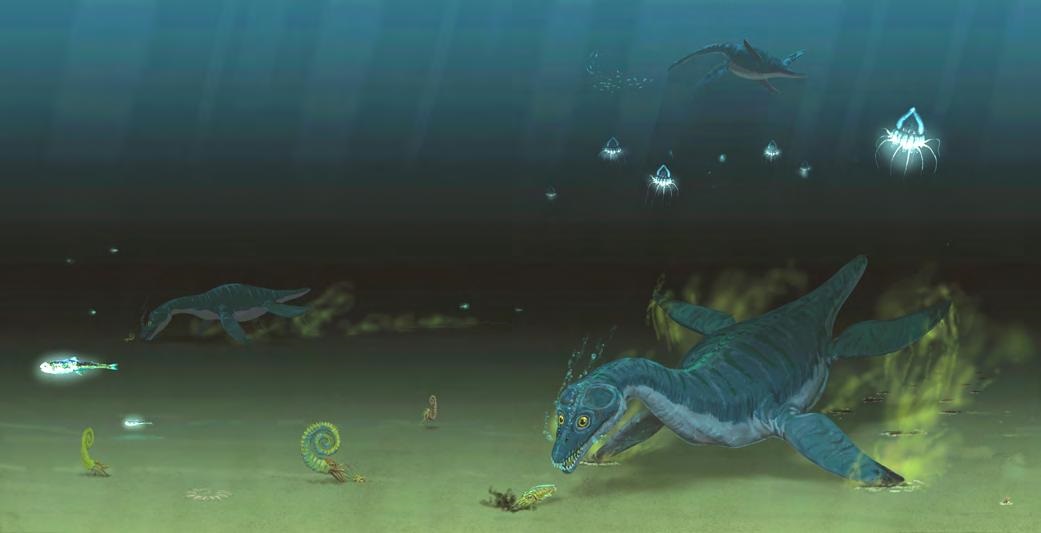
 marine reptiles of the order Plesiosauria, on the seabed of the Tethys Ocean. The plesiosaur shown here in the foreground, together with the one on the left, is inspired by Leptocleidus, a short-necked plesiosaur, as an example of the supposed author of the trackway under study. In the background on the right side, one sees another plesiosaurid: Brancasaurus, a typical long-necked plesiosaur, another hypothetical author of the trackway.
Art by Marco Astracedi.

 Abstract
An uncommon ichnofossil, constituted of a sequence of eleven imprints, named as Coneroichnus marinus ichnog. et ichnosp. nov., is described from Mount Conero, Province of Ancona, Italy. The trackway is impressed in whitish micritic limestone of the Maiolica Formation (Upper Jurassic–Lower Cretaceous), herein interpreted as the passage on the sea bottom of a marine reptile, softly interfering in the sediment-water interface. Its gait can be defined as half-swimming, that is the swimming in exploratory and punting propulsive contact with the mud at the bottom. We discuss the probable trackmaker and we suggest it was probably a pliosaurid Plesiosauria. The extreme rarity of ichnofossils of tetrapods on the deep-sea bottom in the whole world is herein confirmed.

Keywords: Early Cretaceous, Coneroichnus marinus ichnog. et ichnosp. nov., pelagic reptile trackway.


The image shows marine reptiles of the order Plesiosauria, on the seabed of the Tethys Ocean. The plesiosaur shown here in the foreground, together with the one on the left, is inspired by Leptocleidus, a short-necked plesiosaur, as an example of the supposed author of the trackway under study. In the background on the right side, one sees another plesiosaurid: Brancasaurus, a typical long-necked plesiosaur, another hypothetical author of the trackway.
Art by Marco Astracedi.


CONCLUSIONS: 
In the present paper we have allocated from an ichnotaxonomical and ichnological point of view a trackway, from deep pelagic environment, on the seabed of the Tethys Ocean, which then became a limestone bank of the Maiolica Formation, of the Berriasian–Hauterivian, Early Cretaceous of Mount Conero (Sirolo, Marche, Italy). We have updated the most likely stratigraphic position of the outcrop bearing the sequence of tracks;we have assigned to them the name of Coneroichnus marinus ichnog. et ichnosp. nov.
We concluded that its gait can be defined as the half-swimming manner of gait, that is the exploratory and propulsive contact swimming with the mud saturated with water on the bottom. Since this kind of underwater progression happens, in this specific case, in contact with the sea bottom, it was here also defined as a punting and foraging manner of gait.
Only two other tracksites with tracks attributed to fossil marine reptiles had been so far found in sediments from the deep seabed paleoenvironment, not only in Italy, but in the entire world. Mount Conero is the third ichnosite in the world with deep-marine fossil trackways. It will be useful to carry out more intense research along all the outcrops of Maiolica at Mount Conero and along the Adriatic Sea, but also in other areas, on tabular surfaces of layers not too eroded, looking for other specimens of marine reptile tracks like these or similar to them.


Luca Natali and Giuseppe Leonardi. 2023. Coneroichnus marinus ichnogenus et ichnospecies nov., A Fossil Trackway of Marine Reptile in the Maiolica Formation (Upper Jurassic–Lower Cretaceous) from Monte Conero, Marche, Italy.  Revista Brasileira De Paleontologia. 26(3), 156–171. DOI: 10.4072/rbp.2023.3.02

RESUMO – Um raro icnofóssil, ou seja, uma sequência de onze impressões em micrite calcária da Formação Maiolica (Jurássico Superior–Cretáceo Inferior), é aqui nomeado como Coneroichnus marinus ichnog. et ichnosp. nov. sendo detalhadamente descrito. A pista se encontra no Monte Conero, na Província de Ancona, Itália. Ela é atribuída à passagem sobre o fundo do mar de um réptil marinho, o qual deformou a superfície na interface sedimento-água. Seu deslocamento pode ser definido como semi-natação, que corresponde a uma natação de caráter exploratório e propulsivo em contato com a lama do fundo. Discute-se o produtor desta pista, possivelmente um pliosaurídeo Plesiosauria. A extrema raridade de icnofósseis de tetrápodes no substrato marinho profundo em todo o mundo é confirmada.
Palavras-chave: Cretáceo Inferior, Coneroichnus marinus ichnog. et ichnosp. nov., pista de um réptil pelágico.

Monday, October 16, 2023

[Paleontology • 2023] Lorrainosaurus keileni • The Rise of Macropredatory Pliosaurids near the Early-Middle Jurassic Transition


 Lorrainosaurus keileni   

 in Sachs, Madzia, Thuy & Kear, 2023.
artwork: Joschua Knüppe

Abstract
The emergence of gigantic pliosaurid plesiosaurs reshaped the trophic structure of Mesozoic marine ecosystems, and established an  ~ 80 million-year (Ma) dynasty of macropredatory marine reptiles. However, the timescale of their ‘defining’ trait evolution is incompletely understood because the fossil record of gigantic pliosaurids is scarce prior to the late-Middle Jurassic (Callovian),  ~ 165.3 Ma. Here, we pinpoint the appearance of large body size and robust dentitions to early-Middle Jurassic (Bajocian) pliosaurids from northeastern France and Switzerland. These specimens include a new genus that sheds light on the nascent diversification of macropredatory pliosaurids occurring shortly after the Early-Middle Jurassic transition, around  ~ 171 Ma. Furthermore, our multivariate assessment of dental character states shows that the first gigantic pliosaurids occupied different morphospace from coeval large-bodied rhomaleosaurid plesiosaurs, which were dominant in the Early Jurassic but declined during the mid-Jurassic, possibly facilitating the radiation and subsequent ecomorph acme of pliosaurids. Finally, we posit that while the emergence of macropredatory pliosaurids was apparently coordinated with regional faunal turnover in the epeiric basins of Europe, it paralleled a globally protracted extinction of other higher trophic-level marine reptiles that was not completed until after the earliest-Late Jurassic,  ~ 161.5 Ma.


Skeletal remains of the holotype (MNHNL BU159) of Lorrainosaurus keileni.
(a) Reconstruction in lateral view showing recovered elements. (b) Tooth crown with root. (c) Posterior section of mandible in lateral view. (d) Glenoid section of mandible in articular view. (e) Complete mandible in ventral view. (f) Enlargement of the mandibular symphysis. (g) Coracoid in dorsal view.


Plesiosauria de Blainville, 1835 

Pliosauridae Seeley, 1874 

Thalassophonea Benson & Druckenmiller, 2014 

Lorrainosaurus gen. nov.

Etymology: Derived from ‘Lorraine’, for the type locality; and ‘σαῦρος’ (sauros), Greek for ‘reptile’.

Type species: Lorrainosaurus keileni (Godefroit, 1994) 


Type locality and stage: A temporary road cutting between Montois-la-Montagne and Sainte-Marie-aux-Chênes ~ 18 km northeast of Metz in Lorraine, northeastern France. These deposits form part of the Marnes de Gravelotte regional lithostratigraphical unit correlated with the upper Bajocian (mid-Middle Jurassic) Parkinsonia parkinsoni Zone.

Diagnosis: Large-bodied thalassophonean pliosaurid autapomorphically distinguished by a transversely broad, ‘wedge-shaped’ splenial contact that extends anteriorly to the level of the fourth mandibular alveolus. Lorrainosaurus keileni also displays a unique character state combination: (1) laterally expanded and posteriorly constricted ‘spatulate’ symphyseal section of the mandible bearing five to six alveoli; (2) lateral trough on the mandible anterior to the glenoid fossa; (3) a retroarticular process that is shorter than the glenoid fossa; (4) retroarticular process with posteroventrally oriented dorsoventral long axis and slightly posteromedially inflected mediolateral long axis; (5) wide posteromedial seperation of the coracoids; (6) posterolateral edge of the coracoid (cornu) projecting beyond the level of the glenoid fossa (Fig. 1).


 Sven Sachs, Daniel Madzia, Ben Thuy and Benjamin P. Kear. 2023. The Rise of Macropredatory Pliosaurids near the Early-Middle Jurassic Transition. Scientific Reports. 13: 17558. DOI: 10.1038/s41598-023-43015-y
 

Monday, September 26, 2022

[Paleontology • 2022] Serpentisuchops pfisterae • A Long-snouted and Long-necked Polycotylid Plesiosaur from the Late Cretaceous of North America


Serpentisuchops pfisterae
Scott Persons, Street & Kelley, 2022

Artwork by Nathan Rogers. twitter.com/NathanERogers

Highlights
Serpentisuchops is a polycotylid plesiosaur, from the Cretaceous of Wyoming
• Unlike most plesiosaurs, it has both a long neck and large, elongated jaws
• The partial skeleton indicates the animal was over seven meters long
• The long jaws and neck likely aided in rapid lateral striking to snag fast, small prey

Summary
Plesiosaurs are a group of Mesozoic marine diapsids. Most derived plesiosaurs fall into one of two typical body forms: those with proportionately small heads, short snouts, and elongated necks, and those with large heads, elongated snouts, and short necks. Serpentisuchops pfisterae is a polycotylid plesiosaur from the Upper Cretaceous Pierre Shale that presents the trait combination of both an elongate snout and elongate neck (consisting of 32 vertebrae). Phylogenetic analysis places Serpentisuchops within the Polycotylinae, indicating that its long snout is an ancestral trait, while its long neck is secondarily derived and convergent with that of ancestral plesiosaurs, contemporaneous elasmosaurids, and some more basal members of the Polycotylidae. The conical, recurved, and narrow teeth are consistent with a piscivorous diet. The tall and anteroposteriorly broad cervical neural spines indicate large epaxial muscles, suggesting that Serpentisuchops used both its neck and snout in fast lateral strikes aimed at proportionately small prey.

Holotype of Serpentisuchops pfisterae. Specimen GPM5001 from the Upper Cretaceous Pierre Shale Formation, of Wyoming

Plesiosauria de Blainville, 1835.
Plesiosauroidea Welles, 1943.
Polycotylidae Williston, 1908.

Serpentisuchops pfisterae Persons, Street, and Kelley, 2022, gen. et sp. nov.

Holotype: Specimen GPM5001 at the Glenrock Paleon Museum in Glenrock, Wyoming, USA, a partial skull, lower jaw, and vertebral column, plus left ileum and pubis (Figure 1).
 
Horizon and Locality Old Woman Anticline (Gill and Cobban, 1966), upper half of the upper member of the Pierre Shale, lower Maastrichtian (Upper Cretaceous), 69.59 (±0.36) to 70.00 (±0.45) million years ago (Ogg et al., 2012).

Diagnosis: A polycotylid having 36 dentary alveoli; a mandibular symphysis dominated by the dentaries and in which each angular extends for less than 0.3% of the total symphysis length (6 mm in the holotype); a pre-dorsal vertebra series of 32 cervical vertebrae and 4 pectoral vertebrae; posterior cervical vertebrae with neural spines that broaden anteroposteriorly into expanded dorsal tips; an ilium with a sacral end that is the anteroposteriorly widest and mediolaterally thinnest part of the ilium and is neither rounded nor tapered, but forms an abrupt and anteroposteriorly straight edge; and a pubis with a posterolateral edge that extends anteriorly and curves strongly to form a posterolateral projection that is hook-shaped in dorsal and ventral view. In addition, Serpentisuchops presents a unique combination of characters: as in Polycotylus, the splenial is not visible dorsally and the left and right angulars never converge on the ventral surface of the mandible; as in Dolichorhynchops, the dorsal vertebrae have anteroposteriorly elongate centra and neural spines with anteroposteriorly long and flat distal tips; the medioposterior edge of the pubis is strongly curved, but does not end in a prominent posterior projection (as it does in Dolichorhynchops tropicensis) and does not extend as far posteriorly as the ischial articulation facet.


Hypothetical flesh reconstruction of Serpentisuchops pfisterae
by Nathan Rogers.

Etymology: Serpentisuchops from serpent (Latin), snakesuchus (Latin), crocodile, and ops (Greek), face; and pfisterae for Anna Pfister, the landowner whose generosity afforded the scientific study and donation of the type specimen.

 
Walter Scott Persons, Hallie P. Street and Amanda Kelley. 2022. A Long-snouted and Long-necked Polycotylid Plesiosaur from the Late Cretaceous of North America. iScience.  DOI: 10.1016/j.isci.2022.105033
https://today.cofc.edu/2022/09/26/cofc-paleontologists-uncover-strange-new-prehistoric-sea-monster/


Tuesday, July 26, 2022

[Paleontology • 2022] Plesiosaurs from the Fluvial Kem Kem Group (mid-Cretaceous) of eastern Morocco and A Review of Non-marine Plesiosaurs


in Bunker, Martill, ... et Longrich, 2022. 

Abstract
Plesiosaurs were a long-lived and widespread group of marine reptiles, with a worldwide distribution and a temporal range from the Late Triassic to the Late Cretaceous. Most occur in marine deposits, but some occur in low-salinity, brackish to freshwater environments. We report plesiosaurs from the freshwater fluvial deposits of the mid-Cretaceous (?Albian-Cenomanian) Kem Kem Group of Morocco. Remains include numerous shed teeth, vertebrae, and a humerus. The humerus represents a young juvenile; vertebrae likely belong to sub-adults. Teeth show heavy wear, similar to teeth of co-occurring spinosaurids. While coeval plesiosaurs from the Bahariya Formation of Egypt are members of Polycotylidae, the Kem Kem fossils show features of Leptocleididae, small-bodied plesiosaurs that were widely distributed in nearshore and non-marine settings in the Early Cretaceous. These fossils are the first freshwater plesiosaurs from Morocco, and are among the youngest representatives of Leptocleididae. The Kem Kem leptocleidids could have been infrequent visitors from the sea, freshwater-tolerant, or even freshwater-adapted, as in modern river dolphins. The abundance of shed teeth in the Kem Kem Group supports the hypothesis that they had some degree of freshwater tolerance. Furthermore, leptocleidids occur almost exclusively in shallow nearshore, brackish, or freshwater environments, suggesting adaptation to shallow, low-salinity environments. Other plesiosaur groups and other Mesozoic marine reptiles, including teleosaurids and mosasaurids, also occur in freshwater settings, suggesting plesiosaurs and other marine reptiles frequently exploited non-marine environments.

Keywords: Plesiosauria, Leptocleididae, Palaeoecology, Kem Kem Group, Morocco, Freshwater

Plesiosaurs and spinosaurus may have both inhabited freshwater rivers.

 
Georgina Bunker, David M. Martill, Roy Smith, Samir Zourhi and Nick Longrich. 2022. Plesiosaurs from the Fluvial Kem Kem Group (mid-Cretaceous) of eastern Morocco and A Review of Non-marine Plesiosaurs.   Cretaceous Research. 105310. In Press. DOI: 10.1016/j.cretres.2022.105310 

bath.ac.uk/announcements/plesiosaur-fossils-found-in-the-sahara-suggest-they-werent-just-marine-animals


Tuesday, March 15, 2022

[Paleontology • 2020] A Gigantic Pliosaurid (Pliosauridae: Brachaucheninae) from the Cenomanian (Upper Cretaceous) of the Volga Region, Russia


in Zverkov et Pervushov, 2020. 
Illustration: Andrey Atuchin   twitter.com/AndreyAtuchin

Abstract
Pliosaurid plesiosaurs were among the largest predators of Mesozoic marine ecosystems attaining giant sizes up to 10–11 m in length, near a quarter of which could be constituted by a massive head. The known Late Cretaceous pliosaurids are comparatively smaller than the stratigraphically older taxa and lack a suite of macropredaceous features, demonstrating a somewhat decline of the group members towards their extinction in the Turonian. However, the early Late Cretaceous (Cenomanian) record of pliosaurids is scarce and mostly represented by isolated teeth, thus hampering the recognition of diversity and disparity of pliosaurids in this time interval. Here we describe a very large isolated cervical centrum (19 cm in maximum diameter) belonging to a brachauchenine pliosaurid. The comparison with other pliosaurids indicates that the centrum belonged to one of the largest known pliosaurids, comparable in size to Kronosaurus queenslandicus, ‘Kronosaurusboyacensis and Sachicasaurus vitae from the Aptian–Albian of Australia and Barremian–Aptian of Colombia. This finding indicates that gigantic pliosaurids were also present in the Cenomanian. Thus, the previously inferred decrease in size of pliosaurids in the Late Cretaceous is likely a result of sampling bias, and, if present, it happened not earlier than in the late Cenomanian–Turonian, right before the extinction of the group.
 
Keywords: Pliosauridae, Brachaucheninae, Gigantic pliosaurids, Late Cretaceous, Cenomanian


 Nikolay G. Zverkov and Evgeny M. Pervushov. 2020. A Gigantic Pliosaurid from the Cenomanian (Upper Cretaceous) of the Volga Region, Russia. Cretaceous Research. 110, 104419. DOI: 10.1016/j.cretres.2020.104419 

Найденный на берегу Волги позвонок удлинил время существования гигантских плиозавров