Showing posts with label Journal: Acta Geol. Sin.. Show all posts

Tuesday, August 26, 2025

[Paleontology • 2025] Huashanosaurus qini • A New Eusauropod Dinosaur from the Lower and Middle Jurassic Wangmen Formation of Ningming County, Guangxi, South China


Huashanosaurus qini 
Mo, Zhou, Fu, Xiong, Hu & Xu, 2025
  

Abstract
We report a new eusauropod dinosaur, Huashanosaurus qini gen. et sp. nov., based on a partial skeleton recovered from a bed in the Lower to Middle Jurassic Wangmen Formation (Fm.) from Huqiu Quarry near Mingjiang River, Ningming County, Guangxi Zhuang Autonomous Region, southern China. The new taxon can be diagnosed by the following autapomorphies: posterior process of the ulna hook-shaped; the cross-section of the proximal part of the ulna crescent-shaped; groove structure present at the posterodistal surface of the fibula. Phylogenetic analysis reveals that H. qini is later-diverging than the Middle Jurassic Shunosaurus. Previous work showed that the Wangmen Fm. is early Early Jurassic in age whereas the new eusauropod discovery indicates that the Wangmen Fm. is probably somewhat younger Early–Middle Jurassic in age. The find increases the diversity of Jurassic eusauropods in China.

Key words: vertebrate paleontology, eusauropoda, Wangmen Formation, Early–Middle Jurassic, Guangxi


Huashanosaurus qini gen. et sp. nov.


MO Jinyou, ZHOU Xiuzhen, FU Qiongyao, XIONG Duo, HU Minhang and XU Xing. 2025. A New Eusauropod Dinosaur from the Lower and Middle Jurassic Wangmen Formation of Ningming County, Guangxi, South China. [J]. ACTA GEOLOGICA SINICA (English edition). 99(4): 909-924. DOI: 10.1111/1755-6724.15331 

Sunday, October 2, 2022

[Paleontology • 2022] The Shishugou Fauna of the Middle-Late Jurassic Transition Period in the Junggar Basin of Western China


The Shishugou Fauna in the Junggar Basin of Western China

in Xu, Clark, Eberth & Currie, 2022. 
illustrated by Chuang ZHAO 
  
 Abstract
The Middle–Late Jurassic transition period is a critical period for the evolution of terrestrial vertebrates, but the global fossil record from this time is relatively poor. The Shishugou Fauna of this period has recently produced significant fossil remains of dinosaurs and other vertebrate groups, some representing the earliest known members of several dinosaurian groups and other vertebrate groups and some representing the best-known specimens of their group. These discoveries are significant for our understanding of the origin and evolution of several vertebrate lineages. Radiometric dating indicates that the fauna is aged approximately 159–164 Ma. Comparisons with other similarly-aged terrestrial faunas such as Shaximiao and Yanliao show both taxonomic similarities and differences between these faunas and indicate that the Junggar deposits might have preserved the most complete vertebrate fossil record for a Middle–Late Jurassic Laurasian terrestrial fauna.

 Keywords: Middle–Late Jurassic, Shishugou Fauna, Shishugou Formation, terrestrial ecosystem, Shaximiao, Yanliao, Junggar Basin


Xing Xu, James M. Clark, David A. Eberth and Philip J. Currie. 2022. The Shishugou Fauna of the Middle-Late Jurassic Transition Period in the Junggar Basin of Western China. Acta Geologica Sinica - English Edition. Special Paper for 100th Anniversary. DOI: 10.1111/1755-6724.14996

Shishugou Formation, China, 157 million years ago. 
Mamenchisaurus, Sinraptor, Guanlong, Limusaurus, Zuolong, ..

Monday, June 12, 2017

[Paleontology • 2017] Daliansaurus liaoningensis • A New Troodontid Dinosaur from the Lower Cretaceous Yixian Formation of Liaoning Province, China


Daliansaurus liaoningensis 
Shen, Lü, Liu, Kundrát, Brusatte & Gao, 2017


Abstract
 A new troodontid dinosaur, Daliansaurus liaoningensis gen. et sp. nov., is erected based on a nearly complete specimen from the Lower Cretaceous Yixian Formation of Beipiao City, Liaoning Province, China. This well preserved skeleton provides important new details of the anatomy for Liaoning troodontids, and gives new insight into their phylogenetic relationships and evolution. Daliansaurus is distinguished from other troodontids by an enlarged ungual on pedal digit IV, which is approximately the same size as the sickle-shaped second ungual, and is differentiated from other Liaoning troodontids by a number of characters of the skull, manus, pelvis, and hindlimb. A phylogenetic analysis recovers Daliansaurus within a subclade of Liaoning troodontids that also includes Sinovenator, Sinusonasus, and Mei. We erect a name for this group — Sinovenatorinae — and argue that it reflects a localized radiation of small-bodied troodontids in the Early Cretaceous of eastern Asia, similar to previously recognized radiations of Liaoning dromaeosaurids and avialans. As more Liaoning theropods are discovered, it is becoming apparent that small, feathered paravians were particularly diverse during the Early Cretaceous, and future work is needed to clarify how this diversity arose, which species coexisted, and how these numerous species partitioned niches. 

Key words: Troodontids, Daliansaurus liaoningensis, Early Cretaceous, Yixian Formation, Liaoning


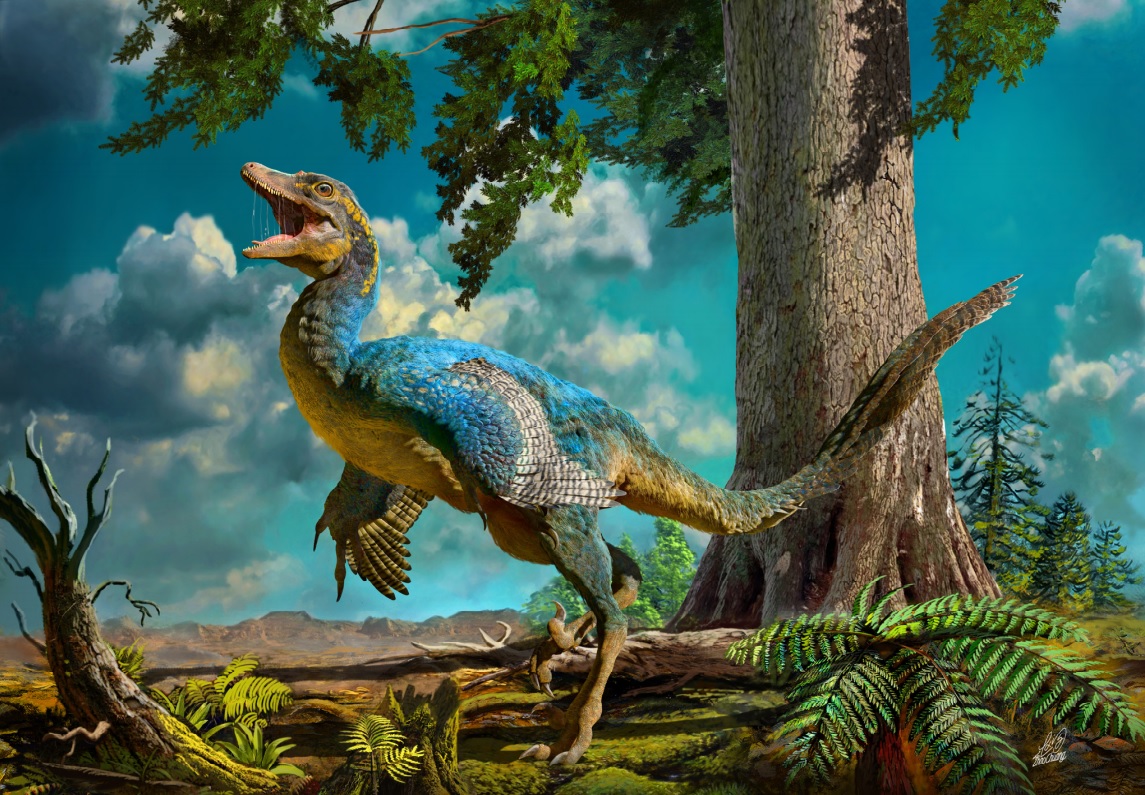
Fig. 15. The living scene of Daliansaurus liaoningensis gen. et sp. nov. (DNHM D 2885) (drawn by Zhao Chuang)
Fig. 2. Photograph of the holotype of Daliansaurus liaoningensis gen. et sp. nov. (DNHM D2885).

Theropoda Marsh, 1881
Maniraptora Gauthier, 1986

Troodontidae Gilmore, 1924 
 Sinovenatorinae subfamily nov. 

Definition: The most inclusive clade including Sinovenator changii but not Troodon formosus, Saurornithoides mongoliensis, Anchiornis huxleyi, Archaeopteryx lithographica, Gallus gallus, Unenlagia comahuensis, or Dromaeosaurus albertensis. 

  Diagnosis: Based on our phylogenetic analysis, this clade can be diagnosed with the following combination of characters (for further discussion, see below): a premaxilla whose anteroposterior length is less than 10% of the length of the maxilla along the ventral margin of the upper jaw; a premaxillary maxillary process that contacts the nasal ventral to the external naris; some maxillary and dentary teeth that lack serrations on the mesial carina; unfused zygapophyses on the sacral vertebrae; an antitrochanter that is posterodorsal to the acetabulum; and a metatarsal IV that is mediolaterally wide and flattened in cross section.

 Included species: Based on our phylogenetic analysis, this clade currently includes Sinovenator changii, Sinusonasus magnodens, Mei long, and Daliansaurus liaoningensis gen. et sp. nov.


 Daliansaurus liaoningensis gen. et sp. nov.

Etymology: The generic name refers to the city of Dalian in the south of Liaoning province. The specific name “liaoningensis” refers to the province in which the specimen was discovered.

Locality and horizon: Lujiatun, Beipiao City, Liaoning Province; Yixian Formation, Lower Cretaceous.


Fig. 15. The living scene of Daliansaurus liaoningensis gen. et sp. nov. (DNHM D 2885) (drawn by Zhao Chuang) 

Conclusions
 It appears that small-bodied, feathered, winged paravian theropods from Liaoning—dromaeosaurids, avialans, and troodontids—were exceptionally diverse. Each group experienced its own local Early Cretaceous diversification, which produced a number of species that either coexisted or, perhaps more likely, replaced each other over time or partitioned niches and geographic ranges so that they did not extensively overlap in space. The discovery of Daliansaurus also demonstrates that Liaoning continues to produce new dinosaur taxa, and remains one of the world’s most productive sites for understanding paravian evolution, more than two decades after the first feathered dinosaurs were reported.


 SHEN Caizhi, LÜ Junchang, LIU Sizhao, Martin KUNDRÁT, Stephen L. BRUSATTE and GAO Hailong. 2017. A New Troodontid Dinosaur from the Lower Cretaceous Yixian Formation of Liaoning Province, China.  ACTA GEOLOGICA SINICA.  91(3); 763–780. 


Wednesday, June 7, 2017

[Paleontology • 2017] Liaoningvenator curriei • A New Troodontid Dinosaur from the Early Cretaceous Yixian Formation in Western Liaoning, China


Liaoningvenator curriei  
Shen, Zhao, Gao, Lü & Kundrát, 2017

reconstruction by Chuang ZHAO || DOI: 10.3975/cagsb.2017.03.06 

Abstract

      A new troodontid, Liaoningvenator curriei gen. et sp. nov., is described based on a complete skeleton from the Early Cretaceous Yixian Formation of Beipiao City, Liaoning Province. It bears the following characteristics of Troodontidae: numerous and more closely appressed maxillary and dentary teeth; the teeth markedly constricted between the roots and crowns; the nutrient foramina in groove on the external surface of dentary; distal caudal vertebrae having a sulcus on the dorsal midline rather than a neural spine. Unlike other troodontids, Liaoningvenator exhibits a sub-triangular ischial boot in lateral view and slender ischial obturator process; transition point in caudal vertebrae starts from the seventh caudal vertebra. A phylogenetic analysis recovers Liaoningvenator and Eosinopteryx as sister taxa that belong to the same clade. These two taxa share the following three characteristics: (1) anterior maxillary and dentary teeth lack serrations along the anterior carina; (2) shafts of cervical ribs are longer than vertebral centra with which they articulate; and (3) anterior margin of ilium is straight. The histological study indicates that Liaoningvenator was attaining skeletal maturity and at least four years old when it perished. Liaoningvenator represents the fifth troodontid taxon from the Lower Cretaceous equivalent strata of western Liaoning. It provides much new anatomical information on basal troodontid dinosaurs in this region. It also enhances the diversity of the troodontids in Early Cretaceous of China currently known.

Keywords: troodontid, new genus and species, Early Cretaceous, phylogenetic analysis, western Liaoning

Fig. 1 Line drawing (A) and photograph (B) of Liaoningvenator curriei gen. et sp. nov. (DNHM D3012)
Systematic paleontology
Theropoda Marsh, 1881
Maniraptora Gauthier, 1986
Troodontidae Gilmore, 1924

Liaoningvenator curriei gen. et sp. nov.  

Etymology: The genus name refers to Liaoning, and “venator” meaning hunter; the specific name honors Professor Philip J. Currie for his outstanding contribution to the research on small theropod dinosaurs.

Holotype: A nearly complete, naturally articulated skeleton with skull and lower jaws (DNHM D3012), all bones are three dimensionally preserved. The type specimen is housed in the collections of the Dalian Natural History Museum (DNHM), Dalian City, Liaoning Province, China.

 Type locality and horizon: Lujiatun, Shangyuan, Beipiao City, Liaoning Province, China; fluvial and volcaniclastic beds of the basal Yixian Formation, Hauterivian, Lower Cretaceous (Xu et al., 2002).

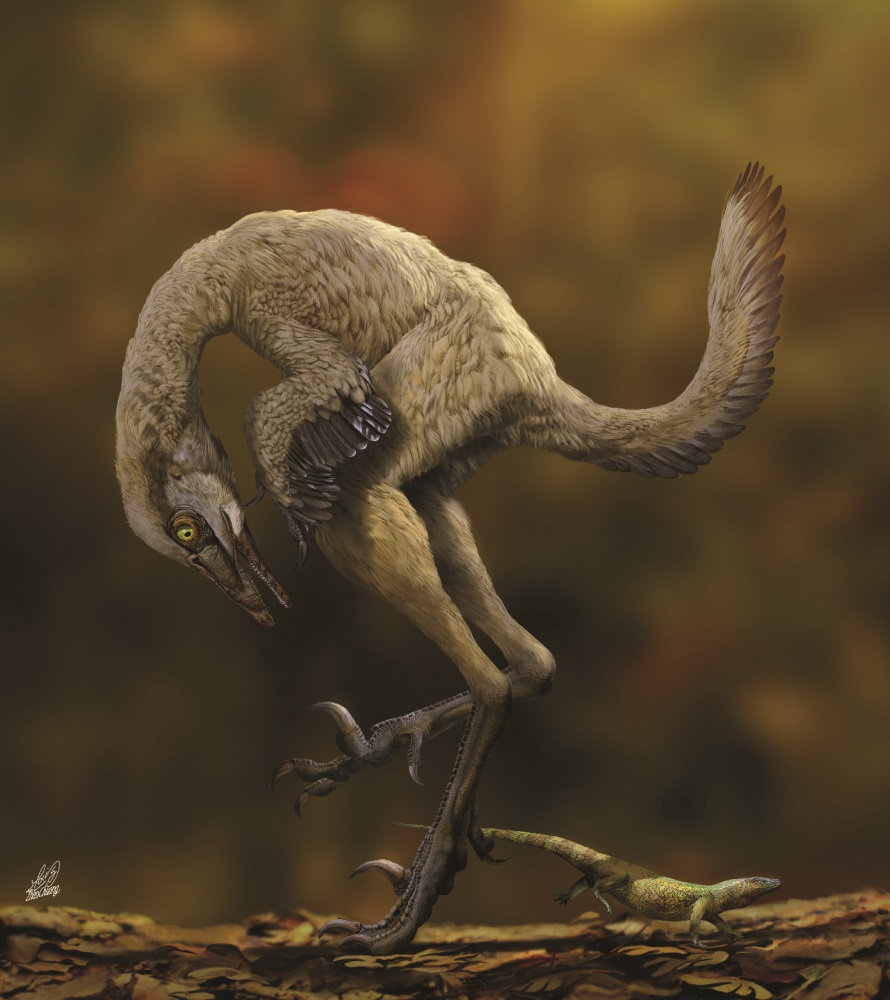
The reconstruction of Liaoningvenator curriei gen. et sp. nov. (DNHM D3012)
drawn by ZHAO Chuang


Cai-zhi Shen, Bo Zhao, Chun-ling Gao, Jun-chang Lü and Martin Kundrát. 2017. A New Troodontid Dinosaur (Liaoningvenator curriei gen. et sp. nov.) from the Early Cretaceous Yixian Formation in Western Liaoning Province. Acta Geoscientica Sinica. 38: 359-371.  DOI: 10.3975/cagsb.2017.03.06


Liaoningvenator, a new troodontid from China http://www.wildprehistory.com/abstract/liaoningvenator-a-new-troodontid-from-china/ @wildprehistory

Saturday, April 2, 2016

[PaleoOrnithology • 2013] Xinghaiornis lini (Aves: Ornithothoraces) from the Early Cretaceous of Liaoning: An Example of Evolutionary Mosaic in Early Birds


Xinghaiornis lini 
Wang, Chiappe, Teng & Ji, 2013 DOI: 10.1111/1755-6724.12080

      We describe a new species of Early Cretaceous bird from the Yixian Formation of Liaoning Province. Xinghaiornis lini gen. et sp. nov. is relatively large and characterized by a long, toothless rostrum and an elevated pedal digit I. The design of the skull and feet suggests that this bird was likely a mud-prober. This discovery provides strong support indicating that this avian trophic specialization originated at least 125 million years ago.

Keywords: Early Cretaceous, Xinghaiornis lini, Yixian Formation, avian trophic specialization


Xuri Wang, Luis M. Chiappe, Fangfang Teng and Qiang Ji. 2013. Xinghaiornis lini (Aves: Ornithothoraces) from the Early Cretaceous of Liaoning: An Example of Evolutionary Mosaic in Early Birds. Acta Geologica Sinica (English Edition). 87(3): 686–689.

Thursday, September 18, 2014

[Paleontology • 2012] Datanglong guangxiensis • A New Carcharodontosauria (Theropoda) from the Early Cretaceous of Guangxi, Southern China


  Datanglong guangxiensis
Mo, Zhou, Li, Hunag & Cao, 2014
illustration: EloyManzanero on @deviantART 
Abstract
A new large-bodied theropod dinosaur, Datanglong guangxiensis gen. et sp. nov., was recovered from the Lower Cretaceous Xinlong Formation of the Datang Basin, Guangxi. It is unique in several features including: posteriormost dorsal vertebra with teardrop-shaped pneumatic foramen confined by enlarged pcdl, acpl and the centrum; posteriormost dorsal with well-developed, horizontal prpl; posteriormost dorsal with a parapophysis projecting more laterally than the diapophysis; brevis fossa shallow with short, ridge-like medial blade; and iliac pubic peduncle with posteroventrally expanded margin. Cladistic analysis supports the idea that this new taxon Datanglong guangxiensis is a primitive member of the Carcharodontosauria in possessing two unambiguous synapomorphies: large external pneumatic foramina and internal spaces present in the lateral surface of ilium, and a peg-and-socket ischiac articulation with the ilium. The presence of the new taxon from Guangxi further confirms that Carcharodontosauria were cosmopolitan large-bodied predators during the Early-mid Cretaceous.

Keywords: Theropoda; Carcharodontosauria; Lower Cretaceous; Xinlong Formation; Guangxi


MO, J., ZHOU, F., LI, G., HUANG, Z. and CAO, C. 2014, A New Carcharodontosauria (Theropoda) from the Early Cretaceous of Guangxi, Southern China. Acta Geologica Sinica, 88: 1051–1059. doi: dx.doi.org/10.1111/1755-6724.12272
Cau, Andrea. 2014. "Datanglong: un nuovo carcharodontosauriano?" [Datanlong: a new carcharodontosaur?]. Theropoda (in Italian) http://theropoda.blogspot.com/2014/08/datanglong-un-nuovo-carcharodontosauria.html