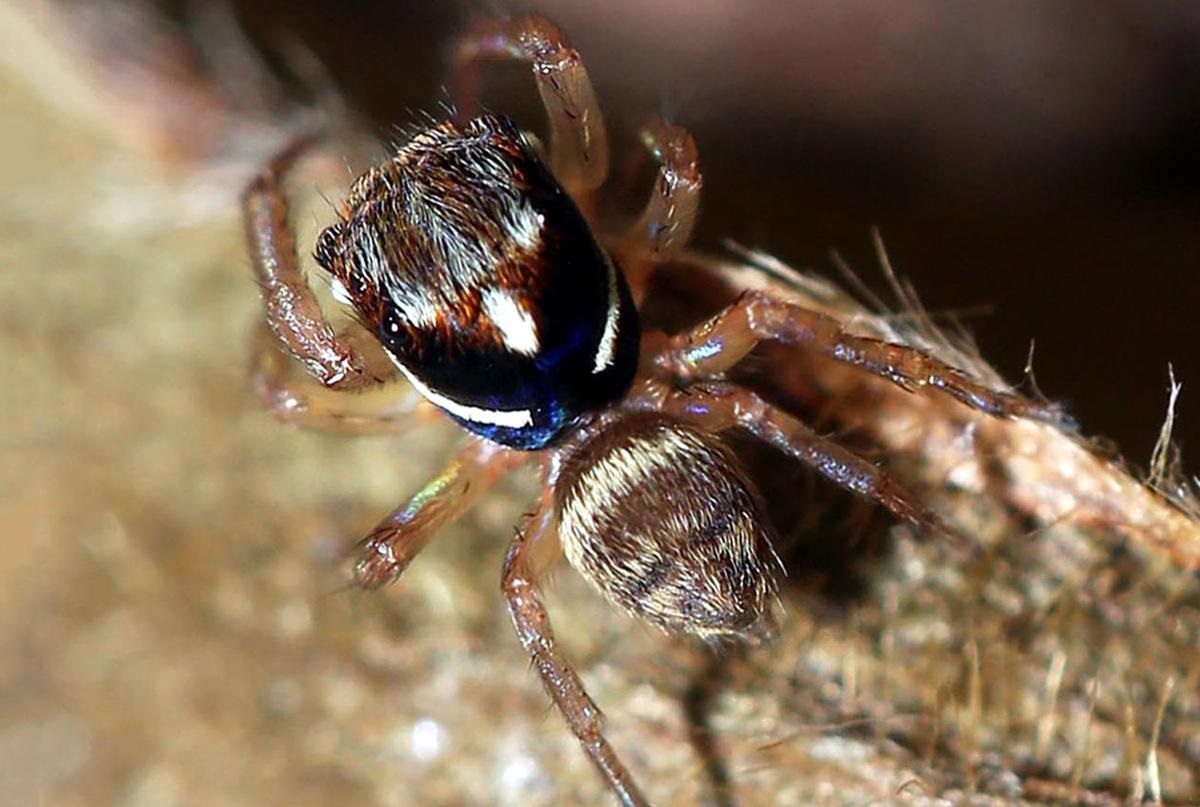
Showing posts with label Salticidae. Show all posts

Wednesday, May 6, 2026

[Arachnida • 2026] Langelurillus sahyadri & L. udaipurensis • Further Notes on Indian Langelurillus Próchniewicz, 1994 (Araneae: Salticidae), with the Description of Two New Species


Langelurillus sahyadri Sanap, Tripathi, Thackeray & Caleb, 

in SanapTripathiCaleb, H. Koli, V.K. Koli, Intodia et Thackeray, 2026.

Abstract
We describe two new species, Langelurillus sahyadri Sanap, Tripathi, Thackeray & Caleb sp. nov. (♂♀) from Maharashtra and Langelurillus udaipurensis Tripathi, Sanap & Caleb sp. nov. (♂) from Rajasthan. Additionally, the previously unknown females of L. lacteus Sanap, Joglekar & Caleb, 2017 and L. onyx Caleb, Sanap, Joglekar & Prajapati, 2017 are described for the first time. Detailed morphological descriptions, illustrations, diagnostic comparisons of the studied species, and a distributional map for all Indian species are provided.

Araneae, Aravalli hills, distribution, jumping spider, taxonomy, Western Ghats


 Langelurillus sahyadri Sanap, Tripathi, Thackeray & Caleb sp. nov. 

Langelurillus udaipurensis Tripathi, Sanap & Caleb sp. nov. 


Langelurillus lacteus Sanap, Joglekar & Caleb, 2017 
L. onyx Caleb, Sanap, Joglekar & Prajapati, 2017


RAJESH V. SANAP, RISHIKESH TRIPATHI, JOHN T.D. CALEB, HEMLATA KOLI, VIJAY KUMAR KOLI, ANJANA INTODIA and TEJAS THACKERAY. 2026. Further Notes on Indian Langelurillus Próchniewicz, 1994 (Araneae: Salticidae), with the Description of Two New Species. Zootaxa. 5792(1); 183-199. DOI: doi.org/10.11646/zootaxa.5792.1.11 [2026-04-10]

Friday, April 10, 2026

[Arachnida • 2026] Mogrus shushka & M. pune • Two New Mogrus Species (Araneae: Salticidae) from India


[A–F] Mogrus shushka Tripathi, Kadam & Prajapati, 
Mogrus pune Tripathi, Kulkarni & Kadam, 

in Tripathi, Kadam, Asha, Kulkarni, Jangid, Prajapati et Sudhikumar, 2026. 

 Abstract
This study provides taxonomic contributions to the genus Mogrus Simon, 1882 from India, with the descriptions of two new species: Mogrus shushka Tripathi, Kadam & Prajapati sp. nov. and Mogrus pune Tripathi, Kulkarni & Kadam sp. nov. Furthermore, the male of Mogrus rajasthanensis Caleb, Chatterjee, Tyagi, Kundu & Kumar, 2017 is described for the first time, while Mogrus larisae Logunov, 1995 is newly reported from India. We provide detailed morphological descriptions and images, as well as discuss variations in female genitalia within the genus.

Keywords: jumping spiders, genitalia variation, semi-arid ecosystems, species record, taxonomy

Field photographs of Mogrus shushka Tripathi, Kadam & Prajapati, 2026 sp. nov.
A–D. Holotype, ♂ (NRC-AA-0640). E–F. Paratype, ♀ (NRC-AA-0641).

Field photographs of Mogrus pune Tripathi, Kulkarni & Kadam sp. nov.
A–B.Holotype, ♂  (NRC-AA-0645). C–D.Paratype, ♀ (NRC-AA-0646).

Mogrus shushka Tripathi, Kadam & Prajapati sp. nov. 
Mogrus pune Tripathi, Kulkarni & Kadam sp. nov.  


Rishikesh Tripathi, Gautam Kadam, Theresa Joy Asha, Atharva Kulkarni, Ashish Kumar Jangid, Dhruv A. Prajapati, Ambalaparambil Vasu Sudhikumar. 2026. Discoveries of Two New Mogrus Species (Araneae: Salticidae) and notable records from India. European Journal of Taxonomy. 1048(1); 223–244. DOI: doi.org/10.5852/ejt.2026.1048.3249 

Thursday, December 11, 2025

[Arachnida • 2025] Asemonea dentis & Colyttus nongwar • Two New Species of Jumping Spiders (Araneae: Salticidae) from Northeastern India


Asemonea dentis & Colyttus nongwar 
Sudhin & Sen, 2025

 
Abstract
Two new species—Asemonea dentis sp. nov. (male, female), and Colyttus nongwar sp. nov. (male, female)—are described from Meghalaya state of India. Detailed morphological descriptions, illustrations, and diagnoses of the species are provided along with a distributional map.

Araneae, biodiversity hotspot, Meghalaya, salticid, taxonomy


Asemonea dentis sp. nov. (male, female), 
Colyttus nongwar sp. nov. (male, female) 


PUTHOOR PATTAMMAL SUDHIN and SOUVIK SEN. 2025. Two New Species of Jumping Spiders (Araneae: Salticidae) from Northeastern India. Zootaxa. 5723(2); 281-291. DOI: doi.org/10.11646/zootaxa.5723.2.7 [2025-11-25]

Friday, November 28, 2025

[Arachnida • 2025] Phenasurya daeng • A New Genus and Species of plexippine Jumping Spider (Salticidae: Plexippini) from Thailand


Phenasurya Marathe & Maddison,
Phenasurya daeng Marathe, Maddison & Trębicki,

in Marathe, Trębicki, Janik-Superson, Samoh, Zhang et Maddison, 2025. 

Abstract
We describe a new plexippine genus and new speciesPhenasurya daeng gen. et sp. nov., with a striking red face, from Thailand. Its placement within Plexippina is supported by ultraconserved element (UCE)-based phylogenomic analyses, supplemented with a broader four-gene analysis. Morphological evidence further justifies its generic status. Phenasurya daeng is recovered near cf. Colopsus and Pancorius but is morphologically distinct from both. These findings reveal a new red-faced lineage and settle the identity of a perplexing jumping spider.

Key words: Araneae, biodiversity, Indochina, phylogenomics, systematics, taxonomy, UCE

Family Salticidae Blackwall, 1841
Subfamily Salticinae Blackwall, 1841

Tribe Plexippini Simon, 1901
Subtribe Plexippina Simon, 1901

Phenasurya daeng, male (9–17) and female (18–20).

 Phenasurya Marathe & Maddison, gen. nov.
 
Etymology. The genus name Phenasurya is derived from the Greek “phen-”, referring to appearance, and the Thai “Surya”, referring to the sun. This alludes to the face of this elegant spider, red like the setting sun.

 Phenasurya daeng Marathe, Maddison & Trębicki, sp. nov.

Etymology. The specific epithet daeng means “red” in Thai, alluding to the species’ distinctive red face.


 Kiran Marathe, Łukasz Trębicki, Katarzyna Janik-Superson, Abdulloh Samoh, Junxia Zhang, Wayne P. Maddison. 2025. Phenasurya daeng, A New Genus and Species of plexippine Jumping Spider (Salticidae, Plexippini, Plexippina) from Thailand. ZooKeys. 1259: 335-348. DOI:  doi.org/10.3897/zookeys.1259.169914 

Thursday, August 21, 2025

[Arachnida • 2025] Noegus sombrerovueltiao • A New Species of Jumping Spider of the Genus Noegus Simon 1900 (Araneae: Salticidae: Amycini) from Colombia


Noegus sombrerovueltiao Suárez-Martínez & Bedoya-Roqueme,

in Suárez-Martínez, Bedoya-Roqueme et Quirós-Rodríguez, 2025. 
 
Abstract
A new salticid species of the genus Noegus Simon 1900 is described herein as N. sombrerovueltiao sp. nov. (♂♀), found in the dry forest of the Córdoba department in northwestern Colombia. Photographs and illustrations of the diagnostic characters for males and females and ecological comments are provided. Distribution maps and habitat photographs are also included.

Keywords: Arachnida, dry forest, Neotropics, taxonomy, zoogeography

Noegus sombrerovueltiao sp. nov.
Female paratype (1, 2), views of a specimen in life from Momil, Mata de Caña;
male holotype (3, 4), views of a specimen in life from Momil, Córdoba department, Colombian Caribbean.

Habitus Noegus sombrerovueltiao sp. nov.
 Male holotype (5, 6); female paratype (7, 8).
5, 7, dorsal view; 6, 8 ventral view. Scales = 2.0 mm.

 Male holotype of Noegus sombrerovueltiao sp. nov. 
 13, palp in ventral view; 14, palp in dorsal view; 15, palp in prolateral view; 16, palp in retrolateral view. Scales = 0.5 mm.

Taxonomy
Family Salticidae Blackwall 1841 
Subfamily Salticinae Blackwall 1841 
Tribe Amycini F.O. Pickard-Cambridge 1900 Genus Noegus Simon 1900 

Type species: Noegus vulpio Simon 1900 

Noegus sombrerovueltiao Suárez-Martínez & Bedoya-Roqueme sp. nov.

Etymology. The specific epithet “sombrerovueltiao” is in homage to the “Sombrero Vueltiao”, a piece of clothing (hat) autochthonous of the region where the specimens were collected, whose design of lines turning around is similar to the turns that the embolus makes around the pedipalp of the male.


Leiner A. Suárez-Martínez, Edwin Bedoya-Roqueme and Jorge A. Quirós-Rodríguez. 2025. A New Species of Jumping Spider of the Genus Noegus Simon 1900 (Araneae: Salticidae: Amycini) from Colombia. Acta Arachnologica. 74(1); 9-18. DOI: doi.org/10.2476/asjaa.74.9
https://x.com/LSuarezm_8legs/status/1958026220223762936

Monday, June 23, 2025

[Arachnida • 2024] Neonella almita • A New Species of Neonella Gertsch, 1936 (Araneae: Salticidae: Euophryini), new records and conservation issues for the genus from Uruguay


Neonella almita Hagopián & Simó,

in Hagopián, Cajade, Maldonado, Pompozzi, Laborda et Simó. 2024. 

Abstract
A new species of Neonella Gertsch, 1936 is described from Uruguay: N. almita n. sp., which inhabits natural grasslands. Additionally, first records of N. acostae Rubio, Argañaraz & Gleiser, 2015, and new records of N. lubrica Galiano, 1988, N. minuta Galiano, 1965, and N. montana Galiano, 1988 are given. Illustrations of the habitus, sexual characters, photographs of living specimens, natural history data and a distribution map of species of Neonella from Uruguay are provided. Conservation issues based on distributional patterns of the species are proposed.

 KEYWORDS: conservation, Jumping spiders, natural history, taxonomy

Neonella almita n. sp., photographs in vivo.
A grassland with Saccharum angustifolium (Nees) Trin;
B, D, F male; C, E, G female.

Salticidae Blackwall, 1841
Salticinae Blackwall, 1841
Euophryini Simon, 1901
Neonella Gertsch, 1936

Neonella Gertsch, 1936: 24 
(type species by monotypy: Neonella vinnula Gertsch, 1936).

Neonella almita Hagopián & Simó n. sp. 

Etymology: The specific epithet is a Spanish noun in apposition and means ‘small soul’, in reference to the small size of the species and because it is one of the smallest jumping spiders in the world. 


Damián Hagopián, Manuel Cajade, M. Belén Maldonado, Gabriel Pompozzi, Álvaro Laborda and Miguel Simó. 2024. A New Species of Neonella Gertsch, 1936 (Araneae: Salticidae: Euophryini), new records and conservation issues for the genus from Uruguay. Arachnology. 19(9):1143-1151. DOI: doi.org/10.13156/arac.2024.19.9.1143 [13 November 2024] 

Monday, May 12, 2025

[Arachnida • 2024] Evarcha tsipikafotsy, E. vavannyangisy & Thyene volombavatanany • Three New Species of plexippine jumping spiders (Salticidae: Salticinae: Plexippini) from dry forest in Boeny Region, north-western Madagascar


[12-13] Evarcha tsipikafotsy,
[20-23] E. vavannyangisy 

 Murray, Escobar-Toledo & Pett, 2024 

Abstract
Despite being the most diverse family of spiders, Salticidae (jumping spiders) are poorly studied in Madagascar with only 47 of the total 105 species recorded in the last 100 years. Here, we describe three new species of Plexippini Simon, 1901 from dry forests in North-western Madagascar as part of an ongoing biomonitoring programme. This paper increases the number of species in the genus Evarcha Simon, 1902 from 93 to 95 and Thyene Simon, 1885 from 55 to 56. Additionally, we publish specimen records of Plexippus petersi (Karsch, 1878) from Madagascar for the first time. All new species are diagnosed and illustrated through photographs and drawings.

Key words: Afrotropics, discovery, Evarcha, new record, new species, taxonomy, Thyene
 
Evarcha tsipikafotsy sp. nov. in vivo images, male.
Photo credits: J.E.T.

Evarcha vavannyangisy sp. nov.
20–23 male holotype habitus 24, 25 male pedipalp 20 dorsal 21 lateral 22 frontal 23, 24 ventral 25 retrolateral. Scale bars: 1 mm (20–23); 0.5 mm (24, 25).


Evarcha tsipikafotsy sp. nov.
Evarcha vavannyangisy sp. nov.

 Thyene volombavatanany sp. nov.


 Katie I. Murray, Jaime Escobar-Toledo and Brogan L. Pett. 2024. Three New Species of plexippine jumping spiders (Salticidae, Salticinae, Plexippini) from dry forest in Boeny Region, north-western Madagascar. African Invertebrates. 65(2): 61-74. DOI: doi.org/10.3897/afrinvertebr.65.126810  

Monday, September 2, 2024

[Arachnida • 2024] Gelotia onoi • First Record of Gelotia Thorell, 1890 (Araneae: Salticidae) from Vietnam with Description of A New Species


Gelotia onoi
Hoang, Phan & Vo, 2024

RAFFLES BULLETIN OF ZOOLOGY. 72;

 Abstract
 A novel species of the spartaeine genus Gelotia Thorell, 1890, G. onoi, new species is described from the Central Highlands of Vietnam. Additionally, two species, G. liuae Wang & Li, 2020 and G. zhengi Cao & Li, 2016 are also recorded from Vietnam for the first time. Detailed descriptions, illustrations of the copulatory organs, somatic features, and DNA barcodes for the species are provided. 

Key words. DNA barcoding, jumping spiders, Southeast Asia, Spartaeinae

Habitus of Gelotia onoi, new species (female, holotype) in life. A, B, habitus, dorsal view; C, D, habitus, dorso-lateral view.

Gelotia onoi, new species

Diagnosis. The female of Gelotia onoi, new species (Figs. 1–2) resembles those of the type species, G. frenata Thorell, 1890 and G. liuae Wang & Li, 2020 in having the epigyne with a fold and rounded window, but differs from two latter species by the following characteristics: the epigynal window located in the near middle in the new species (Fig. 2C) while anterior in both G. frenata (fig. 5 in Prószyński, 1969) and G. liuae (cf. Fig. 4C and fig. 8A in Wang & Li, 2020), copulatory duct significantly longer than the length of spermathecae (Fig. 2D) (shorter in other species), spermathecae almost rounded, relatively very small (Fig. 2D) in comparision with G. frenata and G. liuae as well as all other members of the genus Gelotia (see comparative illustrations in Metzner, 2024).
 
Etymology. This specific epithet is given to honour Dr. Hirotsugu Ono (Japan), who has made great contributions to improving knowledge of the spider fauna in Vietnam. 


Quang D. Hoang, Quoc T. Phan and Van M. Vo. 2024. First Record of Gelotia Thorell, 1890 (Araneae: Salticidae) from Vietnam with Description of A New Species. RAFFLES BULLETIN OF ZOOLOGY. 72; 294–302.


[Arachnida • 2024] Mimetus parvulus & M. spinatus • Two New Species and A New Transfer in the Pirate Spider Genus Mimetus Hentz, 1832 (Araneae: Mimetidae: Mimetinae) from India


 Mimetus parvulus Sankaran, Sudhin & Sen, 
M. spinatus Sudhin, Sankaran & Sen, 

in Sudhin, Sankaran & Sen, 2024. 
 
Abstract
Two new species of Mimetus Hentz, 1832 are described from India: Mimetus parvulus Sankaran, Sudhin & Sen, 2024 n. sp., and M. spinatus Sudhin, Sankaran & Sen, 2024 n. sp.. Detailed descriptions and illustrations of both species are provided, and their current distribution is mapped. Based on familial and generic similarities, we transfer the misplaced M. tikaderi Gajbe, 1992 to the Liocranidae genus Agroeca Westring, 1861.

Araneae, Agroeca, distribution, Kerala, Liocranidae, taxonomy


Puthoor Pattammal Sudhin, Pradeep M. Sankaran, Souvik Sen. 2024. Two New Species and A New Transfer in the Pirate Spider Genus Mimetus Hentz, 1832 (Araneae: Mimetidae: Mimetinae) from India.  Zootaxa. 5496(4); 555-566. DOI: doi.org/10.11646/zootaxa.5496.4.5


Monday, August 26, 2024

[Arachnida • 2024] Ligdus garvale • Reviving Ligdus Thorell, 1895 (Araneae: Salticidae: Ballini): Description of A New Species from India, 129 years since the Establishment of the Genus


Ligdus garvale Caleb, 

in Caleb, Shree, Kumar et Abhijith, 2024. 

The jumping spider genus Ligdus Thorell, 1895 was established as a monotypic genus with Ligdus chelifer Thorell, 1895 as its type species (Thorell 1895). The only known species was described based on a juvenile specimen collected from Tharawaddy, Myanmar (erstwhile Burma), which was later illustrated by Prószyński (1984). During recent field work in Kodagu, Karnataka we collected a peculiar male individual which was later identified as belonging to the genus Ligdus. In this paper, we present the rediscovery of the genus Ligdus 129 years since its establishment, through the description of a new species from Karnataka state, India. The genus is moreover reported for the first time in India.
.

Araneae, Salticidae, Ballini, Ligdus, India

General appearance of Ligdus garvale Caleb, sp. nov.,
 holotype male. 1, 2 dorsal view; 3 left leg I; 4 lateralview; 5 front view; 6 spider in its retreat built on a leaf.
Photo credits: 1–5, A.P.C. Abhijith; 6, Divya Shree.

Ligdus garvale Caleb, sp. nov.


John T.D. Caleb, A. Divya Shree, Lohith Kumar and A.P.C. Abhijith. 2024. Reviving Ligdus Thorell, 1895: Description of A New Species from India, 129 years since the Establishment of the Genus (Araneae: Salticidae: Ballini). Zootaxa. 5448(3):446-450. DOI: doi.org/10.11646/zootaxa.5448.3.8

Thursday, August 22, 2024

[Arachnida • 2024] Habrocestum benjamin & H. swaminathan • On the Genus Habrocestum Simon, 1876 (Araneae: Salticidae: Hasariini) from India


Habrocestum swaminathan and (G-H) H. benjamin 
 Jose, Caleb & Sudhikumar, 2024


Abstract
Two new species of the ground-dwelling jumping spider genus Habrocestum Simon, 1876 from the wet evergreen forests of the southern Western Ghats, India are described: H. benjamin sp. nov. (♂♀) and H. swaminathan sp. nov. (♂♀). Furthermore, H. emanasakgrensis Kadam & Tripathi, 2023 is synonymized with Chinattus validus (Xie, Peng & Kim, 1993) syn. nov.. Diagnoses, digital illustrations, morphological descriptions, natural history notes and discussion are provided.

Araneae, ground spiders, Kerala, Meghalaya, new species, new synonym, primary forest, Western Ghats


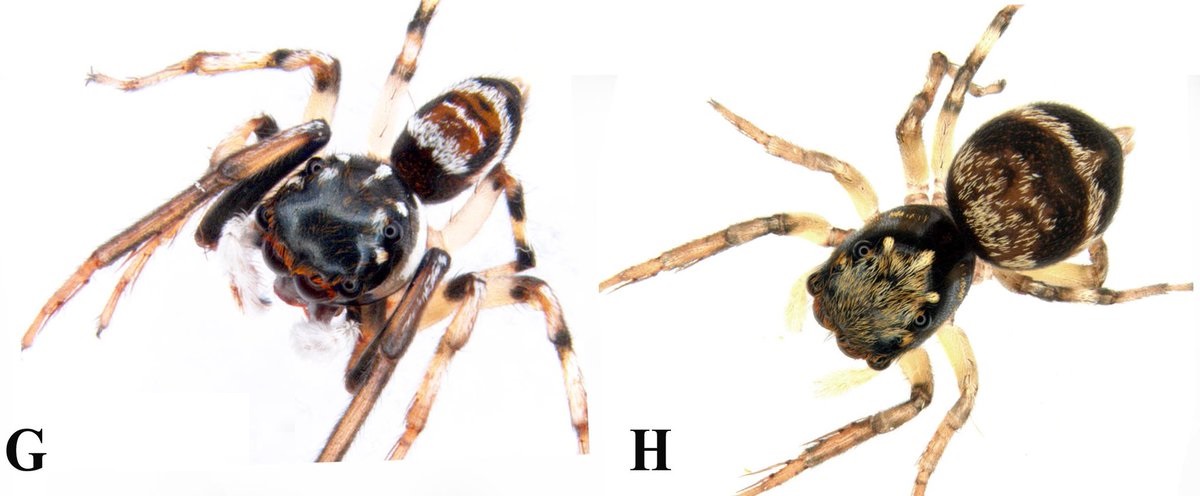
General habitus of Habrocestum swaminathan sp. nov. (A–F). A. Holotype male, dorsal view; B. Same, lateralview; C. Same, frontal view; D. Paratype female, dorsal view; E. Same lateral view; F. Same, frontal view.
General habitus of Habrocestum benjamin sp. nov. (G–H). G. Holotype male, dorsal view; H. Paratype female, dorsal view. 


 Habrocestum benjamin 


Athira Jose, John T.D. Caleb and Ambalaparambil Vasu Sudhikumar. 2024. On Three Species of the Genus Habrocestum Simon, 1876 (Araneae: Salticidae: Hasariini) from India. Zootaxa. 5448(2); 212-224. DOI: doi.org/10.11646/zootaxa.5448.2.3

Thursday, February 29, 2024

[Arachnida • 2024] Ghatippus paschima • A New Species and Genus of plexippine Jumping Spider (Salticidae: Plexippini) from the Western Ghats of India


Ghatippus paschima  Marathe & Maddison,

in Marathe, Maddison & Kunte, 2024. 
  घािटस्  || DOI: 10.3897/zookeys.1191.114117

Abstract
We propose a new genus of plexippine jumping spiders from the Western Ghats of India based on the new species Ghatippus paschima gen. et sp. nov. While it bears a superficial resemblance to Pancorius in body form and Hyllus in membrane-bearing embolus, our UCE phylogenomic data—the first to resolve broad relationships within the Plexippina—as well as morphological features justify its status as a new genus. In addition to the molecular data and morphological descriptions, we provide photographs of living specimens of Ghatippus paschima gen. et sp. nov. and information on their natural history.
 
Key words: Araneae, biodiversity research, classification, phylogenomics, systematics, taxonomy

Habitus of Ghatippus paschima sp. nov.
26–31 male (IBC-BP828/ AS19.4384) 32–34 male (IBC-BP833/ AS19.3805)
35–38 female, (IBC-BP834/ AS19.3814) 39, 40 (IBC-BP835/ AS19.3821).
Scale bar: 1.0 mm.

Ghatippus paschima sp. nov. genitalia (top row) and alcohol preserved types habitus (bottom row)
18 male (holotype IBC-BP817) left palp, ventral view 19 ditto, retrolateral view
20 epigyne, ventral view (paratype IBC-BP818) 21 vulva, dorsal view (paratype IBC-BP818)
22 male (holotype IBC-BP817), dorsal view 23 ditto, ventral view
24 female (paratype IBC-BP818), dorsal view 25 ditto, ventral view.
Scale bars: 0.1 mm for genitalia; 1.0 mm for bodies.

Family Salticidae Blackwall, 1841

Tribe Plexippini Simon, 1901
Subtribe Plexippina Simon, 1901

 Ghatippus Marathe & Maddison, gen. nov.
  Kannada: ಪ | Devanagari: घािटस्
 
Ghatippus paschima Marathe & Maddison, sp. nov. 

Etymology: The generic name Ghatippus gen. nov. combines the word ‘Ghat’, representing the collecting locality—the Western Ghats Mountain range—with the distinctive suffix found in several plexippine genera. The generic name is assigned to the masculine gender.

Diagnosis: The UCE phylogeny implies genetic diagnosability of Ghatippus gen. nov., but here we focus on the morphological distinctions. The membranous retrolateral edge of the embolus (Figs 2, 18) and lack of distinct epigynal coupling pockets (Figs 4, 20) differentiate Ghatippus gen. nov. from all members of clade 1 (Fig. 1) and other plexippines except Hyllus, Thyene Simon, 1885, and Vailimia Kammerer, 2006. Also, Ghatippus gen. nov. is the only plexippine reported to have a bifurcated male fang with nearly co-equal branch points (Figs 6, 12).

 Ghatippus paschima Marathe & Maddison, sp. nov.

Etymology: The specific epithet paschima, a noun in apposition, means “west” in both Sanskrit and Kannada.


 Kiran Marathe, Wayne P. Maddison and Krushnamegh Kunte. 2024. Ghatippus paschima, A New Species and Genus of plexippine Jumping Spider from the Western Ghats of India (Salticidae, Plexippini, Plexippina). ZooKeys. 1191: 89-103. DOI: 10.3897/zookeys.1191.114117

Thursday, January 18, 2024

[Arachnida • 2024] Thiratoscirtus iyomii, T. kalisia & T. khonvoum • Three New Species of Thiratoscirtus (Araneae: Salticidae: Thiratoscirtinae) from Central African Rainforest


Thiratoscirtus iyomii
Pett, Iyomi & Mbende, 2024

 
Abstract
Three new species of Thiratoscirtus are described from Salonga National Park, D.R. Congo: Thiratoscirtus iyomii (♂♀), T. kalisia (♀) and T. khonvoum (♀). All species were caught on the forest floor during a rapid biodiversity inventory and represent the second report of spider collections from the largest protected tropical rainforest reserve in Africa.

Araneae, Salonga National Park, D.R. Congo, jumping spiders, leaf litter


Brogan L. Pett, Dieu Merci Mpongo Iyomi and Menard Mbende. 2024. Discovery of Three New Species of Thiratoscirtus (Araneae: Salticidae: Thiratoscirtinae) from Central African Rainforest.   Zootaxa. 5399(2); 155-162. DOI: 10.11646/zootaxa.5399.2.4

Sunday, December 31, 2023

[Arachnida • 2023] Stenaelurillus megamalai & S. neyyar • Two New Stenaelurillus Species (Araneae: Salticidae: Aelurillina) from Western Ghats, India


Stenaelurillus neyyar
Sudhin, Sen & Caleb, 2023


Abstract
Two new species – Stenaelurillus megamalai sp. nov. (♂♀) from the colorful group and Stenaelurillus neyyar sp. nov. (♂♀) from the black and white group – are described from the southern Western Ghats of India. Detailed morphological descriptions, illustrations, as well as the distribution maps are provided. New distributional data for three other species, Stenaelurillus albus Sebastian, Sankaran, Malamel & Joseph, 2015, S. arambagensis (Biswas & Biswas, 1992) and S. wandae Logunov, 2020 are also provided.

Key Words: Jumping spider, Kerala, species discovery, Tamil Nadu, taxonomy

Stenaelurillus neyyar sp. nov.
A. Male, dorsal view; B. Same, ventral view; C. Same, lateral view; D. Female dorsal view; E. Same, ventral view; F. Same, lateral view; G. Male, frontal view; H. Female, frontal view.
 Scale bars: 1 mm (A–H).


Puthoor Pattammal Sudhin, Souvik Sen and John T. D. Caleb. 2023. Two New Stenaelurillus Species (Araneae, Salticidae, Aelurillina) from Western Ghats, India. Zoosystematics and Evolution. 99(1): 123-133. DOI: 10.3897/zse.99.97985

Monday, November 6, 2023

[Arachnida • 2023] Sparbambus sindhudurg • First Record of Sparbambus Zhang, Woon & Li, 2006 (Araneae: Salticidae) from India, with Description of A New Species


Sparbambus sindhudurg Kadam & Tripathi,

in Tripathi, Kadam, Asha et Sudhikumar, 2023. 

Sparbambus was erected by Zhang, Woon & Li in 2006, and its generic name ‘Sparbambus’ reflects that it belongs to the subfamily Spartaeinae and the specimens were collected from a bamboo habitat. The monotypic genus originally reported from Malaysia was recently described from China (Wang et al. 2022). In this paper, we record Sparbambus for the first time and describe a new species from India.

Keywords: Araneae, Sparbambus, Salticidae, India


Living photos of Sparbambus sindhudurg Kadam & Tripathi, sp. nov.
1-3 holotype male (NRC-AA-4151); 4-5 paratype female (NRC-AA-4152).
Photos by G. Kadam.


Sparbambus sindhudurg Kadam & Tripathi, sp. nov.


Rishikesh Tripathi, Gautam Kadam, Theresa Joy Asha and Ambalaparambil Vasu Sudhikumar. 2023. First Record of Sparbambus Zhang, Woon & Li, 2006 from India, with Description of A New Species (Araneae: Salticidae).  Zootaxa. 5352(3); 447-450. DOI: 10.11646/zootaxa.5352.3.10
  Researchgate.net/publication/374418554_First_record_of_Sparbambus_from_India


Monday, August 14, 2023

[Arachnida • 2023] Pancorius guiyang • A New Species of Jumping Spiders (Araneae: Salticidae) from Guizhou Province, China


Pancorius guiyang Yang, Gu & Yu, 

in Yang, Zhou, Gu & Yu, 2023.
 
Abstract
Background: 
Pancorius Simon, 1902 is a relatively large genus of jumping spider family Salticidae and currently contains 42 valid species that are mainly distributed in South East Asia, 11 of which are recorded from China.

New information: 
A new spider species of the genus Pancorius from Guiyang City in southwest China, is described under the name of P. guiyang Yang, Gu & Yu, sp. nov. Detailed descriptions and photographs are provided. DNA barcodes (a partial fragment of the mitochondrial cytochrome oxidase subunit I gene, COI) of the species were obtained to confirm matching of the sexes and for future use in molecular studies.

Keywords: new species, morphology, DNA barcoding, diagnosis, taxonomy

Pancorius guiyang sp. nov., live specimens. 
 A–C male holotype; D–F female paratype.
Photographs by Qianle Lu 

Pancorius guiyang Yang, Gu & Yu sp. nov.

Diagnosis: The male of this new species closely resembles that of P. crinitus Logunov & Jäger, 2015 from Vietnam and P. candidus Wang & Wang, 2020 from China. The three species share the similarly distinctly short RTA whose apex points dorsally (vs. RTA relatively longer and apex pointing anteriorly in all other congeners). However, P. guiyang sp. nov. can be differentiated from P. crinitus and P. candidus by the distinctly slender, needle-shaped embolus without subdistal projection (Fig. 3A) (vs. embolus thicker and claw-shaped in P. crinitus as in Logunov and Jäger (2015): fig. 40, with a subdistal projection in P. candidus as in Wang and Wang (2020): figs. 5–7). The female of P. guiyang sp. nov. also resembles that of P. crinitus in having similar shape of the vulva, but can be separated by the paired epigynal pockets distinctly concaved, narrowed (vs. very shallow and wide) (cf. Fig. 4A, C, E and Logunov and Jäger (2015): fig. 44) and by copulatory ducts descending slightly oblique (vs. running distinctly oblique, almost horizontal) (cf. Fig. 4B, D and Logunov and Jäger (2015): fig. 43).

Etymology: The species name is derived from the name of the type locality; noun in apposition.


Weicheng Yang, Yufeng Zhou, Dongxue Gu, Hao Yu. 2023. Pancorius guiyang sp. nov., A New Species of Jumping Spiders (Araneae, Salticidae) from Guizhou Province, China. Biodiversity Data Journal. 11: e108159. DOI: 10.3897/BDJ.11.e108159