Showing posts with label Lacertilia - Lizard. Show all posts

Friday, April 7, 2023

[Herpetology • 2022] Nephrurus eromanga • Plio–Pleistocene Vicariance across Arid Australia in the ‘Spiny Knob-tailed Geckos’ (Carphodactylidae: Nephrurus asper group), with the Description of A New Species from western Queensland


Nephrurus eromanga
 Oliver, Donnellan & Gunn, 2022 


Abstract
Across Australia’s monsoon tropics and vast arid zone isolated regions or ‘islands’ of upland or rocky habitat are home to disjunct populations of many taxa of plants and animals. Comparative analyses of lineages that occur across these habitat islands provide opportunities to understand when and how environmental change drove isolation and diversification across arid Australia. Here we present an analysis of mitochondrial genetic diversity across disjunct populations of geckos in the Nephrurus asper group. Dating analyses suggest that disjunct and genetically divergent populations spanning the northern half of Australia diverged through the Plio–Pleistocene. Based on the timing of divergence and current habitat associations we hypothesise that species in this lineage were isolated by the expansion of unsuitable arid-zone habitats from the late Pliocene onwards. Across most areas, these barriers appear to be sandy or stony deserts. However, in eastern Australia genetically divergent populations are separated by grassland on flat vertisol-dominated soils (‘blacksoils’), suggesting that these habitats also expanded during the late Pliocene aridification. Finally, we show that western Queensland populations formerly referred to N. asper are genetically divergent and diagnosable on the basis of colour pattern and, herein, recognise these populations as a distinct species. 

Keywords: aridification, biogeography, blacksoil, Nephrurus eromanga sp. nov, refugia, sandy deserts, stony deserts, vicariance, gecko.
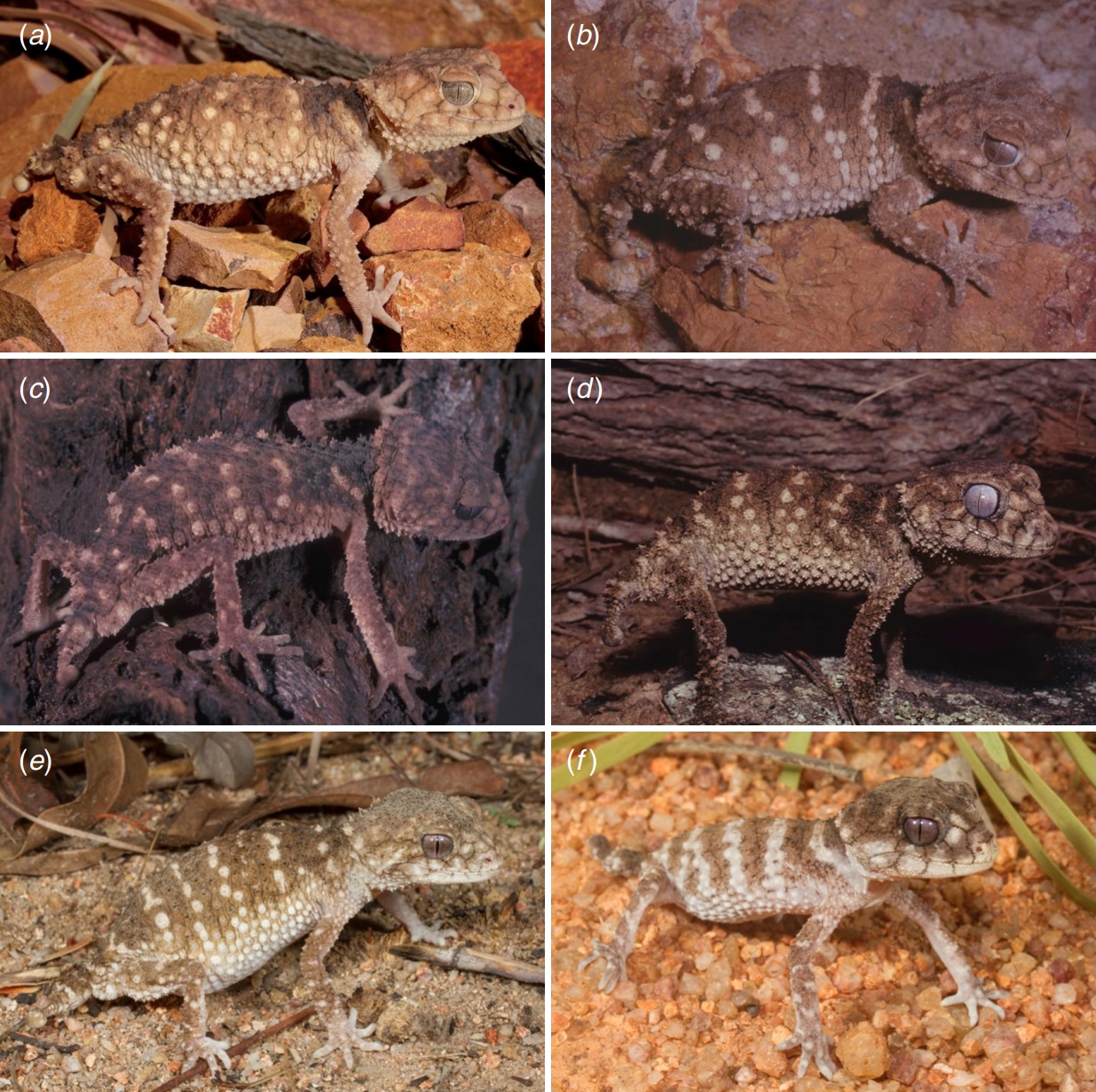

Photographs of examples of Nephrurus asper East and West showing variation in colour pattern in life: 

(a) N. asper West from Noonbah Station; (b) N. asper West from South Galway Range Station;

(c) N. asper West from Cork Station; (d) N. asper East from Moura;
(e) N. asper East from Almaden; and (f ) N. asper East from Hervey’s Range.

Photographs: (a) Angus Emmott, (b) Queensland Museum, (c, d) Steve Wilson, (e, f ) Chris Jolly.


Nephrurus eromanga
(a) from West from Noonbah Station; (b) from West from South Galway Range Station.

Nephrurus eromanga Oliver, Donnellan & Gunn, sp. nov. 
(Eromanga Basin Knob-Tail Gecko)

Diagnosis: Nephrurus eromanga, sp. nov. can be distinguished from other taxa in the N. asper group by the following combination of characters: moderately large size (maximum SVL males ~105 mm, females ~114 mm); fawn to mid-brown (reddish in life) dorsal colouration on dorsal and lateral surfaces of head, torso and limbs; narrow to wide pale dorsal crossbands or broken series of blotches; dark-brown saddle on the nape, which extends posterior to the forelimbs and contrasts strongly with the base colouration on the back the head and remainder of torso; digits lacking dark-brown or grey bands or flecks; and basal scales surrounding each tubercle uniform in height and less than half the height of the scale they enclose. 

Etymology: Named after the Eromanga Basin, a Mesozoic sedimentary basin in inland eastern Australia that entirely circumscribes the distribution of the species. The name Eromanga is in turn derived from the small town of Eromanga (at which this species does not occur). Eromanga is used as a noun in apposition.

  habitat for Nephrurus eromanga, sp. nov. in western Queensland, Australia:
(a) Beal Range, South Galway Station;
 The species is typically found associated with scree habitats on and around mesas.
Photographs: (a) Steve Wilson 

 
Paul M. Oliver, Stephen C. Donnellan  and Bee F. Gunn. 2022. Plio–Pleistocene Vicariance across Arid Australia in the ‘Spiny Knob-tailed Geckos’ (Nephrurus asper group), with the Description of A New Species from western Queensland. Australian Journal of Zoology. 69(6); 216-228. DOI: 10.1071/ZO22008

Understanding the diversity of some of Queensland’s oddest lizards


Tuesday, February 21, 2023

[Herpetology • 2023] Phyllurus fimbriatus • A New Species of Phyllurus Leaf-tailed Gecko (Lacertilia: Carphodactylidae) from Scawfell Island, mid-east Queensland, Australia


Phyllurus fimbriatus  
Hoskin, 2023

Photos: Edward Evans & Conrad Hoskin.
  
Abstract
A recent targeted reptile survey of Scawfell Island, in the South Cumberland Group, revealed a species of Phyllurus gecko that could not be morphologically assigned to any described species. Here I describe this as a new species, Phyllurus fimbriatus sp. nov., based on differences in a number of morphometric and scalation traits from congeners. Phyllurus fimbriatus sp. nov. is restricted to deeply-piled boulder habitat under rainforest canopy on Scawfell Island, approximately 50 km offshore from Mackay in mid-east Queensland. A survey in rocky, rainforest habitat on nearby Carlisle Island failed to find the species, and other nearby islands appear to lack sufficiently deep rock outcropping to support the species. Phyllurus fimbriatus sp. nov. is known from two small patches of habitat on Scawfell Island, but it is common within these, and is likely to be found in other suitable habitat patches on the island. Based on assessment of imagery, the total area of habitat occupied may be < 1 km2. The island is protected within South Cumberland National Park, but fire encroachment from adjacent dry sclerophyll habitats, climate change, competition from introduced Asian House Geckos (Hemidactylus frenatus Duméril & Bibron, 1836), and poaching are potential threats.

Keywords: Phyllurus fimbriatus, sp. nov., leaf-tailed gecko, rainforest, boulder-field, Reptilia


Holotype of Phyllurus fimbriatus sp. nov. (QM J97578).
Photo: Edward Evans.

Phyllurus fimbriatus sp. nov. in life:
 (A) adult female with original tail; (B) juvenile with original tail;
(C) adult female with regenerated tail; (D) adult male of unusual colouration, with regenerated tail.
Photos: Conrad Hoskin.

Habitat of Phyllurus fimbriatus sp. nov. on Scawfell Island. Photo: Conrad Hoskin.

Phyllurus fimbriatus sp. nov.

Diagnosis. Distinguished from congeners by the following characters: large size (SVL to 113 mm); obviously flared original and regenerated tail; rostral scale partially divided by a single groove; body and tail surfaces with small tubercles, with larger spinose tubercles largely restricted to margins of original tail; anterior-most white band on original tail V-shaped or notched, and spanning full width of tail; ventral surfaces immaculate. 

Etymology. The species name fimbriatus is Latin for ‘fringed’, referring to the restriction of spines on the original tail to a fringe along the outer edge.


Conrad J. Hoskin. 2023. A New Species of Phyllurus Leaf-tailed Gecko (Lacertilia: Carphodactylidae) from Scawfell Island, mid-east Queensland, Australia. Zootaxa. 5244(3)233-243. DOI: 10.11646/zootaxa.5244.3.2

Monday, April 1, 2019

[Herpetology • 2019] Phyllurus pinnaclensis • A New Species of Phyllurus Leaf-tailed Gecko (Lacertilia: Carphodactylidae) from The Pinnacles, north-east Australia


Phyllurus pinnaclensis
Hoskin, Bertola & Higgie, 2019


Abstract
Recent surveys of rocky rainforest in the Townsville region have found additional populations of Phyllurus geckos. One of these populations was discovered at The Pinnacles, an isolated area of habitat in between the distributions of P. gulbaru and P. amnicola. Genetic and morphological data shows that this population is most similar to P. gulbaru Hoskin, Couper & Schneider, 2003 but divergent in a number of traits. Here we describe this population as a new speciesPhyllurus pinnaclensis sp. nov., based on genetic divergence and differences in a number of morphometric and scalation traits from other populations of Phyllurus. Phyllurus pinnaclensis sp. nov. appears to be restricted to a few small areas of deeply layered rock with associated dry rainforest. This habitat is fire-sensitive and increased frequency and intensity of fires (due to late season burns and high fuel loads of invasive grasses) threatens to reduce and fragment these dry rainforest patches. Other threats include potential future invasion of the habitat by introduced Asian House Geckos (Hemidactylus frenatus Duméril & Bibron, 1836) and illegal collecting. Given the very small and fragmented distribution and potential reduction in habitat area due to fire, P. pinnaclensis sp. nov. warrants a Critically Endangered listing. Resolving the distributional change of dry rainforest in the Townsville region in recent decades, particularly in regards to fire, is key to resolving the status of this and other locally threatened taxa that depend on this habitat.

Keywords: Reptilia, Phyllurus pinnaclensis sp. nov., leaf-tailed gecko, rainforest, boulder-field


Phyllurus pinnaclensis


Conrad J. Hoskin, Lorenzo V. Bertola and Megan Higgie. 2019. A New Species of Phyllurus leaf-tailed Gecko (Lacertilia: Carphodactylidae) from The Pinnacles, north-east Australia. Zootaxa. 4576(1); 127–139.  DOI:  10.11646/zootaxa.4576.1.6

Tuesday, May 15, 2018

[Herpetology • 2018] Austroablepharus gen. nov. • A New Genus to Accommodate Three Skinks Currently Assigned to Proablepharus (Lacertilia: Scincidae)


Austroablepharus kinghorni  (Copland, 1947)
Proablepharus reginae (Glauert, 1960)

in Couper, Hoskin, Potter, et al., 2018. 
Memoirs of the Queensland Museum – Nature. 60 

ABSTRACT
The genus Proablepharus currently contains five species (P. barrylyoni, P. kinghorni, P. naranjicaudus, P. reginae and P. tenuis). Morphologically, these are readily separated into two groups: the small, almost patternless species (P. reginae and P. tenuis) and the larger, striped species (P. kinghorni, P. barrylyoni and P. naranjicaudus). We present genetic and morphological data to demonstrate that these two groups are generically distinct from each other. As P. reginae is the type species for Proablepharus, we erect a new genusAustroablepharus gen. nov., for the kinghorni group and designate A. kinghorni as the type species. 

Keywords:  ProablepharusAustroablepharus gen. nov., Australia, morphology, genetics. 

 FIG. 2. Austroablepharus kinghorni, type species for the genus, with characteristic stripes and an orange tail; Durham Downs, Queensland (Image: Steve Wilson).

 FIG. 2. Austroablepharus kinghorni, type species for the genus, with characteristic stripes and an orange tail; Durham Downs, Queensland
FIG. 1. Proablepharus reginae showing a drab brown, relatively uniform pattern; Tennant Creek, Northern Territory

(Images: Steve Wilson).

Proablepharus Fuhn, 1969

Proablepharus reginae (Glauert, 1960)
Proablepharus tenuis (Broom, 1896)


Austroablepharus gen. nov.
 Suggested common name. Grassland Striped Skinks. 

Type species. Austroablepharus kinghorni (Copeland, 1947) 
Species. A. kinghorni (Copland 1947), A. naranjicaudus (Greer, Fisher & Horner 2004), A. barrylyoni (Couper, Limpus, McDonald & Amey 2010). 

Etymology. Austro for Australia and ablepharus referring to an immovable lower eyelid that is partially fused to the upper eyelid to form a permanent spectacle.

 Diagnosis. A genus of small skinks (adult SVL ≤ 51mm ) with pentadactyl limbs, ≤ 24 midbody scale rows, ≥ 55 paravertebral scales, and ≥ 30 presacral vertebrae. Limbs narrowly to widely separated when adpressed. Supranasals absent and nasals undivided; prefrontals large, in contact or narrowly separated; eye moderate-sized with lower eyelid immovable, partially fused to upper eyelid to form a permanent spectacle but with a distinct slit between the lower eyelid and the supraciliaries (preablepharine); frontoparietals fused; interparietal free or fused; ear opening very small; parietals in contact; body pattern consisting of alternating pale and dark stripes (each dorsal body scale with a pale centre and dark lateral edges); adult tail colouration red/orange.


Patrick J. Couper, Conrad J. Hoskin, Sally Potter, Jason G. Braggand Craig Moritz. 2018. A New Genus to Accommodate Three Skinks Currently Assigned to Proablepharus (Lacertilia: Scincidae). Memoirs of the Queensland Museum – Nature. 60; 227-231. 
DOI: 10.1082/j.2204-1478.60.2017.2017-15

Tuesday, January 14, 2014

[Herpetology • 2013] Cryptic Speciation Patterns in Iranian Rock Lizards Darevskia Uncovered by Integrative Taxonomy


Figure 5. Studied species of Darevskia in life:
D. caspica
sp. n. (A; photo by N. Moradi); D. chlorogaster (B; photo by M. Auer); D. kamii sp. n. (C; photo by O. Mozaffari); D. defilippii (D; photo by A. Shahrdari) D. kopetdaghica sp. n. (E; photo by O. Mozaffari); D. schaekeli sp. n. (F; photo by Barbod Safaei Mahroo); and D. steineri (G; photo by O. Mozaffari).

Abstract
While traditionally species recognition has been based solely on morphological differences either typological or quantitative, several newly developed methods can be used for a more objective and integrative approach on species delimitation. This may be especially relevant when dealing with cryptic species or species complexes, where high overall resemblance between species is coupled with comparatively high morphological variation within populations. Rock lizards, genus Darevskia, are such an example, as many of its members offer few diagnostic morphological features. Herein, we use a combination of genetic, morphological and ecological criteria to delimit cryptic species within two species complexes, D. chlorogaster and D. defilippii, both distributed in northern Iran. Our analyses are based on molecular information from two nuclear and two mitochondrial genes, morphological data (15 morphometric, 16 meristic and four categorical characters) and eleven newly calculated spatial environmental predictors. The phylogeny inferred for Darevskia confirmed monophyly of each species complex, with each of them comprising several highly divergent clades, especially when compared to other congeners. We identified seven candidate species within each complex, of which three and four species were supported by Bayesian species delimitation within D. chlorogaster and D. defilippii, respectively. Trained with genetically determined clades, Ecological Niche Modeling provided additional support for these cryptic species. Especially those within the D. defilippii-complex exhibit well-differentiated niches. Due to overall morphological resemblance, in a first approach PCA with mixed variables only showed the separation between the two complexes. However, MANCOVA and subsequent Discriminant Analysis performed separately for both complexes allowed for distinction of the species when sample size was large enough, namely within the D. chlorogaster-complex. In conclusion, the results support four new species, which are described herein.

Figure 5. Studied species of Darevskia in life:
D. caspica 
sp. n. (A; photo by N. Moradi); D. chlorogaster (B; photo by M. Auer); D. kamii sp. n. (C; photo by O. Mozaffari) 

Figure 5. Studied species of Darevskia in life: 
D. defilippii
 (D; photo by A. Shahrdari) D. kopetdaghica sp. n. (E; photo by O. Mozaffari); D. schaekeli sp. n. (F; photo by Barbod Safaei Mahroo); and D. steineri (G; photo by O. Mozaffari).


Faraham Ahmadzadeh, Morris Flecks, Miguel A. Carretero, Omid Mozaffari, Wolfgang Böhme, D. James Harris, Susana Freitas and Dennis Rödder. 2013. Cryptic Speciation Patterns in Iranian Rock Lizards Uncovered by Integrative Taxonomy. PLoS ONE. 8(12): e80563. doi: dx.doi.org/10.1371/journal.pone.0080563

Monday, February 20, 2012

[Herpetology • 1991] Brookesia valerieae • Field observations on some dwarf chameleons (Brookesia spp.) from rainforest areas of Madagascar, with the description of a new species


Six species of Brookesia dwarf chameleons were recorded during two rainforest expeditions in Madagascar. One of these is described as a new species Brookesia valerieae based on the arrangement of the nine pairs of dorso-lateral spines, the lack of a pelvic shield, and dorsal chevron markings. Observations were made on the defence and roosting behaviours shown by these six species. Aspects concerning the evolution and conservation in Madagascar are discussed for this poorly studied group of endemic Malagasy reptiles.


Brookesia valerieae sp. nov.
Holotype- Adult female, BM(NH) 1988.8, Manongarivo Special Reserve, north-west Madagascar, 14" 4' S, 48" 17' E, 350 m altitude, caught on the forest floor at midday by N. Quansah, collected by C. J. Raxworthy, 17.2.88.
The holotype is shown in Plates V and VI. It has been deposited at the British Museum (Natural History).


Etymology: This species of chameleon has been named for Valerie M. Raxworthy in recognition of her support towards this work in Madagascar.


Raxworthy, C. J. 1991. Field observations on some dwarf chameleons (Brookesia spp.) from rainforest areas of Madagascar, with the description of a new species. J. Zool., London 224: 11-25.

Sunday, February 19, 2012

[Herpetology • 2012] Brookesia micra • Rivaling the World's Smallest Reptiles: Discovery of Miniaturized and Microendemic New Species of Leaf Chameleons (Brookesia) from Northern Madagascar


Brookesia micra sp. n. from Nosy Hara, northern Madagascar.

Abstract 
Background
One clade of Malagasy leaf chameleons, the Brookesia minima group, is known to contain species that rank among the smallest amniotes in the world. We report on a previously unrecognized radiation of these miniaturized lizards comprising four new species described herein.

Methodology/Principal Findings
The newly discovered species appear to be restricted to single, mostly karstic, localities in extreme northern Madagascar: Brookesia confidens sp. n. from Ankarana, B. desperata sp. n. from Forêt d'Ambre, B. micra sp. n. from the islet Nosy Hara, and Btristis sp. n. from Montagne des Français. Molecular phylogenetic analyses based on one mitochondrial and two nuclear genes of all nominal species in the B. minima group congruently support that the four new species, together with B. tuberculata from Montagne d'Ambre in northern Madagascar, form a strongly supported clade. This suggests that these species have diversified in geographical proximity in this small area. All species of the B. minima group, including the four newly described ones, are characterized by very deep genetic divergences of 18–32% in the ND2 gene and >6% in the 16S rRNA gene. Despite superficial similarities among all species of this group, their status as separate evolutionary lineages is also supported by moderate to strong differences in external morphology, and by clear differences in hemipenis structure.

Conclusion/Significance
The newly discovered dwarf chameleon species represent striking cases of miniaturization and microendemism and suggest the possibility of a range size-body size relationship in Malagasy reptiles. The newly described Brookesia micra reaches a maximum snout-vent length in males of 16 mm, and its total length in both sexes is less than 30 mm, ranking it among the smallest amniote vertebrates in the world. With a distribution limited to a very small islet, this species may represent an extreme case of island dwarfism.


Figure 8. Brookesia micra sp. n. from Nosy Hara, northern Madagascar.
(A) adult male on black background, showing orange tail colouration; (B) juvenile on finger tip; (C) juvenile on head of a match; (D) habitat along a small creek on western flank of Nosy Hara, where part of the type series was collected.

Brookesia micra sp. n. 
ZooBank LSID: urn:lsid:zoobank.org:act:D1A239D6-93E8-4​C34-A428-F79A2C8B6405

Holotype.— ZSM 2181/2007 (FGZC 1271), adult male (hemipenes everted), collected on Nosy Hara island, 12°14′40″S, 49°00′30″E, ca. 10–20 m a.s.l., Antsiranana Province, northern Madagascar, on 7 March 2007 by H. Enting, F. Glaw and J. Köhler.

Etymology.— The species epithet is a latinized derivation from the Greek word “μικρός” (mikros), meaning “tiny” or “small” and referring to the extremely diminutive body size. It is used as an invariable noun in apposition.

Distribution.— Only known from two sites (see localities in type series) on the small island of Nosy Hara, northern Madagascar (e.g. Fig. 8D). Remarkably, no Brookesia species was recorded during intensive herpetological surveys of Nosy Hara, nearby islands and the adjacent mainland, suggesting that B. micra might be difficult to record.

Natural History.— B. micra was found during the day active on the ground in a mosaic of eroded limestone boulders and dry forest leaf litter, and at night roosting on branches in very low vegetation (ca. 5–10 cm above the ground). In contrast to B. tristis and B. confidens its occurrence was not remarkably patchy.

Figure 1. Map of northern Madagascar showing distribution of species of the Brookesia minima group.
Type localities in bold, B. dentata, B. exarmata, B. karchei, B. peyrierasi, and B. ramanantsoai not included, because their ranges are located further south; see inset maps in Fig. 2. Orange (dry forest) and green (rainforest) show remaining primary vegetation in 2003–2006, modified from the Madagascar Vegetation Mapping Project (http://www.vegmad.org).


Figure 2. Phylogenetic relationships among species of the Brookesia minima group based on mitochondrial DNA sequences.

Glaw, F.; Köhler, J. R.; Townsend, T. M.; Vences, M. 2012. Salamin, Nicolas. ed. "Rivaling the World's Smallest Reptiles: Discovery of Miniaturized and Microendemic New Species of Leaf Chameleons (Brookesia) from Northern Madagascar". PLoS ONE 7 (2): e31314. doi:10.1371/journal.pone.0031314

[Herpetology • 2012] new species in Brookesia minima group • Discovery of Miniaturized and Microendemic New Species of Leaf Chameleons (Brookesia) from Northern Madagascar


Adult specimens of newly described species in life.
(A) male and (B) female of Brookesia tristis from Montagne des Français; 
(C) male and (D) female of Brookesia confidens from Ankarana; 
(E) male and (F) female of Brookesia micra from Nosy Hara; 
(G) male and (H) female Brookesia desperata from Forêt d'Ambre.


Abstract 
Background
One clade of Malagasy leaf chameleons, the Brookesia minima group, is known to contain species that rank among the smallest amniotes in the world. We report on a previously unrecognized radiation of these miniaturized lizards comprising four new species described herein.

Methodology/Principal Findings
The newly discovered species appear to be restricted to single, mostly karstic, localities in extreme northern Madagascar: Brookesia confidens sp. n. from Ankarana, B. desperata sp. n. from Forêt d'Ambre, B. micra sp. n. from the islet Nosy Hara, and B. tristis sp. n. from Montagne des Français. Molecular phylogenetic analyses based on one mitochondrial and two nuclear genes of all nominal species in the B. minima group congruently support that the four new species, together with B. tuberculata from Montagne d'Ambre in northern Madagascar, form a strongly supported clade. This suggests that these species have diversified in geographical proximity in this small area. All species of the B. minima group, including the four newly described ones, are characterized by very deep genetic divergences of 18–32% in the ND2 gene and >6% in the 16S rRNA gene. Despite superficial similarities among all species of this group, their status as separate evolutionary lineages is also supported by moderate to strong differences in external morphology, and by clear differences in hemipenis structure.

Conclusion/Significance
The newly discovered dwarf chameleon species represent striking cases of miniaturization and microendemism and suggest the possibility of a range size-body size relationship in Malagasy reptiles. The newly described Brookesia micra reaches a maximum snout-vent length in males of 16 mm, and its total length in both sexes is less than 30 mm, ranking it among the smallest amniote vertebrates in the world. With a distribution limited to a very small islet, this species may represent an extreme case of island dwarfism.


Figure 1. Map of northern Madagascar showing distribution of species of the Brookesia minima group.
Type localities in bold, B. dentata, B. exarmata, B. karchei, B. peyrierasi, and B. ramanantsoai not included, because their ranges are located further south; see inset maps in Fig. 2. Orange (dry forest) and green (rainforest) show remaining primary vegetation in 2003–2006, modified from the Madagascar Vegetation Mapping Project (http://www.vegmad.org).


Figure 2. Phylogenetic relationships among species of the Brookesia minima group based on mitochondrial DNA sequences.


Figure 9. Life history and morphology of Brookesia desperata.
(A) Female (displaying stress colouration) with two recently laid eggs. (B) Figure showing well-developed pelvic spine (1) and lateral spines on tail (2).


Figure 8. Brookesia micra sp. n. from Nosy Hara, northern Madagascar.
(A) adult male on black background, showing orange tail colouration; (B) juvenile on finger tip; (C) juvenile on head of a match; (D) habitat along a small creek on western flank of Nosy Hara, where part of the type series was collected.


Figure 6. Hemipenes of species in the Brookesia minima group.


Glaw, F.; Köhler, J. R.; Townsend, T. M.; Vences, M. 2012. Salamin, Nicolas. ed. "Rivaling the World's Smallest Reptiles: Discovery of Miniaturized and Microendemic New Species of Leaf Chameleons (Brookesia) from Northern Madagascar". PLoS ONE 7 (2): e31314. doi:10.1371/journal.pone.0031314

Glaw, F., M. Vences, T. Ziegler, W. Bohme, and J. Kohler. 1999. 1999. Specific distinctness and biogeography of the dwarf chameleons Brookesia minima, B. peyrierasi and B. tuberculata (Reptilia: Chamaeleonidae): evidence from hemipenal and external morphology. Journal of Zoology 247: 225-238.  http://www.zsm.mwn.de/her/pdf/64_Glaw_et_al_1999_Brookesia_minima_group.pdf

[Herpetology • 1996] Brookesia exarmata • a new dwarf chameleon (Reptilia, Chamaeleonidae) from the limestone outcrops of western Madagascar


Dwarf Chameleon (Brookesia exarmata)
Amber Mountain National Park, Madagascar

Abstract
During fieldwork carried out in January-February 1995 in the Strict Nature Reserve No. 9 (western Madagascar), a new species of dwarf chameleon (genus Brookesia) was discovered on the western slopes of the Antsingy forest. The inaccessible habitat of this new taxon consists of dense subhumid tropophile forest growing among the limestone blocks belonging to the huge karstic complex of the Massif, where Brookesia exarmata sp. nov. is sympatric with Brookesia perarmata, a taxon likely endemic to the Antsingy forest, and Brookesia brygooi. The new taxon, formally described in this paper, is a small-sized chameleon whose total adult length ranges between 30 and 45 millimetres: this feature, together with the absence of a pelvic shield and the presence of a series of dorsolateral tubercles (or a few small dorsolateral spines), leads to Brookesia exarmata being ascribed to the Brookesia minima group. Brookesia tuberculata and Brookesia peyrierasi are ressurrected from the synonymy of Brookesia minima and a new identification key to these and to the other three species included in the Brookesia minima group is proposed.

Type locality: River Ambodyreana, Tsingy de Bemaraha, Antsalova, Fivondronana, Mahajanga Province, Madagascar.

Schimmenti G; Jesu R 1996. Brookesia exarmata sp. nov. (Reptilia, Chamaeleonidae): a new dwarf chameleon from the limestone outcrops of western Madagascar. ITALIAN JOURNAL OF ZOOLOGY (MODENA) 63(2) 1996: 193-197

[Herpetology • 1995] 6 new Brookesia | B. ambreensis, B. antakarana, B. lineata, B. lolontany, et. al. • Systematics, speciation and biogeography of the dwarf chameleons (Brookesia; Reptilia, Squamata, Chamaeleontidae) of northern Madagascar


Brookesia ambreensis 

Brookesia dwarf chameleons, endemic to Madagascar, were surveyed at  the following localities in  northern  Madagascar (north of 16”s): Montagne  d’Ambre, Ankarana, Manongarivo, Tsaratanana, Marojejy and Masoala. A total of 15 species occur in this region. Six new species are  described  and five new synonyms are identified. The genus Brookesia, the most speciose chamaeleontid genus in Madagascar, contains 23 species. 
Almost all the northern Brookesia species are restricted to rainforest and occupy a relatively narrow elevational range. Although the northern rainforests represent just one-third of the total rainforest and  about 5 %  of the total island  area,  65%  of the Brookesia species occur in this region, and 52% are endemic t o  the northern rainforest. Five new biogeographic regions of the northern rainforest are identified based on centres of Brookesia endemicity: Montagne d’Ambre, Northwest, Tsaratanana, Northeast and East. Speciation is thought to have been facilitated in the  north  through geographic isolation, with  the  Tsaratanana mountain range and the dry forests south of Montagne d’Ambre forming barriers  to dispersal,  and the Tsaratanana mountains acting as a centre of isolation. The fragmented distribution of several Brookesia species of low altitude rainforest suggests a period in Madagascar’s history when the climate was wetter and low altitude rainforest much more widespread. 


Brookesia ambreensis sp. nov. 
Holotype- UMMZ  203635,  mature  male,  collected  8  January  1992,  Antomboka  River, Montagne D’Ambre National  Park,  12’29’5  49” lO’E,  670 m  altitude,  Antsiranana Fivondronana, Antsiranana (Diego Suarez) Province, Madagascar,  by J.B. Ramanamanjato,  A. Raselimanana and C.J. Raxworthy.

Etymology- The  specific name refers to the type locality Montagne d’Ambre
Habitat and  distribution.- All  specimens collected  in  primary rainforest. All known specimens were collected between 650 and 1150m altitude a t  Montagne  d’Ambre, within the National Park and Parcel 2 of the Special Reserve. This species is probably endemic to  Montagne d’Ambre.


Brookesia antakarana sp. nov. 
Holotype- UMMZ  200071,  mature male, collected  6  December  1991, Antomboka  River, Montagne d’Ambre National Park,  12’32’S, 49’10’E,  1050 m altitude, Antsiranana Fivondronana, Antsiranana  (Diego Suarez) Province, Madagascar, by J.B. Ramanamanjato, A. Raselimanana and C.J. Raxworthy.

Etymology- The specific name refers to the Antakarana people and region of northern Madagascar, where this species appears to be restricted. 
Habitat  and  distribution- All  known specimens were collected in rainforest between  50-1200 m altitude  at Montagne d'Ambre, within the National Park and from Parcel 2 of the Special Reserve. This species is probably endemic to Montagne d'Ambre. 


Brookesia bekolosy sp. nov. 
Holotype- UMMZ  200078, mature male, collected 8 March  1992, Bekolosy, Manongarivo Special Reserve, 14"03'S, 48" 1 S'E,  1200 m altitude, Ambanja Fivondronana, Antsiranana (Dikgo Suarez) Province, Madagascar, by C.J. Raxworthy.

Etymology- The specific name refers to the type locality, the Bekolosy Plateau at  Manongarivo. 
Habitat and distribution- The  holotype was collected at 22:00 h, roosting on a thin branch at 1 m height, in primary rainforest at 1200m altitude on a ridge. No other locality is presently known  for  this species. The rainforest  a t  Berkolosy is  high altitude, with the forest  canopy typically between  5-10m in height,  and  tree branches  heavily  draped  with lichens. A more intensive survey was made by us at lower elevation forests in the Manongarivo Reserve (between 50-800m).  The absence of this species a t  these lower altitudes makes us think it is restricted to higher  elevation forest,  probably  in  excess  of  1000m. This species is  probably  restricted  to rainforest in the Northwest biogeographic region (see below). 


Brookesia brygooi sp. nov .  
Holotype- MHNP 8219,  female, collected  at  Analavelona, Southwest  Madagascar by H.  Humbert.

Etymology- The  specific name honours Dr  E.  R. Brygoo, who first described specimens of this new species, and contributed to the understanding of Brookesia systematics. 
Habitat and distribution- In  addition  to the localities given for the holotype, paratype  and other specimens, Brygoo (1 978) reported specimens (without calalogue numbers) from Bemaraha (Rtserve Naturelle IntCgrale No. 11) and Antsalova, also in the Southwest, Brookesia brygooi is found  in  the arid  Southwest  and  West  of  Madagascar,  occurring between  17-23"S,  and  is probably restricted t o  native deciduous forests in these regions. Brookesia brygooi is one of the few  arid-adapted species of the genus. The other species found in arid habitats of the Western Domain are B. bonsi, B. decaryi, B. perarmata  and B. stumpfi. 


Brookesia lineata sp. nov. 
Holotype- UMMZ  200073, mature male, collected 8 March  1992, Bekolosy, Manongarivo Special Reserve, 14"03'S, 48" 18'E, 1200 m altitude, Ambanja Fivondronana, Antsiranana (Diego Suarez) Province, Madagascar, by A. Raselimanana. 

Etymology- The  specific name refers t o  the unusual dark lines on the body of this species. 
Habitat and distribution- The  holotype was collected a t  night, roosting on a leaf a t  1 m height, in primary rainforest  a t  1200 m altitude on a ridge. No other locality is presently known for this species. For additional information see comments on habitat for Brookesia bekolosy
Remarks- Brookesia lineata is unusual in that  the flanks are marked  by  bold, dark brown, longitudinal lines. Brygoo (1978) does  not  describe such  a coloration pattern for any other Brookesia species, although dark flank lines occur in male Brookesia thieli (UMMZ 196217-8). 


Brookesia lolontany sp. nov. 
Holotype- UMMZ  203629,  mature  female, collected  29  March  1993, Matsabory  Lake, Tsaratanana,  14"09/S, 48"58/E, 2050 m altitude,  Bealanana  Fivondronana,  Mahajanga Province, Madagascar, by Angeluc Razafimanantsoa. 

Etymology- The  specific name “lolontany” is  the Malagasy name of  the Tsaratanana mountain spirits that are believed to occupy the forests where the types were collected. 
Habitat  and distribution- UMMZ  203629 collected at  20:00h, roosting on a leaf at 0.7m height, in bamboo dominated primary rainforest; UMMZ  203630 collected at  20:00 h, roosting on  a branch  a t   0.05m  height, in  primary rainforest.  Both specimens were  collected  in  the Tsaratanana mountain range, which includes the highest mountain in Madagascar, Maromokotro,  at  2876m altitude. The holotype of Brookesia lolontany was collected at  a higher altitude than any other Brookesia species. This species is probably restricted to  high altitude rainforest in the Tsaratanana Mountains. 
Remarks- The only other species known to occur at a similarly high elevation is Brookesia nasus, which  has been collected up to 1650m altitude at Andringitra. The latter species is morphologically the most similar species to Brookesia lolontany


Raxworthy, C. J. & R. A. Nussbaum 1995. Systematics, speciation and biogeography of the dwarf chameleons (Brookesia; Reptilia, Squamata, Chamaeleontidae) of northern Madagascar. J. Zool., London 235: 525-558. http://deepblue.lib.umich.edu/bitstream/2027.42/75501/1/j.1469-7998.1995.tb01767.x.pdf

Saturday, February 18, 2012

[Herpetology • 2006] 3 new Rhampholeon | R. beraduccii, R. acuminatus & R. viridus • The pygmy chameleons of the eastern Arc range (Tanzania): Evolutionary relationships


Abstract
The pygmy chameleons of the Eastern Arc Range forests in Tanzania are reviewed on the basis of  known  and newly  collected material. Two new species be longing to Rhampholeon (Rhinodigitum) and one to Rh. (Rhampholeon) from the Pare, Nguru and Mahenge Mountains are described. The status and distribution of the other species known in the area are reviewed, and an identification key is provided. The phylogenetic relationships between these taxa are discussed on the basis of small and large mt-rDNA subunits sequences and the relative importance of some morphological characters is evaluated. Hypotheses about the evolution of the group in the area are presented.
Key words: biodiversity hotspot, biogeography, molecular systematics, Rhampholeon, Rieppeleon

Rhampholeon (Rhinodigitum) beraduccii n. sp.

Etymology. The new species is named in honour of Joe Beraducci, Arusha, Tanzania, as an appreciation for his generous assistance and help provided to us and to numerous other scientists working in the EAR.

Distribution and ecology. Rh. beraduccii is to date only known from the vicinity of Sali in the Mahenge mountains, an isolated massif separated from the Udzungwa range by the Kilombero valley. All animals were found alone, on low shrubs or herbs, within a few centimetres of the ground, in open land, in the immediate vicinity of the village.

Rhampholeon (Rhinodigitum) acuminatus n. sp.

Etymology. From Latin acuminare (to sharpen), in reference to the numerous sharp spines found on the head and body

Distribution and ecology. So far Rh. acuminatus is known from a single population in an Afro-montane rainforest between 1500 and 1600 m above the village of Ubili in the Nguru mountains. The species seems to be locally abundant. Six specimens have been collected for the present description; another six have been transferred to a reptile park in Arusha to attempt captive breeding. Most animals have been found between 50 cm and 2 m high on large ferns and shrubs, although several have been spotted up to an estimated 3-4 m high. This spatial distribution is rather unusual for pygmy chameleons, which generally stay closer to the ground. Interestingly it is comparable in its arboreal inclination to the morphologically similar Rh. spinosus from the Usambara mountains. The living specimens laid 2-4 eggs, hatching in January (J. Beraducci, Arusha, in litt.).


Rhampholeon (Rhampholeon) viridis n. sp. 

Etymology. The specific name derives from Latin viridis (green) and refers to the rich green colour of the males.

Distribution and ecology. This species inhabits the undergrowth and lower story vegetation of the submontane evergreen forests of the South and North Pare mountains. Its occurrence in the West Usambara is based on a single specimen in the British Museum collected in 1980 but its presence in these mountains has not since been reconfirmed. The holotype was collected at an altitude of 1450 m, but specimens have been found up to 2070 m in the South Pare and 1700 m in the North Pare. These forests are typical examples of the Afromontane forests that are dominated by emergent trees such as  Albizia gummifera, Macaranga kilimandscharica, Xymalos monospora, Ocotea usambarensis, Podocarpus latifolius and Chrysophyllum gorongosanum.
When handled these chameleons produced an easily felt “buzzing” vibration, particularly if touched lightly on the back. At the time of collection in early July, an adult male and female chameleon were found sleeping within a few centimetres of each other, indicating pairing off and thus possible recent past or potentially future mating activity.

Mariaux, Jean and Colin R. Tilbury. 2006. The pygmy chameleons of the eastern Arc range (Tanzania): Evolutionary relationships and the description of three new species of Rhampholeon (Sauria: Chamaeleonidae). Herpetological Journal. 16 (3): 315-331: [Fulltext]