Showing posts with label Stygobitic. Show all posts

Tuesday, April 7, 2026

[Crustacea • 2026] Caridina zhaoi • A New stygobiont atyid Shrimp (Decapoda: Caridea: Atyidae) from a limestone cave in Guizhou Province, China


Caridina zhaoi
Jiang, Zhou & Chen, 2026 


Abstract
A new stygobiont species of freshwater shrimp, Caridina zhaoi sp. nov., from a karst cave in Guiyang, Guizhou Province, southwestern China, is described and illustrated. The new species is morphologically distinct from its epigean congeners by a suite of stygobiotic characters, including the degeneration of eyes and absence of body pigmentation. It can be further distinguished from other known Chinese cavernicolous Caridina species by the combination of a relatively long rostrum with a specific rostral formula, the length of the stylocerite, the proportions of various joints of the first and second pereiopods, and the armature of the dactylus of the third and fifth pereiopods. Molecular analysis based on the mitochondrial COI gene reveals a high genetic divergence (14.70%–23.47%) between the new species and other atyids, supporting its validity as a distinct species. This discovery brings the total number of stygobiont Caridina species in China to 10, highlighting the rich but underestimated subterranean biodiversity of the Guizhou karst region.

Key Words: COI, Crustacea, morphology, stygofauna, subterranean biodiversity, taxonomy


A. The entrance of Xiangshui Cave; B. Live specimen of Caridina zhaoi sp. nov..

Caridina zhaoi sp. nov.


 Xuankong Jiang, Jiajun Zhou and Huiming Chen. 2026. Caridina zhaoi sp. nov., A New stygobiont atyid Shrimp (Decapoda, Caridea, Atyidae) from a limestone cave in Guizhou Province, China. Zoosystematics and Evolution. 102(2): 601-609. DOI: doi.org/10.3897/zse.102.182296 [06 Apr 2026]

Friday, November 21, 2025

[Ichthyology • 2025] Sinocyclocheilus changlensis • A New eyeless Cavefish Species of the Genus Sinocyclocheilus (Cypriniformes: Cyprinidae) from Guangxi, China


Sinocyclocheilus changlensis Liu, Mao & Yang, 

in Liu, Mao, Sudasinghe, Zhou, Chen, Yang & Meegaskumbura, 2025 
Changle Golden-line Barb | 长乐金线鲃  ||  DOI: doi.org/10.1002/ece3.72370

ABSTRACT
The extensive limestone landscapes of southwestern China form one of the world's largest karst regions, providing ideal conditions for cavefish evolution. Within this region, Sinocyclocheilus, the most speciose cavefish genus globally, comprises 84 species adapted to dark environments. Despite the many species, the region is still poorly explored, with new species currently being added to the total. Here, using integrative taxonomic methods involving morphological and molecular analyses, we describe Sinocyclocheilus changlensis, a new troglobitic species discovered in a cave in central Guangxi, China. This species is characterized by the absence of eyes, an unpigmented and complete scaled body, and a forked, horn-like structure at the dorsal posterior edge of the head. Morphologically, S. changlensis differs from its congeners by having pelvic-fin rays that do not reach the anus when extended, 42–46 lateral line scales, and a posterior operculum margin reaching the base of the pectoral fin at vertical. Molecular phylogenetic analyses using mitochondrial markers (cytb and ND4), genetic distances, and geometric morphometric analysis further confirmed S. changlensis as a distinct species. The description of this new species contributes to the understanding of cave-dwelling fish diversity in China and underscores the importance of further exploration of stygomorphic species across this poorly explored karstic landscape.

Keywords: blindness, cavefish, Hongshui River, landmarks, molecular systematics, morphology, Sinocyclocheilus, stygomorphic


Sinocyclocheilus changlensis, GXU2020000041, HOLOTYPE, 137.8 mm SL.
(a) Lateral view of preserved specimen; (b) dorsal view of head in preserved specimen; (c) live specimen.

Sinocyclocheilus changlensis Liu, Mao & Yang, sp. nov.

Diagnosis: Sinocyclocheilus changlensis can be distinguished from all other congeners by the following combination of characters: eye absent (eyeless); pelvic-fin rays tip not reaching the anus when pelvic-fin rays are extended backward; having a forked horn-like structure at the dorsal posterior edge of the head; albinotic body without pigmentation; lateral line scales 42–46; posterior margin of operculum close to the base of pectoral-fin origin; a distinct hump in the predorsal profile; rostral barbel not reaching the depression after eye degeneration; maxillary barbel not reaching the posterior margin of preoperculum; pharyngeal teeth pattern 1,3,4–3,3,1; vertebrae 4 + 35–36; 11 outer rakers on the first gill arch.


Yewei Liu, Tingru Mao, Hiranya Sudasinghe, Jiajun Zhou, Rongjiao Chen, Jian Yang, Madhava Meegaskumbura. 2025. Description of A New Eyeless Cavefish Species Using Integrative Taxonomic Methods—Sinocyclocheilus changlensis (Cypriniformes, Cyprinidae), From Guangxi, China. Ecology and Evolution.15(11); e72370.  DOI: doi.org/10.1002/ece3.72370 [19 November 2025]
 

Monday, December 18, 2023

[Crustacea • 2023] Sinodina ashima • the First stygobiotic Species of the atyid Shrimp Genus Sinodina (Decapoda: Caridea: Atyidae) from Yunnan Province, China


Sinodina ashima
Jiang, Zhou, Wang, W. Chen & H. Chen, 2023

 
Abstract
Sinodina Liang & Cai, 1999, a genus of atyid shrimp, is endemic to China and distributed only in the Yunnan-Guizhou Plateau. We describe here the thirteen species of Sinodina, and the first cave-dweller of the genus, Sinodina ashima sp. nov., collected from a limestone cave in Shilin County, Yunnan Province. This species can be distinguished from its congeners by the completely degraded pigment and eyes, the extremely long rostrum, the rostral formula and the absence of sexual dimorphism of the third and fourth pereiopods. A phylogenetic analysis based on four genes (COI, 16S, 18S, H3) shows that the new species strongly clustered with the type species of this genus, Sinodina gregoriana (Kemp, 1923), supporting the generic status of this new species.

Key words: Diversity, morphology, new species, phylogeny, stygobiont, taxonomy

Live specimens of Sinodina ashima sp. nov.

 Sinodina ashima sp. nov.

Etymology: The specific name is in honor of Ashima, who is a famous female character of the local legend spreading among the Yi nationality and is a symbol of love and bravery.

Distribution: Yunnan Province (Xiangshuiqing Cave), China.

Habitat: Subterranean river in a karst cave.


Xuankong Jiang, Jiajun Zhou, Jianguo Wang, Wenlong Chen and Huiming Chen. 2023. Description of the First stygobiotic Species of the atyid Shrimp Genus Sinodina (Decapoda, Caridea, Atyidae) from Yunnan Province, China. ZooKeys. 1186: 123-137. DOI: 10.3897/zookeys.1186.112657

Friday, August 25, 2023

[Entomology • 2023] Ngaliadessus humphreysiPhylogenetic Placement and Description of A Subterranean Diving Beetle (Coleoptera: Dytiscidae: Bidessini) from the Ngalia Basin in central Australia


Ngaliadessus humphreysi Watts & Villastrigo, 

in Watts, Villastrigo, Langille, Stringer, Bradford, ... et Cooper, 2023. 

Abstract
The largest diversity in the world of subterranean diving beetles (Dytiscidae) has been discovered in underground waters of the Australian arid zone. The majority of species are from the Dytiscidae genera Limbodessus Guignot, 1939 (Bidessini) and Paroster Sharp, 1882 (Hydroporini) and are distributed within two major regions: calcrete islands of central Western Australia and the Ngalia Basin of the Northern Territory. Here, we use an integrative approach based on morphological and molecular analyses to describe Ngaliadessus humphreysi gen. et sp. nov. Watts & Villastrigo representing a new genus and species of stygobiotic Bidessini collected from a single well in the Ngalia Basin. Phylogenetic analyses using whole mitochondrial genome, Histone 3 and 18S rRNA data, representing a comprehensive coverage of Bidessini genera, support the distinction of the genus and species as a separate evolutionary lineage sister to the Australasian genus Limbodessus and the widely distributed genus Allodessus Guignot, 1953. Our study further confirms that the Ngalia Basin, containing 13 subterranean dytiscid species from four distinct genera, is one of the most speciose areas within the world's most diverse hotspot of subterranean diving beetles.

Keywords: aquifer, Bidessini, calcrete, groundwater, mitochondrial genome, phylogenetic analyses, water beetle

A geological representation of the Ngalia Basin with subterranean groundwaters and its main sampling sites for stygobiotic taxa, including Sullivans Well.

Adult Ngaliadessus humphreysi sp. nov., Watts & Villastrigo.
 (a) Dorsal view of adult; (b) line drawing; (c) line drawing of ventral surface of mesotrochanter and mesofemur; (d) line drawing of ventral surface of metatrochanter and metafemur; (e) portion of spermatheca with internal spine.

TAXONOMY: 
Ngaliadessus gen. nov., Watts & Villastrigo
 

Type species: Ngaliadessus humphreysi sp. nov., Watts & Villastrigo by current designation (monotypy).

Description: Small (<3 mm long), integument soft, head without eyes or eye remnants, clypeus not bordered, pronotum without basal stria, elytra without basal stria, without sutural stria, punctures sparce, setae sparce restricted to margins. Prosternal process narrow, reaching mesoventrite, suture between first and second ventrites complete, protarsus 5-segmented, mesofemur without basal spines on posterior margin, metatibia weakly curved. Spermatheca with well-developed triangular spine. Male not known.

Etymology: Named after the Ngalia Basin groundwater system, the type locality for the genus.

Ngaliadessus humphreysi sp. nov., Watts & Villastrigo

 
Christopher H. S. Watts, Adrián Villastrigo, Barbara L. Langille, Danielle N. Stringer, Tessa M. Bradford, William F. Humphreys, Andrew D. Austin, Michael Balke and Steven J. B. Cooper. 2023. Phylogenetic Placement and Description of Ngaliadessus humphreysi gen. et sp. nov., Watts & Villastrigo (Coleoptera: Dytiscidae), A Subterranean Diving Beetle from the Ngalia Basin in central Australia. Austral Entomology. DOI: 10.1111/aen.12649


Tuesday, February 7, 2023

[Ichthyology • 2023] Neolissochilus pnar • The World’s Largest Cave Fish from Meghalaya, Northeast India (Cypriniformes: Cyprinidae: Torinae)


 Neolissochilus pnar 
Dahanukar, Sundar, Rangad, Proudlove & Raghavan, 2023


Abstract
The world’s largest subterranean fish was discovered in 2019, and was tentatively identified as a troglomorphic form of the golden mahseer, Tor putitora. Detailed analyses of its morphometric and meristic data, and results from molecular analyses now reveal that it is a new species of the genus Neolissochilus, the sister taxon of Tor. We formally describe the new species as Neolissochilus pnar, honouring the tribal communities of East Jaintia hills in Meghalaya, Northeast India, from where it was discovered. Neolissochilus pnar possesses a number of characters unique among species of Neolissochilus, with the exception of the similarly subterranean N. subterraneus from Thailand. The unique characters that diagnose N. pnar from all epigean congeners comprise highly reduced eye size to complete absence of externally visible eyes, complete lack of pigmentation, long maxillary barbels, long pectoral-fin rays, and scalation pattern. Neolissochilus pnar is distinguished from the hypogean N. subterraneus, the type locality of which is a limestone cave ~2000 kms away in Central Thailand, by a lesser pre-pelvic length (47.8–49.4 vs. 50.5–55.3 %SL), a shorter caudal peduncle (16.1–16.8 vs. 17.8–23.7 %SL), and shorter dorsal fin (17.4–20.8 vs. 21.5–26.3 %SL). In addition, Neolissochilus pnar is also genetically and morphologically distinct from its close congeners with a raw genetic divergence of 1.1–2.7% in the COI gene with putative topotype of N. hexastichus and 2.1–2.6% with putative topotype of N. hexagonolepis.

Keywords: Eastern Himalaya, limestone cave, mahseer, new species, subterranean fishes


Live images of  Neolissochilus pnar in their habitat from Krem Um Ladaw
 (Photos A, B, C: Uros Aksamovic, D: Dan Harries).

Neolissochilus pnar sp. nov.
 
Diagnosis: Neolissochilus pnar is distinguished from all its congeners by mandibular barbel long, reaching anterior margin of opercle (vs. short, not reaching margin of opercle). It is further distinguished from all epigean congeners by atrophied eyes, highly reduced in size in juveniles and small-adults and absence of externally visible eyes in adults (vs. presence of well-developed eyes in all life-stages); complete absence of pigmentation (vs. presence); long pectoral-fin reaching anterior base of pelvic fin (vs. short, not reaching anterior base of pelvic fin); and distinct scalation pattern with 28+2 (2) or 31+1 (1) lateral line scales, 8 scales in transverse series with 4 above the lateral line and 3 below the lateral line. Neolissochilus pnar is distinguished from the only other subterranean congener, N. subterraneus by shorter pre-pelvic length (47.8–49.4 vs. 50.5–55.3 %SL), shorter caudal-peduncle length (16.1–16.8 vs. 17.8–23.7 %SL) and shorter dorsal-fin length (17.4–20.8 vs. 21.5–26.3 %SL).

Etymology: The species name pnar, honours the ‘pnar’, the sub-tribal group of the Khasi people in the state of Meghalaya, India.


Neelesh Dahanukar, Remya L. Sundar, Duwaki Rangad, Graham Proudlove and Rajeev Raghavan. 2023. The World’s Largest Cave Fish from Meghalaya, Northeast India, is A New Species, Neolissochilus pnar (Cyprinidae, Torinae). Vertebrate Zoology. 73: 141-152. DOI: 10.3897/vz.73.e101011

Friday, January 27, 2023

[Ichthyology • 2023] Horaglanis populiEvolution in the Dark: Unexpected Genetic Diversity and Morphological Stasis in the Blind, Aquifer-dwelling Catfish Horaglanis (Siluriformes: Clariidae)


Horaglanis populi
Raghavan, Sundar, Arjun, Britz & Dahanukar, 2023
 

Abstract
The lateritic aquifers of the southern Indian state of Kerala harbour a unique assemblage of enigmatic stygobitic fishes which are encountered very rarely, only when they surface during the digging and cleaning of homestead wells. Here, we focus on one of the most unusual members of this group, the catfish Horaglanis, a genus of rarely-collected, tiny, blind, pigment less, and strictly aquifer-residing species. A six-year exploratory and citizen-science backed survey supported by molecular phylogenetic analysis reveals novel insights into the diversity, distribution and population structure of Horaglanis. The genus is characterized by high levels of intraspecific and interspecific genetic divergence, with phylogenetically distinct species recovered above a 7.0% genetic-distance threshold in the mitochondrial cytochrome oxidase subunit 1 gene. Contrasting with this deep genetic divergence, however, is a remarkable stasis in external morphology. We identify and describe a new cryptic species, Horaglanis populi, a lineage that is the sister group of all currently known species. All four species are represented by multiple haplotypes. Mismatch distribution reveals that populations have not experienced recent expansions.

KeywordsCryptic species, groundwater, Kerala, molecular ecology, stygobitic, subterranean


Horaglanis populi in life. B Typical laterite rock showing tiny pores. C Homestead lateritic dug-out well in Kerala – habitat of Horaglanis.


Horaglanis populi holotype (KUFOS.F.2022.101, 32.5 mm standard length) in A life and B–F immediately after preservation.
A, B Lateral view; C ventral view; D dorsal view; E lateral view of head; F ventral view of head.

Horaglanis populi, sp. nov. 

Diagnosis: A species of Horaglanis as evidenced by the absence of eyes and pigment, a blood-red body in life, a highly reduced pectoral fin in which only a shortened spine is present, an elongate body with long dorsal and anal fins extending to the base of the caudal peduncle, and four pairs of well-developed barbels. Genetically, Horaglanis populi forms a distinct clade, the sister group to the other three congeners (Fig. 2), from which it differs by a genetic uncorrected p distance of 13.8–17.4% in the COI gene, and between 12.3–14.0% in the cyt b gene. Specifically, H. populi differs from all three known species in the barcoding gene (Supplementary Table S4) in positions 106 (C vs. T), 115 (T vs. C), 142 (T vs. C), 171 (G vs. A), 183 (T vs. C), 216 (A vs. C or T), 234 (C vs. T), 237 (G vs. A), 265 (T vs. G), 270 (C vs. A), 312 (A vs. C or T), 324 (A vs. C), 325 (T vs. C) 330 (G. vs. A or T), 350 (G vs. T), 363 (T vs. G), 421 (C vs. G), 448 (C vs. T), 481 (G vs. T), 489 (C vs. T), 496 (A vs. G), 517 (c vs. T), 528 (G vs. T), 533 (G vs. A), 538 (A vs. C), 539 (A vs. G), 542 (T vs. C), 565 (T vs. A), 576 (G vs. T or C), 597 (A vs. C), 618 (C vs. T), 633 (G vs. A) and 636 (C vs. T).

EtymologyThe species name populi, genitive of the Latin noun populus people, honours the invaluable contributions made by interested members of the public in the southern Indian state of Kerala, helping to document the biodiversity of subterranean and groundwater systems, including the discovery of this new species.


Rajeev Raghavan, Remya L. Sundar, C.P. Arjun, Ralf Britz and Neelesh Dahanukar. 2023. Evolution in the Dark: Unexpected Genetic Diversity and Morphological Stasis in the Blind, Aquifer-dwelling Catfish Horaglanis. Vertebrate Zoology. 73: 57-74. DOI: 10.3897/vz.73.e98367


Thursday, June 30, 2022

[Crustacea • 2022] Caridina stellata • A New Species of Atyid Shrimp (Decapoda, Caridea, Atyidae) with the Male Description of Caridina cavernicola Liang & Zhou, 1993 from Guangxi, China

 
(A) Caridina stellata 
Guo, Chen, Chen, Cai & Guo. 2022
Caridina cavernicola 
Liang & Zhou, 1993

Abstract
Caridina stellata sp. nov. is described from streams in Guangxi, south-western China. The new species clearly belongs to “Caridina serrata group” of the genus and shows a morphological similarity with C. cantonensis Yu, 1938, C. serrata Stimpson, 1860 and C. pacbo Do et al. 2020. Caridina stellata is distinguished from congeners, based on differences in its male first pleopod and appendix masculina morphology, along with COI and 16S rRNA molecular evidence. The first pleopod endopod in male is rectangle, about 0.70 × length of exopod, about 3.7–3.9 × as long as proximally wide, inner margin concave, bearing nearly equal spine setae, outer margin bearing nearly equal long and dense spine setae; appendix interna well developed, arising from distal 1/5 of endopod, reaching to end of endopod, with cincinuli distally. The new species displays a unique and brightly coloured pattern and, therefore, can be easily recognised in the field. Liang & Zhou, 1993 described C. cavernicola from the Lenggu Cave, Du’an County, Guangxi. However, the description was based exclusively on two females. We have collected specimens of both sexes near the type locality and describe herein the previously unknown male and present morphological data on females. Data on the habitat, ecology and levels of threat of the two species are provided and suggest that they should be categorised as vulnerable (VU) under the current IUCN Criteria.

Keywords: COI and 16S rRNA, ecology, habitat, levels of threat, new species, south-western China


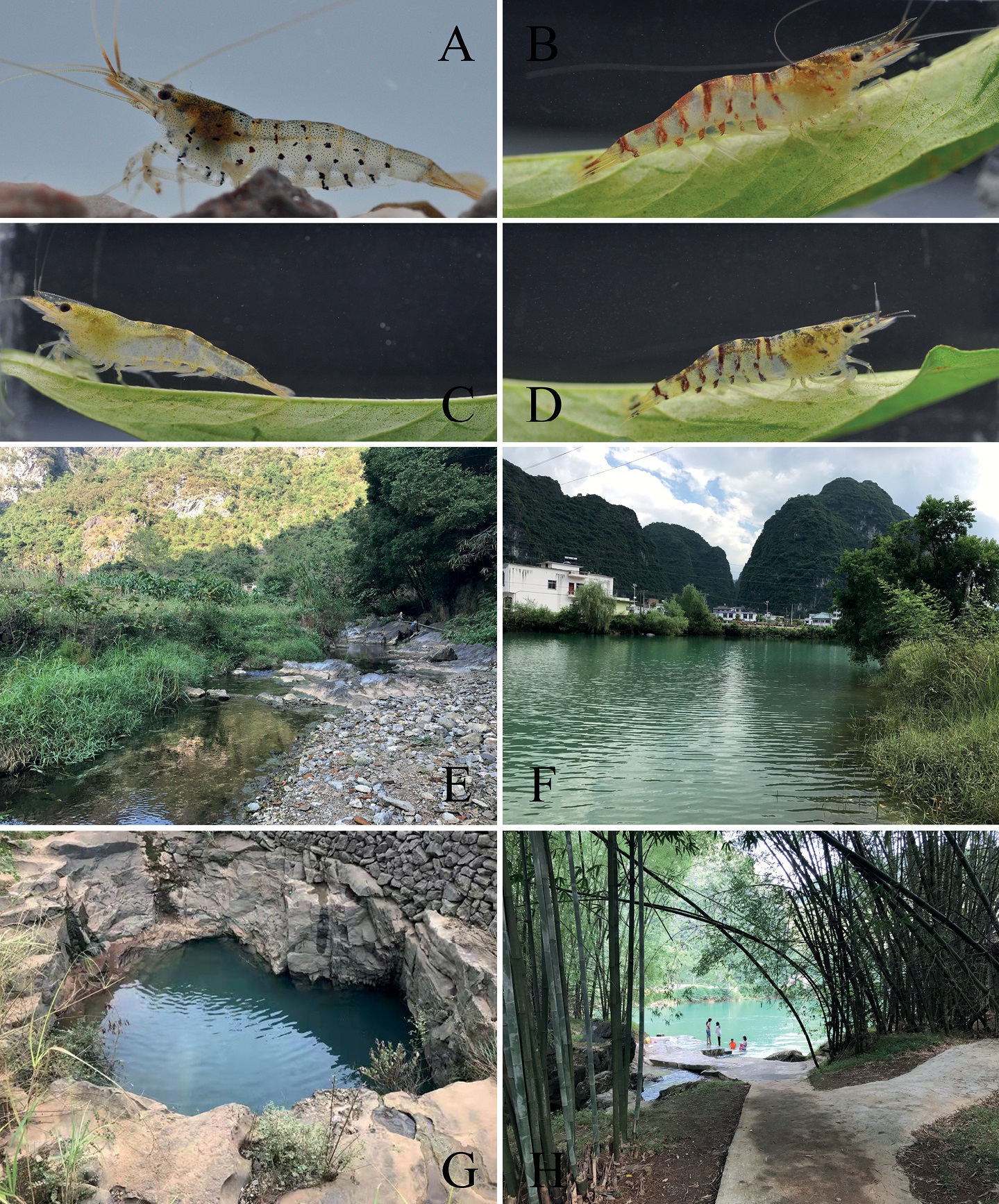
Habitats and live colouration of Caridina stellata sp. nov. and C. cavernicola
C. stellata sp. nov. B–D C. cavernicola;
E–H surrounding environment of C. stellata sp. nov. (E) and C. cavernicola (F–H).

Family Atyidae De Haan, 1849

Genus Caridina H. Milne Edwards, 1837

 Caridina stellata sp. nov.

Diagnosis: Rostrum long, straight, slightly sloping downwards, reaching to end of 2nd segment of antennular peduncle, occasionally reaching to end of 3rd segment of antennular peduncle; rostral formula 6-8+7-16/6-13. 1st pereiopod carpus 0.43–0.71 × as long as chela, 1.2–1.4 × as long as high; chela 1.8–2.4 × as long as broad; fingers 0.80–1.1 × as long as palm. 2nd pereiopodcarpus 1.1–1.3 × as long as chela, 4.0–4.8 × as long as high; chela 2.1–2.4 × as long as broad; fingers 1.1–1.4 × as long as palm. 3rd pereiopod propodus 4.0–5.5 × as long as dactylus, with two rows thin spines on the posterior margin, ischium with one spine on the posterior margin. 5th pereiopod propodus 4.2–5.3 × as long as dactylus, with two rows of thin spines on the posterior and lateral margins, dactylus terminating in one claw, with 35–40 spinules on flexor margin. Endopod of male 1st pleopod extending to 0.68 × exopod length, wider proximally, rectangle, about 3.7–3.9 × as long as wide, appendix interna well developed, arising from distal 1/6 of endopod, reaching end of endopod. Appendix masculina of male 2nd pleopod cylindrical, reaching to 0.58 length of endopod, appendix interna reaching to 0.50 length of appendix masculina. Uropodal diaeresis with 17–19 movable spinules. Eggs 0.84–0.89 × 1.27–1.39 mm in diameter.
 
Etymology: Caridina stellata is named after the Latin word stellatus, for dots, alluding to the pigmented pattern of the body.


 Guo-Cai Guo, Qing-Hua Chen, Wen-Jian Chen, Chao-Huang Cai and Zhao-Liang Guo. 2022. Caridina stellata, A New Species of Atyid Shrimp (Decapoda, Caridea, Atyidae) with the Male Description of Caridina cavernicola Liang & Zhou, 1993 from Guangxi, China. ZooKeys. 1104: 177-201. DOI: 10.3897/zookeys.1104.81836


Wednesday, May 26, 2021

[Crustacea • 2021] Procambarus adani • A New Species of Crayfish of the Genus Procambarus, and Notes on Procambarus pilosimanus (Decapoda: Cambaridae) from Chiapas, Mexico


Procambarus adani 
Álvarez, Torres & Villalobos, 2021
 

Abstract
A new species of crayfish is described from the Cave of Sótano de La Lucha, in the border between the Mexican states of Chiapas and Oaxaca. The new species is completely adapted to the cave environment with reduced eyes lacking cornea and visual pigments, an almost unpigmented body and elongated appendages. We also report on crayfish populations from the “Lagunas de Montebello” area, which fit well the description of Procambarus pilosimanus (Ortmann, 1906), a heretofore problematic species in southern Mexico.

Keywords: Stygobitic crayfish; Sótano de La Lucha; Lagunas de Montebello; Chiapas

Figure 4. Habitus of a living specimen of Procambarus adani, new species.


Family Cambaridae Hobbs, 1942 
Genus Procambarus Ortmann, 1905 

Procambarus adani n. sp. 

Diagnosis. Body almost unpigmented, whitish with minute orange dots dorsally (Fig. 4). Eyes reduced to a blunt peduncle, no facets or visual pigments present. Rostrum slender, acumen acute, slightly surpassing distal margin of third antennular segment, 26.4 to 31.8% (_ = 28.2%) of TCL, with marginal spines (Fig. 2A). Areola 2.3 to 3.4 times (_ = 2.8) as long as wide, 29.5 to 35.7% (_ = 32.6%) of TCL, 36.7 to 43.6% (_ = 40.6%) of postorbital length, with 4 or 5 punctuations across narrowest part. Postorbital spines prominent, cervical spine robust, single branchiostegal spine (Fig. 2A, B). Antennal scale 1.9 to 2.1 (_ = 2.0) times longer than wide, with shallow longitudinal groove. Chelipeds shorter than total body length, surface covered with minute granules with tuft of short setae; fingers longer than palm, cutting edges finely toothed (Fig. 2C).
...

Etymology. This species is dedicated to the memory of Adán Gómez González, outstanding biologist and friend, whose untimely passing away has been felt deeply.


Fernando Álvarez, Eduardo Torres and José Luis Villalobos. 2021. New Species of Crayfish of the Genus Procambarus, and Notes on Procambarus pilosimanus (Decapoda: Cambaridae) from Chiapas, Mexico. Revista Mexicana de Biodiversidad. 92(2021): e923833. DOI: 10.22201/ib.20078706e.2021.92.3833

Thursday, April 8, 2021

[Crustacea • 2021] Caridina incolor • Integrative Taxonomy uncovers A New Stygobiotic Caridina Species (Decapoda, Caridea, Atyidae) from Guizhou Province, China


Caridina incolor 
 Feng, Chen & Guo, 2021


Abstract
Collecting much-needed information on the taxonomy, distribution, and ecology of cave-dwelling shrimp is vital for addressing the urgent challenges in conservation biodiversity in fragile cave ecosystems. Caridina incolor sp. nov., a new atyid shrimp from an underground stream of Yaoshui Cave, Daqikong scenic area, Libo County, Guizhou Province, southwestern China is described based on morphology and DNA analysis (mitochondrial COI). Caridina incolor sp. nov. differs from epigean congeners by its smaller eyes which range from reduced to completely blind; colorless body and appendages; long stylocerite and sixth abdominal segment; and relatively large eggs. In comparison to other cave species, Caridina incolor sp. nov. presents a long rostrum and stylocerite; slender sixth abdominal segment; and unique shape of the appendix masculina. Data on the habitat, ecology, and levels of threat are provided and suggest that it should be categorized as Critically Endangered (CR) under the current IUCN criteria.

Keywords: Caridina, COI, conservation biodiversity, freshwater biodiversity, southwestern China, speleology, taxonomy

Figure 1. Type locality and schematic diagram of the cave of Caridina incolor sp. nov.
A Yaoshui Cave is located near Libo County and is marked by the red dot B the sampling point of shrimp C the sampling point of fish D side view of the cave E plan view of the cave F a pool in a weak light zone G river in the dark zone.

Figure 5. Habitats, variable features, and live coloration of Caridina incolor sp. nov.
 A surrounding environment of Yaoshui Cave during the dry season B same site during the rainy season C–E variable rostrum and eye size in life F ovigerous female in life.

Caridina incolor 

Diagnosis: Body and appendages without coloration, translucent. Rostrum slender, slightly elevated at base, reaching to base of 3rd segment of antennular peduncle to end of scaphocerite; straight, slightly sloping downwards, sometimes with tip turned upwards; rostral formula 6–10+11–27/4–15. First pereiopod carpus 0.83–0.91 × as long as chela, 2.3–2.7 × as long as high; chela 2.2–2.5 × as long as broad; fingers 1.1–1.4 × as long as palm. Second pereiopod carpus 1.3–1.4 × as long as chela, 5.4–5.6 × as long as high; chela 2.4–2.6 × as long as broad; fingers 1.6–1.8 × as long as palm. Third pereiopod propodus 3.8–4.0 × as long as dactylus, 13.6–14.4 × breadth, with 8–11 thin spines on the posterior and lateral margins. Fifth pereiopod propodus 4.0–4.7 × as long as dactylus, 17.6–20.5 × breadth, with 17–20 thin spines on the posterior and lateral margins, dactylus terminating in one claw, with 50–55 spinules on flexor margin. Endopod of male subrectangular, slightly wider proximally, length 0.39–0.46 × exopod length, 2.0–2.2 × proximal breadth, ending broadly rounded; inner margin slightly concave, bearing spine-like setae, outer margin slightly convex, proximally 1/3 bearing nearly equal length short spine-like setae, distally 2/3 bearing nearly equal length long spine-like setae, and top bearing nearly equal length stout spine-like setae; appendix interna well developed, arising from distal 1/3 of endopod, beyond the end of endopod, distally with cincinulli. Appendix masculina rod-shaped and gradually tapering into a triangular tip, reaching about 0.48–0.51 × length of endopod, with numerous long spined setae on proximal and distal regions; endopod reaching about 0.76–0.79 × length of exopod; appendix interna well developed, reaching about 0.58–0.78 × length of appendix masculina, with cincinulli distally. Uropodal diaeresis with 10–12 movable spinules. Females carry 10–15 eggs, size of undeveloped eggs (without eyespots) 0.83–0.88 × 1.18–1.26 mm.

Etymology: Caridina incolor sp. nov. is named after the colorless and transparent body color.


 Shuo Feng, Qing-Hua Chen and Zhao-Liang Guo. 2021. Integrative Taxonomy uncovers A New Stygobiotic Caridina Species (Decapoda, Caridea, Atyidae) from Guizhou Province, China. ZooKeys. 1028: 29-47. DOI: 10.3897/zookeys.1028.63822


Thursday, February 25, 2021

[Crustacea • 2021] Caridina thachlam • Deep into Darkness: The First Stygobitic Species of Freshwater Shrimp of the Genus Caridina (Decapoda: Atyidae) from Northern Vietnam


Caridina thachlam 
Do, Cao & von Rintelen, 2021


Abstract
The first stygobitic species of atyid freshwater shrimps from Vietnam is described from Cuc Phuong National Park, Northern Vietnam. Caridina thachlam sp. nov. can be distinguished from its congeners by a suite of morphological characters such as strongly reduced eyes without eyestalk, short and almost unarmed rostrum and slender pereiopods. Molecular phylogenetic data from the mitochondrial cytochrome oxidase subunit I (COI) and 16S ribosomal RNA genes also support the distinctiveness of the new species from all other species that we have examined.

 Keywords: Crustacea, Caridina thachlam sp. nov., atyid shrimp, new species, Cuc Phuong National Park


Caridina thachlam sp. nov. 

Do Van Tu, Cao Thi Kim Thu and Thomas von Rintelen. 2021. Deep into Darkness: The First Stygobitic Species of Freshwater Shrimp of the Genus Caridina (Crustacea: Decapoda: Atyidae) from Northern Vietnam. Zootaxa. 4933(3); 422–434. DOI: 10.11646/zootaxa.4933.3.8


Tuesday, January 12, 2021

[Crustacea • 2020] Caridina sinanensis • A New Species of Stygobiotic Atyid Shrimp (Decapoda, Caridea, Atyidae) from A Karst Cave in the Guizhou Province, southwestern China


 Caridina sinanensis
Xu, Li, Zheng & Guo, 2020

Abstract

From a biodiversity survey of a subterranean habitat near Sinan County, Guizhou Province, southwestern China, a new atyid shrimp of the genus Caridina H. Milne Edwards, 1837, C. sinanensis sp. nov. was discovered. The new species can be separated from other congeners based on a combination of characters including depigmentation in body and reduction of eyes, small pigment spot at the centre of the cornea, the shape of rostrum and the endopod of the 1st male pleopod, and the relatively longer appendix interna on the appendix masculina of the 2nd pleopod. Mitochondrial COI and 16S rRNA gene sequences also support the establishment of the new species. Information on the habitat, and the levels of threat are discussed to guide the conservation of C. sinanensis sp. nov.

Keywords: Caridina, COI and 16S rRNA, freshwater biodiversity, karst landform, southwestern China, spelaeology, taxonomy

Figure 2. Schematic diagram of the cave
A plan view of the cave B left profile view of the cave C close-up view of cave entrance D the vegetation around the cave E light zone of cave F dim light zone of cave.


Figure 5. The cave dwelling organisms, colour in life
A–D  Caridina sinanensis sp. nov.
E a blind millipede F a camel cricket.


Family Atyidae De Haan, 1849

Genus Caridina H. Milne Edwards, 1837

Caridina sinanensis sp. nov.
  
Diagnosis: Rostrum short, slightly sloping downwards, usually reaching to the end of the 2nd segment, occasionally reaching to the end of the 1st segment or the end of the 3rd segment of antennular peduncle, rostral formula 4–10+10–16/3–11. 1st pereiopod carpus 0.77–0.83× as long as chela, 1.6–1.7× as long as high; chela 1.9–2.2× as long as broad; fingers 1.2–1.3× as long as palm. 2nd pereiopod carpus 1.2–1.3× as long as chela, 4.7–6.1× as long as high; chela 2.2–2.9× as long as broad; fingers 1.6–2.3× as long as palm. 3rd pereiopod propodus 3.8–4.1× as long as dactylus, with 9–11 thin spines on the posterior and lateral margins. 5th pereiopod propodus 3.7–4.1 × as long as dactylus, with 11–13 thin spines on the posterior and lateral margins, dactylus terminating in one claw, with 38–44 spinules on flexor margin. Endopod of male 1st pleopod extending to 0.45–0.50× exopod length, distal half usually curved posteriorly in the natural, occasionally not bent backwards, wider proximally, subrectangular, 2.4–2.7× as long as wide, appendix interna well developed, arising from distal 1/3 of endopod, reaching beyond end of endopod. Appendix masculina of male 2nd pleopod rod-shaped, reaching to 0.51 length of endopod, appendix interna reaching to 0.93 length of appendix masculina. Uropodal diaeresis with 10–12 movable spinules. Eggs size (without eyespots) 0.67–0.82 × 1.29–1.38 mm, eggs size (containing embryos with eyes) 0.98–1.02 × 1.16–1.47 mm.

Etymology: Caridina sinanensis is named after Sinan County, where the type locality is located.


Da-Jian Xu, Deng-Xu Li, Xiao-Zhuang Zheng and Zhao-Liang Guo. 2020. Caridina sinanensis, A New Species of Stygobiotic Atyid Shrimp (Decapoda, Caridea, Atyidae) from A Karst Cave in the Guizhou Province, southwestern China.  ZooKeys. 1008: 17-35. DOI: 10.3897/zookeys.1008.54190


Tuesday, July 31, 2018

[Invertebrate • 2018] Diversity and Evolution of the Stygobitic Speleonerilla nom. nov. (Nerillidae, Annelida) with Description of Three New Species from Anchialine Caves in the Caribbean and Lanzarote


Speleonerilla saltatrix (Worsaae et al. 2004)
 Speleonerilla Worsaae, Sterrer & Iliffe, 2018

in Worsaae, Gonzalez, Kerbl, Nielsen, Jørgensen, et al., 2018. 

Abstract
Anchialine caves have revealed a variety of highly adapted animals including several records of nerillid annelids. However, only one stygobitic lineage, Speleonerilla nom. nov. (previously known as Longipalpa), seems obligate to this environment. We here provide new information on this lineage including the description of three new species, two new records, and the first phylogeny of the genus. All species have been collected from the water column of anchialine caves in the Caribbean, Bermuda, and Canary Islands, contrary to their benthic and interstitial nerillid relatives. New species were described combining light, scanning electron, and confocal laser scanning microscopy and named after traditional dances from their corresponding countries. Speleonerilla isa sp. n. is morphologically the most divergent species, characterized by the presence of nine segments, two pairs of spermioducts, and parapodial cirri present on all segments. Speleonerilla calypso sp. n. and S. salsa sp. n. are mainly distinguished from S. saltatrix by the presence of one additional pair of nephridia and are diagnosed based on unique combinations of characters including the specific arrangements of trunk ciliation, parapodial cirri, and number of chaetae. Two additional records from anchialine caves in Northeast Cuba and México were not described due to limited available material. Phylogenetic analyses of four molecular markers recovered the East Atlantic S. isa as sister to a clade containing the West Atlantic species, the interrelationship of which did not further reflect the geographical distances within the Caribbean. Evolutionary adaptations are discussed, such as the long ciliated palps and pygidial lobes of Speleonerilla used for swimming and their high tolerance to changing salinities when apparently feeding on bacteria in the halocline of the anchialine cave systems.

Keywords: Interstitial, Cave fauna, Meiofauna, Troglomorphism, Stygofauna 


Drawing of Speleonerilla saltatrix (Worsaae et al. 2004),
scale bar 100 μm

Family Nerillidae Levinsen, 1883

Genus Speleonerilla Worsaae, Sterrer & Iliffe, 2018. 
Speleonerilla is new replacement name for Longipalpa Worsaae, Sterrer & Iliffe, 2004 
[preoccupied: Longipalpa Pagenstecher, 1900 (Insecta: Lepidoptera) (see Pagenstecher,1900)].  
  
Remarks: A new generic name, Speleonerilla nov. nom., is here proposed in order to eliminate the homonymy between the genera Longipalpa Pagenstecher, 1900, junior synonymy of Bytharia Walker, 1865 (Geometridae, Lepidoptera) (see Walker, 1865) and Longipalpa Worsaae, Sterrer and Iliffe, 2004 (Nerillidae, Annelida).
....

Speleonerilla calypso sp. n.

Etymology: The species is named after the dance calypso, which originated in Trinidad & Tobago and later spread to other Caribbean Islands, including the Bahamas.


Speleonerilla salsa sp. n.

Etymology: The species is named after the dance salsa, the musical roots of which lie in Eastern Cuba.


Speleonerilla isa sp. n.

Etymology: The species is named after the Canarian traditional folk dance “isa” from Lanzarote.


Katrine Worsaae, Brett C. Gonzalez, Alexandra Kerbl, Sofie Holdflod Nielsen, Julie Terp Jørgensen, Maickel Armenteros, Thomas M. Iliffe and Alejandro Martínez. 2018. Diversity and Evolution of the Stygobitic Speleonerilla nom. nov. (Nerillidae, Annelida) with Description of Three New Species from Anchialine Caves in the Caribbean and Lanzarote. Marine Biodiversity  DOI:  10.1007/s12526-018-0906-5