Showing posts with label Webbia. Journal of Plant Taxonomy and Geography. Show all posts

Wednesday, September 24, 2025

[Botany • 2025] Homalomena siaisensis (Araceae) • One name, many faces: the dolphin case of Homalomena siaisensis in ornamental trade


Homalomena siaisensis A.S.D.Irsyam, M.R.Hariri &Raynalta,

in Irsyam, Raynalta et Hariri, 2025.

Abstract
Homalomena siaisensis is a newly described species of Sumatran aroid. The species was discovered in January 2024 from South Tapanuli, North Sumatra, Indonesia. This small lithophytic species has recently gained attention in the ornamental plant trade, where it is informally known as Homalomena ‘Dolphin Skin’ and frequently marketed via social media platforms. The species is formally described and illustrated in the present work.

Keywords: Araceae, Malesia, Ornamental, Philodendreae, Sumatra


Homalomena siaisensis A.S.D.Irsyam, M.R.Hariri &Raynalta, sp. nov.


Arifin S.D. Irsyam, Erick Raynalta and Muhammad R. Hariri. 2025. One name, many faces: the dolphin case of Homalomena siaisensis in ornamental trade. Webbia. Journal of Plant Taxonomy and Geography. 80(2); 291-294. DOI: doi.org/10.36253/jopt-17743  [2025-07-18]

Monday, September 15, 2025

[Botany • 2025] Homalomena renda (Araceae) • A remarkable New Species from the Rainforests of Jambi, Sumatra


Homalomena renda A.S.D.Irsyam & M.R.Hariri, 

in Irsyam, Hariri et Setiawan, 2025.

Abstract
Homalomena renda, a new species from Jambi, Sumatra, Indonesia, is most similar to H. cristata in having cristate petioles, leaf blade margins, and primary lateral veins. It is distinguished by its ovate leaf blade; cuneate to truncate base; apiculate apex; revolute margins; and spongy texture. Diagnostic features include a crista along the entire midrib, 8–14 deeply impressed lateral veins, a white lobed ovary, and a markedly shorter peduncle (1.5–4.5 mm). A morphological description, illustration, and comparative notes with H. cristata are provided.

Keywords: Araceae, Chamaecladon, Malesia, Ornamental, Sumatra

Homalomena renda.
 A. Habit; B. Adaxial and abaxialleaf surfaces; C. Cristate petiole; D. Cross section of petiole withsheath; E. Cross section of petiole showing cristae; F. Abaxial sur-face leaf showing veins cristae; G. Inflorescence; H. Cristate pedun-cle; I. Inflorescence with full and half of spathe removed artificially;J. Staminate flowers; K. Pistillate flowers with lobed ovary (yellow arrow) and staminodes (red arrow).

Homalomena renda A.S.D.Irsyam & M.R.Hariri, sp.nov. 

Etymology: The specific epithet renda is derived from the Indonesian language, where it refers to the term crista. Thisname highlights a defining characteristic of the species,emphasizing the distinct ridges or crests present on theplant.

Vernacular name. In Indonesia, this species is commonly marketedand sold under the local name Homalomena ‘Renda’.This name is widely used among plant enthusiasts, hor-ticulturists, and sellers, particularly in nurseries andplant markets. 


Arifin S.D. Irsyam, Muhammad R. Hariri and Ade A. Setiawan. 2025. Homalomena renda (Araceae), A remarkable New Species from the Rainforests of Jambi, Sumatra. Webbia. Journal of Plant Taxonomy and Geography. 80(2); 249-252. DOI: doi.org/10.36253/jopt-17435  [2025-07-18]
https://itb.ac.id/berita/penemuan-spesies-baru-homalomena-berhiaskan-renda-dan-daun-berdaging-dari-sumatera/62686

Wednesday, September 3, 2025

[Botany • 2024] Cyrtosperma prasinispathum (Araceae: Lasioideae) • A New fascinating Aroid Species from Papua, Indonesia


Cyrtosperma prasinispathum A.S.D.Irsyam &M.R.Hariri, 

in Hariri, Irsyam, Ariati, Raynalta, Setyanti et Supriyanta, 2024.  

Abstract   
Cyrtosperma prasinispathum A.S.D.Irsyam & M.R.Hariri is a newly described species of Lasioid discovered in Sorong, Southwest Papua Province, Indonesia. This new species is exclusively described from living specimens that are kept at the Bogor Botanic Gardens. Morphologically, it has a glossy leek-green spathe that is deflected, with a yellowish-green or yellow spadix. Its striking-colored spathe made this species an important candidate for horticultural plants.

Keywords: Araceae, Lasieae, Lasioideae, Malesia, New Guinea
   

Cyrtosperma prasinispathum A.S.D.Irsyam &M.R.Hariri, sp. nov.

Etymology: The specific epithet is derived from the Latin ‘prasinus’ – and ‘spathum’, which signifies the leek-green coloured spathe.


Muhammad R. Hariri, Arifin S.D. Irsyam, Siti R. Ariati, Erick Raynalta, Dwi Setyanti and Ikar Supriyanta. 2024. Cyrtosperma prasinispathum: A New fascinating Aroid Species from Papua, Indonesia. Webbia. Journal of Plant Taxonomy and Geography. 79(2),; 291-294. DOI: doi.org/10.36253/jopt-16076 [2024-09-03]

Wednesday, July 23, 2025

[Botany • 2025] Homalomena chikmawatiae (Araceae) • A New Species from Riau, Sumatra


Homalomena chikmawatiae A.S.D.Irsyam & M.R.Hariri,  
 
in Irsyam, Raynalta et Hariri. 2025. 

Abstract
The genus Furtadoa M. Hotta (Araceae) is reviewed, with its morphological characteristics compared to those of Homalomena Schott, and its molecular phylogenetic position analyzed in relation to other Homalomena species. A comparative assessment of molecular data supports the reclassification of Furtadoa within Homalomena, resulting in the establishment of two new combinations. Two species names are changed: H. indrae for F. indrae and H. sumatrensis for F. sumatrensis. In this paper, we also describe a new species of ‘Furtadoa-like’ Homalomena from Riau, Sumatra, H. chikmawatiae A.S.D.Irsyam & M.R.Hariri. This new species is readily identified by its peltate leaves and large sterile appendix at the spadix.

Keywords: Aroid, Sumatra, Homalomena, internal transcribed spacer, Malesia

Homalomena chikmawatiae.
A. Habit; B. Adaxial leaf surface; C. Abaxial leaf surface; D. Inflorescence; E. Spadix; F, G. Spadix with half of spathe removed artificially showing huge sterilespadix appendix; H. Part of upper spadix showing staminate flowersand pistillodes; I. Part of lower-half spadix showing pistillate flowers and staminodes; J. Pistil with basal placentation

Homalomena chikmawatiae A.S.D.Irsyam & M.R.Hariri, sp. nov.

Diagnosis: Homalomena chikmawatiae is readily distinguishable from other Homalomena species with ‘Furtadoa-type’ spadices by its clearly peltate leaves and the conspicuous sterile appendix at the upper 2/5 of the spadix. 


Arifin S.D. Irsyam, Erick Raynalta and Muhammad R. Hariri. 2025. Nomenclatural Changes and Bew Species in Malesian Homalomena (Araceae). Webbia: Journal of Plant Taxonomy and Geography. 80(1); 99-104. DOI: doi.org/10.36253/jopt-17033  [2025-04-17]


Herbarium Bandungense of SITH ITB Collaborates with BRIN, Uncovers Six New Species of Indonesian Endemic Plants

[Botany • 2025] Homalomena pistioides (Araceae) • A New small-sized lithophytic Species of Sumatran Aroid


Homalomena pistioides A.S.D.Irsyam, M.R.Hariri & Raynalta, 

in Irsyam, Husaini, Raynalta et Hariri. 2025. 

Abstract
Homalomena pistioides A.S.D.Irsyam, M.R.Hariri & Raynalta represents a recently identified species within the Aroid family, hailing from the region of Sumatra, Indonesia. The newly identified species is a lithophytic plant distinguished by its rosette leaf arrangement, short petiole, obovate leaf blade, spongy leaf texture, erect-spreading inflorescence, and slender peduncle. The species is promoted by Sumatran horticulturists and enthusiasts as Homalomena “Dolphin” on social media.

Keywords: Araceae, Homalomeneae, Ornamental, Sumatra


Homalomena pistioides A.S.D.Irsyam, M.R.Hariri & Raynalta

Etymology: The nomenclature originates from Pistia, which is a genus within the family of aquatic aroids, combined with the suffix -oides, signifying a likeness or resemblance. The observation pertains to the similarity in the leaf morphology of the newly identified species to that of Pistia stratiotes L.


Arifin S.D. Irsyam, Iin P.A. Husaini, Erick Raynalta and Muhammad R. Hariri. 2025. Homalomena pistioides: A New small-sized lithophytic Species of Sumatran Aroid. Webbia: Journal of Plant Taxonomy and Geography. 80(1); 95-98. DOI: doi.org/10.36253/jopt-16710 [2025-04-17]
 
Herbarium Bandungense of SITH ITB Collaborates with BRIN, Uncovers Six New Species of Indonesian Endemic Plants

Sunday, June 15, 2025

[Botany • 2025] Microlicia geraizeira (Melastomataceae: Lavoisiereae) • A Newly discovered Species from northern Minas Gerais, Brazil


Microlicia geraizeira Versiane & R.Romero, 

in Versiane, Rocha et Romero, 2025. 

Abstract
One-third of Brazilian melastomes occur in Minas Gerais, the most floristically diverse state in the country. In this paper, we introduce Microlicia geraizeira, a new species of Melastomataceae exclusively collected in the Serra Nova e Talhado State Park, northern Minas Gerais. The new species has leaves, hypanthia, and sepals densely covered with spherical glands mixed with glandular trichomes, elliptic-lanceolate to oblong-lanceolate leaf blades, urceolate hypanthia, triangular to narrowly triangular sepals, pentamerous flowers, dimorphic and concolor androecium, tetrasporangiate anthers, and five locular ovaries. We compare M. geraizeira to M. gentianoides, M. indurata, M. macrantha, M. mellobarretoi, M. pilosa, and M. septentrionalis. Also, we provide an illustration plate, field images, an occurrence map, and an identification key for closely similar species.

Keywords: campo rupestre, conservation area, endemism, Espinhaço Range, Gerais


Microlicia geraizeira Versiane & R.Romero, sp. nov. 

Etymology: the specific epithet honors the geraizeiros, traditional communities (see Decree nº 8.750/2016) inhabiting northern Minas Gerais, where this new species is endemic. the term comes from the region known as Gerais, which is in the transitional zone between the Cerrado and Caatinga biomes (Dayrell 1998). the geraizeiros have long fought to protect the Gerais’ biodiversity, but since the 1970s, it has been severely threatened by Eucalyptus sp. monocultures, mining, and cattle ranching (Dayrell 1998; Nogueira 2009; Magalhães and Amorim 2015).


Ana Flavia Alves Versiane, Maria José Reis da Rocha and Rosana Romero.2025. Microlicia geraizeira (Melastomataceae, Lavoisiereae): A Newly discovered Species from northern Minas Gerais, Brazil. Webbia. Journal of Plant Taxonomy and Geography. 80(1); 43-50. DOI: doi.org/10.36253/jopt-17079  [2025-04-17]

Tuesday, May 6, 2025

[Botany • 2025] Begonia ebo sp. nov. (Begoniaceae, sect. Filicibegonia), endangered in Ebo, a highly threatened forest in Littoral Region, Cameroon


Begonia ebo H.Lockwood,

in Lockwood et Tchatchouang, 2025. 

Abstract  
Begonia ebo H.Lockwood sp. nov., a terrestrial herb endemic to Cameroon cloud forest, is described, mapped and illustrated. It is the first species of Begonia Section Filicibegonia known to have yellow flowers (vs pink or white), to have inflorescences that are epiphyllous, appearing to emerge from the upper leaf surface (vs ordinarily axillary) and, also, the first species of the section known to be endemic to Cameroon. It is also endemic to the Cross-Sanaga River Interval. In contrast, six of the nine species of Sect. Filicibegonia are endemic to the interval between the Sanaga River of Cameroon and the Congo River. So far Begonia ebo is only known from inside or adjacent to the Ebo forest, Littoral Region, Cameroon, apart from a single record from the Chaine de Nkohom in Central Region c. 60 km distant. In view of the massive ongoing threats of industrial logging to the Ebo Forest, the stronghold and main centre of this species on current evidence, the conservation status of Begonia ebo is provisionally assessed as Endangered, EN B1 ab(iii) +B2ab(iii).

Keywords: Cross-Sanaga River interval, epiphyllous, yellow-flowered

Begonia ebo.
Habit showing male and female flower. Lockwood 61 (K, YA).
Photo by H. Lockwood.

Begonia ebo.
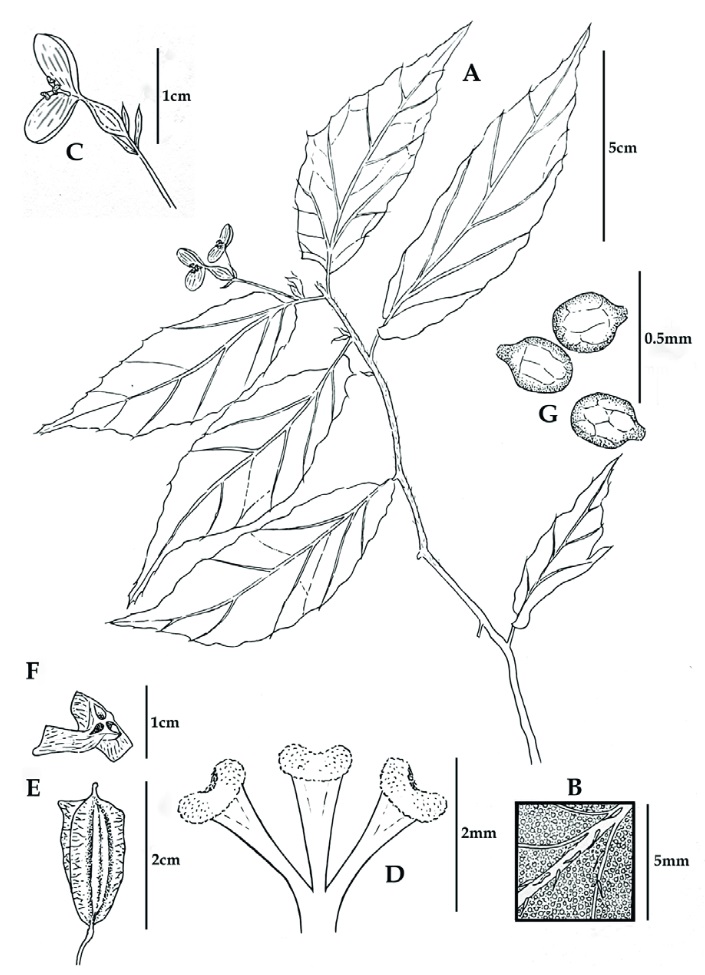
A habit, flowering stem; B. detail of abaxial blade surface showing midrib and hairs; C. female flower and inflorescence; D. style and stigmas; E fruit, side view showing unequal dorsal wing; F. fruit, transverse section showing locules; G. seeds, side view.
All from Lockwood 61 (K). Drawn by H. Lockwood.

Begonia ebo H.Lockwood sp. nov.

 Diagnosis: Begonia ebo differs from all known species of Begonia Sect. Filicibegonia due to its yellow (not white or pink) perianth lobes, and also in the peculiar posture of the inflorescence, which lie along the groove of the adaxial petiole leaf-blade midrib, the flowers appearing superficially to arise from the middle of the leaf-blade (vs inflorescence sessile, or held above or below the leaf blades).

Etymology: Named as a noun in apposition for the forest of Ebo, Littoral  Region,  whence  most  of  the  known  specimens  were found.


Helen Lockwood and Eric Ngansop Tchatchouang. 2025. Begonia ebo sp. nov. (Sect. Filicibegonia-Begoniaceae), endangered in Ebo, a highly threatened forest in Littoral Region, Cameroon. Webbia. Journal of Plant Taxonomy and Geography. 80(1); 77-87. DOI: doi.org/10.36253/jopt-17739 [2025-04-17]

Wednesday, April 30, 2025

[Botany • 2025] Alpinia arachniformis (Zingiberaceae) • A New Species from New Ireland, Papua New Guinea


Alpinia arachniformis A.D.Poulsen, 

in Docot, Haevermans, Sule et Poulsen. 2025.

Abstract
During explorations of the ginger flora of the Bismarck Archipelago in 2013 and 2023, we made collections of the ginger genus Alpinia sensu lato, some of which had unusually elongated cincinni composed of distichously arranged bracteoles and in the present paper we conclude that these collections document a distinct species new to science, Alpinia arachniformis A.D.Poulsen. The choice of epithet refers to the spider-like appearance of the inflorescence. Similar morphology of the cincinni is found in other lineages of Alpinia, but our molecular analysis using the Internal Transcribed Spacer (ITS) marker established a close relationship with A. oceanica from which the new species differs by having cincinni with more flowers and linear labellum. An ink drawing and colour plates, information on distribution and habitat, and provisional conservation status are provided for the new species as well as a key to species of Alpinia in the Bismarck Archipelago.

Keywords: Alpinia oceanica, Alpinia vittata, Bismarck Archipelago, ITS, Zingiberaceae


Alpinia arachniformis A.D.Poulsen
A. Pseudostem showing the sheaths and ligules. B. Inflorescences in different stages. C. Cincinnus with supporting bract. D. Flower (front view). E. Fruits.
Based from A.D. Poulsen et al. 2893 (type). Photos: A.D. Poulsen.

 Alpinia arachniformis A.D.Poulsen sp. nov.
  
Diagnosis: Similar to Alpinia oceanica Burkill in the vegetative characters but differs by the erect inflorescence (vs mostly pendulous); exposed distal peduncle (vs hidden within sheaths); cincinni laxly arranged (5–8 mm apart) along the rachis, 3–11 cm long with 2 mm long stalk at base and composed of up to 15 flowers (vs congested, 3–7 cm long, sessile, up to 7); and linear labellum with a retuse apex (vs narrowly triangular, apex truncate).

Etymology: The elongated cincinni suggest a spider-like resemblance.


Rudolph Valentino A. Docot, Thomas Haevermans, Bernard Sule and Axel Dalberg Poulsen. 2025. Alpinia arachniformis (Zingiberaceae): A New Species from New Ireland, Papua New Guinea. Webbia. Journal of Plant Taxonomy and Geography. 80(1); 51-65. DOI: doi.org/10.36253/jopt-17291

Monday, April 28, 2025

[Botany • 2025] Begonia gigang (Begoniaceae, sect. Petermannia) • A New Species from Zamboanga Peninsula, Mindanao Island, Philippines


Begonia gigang Mazo & Rubite, 

in Mazo et Rubite, 2025. 

Abstract
A new species of Begonia from Zamboanga del Norte, Mindanao Island, Philippines, is described. Begonia gigang is morphologically similar to Begonia corazoniae but can be distinguished by having smaller leaves which are hirsute on both surfaces, longer panicles and peduncles, shorter pedicels for both staminate and pistillate flowers, and trigonous-ellipsoid ovary. Begonia gigang is assessed as Endangered under the IUCN Red List Categories and Criteria. A detailed description, photographs, and ecological notes, and are provided.

Keywords: Begonia corazoniae, Begonia tinuyopensis, endangered, endemic, taxonomy

Begonia gigang Mazo & Rubite.
A. Habit; B. Leaf adaxial surface; C. Leaf abaxial surface showing leaf margin; D. Stem and stipules; E. Staminate and pistillate flowers, inset 3-tepaled staminate flower; F. Cross-section of the ovary; G. Capsules.
All from K. R. F. Mazo 112.

Begonia gigang
 
Mazo & Rubite, sp. nov.  
Section Petermannia

Diagnosis: A species similar to Begonia corazoniae Naive (Naive et al. 2024) in having lamina with greenish to yellowish spots and variegations on the veins but differs in having smaller leaves (10.0–14.5 × 5–7 cm vs. up to 21 × 10.0–13.3 cm) which are hirsute on both surfaces (vs. glabrous), longer panicles and peduncles (15–23 cm vs. 8–13 cm; 9–12 cm vs. up to 4 cm), shorter pedicels for both staminate and pistillate flowers, and trigonous-ellipsoid ovary (vs. trapezoid to obovoid).

Etymology: The specific epithet is derived from the Subanen dialect refers to the rock formations where the new species was found.
 
 
Kean Roe F. Mazo and Rosario R. Rubite. 2025. Begonia gigang (section Petermannia: Begoniaceae), A New Species from Zamboanga Peninsula, Mindanao Island, Philippines. Webbia. Journal of Plant Taxonomy and Geography. 80(1); 89-94. DOI: doi.org/10.36253/jopt-17444 [2025-04-17]

Sunday, December 15, 2024

[Botany • 2020] Ophiorrhiza meenachilarensis (Rubiaceae) • A New Species from southern Western Ghats, India


Ophiorrhiza meenachilarensis Robi & Balan, 

in Balan, Robi et Joseph, 2020. 

Abstract
A new species of Ophiorriza (Rubiaceae) from southern Western Ghats, India is here described and illustrated. Ophiorriza meenachilarensis is similar to O. eriantha, from which it differs in its herbaceous habit (vs. shrubby habit), densely villous-hirsute stem (vs. pubescent-glabrous stem), entire stipule (vs. bifid stipule), short-peduncled cymes (vs. comparatively long-peduncled cymes), unscented flowers (vs. scented flowers) and corolla tube with a ring of hairs at the middle of the tube (vs. corolla tube without a ring of hairs). A detailed description, illustrations, ecological observations, and geographic distribution are provided.

 Keywords: Ophiorrhizeae, Camptothecin, Kerala, Rubioideae, Vagamon hills


Ophiorrhiza meenachilarensis Robi & Balan, sp. nov.

 
Anoop Puthuparampil Balan, Aloor Jose Robi and Ginu Joseph. 2020. Ophiorrhiza meenachilarensis, A New Species of Rubiaceae from southern Western Ghats, India.  Webbia. 75(2), 231–236. DOI: doi.org/10.36253/jopt-8508  

Monday, November 25, 2024

[Botany • 2022] Pleroma barbellatum (Melastomataceae: Melastomateae) • A New Species from the Southern Espinhaço, Minas Gerais, Brazil

 
Pleroma barbellatum P.J.F.Guim., D.Nunes & I.M.Araújo,

in Guimaraes, Silva, Araújo et Romero, 2022.

Abstract
Pleroma barbellatum P.J.F.Guim., D.Nunes & I.M.Araújo a new species of Melastomataceae (Melastomateae) from the Espinhaço Range of Minas Gerais State, Brazil, is described and illustrated, and their affinities and diagnostic characters are here discussed. Pleroma barbellatum is closely related to P. formosum, P. martiale, and P. riedelianum. They share a similar habit and leaves that are alike in size and shape. However, they can be distinguished by differences in the trichomes of the branches, leaves and inflorescences, in addition to other characters related to the type of inflorescence and size of the bracteoles. We recommend a conservation status of Endangered for P. barbellatum.

Keywords: Campos Rupestres, Diamantina Plateau, Espinhaço Meridional, Grão-Mogol, Melastomateae


Pleroma barbellatum P.J.F.Guim., D.Nunes & I.M.Araújo.
(a) Flowering branch. (b) Barbellate trichomes on the branch. (c) Floral bud. (d) Outer surface of bracteole. (e) Inner surface of bracteole. (f) Flower with petals removed. (g) Petal. (h) Antesepalous stamen. (i) Detail of the trichomes on the filament. (j) Anther apex. (k) Flower in longitudinal section.
From W.R. Anderson et al. 35497 (at RB).

Environments and living specimens of Pleroma barbellatum P.J.F.Guim., D.Nunes & I.M.Araújo.
 (a) Rocky outcrop of campo rupestre in Biribiri State Park. (b) Steep rocky slopes with extensive outcrops in Biribiri State Park.
(c) Flower. (d) Leaf blades and gall. (e) Detail of bracts. (f) Fruits.
Living specimens from I.M. Araújo et al. 261. Photos: I.M. Araújo.

 Pleroma barbellatum P.J.F.Guim., D.Nunes & I.M.Araújo sp. nov.

Diagnosis: A shrub or tree 1–2 m or 2–3 m tall, is readily recognized by its barbellate and eglandular trichomes (on the branches, petioles, leaf blade surfaces, pedicels, bracts and bracteoles, hypanthia, outer surface and margins of sepals, and base of style), oblong, elliptic or lanceolate leaf blades 15–44 × 6.5–13.5 mm, with strigose indumentum on the adaxial surface, and obtuse, rounded or cuneate base, terminal cyme inflorescences 3–5 cm long with up to 5 flowers or flowers solitary and terminal, campanulate hypanthia covered by a strigose bristly indumentum, and ensiform sepals 4–6 × 1.5–2.5 mm. Pleroma barbellatum is similar to Pleroma formosum (Cogn.) P.J.F.Guim. & Michelang., but is readily distinguished by shorter leaf blades 15–44 mm long (versus 40–55 mm long in P. formosum), cyme inflorescences (vs. thyrsoids), 1–5 flowers per inflorescence (vs. 35–58 flowers per inflorescence), bracteoles 10–17.5 × 6.5–10 mm (vs. 4–6 × 1.4–2 mm), sepals 4–6 mm long (vs. 2.5–2 mm long).

Etymology: The specific epithet, barbellatum, refers to shortly barbed trichomes (see Beentje 2016) that are easily observed on branches, leaves, pedicels, bracts and bracteoles, hypanthia, outer surface and margins of sepals, and base of the style (see Figures 1B and 2).


Paulo José Fernandes Guimaraes, Diego Nunes Da Silva, Inara Montini Araújo and Rosana Romero. 2022. A New Species of Pleroma (Melastomataceae) from the Southern Espinhaço, Minas Gerais, Brazil.  Webbia. Journal of Plant Taxonomy and Geography.  77(2); 247-256. DOI: 10.36253/jopt-13088

Friday, September 6, 2024

[Botany • 2024] Amorphophallus samarensis (Araceae) • A New Species endemic to Samar Island, Eastern Visayas, Philippines


 Amorphophallus samarensis Fontarum-Bulawin, Medecilo-Guiang & Alejandro,

in Fontarum-Bulawin, Medecilo-Guiang et Alejandro, 2024. 

Abstract
Amorphophallus samarensis is described as a new species from Paranas, Samar Island Natural Park, Samar Eastern Visayas, Philippines. A. samarensis resembles A. calcicola by having a solitary leaf, long peduncled solitary flower, cylindric female zone, ovary depressed, disk shape, slightly distant ovaries, and absence of staminode. It differs from A. calcicola by having the rachis winged at the distal part of the leaf, pale to dark maroon slightly depressed globose capitate stigma, style color, length of spadix, and truncate anther. The new species is considered Critically Endangered (CR) based on IUCN guidelines due to persistent anthropogenic activities. There are 30 individual plants encountered in the locality with less than 100 sq. km area of occupancy with an observed threat.

Keywords: Amorphophallus calcicola, biodiversity, conservation, critically endangered, taxonomy


Amorphophallus samarensis Fontarum-Bulawin, Medecilo-Guiang & Alejandro, sp. nov 

Diagnosis: Amorphophallus samarensis has widely triangular, undulating, pale green, cream to maroon spathe, with maroon spots, an undulate to entire spathe mar-gin; cylindric female zone; spadix longer than spathe; slightly distant depressed globose ovaries; pale to dark maroon slightly depressed globose capitate stigma; elongate cylindrical male zone; truncate anther; absent of staminode; and smooth narrowly elongate cylindric appendix. A. samarensis is like A. calcicola, A. longispathaceus, and A. rostratus for having solitary leaf, spadix longer than spathe, long peduncled solitary flower, ...


Norilyn Fontarum-Bulawin, Maria Melanie Medecilo-Guiang and Grecebio Jonathan D. Alejandro. 2024. Amorphophallus samarensis (Araceae), A New Species endemic to Samar Island, Eastern Visayas, Philippines. Webbia. Journal of Plant Taxonomy and Geography. 79(2),; 295-303. DOI: doi.org/10.36253/jopt-16302


Wednesday, April 17, 2024

[Botany • 2024] Begonia abhak (Begoniaceae, sect. Petermannia) • A New Species from Lanuza, Surigao del Sur, Philippines


Begonia abhak Blasco, Alejandro, Tandang & Rubite,  

in Blasco, Alejandro, Tandang et Rubite, 2024. 

Abstract
A new Begonia species, Begonia abhak, from section Petermannia is described and illustrated. Growing on shady, moist, rocky slopes alongside a small creek of Bujon, Lanuza, Surigao del Sur. The new species resembles Begonia panayensis in having glabrous stems, membranous, shiny leaves, oblong to oblanceolate lamina, acuminate apex and green ovary with pink wings but is distinct in having short stems, broadly ovate stipules, acute leaf base, serrated margins, and the slashed or jagged to almost entire margins of the capsule wings. Based on IUCN criteria, B. abhak is hereby proposed as Least Concern (LC).

Keywords: Begonia panayensis, Mindanao, medicinal plants, Surigao provinces, Taxonomy


Begonia abhak Blasco, Alejandro, Tandang & Rubite, sp. nov.
A. Stem, B. Stipule, C. Bracts, D. Staminate flowers, E. Young pistillate flower, F. Mature pistillate flower, G. Pistillate flower side view, H. & I. Immature capsules, J. Matured capsule, K. Cross section of the ovary.
All from Freddie A. Blasco 22-009.

Begonia abhak Blasco, Alejandro, Tandang & Rubite, sp. nov.
A. & B. Habit and Habitat. All from Freddie A. Blasco 22-009.

Begonia abhak Blasco, Alejandro, Tandang & Rubite, sp. nov. 
Sect. Petermannia.

Diagnosis: Begonia abhak resembles B. panayensis Merril in having tall, erect and glabrous stems, oblanceolate leaves, glossy surface adaxially, light green abaxially, acuminate apex, acute base, 2 tepaled staminate flowers, 5 tepaled pistillate flowers and green ovaries with pink wings. However, B. abhak differs in having shorter stems at 1.3 m (vs. 1.5 m), stipules broadly ovate at 19–20 × 9–10 mm (vs. oblanceolate 15–20 mm long), smaller lamina at 14–15 × 5.5–6 cm (vs. 16–20 × 4–6 cm.) with serrated margins (vs. dentate), broadly ovate male tepals (vs. orbicular), shorter and narrower capsules at 16–17 × 14–15 mm. (vs. longer and wider 25 × 20 mm).

Etymology: The specific epithet abhak is derived from the Bisayan/Cebuano word, which means sliced or slashed, referring to the margin of the capsule wings.


Freddie A. Blasco, Grecebio Jonathan D. Alejandro, Danilo N. Tandang and Rosario R. Rubite. 2024. Begonia abhak (section Petermannia, Begoniaceae), A New Species from Lanuza, Surigao del Sur, Philippines. Webbia. 79(1); 47-50. DOI: DOI: 10.36253/jopt-15356

Saturday, March 23, 2024

[Botany • 2023] Rigiolepis gayoensis (Ericaceae: Vaccinioideae) • A New Species from the Gayo Plateau, Aceh Province, Indonesia


Rigiolepis gayoensis Mustaqim, M.N.Tamayo & P.W.Fritsch, 

in Mustaqim, Tamayo, Hutabarat, Arico et Fritsch, 2023.

Abstract
A new species of Ericaceae from the Gayo Plateau, Aceh Province, Indonesia is described. Rigiolepis gayoensis resembles R. lanceolata but differs by having shorter leaves, non-protruding basal leaf glands, longer flowering pedicels, a glabrous hypanthium, and a dark red or maroon corolla. A detailed morphological description, ecological notes, conservation status, and photographs are presented. The new species represents the third species of Rigiolepis found in the island of Sumatra. A key to the species of Rigiolepis in Sumatra is provided.

Keywords: epiphyte, Rigiolepis, Sumatra, taxonomy, Vaccinioideae

Rigiolepis gayoensis Mustaqim, M.N.Tamayo & P.W.Fritsch.
A. Leafy branchlet. B. Portion of stem showing indumentum, per-ennating buds, and cordate leaf blade base. C. Adaxial leaf surface. D. Abaxial leaf surface. E. Inflorescence. F. Anterior view of flower. G. Ovary cross-section. H. Immature fruits. I. Mature (left) and submature (right) fruits.
Scale bar: A = 1 cm, B, G = 2 mm, C, D, H, I = 5 mm, E = 2 mm, F = 1 mm. 
Photographs by Wendy A. Mustaqim. A–F, H, I from the holotype W.A. Mustaqim 2563; G from W.A. Mustaqim 2575.

Rigiolepis gayoensis Mustaqim, M.N.Tamayo &. P.W.Fritsch, sp. nov.

Diagnosis: Rigiolepis gayoensis closely resembles R. lanceolata (Blume) J.J.Sm. but differs by having shorter leaves [4.6–5.5 cm vs. c. 9.0 cm (or longer)], non-protruding basal leaf glands (vs. protruding), longer flowering pedicels (c. 11 mm vs. 2–3 mm), a glabrous hypanthium (vs. densely hairy), and a dark red or maroon corolla (vs. creamy white).

Etymology: The epithet gayoensis is derived from the Gayo Plateau, the name of the area where the species was found.


Wendy A. Mustaqim, Maverick N. Tamayo, Prima W.K. Hutabarat, Zulfan Arico and Peter W. Fritsch. 2023. A New Species of Rigiolepis (Ericaceae: Vaccinioideae) from the Gayo Plateau, Aceh Province, Indonesia. Webbia. 78(2); 73-78. DOI: 10.36253/jopt-14872