Showing posts with label Oviraptoridae. Show all posts

Saturday, February 26, 2022

[Paleontology • 2022] Cranial Muscle Reconstructions Quantify Adaptation for High Bite Forces in Oviraptorosauria


in Meade & Ma, 2022. 

Abstract
Oviraptorosaurians are an unusual and probably herbivorous group of theropod dinosaurs that evolved pneumatised crania with robust, toothless jaws, apparently adapted for producing a strong bite. Using 3D retrodeformed skull models of oviraptorid oviraptorosaurians Citipati, Khaan, and Conchoraptor, along with the earliest diverging oviraptorosaurian, Incisivosaurus, we digitally reconstruct jaw adductor musculature and estimate bite force to investigate cranial function in each species. We model muscle length change during jaw opening to constrain optimal and maximum gape angles. Results demonstrate oviraptorids were capable of much stronger bite forces than herbivorous theropods among Ornithomimosauria and Therizinosauria, relative to body mass and absolutely. Increased bite forces in oviraptorid oviraptorosaurians compared to the earliest diverging oviraptorosaurian result from expanded muscular space and different cranial geometry, not changes in muscular arrangement. Estimated optimal and maximum possible gapes are much smaller than published estimates for carnivorous theropods, being more similar to the herbivorous therizinosaurian theropod Erlikosaurus and modern birds. Restrictive gape and high bite force may represent adaptation towards exploiting tough vegetation, suggesting cranial function and dietary habits differed between oviraptorids and other herbivorous theropods. Differences in the relative strength of jaw adductor muscles between co-occurring oviraptorids may be a factor in niche partitioning, alongside body size.


Luke E. Meade and Waisum Ma. 2022. Cranial Muscle Reconstructions Quantify Adaptation for High Bite Forces in Oviraptorosauria. Scientific Reports. 12: 3010. DOI: 10.1038/s41598-022-06910-4


Wednesday, December 22, 2021

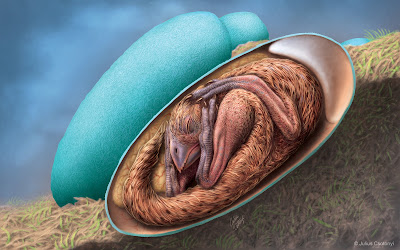
[Paleontology • 2021] An Exquisitely Preserved in-ovo Theropod Dinosaur Embryo sheds Light on Avian-like Prehatching Postures


in Xing, Niu, Ma, ... et Brusatte, 2021.

Artwork by Julius Csotonyi facebook.com/JuliusCsotonyi 

Highlights:
• A Late Cretaceous oviraptorid theropod dinosaur embryo is preserved in-ovo
• Its head lies ventral to the body, and the back curled along the egg's blunt pole
• Its posture is similar to that of a late-stage modern bird embryo
• Avian tucking behavior possibly originated among non-avian theropods

Summary
Despite the discovery of many dinosaur eggs and nests over the past 100 years, articulated in-ovo embryos are remarkably rare. Here we report an exceptionally preserved, articulated oviraptorid embryo inside an elongatoolithid egg, from the Late Cretaceous Hekou Formation of southern China. The head lies ventral to the body, with the feet on either side, and the back curled along the blunt pole of the egg, in a posture previously unrecognized in a non-avian dinosaur, but reminiscent of a late-stage modern bird embryo. Comparison to other late-stage oviraptorid embryos suggests that prehatch oviraptorids developed avian-like postures late in incubation, which in modern birds are related to coordinated embryonic movements associated with tucking — a behavior controlled by the central nervous system, critical for hatching success. We propose that such pre-hatching behavior, previously considered unique to birds, may have originated among non-avian theropods, which can be further investigated with additional discoveries of embryo fossils.


Lida Xing, Kecheng Niu, Waisum Ma, Darla K. Zelenitsky, Tzu-Ruei Yang and Stephen L. Brusatte. 2021. An Exquisitely Preserved in-ovo Theropod Dinosaur Embryo sheds Light on Avian-like Prehatching Postures. iScience.  DOI: 10.1016/j.isci.2021.103516

Wednesday, December 30, 2020

[Paleontology • 2021] An Oviraptorid Preserved Atop An Embryo-bearing Egg Clutch sheds light on the Reproductive Biology of Non-avialan Theropod Dinosaurs


 an oviraptorid specimen [LDNHMF2008]
consisting of an adult skeleton preserved atop an embryo-bearing egg clutch. 

Bi, Amiot, Peyre de Fabrègues, ... et Xu, 2020.
 Artwork by Zhao Chuang. english.IVPP.cas.cn

 
Abstract
Recent studies demonstrate that many avialan features evolved incrementally prior to the origin of the group, but the presence of some of these features, such as bird-like brooding behaviours, remains contentious, in non-avialan dinosaurs. Here we report the first non-avialan dinosaur fossil known to preserve an adult skeleton atop an egg clutch that contains embryonic remains. The preserved positional relationship of the adult to the clutch, coupled with the advanced growth stages of the embryos and their high estimated incubation temperatures, provides strong support for the brooding hypothesis. Furthermore, embryos in the clutch are at different developmental stages, suggesting the presence of asynchronous hatching—a derived feature even among crown-group birds—in non-avialan theropods. These findings demonstrate that the evolution of reproductive biology along bird-line archosaurs was a complex rather than a linear and incremental process, and suggest that some aspects of non-avialan theropod reproduction were unique to these dinosaurs.

Keywords: Oviraptorosauria, Cretaceous, Clutch, Brooding, Embryos, Asynchronous hatching


Fig. 1. LDNHMF2008, an oviraptorid specimen consisting of an adult skeleton preserved atop an embryo-bearing egg clutch.
(a) Photograph. (b) Interpretive drawing with bones and gastroliths in white and eggs color-coded by ring (A, red; B, green; C, blue).
(c) Restoration (white indicates bones preserved in the adult skeleton).

Abbreviations: I, digit I; II, digit II; III, digit III; A#, egg in lowermost ring (A); as, astragalus; B#, egg in middle ring (B); C#, egg in uppermost ring (C); cav, caudal vertebra; ch, chevron; cv, cervical vertebra; di, manual digit; dr, dorsal ribs; dv, dorsal vertebra; em, egg known to preserve embryo; fe, femur; fi. fibula; ga, gastralium; gl, gastroliths; h, humerus; il, ilium; is, ischium; mt, metatarsal; O2, egg sampled for oxygen isotope analysis; pb, pubis; pp, pedal phalanges; ra, radius; sl, semilunate carpal; ti, tibia; ul, ulna. Note that C11 and C12 are not paired eggs. The eggs that would have been paired with C11 and C12 are probably not preserved, as is the case for some other eggs and skeletal elements.
 

An attentive oviraptorid theropod dinosaur broods its nest of blue-green eggs while its mate looks on in what is now Jiangxi Province of southern China some 70 million years ago.
 Artwork by Zhao Chuang.


 Shundong Bi, Romain Amiot, Claire Peyre de Fabrègues, Michael Pittman, Matthew C. Lamanna, Yilun Yu, Congyu Yu, Tzuruei Yang, Shukang Zhang, Qi Zhao and Xing Xu. 2020. An Oviraptorid Preserved Atop An Embryo-bearing Egg Clutch sheds light on the Reproductive Biology of Non-avialan Theropod Dinosaurs. Science Bulletin. In Press. DOI: 10.1016/j.scib.2020.12.018

Researchers Announce World’s First Dinosaur Preserved Sitting on Nest of Eggs that Includes Fossilized Babies

Thursday, February 7, 2019

[Paleontology • 2019] Gobiraptor minutus • A New Baby Oviraptorid Dinosaur (Dinosauria: Theropoda) from the Upper Cretaceous Nemegt Formation of Mongolia


Gobiraptor minutus 
Lee, Lee, Chinsamy, Lü, Barsbold & Tsogtbaatar, 2019


Abstract
Recent discoveries of new oviraptorosaurs revealed their high diversity from the Cretaceous Period in Asia and North America. Particularly, at the family level, oviraptorids are among the most diverse theropod dinosaurs in the Late Cretaceous of Mongolia and China. A new oviraptorid dinosaur Gobiraptor minutus gen. et sp. nov. from the Upper Cretaceous Nemegt Formation is described here based on a single holotype specimen that includes incomplete cranial and postcranial elements. The most prominent characters of Gobiraptor are its thickened rostrodorsal end of the mandibular symphysis and a rudimentary lingual shelf on each side of the dentary. Each lingual shelf is lined with small occlusal foramina and demarcated by a weakly developed lingual ridge. This mandibular morphology of Gobiraptor is unique among oviraptorids and likely to be linked to a specialized diet that probably included hard materials, such as seeds or bivalves. The osteohistology of the femur of the holotype specimen indicates that the individual was fairly young at the time of its death. Phylogenetic analysis recovers Gobiraptor as a derived oviraptorid close to three taxa from the Ganzhou region in southern China, but rather distantly related to other Nemegt oviraptorids which, as the results of recent studies, are also not closely related to each other. Gobiraptor increases diversity of oviraptorids in the Nemegt Formation and its presence confirms the successful adaptation of oviraptorids to a mesic environment.

Fig 4. Postcranial elements of the holotype specimen (MPC-D 102/111) of Gobiraptor minutus gen. et sp. nov.
 (A) Skeletal reconstruction in left lateral view (missing and damaged portions of the bones in gray). (B) Left ilium in lateral view. (C) Proximal caudal vertebrae in left lateral view with close-up of the infraprezygapophyses. (D) Chevron in cranial view. (E-F) Right scapula in dorsal (E) and lateral (F) views. (G) Last sacral and the two proximalmost caudals in left lateral view. (H) Right pubis in medial view. (I) Right ischium in lateral view. (J) Right femur in distal view. (K) Left metatarsus and distal tarsals in proximal view. (L) Right femur in cranial view. (M-N) Left metatarsus in lateral (M) and dorsal (N) views. 

Abbreviations: acr, acromion process; ant, antitrochanter; ch, chevron; cv, caudal vertebra(e); diprf, dorsal infraprezygapophyseal fossa; dt, distal tarsal(s); fct, cranial trochanter of femur; fh, femoral head; gl, glenoid fossa; idf, infradiapophyseal fossa; lc, lateral condyle; mc, medial condyle; mep, medial epicondyle; miprf, middle infraprezygapophyseal fossa; mt II, metatarsal II; mt IV, metatarsal IV; mt V, metatarsal V; ns, neural spine; obp, obturator process; pra, preacetabular process; pup, pubic peduncle; sprf, supraprezygapophyseal fossa; sv, sacral vertebra; tfc, tibiofibular crest; tp, transverse process; viprf, ventral infraprezygapophyseal fossa. Scale bars equal 10 cm in (A); 1 cm in (B-N).

Systematic paleontology

Dinosauria Owen, 1842
Theropoda Marsh, 1881
Maniraptora Gauthier, 1986

Oviraptorosauria Barsbold, 1976
Oviraptoridae Barsbold, 1976

Gobiraptor minutus gen. et sp. nov.

Etymology: The generic name Gobiraptor is a combination of ‘Gobi’ which refers to the Gobi Desert where the holotype specimen was found and ‘raptor’ which is Latin for thief. The specific name ‘minutus’ is Latin for small and refers to the small size of the holotype specimen.

Holotype: The holotype specimen (MPC-D 102/111) (Figs 2–4, S2 and S3 Figs) consists of mostly incomplete cranial and postcranial elements including ventral parts of the premaxillae and maxillae, a tip of the right jugal, fused vomer, parts of articulated pterygoids and ectopterygoids, incomplete right palatine, central part of the left postorbital, partial right quadrate and quadratojugal, incomplete lower jaw, with most of its elements broken, the last sacral vertebra which is articulated with the two proximalmost caudal vertebrae, articulated but incomplete proximal caudal vertebrae, fragments of chevrons, partial right scapula and humerus, incomplete pelvic girdles, nearly complete both femora, complete left metatarsus with distal tarsals 3 and 4, incomplete left pedal digits I, III, and IV, and several unidentified fragments. MPC-D 102/111 was also found with other theropod skeletons including postcranial elements of alvarezsaurids and larger oviraptorids.


Type locality and horizon: Altan Uul III, Ömnögovi Province, Mongolia (Fig 1, S1 Fig). Upper Cretaceous Nemegt Formation.

Diagnosis: Gobiraptor minutus is an oviraptorid dinosaur diagnosed by the following unique set of characteristics (autapomorphies are marked with an asterisk): a flat articular surface for the quadratojugal on the quadrate*; rostrocaudally elongate dentary rostral to the external mandibular fenestra; extremely thickened rostrodorsal end of the mandibular symphysis with a caudal expansion of its dorsal surface *; a rudimentary lingual triturating shelf on each dentary bearing small occlusal foramina*; a weakly developed lingual ridge on each lingual shelf*; absence of any prominent symphyseal ventral process of the dentary; coronoid bone present; the rostral end of the coronoid bone wedging into the ventral surface of the dorsal ramus of the dentary*; cranial trochanter of the femur separated from the greater trochanter with a distinct furrow between them.
....


Conclusions: 
Gobiraptor minutus gen. et sp. nov. is a new derived oviraptorid represented by an incomplete skeleton including both cranial and postcranial elements. Gobiraptor is primarily distinguished from other oviraptorids by its dentary with the extremely thickened rostrodorsal end of the mandibular symphysis, lingual ridges and lingual shelves bearing occlusal foramina. The unique morphology of the mandible of Gobiraptor is probably closely related to a crushing-related feeding style and a specialized diet, which may have incorporated hard seeds or shelled organisms. Although Gobiraptor was recovered from the Nemegt Formation, its phylogenetic position showed a close relationship with three Ganzhou oviraptorids. The distant relationships among the Nemegt oviraptorids on the phylogenetic tree were reaffirmed in this study. Therefore, it is highly unlikely that the evolution of these unusually diverse animals was facilitated by a simple sympatric speciation. The presence of Gobiraptor in the Nemegt Formation, together with occurrences of other oviraptorids, also indicates that abundant oviraptorids lived in mesic environments and they were one of the most diverse and successful groups of dinosaurs in the Nemegt region.


 Sungjin Lee, Yuong-Nam Lee , Anusuya Chinsamy, Junchang Lü†, Rinchen Barsbold and Khishigjav Tsogtbaatar. 2019. A New Baby Oviraptorid Dinosaur (Dinosauria: Theropoda) from the Upper Cretaceous Nemegt Formation of Mongolia.  PLoS ONE. 14(2): e0210867. DOI: 10.1371/journal.pone.0210867

New oviraptorosaur species discovered in Mongolia phys.org/news/2019-02-oviraptorosaur-species-mongolia.html via @physorg_com


Monday, July 31, 2017

[Paleontology • 2017] Corythoraptor jacobsi • High Diversity of the Ganzhou Oviraptorid Fauna Increased by A New “Cassowary-like” Crested Species


Corythoraptor jacobsi
Lü, Li, Kundrát, Lee, Sun, Kobayashi, Shen, Teng & Liu, 2017


Abstract
A new oviraptorid dinosaur from the Late Cretaceous of Ganzhou, bringing oviraptrotid diversity of this region to seven taxa, is described. It is characterized by a distinct cassowary-like crest on the skull, no pleurocoels on the centra from the second through fourth cervical vertebrae, a neck twice as long as the dorsal vertebral column and slightly longer than the forelimb (including the manus). Phylogenetic analysis recovers the new oviraptorid taxonCorythoraptor jacobsi, as closely related to Huanansaurus from Ganzhou. Osteochronology suggests that the type specimen of Corythoraptor had not reached stationary growth stage but died while decreasing growth rates. The histology implies that it would correspond to an immature individual approximately eight years old. We hypothesize, based on the inner structure compared to that in modern cassowaries, that the prominent casque of Corythoraptor was a multifunction-structure utilized in display, communication and probably expression of the fitness during mating seasons.

Figure 1: The holotype of Corythoraptor jacobsi gen. et sp. nov. (JPM-2015-001). (a) Photograph. (b) Outline drawings. (c) Close up of the skull and lower jaw, showing the pneumatic cassowary-like crest (Only skull and lower jaw elements are labeled). (d) Skeletal reconstruction (missing parts are in grey).

 Abbreviations: aof, antorbital fenestra; cav. caudal vertebrae; cr. cervical ribs; cv. cervical vertebrae; dv. dorsal vertebrae; fe, femur; fi. fibula; h, humerus; il, ilium; is, ischium; l, lacrimal; lj, lower jaw; ltf, lower temporal fenestra; m, maxilla; n, nasal; nar, narial opening; o, orbit; oc, occipital condyle; p, parietal; pm, premaxilla; po, postorbital; ps, pes; psc, pneumatic skull crest; pu. pubis; q, quadrate; ra, radius; sk, skull; sq, squamosal; stf, super temporal fenestra; ti, tibia; ul, ulna. Scale bar = 8 cm in (c) and 100 cm in (d).


Systematic palaeontology

Oviraptorosauria Barsbold, 1976.
Oviraptoridae Barsbold, 1976.

Corythoraptor jacobsi gen. et sp. nov.

Etymology: The generic name Corythoraptor refers to a raptor bearing a “cassowary-like crest” on its head, and the specific name is in honor of Professor Louis L. Jacobs, who has contributed to dinosaur research and has given excellent mentoring to three authors (JLü, YL and YK) when they were Ph.D. students at Southern Methodist University, Dallas, Texas, USA.

Type locality and horizon: A site in the vicinity of the Ganzhou Railway Station (GPS coordinates are provided on request from the first author), Ganzhou City; Campanian-Maastrichtian; Nanxiong Formation (Upper Cretaceous).

 Diagnosis: An oviraptorosaurian dinosaur with the following unique combination of characters: ratio of the length of the tomial margin of the premaxilla to the premaxilla height (ventral to the external naris) is 1.0–1.4; inclination of the anteroventral margin of the premaxilla relative to the horizontally positioned ventral margin of the jugal posterodorsal; antorbital fossa bordered anteriorly by the maxilla; narial opening much longer than width; infratemporal fenestra dorsoventrally elongate, narrow anteroposteriorly; the supranarial process of the premaxilla bears two processes: a short posterodorsally extending process, forming the anterodorsal margin of the external nasal opening, and a long process, forming most of the anterodorsal process of the premaxilla; distinct cassowary-like helmet on the skull; long axis of the external narial opening parallel to the dorsal margin of antorbital fenestra; straight anterodorsal margin of dentary in lateral view; a deep fossa, sometimes with associated pneumatopore on lateral surface of dentary; no pleurocoels on the centra from the second through fourth cervical vertebrae; the length of the neck twice as long as the dorsal vertebral column, and slightly longer than the entire forelimb length (including the manus); less pronounced deltopectoral crest of humerus, forming an arc rather than being quadrangular; ratio of the length of the manus to the length of the humerus plus the radius between 0.50 and 0.65; the ungual of digit III less curved than other unguals; lesser trochanter (cranial trochanter) completely fused with the greater trochanter and distal ends of shafts of metatarsal II straight and metatarsal IV laterally deflected. 

Corythoraptor jacobsi gen. et sp. nov. is assigned to oviraptorid dinosaurs based on the following characters: proximal caudals with pneumatized centra; ischium with its posterior profile concave3; premaxilla pneumatized; the subantorbital portion of the maxilla inset medially; the palate extending below the cheek margin; the external naris overlapping most of the antorbital fossa rostrodorsally; the bones of the skull roof pneumatized; the pubic shaft concave cranially, the mandibular symphysis tightly sutured; the shortened preorbital region, and the toothless jaws.

.....


Figure 2: The cranial casque of Corythoraptor jacobsi and recent cassowaries. (a–c) the crested skull of Corythoraptor and head appearance restorations. (d) a close-up (see dotted rectangle in a and b) of eroded bony shell in the posterolateral casque of Corythoraptor. (e) the crested skull of the recent cassowary (Casuarius uniappendiculatus; Museum für Naturkunde in Berlin, Germany: MfN-ZMB 93274). (f) a keratinous helmet over the skull of the recent cassowary (unnumbered specimen of Casuarius casuarius from the osteological collections of ZOO Protivín, Czech Republic). (g,h) coronal cuts through the cassowary skull – (g) Casuarius casuarius MfN-ZMB 36820, (h) Casuarius casuarius: MfN-ZMB 36885 (see dotted lines in f); note transition in strut-like trabecular arrangement. (i) close-up to contact between keratinous and skeletal components of the casque in recent cassowary, unnumbered specimen of Casuarius sp. from the osteological collections of Field Museum of Natural History, Chicago, USA.

Abbreviations: cq, casque; cr, cranium; exs, external surface; kesh, keratinous sheath; or, orbit; tr, trabeculae.

Figure 5: The living scene of Corythoraptor jacobsi gen. et sp. nov.
Drawn by Zhao Chuang


Junchang Lü, Guoqing Li, Martin Kundrát, Yuong-Nam Lee, Zhenyuan Sun, Yoshitsugu Kobayashi, Caizhi Shen, Fangfang Teng and Hanfeng Liu. 2017. High Diversity of the Ganzhou Oviraptorid Fauna Increased by A New “Cassowary-like” Crested Species.
  Scientific Reports. 7, Article number: 6393. DOI: 10.1038/s41598-017-05016-6


Introducing Corythoraptor jacobsi.  paleonerdish.wordpress.com/2017/07/28/introducing-corythoraptor-jacobsi/ via @ferwen


Tuesday, November 15, 2016

[Paleontology • 2016] Tongtianlong limosus • A Late Cretaceous Diversification of Asian Oviraptorid Dinosaurs: Evidence from A New Species preserved in An Unusual Posture


Tongtianlong limosus 
Lü, Chen, Brusatte, Zhu & Shen, 2016

 An artistic reconstruction, showing the last-ditch struggle of Tongtianlong limosus as it was mired in mud, one possible, but highly speculative, interpretation for how the specimen was killed and buried.
(Drawn by Zhao Chuang)  DOI: 10.1038/srep35780  

Abstract
Oviraptorosaurs are a bizarre group of bird-like theropod dinosaurs, the derived forms of which have shortened, toothless skulls, and which diverged from close relatives by developing peculiar feeding adaptations. Although once among the most mysterious of dinosaurs, oviraptorosaurs are becoming better understood with the discovery of many new fossils in Asia and North America. The Ganzhou area of southern China is emerging as a hotspot of oviraptorosaur discoveries, as over the past half decade five new monotypic genera have been found in the latest Cretaceous (Maastrichtian) deposits of this region. We here report a sixth diagnostic oviraptorosaur from Ganzhou, Tongtianlong limosus gen. et sp. nov., represented by a remarkably well-preserved specimen in an unusual splayed-limb and raised-head posture. Tongtianlong is a derived oviraptorid oviraptorosaur, differentiated from other species by its unique dome-like skull roof, highly convex premaxilla, and other features of the skull. The large number of oviraptorosaurs from Ganzhou, which often differ in cranial morphologies related to feeding, document an evolutionary radiation of these dinosaurs during the very latest Cretaceous of Asia, which helped establish one of the last diverse dinosaur faunas before the end-Cretaceous extinction.


Figure 2: The whole skeleton of the holotype Tongtianlong limosus gen. et sp. nov. in dorsal view (a) and lateral view (b). Scale bar = 10 cm. 

Systematic Paleontology

Dinosauria Owen, 184231.

Theropoda Marsh, 188132.
Maniraptora Gauthier, 198633.

Oviraptorosauria Barsbold, 197634.
Oviraptoridae Barsbold, 197634.

Tongtianlong limosus gen. et sp. nov. (Figs 2, 3 and 4)


Holotype: A nearly complete, three-dimensionally preserved skeleton with skull and lower jaws (DYM-2013-8). The specimen is accessioned at the Dongyang Museum, Dongyang City, Zhejiang Province.

Type locality and horizon: The building site of the No. 3 high school of Ganxian (GPS coordinates are provided on request from the first author); Nanxiong Formation (Maastrichtian, Upper Cretaceous).


Etymology: Tongtian, Chinese Pinyin, refers to Tongtianyan of Ganzhou, the first grotto south of the Yangtze River. Tongtian also means the road to heaven, a fitting epitaph for a deceased dinosaur preserved with outstretched arms. Long, Chinese Pinyin for dragon. Limosus, Latin for muddy, refers to the holotype specimen being found in an unusual posture in a mudstone (Fig. 5).


Junchang Lü, Rongjun Chen, Stephen L. Brusatte, Yangxiao Zhu and Caizhi Shen. 2016. A Late Cretaceous Diversification of Asian Oviraptorid Dinosaurs: Evidence from A New Species preserved in An Unusual Posture. Scientific Reports. 6, Article number: 35780. DOI: 10.1038/srep35780


Sunday, June 19, 2016

[Paleontology • 2013] Yulong mini • Chicken-sized Oviraptorid Dinosaurs from central China and their Ontogenetic Implications


Yulong mini  
Lü, Currie, Xu,Zhang, Pu & Jia, 2013


Abstract
Oviraptorids are a group of specialized non-avian theropod dinosaurs that were generally one to 8 m in body length. New specimens of baby oviraptorids from the Late Cretaceous of Henan Province are some of the smallest individuals known. They include diagnostic characters such as the relative position of the antorbital fenestra and the external naris, distinct opening in the premaxilla anteroventral to the external naris, antorbital fossa partly bordered by premaxilla posterodorsally, lacrimal process of premaxilla does not contact the anterodorsal process of the lacrimal, parietal almost as long as frontal; in dorsal view, posterior margin forms a straight line between the postzygapophyses in each of the fourth and fifth cervicals; femur longer than ilium. They also elucidate the ontogenetic processes of oviraptorids, including fusion of cranial elements and changes in relative body proportions. Hind limb proportions are constant in oviraptorids, regardless of absolute body size or ontogenetic stage. This suggests a sedentary lifestyle that did not involve the pursuit of similar-sized prey. The functional implications for bite force and therefore dietary preferences are better understood through the study of such small animals. The comparison of the measurements of 115 skeletons indicates that oviraptorids maintain their hind limb proportions regardless of ontogenetic stage or absolute size, which is a pattern seen more commonly in herbivores than in carnivores. This may weakly support the hypothesis that oviraptorids are herbivores rather than active carnivores.

Keywords: Baby oviraptorid, Yulong, Late Cretaceous, Henan Province


Fig. 1: a Photograph and b line drawings of  Yulong mini  (HGM 41HIII-0107).
cv cervical vertebrae, d dentary, fe femur, fi fibula, h humerus, il ilium, mt metatarsals, o orbital, po postorbital, rd radius, ul ulna, ti tibia.    DOI:10.1007/s00114-012-1007-0

Systematic paleontology

Oviraptorosauria Barsbold 1976
Oviraptoridae Barsbold 1976

Yulong mini gen. et sp. nov.

Etymology: Generic name derived from “Yu”, the abbreviated name for Henan Province, and “long” from Chinese, meaning dragon. The specific name refers to the small size of known specimens.

Holotype: Henan Geological Museum HGM 41HIII-0107, an exceptionally well-preserved skeleton with a skull and lower jaws.

Referred specimens: HGM 41HIII-0108, nearly complete skull with lower jaws; HGM 41HIII-0109, well-preserved skull, lower jaws and partial postcranial skeleton; HGM 41HIII-0110, partial skull, lower jaws and a few cervical centra; HGM 41HIII-0111, one complete left ilium.

Type locality and horizon: Qiupa Town, Luanchuan County, Henan Province; Upper Cretaceous, Qiupa Formation (Bureau of Geology and Mineral Resources of Henan Province 1989; Lü et al. 2007).

Diagnosis: Oviraptorid with the following characters: posterodorsal corner of the antorbital fenestra and the anteroventral corner of the external naris at the same level (similar conditions in Citipati osmolskae [MPC-D 100/978] and Citipati sp. [MPC-D 100/42]); distinct opening in the premaxilla anteroventral to the external naris; antorbital fossa partly bordered by premaxilla anterodorsally; lacrimal process of premaxilla does not contact the anterodorsal process of the lacrimal; parietal almost as long as frontal; in dorsal view, posterior margin forms a straight line between the postzygapophyses in each of the fourth and fifth cervicals; femur longer than ilium.


Lü, J.; Currie, P. J.; Xu, L.; Zhang, X.; Pu, H.; Jia, S. 2013. Chicken-sized Oviraptorid Dinosaurs from central China and their Ontogenetic Implications. Naturwissenschaften. DOI:10.1007/s00114-012-1007-0


Friday, July 3, 2015

[Paleontology • 2015] Huanansaurus ganzhouensis • A New Oviraptorid Dinosaur (Dinosauria: Oviraptorosauria) from the Late Cretaceous of Southern China and Its Paleobiogeographical Implications


 Huanansaurus ganzhouensis 
Lü, Pu, Kobayashi, Xu, Chang, Shang, Liu, Lee, Kundrát & Shen, 2015
Illustration: Chuang Zhao  doi: 10.1038/srep11490

The Ganzhou area of Jiangxi Province, southern China is becoming one of the most productive oviraptorosaurian localities in the world. A new oviraptorid dinosaur was unearthed from the uppermost Upper Cretaceous Nanxiong Formation of Ganzhou area. It is characterized by an anterodorsally sloping occiput and quadrate (a feature shared with Citipati), a circular supratemporal fenestra that is much smaller than the lower temporal fenestra, and a dentary in which the dorsal margin above the external mandibular fenestra is strongly concave ventrally. The position of the anteroventral corner of the external naris in relation to the posterodorsal corner of the antorbital fenestra provides new insight into the craniofacial evolution of oviraptorosaurid dinosaurs. A phylogenetic analysis recovers the new taxon as closely related to the Mongolian Citipati. Six oviraptorid dinosaurs from the Nanxiong Formation (Ganzhou and Nanxiong) are distributed within three clades of the family. Each of the three clades from the Nanxiong Formation has close relatives in Inner Mongolia and Mongolia, and in both places each clade may have had a specific diet or occupied a different ecological niche. Oviraptorid dinosaurs were geographically widespread across Asia in the latest Cretaceous and were an important component of terrestrial ecosystems during this time.

Systematic Paleontology

Oviraptorosauria Barsbold, 1976.

Oviraptoridae Barsbold, 1976.
Oviraptorinae Barsbold, 1981.

Huanansaurus ganzhouensis gen. et sp. nov. 

Etymology: Generic name refers to “Huanan” (in Chinese Pinyin), which means southern China, because the dinosaur was discovered in Ganzhou of Jiangxi Province. The specific name refers to the locality of Ganzhou.

Figure 2: The holotype of Huanansaurus ganzhouensis (HGM41HIII-0443) gen. et sp. nov.

Holotype: Partial skeleton with a nearly complete skull (HGM41HIII-0443); accessioned at the Henan Geological Museum, Zhengzhou, China.

Type locality and horizon: In the vicinity of the Ganzhou Railway Station (GPS coordinates are provided on request from the first author), Ganzhou City; Campanian-Maastrichtian; Nanxiong Formation (Upper Cretaceous)

Figure 1: Map of the fossil locality near Ganzhou, Jiangxi Province, southern China.


Junchang Lü, Hanyong Pu, Yoshitsugu Kobayashi, Li Xu, Huali Chang, Yuhua Shang, Di Liu, Yuong-Nam Lee, Martin Kundrát and Caizhi Shen. 2015. A New Oviraptorid Dinosaur (Dinosauria: Oviraptorosauria) from the Late Cretaceous of Southern China and Its Paleobiogeographical Implications. Scientific Reports. 5:11490. doi: 10.1038/srep11490

New Oviraptorosaur Discovered at Railroad Construction Site in China | IFLScience.com/plants-and-animals/new-oviraptorosaur-discovered-railroad-construction-site-china


Monday, January 14, 2013

[Paleontology • 2010] Banji long | 'Striped crest Dragon' • A new oviraptorid dinosaur (Theropoda: Oviraptorosauria) from the Upper Cretaceous of China

Banji long


Abstract
Here we report a new oviraptorid taxon based on a specimen possibly collected from the Upper Cretaceous Nanxiong Formation of Ganzhou, Jiangxi, China. This new taxon is distinguishable from other species based on the following features: a crest formed by the premaxillae and nasals having a step-wise posterior end and bearing two longitudinal grooves and numerous oblique striations on each of its lateral surfaces, an extremely elongate external naris that is posteriorly situated and close to the orbit, a deep fossa on the dorsal surface of the palatal ramus of the pterygoid, several longitudinal grooves along the posterior part of the dorsal margin of the dentary, and several tubercles along the lateral shelf at the dorsal margin of the surangular. This new taxon possesses some palatal and mandibular features not seen in other oviraptorids but similar to those in more basal oviraptorosaurs, suggesting a relatively basal position for this taxon within the Oviraptoridae. This systematic hypothesis is supported by a numerical cladistic analysis. This discovery not only adds to the known diversity of Late Cretaceous oviraptorids, but provides significant new information on the evolution of some oviraptorid features.

Key words: China; Late Cretaceous; Oviraptoridae, Theropoda


Etymology: Genus name from 'ban', speckle, but sometimes referring to stripes in Chinese, and 'ji', crest; refers to the animal's bearing a crest with distinctive striations over the snout. The species name 'long' is a transliteration of the Chinese word for dragon.

Fig.1: Holotype of Banji long gen. et sp. nov., IVPP V 16896,
in left (A) and right (B) lateral view (Courtesy of Dr. XU Xing)

New Oviraptorid Dinosaur (Theropoda: Oviraptorosauria) Found in China

Xu, X. and Han, F.-L. 2010. A new oviraptorid dinosaur (Theropoda: Oviraptorosauria) from the Upper Cretaceous of China. Vertebrata PalAsiatica, 48(1): 11–18.