Showing posts with label Dendrobatidae. Show all posts

Wednesday, October 8, 2025

[Herpetology • 2025] Ranitomeya hwata • A New Species of Bamboo-dwelling Ranitomeya (Anura: Dendrobatidae) from the Upper Purus River Basin of Brazil and Peru


Ranitomeya hwata
 Twomey, Melo-Sampaio, Brown, Castroviejo-Fisher, Gagliardi-Urrutia, Padial, Poblete & Chaparro, 2025
 
 
Abstract
A new species of Ranitomeya from Amazonian lowland forests in western Brazil and southeastern Peru is described and named. This species was formerly considered to be an outlying population of R. sirensis on the far eastern periphery of its geographic distribution. We analyze new and existing phylogenomic data and infer that the new species is not part of, or closely related to R. sirensis, but is sister to a clade including R. aetherea, R. aquamarina, R. cyanovittata, R. flavovittata, and R. yavaricola. The new species can be distinguished from species in its sister clade by its color pattern (yellow dorsal stripes, finely spotted ventral pattern, and a distinctive black band separating the gular and belly regions), and from R. sirensis by the presence/absence of a ventral color patch (absent in the new species, present in R. sirensis). Calls of the new species are longer in duration, with more pulses per call, and a slightly higher pulse rate, than any of the species in its sister clade for which call data are available. The new species is strongly associated with native Guadua bamboo, which it uses for reproduction. Based on museum records the new species also occurs in northern Bolivia. Unlike other close relatives, which are mostly monogamous, males of the new species appear to be polygynous, recruiting multiple females per breeding site.

Amphibia, Anura, poison dart frog, ultraconserved elements, phylogenomics, bioacoustics


Ranitomeya hwata sp. nov.


Evan TWOMEY, Paulo R. MELO-SAMPAIO, Jason L. BROWN, Santiago CASTROVIEJO-FISHER, Giussepe GAGLIARDI-URRUTIA, José M. PADIAL, Roberto Gutierrez POBLETE and Juan C. CHAPARRO. 2025. A New Species of Bamboo-dwelling Ranitomeya (Anura: Dendrobatidae) from the Upper Purus River Basin of Brazil and Peru. Zootaxa. 5701(4); 428-446. DOI: doi.org/10.11646/zootaxa.5701.4.2 [2025-10-06]

Tuesday, May 27, 2025

[Herpetology • 2025] Ranitomeya aquamarinaAn Amazonian Hidden Gem: A New Metallic-colored Species of Ranitomeya (Anura: Dendrobatidae) from Juruá River Basin forests, Amazonas State, Brazil


Ranitomeya aquamarina
Mônico, Koch, Dayrell, Moravec & Lima, 2025


Abstract  
The genus Ranitomeya has 16 known species, and the last of them was described 13 years ago. The forests of the Juruá River basin are known for their enormous vertebrate diversity, despite being one of the least sampled regions in the entire Amazonia. Our recent expeditions to the region resulted in the discovery of a Ranitomeya species with blue-green dorsal stripes and quite peculiar behavior. Here, it is described as a new species using morphological, morphometric, advertisement call, natural history, and genetic data. This new species is strongly nested within the R. vanzolinii clade, with interspecific p-distances ranging from 2.94 to 3.91%, and it was confirmed in all the delimitation methods used. It differs from its closest relatives mainly by (i) its size (male SVL 15.4–17.7 mm, n = 8; female SVL 17.3–18.5 mm, n = 5), (ii) its unique color pattern that is metallic pale yellowish green to metallic pale turquoise-green dorsal stripes pattern, limbs metallic chrome with dark carmine spotting), (iii) presence of a conspicuous sulfur yellow spot on the dorsal surface of the thighs, (iv) tadpoles with posterior tooth rows P1 > P2 > P3 in all stages, head translucent brownish and lack of emarginate lateral papillae, and (v) its advertisement call (composed of 21–45 notes, call duration of 647–1,424 ms, note rate of 28–36 notes/s and dominant frequency of 4,996–6,288 Hz).

Key words: Advertisement call, Amphibia, biodiversity, integrative taxonomy, morphology, phylogeny


Adult individuals of Ranitomeya aquamarina sp. nov. in natural posture
A holotype, male INPA-H 47568 B paratype, female INPA-H 47569
C paratype, male MPEG 45223 D paratype, male INPA-H 47570 E Paratype, female MPEG 45222.
Photographs A.T. Mônico.
  
 Ranitomeya aquamarina sp. nov.
 
Chresonymy. Ranitomeya sp. Envira – Twomey et al. (2023); 
Ranitomeya aff. sirensis – Lima et al. (2024).

Vernacular names.  Suggested English name: Metallic poison frog.
Suggested Spanish name: Rana venenosa metálica.
Suggested Portuguese name: Rãzinha-venenosa-metalizada.

Etymology. The specific epithet ‘aquamarina’ is a Latin adjective that means “pale blue-green”, referring to the coloration of the dorsal-lateral stripes of the new species. Another aspect that led us to use this epithet was the metallic blue and greenish tones of the stripes, which resemble seawater. Additionally, aquamarine is a gemstone, which philosophically conveys the value of this discovery.


 Alexander Tamanini Mônico, Esteban Diego Koch, Jussara Santos Dayrell, Jiří Moravec and Albertina Pimentel Lima. 2025. An Amazonian Hidden Gem: A New Metallic-colored Species of Ranitomeya (Anura, Dendrobatidae) from Juruá River Basin forests, Amazonas State, Brazil. ZooKeys. 1236: 51-83. DOI: doi.org/10.3897/zookeys.1236.146533 

Thursday, May 15, 2025

[Herpetology • 2025] Ranitomeya aetherea • A remarkable New blue Ranitomeya Species (Anura: Dendrobatidae) with copper metallic legs from Open Forests of Juruá River Basin, Amazonia


Ranitomeya aetherea 
Koch, Mônico, Dayrell, Ferreira, Dantas, Moravec & Lima, 2025


 Abstract

Poison dart frogs (Dendrobatidae) are known for their aposematic coloration and toxic skin, making them a frequent subject of interest and research. However, descriptions of new species of Ranitomeya were interrupted for more than a decade. The implementation of a RAPELD (Rapid Assessment surveys of Long-Term Ecological Research) module in the Juruá River basin, a highly biodiverse and underexplored region, led to the record of a Ranitomeya species with blue dorsal stripes and coppery limbs. Herein we use morphological, morphometric, advertisement call, natural history, tadpole data and genetic data to describe the new species. Our phylogenetic analysis places the species within the Ranitomeya vanzolinii clade, and all delimitation methods confirmed its status as a new species. The species is characterized by its (i) small size (snout-vent length: males 15.2–17.0 mm, females 14.4–16.9 mm), (ii) dorsum with light sky-blue stripes on a reddish-brown ground, and metallic copper limbs with reddish-brown spots, (iii) ring-shaped granular region on the belly, (iv) toes with poorly developed lateral fringes, (v) later tadpole stages with tooth rows P1 = P2 > P3, P3 of 83–87% of P1, and conspicuous light sky-blue dorsal stripes, and (vi) cricket-like advertisement call consisting of 16–35 notes, call duration of 490–1,005 ms, note duration of 8.2–16.9 ms and dominant frequency of 5,168–6,029 Hz. The discovery of the new species emphasizes the significance of researching under-sampled regions like the Juruá River basin, and the usefulness of using a multidisciplinary approach to reveal new dendrobatid species. 

In life holotype of Ranitomeya aetherea sp. nov. (INPA-H 47581, APL 24826):
(A) lateral and (B) dorsal view, (C) lateral view showing the spots in lateroventral and inguinal region. Photographs: A. T. Mônico.

Dorsal and ventral color pattern variation of the Ranitomeya aetherea sp. nov. in life:
Males (A) Holotype - INPA-H 47581, (B) INPA-H 47575, (C) INPA-H 47584;
females (E) INPA-H 47580, (F) INPA-H 47583, (G) INPA-H 47584.
Photographs: A.T. Mônico.


Ranitomeya aetherea sp. nov. 

Etymology: The specific epithet aetherea is a Latin adjective meaning “heavenly”, which philosophically refers to the coloration of the species’ dorsal stripes: a shade of blue reminiscent of the sky. In addition, we attribute this name to one’s feeling of enchantment and delicacy when encountering these frogs, as if they were from outside this world.


Ranitomeya aetherea sp. nov. natural history and breeding aspects:
 [A] ombrophilous open forests with palms inhabited by the new species; [B] habitat of the new species in detail; [C] single tadpole within a phytotelma; [D] tadpole with a partly developed dorsal pattern of the adult individuals; [E] metamorph displaying adult coloration; [F] juvenile; [G] calling male with inflated vocal sac.
 Photographs: A.T. Mônico (A, B, C, F and G), A.P. Lima (D), S. Dantas (E).


 Esteban Diego Koch, Alexander Tamanini Mônico, Jussara Santos Dayrell, Anthony Santana Ferreira, Silionamã Pereira Dantas, Jiří Moravec and Albertina Pimentel Lima. 2025. A remarkable New blue Ranitomeya Species (Anura: Dendrobatidae) with copper metallic legs from Open Forests of Juruá River Basin, Amazonia. PLoS One. 20(5): e0321748. DOI: doi.org/10.1371/journal.pone.0321748 [May 14, 2025]

Saturday, February 15, 2025

[Herpetology • 2025] Epipedobates currulao (Anura: Dendrobatidae) • Honoring the Afro-Colombian Musical Culture with the Naming of A Frog from the Pacific Rainforests


 Epipedobates currulao  
Betancourth-Cundar, Ríos-Orjuela, Crawford, Cannatella & Tarvin, 2025

Currulao Nurse Frog | Rana nodriza de currulao  ||  DOI: doi.org/10.3897/zookeys.1226.123803  

Abstract
The number of amphibian species described yearly shows no signs of slowing down, especially in tropical regions, implying that the biodiversity of amphibians remains woefully underestimated. A new species of poison frog is described from the Pacific lowlands of southwestern Colombia: Epipedobates currulao sp. nov., named for the Pacific music and dance genre known as "currulao" or "bambuco viejo". This species inhabits lowland forests from 0–260 m a.s.l. This taxon differs from congeners by having a combination of bright yellow blotches in the dorsal anterior region of the thigh and upper arm, homogenous dark-brown dorsal coloration, and advertisement calls of long duration and many pulses. We also describe the courtship call of E. currulao sp. nov., which is lower in frequency and shorter in duration than its advertisement call. Molecular phylogenetic analyses confirm the monophyly of the populations sampled and its position as the sister species of Epipedobates narinensis, which occurs in southwestern Colombia. Among species of Epipedobates, the new species has been previously confused with E. boulengeri, but the two species are allopatric and represent two divergent clades (1.77% divergent for 12S–16S and 5.39% for CYTB). These species can be distinguished by the presence of a bright yellow blotch on the dorsal anterior region of the thigh and on the upper arm of E. currulao sp. nov., blotches that are either more white than yellow or absent in E. boulengeri. In addition, the advertisement calls are distinct, with E. currulao sp. nov. having a single but long call in each call series while E. boulengeri has 2–6 calls in a series with each call being much shorter in length. Epipedobates currulao sp. nov. is the most northern species of Epipedobates, which extends southwards along the western edge of the Andes. Known as the Chocó, this biogeographic region has been largely converted to agriculture in Ecuador and is experiencing widespread transformation in Colombia, which may endanger E. currulao sp. nov. and biodiversity in the region.  

Key words: Alpha taxonomy, bioacoustics, Chocó, DNA barcoding, megadiverse, music, new species, poison frogs


Images in life and in preservative of the holotype of Epipedobates currulao sp. nov.
A full specimen in life B dorsal view in life C ventral view in life D lateral view in life E dorsal view in preservative (70% ethanol) F ventral view in preservative G lateral view in preservative H dorsal hand in preservative I ventral hand in preservative J dorsal foot in preservative K ventral foot in preservative.
Scale bars: 5 mm (B–G); 2.5 mm (H–K).

Images in life of  Epipedobates currulao sp. nov. in comparison with close congeners and sympatric species
 Epipedobates currulao sp. nov. from the type locality of Ladrilleros, Valle de Cauca, Colombia (ANDES:A:5261; SVL = 20.0 mm; adult male; paratype) B E. narinensis from Biotopo, Nariño, Colombia (ANDES:A:3704; 16.39 mm; adult male); C. Andinobates minutus from Ladrilleros, Valle de Cauca, Colombia (ANDES:A:5266; 13 mm; sex not determined)
E. boulengeri from Isla Gorgona, Cauca, Colombia (individual not captured) E E. espinosai from Río Palenque, Santo Domingo de los Tsáchilas, Ecuador (individual not captured) F E. aff. espinosai from La Nutria, Nariño, Colombia (ANDES:A:2476; 17.77 mm; sex not determined)
E. boulengeri from Maragrícola, Nariño, Colombia (ANDES:A:2472; 18.96 mm; adult female) H A side-by-side image of E. boulengeri from Isla Gorgona (ANDES:A:3695; 20.65 mm; adult female) and E. currulao sp. nov. from Pianguita, Valle de Cauca, Colombia (ANDES:A:3690; 16.42 mm; adult female) demonstrating the large size difference between the two species.
All images were taken by Rebecca D. Tarvin except for A and C, which were taken by Juan Camilo Ríos-Orjuela. Photos are not to scale.

 Epipedobates currulao sp. nov.
  Proposed English common name: Currulao Nurse Frog 
Proposed Spanish common name: Rana nodriza de currulao

Diagnosis: Epipedobates currulao is a small dendrobatid frog (SVL mean = 17.99 mm and SD = 0.95 mm, n = 16 frogs; Tables 1, 2) with uniformly brown dorsal coloration, black sides, a white to yellow oblique lateral stripe, a bright yellow blotch on the anteriodorsal side of thigh and on the upper arm, and a pale-blue or turquoise venter with black mottling (Fig. 2, Suppl. material 3). Calls of E. currulao sp. nov. are long with a call duration of 0.67–3.88 s (mean = 2.21, SD = 0.54 s, n = 15) and 22–122 pulses per call (mean = 73.98, SD = 18.77, n = 15). They occur in call series of only one call (Tables 3, 4).

Etymology: The specific epithet "currulao" is a noun in apposition of masculine gender. It refers to the musical genre that originated on the southern Pacific coast of Colombia and Ecuador, where E. currulao occurs and also contributes to the local soundscape. Currulao, also known as bambuco viejo, is an Afro-Colombian sounded practice that inspires dancing and transmits the happiness and cultural tradition of this region. It is a symbol of resilience in the face of racial and regional oppression (Abadía 1973; Aristizabal 2002; Birenbaum Quintero 2006, 2019). We named this species in honor of, and as an homage to, this musical genre that represents the culture of the southern Colombian Pacific because: “la música, como la vida, no se pueden dejar perder”, which translates to “music, like life, cannot be allowed to be lost” (Cruz Hoyos 2016).
  
Habitat structure of Epipedobates currulao sp. nov. at two localities
A–C images of the type locality at Ladrilleros, Buenaventura, Valle del Cauca, Colombia. Usually, this species is found on roadsides near streams formed by rainfall
D–F at the type locality, we observed frogs in habitats contaminated with garbage or agricultural waste. Note the frog in F (red circle)
G–J habitat characteristics in Anchicayá, Dagua, Valle del Cauca, Colombia.
Images B, C, and E were taken by Rebecca D. Tarvin, all others by Mileidy Betancourth-Cundar.


Mileidy Betancourth-Cundar, Juan Camilo Ríos-Orjuela, Andrew J. Crawford, David C. Cannatella and Rebecca D. Tarvin. 2025. Honoring the Afro-Colombian Musical Culture with the Naming of Epipedobates currulao sp. nov. (Anura, Dendrobatidae), A Frog from the Pacific Rainforests. ZooKeys. 1226: 139-170. DOI: doi.org/10.3897/zookeys.1226.123803  

Resumen: El número de especies de anfibios descritas cada año continúa aumentando, especialmente en las regiones tropicales, lo que implica que la biodiversidad de anfibios sigue siendo subestimada. Se describe una nueva especie de rana venenosa de las tierras bajas del Pacífico del suroccidente de Colombia: Epipedobates currulao sp. nov., nombrada así por el género de música y danza del Pacífico conocido como "currulao" o "bambuco viejo". Las ranas de esta especie habitan en bosques de tierras bajas desde el nivel del mar hasta los 260 m. Este taxón se diferencia de sus congéneres por tener una combinación de manchas amarillas brillantes en la región dorsal anterior del muslo y los brazos, una coloración dorsal homogénea marrón oscuro y cantos de advertencia más largos y en consecuencia con mayor número de pulsos. También describimos la llamada de cortejo de E. currulao, con menor frecuencia pico y duración que la llamada de advertencia. Los análisis filogenéticos confirman la monofilia de la especie y su posición como hermana de Epipedobates narinensis, la cual se distribuye en el suroccidente de Colombia. Entre las especies de Epipedobates, la nueva especie ha sido previamente asignada a E. boulengeri, pero las dos especies son alopátricas y representan dos clados filogenéticamente divergentes (1.77% divergentes para 12S–16S y 5.39% para CYTB). Estas especies se pueden distinguir fenotípicamente por la presencia de una mancha amarilla brillante en la región dorsal anterior del muslo y en la parte superior del brazo en E. currulao sp. nov., que son más blancas que amarillas o están ausentes en E. boulengeri. Además, los cantos de advertencia son distintos, E. currulao sp. nov. tiene una única y larga llamada en una serie de llamadas, mientras que E. boulengeri tiene de 2 a 6 llamadas por serie, siendo cada llamada mucho más corta. Epipedobates currulao es la especie distribuida más al norte del género Epipedobates, el cual se extiende hacia el sur a lo largo del flanco occidental de la cordillera de los Andes. Esta región conocida como el Chocó biogeográfico, ha sido fuertemente transformada por agricultura en Ecuador y está experimentando una transformación generalizada de sus bosques en Colombia, lo cual pone en peligro a E. currulao sp. nov. y toda su biodiversidad en un futuro cercano. Una traducción del texto principal al español está disponible en el material suplementario 8.

Wednesday, September 18, 2024

[Herpetology • 2024] Phyllobates samperi & P. bezosi • Molecular Phylogenetics uncovers Two New Species in the Genus Phyllobates (Anura: Dendrobatidae): the terrible frog gets two new sisters


 Phyllobates samperi P. bezosi
 Amézquita, Vargas-Salinas, Ramos, Palacios-Rodríguez, Salazar, Quiroz, Bolívar, Galindo-Uribe Mazariegos-H, 2024.
  

Abstract
True poison-dart frogs (Phyllobates, Dendrobatidae) evolved the ability to secrete batrachotoxins, the most powerful alkaloids known to date. The genus comprises five species whose systematics, at first glance, appeared clear. The most derived clade would include two Colombian species (P. terribilis and P. bicolor) with the highest toxicity, the largest body size, and predominantly yellow body colouration. The other three species (P. aurotaenia, P. vittatus, and P. lugubris) are less toxic on average, have smaller size, and are predominantly black with bright dorsolateral stripes. Recent research has revealed the existence of two major lineages among the three Colombian species. The northern lineage appears to result from a complex evolutionary history, including perhaps introgression among yellow and black taxa. The southern lineage instead revealed the existence of new clades closely related to P. terribilis, black and yellow, that arguably deserve their recognition as new species. Here, available evidence is combined to support the erection of southern populations of P. aurotaenia as a new highly toxic species, sister to P. terribilis, and much closer to it than to any other yellow or black-bodied species, Phyllobates samperi sp. nov. Their common ancestor is sister to an additional yellow species, which we also describe here as Phyllobates bezosi sp. nov. Both new species can be externally diagnosed using colouration. Our previous and current analyses also suggest the existence of additional taxa and corroborate multiple transitions in colouration across these hypertoxic taxa.

Key words: Chocoan region, Colombia, hypertoxic frogs, molecular phylogenetics, Phyllobates


Dorsal and ventral view of Phyllobates species in Colombia, including the narrow-banded (P. aurotaenia AT, Atrato in Fig. 1) and broad-banded (P. aurotaenia SJ, San Juan in Fig. 1) morphs of P. aurotaenia. The tree topology follows the results depicted in Fig. 1.

Colour variation among individuals of Phyllobates bezosi sp. nov. (HT: holotype) including A dorsal and B ventral images for adult individuals and C three froglets, which exhibit the typical colouration with dorsolateral lines that characterises juvenile Phyllobates. To compare with juveniles of this species, we add a single image D of P. samperi sp. nov.

 Phyllobates samperi sp. nov.

Diagnosis: Phyllobates samperi sp. nov. is a small to medium-sized dendrobatid with an adult SVL of 21–27 mm (24.5 ± 1.6 mm, mean ± SD, n = 17). It is mostly pitch-black, with a narrow golden yellow/orange complete dorsolateral stripe (sensu Grant et al. 2006) extending from the snout, along the outer margin of the upper eyelid, to the dorsum near the dorsal base of the thigh. The ends of the stripe do not meet at the urostyle. Some individuals exhibit a few yellow/orange specks on the forearms, legs and/or venter. We assign this species to Phyllobates based on other studies with more extensive outgroup sampling, including molecular (Santos et al. 2009) and combined (with morphological traits) phylogenetic analyses (Fig. 1; Grant et al. 2006, 2017; Márquez et al. 2020). We also use the following combination of traits: finger I longer than finger II, maxillary teeth present, call of the trill type (Myers and Daly 1976; Myers et al. 1978), and the ability to secrete batrachotoxin (T. Escovar, M.C. González, and A. Amézquita, pers. obs.).

Etymology: The species is named honouring Colombian biologist Cristian Samper, for his lasting impact on the world of conservation science and environmental stewardship. As founding director of the Alexander von Humboldt Biodiversity Institute of Colombia, President and CEO of the Wildlife Conservation Society, Director of the Smithsonian National Museum of Natural History and Managing Director of the Bezos Earth Fund, Samper is a leading voice in global conservation efforts, overseeing initiatives that span across 65 countries to protect 11.6 million square kilometres of wild places. Samper’s expertise in biodiversity and policy has been instrumental in shaping international dialogues around conservation, making him a respected figure in the intersection of science, governance, and activism.


Systematics and estimated distribution of the seven Phyllobates species. Distribution was estimated from GBIF records (GBIF2023a–f), some of which were excluded based on well-acknowledged information (e.g., the genus distribution in South America is cis-Andean and not trans-Andean) as well as studies addressing distribution with the support of molecular data (Márquez et al. 2012; Márquez et al. 2020; González-Santoro et al. 2023). Dots with a point in the middle denote the localities in western Colombia that were sampled for molecular phylogenetic analyses in the current and previous studies (Márquez et al. 2020). Squares denote type localities for all species except P. bicolor. The tree topology follows the results depicted in Fig. 1. Frog icon colouration is approximate and should not be used to obtain diagnostic traits. See Fig. 4 for a colour diagnosis of the Colombian species.

 Phyllobates bezosi sp. nov.

Diagnosis: Phyllobates bezosi sp. nov. is a medium-sized dendrobatid with an adult snout-to-vent length (SVL) of 31–36 mm (33.6 ± 1.7 mm, mean ± SD, n = 9). Body dorsal colouration is predominantly orange to yellow, with mid-dorsal black bands or blotches, usually incomplete and poorly defined, more frequently near the urostyle or between the eyes (Fig. 7). Laterally, the trunk shows suffusion of yellow into black. Dorsal surface of the limbs with irregular orange-to-yellow blotches on a predominantly black background. More yellow is generally found near the limb insertions. We also assign this species to Phyllobates based on other studies with more extensive outgroup sampling, including molecular (Santos et al. 2009) and combined (with morphological traits) phylogenetic analyses (Fig. 1; Grant et al. 2006, 2017; Márquez et al. 2020). We also use the following combination of traits: finger I longer than finger II, maxillary teeth present, and call of the trill type (Myers and Daly 1976; Myers et al. 1978).

Etymology: The species is named honouring American entrepreneur Jeff Bezos, for his contributions to environmental conservation, particularly through the Bezos Earth Fund. The fund aims to combat climate change and preserve the natural world by funding scientists, NGOs, and other local communities dedicated to environmental action. The fund’s investments in conservation, restoration initiatives, food systems, clean energy, and sustainable development reflect a commitment to stewarding the planet for future generations. The considerable financial resources allocated for environmental causes symbolise an important step in mobilising private capital for public good, particularly in an era urgently demanding climate solutions. The name of this new remarkable species is expected to highlight this hallmark decision.


 Adolfo Amézquita, Fernando Vargas-Salinas, Iván Ramos, Pablo Palacios-Rodríguez, Erika Nathalia Salazar, Michelle Quiroz, Wilmar Bolívar, Diana M. Galindo-Uribe and Luis A. Mazariegos-H. 2024. Molecular Phylogenetics uncovers Two New Species in the Genus Phyllobates (Anura: Dendrobatidae): the terrible frog gets two new sisters. ZooKeys. 1212: 217-240. DOI: doi.org/10.3897/zookeys.1212.126733

Saturday, April 6, 2024

[Herpetology • 2024] Deep Divergences among inconspicuously colored Clades of Epipedobates Poison Frogs (Anura: Dendrobatidae)


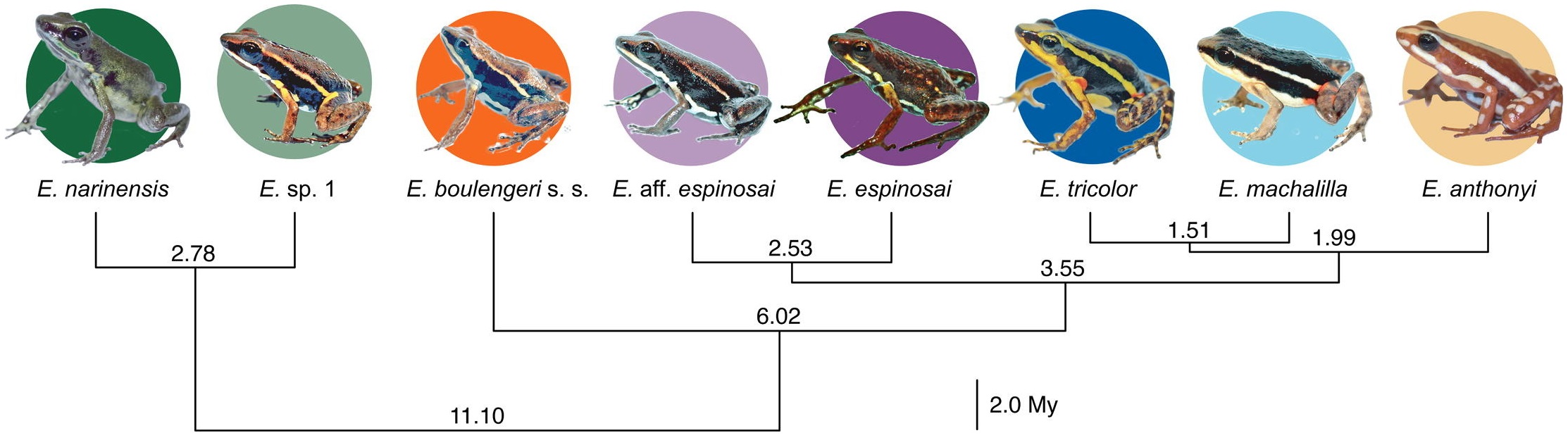
Distribution of sequenced individuals of Epipedobates, their type localities (stars), and estimated divergence times.

in López-Hervas, Santos, Ron, Betancourth-Cundar, Cannatella et Tarvin, 2024. 
 
Highlights: 
• The poison frog genus Epipedobates is ∼11 My old and contains eight putative species.
• Inconspicuous Epipedobates spp. are more deeply diverged genetically than aposematic spp.
• We reorganize the E. boulengeri/espinosai species complex into four species.
• We synonymize E. darwinwallacei with E. espinosai.
• We provide the first genetic data for E. narinensis.

Abstract
Poison frogs (Dendrobatidae) are famous for their aposematic species, having a combination of diverse color patterns and defensive skin toxins, yet most species in this family are inconspicuously colored and considered non-aposematic. Epipedobates is among the youngest genus-level clades of Dendrobatidae that includes both aposematic and inconspicuous species. Using Sanger-sequenced mitochondrial and nuclear markers, we demonstrate deep genetic divergences among inconspicuous species of Epipedobates but relatively shallow genetic divergences among conspicuous species. Our phylogenetic analysis includes broad geographic sampling of the inconspicuous lineages typically identified as E. boulengeri and E. espinosai, which reveals two putative new species, one in west-central Colombia (E. sp. 1) and the other in north-central Ecuador (E. aff. espinosai). We conclude that E. darwinwallacei is a junior subjective synonym of E. espinosai. We also clarify the geographic distributions of inconspicuous Epipedobates species including the widespread E. boulengeri. We provide a qualitative assessment of the phenotypic diversity in each nominal species, with a focus on the color and pattern of inconspicuous species. We conclude that Epipedobates contains eight known valid species, six of which are inconspicuous. A relaxed molecular clock analysis suggests that the most recent common ancestor of Epipedobates is ∼ 11.1 million years old, which nearly doubles previous estimates. Last, genetic information points to a center of species diversity in the Chocó at the southwestern border of Colombia with Ecuador. A Spanish translation this text is available in the supplementary materials.
 
Keywords: Aposematism, Cryptic species, Genetic divergence, Polytypic species, Species delimitation, Phylogenetics

phylogeny of Epipedobates

Conclusion: 
Epipedobates forms a radiation of species on the west of the Andes in northern Peru, Ecuador, and Colombia. Epipedobates is a model clade for studying the relationship between phenotypic and genetic divergence. The boundaries between species pairs are difficult to assess. We found that the nominal species Epipedobates boulengeri” included cryptic and understudied diversity; i.e., individuals included in that species now correspond to E. espinosai, E. aff. espinosai, and E. sp. 1. In contrast, a relatively young clade contains three phenotypically distinctive species, E. anthonyi, E. machalilla and E. tricolor, with very low genetic divergence despite high levels of morphological divergence. Two of these species might have evolved conspicuous coloration independently, yet introgression and relatively recent divergence in less than 2 Mya might also explain such events. We found evidence of gene flow between E. machalilla and E. aff. espinosai, and we suggest that further sampling using highly variable markers from genome-wide data is needed to assess introgression between these and possibly other pairs of Epipedobates species.


Karem López-Hervas, Juan C. Santos, Santiago R. Ron, Mileidy Betancourth-Cundar, David C. Cannatella and Rebecca D. Tarvin. 2024. Deep Divergences among inconspicuously colored Clades of Epipedobates Poison Frogs. Molecular Phylogenetics and Evolution. In Press, 108065.  DOI: 10.1016/j.ympev.2024.108065

Resumen: Las ranas venenosas (Dendrobatidae) son famosas por sus especies aposemáticas, que se caracterizan por una combinación de diversos patrones de color y toxinas cutáneas defensivas. Sin embargo, la mayoría de las especies de esta familia tienen colores inconspicuos y no se consideran aposemáticas. Epipedobates se encuentra entre los clados más jóvenes a nivel de género de Dendrobatidae que incluye especies tanto aposemáticas como inconspicuos. Usando marcadores mitocondriales y nucleares, demostramos profundas divergencias genéticas entre especies inconspicuos de Epipedobates pero divergencias genéticas relativamente superficiales entre especies conspicuas. Nuestro análisis filogenético incluye un amplio muestreo geográfico de los linajes inconspicuos típicamente identificados como E. boulengeri y E. espinosai. Los resultados revelan dos nuevas especies putativas, una en el centro-oeste de Colombia (E. sp. 1) y la otra en el centro-norte de Ecuador (E. aff. espinosai). Determinamos que E. darwinwallacei es un sinónimo subjetivo menor de E. espinosai y aclaramos las distribuciones geográficas de las especies inconspicuos de Epipedobates, incluyendo E. boulengeri. Con una evaluación cualitativa enfocado en el color y el patrón de las especies inconspicuas describimos la diversidad fenotípica en cada especie nominal. Concluimos que el género Epipedobates contiene ocho especies válidas conocidas, seis de las cuales son en su mayoría inconspicuas. Un análisis de reloj molecular relajado nos sugiere que el ancestro común más reciente de Epipedobates tiene ∼ 11,1 millones de años, lo que casi duplica las estimaciones anteriores. Por último, la información genética apunta a un centro de diversidad de especies en el Chocó en la frontera suroeste de Colombia con Ecuador. Una traducción al español de este texto está disponible en los materiales suplementarios.

Tuesday, January 18, 2022

[Herpetology • 2022] Phylogenomic Analysis of Evolutionary Relationships in Ranitomeya Poison Frogs (Dendrobatidae) using Ultraconserved Elements


Ranitomeya Poison Frogs

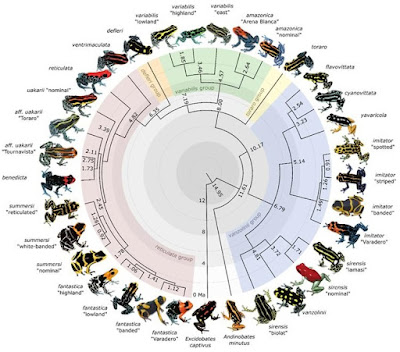
in Muell, Chávez, Prates, Guillory, ... et Brown, 2022.
 
Highlights: 
• We present the first comprehensive genome-scale phylogeny for the Ranitomeya genus.
R. toraro and R. defleri are not sister species.
R. uakarii is paraphyletic, segregating based on geography and color pattern.
• We designate R. amazonica from French Guiana and eastern Brazil as R. variabilis.
• We describe two biogeographic hypotheses for Ranitomeya based on divergence times.

Abstract
The use of genome-scale data in phylogenetics has enabled recent strides in determining the relationships between taxa that are taxonomically problematic because of extensive morphological variation. Here, we employ a phylogenomic approach to infer evolutionary relationships within Ranitomeya (Anura: Dendrobatidae), an Amazonian lineage of poison frogs consisting of 16 species with remarkable diversity in color pattern, range size, and parental care behavior. We infer phylogenies with all described species of Ranitomeya from ultraconserved nuclear genomic elements (UCEs) and also estimate divergence times. Our results differ from previous analyses regarding interspecific relationships. Notably, we find that R. toraro and R. defleri are not sister species but rather distantly related, contrary to previous analyses based on smaller genetic datasets. We recover R. uakarii as paraphyletic, designate certain populations formerly assigned to R. fantastica from Peru as R. summersi, and transfer the French Guianan and eastern Brazilian R. amazonica populations to R. variabilis. By clarifying both inter- and intraspecific relationships within Ranitomeya, our study paves the way for future tests of hypotheses on color pattern evolution and historical biogeography.
 
Keywords: Ranitomeya, UCEs, Divergence time estimation, Phylogenomics, Dendrobatidae, Amphibians


Morgan R. Muell, Germán Chávez, Ivan Prates, Wilson X. Guillory, Ted R. Kahn, Evan M. Twomey, Miguel T. Rodrigues and Jason L. Brown. 2022. Phylogenomic Analysis of Evolutionary Relationships in Ranitomeya Poison Frogs (Family Dendrobatidae) using Ultraconserved Elements.  Molecular Phylogenetics and Evolution. 168, 107389. DOI: 10.1016/j.ympev.2022.107389

Wednesday, October 6, 2021

[Herpetology • 2021] Andinobates supata • A New Species of Andean Golden Poison Frog (Anura: Dendrobatidae) from the Eastern Andes of Colombia


Andinobates supata
 Cháves-Portilla, Salazar, Gil-Acero, Dorado-Correa, Márquez, Rueda-Almonacid & Amézquita, 2021

 
Abstract
A new species of Andinobates (Dendrobatidae) is described from the East Andes of Colombia, just 37 km away from the Colombian capital, Bogotá. Andinobates supata sp. nov., represents the second known species of yellow Andinobates, and can be distinguished from the other, Andinobates tolimensis, by an unique combination of ventral and dorsal color patterns. Our phylogenetic analyses, based on ≈ 1120 bp from two mitochondrial markers (16S rRNA and cytochrome b) showed that this new taxon is sister to a clade formed by A. cassidyhornae, A. bombetes, A. opisthomelas, A. tolimensis and A. virolinensis. The new species appears to be restricted to a handful of small forest fragments (<10 ha) distributed in no more than 5 km2, between 1800–2000 m elevation, where the human activity is high. In addition, more than 90% of the original forest has been logged at the type locality, and its watersheds receive considerable agrochemical discharges. Altogether, the evidence suggests that this new species should be listed as Critically Endangered and should receive immediate attention regarding basic research and urgent conservation measures.

Keywords: Amphibia, Andinobates supata sp. nov., Andinobates bombetes group, poison frogs, Eastern Andes, Colombia 


Andinobates supata sp. nov.


 Giovanni A. Cháves-Portilla, Erika Nathalia Salazar, José Gil-Acero, Adriana Dorado-Correa, Roberto Márquez, José Vicente Rueda-Almonacid and Adolfo Amézquita. 2021. A New Species of Andean Golden Poison Frog (Andinobates, Dendrobatidae) from the Eastern Andes of Colombia. Zootaxa. 5047(5); 531-546. DOI: 10.11646/zootaxa.5047.5.3


Wednesday, December 23, 2020

[Herpetology • 2020] Leucostethus bilsa • A New Species of Leucostethus (Anura: Dendrobatidae) from the Cordillera Mache-Chindul in northwestern Ecuador, with comments on similar Colostethus and Hyloxalus


Leucostethus bilsa 
Vigle, Coloma, Santos, Hernandez-Nieto, Ortega-Andrade, Paluh & Read, 2020


Abstract
We describe a new species of dendrobatid frog, Leucostethus bilsa sp. nov., using molecular, morphological, and acoustic evidence. We also comment on the taxonomic status of four similar Hyloxalus and Colostethus. We provide an updated phylogeny of Leucostethus that corroborates previous hypotheses of relationships of nine species. Phylogenetic analysis using mitochondrial (i.e., 7095 bp of combined data from NADH1, NAHD2, cytochrome c oxidase I, cytochrome b and 12S-16S rRNA) and seven nuclear genes (i.e., 4739 bp) indicate a close relationship of L. bilsa to an undescribed species from Gorgona Island, Colombia, both of which apparently diverged in the Pliocene about 3 million years ago with about 6.25% (i.e., 146/2335 bp) differences for the section of 12S-16S mitochondrial fragment. Leucostethus bilsa is diurnal and riparian, characterized by distinctive bright mustard-yellow flash marks in the axillar and groin regions, posterior belly, and in the hindlimbs, the presence of dark gray lower labial stripe or marks, sexual dimorphism in ventral pattern, and by having male uniparental care. We describe its osteology and the male advertisement call, which is a series of peep notes. Osteological microCT images of representatives of each of the Colostethinae genera reveal a number of intriguing characters that may prove to be useful in phylogenetic studies. In terms of its distribution, Leucostethus bilsa is currently known only from a very small area within the Reserva Biológica Bilsa, located within the Cordillera Mache-Chindul in the Chocoan region of northwestern Ecuador, which was a Pliocene-Pleistocene refugium. This region is highly threatened with habitat degradation and remains as the last surviving refuge for a forest community known for a high proportion of endemic species of both flora and fauna.

Keywords: Anura, Chocoan, morphology, phylogeny, systematics, vocalization


 Leucostethus bilsa sp. nov.
 

Gregory O. Vigle, Luis A. Coloma, Juan Carlos Santos, Sebastian Hernandez-Nieto, H. Mauricio Ortega-Andrade, Daniel J. Paluh and Morley Read. 2020. A New Species of Leucostethus (Anura: Dendrobatidae) from the Cordillera Mache-Chindul in northwestern Ecuador, with comments on similar Colostethus and Hyloxalus. Zootaxa. 4896(3); 342–372. DOI: 10.11646/zootaxa.4896.3.2

Saturday, October 26, 2019

[Herpetology • 2020] Phylogenetic Relationships and Systematics of the Amazonian Poison Frog Genus Ameerega using Ultraconserved Genomic Elements


in Guillory, French, Twomey, et al., 2020. 

Highlights: 
• We present the first comprehensive phylogeny for the poison frog Ameerega from genome-scale data.
• There is evidence for at least six undescribed species of Ameerega.
• Our phylogenetic reconstruction of Ameerega differs strongly from previously published ones.
Ameerega almost certainly has its origins in the Andes Mountains.
Ameerega most likely diverged from its sister taxon ~20 million years ago.

Abstract
The Amazonian poison frog genus Ameerega is one of the largest yet most understudied of the brightly colored genera in the anuran family Dendrobatidae, with 30 described species ranging throughout tropical South America. Phylogenetic analyses of Ameerega are highly discordant, lacking consistency due to variation in data types and methods, and often with limited coverage of species diversity in the genus. Here, we present a comprehensive phylogenomic reconstruction of Ameerega, utilizing state-of-the-art sequence capture techniques and phylogenetic methods. We sequenced thousands of ultraconserved elements from over 100 tissue samples, representing almost every described Ameerega species, as well as undescribed cryptic diversity. We generated topologies using maximum likelihood and coalescent methods and compared the use of maximum likelihood and Bayesian methods for estimating divergence times. Our phylogenetic inference diverged strongly from those of previous studies, and we recommend steps to bring Ameerega taxonomy in line with the new phylogeny. We place several species in a phylogeny for the first time, as well as provide evidence for six potential candidate species. We estimate that Ameerega experienced a rapid radiation approximately 7–11 million years ago and that the ancestor of all Ameerega was likely an aposematic, montane species. This study underscores the utility of phylogenomic data in improving our understanding of the phylogeny of understudied clades and making novel inferences about their evolution.

 Keywords: Phylogenomics, UCEs, Ameerega, Systematics, Dendrobatidae, Amphibians


 Wilson X. Guillory, Connor M. French, Evan M. Twomey, Germán Chávez, Ivan Prates, Rudolf von May, Ignacio De la Riva, Stefan Lötters, Steffen Reichle, Shirley J .Serrano-Rojas, Andrew Whitworth and Jason L. Brown. 2020. Phylogenetic Relationships and Systematics of the Amazonian Poison Frog Genus Ameerega using Ultraconserved Genomic Elements. Molecular Phylogenetics and Evolution. 142; 106638. DOI: 10.1016/j.ympev.2019.106638