Showing posts with label Tribe. Show all posts

Sunday, July 12, 2026

[Herpetology • 2026] Allobates tanaruThe First Chlorotic Species of the Superfamily Dendrobatoidea: A New Nurse Frog of the Allobates albiventris Complex (Anura: Aromobatidae) with remarkably greenish hatchlings from Brazilian Amazonia


 Allobates tanaru 
Dantas, Ferrão, Cunha-Machado & Lima, 2026


 Abstract -
While many frogs around the world have blue-green tissues because of the accumulation of a pigment called biliverdin, this had never been observed in nurse or poison frogs until now. In this study, we describe a new species of nurse frog from southwestern Amazonia that breaks new ground in Neotropical amphibian taxonomy: It is the first chlorotic species—with greenish hatchlings—ever recorded in the large superfamily Dendrobatoidea. Previously lumped within Allobates albiventris, integrative taxonomy reveals it as a distinct species, supported by a set of morphological and bioacoustic traits. It differs from most of its congeners by a call consisting of a pair of notes emitted in a single exhalation; males with lateral expansions on fingers II and III, and a white vocal sac covered with melanophores; dark brown oocytes, hatchlings with greenish yolk, and tadpoles with two or three short, pyramidal papillae distributed in a single row on each lateral margin of the anterior lip. Beyond its diagnostic features, this discovery is notable because chlorotic tissues were previously unknown in Dendrobatoidea, a superfamily with more than 350 species known for its terrestrial habitat, territoriality, carrying behavior, and nonchlorotic adults. The distinctive greenish hue seen in embryos of certain species, particularly in the new Allobates, may serve as an adaptation for predator avoidance, and it also highlights the ecological plasticity and morphological diversity within the genus. This opens fresh avenues to study the ecological, evolutionary, and developmental significance of biliverdin in frogs using a lineage wherein the biology contrasts with classic model species.

KEYWORDS: biodiversity, chlorosis, Integrative taxonomy, Madeira River, new species, species delimitation

Color in life of adults of Allobates tanaru sp. nov.
(A–C) Female, INPA-H 45548, SVL 17.4 mm. (D–F) Female, MPEG 45484, SVL 17.5 mm.
(G, I) Male, INPA-H 45552, SVL 17.0 mm. (H) Female, INPA-H 45549, SVL 16.9 mm.
(J–L) Male, INPA-H 45554, SVL 15.8 mm.

Allobates tanaru sp. nov. Dantas, Ferrão & Lima
  
Etymology: The specific epithet tanaru is a noun in apposition and honors the indigenous Tanaru, known in Portuguese as Índio Tanaru and Índio do Buraco (Indigenous Tanaru and Indigenous of the Hole, respectively). Tanaru died on 23 August 2022; he was the last representative individual of a poorly known ethnic group that lived in Rondônia, Brazil. His people were exterminated by gunmen at the behest of illegal loggers in 1995. After that, Tanaru lived isolated for almost 30 years in the Tanaru Indigenous Land, located in the southeast Rondônia, approximately 700 km from Rondônia's capital. Because the Tanaru Indigenous Land does not have a consolidated land demarcation and is surrounded by agricultural farms, the land suffers continuous threats and attacks, some of which started just some days after Tanaru's death. The indigenous Txai Suruí, from the Suruí ethnic group, said: “Known for his solitude, Tanaru resisted the contact with non-indigenous people until his last days after so much trauma and violence. His territory must continue to represent resistance and must be preserved and cared for, becoming a permanent conservation area.”

Vernacular names: Tanaru's nurse frog (English),
Rana Cuidadora de Tanaru (Spanish),
Rãzinha Cuidadora do Tanaru (Portuguese).

Diagnosis: A nurse frog Allobates characterized by the following combination of characters. Small-bodied species, SVL 14.1–17.0 mm (n = 18) in males and 16.9–18.2 mm (n = 9) in females; granular dorsal skin; one subarticular tubercle on finger IV; tip of finger IV reaches the distal phalanx of finger III; cream dorsum with contrasting brown marks; dorsolateral stripe present; conspicuous ventrolateral line absent; translucent-white vocal sac; white ventral surface in males; white chest and belly in females; and dorsal surface of fingers brown. Advertisement calls characterized by the emission of two notes in a single exhalation; with a call duration of 64 ± 4 ms (57–69 ms); first note (18 ± 2 ms; 16–22 ms) shorter than the second (27 ± 2 ms; 24–32 ms); an intercall interval of 275 ± 24 ms (220–309 ms); an intercall-series interval 854 ± 123 ms (645–1,118 ms); and a dominant frequency of 5,518 ± 200 Hz (5,168–5,879 Hz). Hatchlings with greenish yolk. Exotrophic tadpoles with an oral disc; labial keratodont row formula 2(2)/3(1); 13–15 pyramidal and cylindrical papillae on posterior labium; three pyramidal papillae at each end of the posterior labium; cylindrical papillae on the central portion of posterior labium; posterior labium length formulae P-I = P-II > P-III; and light-brown melanophores on tail and fins not forming blotches or spots.

Coloration of freshly laid eggs (A), embryos (B), and hatchlings (C) of  Allobates tanaru sp. nov.


Silionamã Pereira Dantas, Miquéias Ferrão, Antônio Saulo Cunha-Machado and Albertina Pimentel Lima. 2026. The First Chlorotic Species of the Superfamily Dendrobatoidea: A New Nurse Frog of the Allobates albiventris Complex (Anura, Aromobatidae) with remarkably greenish hatchlings from Brazilian Amazonia. Breviora. 579 (1), 1-35. DOI: doi.org/10.3099/0006-9698-579.1.1 (8 July 2026) 


Wednesday, July 23, 2025

[Entomology • 2025] A Revised Classification of the Assassin Bugs (Hemiptera: Heteroptera: Reduviidae) based on combined analysis of phylogenomic and morphological data


Assassin bug diversity and examples of unique morphological and behavioural adaptations found across the family.

in Masonick, Knyshov, Gordon, Forero, Hwang, ... et Weirauch, 2025. 
  
Abstract
Assassin bugs (Hemiptera: Reduviidae Latreille) comprise not only one of the largest radiations of predatory animals (22 subfamilies; >6,800 spp.) but also include the medically important kissing bugs (Triatominae Jeannel). Reduviidae are morphologically diverse, engage in an astounding array of predatory strategies and have evolved some of the most unique anti-predator and stealth techniques in the animal kingdom. While significant progress has been made to reveal the evolutionary history of assassin bugs and revise their taxonomy, the non-monophyly of the second largest assassin bug subfamily, Reduviinae Latreille, remains to be addressed. Leveraging phylogenomic data (2,291 loci) and 112 morphological characters, we performed the first data- and taxon-rich (195 reduvioid taxa) combined phylogenetic analysis across Reduvioidea and reconstructed morphological diagnostic features for major lineages. We corroborated the rampant polyphyly of Reduviinae that demands substantial revisions to the subfamilial and tribal classification of assassin bugs. Our new classification for Reduviidae reduces the number of subfamilies to 19 and recognizes 40 tribes. We describe three new subfamilies to accommodate distantly related taxa previously classified as Reduviinae (Heteropinae subfam. nov.Nanokeralinae subfam. nov., and Pasirinae subfam. nov.). Triatominae sensu nov. are expanded to include closely related predatory reduviine genera. Cetherinae Jeannel, Chryxinae Champion, Pseudocetherinae Villiers, Salyavatinae Amyot & Serville and Sphaeridopinae Amyot & Serville are treated as junior synonyms of Reduviinae sensu nov. Epiroderinae Distant are synonymized with Phimophorinae Handlirsch sensu nov. and Bactrodini Stål stat. nov. are reclassified as a tribe of Harpactorinae Amyot & Serville. Psophidinae Distant is treated as a valid subfamily. This new classification represents a robust framework for future taxonomic and evolutionary research on assassin bugs.

Keywords: ancestral state reconstruction, Cimicomorpha, phylogenetic systematics, revised classification, taxonomy, true bugs
 
Assassin bug diversity and examples of unique morphological and behavioural adaptations found across the family.
(a) Holoptilinae: Ptilocnemus femoralis Horváth (© Martin Lagerwey, Australia); (b) Phymatinae: Phymata americana Melin male mate guarding female (© Marie-Lise Beaudin, Canada); (c) Peiratinae: Rasahus arcuiger (Stål) (© sandralamberts, Peru);
(d) Psophidinae stat. nov.Korinchocoris insolitus Miller (© Joshua Wong, Singapore); (e) Ectrichodiinae: nr. Ectrichodia Lepeletier and Serville communal feeding of adults and nymphs on a millipede (© Nick Ramsey, Equatorial Guinea); (f) Emesinae: Ghilianella sp. Spinola (© Thomas Shahan, Belize);
(g) Stenopodainae (© Damien Brouste, New Caledonia); (h) Triatominae sensu nov.Zelurini trib. nov.Zelurus festivus (Stål) (© sandralamberts, Peru); (i) Triatominae sensu nov.: Rhodniini: Rhodnius sp. Stål nymph engorged on blood-meal (© César Favacho);
(j) Phimophorinae sensu nov.Physoderes sp. Westwood (© Nick Porch, Republic of Mauritius); (k) Harpactorinae sensu nov.: Ectinoderini: Amulius sp. Stål forelegs coated with resin (© Julius Simonelli, Indonesia); (l) Harpactorinae sensu nov.: Bactrodini stat. nov.Bactrodes sp. Stål (© Stephen_WV, Brazil),
 (m) Reduviinae sensu nov.: Reduviini stat. nov.sensu nov.Reduvius sonoraensis Usinger (© James Bailey, USA); (n) Reduviinae sensu nov.: Acanthaspidini stat. nov.sensu nov.Inara flavopicta Stål nymph with corpse backpack (© budak, Singapore); (o) Reduviinae sensu nov.: Salyavatini stat. nov.Salyavata macmahanae van Doesburg and Brailovsky (© Tom Murray, Honduras).

Habitus plate of newly described reduviid subfamilies and other revived taxa.
(a)–(b) Heteropinae subfam. nov. (a) Heteropinus mollis (UCR_ENT 00115568). (b) Platymicrus sp. (UCR_ENT 00129721).
(c) Nanokeralinae subfam. nov.Hadrokerala major (UCR_ENT 00052179).
(d)–(e). Pasirinae subfam. nov. (d) Pasira sp. (UCR_ENT 00052217). (e) Pasiropsis sp. (UCR_ENT 00052178).

(f) Triatominae sensu nov.: Opisthacidiini trib. nov.: Opisthacidius sp. (UCR_ENT 00012957). (g) Phimophorinae sensu nov.Nalata squalida (UCR_ENT 00002748).
(h)–(j) Reduviinae sensu nov.: Lenaeini stat. nov. (h) Pseudozelurus arizonicus (UCR_ENT 00004573). (i) Dyakocoris vulnerans (UCR_ENT 00052204). (j) Tiarodes versicolor (UCR_ENT 00052171).

(k) Reduviinae sensu nov.: Euphenini stat. nov., sensu nov.Australocleptes sp. (AMNH_PBI 00218999). (l)–(m). Reduviinae sensu nov.: Psyttalini trib. nov. (l) Varus flavoannulatus (UCR_ENT 00004574). (m) Cerilocus nero (UCR_ENT 00129676)
(n)–(o). Reduviinae sensu nov.: Acanthaspidini stat. nov.sensu nov. (n) Plynoides sp. (UCR_ENT 00129678). (o) Eriopreda feai (UCR_ENT 00129696).


Paul K. Masonick, Alex Knyshov, Eric R. L. Gordon, Dimitri Forero, Wei Song Hwang, Rochelle Hoey-Chamberlain, Tatiana Bush, Stephanie Castillo, Madison Hernandez, Jamie Ramirez, Samantha Standring, Junxia Zhang and Christiane Weirauch. 2025. A Revised Classification of the Assassin Bugs (Hemiptera: Heteroptera: Reduviidae) based on combined analysis of phylogenomic and morphological data. Systematic Entomology. DOI: doi.org/10.1111/syen.12646 [17 July 2024]

Monday, June 10, 2024

[Mollusca • 2017] Leoparreysia gen. nov. & Trapezidens gen. nov., Radiatula mouhoti, Trapezoideus panhai, ... • New Taxa of Freshwater Mussels (Unionidae) from A Species-rich but overlooked Evolutionary Hotspot in Southeast Asia


Shells of the endemic Parreysiinae taxa from the Sittaung River basin, Myanmar.
 (a) Leoparreysia canefrii Vikhrev, Bolotov et Kondakov gen. et sp. nov., Sittaung River near Taungoo, 
(b) Radiatula mouhoti Vikhrev, Bolotov et Konopleva sp. nov., Sittaung River near Taungoo, 
(c) Lamellidens brandti Bolotov, Konopleva et Vikhrev sp. nov., Pathi River, 
(d) Trapezidens obesa feae Kondakov, Konopleva et Vikhrev gen. et ssp. nov., Myit Kyi Pauk Stream,  
Scale bar = 2 cm.

in Bolotov, Vikhrev, Kondakov, Konopleva, Gofarov, Aksenova et Tumpeesuwan, 2017. 
 (Photos: Ekaterina S. Konopleva).


Abstract
Southeast Asia harbors a unique and diverse freshwater fauna of Mesozoic origin, which is under severe threat of extinction because of rapid economic development and urbanization. The largest freshwater basins of the region are certainly the primary evolutionary hotspots and they attract the most attention as key biodiversity areas for conservation. In contrast, medium-sized rivers are considered low-importance areas with secondary biodiversity, whose faunas originated via founder events from larger basins during the Pleistocene, although such a scenario has never been tested by using a phylogenetic approach. In this investigation, we used freshwater mussels (Unionidae) as a model to estimate the levels of endemism within the Sittaung, a little-known remote basin in Myanmar, compared with the surrounding larger rivers (Irrawaddy, Salween and Mekong). We discovered that the Sittaung represents an exceptional evolutionary hotspot with numerous endemic taxa of freshwater mussels. On the basis of our extensive dataset, we describe two new tribes, two genera, seven species and a subspecies of Unionidae. Our results highlight that medium-sized basins may represent separate evolutionary hotspots that harbor a number of endemic lineages. These basins should therefore be a focus of special conservation efforts alongside the largest Southeast Asian rivers.

Leoparreysiini Vikhrev, Bolotov et Kondakov tribe nov. 
Pilsbryoconchini Bolotov, Vikhrev et Tumpeesuwan tribe nov.


Shells of the endemic Parreysiinae taxa from the Sittaung River basin. (a) Leoparreysia canefrii Vikhrev, Bolotov et Kondakov gen. et sp. nov., Sittaung River near Taungoo, Myanmar (holotype RMBH biv254_4). (b) Radiatula mouhoti Vikhrev, Bolotov et Konopleva sp. nov., Sittaung River near Taungoo, Myanmar (holotype RMBH biv256). (c) Lamellidens brandti Bolotov, Konopleva et Vikhrev sp. nov., Pathi River, Myanmar (holotype RMBH biv243_14). (d) Trapezidens obesa feae Kondakov, Konopleva et Vikhrev gen. et ssp. nov., Myit Kyi Pauk Stream, Myanmar (holotype RMBH biv250_4).
Scale bar = 2 cm. (Photos: Ekaterina S. Konopleva).


Shells of the endemic Pseudodontinae and Rectidentinae taxa from the Sittaung River basin.
 Pseudodontinae (a,b), including (a) Pseudodon bogani Bolotov, Kondakov et Konopleva sp. nov., Kanni River, Myanmar (holotype RMBH biv241_5), and (b) P. manueli Konopleva, Kondakov et Vikhrev sp. nov., Pyowne Stream, Myanmar (holotype RMBH biv246_3).
Rectidentinae (c,d), including (c) Trapezoideus nesemanni Konopleva, Vikhrev et Bolotov sp. nov., Tauk Ue Kupt River, Myanmar (holotype RMBH biv255_2), and (d) T. panhai Konopleva, Bolotov et Kondakov sp. nov., Kyan Hone River (holotype RMBH biv138_4).
Scale bar = 2 cm. (Photos: Ekaterina S. Konopleva).

Haplotype-level phylogeny and distribution of Indo-Chinese Unionidae.
(a) Multi-locus fossil-calibrated phylogeny based on the BEAST 1.8.4 model and obtained for the complete data set of mitochondrial and nuclear sequences (five partitions: three codons of ...
(b) Map of distribution areas. Red circles indicate our collecting localities ...
 

Ivan N. Bolotov, Ilya V. Vikhrev, Alexander V. Kondakov, Ekaterina S. Konopleva, Mikhail Yu. Gofarov, Olga V. Aksenova and Sakboworn Tumpeesuwan. 2017. New Taxa of Freshwater Mussels (Unionidae) from A Species-rich but overlooked Evolutionary Hotspot in Southeast Asia. Scientific Reports. 7, Article number: 11573. DOI: 10.1038/s41598-017-11957-9

Friday, April 19, 2024

[Entomology • 2024] Exanimus somniator, Fijixistra drobnaki, Gammonotus draudrau, Salomonotettix vincekae, etc. • Atlas of Fijian Pygmy Grasshoppers (Orthoptera: Tetrigidae) with New Taxa Descriptions and an Identification Key


Gammonotus draudrau,
Exanimus 
somniator, E. torviscriba,
Fijixistra tvrtkoviciF. drobnaki, F. teo,
 Salomonotettix vincekae
 Kasalo, Tumbrinck, Pavlović & Skejo, 2024

 
Abstract
Fiji is an archipelago in the South Pacific Ocean from which only four species in four genera of Tetrigidae had previously been reported. We report the results of our examination of the Fijian Tetrigidae from the Queensland Museum, Brisbane, and additionally the Nederlands Centrum voor Biodiversiteit (Naturalis Biodiversity Center, formerly Nationaal Natuurhistorisch Museum Naturalis), Leiden. The Fijian fauna is found to be similar to, and therefore likely derived from, the New Guinean fauna. The validity of Asian Metrodorinae is called into question. The following new taxa are described: tribe Exanimini trib. nov. including genera Exanimus gen. nov. (including E. somniator sp. nov. and E. torviscriba sp. nov.) and Fijixistra gen. nov. (including F. abbreviata (Bolívar, 1887) comb. nov. of Amphinotus abbreviatusF. drobnaki sp. nov., F. teo sp. nov., and F. tvrtkovici sp. nov.); tribe Fijitettigini trib. nov. including genera Fijitettix gen. nov. (including F. godeffroyi (Günther, 1939), comb. nov. of Salomonotettix godeffroyi) and Salomonotettix Günther, 1939 (including S. vincekae sp. nov.); genus Gammonotus gen. nov. including Gammonotus draudrau sp. nov. Exanimini trib. nov. and Fijitettigini trib. nov. are of uncertain taxonomic placement, Gammonotus gen. nov. is assigned to Cladonotini Bolívar, 1887, and Thyrsus tiaratus Bolívar, 1887 is transferred from Cleostratini Bolívar, 1887 to Clinophaestini Storozhenko, 2013.

KEYWORDS: Orthoptera, Melanesia, Cladonotinae, Metrodorinae, New Guinea, island biogeography
 

 The following new taxa are described: 
tribe Exanimini trib. nov. 
Exanimus gen. nov. (including E. somniator sp. nov. and E. torviscriba sp. nov.
Fijixistra gen. nov. (including F. abbreviata (Bolívar, 1887) comb. nov.F. drobnaki sp. nov., F. teo sp. nov., and F. tvrtkovici sp. nov.); 

tribe Fijitettigini trib. nov.
Fijitettix gen. nov. (including F. godeffroyi (Günther, 1939), comb. nov. of Salomonotettix godeffroyi) and Salomonotettix Günther, 1939 (including S. vincekae sp. nov.); 

Cladonotini Bolívar, 1887
Gammonotus gen. nov. including Gammonotus draudrau sp. nov. 

 Clinophaestini Storozhenko, 2013
 Thyrsus tiaratus Bolívar, 1887


Niko Kasalo, Josef Tumbrinck, Marko Pavlović, and Josip Skejo. 2024. Atlas of Fijian Pygmy Grasshoppers (Orthoptera: Tetrigidae) with New Taxa Descriptions and an Identification Key. Annales Zoologici. 74(1); 43-70. DOI: 10.3161/00034541ANZ2024.74.1.003

Thursday, April 18, 2024

[Entomology • 2022] Paleogene Forest Fragmentation and Out-of-Africa Dispersal explain Radiation of the Paleotropical Dung Beetle tribe Epactoidini trib. nov. (Coleoptera: Scarabaeidae: Scarabaeinae)


Species illustrated: (a) Ochicanthon hanskii Krikken & Huijbregts, (b) O. woroae Ochi, Ueda & Kon, (c) O. crypticus Krikken & Huijbregts, (d) O. devagiriensis Sabu & Latha, (e) O. ceylonicus Cuccodoro, (f) Grebennikovius basilewskyi (Balthasar), (g) Epactoides giganteus, (h) E. madecassus (Paulian), (i) E. major (Paulian), (j) E. frontalis (Montreuil).

 Epactoidini trib. nov.
Rossini, Grebennikov, Merrien, Miraldo, Viljanen & Tarasov, 2022


Abstract
Paleotropical clades with largely disjunct distributions are ideal models for biogeographic reconstructions. The dung beetle genera Grebennikovius Mlambo, Scholtz & Deschodt, Epactoides Olsouffief and Ochicanthon Vaz-de-Mello are distributed in Tanzania, Madagascar and Réunion, and the Oriental region, respectively. We combine morphology and molecular dataset to reconstruct the phylogenetic relationships between these taxa. Our analyses corroborate previous hypotheses of monophyly of the group, which is here described as new tribe Epactoidini trib. nov. Grebennikovius is recovered as sister to Epactoides, while Ochicanthon emerges as sister to them both. The disjunct distribution of our focal clade is unusual within the subfamily Scarabaeinae. Bayesian divergence time estimates and ancestral range reconstructions indicate an African origin of the crown group of the tribe Epactoidini trib. nov. in the early mid Eocene, ca. 46 Ma. The divergence between Epactoides and its sister is dated to 32.3 Ma, while the crown age for the genus Ochicanthon is dated to 27 Ma. We investigate the factors that may have shaped the current distribution of the tribe Epactoidini trib. nov. The formation of the Gomphotherium landbridge, along with favourable environmental conditions would have allowed dry-intolerant organisms, such as Ochicanthon, to disperse out of Africa. Remarkable climatic stability of the Eastern Arc Mountains was critical for the retention of the monotypic genus Grebennikovius. We suggest two subsequent overwater dispersal events: the migration of the most recent common ancestor (MRCA) of Epactoides from Africa to Madagascar (32.3–29.5 Ma); the lately dispersal of the MRCA of the today's extinct Epactoides giganteus Rossini, Vaz-de-Mello & Montreuil to Réunion island from Madagascar (3.4 Ma). We suggest that the high potential of dispersal of Epactoidini trib. nov. dung beetles and the strict association to forest habitat might have triggered two major radiations, one in Madagascar and one in the Oriental Region.

Keywords: biogeography, evolution, phylogenetics


Epactoidini trib. nov. 

Type genus: Epactoides Olsouffief, 1947

Genera: Epactoides Olsouffief, 1947
Grebennikovius Mlambo et al., 2019
Ochicanthon Vaz-de-Mello, 2003.

Distribution: Tanzania (Uluguru Mountains); Madagascar; Réunion Island; Oriental Region: from southern India to southern Philippines. 

Diagnosis: The tribe Epactoidini is supported by the following diagnostic characters (Figure 2): (i) elytra with 9–10 striae; (ii) besides epipleural carina, elytra with one or two additional lateral carinas; (iii) endophallus without frontolateral peripheral (FLP) endophallite; (iv) radial posterior (RP1) sclerite of hindwings (when present) approaches the posterior side the radial anterior (RA4) sclerite.


Ancestral range reconstruction of Epactoidini trib. nov. BioGeoBEAR tree and map showing suggested dispersal routes of Epactoides and Ochicanthon from Afrotropical ancestors, including date estimation. Nodal support values are expressed as UFBS and SH-aLRT. Bars at nodes indicate 95% CI of estimated ages. Distribution areas of Epactoidini members: Eastern Arc Mountains (EAMs) (red); Madagascar (light blue); Réunion (purple); Oriental (green).
Species illustrated: (a) Ochicanthon hanskii Krikken & Huijbregts, (b) O. woroae Ochi, Ueda & Kon, (c) O. crypticus Krikken & Huijbregts, (d) O. devagiriensis Sabu & Latha, (e) O. ceylonicus Cuccodoro, (f) Grebennikovius basilewskyi (Balthasar), (g) Epactoides giganteus, (h) E. madecassus (Paulian), (i) E. major (Paulian), (j) E. frontalis (Montreuil).


Michele Rossini, Vasily Grebennikov, Thomas Merrien, Andreia Miraldo, Heidi Viljanen and Sergei Tarasov. 2022. Paleogene Forest Fragmentation and Out-of-Africa Dispersal explain Radiation of the Paleotropical Dung Beetle tribe Epactoidini trib. nov. (Coleoptera: Scarabaeinae). Systematic Entomology. DOI: 10.1111/syen.12564


Tuesday, September 26, 2023

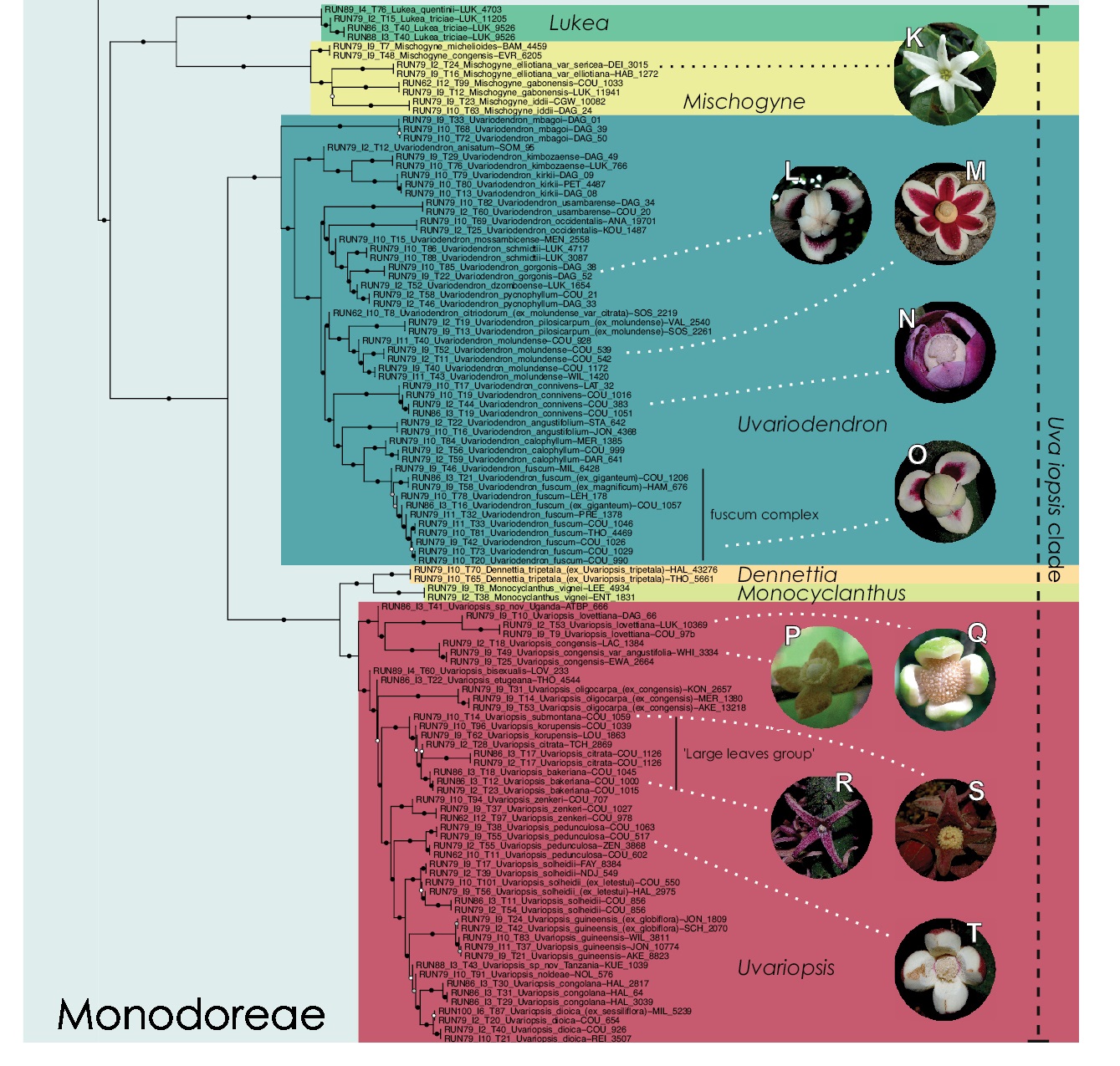
[Botany • 2023] Phylogenomic Inference of the African Tribe Monodoreae (Annonaceae) and Taxonomic Revision of Dennettia, Uvariodendron and Uvariopsis


flowers of K Mischogyne elliotana (no specimen associated) L Uvariodendron gorgonis (Dagallier 38) M Ud. molundense (Bidault 2222) N Ud. connivens (Couvreur 1016) O Ud. var. fuscum (Couvreur 990)
Uvariopsis congensis (Lachenaud 1384) Q Uplovettiana (Couvreur 97b) R Upbakeriana (Couvreur 1000) S Upsubmontana (Couvreur 627) T Uppedunculosa (Couvreur 878).

in Dagallier, Mbago, Couderc, Gaudeul, ... et Couvreur, 2023.

 Photos by Thomas Couvreur, Léo-Paul Dagallier, Carel Jongkind, Ehoarn Bidault & Olivier Lachenaud.

Abstract
Monodoreae (Annonaceae) is a tribe composed of 11 genera and 90 species restricted to the tropical African rain forests. All the genera are taxonomically well circumscribed except the species rich genera Uvariodendron and Uvariopsis which lack a recent taxonomic revision. Here, we used a robust phylogenomic approach, including all the 90 currently accepted species, with several specimens per species, and based on more than 300 Annonaceae-specific nuclear genes, to infer the phylogenetic tree of the Monodoreae and test the limits between the genera and species. We recover all the genera as monophyletic, except the genus Uvariopsis for which the species Uvariopsis tripetala falls outside this clade. We thus reinstate the monotypic genus Dennettia for its single species Dennettia tripetala. We also erect a new tribe, Ophrypetaleae trib. nov., to accommodate the genera Ophrypetalum and Sanrafaelia, as we recover them excluded from the Monodoreae tribe with good support. Below the genus level, the genera Isolona, Monodora, Uvariastrum, Uvariodendron and Uvariopsis show weakly supported nodes and phylogenetic conflicts, suggesting that population level processes of evolution might occur in these clades. Our results also support, at the molecular level, the description of several new species of Uvariodendron and Uvariopsis, as well as several new synonymies. Finally, we present a taxonomic revision of the genera DennettiaUvariodendron and Uvariopsis, which contain one, 18 and 17 species respectively. We provide a key to the 11 genera of the Monodoraeae and describe four new species to scienceUvariodendron kimbozaense Dagallier & Couvreur, sp. nov.Uvariodendron mossambicense Robson ex Dagallier & Couvreur, sp. nov.Uvariodendron pilosicarpum Dagallier & Couvreur, sp. nov. and Uvariopsis oligocarpa Dagallier & Couvreur, sp. nov., and provide provisional descriptions of three putatively new species. We also present lectotypifications and nomenclatural changes implying synonymies and new combinations (Uvariodendron citriodorum (Le Thomas) Dagallier & Couvreur, comb. et stat. nov., Uvariodendron fuscum var. magnificum (Verdc.) Dagallier & Couvreur, comb. et stat. nov., Uvariopsis congensis var. angustifolia Dagallier & Couvreur, var. nov., Uvariopsis guineensis var. globiflora (Keay) Dagallier & Couvreur, comb. et stat. nov., and Uvariopsis solheidii var. letestui (Pellegr.) Dagallier & Couvreur, comb. et stat. nov.).

Key words: conservation, evolution, new species, phylogeny, tropical rain forests


Ophrypetaleae tribe.
Ophrypetalum odoratum Diels  A trunk B young branch with leaves, upper side C flower and flower buds D flower, from below.
Sanrafaelia ruffonammari Verdc E trunk F young branch with leaves and flower buds G flower buds H flower, top view I flower, side view J fruit.
A, B Dagallier 54 C Couvreur 56 D Couvreur 82 E–J Dagallier 31. Photos A,,B, E–J Léo-Paul Dagallier C, ,D Thomas Couvreur.

Phylogenetic trees of the Monodoreae inferred with ASTRAL, based on 334 nuclear genes trees.
The branch support is given as local posterior probability (LPP) in three shades of greys. For the details on the specimens see Suppl. material 3.
Insets: flowers of A Ophrypetalum odoratum (Couvreur 82) B Sanrafaelia ruffonammari (Dagallier 31) C Asteranthe asterias (Dagallier 10) D Hexalobus crispiflorus (no specimen associated) E Uvariastrum zenkeri (no specimen associated) F Isolona hexaloba (no specimen associated) G I. cauliflora (Dagallier 44) H Monodora grandidieri (Dagallier 26) I M. myristica (living specimen at NY conservatory) J M. tenuifolia (Couvreur 1019)
Mischogyne elliotana (no specimen associated) L Uvariodendron gorgonis (Dagallier 38) M Ud. molundense (Bidault 2222) N Ud. connivens (Couvreur 1016) O Ud. var. fuscum (Couvreur 990) P Uvariopsis congensis (Lachenaud 1384) Q Uplovettiana (Couvreur 97b) R Upbakeriana (Couvreur 1000) S Upsubmontana (Couvreur 627) T Uppedunculosa (Couvreur 878).
 Photos CC BY-NC 4.0 A, D–F, J, N, O, Q–T Thomas Couvreur B, C, G–I, L Léo-Paul Dagallier K Carel Jongkind M Ehoarn Bidault P Olivier Lachenaud.

Uvariodendron fuscum (Benth.) R.E.Fr. var. fuscum
A leaf, lower side B apex of young branch with detail of petiole and leaf base, upper side, inset: detail of sparse pubescence on young branch C trunk with flower bud (top) and flower (bottom) D open flower E young fruit with unripe monocarps, one old petal remaining F flower semi-bottom view, showing bracts and sepals G detail of flower after anthesis, note the falling stamens and pollinator insects, inset: detail of Coleoptera full of pollen grains.
A, E, G Couvreur 1046 B, C Couvreur 1029 D, F Couvreur 990. Photos Thomas Couvreur.

Uvariodendron kimbozaense Dagallier & Couvreur
A habit B trunk with borne inflorescences C young inflorescence with flower buds D flower with one outer petal and the 3 inner petals torn or gnawed E young branch with leaves, lower side F young branch with leaves, upper side G detail of flower receptacle with stamens and stigmas, note the gleaming exudate on the stigmas and the hairs stuck on them H base of leaf, upper side, note the slightly raised midrib.
 A–H Dagallier 49 (type). Photos Léo-Paul Dagallier.

 
Léo-Paul M. J. Dagallier, Frank M. Mbago, Marie Couderc, Myriam Gaudeul, Aurélie Grall, Caroline Loup, Jan J. Wieringa, Bonaventure Sonké and Thomas L. P. Couvreur. 2023. Phylogenomic Inference of the African Tribe Monodoreae (Annonaceae) and Taxonomic Revision of DennettiaUvariodendron and UvariopsisPhytoKeys. 233: 1-200. DOI: 10.3897/phytokeys.233.103096

Résumé: La tribu des Monodoreae (Annonaceae) est composée de 11 genres et 90 espèces des forêts tropicales humides d’Afrique. Tout les genres sont taxonomiquement bien résolus, à part les genres Uvariodendron et Uvariopsis qui manquent d’une révision taxonomique récente. Ici, nous avons utilisé une approche phylogénomique robuste pour estimer l’arbre phylogénétique des Monodoreae, et tester les limites de genres et d’espèces. Pour cela, nous avons inclut les 90 espèces acceptées, et avons séquencé plus de 300 gènes. Tous les genres sont retrouvés monophylétiques, à part le genre Uvariopsis pour lequel l’espèce Uvariopsis tripetala se retrouve exclue. Nous rétablissons donc le genre monotypique Dennettia et son unique espèce Dennettia tripetala. Nous érigeons une nouvelle tribu, les Ophrypetaleae trib. nov.pour accueillir les genres Ophrypetalum et Sanrafaelia, car nous les retrouvons exclus de la tribu des Monodoreae avec un bon support. Au niveau infra-générique, les genres Isolona, Monodora, Uvariastrum, Uvariodendron et Uvariopsis montrent de faibles supports de noeuds et des conflits phylogénétiques, ce qui suggère que des processus d’évolution se déroulent au niveau des populations. Nos résultats soutiennent également, sur un plan moléculaire, la description de plusieurs nouvelles espèces d’Uvariodendron et d’Uvariopsis, de même que plusieurs synonymies. Enfin, nous présentons une révision taxonomique des genres Dennettia, Uvariodendron et Uvariopsis, qui contiennent respectivement un, 18 et 17 espèces. Nous fournissons une clé des 11 genres de Monodoreae, et décrivons quatre nouvelles espèces pour la science: Uvariodendron kimbozaense Dagallier & Couvreur, sp. nov.Uvariodendron mossambicense Robson ex Dagallier & Couvreur, sp. nov.Uvariodendron pilosicarpum Dagallier & Couvreur, sp. nov. et Uvariopsis oligocarpa Dagallier & Couvreur, sp. nov., et fournissons une description provisoire de trois autres potentielles. Nous effectuons des lectotypifications et des changements nomenclaturaux tels que des synonymies et des nouvelles combinaisons (Uvariodendron citriodorum (Le Thomas) Dagallier & Couvreur, comb. et stat. nov., Uvariodendron fuscum var. magnificum (Verdc.) Dagallier & Couvreur, comb. et stat. nov., Uvariopsis congensis var. angustifolia Dagallier & Couvreur, var. nov., Uvariopsis guineensis var. globiflora (Keay) Dagallier & Couvreur, comb. stat. nov., et Uvariopsis solheidii var. letestui (Pellegr.) Dagallier & Couvreur, comb. stat. nov.).

Friday, January 13, 2023

[Mammalogy • 2023] Saguinus kulina • Taxonomic Review of Saguinus mystax (Spix, 1823) (Primates: Callitrichidae), and Description of A New Species


Saguinus mystax (Spix, 1823)
Spix’s Mustached Tamarin

Saguinus pileatus pileatus (I. Geoffroy Saint-Hilaire & Deville, 1848)
Red-capped Mustached Tamarin
Saguinus pileatus pluto (Lönnberg, 1926)
White-rumped Mustached Tamarin
Saguinus kulina 
Lopes, Rohe, Bertuol, Polo, Lima, Valsecchi, Santos, Nash, Silva, Boubli, Farias & Hrbek, 2023
 Kulinas’ Tamarin 
 Illustrations by Stephen D. Nash.

Abstract 
Although the Amazon has the greatest diversity of primates, there are still taxonomic uncertainties for many taxa, such as the species of the Saguinus mystax group. The most geographically broadly distributed and phenotypically diverse species in this group is S. mystax, and its phenotypic diversity has been recognized as three subspecies—S. mystax mystax, S. mystax pileatus and S. mystax pluto—with non-overlapping geographic distributions. In this sense, we carried out an extensive field survey in their distribution areas and used a framework of taxonomic hypothesis testing of genomic data combined with an integrative taxonomic decision-making framework to carry out a taxonomic revision of S. mystax. Our tests supported the existence of three lineages/species. The first species corresponds to Saguinus mystax mystax from the left bank of the Juruá River, which was raised to the species level, and we also discovered and described animals from the Juruá–Tefé interfluve previously attributed to S. mystax mystax as a new species. The subspecies S. m. pileatus and S. m. pluto are recognized as a single species, under a new nomenclatural combination. However, given their phenotypic distinction and allopatric distribution, they potentially are a manifestation of an early stage of speciation, and therefore we maintain their subspecific designations.

Order Primates Linnaeus, 1758

Family Callitrichidae Thomas, 1903

Genus Saguinus Hoffmannsegg, 1807

Saguinus mystax (Spix, 1823)
Common name: Spix’s Mustached Tamarin

Distribution. Saguinus mystax occurs in Peru and Brazil (Fig. 2).


Saguinus pileatus pileatus (I. Geoffroy Saint-Hilaire & Deville, 1848) comb. nov. 
Common name: Red-capped Mustached Tamarin

Saguinus pileatus pluto (Lönnberg, 1926) comb. nov.
Common name: White-rumped Mustached Tamarin

 
Coat color pattern of Saguinus mystax and Saguinus sp. analyzed in this study.
 Illustrations by Stephen D. Nash.


Saguinus kulina sp. n. Lopes, Rohe, Bertuol, Polo, Lima, Valsecchi, Santos, Nash, Silva, Boubli, Farias & Hrbek, 2023.
Common name: Kulinas’ Tamarin (English), 
sauim-dos-kulinas (Portuguese), pishi (Kulina).
 
Diagnostic characters:  The new species is diagnosable from all other species of Saguinus by mantle and forelimbs light black brown subterminal band yellow, saddle, rump and hindlimbs light black with brown (Table 1; Figs. 3 and 4).

Etymology. The specific name is a noun in apposition and honors the Kulina indigenous peoples of the Kumaru Indigenous Territory, the largest indigenous territory within Juruá–Tefé interfluve.

Geographic Distribution. Saguinus kulina sp. n. is endemic to the western Amazonia, occurring between the right bank of the Juruá River and the left bank of the Tefé River (Fig. 2).


Conclusions: 
We describe a new species of Saguinus from the Juruá–Tefé interfluve based on robust genomic evidence, pelage characters and geographic distribution. We also elevate Saguinus mystax to the species level, but we find no conclusive evidence for species level differentiation of Saguinus p. pileatus and Saguinus p. pluto. Finally, we emphasize that field surveys and scientific collection of specimens are essential for the continued advancement of knowledge of primate diversity specifically, and all Amazon biodiversity in general.


Gerson Paulino Lopes, Fábio Rohe​, Fabrício Bertuol, Erico Polo, Ivan Junqueira Lima, João Valsecchi, Tamily Carvalho Melo Santos, Stephen D. Nash, Maria Nazareth Ferreira da Silva, Jean P. Boubli, Izeni Pires Farias and Tomas Hrbek​.   2023. Taxonomic Review of Saguinus mystax (Spix, 1823) (Primates, Callitrichidae), and Description of A New Species. PeerJ. 11:e14526. DOI: 10.7717/peerj.14526


Tuesday, January 10, 2023

[Botany • 2023] Pinguicula warijia (Lentibulariaceae) • A Newly Rediscovered Species from the Sierra Obscura, northern Mexico


Pinguicula warijia Zamudio, Hern.Rend., M.Mata-Rosas & M.M.Salinas,

in Zamudio, Mata-Rosas, Salinas-Rodríguez & Hernández-Rendón, 2023. 
Photos by Julián Hernández-Rendón and Martín Mata-Rosas.
 
Abstract
An undescribed species of Pinguicula (Lentibulariaceae), first collected in 1972 was recently rediscovered in the Arroyo Babarocos canyon, located in the Sierra Obscura region, in the municipality of Uruachi, Chihuahua, Mexico. This plant is described and illustrated as Pinguicula warijia. The taxon is compared with the related species P. oblongiloba and P. zamudioana, and a key to the species of P. section Orcheosanthus of western Mexico is provided, along with photographs, distribution map, and taxonomic discussion.

Keywords: Mexican Pinguicula, Sierra Madre Occidental, taxonomy, Eudicots

Pinguicula warijia Zamudio, Hern.Rend., M.Mata-Rosas & M.M.Salinas.
  A. Habitat overview. B. Plants growing on igneous rocks on a ca. 30° slope. C. Plants growing upside down on the ceiling of a small cave.
D. Detail of the flower. E. Capsule. F. Plant growing in a dry area with reduced leaves. G. A two-tailed swallowtail (Papilio multicaudata) butterfly pollinating a P. warijia flower.
Photos A, F and G by Julián Hernández-Rendón; B, C, D and E by Martín Mata-Rosas.
 
Pinguicula warijia Zamudio, Hern.Rend., M.Mata-Rosas & M.M.Salinas, sp. nov.

 Similar to Pinguicula zamudioana but differs in having numerous, sessile, spathulate to elliptic-spathulate leaves (vs. 4–8(10) petiolate, oblong–elliptical to suborbicular leaves), upper calyx lip lobes ovate to elliptic (vs. triangular-lanceolate), lower calyx lip lobes triangular (vs. lanceolate), upper corolla lip lobes suborbicular to oblate (vs. oblong–elliptical to suborbicular), capsule botuliform (vs. subglobose), seeds 1–1.28 mm long, ca. 0.2 mm wide, surface slightly reticulate (vs. ca. 0.5 mm long, ca. 0.1 mm wide, surface reticulate).

Etymology:—The specific epithet honors the Warijó or Guarijó indigenous people, who inhabit this portion of the Sierra Madre Occidental in the municipalities of Chinipas, Moris, and Uruachi in the state of Chihuahua, as well as in the municipalities of Álamos, Quiriego, and Rosario in the state of Sonora. In addition, it is also the ethnic group to which our guide, Mr. Arnulfo Méndez, belongs. The word Warijó means “the people” or “the people that speak the Guarijía language”. Other names by which this ethnic group is known are Marakawe, Macoragüi, Varihio, Varohío, and warijío(a) (Porras 1997). 
 

Sergio Zamudio, Martín Mata-Rosas, María Magdalena Salinas-Rodríguez and Julián Hernández-Rendón. 2023. Pinguicula warijia sp. nov. (Lentibulariaceae), A Newly Rediscovered Species from the Sierra Obscura, northern Mexico. Phytotaxa. 578(3); 219-227. DOI: 10.11646/phytotaxa.578.3.1