Showing posts with label Troglobites. Show all posts

Wednesday, March 11, 2026

[Invertebrate • 2026] Quapawjapyx osage & Holjapyx nimiipuu • New Cave japygids (Diplura: Japygidae) from North America


Quapawjapyx osage Sendra gen. et sp. nov.
Holjapyx nimiipuu Sendra sp. nov.,

in Sendra, Jiménez-Valverde, Selfa et Cupello, 2026. 

Abstract
We studied a significant collection of Japygidae (Diplura) deposited in the Texas A&M University Insect Collection, sampled from several caves in North America, mostly in the early 21st century by a group of American speleologists. Among this biological material, a new genus and species, Quapawjapyx osage Sendra gen. et sp. nov., is described from four caves in Arkansas, and a new species, Holjapyx nimiipuu Sendra sp. nov., from five caves in Idaho; both are named in honor of native American tribes. Quapawjapyx osage can be distinguished from IndjapyxPaurojapyx, and Parindjapyx – which share symmetrical cerci – by the combination of the shape and disposition of the glandular and sensory setae on the first urosternite, together with differences in cercal ornamentation. Holjapyx nimiipuu is characterized by the presence of two conspicuously large predental denticles on the right cercus. Both new taxa of cavernicolous japygids show slight cave-adaptation features, such as large body size, slight elongated appendages, and a small increase in the placoid sensilla of last antennomere. These two new taxa double the number of known cave-adapted japygids in North America, a seemingly low figure that is nonetheless comparable to other karst regions worldwide.

Keywords: Japygoidea, cave-adapted fauna, Nearctic region, taxonomy

Class Diplura Börner, 1904
Superfamily Japygoidea Ewing, 1942

Family Japygidae Haliday, 1864

Quapawjapyx osage Sendra gen. et sp. nov.
A. Paratype, ♂ (TAMU-ENTO X1831026). B, D–E. Paratype, ♂ (TAMU-ENTO X1832015). C. Holotype, ♀ (TAMU-ENTO X1831147).
A. Habitus. B. Last antennomere; placoid sensilla remarked by spotted line. C. Lacinia with interior laminae and mandible. D. Dorsal portion on third antennomere with pores. E. Metathoracic claws.

Genus Quapawjapyx Sendra gen. nov.

Etymology: The generic name is in honor of the Quapaw Nation of Native Americans, who thrived along the lowlands of the Arkansas river five hundred years ago. Today, they live alongside much later European settlersfrom other nations.

Quapawjapyx osage Sendra gen. et sp. nov.

Etymology: The specific epithet is in honor of the Osage Nation of Native Americans, who now reside in Osage County, Oklahoma. They arrived and thrived a few hundred years ago in the northern mountains of Arkansas.


Holjapyx nimiipuu Sendra sp. nov., holotype,  ♀ (TAMU-ENTO X1831140).
A. Habitus. B. Last antennomere. C. Distal portion of urite X including cerci. D. Left cercus. E. Right cercus; placoidsensilla remarked by dash line.

 Holjapyx nimiipuu Sendra sp. nov.

Etymology: Nimiipuu’ (‘we, the people’) is the name by which the Nez Perce Native American tribe refers to themselves. They have thrived in  the Pacific Northwest of North-America for  more than ten   thousand years and today live primarily on their tribal reservation in Idaho. We dedicate this new species to the Nimiipuu people and to their enduring struggle for survival.


Alberto Sendra, Alberto Jiménez-Valverde, Jesús Selfa and Mario Cupello. 2026. New Cave japygids (Diplura: Japygidae) from North America. European Journal of Taxonomy. 1043(1); 166–198. DOI: doi.org/10.5852/ejt.2026.1043.3217 
 

Sunday, September 21, 2025

[Diplopoda • 2025] Pleonaraius spelaeusInto the Depths of Patagonia: The First Troglobitic Species of Pleonaraius Attems, 1898 (Polydesmida: Dalodesmidae) from Argentina


Pleonaraius spelaeus 
Romero-Rincon & Ferreira, 2025


Abstract
A new troglobitic species of Dalodesmidae, Pleonaraius spelaeus n. sp., is described from Rolo Vergara Cave, Neuquén Province, Argentina. This species represents the fourth known troglobitic member of the family, the first troglobitic species of Dalodesmidae recorded in South America, and the first known troglobitic millipede from Argentina. Pleonaraius spelaeus n. sp. is distinguished from its congeners by the absence of cuticular pigmentation and a unique combination of gonopodal characters. Ecological notes, a key, and a distribution map of Pleonaraius species are also provided.

Keywords: cave; Diplopoda; key; new species; taxonomy

 (A) Aereal view of the area where the cave in which Pleonaraius spelaeus n. sp. was found (yellow arrow indicates the cave entrance); (B) cave entrance at the bottom of the sinkhole; (C) cave conduct where the specimens were found and collected; (D) living male.

Pleonaraius spelaeus n. sp.

Diagnosis. Based on the gonopodal conformation, the new species differs from its congeners by the following combination of characters: mb simple (vs. bifurcated and complex in P. omalonotus) and directed ventrad at its apex (vs. directed laterad in P. pachyskeles and P. omalonotus). lb simple with apex acuminate (vs. apex suberect in P. pachyskeles). Presence of pr as in P. pachyskeles (vs. absence in P. omalonotus).

Etymology. Spelaeus, adjective in the masculine gender. The epithet as a reference to the Latin word spelaeus, meaning “cave”.

Distribution. Only known from in Rolo Vergara Cave, municipality of Chos Malal, Neuquén Province, Argentina (Figure 5).


  Juan Romero-Rincon and Rodrigo Lopes Ferreira. 2025. Into the Depths of Patagonia: The First Troglobitic Species of Pleonaraius Attems, 1898 (Polydesmida, Dalodesmidae) from Argentina. Arthropoda. 3(3), 13. DOI: doi.org/10.3390/arthropoda3030013 [3 September 2025] 

Sunday, July 20, 2025

[Arachnida • 2025] Spelaeochthonius dugigulensis, S. yamigulensis ... • Four New Species of Dragon Pseudoscorpions (Pseudoscorpiones: Pseudotyrannochthoniidae: Spelaeochthonius) from Caves in South Korea revealed by integrative taxonomy


Spelaeochthonius dugigulensis
Jeong, Harms, Yoo & Kim, 2025


Abstract
Karst research in Korea is still in its infancy and the invertebrate fauna of subterranean systems across the country is poorly known. One of the very diverse lineages in caves across Korea, the pseudoscorpions, are almost undocumented although they represent stunning examples of cave adaptations and troglomorphism. In this study, we provide a phylogenetic hypothesis for the pseudoscorpion Spelaeochthonius Morikawa, 1954 (Pseudoscorpiones: Pseudotyrannochthoniidae) in South Korea; a genus that exclusively occurs in caves across China, Japan and the Korean Peninsula. We report seven species of which four are newly described and illustrated based on molecular, distributional and morphological data: Spelaeochthonius dugigulensis sp. nov., S. geumgulensis sp. nov., S. magwihalmigulensis sp. nov. and S. yamigulensis sp. nov. All species are strongly cave-adapted and known from a single cave or karst system only, emphasizing the need to implement conservation strategies for Korean karst systems and their fauna.
 
Habitus of Spelaeochthonius dugigulensis sp. nov.
A. Holotype male, dorsal view; B. Holotype male, ventral view;
C. Paratype female, dorsal view; D. Paratype female, ventral view.
Scale bar: 1 mm.

Spelaeochthonius dugigulensis sp. nov., 
S. geumgulensis sp. nov., 
S. magwihalmigulensis sp. nov. 
S. yamigulensis sp. nov.


Kyung–Hoon Jeong, Danilo Harms, Jung-sun Yoo and Sora Kim. 2025. Four New Species of Dragon Pseudoscorpions (Pseudoscorpiones: Pseudotyrannochthoniidae: Spelaeochthonius) from Caves in South Korea revealed by integrative taxonomy. PLoS One. 20(7): e0325375.  DOI: doi.org/10.1371/journal.pone.0325375 [July 9, 2025]

Friday, April 11, 2025

[Arachnida • 2025] Tyrannochthonius rudongyanensis, T. tiani & T. yanwuensis • Three New Cave-dwelling Species of Tyrannochthonius Chamberlin, 1929 (Pseudoscorpiones: Chthoniidae) from Guangxi, China


Tyrannochthonius rudongyanensis
Sun, Guo & Zhang, 2025


Abstract
Three new Tyrannochthonius species are described, including detailed diagnosis and illustrations: T. rudongyanensis sp. nov., T. tiani sp. nov., and T. yanwuensis sp. nov. All samples were collected from the hypogean habitats in Guangxi, China. A distribution map of all Tyrannochthonius species in Guangxi is provided.

Keywords: Diversity, karst, morphology, taxonomy

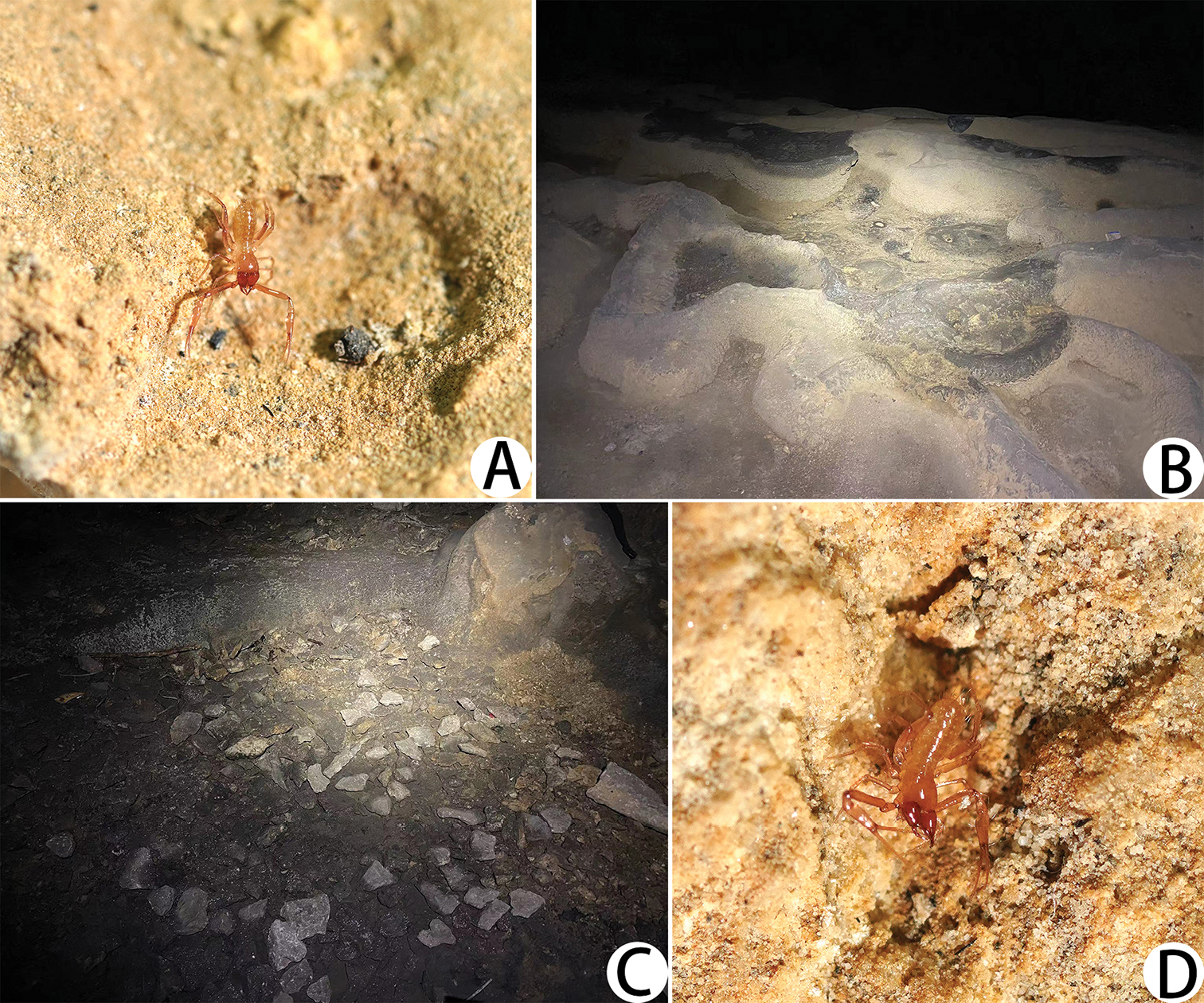
Rudongyan Cave, type locality of Tyrannochthonius rudongyanensis sp. nov.,
A, D live female T. rudongyanensis sp. nov. in its natural environment
B, C areas where T. rudongyanensis sp. nov. specimens were collected.


 Jianzhou Sun, Xiangbo Guo and Feng Zhang. 2025. Three New Cave-dwelling Species of Tyrannochthonius Chamberlin, 1929 (Pseudoscorpiones, Chthoniidae) from Guangxi, China. Subterranean Biology. 51: 115-133. DOI: doi.org/10.3897/subtbiol.51.146465  

Monday, January 27, 2025

[Diplopoda • 2024] Skleroprotopus change, S. incisodentatus, S. megistus, S. tiankeng, etc. • Molecular Phylogenetic and Morphological Studies reveal increased Species Diversity in the Millipede Genus Skleroprotopus Attems, 1901 (Julida: Mongoliulidae) in China


 A Skleroprotopus change sp. nov.; B Skleroprotopus megistus sp. nov.; C Skleroprotopus longissimus sp. nov.;
 D Skleroprotopus genjudi sp. nov.; E Skleroprotopus tiankeng sp. nov.;
Skleroprotopus laiyuanensis sp. nov.; G Skleroprotopus incisodentatus sp. nov. 

 Chen, Zhao, Golovatch & Liu. 2024 

Abstract
A taxonomic study of the genus Skleroprotopus Attems, 1901 from nine provinces in China was conducted utilizing morphological comparisons and molecular phylogenetic analyses. The results reveal thirteen new species, i.e. Skleroprotopus yutiantianae sp. nov., S. tiankeng sp. nov., S. megistus sp. nov., S. penglai sp. nov., S. longissimus sp. nov., S. genjudi sp. nov., S. laiyuanensis sp. nov., S. longiflagellatus sp. nov., S. change sp. nov., S. ampullaceus sp. nov., S. incisodentatus sp. nov., S. multistriatus sp. nov., and S. conicus sp. nov. This significantly enriches the diversity of Skleroprotopus in China, bringing it to a total of 18 species. With the exception of S. yutiantianae sp. nov., all these species were collected in caves. In terms of their degree of adaptation to the cave environment, the latter six species are presumed troglophiles, while the others are likely troglobites. DNA-barcoding based on the COI mitochondrial gene is documented for the first time in this genus. The specific p-distances between Skleroprotopus species range from 6.6–17.0%, while intraspecific p-distances are only 0.2–1.4%. Additionally, the morphological features of male leg-pair 1, the penis and leg-pair 7 are also discussed.

Keywords: barcoding, cave, diversity, new species, phylogeny

Pictures of live animals:
 A Skleroprotopus change sp. nov.; B Skleroprotopus megistus sp. nov.; C Skleroprotopus longissimus sp. nov.; D Skleroprotopus genjudi sp. nov.; E Skleroprotopus tiankeng sp. nov.; F Skleroprotopus laiyuanensis sp. nov.; G Skleroprotopus incisodentatus sp. nov. 
photos by Prof. Mingyi Tian from SCAU

 Skleroprotopus tiankeng sp. nov.
 
Holotype male (SCAU), China, Shaanxi Province, Hanzhong City, Nanzheng District, Cave Xigoutiankeng Dong, ..., 850 m, ....

Diagnosis: Differs from congeners mostly based on the following combination of characters: (1) penis much longer than coxae 2 (Fig. 5I); (2) male leg 7 with a very small coxal process, lower than the telopodite (Fig. 5E); (3) anterior gonopod (Fig. 5G, H) with a large and foot-shaped like coxal process, carrying a broadened membranous lobe, outer margin with a triangular protrusion, and a relatively thick flagellum. — In addition, this new species differs from all other species analyzed in a >10.3% uncorrected p-distance of the COI barcoding gene.

Etymology: The species is named after its type locality that is the Hanzhong sinkhole group, a geological wonder composed of multiple heavenly pits. “Tiankeng” in Chinese “天坑”, a noun in apposition.


 Skleroprotopus megistus sp. nov.
 
Diagnosis: Differs from congeners mostly based on the following combination of characters: (1) telopoditomere 3 of male leg 1 particularly broad and bulging in the middle (Fig. 6E); (2) penis subequal in height to coxae 2 (Fig. 6F); (3) coxal process of male leg 7 very small, lower than the telopodite (Fig. 6D); (4) anterior gonopod with a long coxal process carrying a highly developed, axe-shaped, membranous lobe (Fig. 6I). — In addition, this new species differs from all other species analyzed in a >10.3% uncorrected p-distance of the COI barcoding gene.

Etymology: Latinised Greek “megistus” is meaning “large”. The specific epithet refers to the male leg-pair 1 being particularly large; adjective.


 Skleroprotopus change sp. nov.
 
Holotype male (SCAU), China, Hubei Province, Xianning City, Xian’an District, Chang’e Scenic Park, Cave Feixian Dong, ..., 160 m, ...

Diagnosis: Differs from congeners mostly based on the following combination of characters: (1) telopoditomere 4 of male leg 1 rounded, with a small mesal hump (Fig. 8E); (2) penis slightly longer than male coxae 2 (Fig. 8D); (3) male leg 7 with a very small coxal process and a 4-segmented telopodite (Fig. 8F); (4) anterior gonopod (Fig. 8G, H) with a very long coxal process carrying a somewhat broadened and dentated membranous lobe. — In addition, this new species differs from all other Skleroprotopus species analyzed in uncorrected p-distances ranging from between 6.6% (compared to S. longiflagellatus sp. nov.) and 15.6% (compared to S. longissimus sp. nov.).

Etymology: The specific epithet is primarily derived from its type locality, which is named after Chang’e. She is the fairy of the moon palace in the ancient Chinese mythology. “Change” in Chinese “嫦娥”, a noun in apposition.


 Skleroprotopus incisodentatus sp. nov.
 
Diagnosis: Differs from congeners mostly based on the following combination of characters: (1) telopoditomere 4 of male leg 1 with a small mesal hump (Fig. 13D); (2) penis slightly higher than coxae 2 (Fig. 13C); (3) male leg 7 with a very small coxal process, much lower than telopodite, which is made up of 4 segments and a claw (Fig. 13F); (4) anterior gonopod (Fig. 13E, I) with a very long coxal process carrying a narrow, lower, membranous lobe, distally with a vague indentation. — In addition, this new species differs from all other species analyzed in a >8.0% uncorrected p-distance of the COI barcoding gene.

Etymology: The specific epithet refers to the distally vague indentation of a membranous lobe of anterior gonopod; adjective.
.
.
.


 Rong Chen, Yi Zhao, Sergei Golovatch and Wei-Xin Liu. 2024. Molecular Phylogenetic and Morphological Studies reveal increased Species Diversity in the Millipede Genus Skleroprotopus Attems, 1901 in China (Julida: Mongoliulidae). Arthropod Systematics & Phylogeny. 82: 659-691. DOI: doi.org/10.3897/asp.82.e136751  

Friday, April 26, 2024

[Arachnida • 2024] Troglotayosicus akaido • Phylogeny of the Troglomorphic Scorpion Genus Troglotayosicus (Scorpiones: Troglotayosicidae) with Description of A New Species from Colombia


Troglotayosicus akaido 
 Moreno-González, Luna-Sarmiento & Prendini, 2024


Abstract  
The troglomorphic scorpion genus Troglotayosicus Lourenço, 1981, occurs in hypogean and epigean habitats in the Andean and Amazonian rainforests of Colombia and Ecuador. The phylogenetic relationships among the species of Troglotayosicus are currently unknown. In the present contribution, a new species, Troglotayosicus akaido, sp. nov., is described from specimens collected in the leaf litter of a primary rainforest in the Colombian Amazon, near the border with Peru, raising the number of species in the genus to seven. The new species represents the easternmost record of the genus and further extends its distribution into the Amazon. Its phylogenetic position was tested in an analysis of all species of the genus and two outgroup taxa, scored for 131 morphological characters (16 new and 115 legacy; 104 binary and 27 multistate) analyzed with maximum likelihood under the MK model. Troglotayosicus was recovered as monophyletic and composed of two main clades. The morphological survey revealed that the ventral macrosetae of the leg telotarsi of the type species, Troglotayosicus vachoni Lourenço, 1981, are simple, subspiniform macrosetae, irregularly distributed, but not arranged into clusters nor forming elongated clusters of setae/spinules, as previously suggested. A distribution map and key to the identification of the species of Troglotayosicus are provided. Further research, incorporating molecular data, is needed to understand the evolution and biogeographical history of this enigmatic scorpion genus.

Troglotayosicus akaido, sp. nov., live habitus, holotype ♂ (ICN).
A. Anterior aspect. B. Lateral aspect.

 Troglotayosicus akaido, sp. nov., habitus, dorsal (A, C) and ventral (B, D) aspects.
A, B. Holotype ♂ (ICN). C, D. Paratype ♀ (ICN). Scale bars: 10 mm.


Jairo A. Moreno-González, David A. Luna-Sarmiento and Lorenzo Prendini. 2024. Phylogeny of the Troglomorphic Scorpion Genus Troglotayosicus (Scorpiones: Troglotayosicidae) with Description of a New Species from Colombia. American Museum Novitates. (4011), 1-39. DOI: 10.1206/4011.1 

Tuesday, February 28, 2023

[Arachnida • 2021] Pseudochthonius ramalho • The First Troglobitic Pseudochthonius Balzan, 1892 (Pseudoscorpiones: Chthoniidae) from the Karst Area of Serra do Ramalho, Brazil: A Threatened Species


Pseudochthonius ramalho   
 Assis, Schimonsky & Bichuette, 2021


Abstract
Pseudochthonius ramalho sp. nov. is described to Gruna do Vandercir cave, in the Serra do Ramalho karst area, southwestern Bahia, Brazil. This area has an extensive limestone outcrop, with several caves, and the occurrence of potential minerals that are financially attractive for mining projects. The new species shows troglomorphic characteristics such as the depigmentation of the carapace and absence or reduction of eyes. It is a rare troglobitic species, and following the criteria of IUCN, we categorized the species as Critically Endangered – CR, IUCN criteria B1ab(iii)+2ab(iii). According to Brazilian legislation, locations, where critically endangered species live, can be protected by law, and we consider this cave/region to be of maximal relevance for protection.

Keywords: Arachnida, Bahia State, Chthoniinae, conservation, endemic, troglobite


A Gruna do Vandercir cave B surroundings of Gruna do Vandercir cave with its dry characteristic vegetation
(Images A Adriano Gambarini B Maria Elina Bichuette).

Holotype of Pseudochthonius ramalho sp. nov. in natural habitat, at Gruna do Vandercir cave, Serra do Ramalho, Bahia.
(Image: Adriano Gambarini).

Taxonomy
Family Chthoniidae Daday, 1889
Subfamily Chthoniinae Daday, 1889

Tribe Chthoniini Daday, 1889

Genus Pseudochthonius Balzan, 1892

Pseudochthonius ramalho Assis, Schimonsky & Bichuette, sp. nov.

Diagnosis: Pseudochthonius ramalho sp. nov. can be identified by the following combination of characters: eyes absent (♂) or with eyes-spots (♀); the middle and distal fixed chelal finger teeth positioned two by two with 29–30 acuminate teeth and 3–4 slightly basally rounded ones, the presence of two rounded micro–denticles, along with pedipalpal fixed finger teeth in males; trichobothria ist closer to esb than to the est (ratio ist-est/ist-esb = 4.71); serrula exterior with 13 (♂) or 14 (♀) lamellae, rallum with seven blades, and coxae I and II with 3 to 5 coxal spines.

Etymology: The species is named after the region of Serra do Ramalho due to its importance regarding the speleological heritage and the unique fauna and flora diversity. The name is to be treated as a noun in apposition.


Leonardo de Assis, Diego Monteiro von Schimonsky and Maria Elina Bichuette. 2021. The First Troglobitic Pseudochthonius Balzan, 1892 (Pseudoscorpiones, Chthoniidae) from the Karst Area of Serra do Ramalho, Brazil: A Threatened Species. Subterranean Biology. 40: 109-128.  DOI: 10.3897/subtbiol.40.77451

Wednesday, March 23, 2022

[Arachnida • 2022] Selachochthonius naledi • A New Troglobitic Species of Pseudoscorpion (Pseudoscorpiones, Pseudotyrannochthoniidae) from South Africa


Selachochthonius naledi 
Prado, Du Preez & Ferreira, 2022


Abstract
A new pseudoscorpion species, Selachochthonius naledi sp. nov., is herein described. It can be distinguished from the other species of the genus mainly by the absence of eyes, number and morphology of chelal teeth and coxae setae and by the appendices proportions. This new species represents the fourth record for the genus in South Africa. We also provide some ecological remarks of the new species and recommendations for future research.

Keywords: Cave-dwelling, pseudoscorpion, taxonomy


Type locality and habitat of Selachochthonius naledi sp. nov.
  
A Villa Louise cave entrance B Villa Louise cave interior general aspect
C Villa Louise cave interior, showing altered floor D Yom Tov cave entrance
E live female holotype F live male paratype.

Family Pseudotyrannochthoniidae Beier, 1932

Genus Selachochthonius Chamberlin, 1929

 Selachochthonius naledi sp. nov.
 
Diagnosis: Selachochthonius naledi sp. nov. differs from other members of the genus by the following combination of characters: absence of eyes or eyespots (S. heterodentatus Beier, 1995 with four well-developed eyes and S. serratidentatus Ellingsen, 1912 bearing four small eyes) (Ellingsen 1912; Beier 1955); epistome triangular and strongly dentate (S. cavernicola Lawrence, 1935 presents a flattened apex and slightly dentated epistome) (Lawrence 1935); palpal femur with length of 0.65–0.66 mm or 6.2 times longer than wide (4.0 times in S. serratidentatus and S. heterodentatus with femur length of 1.0 mm); chela 6.1–6.2 times longer than wide (3.8 times in S. serratidentatus and 5.0 times in S. heterodentatus) (Ellingsen 1912; Beier 1955); fixed finger with 32–34 simple, sparse, acute and triangular teeth (S. cavernicola with 23 sparse, simple and triangular teeth, presented in only 2/3 of the segment; S. heterodentatus with 28 acute teeth intercalated by 24 smaller teeth and S. serratidentatus with sparse, acute and complex teeth, each one intercalated by one or two smaller teeth) (Ellingsen 1912; Lawrence 1935; Beier 1955); movable finger with 29–31 simple, sparse acute and triangular teeth (S. cavernicola with 17 simple, sparse, acute and triangular teeth; S. heterodentatus with 16 acute and triangular, intercalated by 12 smaller teeth) (Lawrence 1935; Beier 1955); presence of a small tubercle in both chelae between the 13th and 14th teeth of the female movable finger and between the 10th and 11th teeth of the male movable finger (S. cavernicola, S. heterodentatus and S. serratidentatus lacks tubercle); 7–11 coxal spines tripinnate arranged in a single row on the anterior portion of the coxa I (S. cavernicola with 12 bipinnate coxal spines) (Lawrence 1935).

Etymology: The epithet naledi refers to Homo naledi, an extinct hominid species discovered within the Dinaledi chamber. This chamber is located in the Rising Star Cave (Fig. 1C), a World Heritage site located approximately 50 km from Johannesburg. The caves where the pseudoscorpions were found are located on the same hill as Rising Star Cave. The distances between the entrance of Rising Star Cave and the entrances of Vila Louise and Yom Tov caves are approximately 425 and 220 meters, respectively. Considering the fissure system associated with the carbonatic rock in the area, it is likely that the pseudoscorpions are able to disperse through small fissures to other macrocaves in the hill, including Rising Star Cave.

 
 Guilherme C. Prado, Gerhard C. Du Preez and Rodrigo L. Ferreira. 2022. Selachochthonius naledi sp. nov. (Pseudoscorpiones, Pseudotyrannochthoniidae), A New Troglobitic Species from South Africa. Subterranean Biology. 42: 125-138. DOI: 10.3897/subtbiol.42.79190


Wednesday, November 17, 2021

[Arachnida • 2021] Chthonius kirghisicus • A New Cave-dwelling Species (Pseudoscorpiones, Chthoniidae) from Kyrgyzstan


Chthonius kirghisicus 
Prado, Viana, Milko & Ferreira, 2021


Abstract
A new pseudoscorpion species, Chthonius kirghisicus sp. nov., is described. It can be distinguished from the other species of the genus mainly by the number and shape of chelal teeth, the number of coxae setae, the arrangement of carapacal setae, and its measurements. This new species represents the first record for the genus in Kyrgyzstan. We also provide recommendations for future research on this species.

Keywords: Cave-dwelling, pseudoscorpion, taxonomy


Figure 6. Type locality and habitat of Chthonius kirghisicus sp. nov.
A Kyrgyzstan karst landscape B general area where the cave is located with the lower entrance featured C detail of the lower cave entrance D cave interior E live holotype.

Family Chthoniidae Daday, 1888
Genus Chthonius C.L. Koch, 1843

Chthonius kirghisicus sp. nov.
 
Etymology: The epithet kirghisicus is an adjective that refers to the country where the specimens were collected, Kyrgyzstan.

Diagnosis: Chthonius kirghisicus sp. nov. differs from other members of the subgenus by the following combination of characters: one pair of eyes (C. tadzhikistanicus with four feebly small eyes, C. aquasanctae with two eyespots, C. pagus and C. submontanus bearing two anterior well-developed eyes and two posterior eyespots, C. shelkovnikovi, C. carinthiacus, C. delmastroi and C. tenuis with four well developed eyes, C. azerbaidzhanus and C. satapliaensis lack eyes or eye spots) (Redikorzev 1930; Schawaller and Dashdamirov 1988; Dashdamirov and Schawaller 1992; Gardini 2009; Christophoryová et al. 2011; Ćurčić et al. 2011, 2012a); epistome large and heavily dentated (C. azerbaidzhanus, C pagus and C. satapliaensis with small dentated epistome, C. carinthiacus and C. aquasanctae with a distinct but small epistome, C. ponticus, C. delmastroi, C. tenuis and C. submontanus without an epistome) (Beier 1964; Schawaller and Dashdamirov 1988; Gardini 2009; Christophoryová et al. 2011; Ćurčić et al. 2011, 2012a); anterior margin mostly serrated (ranging between seta ame and al) (C. tadzhikistanicus with anterior margin entirely serrated, C. azerbaidzhanus, C. satapliaensis, C. pagus, C. aquasanctae, C. carinthiacus and C. ponticus with only epistome region serrated) (Beier 1964; Schawaller and Dashdamirov 1988; Christophoryová et al. 2011; Ćurčić et al. 2011, 2012a); carapace with 20 setae, chaetotaxy 4: 2: 4: 4: 2: 4 (C. ponticus [4: 4: 2: 4: 2: 2], C. carinthiacus, C. delmastroi, C. tenuis and C. submontanus [4:6:4:2:2] with 18 setae); il located medially (in C. tadzhikistanicus, C. shelkovnikovi and C. azerbaidzhanus il is situated on the lateral margin), pl situated posteriorly to pm (in C. satapliaensis pl is located anteriorly to pm); palpal femur 5.2 times longer than wide (4.5 times in C. tadzhikistanicus, 3.0 times in C. shelkovnikovi, 5.4 times in C. azerbaidzhanus and 6.1 times in C. satapliaensis); chela 5.8 times longer than wide (5.4 times in C. tadzhikistanicus, 5.1 times in C. satapliaensis, 4.0 times in C. shelkovnikovi and 5.1 times in C. ponticus, 4.9 times in C. aquasanctae, 4.4 times in C. delmastroi, 5.3 times in C. tenuis, 4.5 times in C. submontanus and 4.8 times in C. pagus) (Redikorzev 1930; Beier 1964; Dashdamirov and Schawaller 1992; Gardini 2009; Ćurčić et al. 2011, 2012a); fixed chelal finger with 75–77 contiguous, acute and reclined backwards teeth (25 acute and straight teeth in C. azerbaidzhanus, 28 in C. satapliaensis, 33–38 acute, reclined backwards and close-set teeth in C. carinthiacus, 23–25 in C. aquasanctae, 30–33 in C. pagus, 32–36 in C. submontanus, 38 in C. tenuis, and 27–29 in C. delmastroi; 12–13 acute and sparse teeth in C. ponticus and 50 round and small teeth in C. shelkovnikovi); movable finger with 59–60 contiguous acute and retrorse teeth (18 acute and small teeth in C. azerbaidzhanus, 18 acute and straight teeth in C. satapliaensis, 17–20 acute, reclined backwards and close-set teeth in C. carinthiacus, 19–21 in C. aquasanctae, 25–39 in C. pagus, 23–30 in C. submontanus, 34 in C. tenuis, 26–29 in C. delmastroi; 24 flat and small teeth in C. ponticus and 50 round and small teeth in C. shelkovnikovi); absence of a protuberance near ib and isb (found in C. tadzhikistanicus C. tenuis and C. delmastroi); chelal hand long and slender (C. ponticus presents a ventrally round portion of the hand, C. shelkovnikovi exhibits short and robust chela) (Redikorzev 1930; Beier 1964; Schawaller and Dashdamirov 1988; Dashdamirov and Schawaller 1992; Gardini 2009; Christophoryová et al. 2011; Ćurčić et al. 2011, 2012a).


 Guilherme C. Prado, Ana Clara M. Viana, Dmitry A. Milko and Rodrigo L. Ferreira. 2021. Chthonius kirghisicus (Pseudoscorpiones, Chthoniidae), A New Cave-dwelling Species from Kyrgyzstan. Subterranean Biology. 40: 27-41. DOI: 10.3897/subtbiol.40.67303


Sunday, January 31, 2021

[Arachnida • 2020] The Systematics and Phylogenetic Position of the Troglobitic Australian Spider Genus Troglodiplura (Araneae : Mygalomorphae), with A New Classification for Anamidae


An adult female of Troglodiplura sp. ‘MYG602’.

in Harvey, Rix, Hillyer & Huey, 2020.
 (Image by Paul Devine) museum.WA.gov.au 

Abstract
Compared with araneomorph spiders, relatively few mygalomorph spiders have evolved an obligate existence in subterranean habitats. The trapdoor spider genus Troglodiplura Main, 1969 and its sole named species T. lowryi Main, 1969 is endemic to caves on the Nullarbor Plain of southern Australia, and is one of the world’s most troglomorphic mygalomorph spiders. However, its systematic position has proved to be difficult to ascertain, largely due to a lack of preserved adults, with all museum specimens represented only by cuticular fragments, degraded specimens or preserved juveniles. The systematic placement of Troglodiplura has changed since it was first described as a member of the Dipluridae, with later attribution to Nemesiidae and then back to Dipluridae. The most recent hypothesis specifically allied Troglodiplura with the Neotropical subfamily Diplurinae, and therefore was assumed to have no close living relatives in Australia. We obtained mitochondrial sequence data from one specimen of Troglodiplura to test these two competing hypotheses, and found that Troglodiplura is a member of the family Anamidae (which was recently separated from the Nemesiidae). We also reassess the morphology of the cuticular fragments of specimens from several different caves, and hypothesise that along with T. lowryi there are four new troglobitic species, here named T. beirutpakbarai Harvey & Rix, T. challeni Harvey & Rix, T. harrisi Harvey & Rix, and T. samankunani Harvey & Rix, each of which is restricted to a single cave system and therefore severely threatened by changing environmental conditions within the caves. The first descriptions and illustrations of the female spermathecae of Troglodiplura are provided. The family Anamidae is further divided into two subfamilies, with the Anaminae Simon containing Aname L. Koch, 1873, Hesperonatalius Castalanelli, Huey, Hillyer & Harvey, 2017, Kwonkan Main, 1983, Swolnpes Main & Framenau, 2009 and Troglodiplura, and the Teylinae Main including Chenistonia Hogg, 1901, Namea Raven, 1984, Proshermacha Simon, 1909, Teyl Main, 1975 and Teyloides Main, 1985.
 
Keywords: Australasia, Avicularioidea, molecular phylogenetics, Nemesioidina, taxonomy.


Family Anamidae Simon, 1889

Subfamily Teylinae Main, 1985, stat. nov. 

Included genera: Chenistonia Hogg, 1901, Namea Raven, 1984, Proshermacha Simon, 1909, Teyl Main, 1975 and Teyloides Main, 1985. 

Subfamily Anaminae Simon, 1889

Included genera: Aname L. Koch, 1873, Hesperonatalius Castalanelli, Huey, Hillyer & Harvey, 2017, Kwonkan Main, 1983, Swolnpes Main & Framenau, 2009 and Troglodiplura Main, 1969 (the latter tentatively included; see Results and Discussion, above). 


Genus Troglodiplura Main, 1969 
Type species: Troglodiplura lowryi Main, 1969, by monotypy.

Troglodiplura lowryi Main, 1969


Troglodiplura challeni Harvey & Rix, sp. nov. 

 Etymology: This species is named for Dr Craig Challen, in recognition of his contributions to cave diving and in particular his role in the rescue of 12 students and their coach from Tham Luang Nang Non cave, Thailand, in 2018. 


Troglodiplura harrisi Harvey & Rix, sp. nov.

Etymology: This species is named for Dr Richard Harris, in recognition of his contributions to cave diving and in particular his role in the rescue of 12 students and their coach from Tham Luang Nang Non cave, Thailand, in 2018. 


Troglodiplura beirutpakbarai Harvey & Rix, sp. nov. 

Etymology: This species is named for the late Beirut Pakbara, who assisted in the rescue of 12 students and their coach from Tham Luang Nang Non cave, Thailand, in 2018, but tragically died from a resulting infection in 2019. 


Troglodiplura samankunani Harvey & Rix, sp. nov.

Etymology: This species is named for the late Saman Kunan (1980–2018), in memory of his role in the rescue of 12 students and their coach from Tham Luang Nang Non cave, Thailand, in 2018. 


An adult female of Troglodiplura sp. ‘MYG602’.
 (Image by Paul Devine museum.WA.gov.au)

Troglodiplura sp. ‘MYG602’


Mark S. Harvey, Michael G. Rix, Mia J. Hillyer and Joel A. Huey. 2020. The Systematics and Phylogenetic Position of the Troglobitic Australian Spider Genus Troglodiplura (Araneae : Mygalomorphae), with A New Classification for Anamidae. Invertebrate Systematics. 34(8); 799-822. DOI: 10.1071/IS20034
 B. Y. Main.1969. A blind mygalomorph spider from a Nullarbor Plain cave. Journal and Proceedings of the Royal Society of Western Australia. 52: 9–11.

Rare species of cave-dwelling spiders named in honour of Thai cave rescuers

Sunday, January 17, 2021

[Diplopoda • 2021] The Millipede Family Striariidae Bollman, 1893. II. New Records and Species of the Genus Amplaria Chamberlin, 1941 (Chordeumatida, Striarioidea)


 Amplaria staceyi
Shear, 2021


Abstract
The millipede genus Amplaria Chamberlin, 1941 (senior synonym of Vaferaria Causey, 1958 and Speostriaria Causey, 1960) is endemic to western North America, from Mt. Palomar and San Luis Obispo, California, north to southwestern British Columbia, Canada, and east to northern Idaho. Seven species names are currently assigned to the genus. Below I describe ten additional new speciesAmplaria crawfordi, Amplaria fontinalis, Amplaria rykkenae, Amplaria arcata, Amplaria baughi, Amplaria staceyi, Amplaria umatilla, Amplaria cervus, Amplaria mendocino and Amplaria flucticulus, and provide new records of Amplaria nazinta Chamberlin.

Keywords: Diplopoda, new species, Striaria, California, Oregon, Washington, troglobites


Amplaria staceyi 


William A. Shear. 2021. The Millipede Family Striariidae Bollman, 1893. II. New Records and Species of the Genus Amplaria Chamberlin, 1941 (Diplopoda, Chordeumatida, Striarioidea). Zootaxa. 4908(2); 205–224. DOI: 10.11646/zootaxa.4908.2.3


Wednesday, April 15, 2020

[Invertebrate • 2020] Whittencampa troglobia • A New Genus and Species of Troglomorphic Plusiocampinae (Diplura: Campodeidae) from China


Whittencampa troglobia 
 Sendra & Deharveng, 2020

  RAFFLES BULLETIN OF ZOOLOGY. Supplement No. 35

Abstract
 Whittencampa troglobia, new genus and new species, is a highly troglomorphic Diplura of the Plusiocampinae subfamily described from Lian Hua Dong Cave in southern China. Whittencampa belongs to the Plusiocampinae subfamily, which is widely distributed in the European region, but also has four species in China. Whittencampa is characterised by its thick setiform pretarsal processes completely covered with long barbs with a tiny hooked tip. Whittencampa shares important features with other members of the subfamily, in particular the distribution pattern of notal, femoral and abdominal macrosetae, including the presence of an isolated pair of macrosetae on the eighth urosternite; the last trait characterises the Chinese Plusiocampinae. Scanning electron microscopy reveals new features for this subfamily such as the large subtriangular ending of the neuroglandular setae on the labial palps, the epidermal glands on the labial palps and the bifurcated or double sac ending of the eversible abdominal vesicles. Whittencampa troglobia has remarkable troglomorphic traits: the most elongated antennae, and the largest number of antennomeres (56) among Plusiocampinae, and cerci up to 2.3 times longer than the body. It lives with other highly troglomorphic arthropods at the type locality, Lian Hua Dong, and provides additional evidence that southern China is one of the major biodiversity world hotspots for subterranean fauna.

Key words: subterranean fauna, East Asia, Whittencampa troglobia, troglomorphy

Figs. 21–24. 21. Habitus of Whittencampa troglobia, new species. 22, Distribution map of troglomorphic cave Campodeidae in China: (1) Whittencampa troglobia, Lian Hua Dong near Du’an (Guangxi); (2) Plusiocampa lipsae, Grotte des Quatre Porches near Yishang (Hubei); (3) Whittencampa cf. troglobia, Ji Dong near Huanjiang (Guangxi); (4) Campodeidae sp., Yan Wu Dong near Leye (Guangxi). 23, Microhabitat of Wtroglobia in Lian Hua Dong cave, with specimens around small pools (in white dotted circles). 24, Well decorated passage in Lian Hua Dong cave.

Fig. 1. Whittencampa troglobia, new species; habitus. Scale bar = 3 mm.

SYSTEMATICS 
Class Hexapoda Blainville, 1816

Order Diplura Börner, 1904
Suborder Rhabdura Cook, 1896

Family Campodeidae Lubbock, 1873
Subfamily Plusiocampinae Paclt, 1957

Whittencampa, new genus 

Type species. Whittencampa troglobia, new species.

Etymology. Whittencampa is named in honour of Tony Whitten, who passed away in November 2017. Tony was an enthusiastic initiator and efficient facilitator of biospeological expeditions in China, which allowed the discovery of this new genus, among many other remarkable taxa. Gender: feminine.

Diagnosis. On pronotum 1+1 ma, 1+1 la4 and 2+2 lp1,3, on meso- and metanotum 1+1 ma, 1+1 la, and 2+2 lp2,3 (Figs. 1–3); two dorsal femoral macrosetae; without tibial macrosetae; unequal claws with lateral-crests (Figs. 12, 13); two thick setiform pretarsal processes completely covered with long barbs (Figs. 12, 13, 15); male and female without glandular field on the posterior part of the first urosternite; first urosternite of male with large subcylindrical appendages with conical ending and carrying long glandular a1 and a2 setae (Figs. 16, 17); female with small subcylindrical appendages with concal ending on first urosternite, with long glandular a1 setae; sac of eversible vesicles with double ending (Figs. 18, 19); 1+1 post urotergal macrosetae on III– IV, 4+4 post on V–VII, 5+5 post on VIII and 7+7 post on IX; 13+13–10+10 macrosetae on urosternite I, 5+5 on II– VII and 1+1 macrosetae on VIII (Fig. 20); large subtriangular ending of neuroglandular setae and epidermal glands on labial palps (Figs. 5–10, under SEM magnification); dense barbs on macrosetae on abdominal sternites, legs and calcars (Fig. 11); glandular a1 and a2 setae long and slender (Fig. 17).

Whittencampa troglobia, new species 

Etymology. The epithet emphasises the ecology of the new species, strictly linked to subterranean habitats (from the greek trogle (τρωγλη), which means hole.


 Alberto Sendra and Louis Deharveng. 2020. Whittencampa troglobia, A New Genus and Species of Troglomorphic Plusiocampinae from China (Diplura: Campodeidae). RAFFLES BULLETIN OF ZOOLOGY. Supplement No. 35; 68-77.