Showing posts with label Gabon. Show all posts

Friday, September 5, 2025

[Botany • 2025] Uvariopsis niangadoumae (Annonaceae)Passion and Combat on a Floral Stage: A New Species from Monts de Cristal, Gabon, with Notes on its Unique Pollination Ecology


Uvariopsis niangadoumae  Couvreur & Dagallier,

in Couvreur, Niangadouma, Nguimbit, Paradis, Dagallier, Baudoin-Huit, Collin, Haran et Droissart, 2025. 

Abstract
Background and aims – Gabon is a major centre of biodiversity. We describe a new species from the tropical plant family Annonaceae: Uvariopsis niangadoumae sp. nov., known from a single population in the Monts de Cristal National Park.

Material and methods – Field work was conducted to collect plant specimens and observe floral visitors. Pollen samples were collected and prepared for microscopic analysis. The phylogenetic tree of Uvariopsis was reconstructed using a maximum likelihood method and based on hundreds of nuclear markers. Pollination biology was studied using a DIY camera trap (PICT) placed near a female flower to record floral visitors and their behaviour for one full day. Several flower visitors were collected and identified using DNA barcoding.

Key results – Uvariopsis niangadoumae is a tree reaching five metres tall, characterized by strong-scented leaves, few-flowered cauliflorous foul-smelling flowers, and large pollen grains shed in tetrads. The species is endemic to a small area within the Monts de Cristal National Park. Phylogenetic analysis places U. niangadoumae within the “large-leaved clade” species complex with now five taxa. Pollination is diurnal, and the primary pollinator is a rove beetle (Staphylinidae), which uses the female flowers as a mating site, with males fighting for control of the flower. The rove beetles might be attracted by a chemical cue, the foul scent of the flowers, and visual cues, with the inner part of the petals resembling mushrooms.

Conclusion – These results emphasize once again the importance of the Monts de Cristal National Park for biodiversity and highlight conservation concerns for the newly described species. The new species is monitored regularly, especially for fruiting individuals, to support ex situ propagation. The Kinguélé Aval project maintains a conservation nursery with 56 species, including 20 individuals of this new species.

Keywords: camera trap, hydrological dam, IUCN conservation, plant-insect interactions, saprocantharophily, Staphylinidae

Uvariopsis niangadoumae, detail of male and female flowers. 
A. Detail of inner side of female (left) and male (right) flowers, one petal removed. B. Detail of female flower, one petal removed. C. Detail of inner side of one female petal. D. Old female flower. E. Detail of sepals on male flower. F. Young male flower, not at anthesis yet. 
From Couvreur 1803. Photos by Thomas L.P. Couvreur. Scale bars: A–D = 0.5 cm.

Uvariopsis niangadoumae, natural habit and vegetative characters.
A. Habitat along a small stream. B. General view. C. Young leaves, light green, dropping. D. Detail of adaxial side of leaf base. E. Detail of abaxial side of leaf base.
From Couvreur 1803. Photos by Thomas L.P. Couvreur.

Uvariopsis niangadoumae, detail of fruits and flower visitors.
A. One monocarp. B. Longitudinal section of a single monocarp showing the seeds. C. Male flower with small Diptera visitors. D. Female flower with one large Staphylinidae beetle. F. Upper side of male flower covered with Crematogaster sp. ants. F. Male flower with large Staphylinidae beetle emerging covered in pollen.
 From Couvreur 1803. Photos by Thomas L.P. Couvreur. Scale bars: A, B = 1 cm.

 Uvariopsis niangadoumae Couvreur & Dagallier, sp. nov.
 
Diagnosis: Uvariopsis niangadoumae resembles U. korupensis in the shape and dimensions of its leaves and the overall size of the flowers. It differs by having strong scented leaves versus no clear scent in U. korupensis. Furthermore, U. niangadoumae bears no more than two, few-flowered inflorescences on small protrusions at the base of the trunk, whereas in U. korupensis the base of the trunk is densely covered with inflorescences. Flowers of U. niangadoumae have free petals with a length:width ratio between 1.3 and 1.7 vs fused at base and a l:w ratio between 2.2 and 7 in U. korupensis. Uvariopsis niangadoumae also has fewer carpels than U. korupensis (20–25 vs 25–120).

Etymology: This species is dedicated to the Gabonese botanist Raoul Niangadouma who participated in the (long and arduous) botanical inventories that led to the official recognition of the Monts de Cristal National Park. Raoul Niangadouma is also one of the collectors of the type specimen of this species.


 Thomas L.P. Couvreur, Raoul Niangadouma, Igor Nguimbit, Anne-Hélène Paradis, Léo-Paul M.J. Dagallier, Lola Baudoin-Huit, Myriam Collin, Julien M. Haran and Vincent Droissart. 2025. Passion and Combat on a Floral Stage: A New Species of Uvariopsis (Annonaceae) from Monts de Cristal, Gabon, with Notes on its Unique Pollination Ecology. Plant Ecology and Evolution. 158(2): 294-308. DOI: doi.org/10.5091/plecevo.152843

Friday, May 19, 2023

[Botany • 2023] A Single Origin of Leaflessness in Afro-Malagasy angraecoids (Orchidaceae: Angraecinae)


Microcoelia nguemae  

in Farminhão, Biteau, Yakhouba, Savignac, Simo-Droissart, Droissart, Sonké et Stévart, 2023.
  DOI: 10.1002/tax.12932 

Abstract
Microcoelia and the monospecific Taeniorrhiza and Chauliodon are notable among Afrotropical angraecoid orchids for being leafless. However, the affinity among these genera was not addressed in previous molecular phylogenetic studies, thus precluding the understanding of how many times has leaflessness evolved in angraecoids. The discovery of an additional species ascribable to Taeniorrhiza in Gabon, and a revision of all material referrable to this genus in herbarium collections, created the possibility to investigate the phylogenetic position of Taeniorrhiza relative to Microcoelia and Chauliodon. Based on phylogenetic inference using ITS-1 and two plastid regions (matK/trnK, trnL-trnF), and including 20 of the 34 species of Microcoelia recognised prior to our study, we here demonstrate that Taeniorrhiza and Chauliodon are deeply imbedded in Microcoelia, and are thus treated here as synonyms of the last. Accordingly, we describe the novelty from Gabon as a new species of Microcoelia: Microcoelia nguemae sp. nov. The new species is illustrated with colour photographs, and also with line drawings. Its preliminarily IUCN conservation status is provided. The novelty is notable for the dorsiventrally asymmetric distribution of pneumathodes along its roots and for bearing the longest lip spur in this Afro-Malagasy epiphytic genus. The new phylogenetic framework suggests a single origin of leaflessness in Afrotropical angrecoids and reveals the informative value of the rostellum to reconstruct relationships within Microcoelia. This serves as the basis of a newly proposed sectional treatment for Microcoelia, recognising 37 species, one new section, a new status for the defunct genus Encheiridion and the redefinition of Microcoelia sect. Microcoelia and sect. Brachyglossa.

Keywords: Epidendroideae, epiphyte, Madagascar, shadehouse, systematics, Tropical Africa


Microcoelia nguemae


João Farminhão, Jean Philippe Biteau, Diallo Yakhouba, Marie Savignac, Murielle Simo-Droissart, Vincent Droissart, Bonaventure Sonké and Tariq Stévart. 2023. A Single Origin of Leaflessness in Afro-Malagasy angraecoids (Orchidaceae, Angraecinae). TAXON. DOI: 10.1002/tax.12932


Thursday, September 30, 2021

[Botany • 2021] Streptocarpus malachiticola, S. bampsii, S. malaissei, et al. • Five New Species of Streptocarpus (Gesneriaceae) from Katanga, D.R. Congo


Streptocarpus malachiticola Eb.Fisch. & I.Darbysh.,

in Fischer & Darbyshire, 2021.

Abstract

Background and aims – Five new species of Streptocarpus (Gesneriaceae) are described from D.R. Congo in connection with preparing the family treatment for the Flore d’Afrique centrale.

Methods – Standard herbarium practices were applied.

Key results – Streptocarpus malachiticola sp. nov. is related to S. compressus and S. goetzei while S. bampsii sp. nov., S. malaissei sp. nov., S. salesianorum sp. nov., and S. schaijesii sp. nov. are related to S. michelmorei and S. solenanthus. The differences with these species are discussed and distribution maps for the new taxa are presented. An identification key for all known acaulescent species from D.R. Congo, Rwanda, and Burundi is provided. The conservation status of new species is preliminarily assessed. All taxa are range-restricted in Upper Katanga and the assessments are as follows: S. malachiticola: EN B1+2ab(iii), S. bampsii: CR B2ab(iii), S. malaissei: EN B1+2ab(iii), S. salesianorum: CR B2ab(iii), and S. schaijesii: EN B2ab(iii). Streptocarpus malachiticola is found on metalliferous rocks while the remaining species are either epiphytes in gallery forests (S. bampsii) or occur on humid rocks in gallery forests.

Keywords: central Africa, endemism, new species, Streptocarpus malachiticola, S. bampsii, S. malaissei, S. salesianorum, S. schaijesii, taxonomy


Streptocarpus malachiticola Eb.Fisch. & I.Darbysh.
A, C. Habit. B. Inflorescence. D. Flower.
 
Photographs taken by Julie Lebrun, Biodiversity and Landscape Unit, Gembloux Agro-Bio Tech, University of Liège at Tshilongo, Kabwe (A–B: © Julie Lebrun, all rights reserved) and Michel Schaijes at Tenke (C–D: © Michel Schaijes, all rights reserved).


Streptocarpus malachiticola Eb.Fisch. & I.Darbysh., sp. nov.

Diagnosis – Streptocarpus malachiticola differs from S. goetzei in the glandular-pubescent pedicel with shorter eglandular hairs intermixed, the glandular-pubescent calyx, the smaller corolla with glandular hairs outside, the glandular-pubescent ovary, the bilobed stigma and the distinctly shorter capsule. The upper lip of the corolla bears strongly divaricate lobes, thus also differing from S. goetzei. It differs from S. compressus in the strictly unifoliate habit, the glandular-pubescent calyx, the shorter lower lip of the corolla, the blue-violet corolla with pale-whitish palate, the shape of the upper lobes and the more strongly constricted mouth, the eglandular style and the shorter capsules.

Habitat – Shaded vertical siliceous rock faces, often on metalliferous rocks, e.g. malachite, or rarely on non-mineralized rocks, 1200–1500 m elevation. Malachite is a copper carbonate hydroxide mineral [Cu2CO3(OH)2]. It often results from the weathering of copper ores.

Etymology – Named after the metalliferous rocks which are the preferred habitat.


Streptocarpus bampsii Eb.Fisch. & I.Darbysh., sp. nov.

Diagnosis – The species differs from Streptocarpus solenanthus in the straight and usually shorter corolla tube and the shorter lower lip of the corolla, the darker colouring of the corolla lobes and the longer calyx lobes. The species differs from Streptocarpus michelmorei in the smaller pale lilac corolla lacking a deep violet patch on the palate and behind, the corolla tube being almost straight and not deepened on the lower side at the middle, and the upper and the lower lip being almost equal while in S. michelmoreithe lower lip is distinctly larger. It also differs from S. michelmorei in the distinctly shorter capsule.

Habitat – Epiphyte in gallery forest at foot of waterfalls, 1250 m elevation.

Etymology – Named after Paul Bamps, who made major contributions to the knowledge of the flora of Central Africa, and who collected the type.


Streptocarpus malaissei Eb.Fisch. & I.Darbysh., sp. nov.

Diagnosis – The species differs from Streptocarpus michelmorei in the smaller pale lilac corolla lacking a deep violet patch on the palate and behind, the corolla tube being almost straight and not deepened on the lower side at the middle, and the upper and the lower lips being almost equal while in S. michelmorei the lower lip is distinctly larger. It also differs from S. michelmorei in the distinctly shorter capsule. The species differs from Streptocarpus solenanthusin the straight and usually shorter corolla tube and the shorter lower lip of the corolla. It differs from the morphologically similar Streptocarpusbampsii in the deep violet corolla with pale violet tube, shorter ovary and style and the shorter capsule.

Habitat – Epiphyte or lithophyte on humid rocks in gallery forest or ravine near waterfall, 1450 m elevation.

Etymology – Named after François Malaisse, who made major contributions to the knowledge of the flora of Katanga, and who collected the type.


Streptocarpus salesianorum Eb.Fisch. & I.Darbysh., sp. nov. 

 Diagnosis – Streptocarpus salesianorum differs from all other related species even at first glance by the orbicular leaf with a length/width ratio of ca 1. The flowers are similar to that of S. schaijesii but differ in the much shorter tube and the distinctly shorter upper and lower lips. There is an overall similarity to S. solenanthus but the latter species has a corolla with shorter upper lip and a distinctly longer lower lip and a much more ovate to oblong leaf (7–15 × 4–12 vs 25–27 × 24.5–26.5 cm in S. salesianorum).

Habitat – Humid rocks along stream, ± 1450 m elevation.

Etymology – Named after the Salesian missionaries from Institut Saint François de Sales at Lubumbashi (= Elisabethville) who collected the type specimen.

 
 Streptocarpus schaijesii Eb.Fisch. & I.Darbysh., sp. nov.

Diagnosis – The species differs from Streptocarpus michelmorei in the pale lilac corolla lacking a deep violet patch on the palate and behind, in the corolla tube being only slightly curved and scarcely deepened on the lower side at the middle, and in the distinctly shorter capsule. The species differs from Streptocarpus solenanthus in usually having a shorter corolla tube and in the longer lower lip of the corolla. It differs from Streptocarpusbampsii in the slightly curved and longer corolla tube, the longer corolla lower lip and the longer staminodes.

Habitat – Humid, calcareous rocks in gallery forest or ravine near waterfall, 1200–1650 m elevation.

Etymology – Named after Michel Schaijes, who made major contributions to the knowledge of the flora of Katanga, and who collected the type.


Eberhard Fischer and Iain Darbyshire. 2021. Five New Species of Streptocarpus (Gesneriaceae) from Katanga, D.R. Congo. Plant Ecology and Evolution. 154(2); 264-280. DOI: 10.5091/plecevo.2021.1824

Saturday, March 6, 2021

[Botany • 2020] Three New Species of Tricalysia (Rubiaceae: Coffeeae) from Atlantic Central Africa


Tricalysia lophocarpa O.Lachenaud & Sonké 

in Lachenaud, Stévart & Sonké, 2020. 

Abstract

Background and aims – The genus Tricalysia A.Rich. (Rubiaceae), regarded here in the strict sense (i.e., excluding Empogona Hook.f.), includes 77 species in tropical Africa, Madagascar and the Comoros. In the current paper, three new species from Atlantic Central Africa are described and illustrated; their conservation status is also assessed.

Material and methods – This paper is based on a study of herbarium collections from BR, BRLU, K, LBV, P, WAG and YA. Normal practices of herbarium taxonomy have been applied. The conservation status assessments follow the IUCN Red List criteria.

Results – Tricalysia lophocarpa O.Lachenaud & Sonké is endemic to Gabon and is best recognised by its fruits with 8–10 narrow longitudinal ribs. Tricalysia obovata O.Lachenaud & Sonké is endemic to Equatorial Guinea (Rio Muni) and may be recognised by its obovate leaves with rounded base, glabrous stems, and sessile flowers with included style and half-exserted anthers. Tricalysia wilksii O.Lachenaud & Sonké occurs in Gabon and southwestern Republic of Congo, and may be recognised by its glabrous stems and leaves, the latter with crypt domatia, its linear calyx teeth equalling or exceeding the tube in length, and its shortly pedicellate fruits. The three species are assessed respectively as Near-threatened (T. lophocarpa), Critically Endangered (T. obovata) and Vulnerable (T. wilksii).

Keywords: Tricalysia, Rubiaceae, Coffeeae, new species, taxonomy, Central Africa, Gabon, Equatorial Guinea, Republic of Congo

Tricalysia lophocarpa O.Lachenaud & Sonké.
 A. Fruiting stem. B. Stipule. C. Detail of the domatia. D. Inflorescence. E. Flower. F. Longitudinal section of flower. G. Fruit, side view. H. Fruit, viewed from above.
A–C, G–H from Moungazi 1545; D–F from J.J. de Wilde & de Wilde-Bakhuizen11799. 
Drawn by O. Lachenaud

Tricalysia lophocarpa O.Lachenaud & Sonké, sp. nov.

Diagnosis – Ramulis breviter pubescentibus, foliis ellipticis parvis, floribusque parvis et sessilibus T. pallenti Hiern si-milis, sed differt fructibus longitudinaliter 8–10-costatis (nec laevibus), calyci lobis 0.5–1 mm longis (nec 0.1–0.5 mm), stylo glabro (nec pubescente), foliisque domatiis cryptiformibus (nec foveolatis) munitis et subtus in sicco minute granulosis (nec laevibus).

Etymology – The name lophocarpa refers to the ribbed fruits, the most diagnostic character of the species.

 
Tricalysia obovata O.Lachenaud & Sonké, sp. nov.

Diagnosis – Foliis obovatis basi rotundatis et ut caulibus glaberrimis, floribusque parvis et sessilibus T. amplexicauli Robbr. et T. pedunculosae (N.Hallé) Robbr. var. walkerianae(N.Hallé) Robbr. similis, sed ab ambabus conspicue differt foliis minoribus 8.5–10.7 cm longis (nec 14–35 cm) et sub-tus in sicco laevibus (nec granulosis), floribusque stylo in-cluso (nec exserto) et antheris pro parte inclusis (nec omnino exsertis).

Etymology – The species name refers to the obovate leaves.


Tricalysia wilksii O.Lachenaud & Sonké, sp. nov.

Diagnosis – Foliis ellipticis basi acutis et glabris domatiis exceptis, calycisque lobis linearibus tubo aequantibus vel ex-cedentibus T. obstetrici N.Hallé similis, sed differt fructibus pedicellatis pericarpio tenue (nec sessilibus pericarpio inc-rassato), ovario dense pubescente (nec glabro), bracteolis in cupula breviora (0.8–1.3 mm, nec 1.5–2 mm) connatis, stipu-lis glabris (nec pubescentibus), foliisque nitidis et subtus in sicco laevibus (nec opacis et in sicco granulosis).

Etymology – The species name commemorates the British botanist Christopher Morris Wilks (13 July 1947–2 November 2008), a specialist of Central African trees, and one of the collectors of this plant.

 
Olivier Lachenaud, Tariq Stévart and Bonaventure Sonké. 2020. Three New Species of Tricalysia (Rubiaceae) from Atlantic Central Africa. Plant Ecology and Evolution. 153(2); 257-266. DOI: 10.5091/plecevo.2020.1670
 

Wednesday, July 1, 2020

[Entomology • 2020] Cymothales massaronei • A New Cymothales Gerstaecker (Neuroptera Myrmeleontidae) from the Gabonese Rainforest


Cymothales massaronei 
 Badano, 2020


Abstract
Nine species of Cymothales, one of the most characteristic African antlion genera, are known from the Guineo-Congolian rainforests. A new species, Cymothales massaronei sp. nov. is described here from Gabon. Cymothales massaronei sp. nov. is characterized by the fifth tarsomere equal in length to the first tarsomere, but differs from all of the congeners with this character in the shape and markings of wings, shape of antenna and body pattern.

Keywords: Neuroptera, Neuropterida, Myrmeleontiformia, antlion, Afrotropical Region, Guineo-Congolian forests, Gabon

Myrmeleontidae Latreille, 1802
Dendroleontinae Banks, 1899

Dendroleontini Banks, 1899

Cymothales Gerstaecker, 1893

FIGURE 1. Cymothales massaronei sp. nov., holotype. A: habitus.
Scale bars, A: 10 mm.

FIGURE 1. Cymothales massaronei sp. nov., holotype.
B: head and thorax lateral view. C: head and pronotum, dorsal view. D: head, frontal view.

Scale bars, B: 2 mm, C–D: 1 mm.

Cymothales massaronei sp. nov.  

Etymology. The new species is named in honor of its collector, Carlo Massarone, who brought it to the attention of the author, as a sign of friendship.


Davide Badano. 2020. A New Cymothales Gerstaecker from the Gabonese Rainforest (Neuroptera Myrmeleontidae). Zootaxa. 4803(2); 345–354.  DOI: 10.11646/zootaxa.4803.2.6 


Friday, July 26, 2019

[Crustacea • 2019] The Alpheid Shrimp Genus Nennalpheus Banner & Banner, 1981 (Malacostraca: Decapoda: Caridea) in the Tropical eastern Atlantic, with Description of A New Species from Gabon and New Records of N. sibogae (De Man, 1910) in the Indo-West Pacific


Nennalpheus sibogae (De Man, 1910)

in Anker, 2019. 

Abstract
The alpheid shrimp Nennalpheus Banner & Banner, 1981, hitherto known only from a few records in the tropical western Pacific, is recorded for the first time from the tropical eastern Atlantic, as well as from the Indian Ocean. Nennalpheus gabonensis sp. nov. is described based on a single but complete male specimen collected in mediocre visibility conditions at 11 m depth on a rocky reef north of Libreville, Gabon. The new species presents a substantial number of morphological differences from the two other species of Nennalpheus, especially in the armature of the cheliped fingers. The previously known distribution range of Nennalpheus sibogae (De Man, 1910), the type species of the genus, is extended significantly to include the Central Pacific (Hawaiian Archipelago) and the Indian Ocean (Glorioso Islands in the Scattered Islands group, and Mayotte Island in the Comoro Archipelago). In addition, new illustrations of N. sibogae are provided, including the previously not figured mouthparts and high-quality, contrasting background colour photographs. Field observations indicate that Nennalpheus is able to produce a weak snapping sound by rapidly closing one or both chelipeds, a previously suspected, but never observed behaviour.

Keywords: Crustacea, Alpheidae, Nennalpheus, caridean shrimp, new species, new records, Atlantic Ocean, Central Pacific, Indian Ocean, coral reef, tooth-fossa system, snapping


Nennalpheus sibogae (De Man, 1910) 


Arthur Anker. 2019. The Alpheid Shrimp Genus Nennalpheus Banner & Banner, 1981 in the Tropical eastern Atlantic, with Description of A New Species from Gabon and New Records of N. sibogae (De Man, 1910) in the Indo-West Pacific (Malacostraca: Decapoda: Caridea). Zootaxa. 4646(1)87–100.  DOI: 10.11646/zootaxa.4646.1.5

Wednesday, July 24, 2019

[Botany • 2019] Rhaptopetalum rabiense (Lecythidaceae) • A New Species of Rhaptopetalum from south-western Gabon


Rhaptopetalum rabiense  Kenfack & Nguema


in Kenfack & Nguema, 2019.

Abstract
Rhaptopetalum rabiense Kenfack & Nguema, sp. nov. from the Rabi forest in south-western Gabon is described, illustrated and assigned a provisional conservation status of “Critically Endangered”. An identification key to the five Gabonese species of Rhaptopetalum is also provided.

Keywords: ForestGEO, Gabon, IUCN Red List, new species, permanent plot, Rabi, rainforest, taxonomy

Figure 1. Rhaptopetalum rabiense 
A flowering twig B close-up of the lower surface showing the indumentum and the punctate lamina C detail of inflorescence and stem showing lenticels D flower bud E opened flower F flower with pseudocorolla and stamens removed showing superior ovary G longitudinal section of F showing pendulous ovules H fruiting branch. 

Figure 2. Rhaptopetalum rabiense 
A flowering branch B lateral view of the flower C flower view from above showing the poricidal anthers and the gynoecium D fruiting branch. Photographs by Diosdado Nguema.


Rhaptopetalum rabiense Kenfack & Nguema, sp. nov.


Diagnosis: Rhaptopetalum rabiense is similar to R. belingense by its dome-shaped ovary, its entire calyx margin, its apex placentation and smooth fruits, but differs by its pubescent (vs. glabrous) young branches, its longer pedicel (5–7 mm vs. 3 mm) articulated 1 mm below the calyx (vs. articulated directly below the calyx), and its uni-ovulated loci (vs. multi-ovulated) (Table 1).


 David Kenfack and Diosdado Ekomo Nguema. 2019. A New Species of Rhaptopetalum (Lecythidaceae) from south-western Gabon. PhytoKeys. 128: 39-46. DOI: 10.3897/phytokeys.128.34640


Monday, July 8, 2019

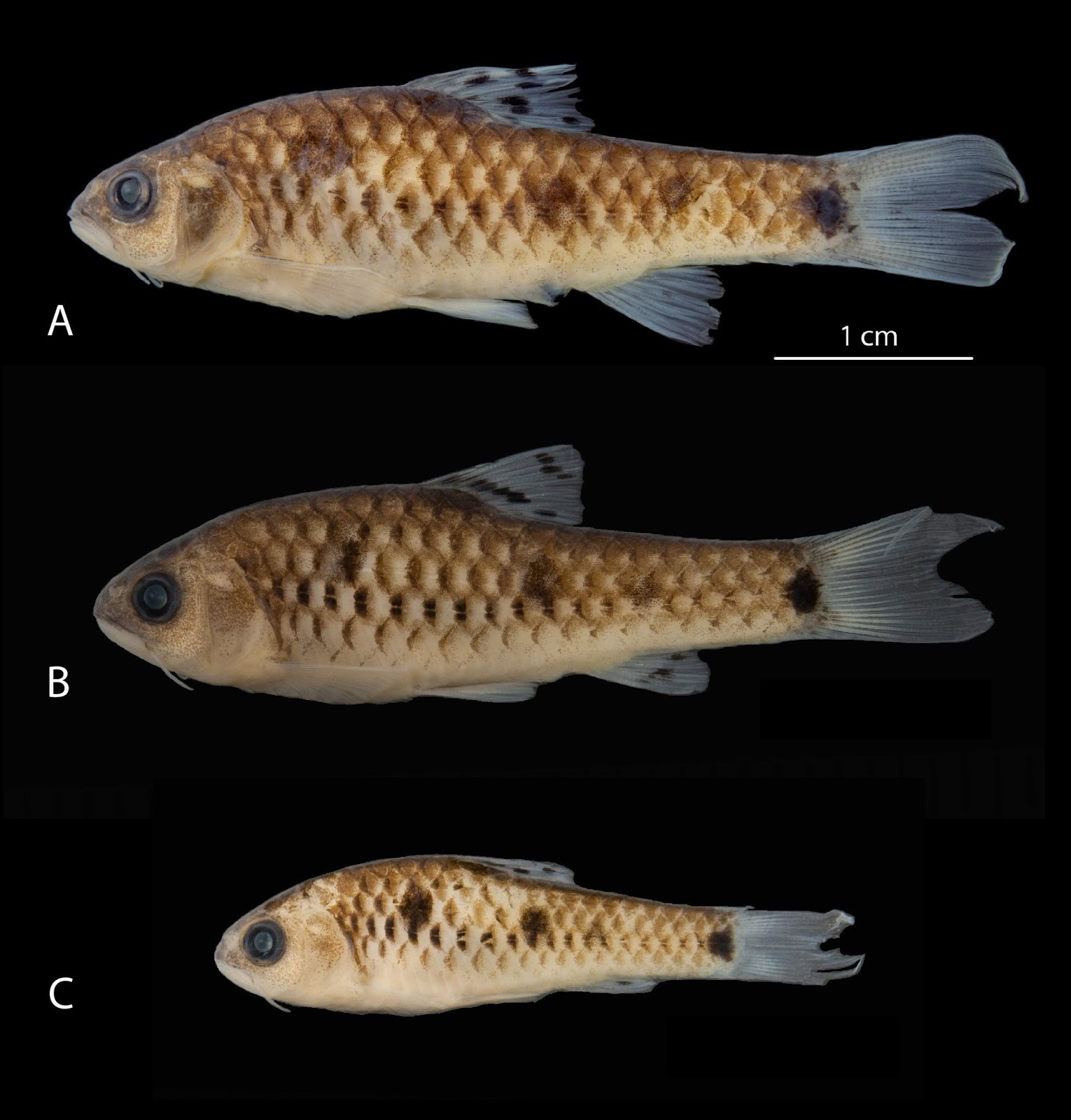
[Ichthyology • 2019] Enteromius pinnimaculatus • A New Species of Enteromius (Cypriniformes: Cyprinidae) from southern Gabon


Enteromius pinnimaculatus 
 Mipounga, Cutler, Mve Beh, Adam & Sidlauskas, 2019

  DOI: 10.1111/jfb.13995 

Abstract
We present and describe a new species of Enteromius, adding to the 16 species of Enteromius currently recorded from Gabon, West Africa. This new species is distinguished from all other Gabonese Enteromius by the presence of several distinct spots on the dorsal fin in combination with three or four round spots on the flanks. In Africa, it is superficially similar to Enteromius walkeri and with which it shares an unusual allometry in that the proportional length of the barbels decreases as the fish grows. Nevertheless, one can distinguish these species by vertebral number, maximum standard length, the length of the anterior barbels, the length of the caudal peduncle and in most specimens, the number of lateral‐line and circumpeduncular scales. These two species also inhabit widely separated drainages, with E. walkeri occurring in coastal drainages of Ghana including the Pra and Ankobra Rivers and the new species occurring in tributaries of the Louetsi and Bibaka Rivers of Gabon, which are part of the Ogowe and Nyanga drainages, respectively. Despite extensive collections in those drainages the new species is known from only two localities, suggesting the importance of conservation of its known habitat.

Keywords: allometry, biodiversity, central Africa, conservation, endemic, morphometrics, systematics

FIGURE 1: Live coloration of Enteromius pinnimaculatus sp. nov. Uncatalogued specimen from swampy lowland tributary of the Bissina River, Nyanga River drainage, Gabon.

Figure 10: (a) Adult Enteromius pinnimaculatus sp. nov. holotype, tissue voucher GAB17‐486, 41.05 mm standard length (LS), Oregon State University, Department of Fisheries and Wildlife, Corvallis, Oregon specimen OS22149, (b) adult paratype, 37.6 mm LS (OS22153) and (c) smaller adult paratype, 27.0 mm LS (OS22152) prior to clearing and staining

Enteromius pinnimaculatus sp. nov.

Etymology: The specific epithet pinnimaculatus refers to the multiple small dark spots on the dorsal fin, which is a rare characteristic within Enteromius. An adjective in the nominative singular.


Hans Kevin Mipounga, Joseph Cutler, Jean Hervé Mve Beh, Benjamin Adam and Brian L. Sidlauskas. 2019. Enteromius pinnimaculatus sp. nov. (Cypriniformes: Cyprinidae) from southern Gabon. Journal of Fish Biology. DOI: 10.1111/jfb.13995  


Wednesday, January 30, 2019

[Fungi • 2019] Lactifluus bicapillus (Russulales, Russulaceae) • A New Species from the Guineo-Congolian Rainforest


Lactifluus bicapillus Lescroart & De Crop 

in De Crop, Lescroart, Njouonkou, et al., 2019. 

Abstract
The milkcap genus Lactifluus is one of the most common ectomycorrhizal genera within Central African rainforests. During a field trip to the Dja Biosphere Reserve in Cameroon, a new Lactifluus species was found. Molecular and morphological analyses indicate that the species belongs to Lactifluus section Xerampelini and we formally describe it here as Lactifluus bicapillus sp. nov.

Keywords: Ectomycorrhizal fungi, Gilbertiodendron, Lactarius, phylogeny, taxonomy, tropical Africa, Uapaca


Figure 2. Basidiomata of Lactifluus bicapillus.
 a–c Basidiomata of Lactifluus bicapillus (EDC 12-176, EDC 12-174, holotype EDC 14-249 resp.)
d Detail of lamellae (EDC 14-176), e) young specimen (EDC 12-169) f Detail of latex (EDC 12-169) g Detail of brown colour change of the latex (EDC 14-238)
(photographs a–f by E. De Crop, g by A. Verbeken).

 Figure 3. Microscopic features of Lactifluus bicapillus a Basidiocarps (from EDC 12-071, EDC 12-169, EDC 12-174, EDC 12-176, and EDC 14-249) b Basidia (from EDC 12-071, and EDC 14-249) c Sterile elements from the hymenium (from EDC 12-169) d Pleuropseudocystidia (from EDC 12-169) e Basidiospores (from EDC 14-249).
Illustrations by E. De Crop, J. Lescroart and A. Verbeken. Scale bar: 10 μm.

Lactifluus bicapillus Lescroart & De Crop

Diagnosis: Lactifluus bicapillus differs from L. xerampelinus by its yellowish-orange to dark red cap, fertile lamella edge, a lampropalisade with two types of terminal elements as pileipellis type, and a distribution in the Guineo-Congolian rainforest.
...

Distribution: Known from Cameroon and Gabon.

Ecology: Guineo-Congolian rainforest, scattered on forest floor under Gilbertiodendron dewevreiUapaca guineensisUacuminata, and Upaludosa.

Etymology: A combination of ‘bi’ and ‘capillus’, referring to the two types of terminal elements in the pileipellis and stipitipellis.


 Eske De Crop, Jonas Lescroart, André-Ledoux Njouonkou, Ruben De Lange, Kobeke Van de Putte and Annemieke Verbeken. 2019. Lactifluus bicapillus (Russulales, Russulaceae), A New Species from the Guineo-Congolian Rainforest. MycoKeys.  45: 25-39.  DOI: 10.3897/mycokeys.45.29964


Monday, April 30, 2018

[Botany • 2018] A Revision of Xylopia L. (Annonaceae): The Species of Tropical Africa


 Xylopia aethiopica from Gabon Xylopia longipetala from Mali, representing a record for the country not otherwise documented Xylopia piratae from Ivory Coast Xylopia odoratissima from Zambia Xylopia arenaria from Tanzania

in Johnson & Murray, 2018.

Abstract
A revision of the 45 species of the pantropical genus Xylopia in Tropical Africa includes descriptions of six new species and a new section of the genus. The fruits and seeds of Xylopia show specializations that promote vertebrate dispersal, primarily by hornbills and monkeys. Over half of the African species have an Area of Occupancy (AOO) less than 80 km2, suggesting that they are in need of protection. African species are classified into five sections. Section Neoxylopia , with four species, is centered in the Guineo-Congolian Region and includes Xylopia globosa sp. nov. Section Ancistropetala, with three species, occurs in the same region. Both of these sections are endemic to Africa. Section Xylopia, which extends to Madagascar and the American tropics, has only a single species in Africa, X. aethiopica. The three species of section Verdcourtia sect. nov. are restricted to the East African coast and Madagascar. The largest number of African species, (34) belong to section Stenoxylopia, in which the seeds lack the arils found in the other sections and instead have a fleshy sarcotesta. Section Stenoxylopia is divided into two informal groups, one centered in eastern and southern Africa (X. odoratissima group) and the other centered in the wetter forests of western and central Africa (X. acutiflora group). Five new species are described in section StenoxylopiaXylopia nilotica sp. nov. from Sudan, South Sudan, and Uganda, Xylopia calva sp. nov. from Nigeria and Cameroon, which is allied to X. phloiodora, and Xylopia monticola sp. nov. from Nigeria and Cameroon, X. piratae sp. nov. from Ivory Coast and Ghana, and X. unguiculata sp. nov. from Gabon. The latter three species are segregates of the former Xylopia acutiflora s. l. One new combination is made at the species level, X. shirensis comb. nov. Keys, descriptions, illustrations, distribution maps, and an index to numbered collections document diversity and assist with species identification. The name Unona oliveriana Baill. was found to pre-date the name Unona lepidota Oliv., requiring the combination Meiocarpidium oliverianum comb. nov.

Keywords: Xylopia, pantropical Annonaceae, Tropical Africa, long distance dispersal, bird/monkey syndrome, X. aethiopica, conservation, new species

Figure 3. Flowers of representative Xylopia species.
A Flower from type collection of Xylopia globosa from Gabon B Xylopia tenuipetala from Mozambique C Xylopia quintasii from Gabon D Xylopia aethiopica from Gabon E Xylopia longipetala from Mali, representing a record for the country not otherwise documented F Xylopia piratae from Ivory Coast G Xylopia odoratissima from Zambia H Xylopia arenaria from Tanzania I Xylopia collina from Tanzania.
A, D by Thomas L. P. Couvreur B by Frances Chase C by Ehoarn Bidault E by Philip Birnbaum F by Céline Pirat G by Warren McClelland H and I by D. M. Johnson.

Xylopia globosa D. M. Johnson & N. A. Murray, sp. nov.

Xylopia nilotica D. M. Johnson & N. A. Murray, sp. nov.

 Xylopia calva D. M. Johnson & N. A. Murray, sp. nov.

 Xylopia monticola D. M. Johnson & N. A. Murray, sp. nov.

Xylopia piratae D. M. Johnson & N. A. Murray, sp. nov.

Figure 4. Fruits and seeds of representative Xylopia species.
A Xylopia staudtii from Democratic Republic of the Congo B Xylopia aethiopica from Republic of the Congo C Xylopia quintasii from Cameroon D Xylopia tenuipetala from Mozambique E Xylopia collina from Mozambique F Xylopia gracilipes from Mozambique G Xylopia hypolampra from Gabon H Xylopia tanganyikensis from Tanzania.

A by Quentin Luke B by David Harris C, G by Thomas L. P. Couvreur D by Jonathan Timberlake E, F by Mervyn Lötter H by Noriko Itoh. C reproduced with permission of Thomas L. P. Couvreur and of the American Society of Plant Taxonomists D reproduced with the permission of Jonathan Timberlake and of the Board of Trustees, Royal Botanic Gardens Kew.


 David M. Johnson and Nancy A. Murray. 2018. A Revision of Xylopia L. (Annonaceae): The Species of Tropical Africa.  PhytoKeys. 97: 1-252.  DOI:  10.3897/phytokeys.97.20975


Saturday, February 4, 2017

[Botany • 2017] Taxonomic Revision of Sabicea Subgenus Anisophyllae (Ixoroideae, Rubiaceae) from Tropical Africa, with Four New Species


Sabicea sthenula 
 (N. Hallé) Razafimandimbison, B. Bremer, Liede & S.A. Khan


Abstract

A taxonomic revision of Sabicea subgenus Anisophyllae (Rubiaceae), a group restricted to Central and East Africa, is presented here. This work, based on a study of herbarium specimens and field observations in Cameroon and Gabon, includes a survey of the morphological features of the group, a key to the species, descriptions of all the taxa, and IUCN conservation status assessments. Fifteen species are recognised, four of which are described as new (Sabicea mapiana, S. ndjoleensisS. parmentieraeSsciaphilantha), three former varieties are raised to species rank (S. crystallinaS. jacfelicisStersifolia), and one species previously sunk into synonymy is restored (Sbequaertii). Two new infraspecific taxa are also described, Sabicea crystallina subsp. engongensis and S. sciaphilantha subsp. hirsuta. The group has its center of diversity in Gabon, where 10 of the 15 species occur, three of them being endemic to the country.

Keywords: Conservation status, Guineo-Congolian Region, IUCN Red List Categories and Criteria, Lower Guinea, taxonomy, Rubiaceae, Sabicea, tropical African flora, Eudicots


Lise L.A. Zemagho, Sigrid Liede-Schumann, Olivier Lachenaud, Steven Dessein and Bonaventure Sonke. 2017.  Taxonomic Revision of Sabicea Subgenus Anisophyllae (Ixoroideae, Rubiaceae) from Tropical Africa, with Four New Species.  Phytotaxa. 293(1); 1–68. DOI: 10.11646/phytotaxa.293.1.1


Friday, December 30, 2016

[Herpetology • 2016] Diet and Body Condition of Cave-dwelling Dwarf Crocodiles (Osteolaemus tetraspis, Cope 1861) in Gabon


Figure 4.   Side by side photo of two adult male Osteolaemus tetraspis. The left individual was captured in the Abanda caves and displays the bizarre orange skin colour. We do not yet fully understand the mechanism underlying this colour change, though suspect it is caused by a chemical bleaching process after long periods of exposure to high urea concentrations from bat guano. 

Abstract

We present the first ever observations of dwarf crocodiles (Osteolaemus tetraspis) selectively utilizing a cave ecosystem. We analysed crocodile diet to preliminarily assess the degree of ecological isolation of cave-dwelling crocodiles from their forest-dwelling conspecifics despite their physical proximity. We additionally conducted the first study of body condition of dwarf crocodiles and compared cave-dwelling individuals to surface-dwelling individuals from a variety of alternative habitats and sites as a means to better understand the implications of a semihypogean life on this species. Crocodiles captured in the caves appeared to forage exclusively in the caves and ate mostly cave crickets and bats, whereas crocodiles captured in the surrounding forest habitat consumed primarily freshwater crustaceans and insects and were not found to consume cave-dwelling prey. Juvenile cave crocodiles had significantly higher body condition compared to juvenile forest crocodiles, which did not vary amongst forest locations. The difference in body condition between adult cave and forest crocodiles was not statistically significant despite also being higher; we suspect this is an artifact of the low sample size rather than a real nondifference. Forest adult crocodiles generally had significantly higher body condition than juveniles, but did not vary by site or habitat. This lack of variation suggests that habitat type is not the most important factor influencing dwarf crocodile body condition. Our results provide a unique insight into facultative cave use by a principally surface-dwelling species and reinforce the necessity for further research into this unique system to better understand the evolutionary-scale implications of cave habitat use by dwarf crocodiles.


Matthew H. Shirley, Brittany Burtner, Richard Oslisly, David Sebag and Olivier Testa. 2016. Diet and Body Condition of Cave-dwelling Dwarf Crocodiles (Osteolaemus tetraspis, Cope 1861) in Gabon.   African Journal of Ecology, DOI:  10.1111/aje.12365 


Résumé: Nous présentons ici la première observation de crocodile nain (Osteolaemus tetraspis) dans un écosystème cavernicole. Nous avons analysé leur régime alimentaire pour évaluer le degré d'isolement écologique par rapport à leurs conspécifiques forestiers indépendamment de leur proximité physique. Nous avons également effectué la première étude sur les conditions physiques des crocodiles nains et nous avons ensuite comparé les individus troglodytes par rapport à ceux de l'extérieur dans une variété d'habitats et de sites afin d'explorer les conséquences d'une vie semi-hypogée sur cette espèce. Les crocodiles capturés dans les grottes semblent trouver leur nourriture exclusivement dans les cavités, la plupart des proies identifiées étant des grillons cavernicoles et des chauves-souris. Au contraire, les crocodiles capturés à l'extérieur dans les habitats forestiers, consomment principalement des crustacés d'eau douce et des insectes mais jamais de proies troglodytes. En comparaison, les crocodiles troglodytes juvéniles avaient une meilleure condition physique que les crocodiles juvéniles forestiers. La différence de condition physique entre les crocodiles troglodytes adultes et les crocodiles adultes forestiers n'a pas été statistiquement significative en dépit d’être également plus élevé; nous soupçonnons que cela soit un artefact de la faible taille de l’échantillon plutôt que d'une véritable non-différence. Sur les différents sites et habitats forestiers, les crocodiles adultes avaient généralement une condition physique meilleure que celle des juvéniles, et les conditions physiques des deux catégories démographiques ne variaient pas. Cette faible variation entre les sites forestiers indique que le type d'habitat n'est pas un facteur important pour le contrôle de la condition physique des crocodiles nains. Ces premiers résultats fournissent un aperçu unique de l'utilisation facultative des grottes par des espèces principalement inféodées à des habitats de surface. Ils renforcent la nécessité de poursuivre les recherches pour mieux comprendre comment et en quoi l'utilisation de l'habitat cavernicole par les crocodiles nains influe sur leur évolution.