Showing posts with label Euphorbiaceae. Show all posts

Monday, December 2, 2024

[Botany • 2022] Euphorbia xiangxiui (Euphorbiaceae, subgenus Esula) • A Remarkable New Species from Jiufeng Mountains in Fujian Province, Eastern China


Euphorbia xiangxiui N.Wei, Q.Yu, G.X.Chen & Q.F.Wang, 

in Yu, Chen, Yang, Wang, et Wei, 2022. 

Abstract 
Euphorbia xiangxiui, a new species of Euphorbiaceae from Eastern China, supported by morphological and molecular evidence, is illustrated and described here. It can be distinguished from its closest relatives by the combination of several characters, including taller stature (up to 1.6 m), leaves of 5‐18 × 0.6‐3 cm in size, color of primary involucral leaves and cyathophylls changing from pink to rose, fading to green after fruiting, and four to six reniform-rounded concave glands. The molecular phylogenetic analysis, based on combined nuclear ribosomal ITS and plastid ndhF sequences, further supports that E. xiangxiui should be placed in the East Asian Clade of Euphorbia subg. Esula sect. Helioscopia.

Keywords: Euphorbia xiangxiui; Flora of China; leafy spurges; phylogeny; taxonomy


Euphorbia xiangxiui N.Wei, Q.Yu, G.X.Chen & Q.F.Wang


  Yu, Qun; Chen, Guo-Xing; Yang, Yi; Wang, Qing-Feng and Wei, Neng. 2022. A Remarkable New Species of Euphorbia section Helioscopia (Euphorbia subgenus Esula, Euphorbiaceae) from Jiufeng Mountains in Fujian Province, Eastern China. Systematic Botany. 47(1); 259-267. DOI: doi.org/10.1600/036364422X16442668893265

Tuesday, November 12, 2024

[Botany • 2024] Euphorbia duerrii (Euphorbiaceae) • A New Species from the Dhule District of Maharashtra, India


Euphorbia duerrii Sarojin. & Raja Kullayisw., 

in Devi et Kullayiswamy, 2024.  

Abstract
A new succulent species Euphorbia duerrii is described and illustrated from the Dhule District of Maharashtra state in India. This new species is allied to Euphorbia sahyadrica but differs in shape of the podaria, short obovate leaves, 2–4 times branched peduncles, fimbriate bracts in male flowers and colliculate capsules. Euphorbia duerrii sp. nov. belongs to Euphorbia section Euphorbia based on the presence of succulent stems, spine shields, ecarunculate seeds, and glands of the cyathium lacking appendages.

Keyword: Euphorbia duerrii, Euphorbia nivulia, Euphorbia sahyadrica, subgenus Euphorbia, Maharashtra, India

Euphorbia duerrii Sarojin. & Raja Kullayisw.
A. Branching peduncles of cyathia; B. Pair of cyathia; C. Male flower; D. Involucre; E. Involucre with glands and involucral bracts; F. Bract on primary peduncle; G. Bract of secondary peduncle; H. Bract of tertiary peduncle; I. Bract of quaternary peduncle; J. Capsule; K. Seeds.

Euphorbia duerrii Sarojin. & Raja Kullayisw.
 A. Habit with leaves; B. Habit with inflorescence; C. Inflorescence; D. Branch with leaves; E. Branch with early stage of inflorescence; F. Leaf; G. T.S of stem; H. Spine shield side view.

Euphorbia duerrii Sarojin. & Raja Kullayisw.
A. Twig with leaves; B. Inflorescence at shoot apex; C. Cyathia on branching peduncles; D. Cyathial cyme; E. Spine shield; F. T.S of stem; G. Young female flowers with papillose stigmas; H. Involucre with glands and involucral bracts; I. Male flowers with bracteole; J. Capsule top view; K. Capsule bottom view; L. Seeds.
(Drawn by Naidu Sarojini Devi)

Euphorbia duerrii Sarojin. & Raja Kullayisw. sp. nov. 

Type: INDIA. Telangana State, Yadadri-Bhongir District, Dharmavana Nature Ark, 17.526426N, 78.889749E, 450 m, 23 May 2024, Sarojini Devi and Raja Kullayiswamy DNA-603 (ex-situ plants cultivated from stem cuttings collected from the Dhule District of Maharashtra, the documented original distribution of the species) Holotype (BSID), Isotypes (MH & SKU).

 Diagnosis: The new taxon is allied to Euphorbia sahyadrica in habit, the presence of terete branches, involucral glands transversely oblong, male flowers in 5 fascicles and ovary trigonous, but it differs in many characters viz. ellipsoid shape of spine shields, (verses a circular); sessile, obovate, obtuse and margin wavy leaves (verses petiolate, elliptic-obovate, attenuate at base, margin entire leaves); four times dichotomously branched peduncle (verses two time branched peduncle); glands transversely oblong glands (verses transversely elliptic glands). 

Etymology: The species epithet ‘duerrii’ honors William Frederick Dürr who has enjoyed the Flora of the Deccan Plateau since moving with his family to Hyderabad, Telangana State, India in the year 2000.

Comparison between Euphorbia duerrii and its allied species:
 A, B, C, D - E. duerrii Sarojin. & Raja Kullayisw. A. Inflorescence at shoot apex; B. Stem new growth with leaves; C. Involucre; D. Capsule;
E, F, G, H - E. sahyadrica Sardesai & Malpure E. Shoot apex with inflorescence; F. Stem new growth with leaves; G. Involucre; H. Capsule;
I, J, K, L - E. nivulia Buch.-Ham. I. Inflorescence at shoot apex; J. Stem new growth with leaves; K. Involucre; L. Capsule.


Naidu Sarojini Devi, Kusom Raja Kullayiswamy. 2024. Euphorbia duerrii (Euphorbiaceae), A New Species from the Dhule District of Maharashtra, India. Taiwania. 69(4); 530-536. DOI: 10.6165/tai.2024.69.530  taiwania.ntu.edu.tw/abstract/2032

Tuesday, November 5, 2024

[Botany • 2024] Croton antioquensis (Euphorbiaceae: Crotoneae) • A New Species of Croton section Geiseleria from the Canyon of the Cauca River (Antioquia), Northwestern Colombia


 Croton antioquensis Zapata-Corr. & Paz-López,

in Zapata-Correa, Paz-López, Torrejano-Munevar et Berrío-Montoya, 2024. 

Abstract
This study describes a new species of Croton section Geiseleria (Euphorbiaceae) based on specimens collected in remnants of vegetation in the municipality of Santa Fe de Antioquia (Antioquia), Northwestern Colombia. Croton antioquensis resembles C. adenodontus, C. bidentatus and C. subsuavis, however, it is differentiated by a set of characters associated with its floral and vegetative morphology, in addition to its geographic distribution. The new species is known from a single locality in an area of occupancy (AOO) of less than 4 km2 with multiple threats of anthropogenic origin. We suggest its inclusion in the category of Critically Endangered (CR) taking into account the IUCN guidelines. A key to the species of Croton sect. Geiseleria in Colombia is included.

Keywords: Cauca River Canyon, Crotonoideae, Dragos, Malpighiales, Santa Fe de Antioquia


 Croton antioquensis Zapata-Corr. & Paz-López, sp. nov.


Diego Alejandro Zapata-Correa, Carlos A. Paz-López, Andrés F. Torrejano-Munevar and Sebastián Berrío-Montoya. 2024. A New Species of Croton section Geiseleria (Euphorbiaceae) from the Canyon of the Cauca River (Antioquia), Northwestern Colombia. DARWINIANA, nueva serie. 12(2): 284-294. DOI: doi.org/10.14522/darwiniana.2024.122.1246

Thursday, October 3, 2024

[Botany • 2024] Euphorbia zhongiana (Euphorbiaceae, subgenus Esula) • A New Species from Danxia Landform Areas in Zhejiang Province, Eastern China


 Euphorbia zhongiana  

in Li, Xu, F. Chen, Pu, Xie, ... et Liang, 2024.
 
Abstract
Euphorbia zhongiana (Euphorbiaceae), from Zhejiang Province, eastern China, is described and illustrated as a new species. It is morphologically similar to E. fauriei, however, differs in its winter green habit, whole plant being glabrous; cyathophylls 2, broadly ovate, yellow-greenish; involucre 2.5–3.0 × 2.5–3.0 mm; the surface of ovary usually smooth, rare sparsely microtuberous; styles connate at middle towards base; apex slightly 2–lobed; capsules smooth without tuberculate or conical verrucae, rare sparsely and inconspicuously rugose; seed coat with reticulate wrinkle.

Euphorbia zhongiana, new species, morphological characters, phylogenetics analysis, Eastern China, Eudicots


Jun-Ping LI, Pan XU, Feng CHEN, Jin-Bao PU, Wen-Yuan XIE, Jun-Feng WANG, Jian-Sheng WANG, Hua-Min ZHU, Zheng-Hai CHEN and Wei-Qing LIANG. 2024. Euphorbia zhongiana (Euphorbia section Helioscopia, subgenus Esula, Euphorbiaceae), A New Species from Danxia Landform Areas in Zhejiang Province, Eastern China. Phytotaxa. 665(2); 96-108. DOI: doi.org/10.11646/phytotaxa.665.2.2
 

Wednesday, August 28, 2024

[Botany • 2023] Dalechampia seccoi (Euphorbiaceae) • A threatened New Species from Southeastern Brazil


  Dalechampia seccoi  J.C.R. Mendes & Pereira-Silva,

in Mendes, Külkamp, Bigio, Torres-Leite et Pereira-Silva, 2023. 
 
Abstract
Dalechampia seccoi is a new endemic species of Euphorbiaceae from the Atlantic Forest domain, southeastern Brazil. Here we describe and illustrate the new species. Collections of botanical material, and standard herbarium practices were applied. The new species is vegetatively similar to D. alata, D. erythrostyla, D. pentaphylla, D. violacea, and D. purpurata, however it is distinguished by exclusive characters such as involucral bracts 4‒5-lobed, pinkish, staminate sepals vinaceous, resin darkish and stigma yellow lobed to crateriform. The new species is restricted to Seasonal Semideciduous Forest with altitudes of ca. 700 m from Caparaó, south of the state of Espírito Santo. In addition, we provide field photographs, preliminary conservation status assessments using IUCN Red List guidelines, as well as a checklist and key for morphological correlated species.

Keywords: Acalyphoideae; Caparaó; endemism; Espírito Santo; Seasonal Semideciduous Forest; taxonomy

  Dalechampia seccoi
(watercolor painting by Cássia Dias).

 Dalechampia seccoi. A. Habit. B. General view of habit with pseudanthium. C-D. Pseudanthium with the two involucral bracts 4−5-lobed, showy, pinkish. E. Detail of staminate pleiochasium, and resin secreted darkish. F. Detail of pistillate cymule, and stigma crateriform to slightly lobed. G. Fruits (capsule).
(Photographs: A, B, C, E, F. André S. Pellanda; D. Filipe Leite; G. Karla Pedra).  

Dalechampia seccoi J.C.R. Mendes & Pereira-Silva, sp. nov.

Dalechampia seccoi is recognized by its involucral bracts 4−5-lobed, pinkish, with magenta veins; staminate column elongated beyond the sepal tips after anthesis; staminate sepals widely lanceolate, vinaceous; style tips not moderately down-curved and stigma crateriform to slightly lobed, yellow; pistillate sepals 12, pinnatifid; 4 bracteoles of staminate pleiochasium, deltoid to oblong, free; resiniferous gland with margin fimbriate, and resin secreted darkish; and seeds grayish with macules brownish.

Etymology ‒ The specific epithet honors Dr. Ricardo de S. Secco, renowned botanist at the Museu Paraense Emílio Goeldi, who contributes significantly to knowledge of the Amazonian flora, as well as of the whole of Brazil, specifically the Euphorbiaceae family, and who greatly assists in the formation of stimulating human resources Euphorbiologists.


Mendes, Jone Clebson Ribeiro; Külkamp, Josimar; Bigio, Narcísio Costa; Torres-Leite, Filipe; Pereira-Silva, Rafaela Alves. 2023. Dalechampia seccoi (Euphorbiaceae), A threatened New Species from Southeastern Brazil. Acta Botanica Brasilica. 37;  DOI: doi.org/10.1590/1677-941X-ABB-2023-0027   Researchgate.net/publication/372616456_Dalechampia_seccoi_a_threatened_new_species_from_Southeastern_Brazil

Tuesday, June 18, 2024

[Botany • 2020] Jatropha longibracteata & J. paganuccii (Euphorbiaceae) • Two New Species from Limestone Outcrops in Brazilian Seasonally Dry Tropical Forests


Jatropha longibracteata A.S.Moreira & Carn.-Torres, 
J. paganuccii A.S.Moreira & Carn.-Torres, 

 in Moreira, Oliveira, Cordeiro et Carneiro Torres, 2020. 

Abstract
We describe and illustrate two new species of Jatropha from Bahia State, Brazil: Jatropha longibracteata and Jatropha paganuccii. The two new species occur on limestone outcrops in seasonally dry tropical forests. We also provide a distribution map and IUCN conservation status, as well as morphological comparisons with the closely related species J. calcarea, J. martiusii, and J. palmatipartita.

Keywords: Biodiversity, Floristics, Malpighiales, Taxonomy, Eudicots

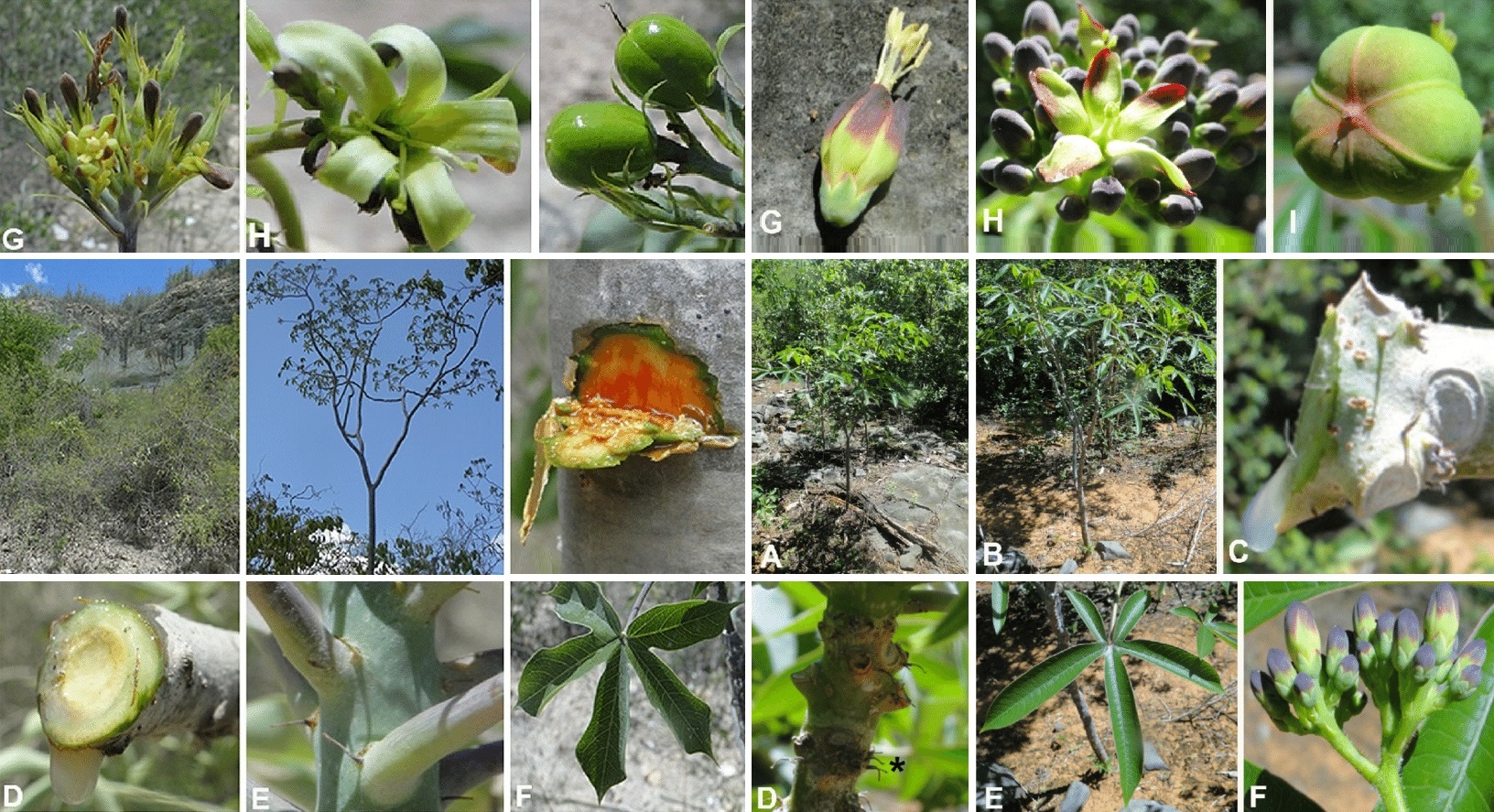
  Jatropha paganuccii.
A) Limestone outcrop at the type locality; B) Habit; C) Latex; D) Stipules; E) Leaf blades; F) Inflorescence; G) Staminate flower; H) Pistillate flower; I) Fruit. Photographs by A.S. Moreira.

  Jatropha longibracteata.
A) Limestone outcrop at the type locality; B) Habit; C) Stem latex; D) Branch latex; E) Stipules at the base of the petioles; F) Leaf blades; G) Inflorescence; H) Pistillate flower; I) Fruits. Photographs by A.S. Moreira.


Ariane dos Santos Moreira, José Florencio Cerqueira Oliveira, Inês Cordeiro and Daniela Santos Carneiro Torres. 2020. Two New Species of Jatropha (Euphorbiaceae) from Limestone Outcrops in Brazilian Seasonally Dry Tropical Forests. Phytotaxa. 451(1); 73–82. DOI: 10.11646/phytotaxa.451.1.6 


Tuesday, May 7, 2024

[Botany • 2022] Croton guaritensis (Euphorbiaceae: Crotoneae) • A New Species endemic to the Brazilian Pampa and its Phylogenetic Affinities


Croton guaritensis  A.P.N.Pereira & Caruzo, 

in Pereira, Riina, Valduga et Caruzo, 2022.

Abstract
Croton guaritensis, sp. nov. is here described, illustrated, and classified based on morphological and molecular data. The new species is restricted to the Pampa biome where it grows around rocky outcrops. Examination of the morphology from herbarium collections and field observations, as well as evidence from molecular analysis, indicate that Croton guaritensis belongs to Croton section Barhamia subsection MedeaCroton subsection Medea is represented by several rare and endemic species and stands out by its glandular structures in stipules, bracts, and sepals. The new species differs from other species of this subsection in the indumentum on branches and leaves, which consists of subentire lepidote trichomes, and in the sepals of staminate and pistillate flowers that have stipitate glands. An identification key to the new species and closely related taxa in southern Brazil is provided, as well as a preliminary conservation status.

Keywords: Croton sect. Barhamia subsect. Medea, Crotoneae, Neotropics, Southern Cone, Taxonomy

Croton guaritensis
d inflorescence with flower buds and two open flowers: the top one staminate and the lower one pistillate; e top view of a staminate flower; f side view of a staminate flower showing the stipitate, green glands along the sepal margins; g detail of a pistillate flower showing the tetrafid styles; h sepals of a pistillate flower showing the green stipitate glands on the outer surface; i young fruit with persistent, accrescent sepals; note that the marginal glands are more noticeably compared to the younger flower (see h); j verruculose seed with cream-colored caruncle.
Scale bar: 1 mm. Photos by A.P.N. Pereira

Croton guaritensis
 a a typical rocky outcrop of the Guaritas area; the new species grows on the slopes and tops of these outcrops (“cerros”);
b subshrub habit; c branches showing yellowish fruits. 
Photos by A.P.N. Pereira

Croton guaritensis A.P.N.Pereira & Caruzo, sp. nov. 

Etymology: The specific epithet refers to the “Guaritas do Camaquã” rock formations in southern Brazil (see Fig. 2a), and is a reference to the type locality.

Comparison of morphology of pistillate and staminate flowers between Croton guaritensis and C. helichrysum:
 a pistillate flower of C. guaritensis showing entire sepals with conspicuous glands; b pistillate flower of C. helichrysum showing the serrate sepals with inconspicuous glands (on teeth apices); c staminate flower of C. guaritensis showing sepals with marginal glands; d staminate flower of C. helichrysum showing sepals without glands.
 Photos by A.P.N. Pereira

 
Amanda da Paixão Noronha Pereira, Ricarda Riina, Eduardo Valduga and Maria Beatriz Rossi Caruzo. 2022.  A New Species of Croton (Euphorbiaceae) endemic to the Brazilian Pampa and its Phylogenetic Affinities. Plant Systematics and Evolution. 308, 14. DOI: 10.1007/s00606-021-01803-x [18 March 2022]

Wednesday, May 1, 2024

[Botany • 2017] Trigonostemon honbaensis (Euphorbiaceae) • A New Species from Mt. Hon Ba, Southern Vietnam


 Trigonostemon honbaensis Tagane & Yahara,  

in Tagane, Yahara, Dang, Toyama et Tran, 2017.

A new speciesTrigonostemon honbaensis Tagane & Yahara (Euphorbiaceae), sp. nov., from Hon Ba Nature Reserve in Khanh Hoa Province, southern Vietnam, is described and illustrated. DNA barcoding data of the rbcL and matK regions is provided. Trigonostemon honbaensis is most similar to T. longifolius Baill. ex Müll.Arg., but distinguished by its less hairy leaves, truncate leaf base (attenuate to obtuse in T. longifolius), larger petals, shorter staminal column, and anthers lacking appendages.

Key words: Euphorbiaceae, Hon Ba Nature Reserve, new species, Trigonostemon, Vietnam

 Trigonostemon honbaensis Tagane & Yahara, sp. nov.
A, flowering branch; B, portion of abaxial surface of leave; C, top branch; D, inflorescence; E & F, staminate flowers. 
A–E: 23 February 2014. 
 Scale bars G = 10 cm; H = 5 mm; J & K = 0.5 mm.


  Shuichiro Tagane, Tetsukazu Yahara, Van-Son Dang, Hironori Toyama and Hop Tran. 2017. Trigonostemon honbaensis (Euphorbiaceae), A New Species from Mt. Hon Ba, Southern Vietnam. Acta Phytotax. Geobot. 68(1): 39–44. 


Friday, October 20, 2023

[Botany • 2023] Acalypha bardotiana & A. inaequibracteata (Euphorbiaceae: Acalyphoideae) • Two New Species from northern Madagascar


Acalypha bardotiana  I.Montero & Cardiel, 

in Montero-Muñoz, Levin, Lorenzo, González et Cardiel, 2023. 

Abstract
Background and aims – Taxonomic knowledge of Acalypha in the Western Indian Ocean Region (WIOR; including Madagascar, Comoros, Mascarenes, Seychelles, and the Scattered Islands) has increased greatly in the last few years. This paper is the latest in a series of publications that have contributed to create a robust taxonomic framework for Acalypha in this region.

Material and methods – The descriptions and illustrations of the new species are based on herbarium specimens and on some field images. Descriptions were made following standard procedures. Maps was prepared using QGIS software and preliminary conservation assessments was made following IUCN guidelines and criteria.

Key results – Two species of Acalypha from northern Madagascar are described as new to scienceAcalypha bardotiana sp. nov., found on the Montagne des Français (Diana region), and Acalypha inaequibracteata sp. nov., found in the Binara forest (Sava region). Line drawings, field images, distribution maps, and a discussion of their morphological and phylogenetic affinities, as well as the preliminary conservation assessments are provided.

Keywords: biodiversity, conservation, IUCN Red Listing, protected areas, taxonomy, WIOR

Acalypha bardotiana in situ.
A. Female inflorescence, leaves, and stipules. B. Habit.
Photos by Mrs Martine Bardot-Vaucoulon, used with permission.

Acalypha bardotiana.
 A. Habit. B. Detail of lower leaf surface. C. Detail of node, stipules, and petiole base. D. Mature female bract. E. Ovary and styles. F. Calyx of the female flower. G. Capsule. H. Seed.
Based on M. Bardot-Vaucoulon. G. Véné & G. Razafindrabelahasy 1209 (P and K). 
Illustration by Laura González Hernández.

Acalypha bardotiana I.Montero & Cardiel, sp. nov. 

Diagnosis: Acalypha bardotiana is morphologically close to A. lanceolata Willd. var. glandulosa (Müll.Arg.) Radcl.-Sm. but differs mainly by having a suffruticose habit and unisexual inflorescences (vs herbaceous habit and androgynous inflorescences), conspicuous stipules up to 8 mm long (vs inconspicuous stipules up to 2 mm long), petioles up to 8 mm long and leaf blades up to 9 cm long (vs petioles up to 4.6 mm long and leaf blades up to 6.5 cm long), and papillose-hispid capsules (vs smooth capsules).

Etymology: The epithet honours Mrs Martine Bardot-Vaucoulon, a French botanist who has conducted extensive botanical research in Madagascar. She is also one of the collectors of the type specimens of this species and kindly provided us with some field images included in this paper.


Acalypha inaequibracteata I.Montero & Cardiel, sp. nov.
 
Diagnosis: Acalypha inaequibracteata is morphologically similar to A. ankaranensis I.Montero & Cardiel, but differs mainly by having minute stipules up to 2 mm long, with simple trichomes (vs. stipules up to 5 mm long, with simple and glandular trichomes), petioles 0.5−1(–1.5) cm long (vs petioles 3−5 cm long), ovate to elliptic-lanceolate leaf blades that are rounded to obtuse at the base and lack domatia (vs broadly ovate-lanceolate leaf blades that are subcordate to cordate at the base and have pocket-shaped domatia), and dimorphic female bracts (vs monomorphic female bracts).

Etymology: The specific epithet refers to the presence of female bracts showing different shapes.


Iris Montero-Muñoz, Geoffrey A. Levin, Concepción Vaquero Lorenzo, Laura González, José M. Cardiel. 2023. Novelties in the Genus Acalypha (Euphorbiaceae, Acalyphoideae): Two New Species from northern Madagascar. Plant Ecology and Evolution. 156(3): 365-373. DOI: 10.5091/plecevo.108024

Saturday, September 9, 2023

[Botany • 2023] Euphorbia yadgirensis (Euphorbiaceae) • A New Species from Karnataka State, India


Euphorbia yadgirensis Sarojin. and Raja Kullayisw, 

in Naidu et Kusom, 2023.  

Abstract
Euphorbia yadgirensis is a new species described and illustrated from the scrub forest of Rayangole village, Yadgiri District of Karnataka, India. It belongs to E. subg. Chamaesyce sect. Hypercifoliae and resembles Euphorbia kadapensis. However, it differs in nature of stipules and bracteole, structure of limbs, lack of sutures on capsules, etc.

Keywords: Chamaesyce. Euphorbia yadgirensis, Hypercifoliae, Karnataka, Rayangole, scrub forest


Euphorbia yadgirensis sp. nov.
 (A) habit, (B) young cyathium, (C) stipules, (D) involucral lobes, limbs and glands, (E) female floret, (F) capsule top view, (G) capsule bottom view, (H) seeds.

Euphorbia yadgirensis sp. nov.
 (A) habit, (B) cyathium at shoot apex, (C) stipules, (D) male floret, (E) portion of involucral cup showing lobes, glands and limbs, (F) capsule top view, (G) capsule bottom view, (H) ripe capsule, (J) cyathia, (K) seeds.

Euphorbia yadgirensis Sarojin. and Raja Kullayisw. sp. nov.  
Euphorbia kadapensis sensu Raja et al. (2020)
  
Diagnosis: An annual decumbent herb growing between rocks in scrub forest. Stem glabrous with sympodial dichotomous branching; stipules laciniate; limb of gland bi- or trifid for one fourth of its length; capsules trigonous, prominently keeled; stigmas simple; seeds transversely deeply rugulose. It resembles E. kadapensis Sarojin. and R.R.V.Raju in having filiform branches, elliptic leaves, dissected limb, long style, and trigonous capsule, but differs in stipules (laciniate versus scaly), limb (bi- or trifid for one fourth of its length versus bi- or trifid for half of its length), number of staminate florets (9−12 versus 15−18), bract of male floret (laciniate versus simple), capsules (ridges absent along the sutures versus prominently ridged along sutures), seeds (transversely deeply rugulose versus transversely slightly rugulose) (Table 1).
...

Etymology: The species is named after the type locality of the Yadgiri District in the north of Karnataka state. The type locality is dominated by granite rocks and scrub brush.


Sarojini Devi Naidu and Raja Kullayiswamy Kusom. 2023. Euphorbia yadgirensis sp. nov., (Euphorbiaceae) from Karnataka state, India. Nordic Journal of Botany. e04041. DOI: 10.1111/njb.04041

Wednesday, March 8, 2023

[Botany • 2020] Euphorbia shehbaziana (Euphorbiaceae) • A New Species from Kurdistan Iraq


Euphorbia shehbaziana S.A. Hama & S.A. Ahmad, 

in Hama & Ahmad, 2020.

 Abstract 
Euphorbia shehbaziana is described and illustrated as a new species from Kurdistan Iraq, and its distinguishing characters from its nearest relatives, E. denticulata and E. craspedia, are discussed.

KEYWORDS: Euphorbia, Iraq, Gmo Mt., Kurdistan

Euphorbia shehbaziana S.A. Hama & S.A. Ahmad.
A, plant; B, cyathium; C, fruit; D, seed with caruncle. Photographs by Saman A. Ahmad based on the holotype.


Euphorbia shehbaziana S.Y. Hama and S.A. Ahmad, sp. nov.

 Euphorbia shehbaziana is readily distinguished from its nearest woody relatives by having entire leaves, 3- to 5-rayed umbels, denticulate glands, bracteate male flowers, and rugose seeds.

Etymology: Euphorbia shehbaziana is named in honor of our mentor and friend Dr. Ihsan A. Al-Shehbaz (MO) in recognition of his devotion to promoting botany in Kurdistan Iraq.


Sakar Y. Hama and Saman A. Ahmad. 2020. Euphorbia shehbaziana (Euphorbiaceae), A New Species from Kurdistan Iraq. Harvard Papers in Botany. 25(1); 73-74. DOI:  10.3100/hpib.v25iss1.2020.n9

Monday, February 27, 2023

[Botany • 2019] Euphorbia pseudodidiereoides (Euphorbiaceae) • A New Species from south-central Madagascar


Euphorbia pseudodidiereoides J.-P. Castillon & Rajaovelona, 
G-H) E. didiereoides 

in Castillon & Rajaovelona, 2019. 

Abstract  
A new species of spiny, multi-stemmed spurge, Euphorbia pseudodidiereoides J.-P. Castillon & Rajaovelona, is described and illustrated here. It is known only from the Ihorombe region, south central Madagascar, and occurs on an isolated quartzite massif surrounded by vast grasslands and granite inselbergs. Its presumed nearest relative is E. didiereoides Denis ex Leandri, with which it shares many common characters, including: general V-shaped habit reminiscent of some species of the genus Alluaudia (Drake) Drake (Didiereaceae), thick stems, numerous spines, rarely solitary, densely arranged, of variable size (5-25 mm), without alignment, green pubescent leaves, elliptic with a mucronate apex, without petiole but bearing a white thick mid-vein, capitate incyathescences, and pubescent peduncle. It differs from E. didiereoides by its shorter size (0.8-1.5 m vs 2-4 m for adult individuals), recumbent branches, and an incyathescence with shorter peduncle (1.5 cm instead of 8 cm), less dense cymes with fewer cyathia (8-16 cyathia instead of 20-60), and wider, rounded, 8x8 mm cyatophylls. This new species is assessed to be Critically Endangered according to IUCN Red List Categories and Criteria because it is only known from a single unprotected locality, with the number of mature individuals being less than 250 and a measurable decline in local natural habitat (CR B1 ab(iii,v) + 2 ab(iii,v); C2 a(ii)).

Key words: Euphorbia, new species, Goniostema, Ihorombe, Madagascar

 A) Sobennikoffia humbertiana
B-F) Euphorbia pseudodidiereoides, G-H) E. didiereoides 


Euphorbia pseudodidiereoides, J.-P. Castillon & Rajaovelona, species nova 

Diagnose: Haec planta Euphorbia didieroides affinisest sed sequentibus characteribus praecipue differt :minore statura (<1,5 m) ; longis caulibus inclinatisad terram ; capitatis inflorescentiis minus densis (8-16 cyathis contra 20-60) ; cyathorum foliis latioribusrotundatisque  
 
  
Jean-Philippe Castillon and Landy Rita Rajaovelona. 2019. Euphorbia pseudodidiereoides, une nouvelle euphorbe épineuse du Centre-sud de Madagascar [A New Spiny Spurge from south-central Madagascar] Malagasy Nature. 13: 60–64.
 http://www.vahatra.mg/volume13/MN13_03_Castillon.pdf


Tuesday, February 21, 2023

[Botany • 2022] Bahiana pyriformis (Euphorbiaceae: Acalyphoideae) • A New Genus from Seasonally Dry Forest in northeastern Brazil, corroborated by molecular and morphological evidence


Bahiana pyriformis J.F.Carrión, 

in Carrión, dos Santos, Cordeiro & Amorim, 2022. 
Illustration by Klei Sousa

Abstract
After discovering an unknown Euphorbiaceae with an unusual combination of morphological characters, molecular phylogenetic analyses were conducted to evaluate the phylogenetic position of the plant. Results of the analyses support the recognition of a resolved lineage sister to a clade comprising Caryodendron, which is sister to the Adenophaedra + Bernardia clade in subfamily Acalyphoideae. The phylogenetic position of this taxon is also supported by morphology, justifying the description of a new genus and species, Bahiana pyriformis, from the Caatinga seasonally dry forest, in Bahia State, Brazil. We compare morphological characters and discuss the phylogenetic relationships of these four genera, here treated as the Bernardia clade, as well as the possible relationship this clade has with genus Avellanita and tribe Plukenetieae.

Keywords: Bernardieae, Caatinga, Caryodendreae, limestone outcrop, phylogenetics


Bahiana pyriformis J.F.Carrión, sp. nov.
 

Juan F. Carrión, Francisco A.R. dos Santos, Inês Cordeiro and André M. Amorim. 2022. Bahiana, A New Euphorbiaceae (Acalyphoideae) Genus from Seasonally Dry Forest in northeastern Brazil, corroborated by molecular and morphological evidence. TAXON. 71(6); 1196-1213. DOI: 10.1002/tax.12795