Showing posts with label flightless. Show all posts

Thursday, June 6, 2024

[PaleoOrnithology • 2024] Skull Morphology of the enigmatic Genyornis newtoni (Aves: Dromornithidae), with Implications for Functional Morphology, Ecology, and Evolution in the Context of Galloanserae


Genyornis newtoni Stirling & Zietz, 1896

in McInerney, Blokland & Worthy, 2024.
 Illustration by Jacob C. Blokland. 

ABSTRACT
The presence of Dromornithidae in the Australian Cenozoic fossil record was first reported in 1872, yet although eight species and hundreds of specimens are known, key information on their morphology remains elusive. This is especially so for their skulls, which contributes to a lack of resolution regarding their relationships within Galloanserae. The skull of the Pleistocene dromornithid, Genyornis newtoni, was initially described in 1913. Additional fossils of this species have since been discovered and understanding of avian skull osteology, arthrology, and myological correlates has greatly advanced. Here we present a complete redescription of the skull of Genyornis newtoni, updating knowledge on its morphology, soft-tissue correlates, and palaeobiology. We explore the diversity within Dromornithidae and make comprehensive comparisons to fossil and extant galloanserans. Furthermore, we expand on the homologies of skull muscles, especially regarding the jaw adductors and address the conflicting and unstable placement of dromornithids within Galloanserae. Findings support generic distinction of Genyornis newtoni, and do not support the close association of Dromornithidae and Gastornithidae. We thus recommend removal of the dromornithids from the Gastornithiformes. Considering character polarities, the results of our phylogenetic analyses, and palaeogeography, our findings instead support the alternative hypotheses, of dromornithids within, or close to, the Suborder Anhimae with Anseriformes.

KEYWORDS: Skull morphology, Homology, Galloanserae, Musculus adductor mandibulae externus, Functional morphology

Systematic palaeontology
AVES Linnaeus, 1758
NEORNITHES Gadow,1892
NEOGNATHAE Pycraft, 1900

GALLOANSERAE Sibley, Ahlquist and Monroe, 1988
DROMORNITHIDAE Fürbringer, 1888

GENYORNIS Stirling and Zietz, 1896

GENYORNIS NEWTONI Stirling and Zietz, 1896

An artistic reconstruction of the skull of Genyornis newtoni, based on all available fossil material, left lateral view.
Scale bar is equal to 50 mm.
 Illustration by Jacob C. Blokland. 

 An artistic reconstruction of the skull of Genyornis newtoni, based on all available fossil material, left lateral view.
Illustration by Jacob C. Blokland. 


Conclusion: 
The discovery of new skull fossils of the Pleistocene dromornithid Genyornis newtoni, and their description and phylogenetic analysis in this study, have considerably furthered the current understanding of this taxon, as well as the Dromornithidae. Their morphology, based on their osteology and inferred syndesmological and myological structures, likely facilitated a wide gape, fine and independent control over movement of the upper and lower bills, and adaptations for water-associated habitats, potentially retained from the early divergence of the anseriform lineage from stem Galloanserae. We support a varied soft-browse, folivorous and frugivorous diet, as previously proposed for dromornithids, although variation between Genyornis newtoni and species of Dromornis, suggest differences in niche occupation and beak functionality.
...


Phoebe L. McInerney, Jacob C. Blokland and Trevor H. Worthy. 2024. Skull Morphology of the enigmatic Genyornis newtoni Stirling and Zeitz, 1896 (Aves, Dromornithidae), with Implications for Functional Morphology, Ecology, and Evolution in the Context of Galloanserae.  Historical Biology: An International Journal of Paleobiology. 36(6); 1093-1165. DOI: 10.1080/08912963.2024.2308212  

Thursday, May 16, 2024

[PaleoOrnithology • 2022] Annakacygna hajimei & A. yoshiiensis • A New Genus for Two remarkable Flightless Swans (Aves: Anatidae: Cygnini) from the Miocene of Gunma, central Japan: With A Note on the Birds’ food niche shift and Specialization of Wings for parental care actions


ANNAKACYGNA, gen. nov.
Annakacygna hajimei and A. yoshiiensis 

Matsuoka & Hasegawa, 2022

Abstract
 A new genus and two new species of flightless fossil Cygnini (Aves: Anatidae), Annakacygna hajimei and A. yoshiiensis are described from the horizon of about 11.5 Ma of the Miocene Haraichi Formation, Annaka Group of Gunma, central Japan. The type specimen of A. hajimei (GMNH-PV-678) is the associated skeleton of an adult bird. Osteological features of A. hajimei indicate that this large anatid bird belongs to tribe Cygnini as it possesses the diagnostic features of the tribe such as the long neck and long pelvis with dorsally swelling ala postacetabularis illi. Annakacygna were a group of flightless birds characterized by the distally small wing elements, large body, and pachyostotic bones. In addition, the autapomorphies of Annakacygna indicate that this bird was an animal with the body plan that specialized in breeding behavior, or sex appeal in a broad sense, and uniquely developed the filter feeding with its large head. In a sense, Annakacygna acquired remarkable evolutionary forms for two essential biological activities, eating and reproduction, is the “ultimate bird” ever exist. A. yoshiiensis, known only from the distal end of tibiotarsus (GMNH-PV-1685), was a gigantic species and showed the diversification within this unique genus in the sea of Miocene Japan. 

Key Words: Miocene, Annaka Group, Cygnini, Flightless bird, Annakacygna


  The skeleton of Annakacygna hajimei.
In standing and wing folded posture. The white elements/parts were not found in the fossil.

Class AVES Linnaeus, 1758 
Order ANSERIFORMES Wagler, 1831 

Family ANATIDAE Leach, 1820 
Subfamily ANSERINAE Vigors, 1825 
Tribe CYGNINI Vigors, 1825

ANNAKACYGNA, gen. nov.

 Type Species— Annakacygna hajimei, sp. nov. 
Included Species— Type species and A. yoshiiensis, sp. nov. 

 Diagnosis— Large-sized anatid with a relatively big head and relatively reduced pectoral skeleton that is characterized by the combination of the following osteological features: craniumwide fossa temporalis, presence of "pseudo-sagittal crest", presence of salt gland impression; lacrimal- unfused to the frontal of ...

Etymology— Combination of Annaka, the city name of type locality, and cygna, the feminine of Latin cygnus, swan.


ANNAKACYGNA HAJIMEI, sp. nov.
Etymology— After local paleontologist Mr. Hajime Nakajima, in recognition of his outstanding contributions to vertebrate paleontology of Gunma. 
  
ANNAKACYGNA YOSHIIENSIS, sp. nov.
Etymology— After the name of type locality town, Yoshiimachi


MATSUOKA Hiroshige and HASEGAWA Yoshikazu. 2022. Annakacygna, A New Genus for Two remarkable Flightless Swans (Aves, Anatidae, Cygnini) from the Miocene of Gunma, central Japan: With A Note on the Birds’ food niche shift and Specialization of Wings for parental care actions. Bull. Gunma Mus. Natu. Hist. (26); 1-30 www.gmnh.pref.gunma.jp/research/no26/
  twitter.com/albertonykus/status/1518579679850029063


Saturday, November 13, 2021

[PaleoOrnithology • 2021] Kaririavis mater • A New Ornithuromorph Bird from the Lower Cretaceous of South America


Kaririavis mater
Carvalho, Agnolin, Rozadilla, Novas, Andrade & Xavier-Neto, 2021


ABSTRACT
The fossil record of Early Cretaceous birds in South America has been restricted to members of Enantiornithes from the Crato Formation (Aptian) of Brazil. Here we describe a new genus and species of bird discovered at Pedra Branca Mine, Nova Olinda County, Ceará State, Brazil, which adds to the avian fossil record from the Crato Formation. The specimen is represented by an isolated foot that is exposed in plantar view. A plantarly displaced metatarsal III with a well-developed hypotarsus supports its referral to Ornithuromorpha, representing the oldest member of the clade reported for Gondwana. Its unique foot conformation indicates that it may belong to an unknown ornithuromorph clade with some cursory similarities to extant flightless ratites. The presence of Early Cretaceous ornithuromorphs in Brazil indicates that the clade was widespread in Gondwana during the Mesozoic.


Kaririavis mater

 
Ismar de Souza Carvalho, Federico L. Agnolin, Sebastián Rozadilla, Fernando E. Novas, José A. Ferreira Gomes Andrade and José Xavier-Neto. 2021. A New Ornithuromorph Bird from the Lower Cretaceous of South America. Journal of Vertebrate Paleontology. e1988623. DOI: 10.1080/02724634.2021.1988623

"Kaririavis mater": nova espécie de pássaro cearense dá pistas sobre origem das aves
O fóssil da "Kaririavis mater" coloca o Ceará como uma das possíveis regiões de origem das aves modernas, antes limitada à Ásia


Tuesday, February 16, 2021

[Entomology • 2021] Revision of the Morphology, Phylogenetic Relationships, Behaviour and Diversity of the Iberian and Italian Ant-like Tachydromia Meigen, 1803 (Diptera: Hybotidae)


Habitus of live specimens of ant-like Tachydromia Meigen, 1803.
Tachydromia cantabrica; T. ebejeri; T. nigrohirtaT. stenoptera; ...
 Gonçalves, Grootaert & Andrade sp. nov. I–J. 

in Gonçalves, Grootaert, ... et Mengual, 2021. 

ABSTRACT
Phylogenetic inference, based on five molecular markers (COI, 28S, AATS, 12S, PGD), corroborates the synonymy of the flightless genera Pieltainia Arias, 1919 and Ariasella Gil, 1923 with Tachydromia Meigen, 1803. The secondary structure of the 28S rRNA gene is used for the first time in this family to align the multiple sequences. Molecular and morphological data are largely congruent for all known species of flightless Tachydromia. This paper treats ten western Mediterranean species (nine Iberian and one Italian) in detail, including the description of four new species: T. ebejeri Gonçalves, Grootaert & Andrade sp. nov., T. stenoptera Gonçalves, Grootaert & Andrade sp. nov., T. cantabrica Gonçalves, Grootaert & Andrade sp. nov. and T. nigrohirta Gonçalves, Grootaert & Andrade sp. nov. The male of Tachydromia pieltaini (Gil Collado, 1936) and the female of Tachydromia apterygon Plant & Deeming, 2006 are described for the first time, while a lectotype is assigned to Tachydromia pandellei (Séguy, 1941). A key to all non-macropterous Tachydromia is supplied. Knowledge on the geographic distribution of most species is considerably enhanced. The mating behaviour of Tachydromia semiaptera (Gil Collado, 1923) and Tachydromia iberica (Arias, 1919) is documented for the first time, and we propose a change in the definition of terms apterous and micropterous to properly accommodate the diversity of wing states in this cluster of species.
 
Keywords: Iberian Peninsula, Hybotidae, flightless, molecular phylogeny, synonym, new species


Phylum Arthropoda Latreille, 1829
Class Insecta Linnaeus, 1758

Order Diptera Linnaeus, 1758
Infraorder Muscomorpha Sharp, 1894

Superfamily Empidoidea Latreille, 1804
Family Hybotidae Meigen, 1820
Subfamily Tachydromiinae Meigen, 1822

Genus Tachydromia Meigen, 1803


Tachydromia apterygon Plant & Deeming, 2006
Tachydromia iberica (Arias, 1919)
Tachydromia lusitanica (Grootaert, Shamshev & Andrade, 2009)
Tachydromia pandellei (Séguy, 1941)
Tachydromia pieltaini (Gil Collado, 1936)
Tachydromia semiaptera (Gil Collado, 1923)


Fig. 16. Habitus of live specimens of the Iberian ant-like Tachydromia Meigen, 1803 and the Italian flightless Tachydromia. Males are pictured in the left column, females in the right.
A–B. T. iberica (Arias, 1919). C–D. T. semiaptera (Gil Collado, 1923).
E–F. T. pieltaini (Gil Collado, 1936).  G–H. T. pandellei (Séguy, 1941).
 I–J. T. apterygon Plant & Deeming, 2006 (Italy).

Fig. 15. Habitus of live specimens of the Iberian ant-like Tachydromia Meigen, 1803. Males are pictured in the left column, females in the right.
A–B. T. lusitanica (Grootaert, Shamshev & Andrade, 2009).
C–D. T. nigrohirta Gonçalves, Grootaert & Andrade sp. nov. E–F. T. ebejeri Gonçalves, Grootaert & Andrade sp. nov. 
G–H. T. stenoptera Gonçalves, Grootaert & Andrade sp. nov. I–J. T. cantabrica Gonçalves, Grootaert & Andrade sp. nov.


Tachydromia cantabrica Gonçalves, Grootaert & Andrade sp. nov.

Diagnosis: Overall dark. Wing dimorphic: male stenopterous; wing with lobed distal apex, no veins distinguishable, dark brown for most part, with black and white lobe; female micropterous, wing bilobate, with 1 seta on each lobe. Palpi, proboscis and antennae black; postpedicel sub-conical, ca1.5  times  as  long  as  pedicel. Legs with a colour pattern of yellowish and dark brown to black; male fore tibia with ciliation of long hairlike setae. Abdomen black, tergites and sternites with evenly distributed setae, covered with grey microtrichia. It shares similarities with T. nigrohirta sp. nov. and T. stenoptera sp. nov., but can be distinguished from these species by the darker leg colouration, lobed distal apex of male wing without any trace of apical digitation, sub-conical postpedicel, and male terminalia.

Etymology: This species is named after the Spanish Cantabrian mountain range, where it was found.

Distribution: Spain. Currently only known from the Cantabrian Mountains.


Tachydromia ebejeri Gonçalves, Grootaert & Andrade sp. nov.

Diagnosis: Overall dark. Micropterous, with minute squamiform wings in both sexes. Palpi, proboscis and antennae black; postpedicel lanceolate, ca1.5 times longer than pedicel. Legs with a colour pattern of yellowish and dark brown to black; fore tibia with ciliation of long hair-like setae. Abdomen black, covered with grey microtrichia and with distinct, strong, setae on posterior margin of first sternite. It shares general similarities with T. cantabrica sp. nov., T. stenoptera sp. nov. T. nigrohirta sp. nov. and T. lusitanica, from which it can be mainly distinguished by microptery in both sexes - while the males of the other species are stenopterous - and male terminalia.

Etymology: The species is named after the dipterologist Martin J. Ebejer for his contribution to the advancement of the knowledge on Portuguese Diptera.

Distribution: Portugal and Spain. Mostly distributed in the northwestern Iberia (North and Central Portugal and Galicia), with just one locality south of the Tagus river (Santa Maria de Marvão).


Tachydromia nigrohirta Gonçalves, Grootaert & Andrade sp. nov.


Diagnosis: Overall very dark and hirsute. Wing dimorphic: male stenopterous; lobed distal apex, suboval, with minute digitation on apical margin. Stalk-like process dark brown on basal half, pale on distal half; distal ⅔ of lobe black, basal ⅓ and digitation translucid; female micropterous, wing bilobate. Palpi, proboscis and antennae black. Postpedicel lanceolate, 2 times as long as pedicel; stylus 1.5 times as long as scape, pedicel and postpedicel combined. Legs mostly black except for yellowish to pale brown trochanters, knees and tarsomeres 1 and 2. Abdomen black, tergites uniformly covered by grey microtrichia and long setae. It closely resembles T. lusitanica, from which it can mainly be distinguished by the noticeably darker leg colouration, male wing with only a minute digitation on apical margin, and male terminalia.

Etymology: Name composed of two Latin words: ‘niger’(nigro) meaning ‘black’ and ‘hīrtus’ (hirta) meaning ‘hairy’. The name combination indicates that this is a characteristically dark and hairy species.


Tachydromia stenoptera Gonçalves, Grootaert & Andrade sp. nov.

 Diagnosis: Overall very dark. Wing dimorphic: male stenopterous; wing with slightly lobed distal apex, dark for most part and lobe black and white; female micropterous, wing bilobate. Palpi, proboscis and antennae black; postpedicel lanceolate, ca1.5 times as long as pedicel. Legs almost completely black. Abdomen black, tergites mostly glabrous and without grey microtrichia.

Etymology: The name of this species means ‘narrow wing’ and derives from the combination of two Greek words: the prefix steno- (stenos), meaning ‘narrow’, with the suffix -ptera (pterá), meaning ‘wing’. Hence, the name reflects the very narrow lobed distal apex of the male wing.


Ana Rita Gonçalves, Patrick Grootaert, Rui Andrade, Octávio S. Paulo and Ximo Mengual. 2021. Revision of the Morphology, Phylogenetic Relationships, Behaviour and Diversity of the Iberian and Italian Ant-like Tachydromia Meigen, 1803 (Diptera: Hybotidae). European Journal of Taxonomy. 732(1), 1-56. DOI 10.5852/ejt.2021.732.1213


Thursday, June 27, 2019

[PaleoOrnithology • 2019] Pachystruthio dmanisensis • A Giant early Pleistocene Bird from eastern Europe: Unexpected Component of Terrestrial Faunas at the Time of early Homo arrival


Pachystruthio dmanisensis

in Zelenkov, Lavrov, Startsev, et al, 2019
  DOI: 10.1080/02724634.2019.1605521
Illustration: Andrey Atuchin

ABSTRACT
Giant birds, comparable in size to elephant birds and moa, have never been reported from Europe. Here, we describe a femur from the lower Pleistocene of the north Black Sea area (Crimea) that is referred to Pachystruthio dmanisensis, comb. nov., a giant bird with an estimated body mass of about 450 kg. This value makes this extinct bird one of the largest known avians (comparable to Aepyornis maximus) and the only bird of such giant size in Europe and the Northern Hemisphere in general. In contrast to very large insular birds, Pachystruthio dmanisensis was a good runner, which may be explained by its coexistence with large carnivoran mammals. Pachystruthio dmanisensis and associated assemblage of fossil mammals are shared with the Dmanisi locality in Georgia (∼1.8–1.7 Ma); thus, this giant bird was likely a typical component of eastern European faunas at the time of early hominin arrival. We suggest that Pachystruthio dmanisensis, together with early Homo and a variety of mammals, reached the northern Black Sea region via the southern Caucasus and Anatolia, because the older (Pliocene) finds of this fauna are known from Georgia and Turkey.


Illustration: Andrey Atuchin 

SYSTEMATIC PALEONTOLOGY
Order ?STRUTHIONIFORMES

Family INCERTAE SEDIS

Genus PACHYSTRUTHIO Kretzoi, 1954 

?PACHYSTRUTHIO DMANISENSIS (Burchak-Abramovich and Vekua, 1990), comb. nov.

FIGURE 2. Fossil femora of an extinct giant bird from the Crimean Peninsula (eastern Europe), with that of an average Recent ostrich for comparison.
A, C, E, F, Pachystruthio dmanisensis, comb. nov., specimen PIN 5644/56, from Taurida Cave, Crimean Peninsula (early Pleistocene);
B, D, Struthio camelus, osteological collection of PIN 1741-1. A, B, cranial view; C, D, caudal view; E, lateral view; F, proximal view.
 Abbreviations: cf, caput femoris; cl, condylus lateralis; cm, condylus medialis; ct, crista trochanteris; faa, facies articularis antitrochanterica; fop, fossa poplitea; fp, foramen pneumaticum; li, linea intermuscularis; sic, sulcus intercondylaris; sp, sulcus patellaris; tfi, trochlea fibularis.

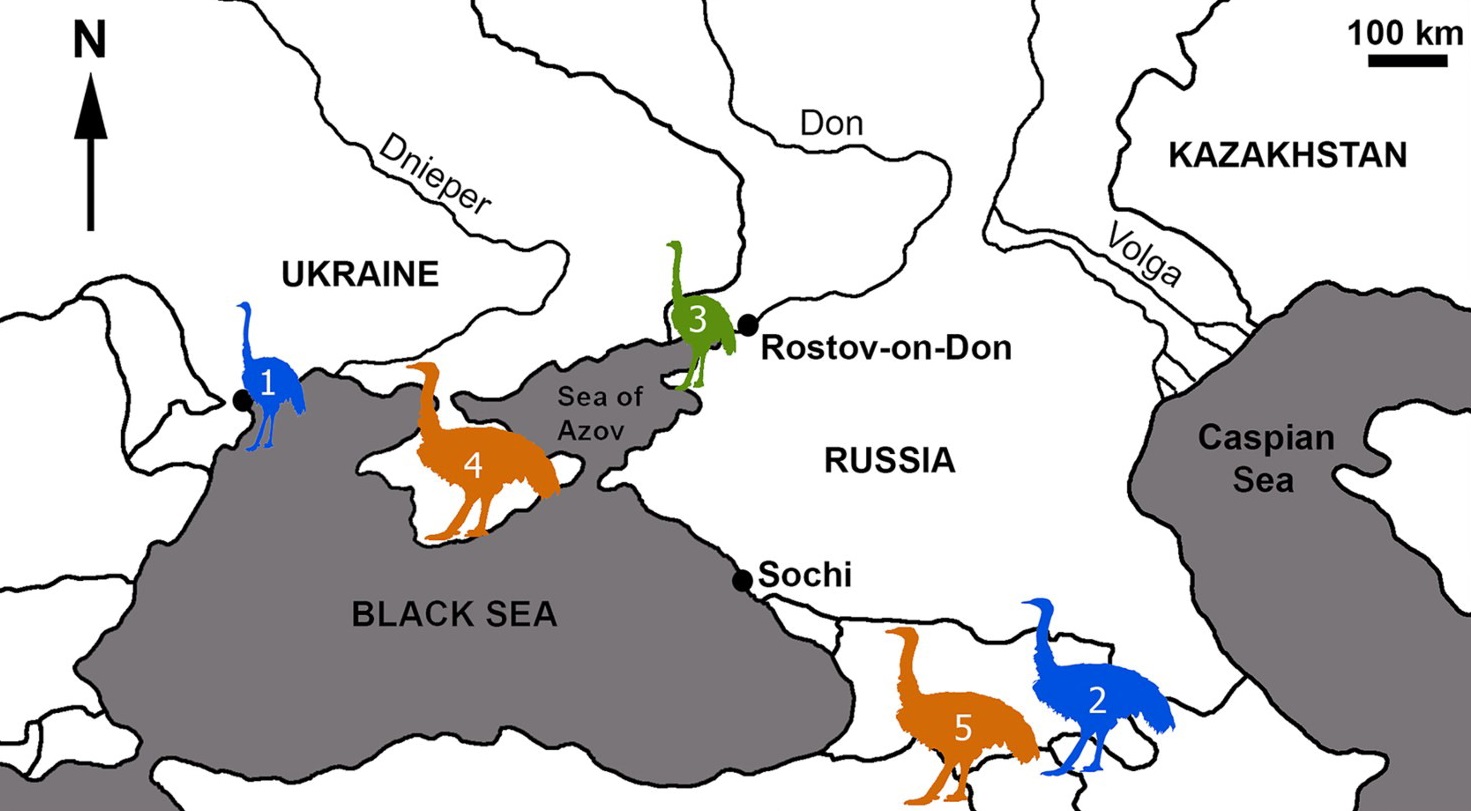
FIGURE 3. Map showing distribution of bony remains of the giant species of Pachystruthio (large ostrich silhouettes) and smaller Struthio ostriches (small ostrich silhouettes) in the Black Sea region in the Pliocene (5.3–2.6 Ma; blue), Gelasian (2.6–1.8 Ma; green), and Calabrian (1.8–0.8 Ma; brown). Pachystruthio from Hungary (Kretzoi, 1954) is not shown. Localities: 1, Odessa catacombs (early Pliocene); 2, Kvabebi (late Pliocene); 3, Liventsovka (Gelasian); 4, Taurida Cave (Calabrian); 5, Dmanisi (Calabrian).


 Nikita V. Zelenkov, Alexander V. Lavrov, Dmitry B. Startsev, Innessa A. Vislobokova and Alexey V. Lopatin. 2019. A Giant early Pleistocene Bird from eastern Europe: Unexpected Component of Terrestrial Faunas at the Time of early Homo arrival. Journal of Vertebrate Paleontology.  e1605521 DOI: 10.1080/02724634.2019.1605521
Half-tonne birds may have roamed Europe at same time as humans  theguardian.com/science/2019/jun/27/half-tonne-birds-roamed-europe-humans 


Monday, October 29, 2018

[Entomology • 2018] A Taxonomic Study of Eupolyphaga Chopard, 1929 (Blattodea: Corydiidae: Corydiinae)


Eupolyphaga nigrinotum
Qiu, Che & Wang, 2018


Abstract 
The cockroach genus Eupolyphaga is revised. Twenty species and two subspecies are recognized, with thirteen species and two subspecies are new to science: Eupolyphaga daweishana sp. nov., E. dongi sp. nov., E. fengi sp. nov., E. hanae sp. nov., E. hupingensis sp. nov., E. maculata sp. nov., E. nigrifera sp. nov., E. nigrinotum sp. nov., E. pilosa sp. nov., E. robusta sp. nov., E. shennongensis sp. nov., E. wooi sp. nov., E. xuorum sp. nov., E. everestiana reni subsp. nov., and E. fengi yongshengensis subsp. nov. Homœogamia sinensis Saussure is placed as a junior synonym of E. sinensis (Walker) and the replaced name E. limbata (Kirby) for Homœogamia sinensis is invalid, the status of Eupolyphaga thibetana (Chopard) is recovered. Male genitalia of species in the genus is described and illustrated. Females and oothecae of some species are described and illustrated. Distribution maps and a checklist of Eupolyphaga are provided. A key to males of Eupolyphaga is given. Plenty habitat photographs are shown.

Keywords: Blattaria, Polyphagini, new species, male genitalia, ootheca, cockroach

Eupolyphaga nigrinotum sp. nov. from Mt. Jizushan, Yunnan.
Female with a large ootheca.
photographed by Lu Qiu.

 Lu Qiu, Yang-li Che and Zongqing Wang. 2018. A Taxonomic Study of Eupolyphaga Chopard, 1929 (Blattodea: Corydiidae: Corydiinae).  Zootaxa. 4506(1); 1–68.   DOI: 10.11646/zootaxa.4506.1.1

Saturday, October 20, 2018

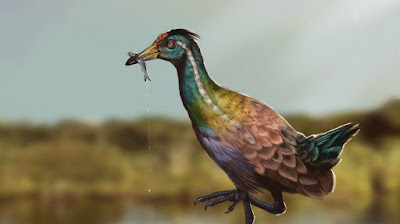
[Ornithology • 2019] Atlantisia rogersi • The Origin of the World’s Smallest Flightless Bird, the Inaccessible Island Rail (Aves: Rallidae)


Atlantisia rogersi Lowe, 1923

in Stervander, Ryan, Melo & Hansson, 2018. 

Highlights
Atlantisia rogersi colonized Inaccessible Island from S. America 1.5 million years ago.
• Its closest relative is the Dot-winged Rail Porzana spiloptera.
 • The well-supported clade also contains Black Rail Laterallus jamaicensis.
• We advise conservative taxonomic changes: Laterallus rogersi, L. spilopterus.
• Further sampling of the ‘Laterallus clade’ required for a fully resolved phylogeny.

Abstract
Rails (Aves: Rallidae) are renowned for their extreme dispersal capability, which has given rise to numerous island lineages. Many insular species lost the ability to fly as a response to release from predator pressure—a feature causing rapid extinction when humans subsequently introduced mammals. The world’s smallest extant flightless bird, the Inaccessible Island Rail Atlantisia rogersi, is endemic to Inaccessible Island, Tristan da Cunha archipelago, in the central South Atlantic Ocean. It is placed in a monotypic genus, but its taxonomic affinity, as well as geographic origin, are disputed. Contrary to its suggested Old World origin, we demonstrate that the Inaccessible Island Rail is nested within the mainly South American ‘Laterallus clade’ and that it colonized ≥3 million-year-old Inaccessible Island from South America c. 1.5 million years ago. The taxonomy of rails has traditionally been based on morphology, and convergent evolution has caused many cases of misclassification. We suggest a re-classification within the ‘Laterallus clade’ and call for extended coverage of taxon sampling for DNA sequencing.

Keywords: Colonization, Oceanic islands, Phylogeny, Phylogeography, Taxonomy


Fig. 1. (A) Map showing the location of Inaccessible Island of the Tristan da Cunha archipelago, and distances to continents and islands (the latter not drawn to scale). The approximate range of Dot-winged Crake Porzana spiloptera, sister species of the Inaccessible Island Rail Atlantisia rogersi, is shown with grey shading.

Fig. 1.  (B) Inaccessible Island Rail Atlantisia rogersi (photo: P.G.R.). (C) Dot-winged Crake Porzana spiloptera (photo: Alec Earnshaw). (D) Black Rail Laterallus jamaicensis, which is sister to B and C (photo: Chuck Streker). (E) Galápagos Crake Laterallus spilonota (photo: Jaime Chaves), which is presumed to belong to the same clade as B–D.


 Martin Stervander, Peter G. Ryan, Martim Melo and Bengt Hansson. 2018. The Origin of the World’s Smallest Flightless Bird, the Inaccessible Island Rail Atlantisia rogersi (Aves: Rallidae). Molecular Phylogenetics and Evolution. 130; 92-98.  DOI: 10.1016/j.ympev.2018.10.007 

Saturday, July 15, 2017

[Ornithology • 2017] Distinct Developmental Pathways Underlie Independent Losses of Flight in Ratites


Greater Rhea (Rhea americana) in the Brazilian Pantanal.
Faux and Field provide developmental support for the surprising hypothesis that rheas, as well as other ratites including ostriches and emus, have evolved flightlessness and large size independently.
photo: Daniel J. Field

Abstract

Recent phylogenetic studies question the monophyly of ratites (large, flightless birds incorporating ostriches, rheas, kiwis, emus and cassowaries), suggesting their paraphyly with respect to flying tinamous (Tinamidae). Flightlessness and large body size have thus likely evolved repeatedly among ratites, and separately in ostriches (Struthio) and emus (Dromaius). Here, we test this hypothesis with data from wing developmental trajectories in ostriches, emus, tinamous and chickens. We find the rate of ostrich embryonic wing growth falls within the range of variation exhibited by flying taxa (tinamous and chickens), but that of emus is extremely slow. These results indicate flightlessness was acquired by different developmental mechanisms in the ancestors of ostriches (peramorphosis) and the emu–cassowary clade (paedomorphosis), and corroborate the hypothesis that flight loss has evolved repeatedly among ratites.

KEYWORDS: ratites, flightlessness, evo devo, embryology, Palaeognathae, heterochrony


Cynthia Faux and Daniel J. Field. 2017. Distinct Developmental Pathways Underlie Independent Losses of Flight in Ratites. Biology Letters.  DOI: 10.1098/rsbl.2017.0234

  The face you make after seeing #BiologyLetters new cover... (photo from @daniel_j_field) via @RSocPublishing


Friday, January 13, 2017

[PaleoOrnithology • 2017] The Extreme Insular Adaptation of Garganornis ballmanni Meijer, 2014: A Giant Anseriformes of the Neogene of the Mediterranean Basin


Figure 4. Reconstruction of Garganornis ballmanni Meijer, 2014 based on the newly described fossil remains. This reconstruction is based on a generic Western Palaearctic Goose with short and robust tarsometatarsus, short toes and very short wings according to the known elements of Garganornis ballmanni.

Illustration made by Stefano Maugeri. 
DOI: 10.1098/rsos.160722 

Abstract

New skeletal elements of the recently described endemic giant anseriform Garganornis ballmanni Meijer, 2014 are presented, coming from the type-area of the Gargano and from Scontrone, southern and central Italy, respectively. The new remains represent the first bird remains found at Scontrone so far, and another shared element between these two localities, both part of the Apulia-Abruzzi Palaeobioprovince. The presence of a very reduced carpometacarpus confirms its flightlessness, only previously supposed on the basis of the very large size, while the morphologies of tarsometatarsus and posterior phalanges clearly indicate the adaptation of G. ballmanni to a terrestrial, non-aquatic, lifestyle. Its very large body size is similar to that observed in different, heavily modified, insular waterfowl and has been normally interpreted as the response to the absence of terrestrial predators and a protection from the aerial ones. The presence of a carpal knob in the proximal carpometacarpus also indicates a fighting behaviour for this large terrestrial bird species.

KEYWORDS: fossil bird, Anseriformes, flightlessness, insular gigantism, Miocene, Italy


Systematic Palaeontology

Class AVES Linnaeus, 1758
Order ANSERIFORMES Wagler, 1831

Family Insertae sedis

GARGANORNIS n. gen.
Meijer, 2014. DOI:  10.1016/j.crpv.2013.08.001 

Type species. Garganornis ballmanni n. sp.

Derivation of name. Masculine, after the Italian region Gargano where the quarries are located, and ‘ornis’, Greek for bird.; ‘ballmanni’ refers to Peter Ballmann who was the first to describe the fossil avifauna of Gargano.

Holotype. Distal left tibiotarsus (RGM 443307), Fig. 2.

Diagnosis. A very large representative of the order Anseriformes characterized by the following unique combination of characters; central placement of the canalis extensorius, medially displaced condylus medialis, fossa intercondylaris very wide and shallow, distal opening of canalis extensorius circular, a less pronounced difference in width of the condylus lateralis and condylus medialis, condylus medialis projecting further cranially than condylus lateralis, a reduced epicondylus lateralis and a modestly developed epicondylus medialis, a reduced sulcus m. fibularis, a deep sulcus extensorius and the lateral half of pons supratendineus sunken.

Type locality. Posticchia 5 fissure filling, Gargano pedemountain belt (41.8° N, 15.4° E), Province of Foggia, Italy.


Conclusion

The data presented here confirm the taxonomic validity of G. ballmanni as a strongly modified species of crown-group Anatidae endemic to the Late Miocene Apulia-Abruzzi Palaeobioprovince of central-southern Italy, on the basis of fossil remains found in the Gargano area and at Scontrone.

The newly described material, although not perfectly preserved, gives new osteological details of the morphology of G. ballmanni, which confirms its flightlessness and its extreme adaptation to a terrestrial, non-aquatic, lifestyle. Furthermore, we observed evidence for wing fighting behaviour.

Garganornis ballmanni also demonstrates the strong endemic character of the Late Miocene Apulia-Abruzzi Palaeobioprovince, already suggested by the highly modified mammals and birds. The Mediterranean Sea thus confirms its role as centre of speciation and its islands can also be confirmed to be an intermediate type of island, with faunal composition halfway between oceanic and continental ones, characterized by a very impoverished mammal fauna with high degree of endemism and no terrestrial carnivores, and by a diversified bird fauna with highly modified taxa.


Marco Pavia, Hanneke J. M. Meijer, Maria Adelaide Rossi and Ursula B. Göhlich. 2017. The Extreme Insular Adaptation of Garganornis ballmanni Meijer, 2014: A Giant Anseriformes of the Neogene of the Mediterranean Basin.  Royal Society Open Science.  DOI: 10.1098/rsos.160722 

Hanneke J. M. Meijer. 2014 A Peculiar Anseriform (Aves: Anseriformes) from the Miocene of Gargano (Italy) [Un ansériforme particulier (Aves : Ansériformes) en provenance du Miocène du Gargano, Italie]. C. R. Palevol. 13(1); 19–26. DOI:  10.1016/j.crpv.2013.08.001 


Abstract
A new large representative of the Anseriformes, Garganornis ballmanni n. gen. et n. sp., from the Miocene of Gargano, Italy, is described from the distal end of a left tibiotarsus. G. ballmanni displays morphological features that are characteristic of the Anseriformes, but differs from all extant and fossil Anseriformes, as well as from taxa closely related to Anseriformes. G. ballmanni is characterized by a very wide and shallow fossa intercondylaris, a less pronounced difference in width of the lateral and medial condyle, reduced epicondyli, and a circular opening of the distal canal. G. ballmanni is larger than any living member of Anseriformes, and with an estimated body mass between 15.3 and 22.3 kg, it was most likely flightless. Although the observed similarities between G. ballmanni and basal taxa might indicate that G. ballmanni represents an insular relict of a stem lineage, it is considered more likely that G. ballmanni was a species of waterfowl highly adapted to a terrestrial lifestyle in an insular environment where mammalian carnivores are rare.
Keywords: Anseriformes; Gargano; Italy; Miocene; Insular evolution

Conclusion: Garganornis ballmanni n. gen. et n. sp. displays morphological features that are characteristic for Anseriformes, but differs from all extant and fossil Anseriformes, as well as from taxa closely related to Anseriformes. Given the marked differences between G. ballmanni and related taxa, as well as the fact that important diagnostic features of the condyles are not preserved, I consider an “incertae sedis” position most appropriate. It should be noted however, that insular evolution can result in morphologies that deviate from the ancestral state, and make it difficult to trace a taxon's ancestry. The observed similarities between G. ballmanni and basal taxa might indicate that G. ballmanni represents an insular relict of one of these basal lineages. Although insular environments can serve as refugia and preserve stem lineages, an alternative hypothesis considers G. ballmanni a species of waterfowl highly adapted to an insular environment, with a morphology that is interpreted as adaptations to a terrestrial lifestyle in an environment where mammalian carnivores are rare. Given similar adaptations in waterfowl from other islands and the highly insular nature of the Gargano fauna, I consider the latter scenario most likely. G. ballmanni thus represents an example of convergent evolution of waterfowl in island ecosystems.

Résumé: Un nouveau grand représentant des ansériformes, Garganornis ballmanni n. gen. et n. sp., est décrit sur la base de l’extrémité distale d’un tibiotarse gauche dans le Gargano (Miocène, Italie). G. ballmanni présente des traits morphologiques qui sont caractéristiques des ansériformes, mais diffèrent de tous les ansériformes actuels et fossiles, ainsi que des taxons étroitement liés aux ansériformes. G. ballmanni est caractérisé par une fosse antérieure intercondylienne large et peu profonde, une différence peu prononcée dans la largeur des condyles latéral et médial, des épicondyli réduits, et une ouverture circulaire du canal distal. G. ballmanni est plus grand que tous les ansériformes actuels, et, avec une masse estimée entre 15,3 et 22,3 kg, il était probablement incapable de voler. Bien que les similitudes observées entre G. ballmanni et les taxons de base puissent indiquer que G. ballmanni représente une relique insulaire d’une lignée primitive, il est considéré comme plus probable que G. ballmanni ait été une espèce d’oiseau aquatique très adaptée à un mode de vie terrestre, dans un environnement insulaire où les mammifères carnivores étaient rares.
Mots clés: Ansériformes; Gargano; Italie; Miocène; Évolution insulaire