Showing posts with label Troodontidae. Show all posts

Thursday, January 15, 2026

[Paleontology • 2026] Xenovenator espinosai • A Thick-Skulled Troodontid Theropod (Maniraptora: Troodontidae) from the Late Cretaceous of Mexico


Xenovenator espinosai 
Rivera-Sylva, Aguillón-Martinez, Flores-Ventura, Sánchez-Uribe, Guzman-Gutierrez & Longrich, 2026


Abstract
Dinosaurs repeatedly evolved adaptations for sexual selection over their 150-million year history, including adaptations for display and intraspecific combat. Adaptations for intraspecific combat have not previously been described in non-avian maniraptorans. We report a troodontid from the Campanian Cerro del Pueblo Formation of Coahuila, Mexico, showing a thickened and domed skull roof. The cranium is domed and bones are extremely thick, a morphology convergent on that of Pachycephalosauridae. Referred specimens show less thickening or doming, suggesting ontogenetic changes or perhaps sexual dimorphism. The holotype shows fusion of the frontal midline suture and tightly interdigitating sutures between skull bones, and a rugose skull roof. The specializations seen here suggest adaptation for intraspecific combat, specifically head-butting as hypothesized for pachycephalosaurids and pachyrhinosaurin ceratopsids. Repeated evolution of elaborate weapons and display features in the Cretaceous suggests that sexual selection became increasingly important in dinosaur evolution during the Cretaceous.

Keywords: Dinosauria; Theropoda; Maniraptora; Troodontidae; Cretaceous; Campanian; Laramidia; sexual selection; intraspecific combat


Saurischia Seeley, 1888 
Theropoda Marsh, 1881  
Avetheropoda Paul, 1988  
Coelurosauria Von Huene 1914  
Maniraptora Gauthier 1986  
Deinonychosauria Colbert and Russell, 1969 
Troodontidae Gilmore, 1924  
Troodontinae van der Reest and Currie, 2017 

Troodontini n. tax.


Xenovenator gen. nov.

Diagnosis. Troodontid characterized by thick frontals, anterior displacement of frontal postorbital processes relative to the parietal suture, broad and transversely arched interfrontal ridge, broad frontal-lacrimal suture.

Etymology. Greek xenos, ‘strange’ + Latin venator, ‘hunter’.

Xenovenator espinosai sp. nov. 

Holotype. CPC 2973, braincase including frontals, parietals, orbitosphenoids, laterosphenoids, exoccipitals, prootics, basisphenoid, basioccipital (Figure 4, Figure 5, Figure 6, Figure 7 and Figure 8).
 
Etymology. The species name honors Luis Espinosa, a pioneer in the study of Mexican dinosaurs and mentor to many generations of paleontologists.

Diagnosis. Xenovenator characterized by the following characters (* = autapomorphy): frontals extensively fused; frontals, parietals, and other cranial bones with strongly interdigitating sutures *; strong doming of frontals *; frontals and parietals massive (up to 12 mm thick) *, thickening well-developed anteriorly and less well-developed in the center of the frontal *; dorsal surface of frontals and parietals rugose and striated *, nasal processes broad between lacrimals *, orbital fossae widely separated ventrally *, frontal with notch and shelf to receive posterior end of lacrimal, parietal forms narrow process inserting between frontals *; triangular parietal table *, anteroventral expansion of the orbitosphenoids and laterosphenoids to enclose braincase ventrally *.

Horizon and Locality. Cerro Del Pueblo Formation, uppermost/latest Campanian (Figure 3), Coahuila, Mexico. CPC 2973 and CPC 3112 are from the La Parrita locality, 54 km west of Saltillo; municipality of General Cepeda, Coahuila, Mexico. CPC 3112 is from the Ejido Trincheras locality, 109 km west of Saltillo, municipality of Parras de la Fuente, Coahuila, Mexico (Figure 2).


 Hector E. Rivera-Sylva, Martha C. Aguillón-Martinez, Jose Flores-Ventura, Ivan E. Sánchez-Uribe, Jose Ruben Guzman-Gutierrez and Nicholas R. Longrich. 2026. A Thick-Skulled Troodontid Theropod from the Late Cretaceous of Mexico. Diversity. 18(1), 38. DOI: doi.org/10.3390/d18010038 [9 January 2026]


Thursday, May 15, 2025

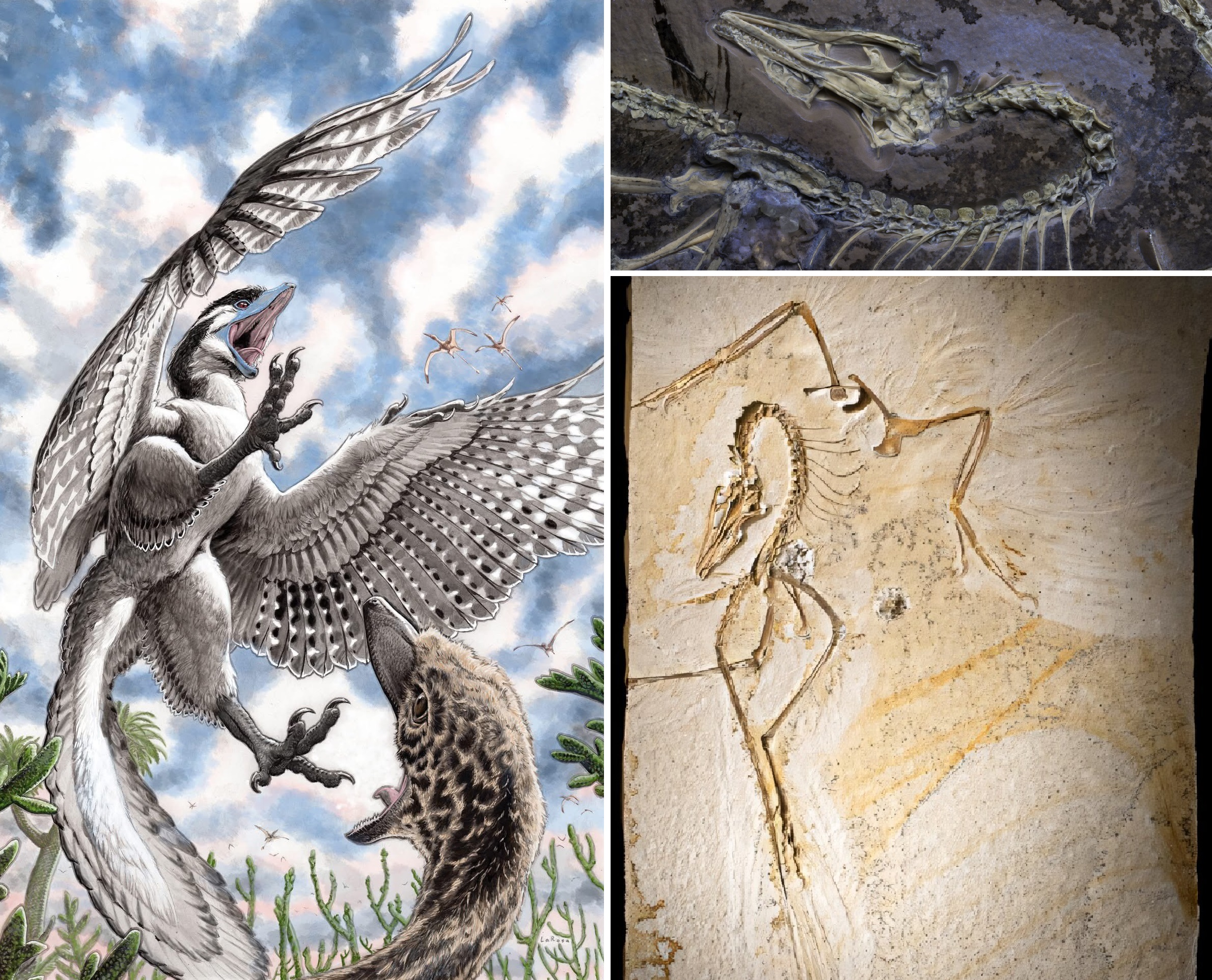
[Paleontology • 2025] Chicago Archaeopteryx informs on the early Evolution of the Avian Bauplan


Chicago Archaeopteryx 

in O’Connor, Clark, Kuo, Kiat, Fabbri, Shinya, Van Beek, Lu, Wang et Hu, 2025.
artwork by Lewis LF LaRosa (color by Adrienne Stroup)

Abstract
Here we report on the nearly complete and uncrushed 14th specimen of Archaeopteryx. Exceptional preservation and preparation guided by micro-computed tomographic data make this one of the best exemplars of this iconic taxon, preserving important data regarding skeletal transformation and plumage evolution in relation to the acquisition of flight during early avian evolution. The ventrolaterally exposed skull reveals a palatal morphology intermediate between troodontids and crownward Cretaceous birds. Modifications of the skull reflect the shift towards a less rigid cranial architecture in archaeopterygids from non-avian theropods. The complete vertebral column reveals paired proatlases and a tail longer than previously recognized. Skin traces on the right major digit of the hand suggest that the minor digit was free and mobile distally, contrary to previous interpretations. The morphology of the foot pads indicates that they were adapted for non-raptorial terrestrial locomotion. Specialized inner secondary feathers called tertials are observed on both wings. Humeral tertials are absent in non-avian dinosaurs closely related to birds, suggesting that these feathers evolved for flight, creating a continuous aerodynamic surface. These new findings clarify the mosaic of traits present in Archaeopteryx, refine ecological predictions and elucidate the unique evolutionary history of the Archaeopterygidae, providing clues regarding the ancestral avian condition.


Chicago Archaeopteryx 
artwork by Lewis LF LaRosa 
(color by Adrienne Stroup)

 
Jingmai O’Connor, Alexander Clark, Pei-Chen Kuo, Yosef Kiat, Matteo Fabbri, Akiko Shinya, Constance Van Beek, Jing Lu, Min Wang and Han Hu. 2025. Chicago Archaeopteryx informs on the early Evolution of the Avian Bauplan. Nature. DOI: doi.org/10.1038/s41586-025-08912-4 [14 May 2025] 

Thursday, August 1, 2024

[Paleontology • 2024] Hypnovenator matsubaraetoheorum • Early Cretaceous troodontine troodontid (Dinosauria: Theropoda) from the Ohyamashimo Formation of Japan reveals the early Evolution of Troodontinae


Hypnovenator matsubaraetoheorum
 Kubota, Kobayashi & Ikeda, 2024


Abstract
A new troodontid dinosaur, Hypnovenator matsubaraetoheorum gen. et sp. nov., is described based on an articulated postcranial skeleton recovered from the fluvial deposits of the Albian Ohyamashimo Formation of the Sasayama Group in Tambasasayama City, Hyogo Prefecture, Japan. Hypnovenator is distinguished from other troodontids by four autapomorphies and a combination of additional features. Our phylogenetic analysis positions Hypnovenator as the oldest and one of the most basal troodontines, forming a clade with Gobivenator mongoliensis. The discovery of Hypnovenator suggests that small-bodied maniraptorans with a sleeping posture were common not only in environments with volcanic and eolian events or alluvial systems but also in fluvial systems. Geometric morphometric analysis of manual ungual phalanges shows that manual ungual phalanges I and III of Hypnovenator exhibit considerable morphological variation but are functionally similar, which differs from those of non-troodontine troodontids, reflecting the transition of manual motion within Troodontinae. Hypnovenator also has mosaic features in the pes related to cursoriality. This study reveals that asymmetrical arctometatarsus occurred by the Albian, and some morphological changes, such as shorter digit IV than digit III and non-ungual phalanges of digits III with roller joints and digit IV with weakly ginglymoid articulation, arose during the early Late Cretaceous.

Keywords: Arctometatarsus, Geometric morphometric analysis, Sleeping posture, Theropoda, Troodontidae, Troodontinae, 


Hypnovenator matsubaraetoheorum gen. et sp. nov.
 Blocks including the forelimb, knee (A), and heel (B). (C) Reconstructed skeleton. Red and yellow colors show the confirmed and probable positions of the recovered elements, respectively (Courtesy of Genya Masukawa). (D) Left manus in medial view. (E) Left manual phalanx I-1 in dorsal view. (F) Removed fragmentary left manual phalanx II-3 (manual ungual phalanx II) for preparing the left manus. (G) Cross-section of the bent right ankle. (H) Left metatarsus in posterior view. 
 Abbreviations: as, astragalus; dp, depression; fe, femur; fi, fibula; hu, humerus; mc I, metacarpal I; mc II, metacarpal II; mc III, metacarpal III; mp I-1, manual phalanx I-1; mp I-2, manual phalanx I-2 (manual ungual phalanx I); mp II-1, manual phalanx II-1; mp II-3, manual phalanx II-3 (manual ungual phalanx II); mp III-3, manual phalanx III-3; mp III-4, manual phalanx III-4 (manual ungual phalanx III); mr, medial ridge; mt II, metatarsal II; mt III, metatarsal III; mt IV, metatarsal IV; mt V, metatarsal V; ra, radius; ti, tibia; ul, ulna. Almost all elements are from the left side. Abbreviations for elements from the right side added ‘(r)’ at the end. 

Systematic paleontology
Theropoda  
Coelurosauria 
Troodontidae 

Hypnovenator matsubaraetoheorum gen. et sp. nov.

Diagnosis: A troodontid with the following unique characters: a pair of proximodistally extended depressions on the proximodorsal surface of manual phalanx I-1; long dorsal and ventral proximal lips on manual phalanx III-2 for tight articulation with phalanx III-1; a proximodistally longitudinal medial ridge on the anterior surface of the femur proximal to the medial condyle; and distorted distal condyles with a widely convex distoventral margin on pedal phalanx III-3. Additionally, it is characterized by the following combination of two features: the thickest portion near the middle portion of the distal end of the ulna, and an angle of less than 11 degrees between the anterior edge of the cnemial crest and the anterior edge of the tibial shaft.

Locality and horizon: Hyogo Prefectural Tamba Namikimichi Central Park at Nishikosa, Tambasasayama City, Hyogo Prefecture, Japan; the early to middle Albian (112.1–106.4 Ma26) Ohyamashimo Formation of the Sasayama Group.


Etymology: The genus name derives from “hypno”, refers to “sleep” in ancient Greek, and “venator”, means “hunter” in Latin. The specific name, “matsubaraetoheorum”, honors Mrs. Kaoru Matsubara and Takaharu Ohe, who are the first discoverers of a block including a part of Hypnovenator matsubaraetoheorum holotype specimen.


Katsuhiro Kubota, Yoshitsugu Kobayashi and Tadahiro Ikeda. 2024. Early Cretaceous troodontine troodontid (Dinosauria: Theropoda) from the Ohyamashimo Formation of Japan reveals the early evolution of Troodontinae. Scientific Reports. 14: 16392. DOI: doi.org/10.1038/s41598-024-66815-2

Tuesday, July 16, 2024

[Paleontology • 2024] Harenadraco prima • The first troodontid (Theropoda: Troodontidae) from the Upper Cretaceous Baruungoyot Formation of Mongolia


Harenadraco prima
S. Lee, Y.-N. Lee, Park, Kim, Badamkhatan, Idersaikhan & Tsogtbaatar, 2024
 
artwork by Yusik Choi

ABSTRACT
Among non-avian dinosaurs, troodontids are relatively rare but diverse. The Nemegt Basin in the Mongolian Gobi Desert, which incorporates three of the most fossiliferous beds in the world, is one such region with high troodontid diversity and has also produced eight troodontid taxa until now. The diversity of troodontids is biased towards the two formations, Nemegt and Djadochta. Despite its rich vertebrate fossil record, no troodontids have been described from the Baruungoyot Formation. This faunal absence is perplexing as the Baruungoyot Formation has often been considered intermediate between the other two units in stratigraphy and paleoenvironment, but there are no definite troodontid materials that could fill this ‘gap.’ Here, we report a new troodontid, Harenadraco prima gen. et sp. nov., from the Baruungoyot Formation in Hermiin Tsav, Mongolia. It is represented by an incomplete skeleton that mainly consists of partially articulated left hind limb elements. Harenadraco is small and lightly built like other troodontids, but its tarsometatarsus exhibits extreme slenderness comparable only to Philovenator among cursorial non-avian maniraptorans. It also implies high cursoriality that could be an adaptation of Harenadraco to its environment where potential prey animals like mammals and predators such as eudromaeosaurs were likely to be agile. The discovery of Harenadraco confirms the presence of troodontids in all three formations in the Nemegt Basin.

 Left pedal phalanges and the skeletal reconstruction of the preserved parts in Harenadraco prima (MPC-D 110/119, holotype). A, left pedal digits II–IV in lateral view. 
 M, skeletal reconstruction of Harenadraco prima (MPC-D 110/119, holotype) with missing parts in gray.
Abbreviations: II-3, pedal phalanx II-3; III-3, pedal phalanx III-3; IV-2, pedal phalanx IV-2.

 Life reconstruction of Harenadraco prima 
(artwork by Yusik Choi).

DINOSAURIA Owen, 1842
THEROPODA Marsh, 1881

TROODONTIDAE Gilmore, 1924

HARENADRACO PRIMA, gen. et sp. nov.

Diagnosis—A small-sized troodontid diagnosed by the following unique combination of characters (autapomorphies indicated with an asterisk): tall S-shaped medial margin of medial condyle of astragalocalcaneum in anterior view*, poorly developed flexor sulcus on the distal articular end of metatarsal II, which also lacks collateral ligament fossae*, metatarsal III excluded from the proximal end of the metatarsus in dorsal view (shared with Tochisaurus, Zanabazar, and Philovenator), metatarsal IV only slightly more robust than metatarsal II at the proximal end in ventral view (shared with Daliansaurus and Philovenator), pronounced ventral protrusion near the proximal end of metatarsal IV (shared with Liaoningvenator), extremely narrow proximal shaft of metatarsal IV*, greatly elongated flexor tubercle of pedal phalanx II-3 that reaches the shaft of the preceding phalanx when in articulation*, and the distal articular surface of pedal phalanx III-3 not ginglymoid*.

Etymology—The name of the genus is a composition of the Latin words harena (sand) and draco (dragon). The species name “prima” means first in Latin, referring to the taxon being the first troodontid from the Baruungoyot Formation.
 

Sungjin Lee, Yuong-Nam Lee, Jin-Young Park, Su-Hwan Kim, Zorigt Badamkhatan, Damdinsuren Idersaikhan and Khishigjav Tsogtbaatar. 2024. The first troodontid (Dinosauria: Theropoda) from the Upper Cretaceous Baruungoyot Formation of Mongolia. Journal of Vertebrate Paleontology. e2364746. DOI: doi.org/10.1080/02724634.2024.2364746  

Tuesday, December 7, 2021

[Paleontology • 2021] The Phylogenetic Affinities and Morphological Peculiarities of the Bird-like Dinosaur Borogovia gracilicrus (Maniraptora: Troodontidae) from the Upper Cretaceous of Mongolia


Borogovia gracilicrus  Osmólska, 1987

in Cau​ & Madzia, 2021.
Artwork by Edyta Felcyn-Kowalska

Abstract 
Borogovia gracilicrus is a small-bodied theropod dinosaur from the Maastrichtian (Upper Cretaceous) Nemegt Formation of southern Mongolia. The taxon is based on a single fragmentary specimen preserving only the distal part of the hindlimbs. The morphology of Borogovia shows a peculiar combination of features, some of which are traditionally considered troodontid synapomorphies and others which are unusual for Troodontidae but are shared with other maniraptoran clades. In particular, the second toe of B. gracilicrus differs from other troodontids in lacking some of the features which contribute to the specialized ‘sickle-clawed’ second toe, here termed the ‘falciphoran condition’, shared with dromaeosaurids and some other paravians, such as the strongly compressed and falciform ungual. Phylogeny reconstructions intended to explore the affinities of Borogovia consistently support its referral within a subclade of troodontids including all Late Cretaceous taxa. The placement of Borogovia is not significantly affected by its unusual combinations of hindlimb features or by the homoplasy of the elements forming the falciphoran condition. Borogovia is supported as a valid taxon and is distinct from the other Nemegt troodontids, Tochisaurus and Zanabazar. The lack of a falciform ungual, and the distinctive morphology of the second toe in B. gracilicrus are interpreted as a derived specialization among Troodontidae and not as retention of the plesiomorphic condition of non-paravian theropods.


Theropoda Marsh, 1881 [Naish et al., 2020]
Paraves Sereno, 1997
Troodontidae Gilmore, 1924

Borogovia gracilicrus Osmólska, 1987


Conclusions: 
Borogovia gracilicrus is a troodontid dinosaur from the Nemegt Formation of Mongolia. Although overlapping material with the other Nemegt trooodontids (Tochisaurus nemegtensis and Zanabazar junior) is limited, Borogovia can be differentiated from these taxa based on the unique combination of features in its tibiotarsus and metatarsus.

The phylogenetic position of B. gracilicrus among Maniraptora is investigated in detail for the first time. This taxon is robustly supported as a member of Troodontidae, and reconstructed among non-troodontine troodontids. These results are not biased by a priori assumptions on character weighting.

The foot of Borogovia is autapomorphic and combines troodontid synapomorphies (e.g., the arctometatarsus) and the secondary loss of some elements of the falciphoran condition widespread among paravians. In particular, the morphology of the second toe of Borogovia might indicate an ecological niche distinct from those of other ‘deinonychosaur-grade’ paravians. Such a scenario could account for the co-occurrence of several troodontids in the paleofauna of the Nemegt Formation.


Andrea Cau​ and Daniel Madzia. 2021. The Phylogenetic Affinities and Morphological Peculiarities of the Bird-like Dinosaur Borogovia gracilicrus from the Upper Cretaceous of Mongolia. PeerJ.  9: e12640. DOI: 10.7717/peerj.12640.  

Monday, May 10, 2021

[Paleontology • 2021] The Early Origin of A Birdlike Inner Ear and the Evolution of Dinosaurian Movement and Vocalization


in Hanson, Hoffman, Norell et Bhullar, 2021.


Abstract
Reptiles, including birds, exhibit a range of behaviorally relevant adaptations that are reflected in changes to the structure of the inner ear. These adaptations include the capacity for flight and sensitivity to high-frequency sound. We used three-dimensional morphometric analyses of a large sample of extant and extinct reptiles to investigate inner ear correlates of locomotor ability and hearing acuity. Statistical analyses revealed three vestibular morphotypes, best explained by three locomotor categories—quadrupeds, bipeds and simple fliers (including bipedal nonavialan dinosaurs), and high-maneuverability fliers. Troodontids fall with Archaeopteryx among the extant low-maneuverability fliers. Analyses of cochlear shape revealed a single instance of elongation, on the stem of Archosauria. We suggest that this transformation coincided with the origin of both high-pitched juvenile location, alarm, and hatching-synchronization calls and adult responses to them.


 Michael Hanson, Eva A. Hoffman, Mark A. Norell and Bhart-Anjan S. Bhullar. 2021. The Early Origin of A Birdlike Inner Ear and the Evolution of Dinosaurian Movement and Vocalization. Science. 372, 6542. 601-609. DOI: 10.1126/science.abb4305
 
 Jonah N. Choiniere, James M. Neenan, Lars Schmitz, David P. Ford, Kimberley E. J. Chapelle, Amy M. Balanoff, Justin S. Sipla, Justin A. Georgi, Stig A. Walsh, Mark A. Norell, Xing Xu, James M. Clark and Roger B. J. Benson. 2021. Evolution of Vision and Hearing Modalities in Theropod Dinosaurs. Science. 372, 6542; 610-613. DOI: 10.1126/science.abe7941
 
Revealing behavioral secrets in extinct species
Extinct species had complex behaviors, just like modern species, but fossils generally reveal little of these details. New approaches that allow for the study of structures that relate directly to behavior are greatly improving our understanding of the lifestyles of extinct animals (see the Perspective by Witmer). Hanson et al. looked at three-dimensional scans of archosauromorph inner ears and found clear patterns relating these bones to complex movement, including flight. Choiniere et al. looked at inner ears and scleral eye rings and found a clear emergence of patterns relating to nocturnality in early theropod evolution. Together, these papers reveal behavioral complexity and evolutionary patterns in these groups.

Tuesday, March 2, 2021

[Paleontology • 2021] Tamarro insperatus • A Fast-growing Basal Troodontid (Theropoda: Maniraptora) from the latest Cretaceous of Europe


Tamarro insperatus  
Sellés, Vila, Brusatte, Currie & Galobart, 2021


Abstract
A characteristic fauna of dinosaurs and other vertebrates inhabited the end-Cretaceous European archipelago, some of which were dwarves or had other unusual features likely related to their insular habitats. Little is known, however, about the contemporary theropod dinosaurs, as they are represented mostly by teeth or other fragmentary fossils. A new isolated theropod metatarsal II, from the latest Maastrichtian of Spain (within 200,000 years of the mass extinction) may represent a jinfengopterygine troodontid, the first reported from Europe. Comparisons with other theropods and phylogenetic analyses reveal an autapomorphic foramen that distinguishes it from all other troodontids, supporting its identification as a new genus and species, Tamarro insperatus. Bone histology shows that it was an actively growing subadult when it died but may have had a growth pattern in which it grew rapidly in early ontogeny and attained a subadult size quickly. We hypothesize that it could have migrated from Asia to reach the Ibero-Armorican island no later than Cenomanian or during the Maastrichtian dispersal events.

Geographic and geological location of Sant Romà d’Abella site. Geographic location of the Tremp Syncline in the southern Pyrenean region (A). Geological map of the eastern part of the Tremp Syncline with the location of the Sant Romà d’Abella site (B). Landscape view of the fossil site (C) with a detailed picture showing the close spatial relationship between the troodontid metatarsal (MCD-7073) and axial elements of Pararhabdodon isonensis (D). Stratigraphic section at Sant Romà d’Abella area with the precise position of the fossiliferous Sant Romà d’Abella site (E).


The European troodontid Tamarro insperatus (MCD-7073) gen. et sp. nov. from the uppermost Maastrichtian of the Tremp Group, Tremp Basin, Southern Pyrenees. Photographic and interpretative ilustrations of the right second metatarsal in anterior (A-A’), lateral (B-B’), posterior (C–C’), medial (D-D’), and distal (F-F’) views. Scheme illustrating the gradual transition of the articular surface–grey arrow–for the accommodation of the metatarsal III (E). Detail of the distal end of the metatarsal II in anterior view showing the anterior contact surface of the metatarsal III (G). Detail of the articular surface of the metatarsal IV in the posterodistal part of the second metatarsal (H) ant anterior; f foramen; lat lateral; lc medial condyle; mc, lateral condyle; II–III contact between the second and third metatarsals; II–IV contact between the second and fourth metatarsals; plr plantar ridge; s sulcus.


Systematic palaeontology
Dinosauria Owen, 1842
Theropoda Marsh, 1881
Coelurosauria Huene, 1914
Maniraptora Gauthier, 1986
Troodontidae Gilmore 1924
? Jinfengopteryginae Turner, Makovicky, and Norell, 2012

Tamarro insperatus gen. et sp. nov.

 
Etymology: Tamarro, Catalan word referring to a small and elusive fantastic creature from the regional (Pallars county) folklore. Insperatus, from the Latin word for “unexpected”, in reference to the unexpected discovery of the specimen.

Holotype: MCD-7073, a partial right metatarsal II.

Diagnosis: Tamarro insperatus is a mid-sized basal troodontid distinguished by the following unique combination of characters (* marks potential autapomorphies): metatarsal II with marked plantar ridge; small foramen on the lateral surface of the plantar ridge of the metatarsal II*; sub-arctometatarsalian condition with the metatarsal III restricted to the plantar margin on its proximal part.

Type locality and age: Sant Romà d’Abella locality (Pallars Jussà, Catalonia); upper part of the Talarn Formation of the Tremp Group. The site is correlated with the C29r magnetochron14, latest Maastrichtian age.


Conclusions: 
The discovery of the new basal troodontid Tamarro insperatus at the very end of the Cretaceous in Europe represents the first evidence of bones of Troodontidae in Europe. Both phylogenetic and osteohistological results support the basal nature of the new taxon, most likely as a representative of the Asian clade Jinfengopteryginae. The histological analysis also has provided evidence for a mature individual with a high growth rate, which allowed the animal to attain subadult body size in a very short time. This growth strategy is similar to other basal troodontids, such as the Asian Mei long.

The fragmentary, yet controversial, record of troodontid-like teeth from Europe together with the likely Asian affinity of Tamarro, confirm that troodontids could have reached the ancient European Archipelago during the Late Cretaceous. Furthermore, the relatively large size of Tamarro insperatus compared with its closest phylogenetic relatives suggests it would be the largest among jinfengopterygines.

 
Albert G. Sellés, Bernat Vila, Stephen L. Brusatte, Philip J. Currie and Àngel Galobart. 2021. A Fast-growing Basal Troodontid (Dinosauria: Theropoda) from the latest Cretaceous of Europe. Scientific Reports. 11: 4855. DOI: 10.1038/s41598-021-83745-5

Thursday, July 11, 2019

[Paleontology • 2019] Hesperornithoides miessleri • A New Paravian Dinosaur from the Late Jurassic of North America supports A Late Acquisition of Avian Flight


Hesperornithoides miessleri 
Hartman, Mortimer, Wahl, Lomax, Lippincott & Lovelace, 2019

Illustration by Gabriel Ugueto twitter.com/SerpenIllus

Abstract 
The last two decades have seen a remarkable increase in the known diversity of basal avialans and their paravian relatives. The lack of resolution in the relationships of these groups combined with attributing the behavior of specialized taxa to the base of Paraves has clouded interpretations of the origin of avialan flight. Here, we describe Hesperornithoides miessleri gen. et sp. nov., a new paravian theropod from the Morrison Formation (Late Jurassic) of Wyoming, USA, represented by a single adult or subadult specimen comprising a partial, well-preserved skull and postcranial skeleton. Limb proportions firmly establish Hesperornithoides as occupying a terrestrial, non-volant lifestyle. Our phylogenetic analysis emphasizes extensive taxonomic sampling and robust character construction, recovering the new taxon most parsimoniously as a troodontid close to Daliansaurus, Xixiasaurus, and Sinusonasus. Multiple alternative paravian topologies have similar degrees of support, but proposals of basal paravian archaeopterygids, avialan microraptorians, and Rahonavis being closer to Pygostylia than archaeopterygids or unenlagiines are strongly rejected. All parsimonious results support the hypothesis that each early paravian clade was plesiomorphically flightless, raising the possibility that avian flight originated as late as the Late Jurassic or Early Cretaceous.

Figure 3: Reconstructed quarry map of WYDICE-DML-001. Association of skeletal elements assembled from 3D scans of specimen blocks prior to final mechanical preparation. Scale bar = 6 cm.

Figure 4: Primary blocks of WYDICE-DML-001. “Left” (A) and “right” (B) sides of the blocks after final preparation (B). Scale bar = one cm. Images taken by Levi Shinkle


Systematic Palaeontology

Theropoda Marsh, 1881
Maniraptora Gauthier, 1986
Paraves Sereno, 1997

Deinonychosauria Colbert & Russell, 1969
Troodontidae Gilmore, 1924

Hesperornithoides miessleri gen. et sp. nov.

Holotype: WYDICE-DML-001 (Wyoming Dinosaur Center, Thermopolis), a single, partially articulated skeleton consisting of most of an articulated skull and mandibles missing the anteriormost portions, hyoids, five cervical vertebrae, first dorsal vertebra, isolated anterior dorsal rib, portions of 12 caudal vertebrae, five chevrons, partial left scapula and coracoid, portions of the proximal left humerus and distal right humerus, left ulna and radius, radiale, semilunate carpal, left metacarpals I–III, manual phalanges III-2 and 3, manual unguals I, II, and III, ilial fragment, most of an incomplete femur, right and left tibiae and fibulae, left astragalus and calcaneum, portions of right and left metatarsal packets, left pedal phalanges III-1, III-2, III-3, IV-1, IV-2, IV-3, IV-4, and pedal unguals II and III and the proximal portion of IV.

Etymology: Hesper,” (Greek) referring to the discovery in the American West, “ornis,” (Greek) for bird and “oeides,” (Greek) for similar, referring to the avian-like form of derived paravians. The trivial epithet honors the Miessler family, who have been avid supporters of the project.

Occurrence: Douglas, Converse County, Wyoming, USA; middle portion of Morrison Formation, which has been variously dated between Oxfordian and Tithonian in age (Trujillo, 2006; Trujillo et al., 2014), associated vertebrate fossils include the sauropod Supersaurus, a stegosaurid plate, and isolated large theropod teeth.

Diagnosis: A paravian with the following derived characters: pneumatic jugal (also in Zanabazar and some eudromaeosaurs among maniraptorans); short posterior lacrimal process (<15% of ventral process length, measured from internal corner; also present in Zanabazar, Archaeopteryx, and Epidexipteryx); quadrate forms part of lateral margin of paraquadrate foramen; small external mandibular fenestra (<12% of mandibular length; also in Zhenyuanlong and Dromaeosaurus among non-avian paravians); humeral entepicondyle >15% of distal humeral width (also in some avialans); manual ungual III subequal in size to ungual II (also in Daliansaurus, IGM 100/44 and Mahakala); mediodistal corner of tibia exposed anteriorly (also in Archaeopteryx and Jeholornis).

Figure 5: Rigorous skeletal reconstruction of WYDICE-DML-001. Scale bar = 25 cm.


Figure 18: Partially expanded, time calibrated phylogenetic results. Clades containing potentially volant taxa (red) are expanded to show their position nested within flightless taxa (black). Taxa exhibiting aerial locomotion directly connected to crown clade Aves are colored blue. Zhongornis is colored purple to reflect the uncertainty revolving around this juvenile specimen. Barred lineages indicate uncertainty in age (Xiaotingia) or referred taxa (Koparion to troodontids and non-Jehol taxa to Confuciusornithiformes).

Conclusions: 
We have described Hesperornithoides miessleri, a new paravian theropod from the Late Jurassic of North America. We ran a phylogenetic analysis based on previous TWiG datasets with expanded taxonomic sampling and recovered it as a troodontid, the oldest diagnostic specimen from North America known from more than teeth. Hesperornithoides was clearly a non-volant, terrestrial theropod that spent at least a portion of its life in a marginal lacustrine or wetland environment. The terrestrial and flightless lifestyle is consistent with the base of Paraves, and with the base of paravian subclades, suggesting that avian flight evolved within Avialae, most likely in the Late Jurassic or Early Cretaceous.


Scott Hartman, Mickey Mortimer, William R. Wahl, Dean R. Lomax, Jessica Lippincott and David M. Lovelace. 2019. A New Paravian Dinosaur from the Late Jurassic of North America supports A Late Acquisition of Avian Flight. PeerJ. 7:e7247. DOI: 10.7717/peerj.7247

Meet Lori, a tiny dinosaur that may help explain how birds evolved flight  on.natgeo.com/2NHQ5RR  @NatGeoScience


Sunday, December 17, 2017

[Paleontology • 2017] Almas ukhaa • A New Late Cretaceous Troodontid from Ukhaa Tolgod, Ömnögovi Aimag, Mongolia


Almas ukhaa
Pei, Norell, Barta, Bever, Pittman & Xu, 2017

  DOI: 10.1206/3889.1 

ABSTRACT
A new troodontid dinosaur, Almas ukhaa, from the Late Cretaceous deposits of the Djadokhta Formation at Ukhaa Tolgod, Mongolia, is described here. The holotype specimen (IGM 100/1323) comprises an almost complete and articulated cranium and partial articulated postcranial skeleton. This specimen has a small body size and a short snout as in basal paravians, but it exhibits a number of derived troodontid features that differentiate Almas ukhaa from the Early Cretaceous troodontids reported from China and unite this new taxon with other Late Cretaceous troodontids. Relative to other troodontids, Almas ukhaa is autapomorphic in the presence of a posteriorly curved pterygoid flange, absence of a lateral groove on the anterior part of the dentary, presence of a distinct spikelike process on the ischium, and elongate chevrons. The eggshell associated with IGM 100/1323 can be assigned to Prismatoolithidae indet. based on the smooth surface, eggshell thickness, and microstructural characteristics, and also preserves attributes similar to Protoceratopsidovum minimum. A unique relationship between Byronosaurus and the perinate troodontids IGM 100/972 and IGM 100/974 is no longer supported based on the new observations of Almas ukhaa and Gobivenator.


FIGURE 2. Skull of IGM 100/1323 in right lateral view.

FIGURE 1. Type specimen of Almas ukhaa, IGM 100/1323.

SYSTEMATIC PALEONTOLOGY
THEROPODA MARSH, 1881
COELUROSAURIA HUENE, 1920
MANIRAPTORA GAUTHIER, 1986
TROODONTIDAE GILMORE, 1924

Almas ukhaa, new taxon

Etymology: Almas is in reference to the wild man or snowman of Mongolian mythology (Rincen, 1964). Ukhaa refers to the locality of Ukhaa Tolgod, discovered in 1993, where the specimen was collected. 


Rui Pei, Mark A. Norell, Daniel E. Barta, G.S. Bever, Michael Pittman and Xing Xu. 2017. Osteology of A New Late Cretaceous Troodontid Specimen from Ukhaa Tolgod, Ömnögovi Aimag, Mongolia. American Museum Novitates. 3889; 1-47.  DOI: 10.1206/3889.1
 digitallibrary.amnh.org/handle/2246/6818
ResearchGate.net/publication/321834802_Osteology_of_a_New_Late_Cretaceous_Troodontid_Specimen_from_Ukhaa_Tolgod_Omnogovi_Aimag_Mongolia