Showing posts with label Testudines. Show all posts

Thursday, June 4, 2026

[Paleontology • 2026] Patagoniaemys aeschyli • A New meiolaniform Turtle from the Maastrichtian of Northern Patagonia, Argentina


Patagoniaemys aeschyli
Agnolin, Rolando, Sterli, Chimento, Novas & Muñoz, 2026


Meiolaniformes are a group of chelonians including the famous horned-turtles Niolamia argentina (Patagonia) and Meiolania platyceps (Australia). In South America, the Late Cretaceous meiolaniforms are represented by two named taxa: Patagoniaemys gasparinae coming from Campanian–Maastrichtian beds of the La Colonia Formation, Chubut province, and Trapalcochelys sulcata from the Campanian–Maastrichtian beds of the Allen Formation, Río Negro Province. The aim of the present contribution is to describe a new meiolaniform chelonian coming from the Upper Cretaceous (Maastrichtian) Los Alamitos Formation, at Río Negro Province, Argentina. The material is represented by a partial basicranium, incomplete carapace and fragmentary postcranial bones (MPMIK 1839/P/33) belonging to a new species Patagoniaemys aeschyli. To this new species we refer all the material previously referred as indeterminate meiolaniid, meiolaniform and cf. Niolamia sp., coming from the same site and locality, and described by different authors since the 1980s. This new species differs from the type species P. gasparinae, particularly by the presence of longitudinal ridges in the nuchal bone. We also include brief comments about meiolaniform palaeobiogeography and the impact of K/Pg extinction event in Patagonian chelonians.

Key words: Testudinata, Meiolaniformes, Los Alamitos Formation, Maastrichtian, Cretaceous, Patagonia, Argentina.


Meiolaniform turtle Patagoniaemys aeschyli sp. nov. holotype (MPMIK 1839/P/33); Cerro Cuadrado locality, Argentina, Los Alamitos Formation Maastrichtian (Upper Cretaceous).
A. Carapace; anterior border in dorsal (A1, A2) and ventral (A3, A4) views, detail of the anterior margin in ventral view (A7, A8), showing the presence of longitudinal ridges that characterize the new species (light grey, nuchal bone; dark grey, broken surfaces).
B. Left hyoplastron fragment Scale bars 100 mm.

Testudinata Klein, 1760 
Meiolaniformes Sterli & de la Fuente, 2013 

Genus Patagoniaemys Sterli & de la Fuente, 2011a 
Type species: Patagoniaemys gasparinae Sterli & de la Fuente, 2011a;
Chubut Province, Argentina, Campanian–Maastrichtian. 

Patagoniaemys aeschyli sp. nov.

Diagnosis.—Large chelonian (maximum anterior carapace width about 60 cm, maximum inferred carapace length 80 cm). Referable to meiolaniforms by several features, namely the presence of small pits and grooves ornamenting carapace bones, anteriorly curved grooves among marginal scutes, opisthocoelous caudal vertebrae, and carapace-plastron connection through ligaments (Gaffney 1996; Hirayama et al. 2000; Sterli and de la Fuente 2013; Sterli et al. 2013). It is referred to Patagoniaemys by having a basioccipital with well-developed basal tubera with a concave surface between them, posteriorly flat occipital condyle, a shallowly notched anterior carapace margin, presence of a thickened bump on ...

Etymology: In reference to Aeschylus (525–455 BC), an ancient Greek writer often described as the father of tragedy. During a visit to the city of Gela (Italy), he was killed outside the city by a tortoise dropped by an eagle, which had mistaken his bald head for a rock suitable for shattering the shell.


the excavation work at the Los Alamitos Formation southwest of Cerro Cuadrado.  


Federico L. Agnolin, Mauro Aranciaga Rolando, Juliana Sterli, Nicolás R. Chimento, Fernando E. Novas, and Gonzalo L. Muñoz. 2026. A New meiolaniform Turtle from the Maastrichtian of Northern Patagonia, Argentina. Acta Palaeontologica Polonica. 71(1); 173-184. DOI: doi.org/10.4202/app.01268.2025 

DESCUBREN UNA TORTUGA GIGANTE DEL FIN DE LA ERA DE LOS DINOSAURIOS EN PATAGONIA

Thursday, December 18, 2025

[Paleontology • 2025] Byeoljubuchelys yeosuensis • A New, Early Cretaceous carettochelyid Turtle (Trionychia: Carettochelyidae) from South Korea provides insights into Softshell Evolution and Aquatic Ecology


Byeoljubuchelys yeosuensis
Kim, J. Jung, Joyce, Park, H.-Y. Jung, Jo & Huh, 2025


Abstract
Here, we present a new Cretaceous carettochelyid turtle, Byeoljubuchelys yeosuensis gen. et sp. nov., from the Lower Cretaceous Hasandong Formation of Yeosu, Korea. A nearly complete shell and select elements of the girdles and limbs provide crucial insight into the evolution and aquatic adaptation of this family. Phylogenetic analyses place Byeoljubuchelys yeosuensis at the most basal position within Carettochelyidae. The mid-sized plastron of Byeoljubuchelys yeosuensis appears to be plesiomorphic for the group. The expansion of the plastron during carettochelyid evolution, especially during the Paleogene, may be an evolutionary response to increasing body size or the threat of mammalian predators. Although the shell of Byeoljubuchelys yeosuensis lacks distinct scute sulci, traces are apparent that are reminiscent of juvenile scutes in the extant Carettochelys insculpta, suggesting that scute loss was facilitated in trionychian evolution through the thickening of the epidermis. Byeoljubuchelys yeosuensis possesses a plesiomorphic humerus with a proximally located lateral process and a sigmoidal shaft lacking torsion, implying rowing locomotion rather than the underwater flapping seen in more recent carettochelyids. The repeated acquisition of a softshell in two clades of trionychians during the mid-Cretaceous may be related to an environmental shift towards humid climates at that time, perhaps reflecting a remarkable adaptation to freshwater ecosystems.

Keywords: Byeoljubuchelys yeosuensis, Early Cretaceous, Hasandong formation, Korea, Carettochelyidae, Paleoecology, Micro-CT

Systematic paleontology
Testudines Batsch, 1788
Cryptodira Cope, 1868
Trionychia Hummel, 1929
Carettochelyidae Gill, 1889

Geographical and geological settings of the type locality of Byeoljubuchelys yeosuensis gen. et sp. nov. 
A, Geographical map of South Korea. B, Geological map of Gyeongsang Basin in South Korea. C, Geological map of Gwangyang Bay. D, Aerial photograph of Soneuk Island with adjacent islands. E, Photographs of the holotype in situ. The red asterisks indicate fossil locality


Byeoljubuchelys yeosuensis gen. et sp. nov.
Photographs (A, C) and micro-CT generated three-dimensional models (B, D) of the holotype [KDRC-YS-SR-001]
A, B, shell in dorsal view. C, D, shell in ventral view.
Abbreviations: co, costal; ent, entoplastron; epi, epiplastron; hyo, hyoplastron; hypo, hypoplastron; nc, nuchal; ne, neural; pe, peripheral; py, pygal; spy, suprapygal; xip, xiphiplastron
 
Byeoljubuchelys yeosuensis gen. et sp. nov.

Diagnosis—Byeoljubuchelys yeosuensis can be diagnosed as a member of Carettochelyidae by the presence of 10 pairs of peripherals, a single, triangular suprapygal, a thickened pygal with an anterior groove, plastral kinesis, a triangular entoplastron, and the absence of plastral scutes. It differs from other carettochelyids by the unique combination of the following characters: neurals and pygal lacking midline keel, neural series broad and continuous, a reversal of neural orientation at neural II, vermiculated peripheral ornamentation, absence of distinct carapacial scute sulci, a lack of paired nuchal processes, a relatively broad cruciform plastron, long cervical vertebrae, and a humerus with sigmoidal shaft and lateral and medial processes at the level of the humeral head.

Type Locality and Horizon—Soneuk Island, Yeosu, Republic of Korea, near the Aptian/Albian boundary, Early Cretaceous.

Etymology—The genus name ‘Byeoljubuchelys’ is derived from the combination of the Korean word ‘Byeoljubu’, a turtle character in Sugungga, one of the epic tales of Pansori (a traditional Korean musical storytelling art), and the Ancient Greek word ‘chelys’ meaning turtle. The species name ‘yeosuensis’ is derived from Yeosu City, where the fossil was found.
 
The peripherals and pygal of KDRC-YS-SR-001, holotype of Byeoljubuchelys yeosuensis gen. et sp. nov. 
Interpretive drawing of carapace in dorsal view and micro-CT generated three-dimensional models of peripherals in dorsal and posterior view. Dotted lines express the reconstructed outline of peripherals and pygal. pe, peripheral
 
 
Minguk Kim, Jongyun Jung, Walter G. Joyce, Jae-Il Park, Hye-Yeon Jung, Hyemin Jo and Min Huh. 2025. A New, Early Cretaceous carettochelyid Turtle from South Korea provides insights into Softshell Evolution and Aquatic Ecology. Swiss Journal of Palaeontology. 144, 75. DOI: doi.org/10.1186/s13358-025-00415-z [08 December 2025]

Thursday, November 20, 2025

[Paleontology • 2025] Shakiremys colombiana • Mosaic Morphology in Podocnemididae (Pleurodira) revealed by A New turtle from the Middle Miocene La Venta Biome, Colombia


 Shakiremys colombiana  
 Cadena, Leal-Amaya, A. Vanegas-Vanegas, R. D. Vanegas-Vanegas & Guevara-Serrano, 2025
  
Illustration by Juan Giraldo

Abstract
A new genus and species of podocnemidid turtle, Shakiremys colombiana, is described here from the Middle Miocene La Venta Biome, located in south-central Colombia. The new taxon is represented by two specimens: one consisting of a complete skull and articulated shell, and the other of an articulated shell only. Shakiremys colombiana is distinguished from other podocnemidids by the following combination of features: intermediate roofing of the temporal emargination; a jugal retracted from the orbital margin; a flatter, more rectangular carapace outline; peripherals 2 with a short, protruding anteromedial margin; vertebral scute 1 narrower than the others and not reaching peripherals 1; the gular scute reaching the pectorals and completely separating the humerals; and anterior plastral lobe margin almost straight. It also has an additional mosaic of characteristics found in Podocnemidinae, Erymnochelyinae and Peltocephalinae. A phylogenetic analysis recovered Sh. colombiana as the basalmost member of a large clade that includes both Erymnochelyinae and Peltocephalinae. Additionally, computed tomography was used to reconstruct and compare the neuroanatomical features of Sh. colombiana with other podocnemidids. The mosaic traits observed in Sh. colombiana are interpreted as advantageous for a broader dietary and ecological spectrum, potentially including an omnivorous diet, and the ability to thrive in various aquatic environments, ranging from blackwater to whitewater habitats. This ecological versatility may have offered a competitive advantage for Sh. colombiana within the diverse palaeoecosystem of La Venta, where multiple podocnemidid and chelid turtle species coexisted.

Keywords: turtle, pleurodire, Miocene, South America, La Victoria Formation


SYSTEMATIC PALAEONTOLOGY

TESTUDINES Batsch 1788 sensu Joyce et al. 2020 
PLEURODIRA Cope 1864 sensu Joyce et al. 2020 
PELOMEDUSOIDES Broin 1988 sensu Joyce et al. 2021 
PAN-PODOCNEMIDIDAE Joyce et al. 2004 sensu Joyce et al. 2021 
PODOCNEMIDIDAE Cope 1868 sensu Joyce et al. 2021 

Genus Shakiremys nov.
 
Derivation of name: In honour of Shakira, a Colombian singer who has inspired generations with her music and dance; music that has accompanied the first author's fieldwork for decades. Shakira also serves as an example of uniqueness, much like the fossil turtle described herein.


Shakiremys colombiana sp. nov.
 
Derivation of name: From Colombia, the country where the species was discovered.

Holotype: VPPLT-1730, complete skull (Figs 2, 3A−C, 4A−B) and articulated shell (carapace and plastron) (Figs 5, 6), belonging to a single individual (Fig. 1D).
 

Palaeoartist's reconstruction of the podocnemidid Shakiremys colombiana gen. et sp. nov. and the fluvial ecosystem.
Illustration by Juan Giraldo.

 
Edwin-Alberto Cadena, David E. Leal-Amaya, Andrés Vanegas-Vanegas, Rubén D. Vanegas-Vanegas, Lino J. E. Guevara-Serrano. 2025. Mosaic Morphology in Podocnemididae revealed by A New turtle from the Middle Miocene La Venta Biome, Colombia. Papers in Palaeontology. DOI: doi.org/10.1002/spp2.70051 [17 November 2025]


Saturday, November 1, 2025

[Paleontology • 2025] Manouria morlathe Ancient One: An Early Miocene large Tortoise (Cryptodira: Testudinidae) from the Swamps of Ahníkov, Czechia


Manouria morla   
Chroust, Szczygielski & Luján, 2025
  
Digital painting by Rudolf Hima

Abstract
Tortoises (Testudinidae) are a clade of turtles highly specialized to terrestrial environments, mainly living in semi-arid conditions. Herein, we present Manouria morla sp. nov., a new species of the genus Manouria, which is considered to be the most basal extant testudinid genus. The studied material comes from the Ahníkov I fossil site, formerly known as Merkur or Merkur-North, located in the Most Basin in NW Bohemia (Czechia), dated to the Early Miocene (Burdigalian, MN 3). Manouria morla sp. nov. is the oldest member of the Manouria lineage, which nowadays inhabits SE Asia only, and therefore its biogeography and plausible European origin are discussed. The specific type of multiplication of plastral scutes in the inguinal region is discussed as a new morphological character diagnostic for the genus. Based on zoological studies, specific environmental requirements of the genus Manouria allow us to use this taxon as a proxy for the paleoclimate reconstruction of the Ahníkov I fossil site which suggests a broadleaf evergreen tropical wet forest. The simplified use of fossil testudinids as a proxy for reconstructing semi-arid palaeoclimate is therefore disproven.

Manouria morla sp. nov. (Ahníkov I, Early Miocene),
anterior part of the plastron in A internal view (photograph), B external view (photograph), C internal view, D external view, E left lateral view, F anterior (epiplastral) view, G right lateral view. Posterior part of the plastron in H internal view (photograph), I external view (photograph), J internal view, K external view

Hypothetical reconstruction of the shell of Manouria morla sp. nov. (Ahníkov I, Early Miocene).
A dorsal view of the carapace, B ventral view of the plastron, C dorsal view of the plastron. Preserved parts indicated in grey color


Systematic palaeontology
Testudinata Klein, 1760
Cryptodira Cope, 1868
Testudinoidea Fitzinger, 1826

Pan-Testudinidae Joyce et al., 2004
Testudinidae Gray, 1825

Genus Manouria Gray, 1854

Manouria morla sp. nov. 

Diagnosis: The genus Manouria can be diagnosed by the following autapomorphies: prominent visceral rims associated with the body wall attachment, developed close to the sutures between the peripherals and costals (also on the nuchal and the pygal); thin carapacial elements (costals/neurals); axillary buttresses long and thin and just barely in contact with costal bones; the visceral surface of costal 5 shows the attachment for the inguinal buttress; the sinusoidal shape of the posterior carapacial edge; the presence of the pygal notch; the presence of 12 marginal pairs; coincidence between the costo-peripheral suture and the pleuro-marginal sulcus; significant serration of the posterior peripherals; posterior sulcus of the fifth vertebral coinciding with the suprapygal-pygal suture; overlap of the plastral scutes into the dorsal surface of the anterior and posterior plastral lobes; lateral portion of the humero-pectoral sulcus perpendicular to the axial plane and anteriorly deflected; pectorals medially short; contact between the inguinal and femoral scutes is present; the presence of the multiplication of inguinal scutes.

Etymology. The species is named after Morla, a fantasy character from the book The Neverending Story (orig. Die unendliche Geschichte) written by Michael Ende (1929–1995), firstly published in 1979, later adapted as a movie in 1984. Morla, the Ancient One, is a giant tortoise who lives in the Swamps of Sadness. The new species described herein is the oldest known species of the genus from the Early Miocene of Czechia; therefore, the Ancient One. Its remains come from the swamp deposits of Ahníkov, a parallel to the Swamps of Sadness.

Life restoration of Manouria morla sp. nov.  
Digital painting by Rudolf Hima
 
Conclusion: 
We describe Manouria morla sp. nov., the oldest member of the extant genus Manouria, from the Ahníkov I (formerly known as Merkur or Merkur-North) fossil site from Czechia (MN 3, Early Miocene). To aid the description, Manouria morla sp. nov. was scored and included in a phylogenetic analysis. According to our results, it seems that the genus Manouria originated in Europe just before the MMCO and later spread to Asia, where it persists until now. In the end, the use of the genus Manouria as an environmental indicator is coherent with the knowledge of the swamp ecosystem of the Most Basin.
 

Milan Chroust, Tomasz Szczygielski and Àngel H. Luján. 2025. Manouria morla sp. nov., the Ancient One: an Early Miocene large tortoise from the Swamps of Ahníkov, Czechia. Swiss Journal of Palaeontology. 144, 63. DOI: doi.org/10.1186/s13358-025-00400-6 [03 October 2025]
  x.com/HimaRudolf/status/1974115834210725948


Wednesday, October 8, 2025

[Paleontology • 2025] Helianthochelys redondita • the southernmost dermochelyid turtle from the Miocene


Helianthochelys redondita 
Sterli, Vlachos, Cuitiño, Cerda & Buono, 2025


Abstract
 Dermochelyids are a unique lineage of turtles where the primary carapace underwent an extreme reduction, with its maximum expression in the extant Dermochelys coriacea. Above the primary carapace (thecal), a secondary (epithecal) carapace formed by thousands of ossicles appeared in the late Paleocene. In general, the fossil record of dermochelyids is incomplete, fragmentary, and patchy. Besides, no indepth and detailed studies on their anatomy led to a poorly resolved alpha taxonomy. In this contribution, we present one of the most complete dermochelyids in the world. Our new turtle was found in the Gaiman Formation (Lower Miocene) in Chubut, Argentina. This Burdigalian record of Patagonia represents the southernmost species in the fossil record of dermochelyid turtles in the Southern Hemisphere in the Miocene. The histological analysis of long bones shows a highly remodeled cortex, a unique condition in turtles. The tissue compaction recorded in this new turtle would suggest it was a very old individual. The phylogenetic analysis recovered the new species in a clade characterized by longitudinal ridges in the carapace and ossicles arranged in a “sunflower” pattern. Exploring the diversity patterns of dermochelyids, we recognize two peaks of diversity and three extinction events, comparable with those observed in other marine tetrapods (e.g., cetaceans, penguins). 

Key words. Dermochelyidae. Marine tetrapods. Gaiman Formation. Patagonia. Diversity.

Anatomy of Helianthochelys redondita gen. and sp. nov. MPEF-PV 10918 from the Gaiman Formation of Chubut Province, Argentina.
1, dorsal view of the carapace with a reconstruction of the carapace outline. 2, oblique view of the carapace showing the primary, middle, secondary, and tertiary ridges. 3, detail of the carapace showing the sunflower pattern and defining the disc and ray ossicles; white scale bar equals 10 cm. 4, visceral view of the carapace showing the various bones in their recovery position. Black scale bar equals 50 cm.

  Testudinata Klein, 1760 (sensu Joyce et al., 2020a) 
Testudines Batsch, 1788 (sensu Joyce et al., 2020b) 
Cryptodira Cope, 1868 (sensu Joyce et al., 2020c) 
Durocryptodira Danilov & Parham, 2006 (sensu Joyce et al., 2021) 
Americhelydia Joyce et al., 2013 (sensu Joyce et al., 2021) 
Chelonioidea Baur, 1893 (sensu Joyce et al., 2021) 
Dermochelyidae Lydekker, 1889 (sensu Joyce et al., 2021) 

Helianthochelys redondita gen. et sp. nov.  

Derivation of the name. The generic name, Helianthochelys, comes from the combination of the Greek words ήλιος (Helios, sun) and ανθός (anthos, flower) combined as “sunflower” and the feminine word χέλυς (chelys, turtle), in allusion to the sunflower pattern of ossicles in the secondary carapace. The specific name, redondita, refers to the type locality Estancia La Redonda Chica, hence the Latin diminutive -ita in the end. 

Holotype. MPEF-PV 10918, almost complete carapace (secondary ossicles and nuchal bone) with a putative skull fragment (jugal) and postcranial elements (cervical vertebrae 4, 7, and 8, ten thoracic vertebrae, thoracic ribs, two sacral neural arches, three caudal vertebrae, both scapulae, both pubes, both ischia, both ilia, right femur), forming part of the paleoherpetological collection of MPEF (see Sterli et al., 2021 for additional information). 

Type locality. Coastal creek located 5 km east of La Redonda Chica House in La Redonda Chica Farm, Chubut province, Argentina (Fig. 2). Age. Gaiman Formation, Burdigalian, Early Miocene (Cuitiño et al., 2023). 

Diagnosis (same for genus and species). Helianthochelys redondita is a dermochelyid turtle, based on the presence of a mosaic carapace (psephophore dermochelyid turtles) and the remaining diagnostic synapomorphies listed above. Helianthochelys redondita shares with other more crownward dermochelyids the presence of the characteristic sunflower pattern formed by the ossicles (helianthophore dermochelyid turtles). Differs from Natemys and is associated with more derived helianthophores in the absence of some elongated ossicles and the presence of anteroposterior ridges. Differs from the type of Psephophorus polygonous and is associated with other closely related taxa from the Atlantic coasts (e.g., “Psephophorusscaldii and Westerschelde specimen from Europe and “Psephophoruscalvertensis from the Atlantic side of North America) due to the absence of change of curvature until the tip of the ridge, in cross-section. Differs from all these Atlantic helianthophores based on the presence of secondary (and even tertiary) anteroposterior ridges between the five primary ridges. Differs from the Westerschelde specimen and “Psephophoruscalvertensis and is more closely related to “Psephophorusscaldii based on higher counts of “ray” ossicles around the central “disk” ossicle (up to 13 ossicles) and the presence of comparatively thinner, medium-thick (0.6–1.1 cm) ossicles as well. Differs from “Psephophorus” scaldii based on the disk/ray pattern: Helianthochelys redondita has usually three ray ossicles between two successive disk ossicles, whereas “Psephophorus” scaldii has, usually, a single ray ossicle between two successive disk ossicles.  


Juliana Sterli, Evangelos Vlachos, José Ignacio Cuitiño, Ignacio A. Cerda, and Mónica Romina Buono. 2025. SOUTHERNMOST DERMOCHELYID TURTLE FROM THE MIOCENE. AMEGHINIANA. 62(4); 1–19. https://www.ameghiniana.org.ar 
https://www.ameghiniana.org.ar/index.php/ameghiniana/libraryFiles/downloadPublic/149
https://x.com/mefpatagonia/status/1974240673780916342

Sunday, September 14, 2025

[Paleontology • 2025] Ueloca colemanorum • A New Leatherback Marine Turtle from the lower Oligocene of North America and A Phylogenetic Nomenclature for Dermochelyidae


Ueloca colemanorum 
 Gentry, Burns, Ebersole, Gregson, Martinez & Parham, 2025 

Abstract
The modern leatherback sea turtle Dermochelys coriacea possesses a unique, flexible mosaic carapace adapted for deep diving. The evolutionary origins of this structure remain poorly understood because of the fragmentary nature of the fossil record. Here we describe Ueloca colemanorum n. gen. n. sp., a novel ridgeless leatherback turtle from the lower Oligocene Glendon Limestone of Alabama, USA. This specimen (MSC 49490) represents one of the most complete fossil leatherback carapaces known and provides new insight into dermochelyid diversity and shell evolution. The carapace is composed of parallel rows of enlarged ossicles interspersed with smaller ossicles arranged in distinctive floriform patterns. Histological analysis reveals a cancellous core with an external cortex but no basal cortex, a condition also observed in Dermochelys coriacea. Phylogenetic analysis places Ueloca within a clade of ridgeless leatherbacks (Uelocini), which diverged from ridge-bearing Dermochelyini in the Eocene. Our revised phylogeny suggests that Uelocini and Dermochelyini represent the two main lineages of dermochelyines, both characterized by mosaic carapaces that undergo parallel morphological trends. These findings clarify the deep history of leatherback shell evolution and emphasize the need for additional well-preserved fossils to further refine dermochelyid systematics.

KEYWORDS: Dermochelys, Glendon Limestone Member, Gulf Coastal Plain, North America

Ueloca colemanorum n. gen. n. sp. from the lower Oligocene of Alabama, USA.
A, B – MSC 49490, holotype, carapace in dorsal view. Scale bar = 10 cm.

Dermochelyinae Weems, 1988
Uelocini new clade

Ueloca new genus
 
Etymology: The generic name, Ueloca (pronounced Wee-low-juh), is a Mvskoke (Creek) name derived from the Mvskoke words “Uewv” for water and “Loca” for turtle. This name honors the indigenous people of southern Alabama and serves as recognition of the contributions of Poarch Creek Indian tribal members to this project.

 Ueloca colemanorum n. gen. n. sp. 
 
Ueloca colemanorum new species
  
Etymology: The species name, colemanorum, honors the Coleman family (Adrienne, Adam, Talah, and Corey) of Mobile, Alabama, who discovered MSC 49490 and then dedicated an extraordinary amount of time, energy, and resources to its recovery.

Holotype: MSC 49490.

Occurrence: Site AMo-10, Monroe County, AL, USA. Lower Oligocene (Rupelian) Glendon Limestone Member of the Byram Formation (NP 22, 33–32 Ma).

Diagnosis: Ueloca colemanorum can be differentiated from most dermochelyids by an absence of carapacial ridges and by having a carapace with parallel, anteroposteriorly oriented rows of enlarged ossicles and clusters of ossicles arranged in floriform or ‘sunflower’ patterns. U. colemanorum. can be distinguished from other ridgeless dermochelyids with floriform ossicle patterns (Ca. rupeliensis and N. peruvianus) by having unsculptured ossicles that regularly exceed 4 cm in length, that are not associated with either floriform patterns or rows of enlarged ossicles, lacking deeply interdigitating ossicle sutures, and having central ossicles of floriform patterns which are only moderately scalloped.


Andrew D. Gentry, Michael E. Burns, Jun A. Ebersole, Kimberly A. Gregson, Emma C. Martinez and James F. Parham. 2025. A New Leatherback Marine Turtle from the lower Oligocene of North America and A Phylogenetic Nomenclature for Dermochelyidae. Palaeodiversity. 18(1):127-149. DOI: doi.org/10.18476/pale.v18.a6 [12 September 2025]

Tuesday, September 2, 2025

[Paleontology • 2025] Tavachelydra stevensoni • A New Pan-chelydrid Turtle (Chelydroidea: Pan-Chelydridae) from the lower Paleocene (early Danian, Puercan) Corral Bluffs Study Area in the Denver Basin, Colorado


Tavachelydra stevensoni
Lyson, Petermann, Bastien, Toth, Tamez-Galvan, Sherman & Joyce, 2025 
 
Artwork by Andrey Atuchin  facebook.com/AndreyAtuchin

Abstract
Isolated pan-chelydrid turtle shell fragments are common in Late Cretaceous and early Paleocene sediments across western North America, but more complete and associated specimens are rare, obfuscating our understanding of the group’s early evolution. Here we describe a new genus and species, Tavachelydra stevensoni, of stem-chelydrid turtle from the early Paleocene of the Denver Formation (Danian, Puercan I and II) of Colorado based on complete shells, associated pelvic material, and referred cranial material. Our phylogenetic analysis places T. stevensoni as the immediate sister to crown chelydrids based on, among others, a purely ligamentous attachment of the plastron and carapace. The costiform process of the nuchal, an important character complex in chelydroid turtles, shows variation in either ending in peripheral II or III. The T. stevensoni material was mostly found in laminated fine-grained deposits, suggesting this taxon inhabited ponded-water environments. The referred cranial material shows broad triturating surfaces indicating a durophagous diet, further underscoring durophagy as an important feeding strategy during the early Paleocene.

Testudines, Chelydroidea, Pan-Chelydridae, Taphonomy, Durophagy

A reconstruction of Tavachelydra stevensoni gen. et sp. nov. basking on a log in a ponded water environment.
Artwork by Andrey Atuchin

 
Tyler R. Lyson, Holger Petermann, Salvador Bastien, Natalie Toth, Evan Tamez-Galvan, Sadie M. Sherman and Walter G. Joyce. 2025. A New Pan-chelydrid Turtle, Tavachelydra stevensoni gen. et sp. nov., from the lower Paleocene (early Danian, Puercan) Corral Bluffs Study Area in the Denver Basin, Colorado. Swiss Journal of Palaeontology. 144; 46. DOI: doi.org/10.1186/s13358-025-00375-4 [05 August 2025]

[Paleontology • 2025] Craspedochelys renzi • The First Occurrence of “Plesiochelyidae” Marine Turtles in the early Cretaceous of South America


Craspedochelys renzi 
Cadena, Carrillo-Briceño, Bastiaans, Fairbanks-Freund, Costeur & Scheyer, 2025 

Illustration by Juan Giraldo

Abstract
Thalassochelydians represent one of the earliest radiations of coastal to marine-adapted turtles, spanning from the Jurassic to Cretaceous periods. This study describes Craspedochelys renzi sp. nov., a new thalassochelydian, “plesiochelyid” turtle from the Hauterivian stage of the Early Cretaceous in Colombia. It is the youngest and the only known record of “Plesiochelyidae’ outside Europe. The holotype, housed at the Naturhistorisches Museum Basel, was rediscovered after over 60 years and includes a partial shell, hindlimb bones, and caudal vertebrae. C. renzi shares key traits with “Plesiochelyidae”, including a V-shaped posterior plastral lobe lacking an anal notch; an indentation at the hypoplastra-xiphiplastra contact; an “intermediate” bone between neural 8 and suprapygal 1; a fully ossified carapace and bridge; and absence of carapacial fontanelles. Within “Plesiochelyidae”, it is assigned to Craspedochelys by its broader carapace, with an estimated length/width ratio of 4.12 for left costal 4, similar to other species in the genus; a relatively shorter plastron; and wider hyoplastra. Geological evidence links the specimen to the Moina Formation, a shallow marine deposit from the Hauterivian. This discovery expands the genus’ spatial and temporal range, underscoring its evolutionary and paleobiogeographic significance. It highlights the importance of museum collections in re-evaluating long-overlooked specimens, enriching our understanding of past biodiversity and turtle dispersal patterns.

Craspedochelys renzi sp. nov. represented by an articulated shell with some postcranial bones. A, B Carapace in dorsal view and interpretative line drawing; C, D Plastron in ventral view, with some postcranial bones and their respective interpretative line drawing. Bones are indicated by dark grey, sutures by white lines, sulci by yellow lines, fractures and margins by black lines, and the rock matrix by light ochre shadows.
Abbreviations: Abd, abdominal scute; Ana, anal scute; Co, costal bone; Fem, femoral scute; fem, femur; fib, fibula; Hum, humeral scute; hyo, hyoplastron; hyp, hypoplastron; Inf, inframarginal scute; Int, intermediate bone; isc, ischium; ne, neural bone; P, pleural scute; pe, peripheral bone; Pec, pectoral scute; py, pygal bone; sp, suprapygal bone; tib, tibia; V, vertebral scute; xip, xiphiplastron


 Craspedochelys renzi sp. nov.

Artistic reconstruction of Craspedochelys renzi sp. nov. and the shallow marine ecosystem where inhabited. The forelimbs with a flippler like shape is based on the most complete thalassochelydian known so far, Thalassemys bruntrutana (Joyce et al., 2021).
Illustration by Juan Giraldo


Edwin-Alberto Cadena, Jorge D. Carrillo-Briceño, Dylan Bastiaans, Tandra Fairbanks-Freund, Loïc Costeur and Torsten M. Scheyer. 2025. The First Occurrence of “Plesiochelyidae” Marine Turtles in the early Cretaceous of South America. Swiss Journal of Palaeontology. 144; 52. DOI: doi.org/10.1186/s13358-025-00394-1 [25 August 2025]


Sunday, March 23, 2025

[Paleontology • 2021] Yakemys multiporcata • A large Macrobaenid Turtle (Cryptodira: Macrobaenidae) from the Basal Cretaceous of Thailand, with a Review of the Turtle Fauna from the Phu Kradung Formation and Its Stratigraphical Implications


Yakemys multiporcata 
 Tong, Chanthasit, Naksri, Ditbanjong, S. Suteethorn, Buffetaut, V. Suteethorn, Wongko, Deesri & Claude. 2021 
  
ยักษ์คีมิส มัลติพอร์คาตา  | เต่ายักษ์ หมวดหินภูกระดึง  ||  DOI: doi.org/10.3390/d13120630 

Abstract
Yakemys multiporcata n. g. n. sp. is described on the basis of shell elements from the upper part of the Phu Kradung Formation (basal Cretaceous), Khorat Plateau, NE Thailand and assigned to Macrobaenidae. The new taxon is unusually large for an early macrobaenid (with an estimated carapace length about 70 cm) and is characterized by a large, rounded, low shell, the presence of a midline keel and numerous additional strong ridges on the carapace, the anterolateral margin upturned to form a gutter, posterolateral peripherals mesiolaterally expanded, narrow vertebrals, the vertebral 4 triangular and narrowed posteriorly, a greatly reduced plastron with a short bridge, an oval and elongate entoplastron with reduced ventral exposure, and strip-shaped epiplastra. The discovery of a macrobaenid turtle provides further support for an Early Cretaceous age for the upper part of the Phu Kradung Formation.  

Keywords: Testudines; Macrobaenidae; Yakemys multiporcata; Phu Kradung Formation; Early Cretaceous; Khorat Plateau; Thailand

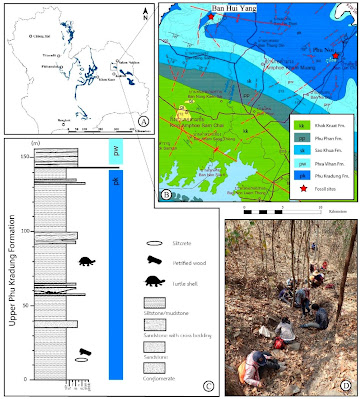
  (A), Map of northern Thailand showing location of Sam Chai area, and outcrops of the Phu Kradung Formation; (B): Geological map of Sam Chai area (modified from [Bumrungsong & Yamunsabideen, 2009]; (C): Stratigraphical column of Ban Hui Yang site; (D): Field work.


 Yakemys multiporcata n. g. n. sp. from the upper part of the Phu Kradung Formation (basal Cretaceous) of Khorat Plateau, NE Thailand. Holotype (SM KS39) from Ban Hui Yang locality, Sam Chai District, Kalasin Province.
(A, B) Carapace in dorsal view; (C, D) shell in ventral view; (E) detail of ornamentation of the carapace surface (on costal 2, indicated by a white rectangle on A), and (F) neural 6–8 with adjacent costal fragments in ventral view.
 Scale bar = 10 cm for (A–D,F) and 2 cm for (E). 
Abbreviations: co, costal plate; Ma, marginal scute; n, neural plate; pe, peripheral plate; py, pygal plate; spy, suprapygal plate; V, vertebral scute.

Testudines Linnaeus, 1758
Cryptodira Cope, 1868
Macrobaenidae Sukhanov, 1964

Yakemys multiporcata n. gen. n. sp.

Diagnosis: A genus of Macrobaenidae of large size, with the carapace length about 70 cm and a combination of characters that differs from all other Macrobaenidae as follows: narrow vertebral scutes; vertebral 4 triangular and narrowed posteriorly, strong midline keel extending to the suprapygal 2, large lateral longitudinal keels on the vertebral region, and additional ridges on the pleural region; plastron reduced, with a triangular short anterior lobe, epiplastron reduced to a strip-shaped plate, entoplastron oval in dorsal view but with a much reduced ventral exposure and an extremely reduced bridge that is shorter than the anterior lobe.

Etymology: Genus name from Yak, giant in Thai (ยักษ์); species name from Latin “multi”: multiple; porcata: from Latin “porca”, ridge.


Conclusions: 
Yakemys multiporcata n. g. n. sp. represents one of the earliest Macrobaenidae hitherto known, and this finding extends the paleogeographical distribution of the group to SE Asia. The discovery of a macrobaenid turtle in Thailand provides further support for the Early Cretaceous age of the upper part of the Phu Kradung Formation and the new evidence of faunal exchange between the SE Asia and more northern parts of mainland Asia at the very beginning of the Cretaceous. Yakemys multiporcata commonly occurs together with Basilochelys macrobios, although both turtles were likely aquatic animals as indicated by their low shell; the different morphology of the shell, especially the plastron, suggests that these turtles had different modes of life. Further discovery of more complete material, especially skull and limb bones, is expected for a better understanding of the phylogenetic relationships and the lifestyle of this strange turtle.


Haiyan Tong, Phornphen Chanthasit, Wilailuck Naksri, Pitaksit Ditbanjong, Suravech Suteethorn, Eric Buffetaut, Varavudh Suteethorn, Kamonlak Wongko, Uthumporn Deesri and Julien Claude. 2021. Yakemys multiporcata n. g. n. sp., a large Macrobaenid Turtle from the Basal Cretaceous of Thailand, with a Review of the Turtle Fauna from the Phu Kradung Formation and Its Stratigraphical Implications. Diversity. 13(12), 630. DOI: doi.org/10.3390/d13120630 
    facebook.com/fossilworld/posts/4864491833572637  ยักษ์คีมิส มัลติพอร์คาตา