Showing posts with label Lamprophiidae. Show all posts

Wednesday, June 4, 2025

[Herpetology • 2025] Elaiophis gen. n. • Generic Affinities of African House Snakes Revised: A New Genus for Lamprophis inornatus (Serpentes: Lamprophiidae: Lamprophiinae: Boaedontini)


  Elaiophis inornatus (Duméril, Bibron & Duméril, 1854) comb. n.
Elaiophis gen. n. 

Tiutenko, Maliuk & Koch, 2025
 Salamandra. 61(2)

Abstract
 This article is the second part of a revision of the systematics of Boaedontini Dowling, 1969 and a follow-up to the work by Tiutenko et al. (2022). As a result of morphological and phylogenetic analyses, further taxonomic actions are taken in the genus Lycodonomorphus Fitzinger, 1843. Lamprophis inornatus Duméril, Bibron & Duméril, 1854, a species initially described in the genus Lamprophis and subsequently assigned to Lycodonomorphus, is here transferred to a new monotypic genus on a basis of combined criteria including genetic distance, morphology, ecology and biogeography. For improved taxonomic stability of the species and the new genus, a neotype for L. inornatus is designated from the specimen ZFMK 032712. The lectotype of Boodon infernalis Günther, 1858 is designated from one of three extant syntypes NHMUK 1858.4.11.5 and the type locality of this species, that is currently treated as a junior synonym of L. inornatus, is restricted to Durban, South Africa. The name ‘infernalis’ should be available if the species status of this northern clade would become restored. Lycodonomorphus subtaeniatus Laurent, 1954, another former Lycodonomorphus species long assumed to be a member of Boaedon, is here formally assigned to this genus and tentatively placed next to Boaedon upembae (Laurent, 1954) and Boaedon virgatus (Hallowell, 1854) on a basis of pholidosis, cranial morphology and dentition. The tribe Boaedontini now contains nine genera that can be separated by morphological characters according to the proposed key. The genus Lycodonomorphus still requires attention of taxonomists, as it contains species, such as L. bicolor, L. laevissimus, L. leleupi, L. mlanjensis, L. obscuriventris, and L. whytii, with uncertain taxonomic position and in this sense has to be viewed as sensu lato.

Key words. Squamata, Elaiophis, nomenclature, osteology, skull, taxonomy

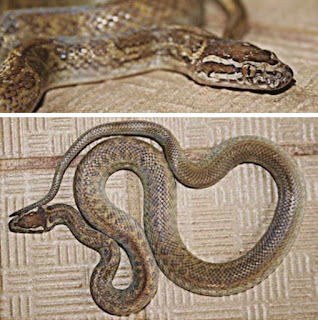
Adult specimens of Elaiophis inornatus comb. n. from Makhanda / Grahamstown, Eastern Cape (A), and Haenertsburg, Limpopo (B).
Photographs by G. K. Nicolau.


Head morphology details (drawings) and general appearance of
Boaedon capensis (A), Lycodonomorphus rufulus (B),
Lamprophis aurora (C), Lycodonomorphus inornatus (D).
Photographs by L. Kemp (A–C) and G. K. Nicolau (D).

Elaiophis gen. n. 

Type species: Lamprophis inornatus Duméril, Bibron & Duméril, 1854,
 by present designation. 

Diagnosis: Body cylindric, moderately short. Head moderately depressed. Eye medium-sized to small. Tail short, representing ca. 12–15% of the total length. Head trapezoidal, broader posteriorly, moderately distinct from neck. Snout blunt, square-shaped. Rostral rather large, approximately as high as broad, well visible from below and above. Nasal divided. Eye medium-sized, with wide sub-elliptical pupil. Anterior chin shields equal in size to the posterior or slightly longer. Loreal single, rectangular, horizontally elongate. No labial pits. No loreal grooves. Dorsal scales with two apical pits, arranged in 23 rows at the middle of the body. Subcaudals paired. Anal entire. 18–19 maxillary, 10–11 palatine, 17–19 pterygoid, 20–23 mandibular teeth. No diastemata. Maxillary teeth subequal. Mandibular teeth 2–7 strongly enlarged. Hemipenis bilobal, shallowly forked; sulcus spermaticus centrifugal, dividing approximately half way up shaft. Dorsal colour olive-green, olive, dark brownish olive, glaucous, dark neutral grey. Ventral colour cream white, or pale neutral grey

Content: The genus is currently monotypic, containing one species – Elaiophis inornatus (Duméril, Bibron & Duméril, 1854) comb. n.

Etymology: In South Africa where this snake is distributed it is called ‘Olive Snake’ in English, or ’Olyfslang’ in Afrikaans. Both names refer to the dorsal colour. The new genus name ‘Elaiophis’ is a translation of these vernacular names into Latin, being a compound of the Greek words ὄφις (snake) and ἐλαία (olive). Since the head of the nominal compound (‘ophis’) is masculine, the new noun is of the same gender. As English name for the new genus, we suggest ‘African olive snakes’.


Tiutenko, A., A. Maliuk and C. Koch. 2025. Generic Affinities of African House Snakes Revised: A New Genus for Lamprophis inornatus (Serpentes: Lamprophiidae: Lamprophiinae: Boaedontini).  Salamandra. 61(2); 215-239. 
https://www.salamandra-journal.com/index.php/contents/2025-vol-61/2182-tiutenko,-a-,-a-maliuk-c-koch/file


Monday, July 3, 2023

[Herpetology • 2023] Psammophis cornusafricae • Diversity of Sand Snakes (Serpentes: Psammophiidae: Psammophis) in the Horn of Africa, with the Description of A New Species from Somalia


Psammophis cornusafricae
Šmíd, Fernández, Elmi & Mazuch, 2023


Abstract
The biological diversity of the Horn of Africa is one of the least studied in the world. Yet the Horn supports rich communities of species that are mostly endemic to the region. Here we study the diversity of Sand Snakes (Psammophis) in East Africa, their phylogeny and systematics. Previous studies have unveiled several cryptic and potentially undescribed species of Psammophis that occur in the Horn and their taxonomic status has remained unclear to this day. We used sequence data from two mitochondrial and one nuclear genes to reconstruct the phylogeny of the genus, in which we included newly obtained samples of six different Psammophis species from Somalia, Ethiopia, Eritrea, Sudan, and Egypt. Our aim was to assess the status of some of the undescribed species, examine the level of intraspecific genetic variation within individual species, improve our understanding of the species distributions, and contribute to the taxonomy of the genus. Our results confirm the existence of two undescribed species, one in eastern Somalia, which we formally describe as new, and one in southern Ethiopia that we refer to as Psammophis cf. sudanensis in accordance with previous studies. Further, we provide first genetic data for the nominotypical subspecies of P. punctulatus and confirm the species status for its subspecies P. trivirgatus. In addition, we provide new genetic data for P. tanganicus from Ethiopia and Somalia, and range extension records for P. rukwae from Eritrea and Ethiopia and for P. aegyptius from Somalia. Our findings contribute considerably to our understanding of the diversity and distribution of Psammophis in East Africa.

Key Words: East Africa, Eritrea, Ethiopia, phylogeny, Reptilia, sand racers, Serpentes


Psammophis cornusafricae sp. nov. in life (specimen NMP-P6V 76373, sample JIR510), with a close-up of the head in the upper left corner, and the habitat at the locality where the specimen was found (8.5 km S of Yuffleh, Somaliland) at the bottom.


Psammophis cornusafricae sp. nov.

Diagnosis: A Psammophis species sister to P. tanganicus, with the following combination of morphological characters: 11 infralabials; 9 supralabials, three of which are in contact with the eye; nostril pierced between two equal sized nasals; 15 anterior dorsals; 14–15 midbody dorsals; 11 posterior dorsals; 146–158 ventrals; 95–100 subcaudals. Body brown, grey or beige with only a faintly visible pale vertebral stripe but with well pronounced dorsolateral orange stripes on each side of the body. Tail with only a slight trace of or completely lacking any dark vertebral stripe; the posterior half of the tail uniformly pale yellow. Venter white to yellowish with a conspicuous stipple of irregular dark smears. Head dorsally with a symmetrical pattern of brown markings outlined by black margins which contrast with the grey or beige background coloration. Labials white with dark margins forming a black lip. Dark brown temporal stripe outlined by black blotches and stretching from the eye to the posterior end of the head.

 English name: African Horn Sand Snake Somali name: Subxaanyo [pronounced Subhanyo]; a term in the Somali language that refers to all Psammophis species that occur in the region. All Subxaanyo are believed to be harmless and friendly by the locals and are an important part of their folklore

Etymology: The species epithet indicates the geographic origin of the species and translates as “The Sand Snake of the Africa’s Horn”. It is a noun in the genitive case that is derived from the Latin words for horn (cornu-us) and Africa (Africa-ae).


Jiří Šmíd, Sergio Matilla Fernández, Hassan Sh Abdirahman Elmi and Tomáš Mazuch. 2023. Diversity of Sand Snakes (Psammophiidae, Psammophis) in the Horn of Africa, with the Description of A New Species from Somalia. Zoosystematics and Evolution. 99(2): 345-361. DOI: 10.3897/zse.99.101943

Monday, February 7, 2022

[Herpetology • 2021] Boaedon mendesi • Taxonomic Revision of the Jita Snakes (Serpentes: Lamprophiidae: Boaedon) from São Tomé and Príncipe (Gulf of Guinea), with the Description of A New Species


Boaedon mendesi  
Ceríaco, Arellano, Jadin, Marques, Parrinha & Hallermann, 2021


ABSTRACT
The taxonomic status of the São Tomé and Príncipe islands ‘Cobras Jitas’, genus Boaedon, has been a subject of confusion. Historically, these island populations have been referred to as part of either the Boaedon fuliginosus species complex or Boaedon capensis species complex, two of the most taxonomically challenging groups of African snakes, or considered a distinct taxonomic entity, B. bedriagae. Here we review the São Tomé and Príncipe populations through a combination of morphological and molecular data. Our results suggest that each island population represents a unique species. After a thorough review of the taxonomic and nomenclatural history of the group, we revalidate B. bedriagae, restricting the application of this name to the São Tomé population by the designation of a lectotype. We also describe the Príncipe population as a new species, Boaedon mendesi sp. nov. This description has implications to our understanding of the diversity and phylogeographic patterns of the Gulf of Guinea Oceanic Islands.

KEY WORDS: Boaedon bedriagae, Boaedon mendesi sp. nov., Boaedon fuliginosus complex, endemism, island biodiversity

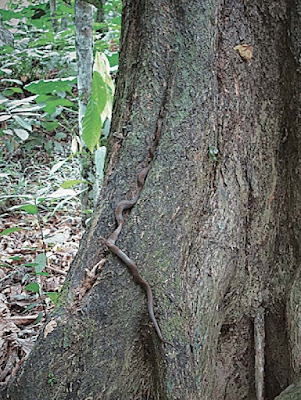
 Live photo of the holotype of Boaedon mendesi sp. nov. 
(MUHNAC/MB03-977).

Boaedon mendesi sp. nov. 

Live photo of the holotype of Boaedon mendesi sp. nov. (MUHNAC/MB03-977), basking in a tree during daytime.
Photo by Luis M.P. Ceríaco.


Luis M.P. Ceríaco, Ana Lisette Arellano, Robert C Jadin, Mariana P Marques, Diogo Parrinha and Jakob Hallermann. 2021. Taxonomic Revision of the Jita Snakes (Lamprophiidae: Boaedon) from São Tomé and Príncipe (Gulf of Guinea), with the Description of A New Species. African Journal of Herpetology. 70(1)  DOI: 10.1080/21564574.2020.1832152

Monday, November 22, 2021

[Herpetology • 2021] Psammophis turpanensis • A New Species of Psammophis (Serpentes: Psammophiidae) from the Turpan Basin in northwest China


 Psammophis turpanensis
 Chen,  Liu, Cai, Li, Wu & Guo, 2021

Photos by Jinlong Ren.
 
Abstract
An adult sand snake specimen was collected during a herpetofaunal survey conducted in the Turpan Basin in northwest China. Phylogenetic analyses revealed that this specimen, along with other snake sloughs and skins collected from different localities in the Turpan Basin formed a clade that is sister to Psammophis lineolatus. This taxon exhibited substantial divergence from its congeners (P. lineolatus and P. condanarus) with uncorrelated p-distances ranging from 11.9 ± 0.9% to 15.8 ± 1.6% for the ND4 gene and from 10.2 ± 0.8% to 13.8 ± 1.1% for the Cytb gene. Given the genetic differences along with morphological differences, we describe the specimen from the Turpan Basin as Psammophis turpanensis sp. nov. We provide detailed morphological descriptions, and compare this specimen with five Asian sand snakes and the Afro-Asian Sand Snake, P. schokari. In addition, we provide brief comments on the biogeography of Psammophis in China.

Keywords: Reptilia, Psammophis turpanensis sp. nov., phylogenetic tree, morphology, mitochondrial DNA, taxonomy


Photographs of the preserved specimen  Psammophis turpanensis sp. nov. (CIB 118224, from Aydingkol Lake, Turpan city, Xinjiang), showing:
 (A) dorsal view of the whole body, (B) ventral view of the whole body, (C) dorsal view of the head, (D) ventral view of the head, (E) lateral view of the head on the right side, (F) lateral view of the head on the left side, (G) dorsal view of part of the body, (H) lateral view of part of the body, and (I) ventral view of part of the body.
Photos by Jinlong Ren.

 Psammophis turpanensis sp. nov. 

Etymology. This name turpanensis is taken from the type locality—Aydingkol Lake, located in the Turpan Basin. To the best of our knowledge, this is the first reported species from the lowest elevation of the type locality in terrestrial animals. 
We recommend “Turpan Sand Snake” as its English common name
 and “Tu Lu Fan Hua Tiao She (吐鲁番花条蛇)” as its Chinese common name.


Minli Chen, Jinlong Liu, Bo Cai, Jun Li, Na Wu and Xianguang Guo. 2021. A New Species of Psammophis (Serpentes: Psammophiidae) from the Turpan Basin in northwest China. Zootaxa. 4974(1); 116–134. DOI:  10.11646/zootaxa.4974.1.4

Thursday, December 31, 2020

[Herpetology • 2019] Kladirostratus gen. nov. & Psammophylax kellyi A Snake in the Grass: Genetic Structuring of the Widespread African Grass Snake (Psammophylax Fitzinger 1843), with the Description of A New Genus and A New Species


 Kladirostratus acutus (Günther 1888) 

in Keates, Conradie, Greenbaum & Edwards, 2019. 

Abstract
Psammophylax (Fitzinger 1843) is a widespread yet poorly studied genus of African grass snakes. A genetic phylogeny of six of the seven species was estimated using multiple phylogenetic and distance‐based methods. To support the genetic analyses, we conducted morphological analyses on the body (traditional morphology) and head (geometric morphometrics) separately. Phylogenetic analyses recovered a similar topology to past studies, but with better resolution and node support. We found substantial genetic structuring within the genus, supported by significantly different head shapes between P. a. acutus and other Psammophylax . Psammophylax a. acutus was recovered as sister to its congeners, and sequence divergence values and morphometrics supported its recognition as a new genus. Increased sampling in East Africa (Tanzania, Kenya, and Ethiopia) revealed that Psammophylax multisquamis is polyphyletic, necessitating the description of a new, morphologically cryptic species from northern Tanzania. The distribution of P. multisquamis sensu stricto is likely restricted to Kenya and Ethiopia. The study has further resolved multiple aspects of Psammophylax systematics, including the taxonomic validity of two central African subspecies, P. variabilis vanoyei (Laurent 1956) and P. tritaeniatus subniger (Laurent 1956). Inclusion of specimens from the more remote parts of Africa, in future analyses, may result in the recovery of additional diversity within Psammophylax .

Keywords: geometric morphometrics, grass snake, molecular biology, phylogenetic analysis, Psammophiinae, taxonomy


Kladirostratus acutus comb. nov. 

 Kladirostratus acutus (Günther 1888) 

Kladirostratus gen. nov. Conradie, Keates & Edwards 
Proposed common group name: Branch's Beaked Snakes.

Type species: Psammophis acutus Günther 1888.

Etymology: The name Kladirostratus is derived from the combination of the Greek word κλάδος (klados) meaning “branch,” and the Latin word “rostratus” meaning beaked. The name honors Professor William R. Branch (1947–2018), Curator Emeritus of herpetology at Port Elizabeth Museum, in recognition of his many contributions to the herpetology of Africa, especially regarding snakes. We benefitted from his generosity as a mentor and he helped shape our careers, for which we are thankful. The name is masculine in gender.

Members of this genus: Kladirostratus acutus (Günther 1888) comb. nov. including the currently recognized subspecies Kladirostratus a. acutus and Kladirostratus a. jappi (Broadley, 1971); Kladirostratus togoensis (Matschie 1893) comb. nov. The latter is provisionally included in this genus based on morphological similarities, but this requires confirmation through molecular phylogenetic analysis.

Distribution: Kladirostratus a. acutus comb. nov. is known from most of Angola through northwestern Zambia, southern Democratic Republic of the Congo (DRC), into western Tanzania, northern Malawi, and north to Rwanda (fide Broadley, 1971). Kladirostratus a. jappi comb. nov. is known only from western Zambia and northeastern Angola (fide Broadley, 1971). Kladirostratus togoensis comb. nov. is known from Ghana, Togo, Central African Republic, northern DRC, and western Uganda (fide Broadley, 1971; Spawls et al., 2002). Occurs at elevations of 450–1,800 m.


Psammophylax kellyi sp. nov.

 Psammophylax kellyi sp. nov. Conradie, Keates & Edwards  
 
Proposed common name: Tanzanian Grass Snake or Tanzanian Skaapsteker.

Etymology. The specific epithet is a patronym in honor of Christopher M. R. Kelly for his considerable contribution to the systematics of the snake family Lamprophiidae.


Chad Keates, Werner Conradie, Eli Greenbaum and Shelley Edwards. 2019. A Snake in the Grass: Genetic Structuring of the Widespread African Grass Snake (Psammophylax Fitzinger 1843), with the Description of A New Genus and A New Species. Journal of Zoological Systematics and Evolutionary Research.  57(4); 1039-1066.  DOI: 10.1111/jzs.12337 

Eastern Cape researchers discover new snake species


Thursday, December 24, 2020

[Herpetology • 2020] Levitonius mirus • A New, Miniaturized Genus and Species of Snake (Cyclocoridae) from the Philippines


Levitonius mirus 
Weinell, Paluh, Siler & Brown, 2020

Waray Dwarf Burrowing Snake || twitter.com/JeffWeinell

Abstract
The Philippine archipelago is an exceptionally biodiverse region that includes at least 112 species of land snakes from 41 genera and 12 families. Recently, Cyclocoridae (formerly Lamprophiidae: Cyclocorinae) was proposed as a distinct, Philippine-endemic family, containing four genera: Cyclocorus, Hologerrhum, Myersophis, and Oxyrhabdium. Here, we describe an additional cyclocorid genus and species, Levitonius mirus, new genus and species, from Samar and Leyte Islands, Philippines. Molecular data support Levitonius, new genus, to be most closely related to Myersophis and Oxyrhabdium, and it shares multiple skeletal characteristics with these genera; Levitonius, new genus, differs from all of these taxa in body size, scalation, and other characters. Skeletal and other phenotypic data suggest that Levitonius, new genus, is fossorial and likely has a diet that is specialized on earthworms. Levitonius mirus, new genus and species, has a maximum total length of 172 mm and is at present the smallest known species in Elapoidea. Our results highlight the need for future work on Samar and Leyte Islands, which have received relatively little attention from systematists, in part because of a prevailing biogeographic paradigm that predicted (not necessarily correctly) that these islands would simply have a nested faunal subset of the Mindanao faunal region land vertebrates. The discovery of a strikingly distinct and phylogenetically divergent snake lineage on these landmasses joins numerous related studies calling for a wholesale reconsideration of the Pleistocene Aggregate Island Complex model (the PAIC paradigm of diversification) biogeographic framework.


Fig. 1 (A) Elevation map of the Philippines, showing location of islands and PAICs mentioned in this article; B.I. = Babuyan Island Group, Sb. = Sibuyan Island, Sq. = Siquijor Island, C.S. = Camiguin Sur, Tb. = Tablas.
(B) Samar, Leyte, and nearby islands; red star indicates the type locality of Levitonius mirus, new genus and species; blue circle indicates a second occurrence locality;
(C) karst rainforest habitat at the L. mirus, new genus and species, type locality (Barangay San Rafael, Municipality of Taft, Samar Island).


Fig. 4 Comparison of selected cranial bones of cyclocorid species. (A) Skull of Levitonius mirus, new genus and species, showing the position of bones i–iv; from left to right: bones of L. mirus, new genus and species, Myersophis alpestris, Oxyrhabdium leporinum, Hologerrhum philippinum, and Cyclocorus lineatus; i = postorbital bone, ii = supratemporal bone, iii = quadrate bone, and iv = maxilla. White scale bars = 1 mm.

Levitonius, new genus
 Dwarf Burrowing Snakes 
Type species.— Levitonius mirus, new species.

Diagnosis.— Members of the genus Levitonius can be distinguished by the possession of five supralabial scales, 15 longitudinal rows of dorsal scales throughout the length of the body, and subcaudal scales unpaired.
 
Etymology.— The new generic appellation Levitonius is a masculine noun and a patronym in the genitive singular, honoring the numerous contributions and life-long dedication of Alan E. Leviton to the study of the systematics of Philippine snakes.

Fig. 7 Photographs of Levitonius mirus, new genus and species, type specimens (alcohol preserved): holotype PNM 9872 (A), and paratypes KU 311288 (B) and KU 305488 (C).
Dorsal view of body (A, top left; B–C, left); ventral view of body (A, bottom left; B–C, center); dorsal view of head (A–C, top right); lateral view of head (A–C, center right); ventral view of head (A–C, bottom right). Thick black scale bars = 10 mm; thin black scale bars = 1 mm.


Fig. 8 Head scalation of Levitonius mirus, new genus and species, holotype (PNM 9872); (A) ventral, (B) lateral, and (C) dorsal views of head.
 Illustrations by Errol D. Hooper (2019). Black scale bar = 1 mm.

Levitonius mirus, new species
 Waray Dwarf Burrowing Snake
 
Diagnosis.— Levitonius mirus can be distinguished from all other SE Asian snake species by having the following combination of characters: small size (largest total length known 172.1 mm); five supralabial scales; 15 longitudinal rows of dorsal scales throughout length of body; subcaudal scales unpaired; pair of internasal scales present; anterior temporal scale present; preocular scale absent; loreal scale present, not in contact with eye; mental scale broadly in contact with anterior chin shields; scales smooth, iridescent; dorsum ground color may be light brown to nearly black; one pale transverse band present on posterior of head, crosses parietals, temporals, and posterior supralabials; pale midventral line present or absent.

Distribution.— The new species is currently only known from Samar and Leyte Islands, southeastern Philippines.

Etymology.— The species epithet mirus is a Latin adjective, meaning unexpected finding or surprise—a fitting specific epithet for the miniaturized, phylogenetically unique evolutionary lineage represented by the new genus and species described here. The suggested common name, the Waray Dwarf Burrowing Snake, honors the Waray-waray people of the eastern Visayas, in particular the Samareños who live in vicinity of the type locality, among the forested mountains of Samar Island, and the Leyteños who inhabit the new genus' only other documented locality in the montane forests of Leyte Island.


Jeffrey L. Weinell, Daniel J. Paluh, Cameron D. Siler and Rafe M. Brown. 2020. A New, Miniaturized Genus and Species of Snake (Cyclocoridae) from the Philippines. Copeia. 108(4); 907-923. DOI: 10.1643/CH2020110


Thursday, August 15, 2019

[Herpetology • 2019] Psammophis afroccidentalis • On the Psammophis sibilans group (Serpentes, Lamprophiidae, Psammophiinae) North of 12°S, with the Description of A New Species from West Africa


Psammophis afroccidentalis Trape, Böhme & Mediannikov

in Trape, Crochet, Broadley, Sourouille, Mané, et al., 2019. 

Abstract
Based on molecular, morphological and field data, the status and zoogeography of the taxa of the Psammophis sibilans group north of 12°S are reviewed. Molecular data including sequences from 20 of the 22 described species known to occur north of 12°S suggest that P. sibilans distribution is restricted to northeastern Africa, from Egypt to Ethiopia. Populations from West Africa are described as a new speciesPsammophis afroccidentalis sp. nov., and those from Chad, Cameroon and Central African Republic are assigned to P. rukwae which is also distributed from Tanzania to Ethiopia. Molecular data indicate the occurrence within this complex of three additional cryptic species in the Horn of Africa. Populations previously assigned to P. phillipsi in Central Africa north, south and east of the Congo forest block are assigned to P. mossambicus and the status of P. occidentalis is discussed. P. phillipsi is restricted to West Africa, with P. irregularis as junior synonym.

 Key words. Reptilia, Ophidia; Psammophiinae, Psammophis sibilans, Psammophis afroccidentalis sp. nov., taxonomy, biogeography, Africa.


Fig. 4. Psammophis afroccidentalis sp. nov. Plain phase. Sequenced specimen IRD TR.4501. Matmata (Mauritania).

 Fig. 5. Psammophis afroccidentalis sp. nov. Lineated phase. Dakar (Senegal).

Fig. 16. Psammophis afroccidentalis sp. nov. General view of a specimen with a typical dorsal head pattern, ill-defined vertebral chain and lacking pale dorsal stripes. Dielmo, Senegal.

PSAMMOPHIS AFROCCIDENTALIS Trape, Böhme & Mediannikov, sp. nov. 

West-African Whip Snake, 
Psammophis ouest-africain, Westafrikanische Sandrennnatter 

Diagnosis. Distinguishable from other species of the P. sibilans group by the combination of the following characters: 17 scale rows around midbody, 156–185 ventrals, 96–120 subcaudals (rarely less than 100), cloacal divided, 5 infralabials in contact with anterior sublinguals (very rarely 4). Dorsum pale brown, dark brown or greenish-brown, rarely uniform, usually a vertebral chain with the scale of vertebral row paler at base, but this chain often restricted to part of the dorsum, ill-defined and occasionally totally absent; pale dorsolateral stripes on the 4th row of dorsals, but often ill-defined or absent; top of head with a pale median stripe on the snout which forks when reaching the frontal and then borders the frontal, but often ill defined or absent in adults. Genetically diagnosable through possession of unique mitochondrial haplotypes. Psammophis afroccidentalis sp. nov. can be distinguished from P. rukwae by a higher number of subcaudals (P. rukwae 70–100, exceptionnaly up to 105), from P. sibilans by major differences in mitochondrial haplotypes, a pale median stripe that borders the frontal (not bordering the frontal in P. sibilans) and a more uniform dorsal colouration in most specimens, from P. schokari and P. aegyptius by a lower number of subralabials (8 versus 9) and a different head pattern, and from P. sudanensis, P. phillipsi, P. occidentalis, P. mossambicus, P. leopardinus, P. zambiensis and P. subtaeniatus by a higher number of infralabials in contact with the anterior sublinguals (5 versus 4) and by different head and dorsal patterns.

Fig. 12. Geographic distribution of the sequenced specimens of P. sibilans and other species frequently confounded with P. sibilans: P. phillipsi, P. mossambicus, P. rukwae, P. sudanensis, and P. afroccidentalis sp. nov. One symbol may correspond to several specimens from neighbouring localities. Location of type locality is approximate for P. sibilans (“Egypt”), P. phillipsi (“Liberia”) and P. mossambicus (“insel Mossambique”).

Habitat. Sahel and Sudan savanna in West Africa. Penetrates in Guinea savanna and relict populations in Sahelo-Saharan wetlands.

 Distribution. Mauritania (northernmost record: Tidra island 19°44’N, 16°24’W), Senegal, Gambia, Guinea Bissau, Guinea, Mali (northenmost record: Tinjemban 16°44’N, 02°50’W and along the Niger River), Ivory Coast, Burkina Faso, Ghana, Togo, Benin, Niger (northernmost record: Azzel 17°03’N, 08°03’E), Nigeria and Chad (Mao). Possibly a relict population in southern Algeria (ZFMK 29365 from 200 km north of Tamanrasset, a damaged specimen previously assigned to P. rukwae by Böhme 1986 and to P. sibilans by Hughes 2012). 


Jean-François Trape, Pierre-André Crochet, Donald G. Broadley, Patricia Sourouille, Youssouph Mané, Marius Burger, Wolfgang Böhme, Mostafa Saleh, Anna Karan, Benedetto Lanza and Oleg Mediannikov. 2019. On the Psammophis sibilans group (Serpentes, Lamprophiidae, Psammophiinae) North of 12°S, with the Description of A New Species from West Africa.   Bonn zoological Bulletin. 68(1); 61–91. DOI: 10.20363/BZB-2019.68.1.061

Monday, April 29, 2019

[Herpetology • 2019] Psammophylax ocellatus & P. ansorgii • Rediscovery, Taxonomic Status, and Phylogenetic Relationships of Two Rare and Endemic Snakes (Lamprophiidae: Psammophiinae) from the southwestern Angolan Plateau


Psammophylax ocellatus Bocage, 1873

in Branch, Baptista, Keates & Edwards, 2019.

Abstract
Two rare and endemic psammophines (Serpentes: Psammophiinae) occur in Angola. The taxonomic status of Psammophylax rhombeatus ocellatus Bocage, 1873 and Psammophis ansorgii Boulenger, 1905 have long remained problematic, with both having varied past and present taxonomic assignments, and whose distributions may therefore present zoogeographic anomalies. Little was known of their biology, habitat associations, or phylogenetic relationships. New material was collected during biodiversity surveys of the Humpata Plateau, near Lubango, Angola. It allowed fuller descriptions of scalation and live coloration for both species, and resolution of their taxonomic status. Genetic analysis confirms that both are distinct at the specific level. In addition, within Psammophis, Jalla’s Sand Snake (Psammophis jallae Peracca, 1896), of which P. rohani Angel, 1925, remains a synonym, is sister to P. ansorgii, and Boulenger’s comment on similarities with P. crucifer are not supported. The status of an unusual skaapsteker from Calueque, Cunene Province, Angola, is discussed and its assignment to Ps. ocellatus is provisional and requires additional material for taxonomic resolution. The new P. ansorgii records from Tundavala represent a range (+400 km southwest) and altitude (1800 m to 2286 m a.s.l) extension from the previous only known precise locality of Bela Vista (= Catchiungo), Huambo Province, whilst that for Ps. ocellatus doubles the known altitude from 1108 m to 2286 m a.s.l and extends the range about 122 km to the northwest from historical material from the plateau of Huíla and Cunene provinces.

Keywords: Psammophis ansorgiiPsammophylax ocellatus, new distribution, phylogenetic relationships, Angolan escarpment, montane grassland, Reptilia


William R. Branch, Ninda Baptista, Chad Keates and Shelley Edwards. 2019. Rediscovery, Taxonomic Status, and Phylogenetic Relationships of Two Rare and Endemic Snakes (Serpentes: Psammophiinae) from the southwestern Angolan Plateau. Zootaxa. 4590(3); 342–366. DOI: 10.11646/zootaxa.4590.3.2

Friday, April 26, 2019

[Herpetology • 2019] The Origins and Diversification of the Exceptionally Rich Gemsnakes (Colubroidea: Lamprophiidae: Pseudoxyrhophiinae) in Madagascar


Phylogeny of Pseudoxyrhophiinae.  

in Burbrink, Ruane, Kuhn, Rabibisoa, Randriamahatantsoa, et al., 2019. 
  DOI: 10.1093/sysbio/syz026  

Abstract
Processes leading to spectacular diversity of both form and species on islands have been well documented under island biogeography theory, where distance from source and island size are key factors determining immigration and extinction resistance. But far less understood are the processes governing in-situ diversification on the world’s mega islands, where large and isolated land masses produced morphologically distinct radiations from related taxa on continental regions. Madagascar has long been recognized as a natural laboratory due to its isolation, lack of influence from adjacent continents, and diversification of spectacular vertebrate radiations. However, only a handful of studies have examined rate shifts of in-situ diversification for this island. Here we examine rates of diversification in the Malagasy snakes of the family Pseudoxyrhophiinae (gemsnakes) to understand if rates of speciation were initially high, enhanced by diversification into distinct biomes, and associated with key dentition traits. Using a genomic sequence-capture dataset for 366 samples, we determine that all previously described and newly discovered species are delimitable and therefore useful candidates for understanding diversification trajectories through time. Our analysis detected no shifts in diversification rate between clades or changes in biome or dentition type. Remarkably, we demonstrate that rates of diversification of the gemsnake radiation, which originated in Madagascar during the early Miocene, remained steady throughout the Neogene. However, we did detect a significant slowdown in diversification during the Pleistocene. We also comment on the apparent paradox where most living species originated in the Pleistocene, despite diversification rates being substantially higher during the earlier 15 million years.

Key Words: Pseudoxyrhophiinae, gemsnakes, island biogeography, in situ diversification, speciation, Neogene

Distribution of pairwise divergence dates for 36 newly discovered species pairs (blue) against previously described species pairs (pink) using BPP.

Phylogeny of Pseudoxyrhophiinae, with photographs showing representative species from all included Madagascan genera.
Distribution of pairwise divergence dates for 36 newly discovered species pairs (blue) against previously described species pairs (pink) using BPP.


Frank T. Burbrink, Sara Ruane, Arianna Kuhn, Nirhy Rabibisoa, Bernard Randriamahatantsoa, Achille P. Raselimanana, Mamy S. M. Andrianarimalala, John E. Cadle, Alan R. Lemmon, Emily Moriarty Lemmon, Ronald A. Nussbaum, Leonard Jones, Richard Pearson and Christopher J. Raxworthy. 2019. The Origins and Diversification of the Exceptionally Rich Gemsnakes (Colubroidea: Lamprophiidae: Pseudoxyrhophiinae) in Madagascar. Systematic Biology. syz026.  DOI: 10.1093/sysbio/syz026