Showing posts with label Amaryllidaceae. Show all posts

Wednesday, February 4, 2026

[Botany • 2026] Allium jammuense (Amaryllidaceae: Allieae) • A New Species from Trikuta Hills of Jammu and Kashmir, India


Allium jammuense  

in Singh, U. Sharma, Thakur, Kumar et N. Sharma, 2026.

Abstract
Allium jammuense, a new species from the Trikuta Hills of Jammu and Kashmir, India, is described here as a member of Allium subgenus Cepa section Cepa. The species is discovered based on a combination of morphological characteristics and molecular evidence. Phylogenetic analysis based on nuclear ribosomal Internal Transcribed Spacer (nrITS) sequences supports that A. jammuense is closely related to A. farctum and A. roylei, forming a distinct clade. A detailed morphological description, identification key, comparative table, IUCN status, and photographic plate are provided to support its taxonomic placement.

Keywords: Allium jammuense, Herbarium of the University of Jammu (HBJU), Jammu, nuclear ribosomal internal transcribed spacer (nrITS), subgenus Cepa, temperate flora


Allium jammuense


Sunit Singh, Udhay Sharma, Sajan Thakur, Anant Kumar and Namrata Sharma. 2026. Allium jammuense (Amaryllidaceae: Allieae) a New Species From Subgen. Cepa (Mill.) Prokh. From Trikuta Hills of Jammu and Kashmir, India. New Zealand Journal of Botany. 64(1); DOI: doi.org/10.1002/nzb2.70033 [31 January 2026]

Monday, January 5, 2026

[Botany • 2026] Allium littoricola (Amaryllidaceae) • A New Species from Zhejiang, East China


Allium littoricola  Z.H. Chen, Y.L. Xu & P. Li,

in Zhang, Xie, Zhou, X.-P. Li, Yang, Xu, Wang, Chen et P. Li, 2026. 

Abstract
A new species of Allium L. (Amaryllidaceae) from Zhejiang, eastern China, namely A. littoricola, was described and illustrated. Morphological analysis indicates this new species is similar to A. longistylum Baker, but differs in having ovoid bulb, tunic white, light-purple, membranous, leaf blades ascending, scape lateral, hollow in cross section or solid at base, perianth segments 5–6 × 2–3 mm, inner filaments base 1-toothed at each side; low altitude and coastal hillside habitat. Molecular phylogenetic analyses also support it as a new species and suggest that it is closely related to A. longistylum Baker.

Keyword: Allium chinense, Allium longistylum, Allium sacculiferum, Allium thunbergii, phylogeny

Morphology of Allium littoricola.
A. Plant; B. Bulb (showing different colors of the tunic); C. Cross section of leaf blade; D. Cross section of scape; E. bracteole; F. Inflorescence; G. Flower; H. Anatomy of a flower; I. Infructescence; J. Seed.

Ink line diagram of Allium littoricola.
 A. Whole plant; B. Flower; C. Tepals and filament; D. Pistil; E. Crosssection of leaf blade; F. Crosssection of scape; G. Capsule; H. Seed.


Allium littoricola Z.H. Chen, Y.L. Xu & P. Li, sp. nov. 
滨海葱

Diagnosis: This new species is similar to A. longistylum Baker, but differs in having bulb ovoid (vs. cylindrically ovoid), tunic white, light purplish, membranous (vs. brown, papery), leave blades ascending (vs. curved), scape lateral, hollow in cross section, or solid at base (vs. central, solid in cross section), perianth segments 5‒6 × 2‒3 mm (vs. 3.5–4.5 × 1.8–2.3 mm), filament 6.4–8.2 mm long, outer ones entire, inner ones with 1-toothed on each side (vs. 8.0–9.5 mm long, margin entire or inner ones with 1-toothed on each side), below ...

Etymology: The specific epithet ‘littoricola’ refers to the habitat of the new species. 

 Habitat and habit of Allium littoricola.
A. Habitat; B. Population (a. early spring; b. flowering period; c. fruiting period); C. Plants.


Xiao-Wei Zhang, Wen-Yuan Xie, Xin Zhou, Xiu-Peng Li, Zi-Feng Yang, Yue-Liang Xu, Mei-Zhen Wang, Zheng-Hai Chen and Pan Li. 2026. Allium littoricola, A New Species from Zhejiang, East China. Taiwania. 71(1); 1-10. DOI: 10.6165/tai.2026.71.1 [01 January 2026]  https://taiwania.ntu.edu.tw/abstract/2138  


Thursday, October 30, 2025

[Botany • 2024] Allium elazigense (Amaryllidaceae) • A New Species of Allium sect. Codonoprasum from eastern Anatolia, Turkey


Allium elazigense Sonay, Gül & E. Bagci, 

in Sonay, Gül et Bağcı, 2024. 

Abstract
Allium elazigense Sonay, Gül & E. Bagci, a new species of sect. Codonoprasum, is described and illustrated from eastern Anatolia, Turkey. It resembles A. chloranthum, but differs from it by several morphological characters. Allium elazigense has a brownish outer tunic that forms a collar on the spiral-shaped spathe valves with a dark brown midrib, greenish-creamy perigon, oblong outer tepals and spathulate-oblong inner tepals, short anthers and a short ovary, a cylindrical-oblong, stipitate capsule, and narrowly semi-cylindrical cymbiform seeds. Based on IUCN criteria, its conservation status is assessed as Critically Endangered (CR).
 

Allium elazigense Sonay, Gül & E. Bagci sp. nov. 


Veysel Sonay, Emel Gül, and Eyüp Bağcı. 2024. Allium elazigense (Amaryllidaceae), a New Species from Eastern Anatolia, Turkey. Annales Botanici Fennici. 61(1), 199-206. DOI: doi.org/10.5735/085.061.0128  (19 July 2024)

Tuesday, May 13, 2025

[Botany • 2024] Hymenocallis ruenesiana (Amaryllidaceae) • A New Species from the Yucatan Peninsula, Mexico


Hymenocallis ruenesiana J.J.Ancona, J.Tun & J.J.Ortiz-Diaz, 

in Ancona, Ortiz-Díaz, Durán, Tun-Garrido et Palma, 2024. 
 
Abstract
Hymenocallis ruenesiana is described and illustrated as a new species from the Yucatan Peninsula, Mexico. When comparing the morphological characters of the leaf, inflorescence, fruit and pollen, as well as the environmental conditions of the habitat of H. ruenesiana, discontinuities were found with those of Hymenocallis littoralis. Hymenocallis ruenesiana is endemic to the Yucatan peninsula, inhabiting seasonal savannas with clayey and floodable soils, while H. littoralis naturally inhabits the coasts, on easily drained sandy soils and it is also widely cultivated as an ornamental plant.

 endemic to Mexico, Campeche, monocots, pollen, Savannas, Monocots


Hymenocallis ruenesiana sp. nov.


Juan José ANCONA, Juan Javier ORTIZ-DÍAZ, Kelly C. DURÁN, Juan TUN-GARRIDO and Geovani A. PALMA. 2024. Hymenocallis ruenesiana (Amaryllidaceae), A New Species from the Yucatan Peninsula, Mexico. Phytotaxa. 645(3); 270-277. DOI: doi.org/10.11646/phytotaxa.645.3.6 [2024-04-26]
 x.com/SocBotMex/status/1785504973960421754

Saturday, April 19, 2025

[Botany • 2019] Clinanthus inflatus & Ismene parviflora • Taxonomic Novelties in Amaryllidaceae from the Department of Ancash, Peru, and A New Combination in Clinanthus


Ismene parviflora Clinanthus inflatus 
Meerow & A.Cano

in Meerow et Cano, 2019.   

Abstract
Clinanthus inflatus and Ismene parviflora (Amaryllidaceae) are described from Ancash Department in Peru. The flower of C. inflatus is urceolate, and resembles that of Urceolina (Amaryllidaceae tr. Eucharideae), a unique morphology for the genus. Ismene parviflora, with its small, loosely formed, narrowly funnelform-tubular perigone with a ventricose limb, appears to have some affinity to subgen. Pseudostenomesson and may represent an intermediate form between the former and species of subgen. IsmeneStenomesson rubrum is transferred to Clinanthus as C. ruber on the basis of its narrowly lorate leaf morphology.

Keywords: Amaryllidaceae, Andean biodiversity, Clinantheae, Hymenocallideae, Ismene, monocots, Neotropical flora, taxonomy

Clinanthus inflatus. A Habit B whole flower C whole flower cut open to show staminal corona and ovule number.
Drawing by Klei Sousa.

Clinanthus inflatus Meerow & A.Cano, sp. nov.
 
Diagnosis: This species differs from all known species of Clinanthus by the uniquely inflated perigone, the shape and coloration of which is reminiscent of the genus Urceolina Rchb. (Eucharideae) or superficially certain species of Andean vaccinioid Ericaceae.

Etymology: The specific epithet is from Latin and refers to the abruptly inflated perigone.

 Ismene parviflora 
D–E flowers F habit in cultivation.
 photos by Asunción Cano 


Ismene parviflora Meerow & A.Cano, sp. nov.

Diagnosis: Ismene parviflora differs from all other species of the genus by the small flowers (< 4 cm long), that are loosely funnelform, terminating with a ventricose limb, but not infundibular to the degree of I. vargasii and I. morrisonii (subgen. Pseudostenomesson Meerow), the latter species to which it approaches in size. All other species of Ismene have large, crateriform flowers (subgen. Ismene) or large, zygomorphic flowers (subgen. Elisena).

Distribution and ecology: Ismene parviflora is known only from the type locality (Fig. 3), in seasonally dry vegetation.

Etymology: The specific epithet is from Latin and refers to the small size of the flowers.


 Alan W. Meerow and Asunción Cano. 2019. Taxonomic Novelties in Amaryllidaceae from the Department of Ancash, Peru, and A New Combination in ClinanthusPhytoKeys. 131: 115-126. DOI: 10.3897/phytokeys.131.36160

Resumen: Clinanthus inflatus (Amaryllidaceae) e Ismene parviflora se describen del departamento de Ancash en el Perú. La flor de C. inflatus es urceolada, y se asemeja a la de Urceolina (Amaryllidaceae tr. Eucharideae), una morfología única para el género. Ismene parviflora, con su forma suelta, perigonio angostamente funeliforme-tubular con una limbo ventricoso, parece tener alguna afinidad al subgen. Pseudostenomesson y puede representar una forma intermedia entre el primero y las especie de subgen. Ismene. Stenomesson rubrum se transfiere a Clinanthus como C. ruber, sobre la base de su morfología de hoja acintada estrecha.

Tuesday, March 4, 2025

[Botany • 2025] Galanthus subalpinus (Amaryllidaceae) • A New Species of Snowdrop from the Western Balkans


Galanthus subalpinus  A.P.Davis & I.McEnery, 

in Davis, McEnery, Csiba, Márquez-Corro et Leitch, 2025. 
Drawn by Lucy T. Smith.

Summary
Galanthus subalpinus (Amaryllidaceae), a new snowdrop species endemic to the Western Balkans (North Macedonia and Kosovo) is described and illustrated. Morphological differences between the new species and the similar Galanthus species, G. nivalis and G. graecus, are reported and discussed, in combination with DNA sequence data from plastid (trnL-trnF, matK) and nuclear (ribosomal ITS) markers and genome size. Line drawings, photographs of habitat and morphology, a distribution map and a preliminary conservation assessment are provided. The genome size (1C-value) of G. bursanusG. samothracicus and G. × valentinei nothosubsp. subplicatus are reported for the first time.

Key Words: Balkan flora, conservation, genome size, 1C-value.

Galanthus subalpinus.
 A habit, flowering; B habit, flower bud stage; C young emerging leaves, showing applanate vernation; D flower; E outer perianth segment, abaxial view (right) and adaxial view (left); F inner perianth segments, with alternative marking types (below), all in abaxial view; G inner perianth segment, adaxial view.
Scale bar: A – C = 4 cm; D = 2.5 cm; E – G = 1 cm. 
All from McEnery s.n. drawn by Lucy T. Smith.

Galanthus subalpinus in situ and in cultivation.
A habitat, subalpine grassland; B small clump, situated in an ephemeral water pool; C flowers; D leaves at early fruiting stage.
A – B North Macedonia; C – D UK, in cultivation.
photos: I. Mcenery.

Galanthus subalpinus A.P.Davis & I.McEnery sp. nov. 
 
ETYMOLOGY. Galanthus subalpinus is named after the subalpine zone (1500 – 1800 m) where the species is found in the wild.


Aaron P. Davis, Ian McEnery, Laszlo Csiba, José Ignacio Márquez-Corro and Ilia J. Leitch. 2025.  Galanthus subalpinus (Amaryllidaceae): A New Species of Snowdrop from the Western Balkans. Kew Bulletin.  DOI: doi.org/10.1007/s12225-024-10239-8 

Sunday, February 16, 2025

[Botany • 2024] Allium ahmet-tirasii (Amaryllidaceae) • A New Species of Allium sect. Scorodon from Southern Anatolia (Türkiye)


Allium ahmet-tirasii Yıldırım, 

in Yıldırım, Özdöl et Erdem, 2024.
Alanya soğanı  ||  DOI: doi.org/10.11646/phytotaxa.644.2.2 

 Abstract 
Allium ahmet-tirasii Yıldırım (Amaryllidaceae) is described as a new species from Alanya district in Antalya province, southern Türkiye. Diagnostic characteristics, a full description, and comprehensive illustrations are provided. Based on morphological features, it belongs to the Allium subgen. Polyprason sect. Scorodon. Allium ahmet-tirasii has no closely related species. It slightly resembles A. sivasicum, by the pale brownish-orange inner tunic and greenish-yellow perigone and A. opacum, by perigone size and color also style length. However, it is easily distinguished from both A. sivasicum and A. opacum by many other morphological characters and its habitat. It is characterized by 1–2 equal bulblets; spathe one or sometimes 2-valved, if with 2-valved, valves unilateral; filaments equal or slightly shorter than tepals; style 1.5–2 mm long before fertilization shorter than perigone.

Monocots, Allium, Scorodon, new species, Türkiye  


Allium ahmet-tirasii Yıldırım sp. nova


Eponymy:—This species is named after Mr. Ahmet Tıraş, an amateur botanist who collected the first specimen of the new species. The Turkish name of this species is suggested as “Alanya soğanı” according to the guidelines of Menemen et al. (2016). 


Hasan YILDIRIM, Tuğkan ÖZDÖL and Seval ERDEM. 2024. Allium ahmet-tirasii (Amaryllidaceae), A New Species from Southern Anatolia (Türkiye).  Phytotaxa. 644(2); 102-112. DOI: doi.org/10.11646/phytotaxa.644.2.2 [2024-04-11]

[Botany • 2023] Allium beypazariense (Amaryllidaceae) • A New Species of Allium sect. Codonoprasum from middle Anatolia (Türkiye)


Allium beypazariense Koçyiğit, Özhatay & E.Kaya,

in Koçyiğit, Erarslan, Özhatay et Kaya, 2023.  
 
Abstract
Allium beypazariense, a newly discovered species from the A. section Codonoprasum, is described and illustrated in this study. The species is endemic to middle Anatolia, Beypazarı and Çayırhan districts in Ankara in Türkiye. This research provides a comprehensive examination of the species, including its morphology, phenology, leaf anatomy, seed testa micromorphology, and conservation status. A comprehensive description of this species is provided, including detailed photographs and illustration, geographical distribution map, habitat and ecology. Furthermore, the taxonomic relationships between Allium beypazariense and its closest relatives, A. opacum is thoroughly explored and discussed. The new species can be easily distinguished from the close species by its mucronate tepal apex, sessile ovary, different anther colour, and thick scape.

Anatolia, endemic, Sect. Codonoprasum, leaf anatomy, taxonomy, seed micromorphology, Monocots


Allium beypazariense Koçyiğit, Özhatay & E.Kaya, sp. nov.

Etymology:—The name of the species is derived from Beypazarı District. Beypazarı is a district of Ankara, Türkiye, and is the region where the new species was discovered for the first time. 


Mine KOÇYİĞİT, Zeynep Büşra ERARSLAN, Neriman ÖZHATAY and Erdal KAYA. 2023. Allium beypazariense (Amaryllidaceae), A New Species from middle Anatolia (Türkiye).  Phytotaxa. 630(1); 51-60. DOI: doi.org/10.11646/phytotaxa.630.1.4 [2023-12-12]

[Botany • 2022] Allium ayhan-toprakii (Amaryllidaceae) • A New Species of Allium sect. Codonoprasum from western Anatolia, Turkey


Allium ayhan-toprakii Yıldırım, 

in Özdöl, Erdem et Yıldırım, 2022.

Allium ayhan-toprakii Yıldırım (Amaryllidaceae) is described as a new species from Mt. Sandras, Muğla Province, western Anatolia, Turkey. Based on morphological features, it belongs in Allium subgen. Allium sect. Codonoprasum. It is similar to A. carium and A. flavum subsp. tauricum var. Pilosum, but differs from them in several morphological characters, such as its flexous stem, stem length, indumentum, pedicel length, perigone length and colour, and ovary shape.
 

Allium ayhan-toprakii Yıldırım


Tuğkan Özdöl, Seval Erdem, and Hasan Yıldırım. 2022. Allium ayhan-toprakii (Amaryllidaceae), A New Species from Turkey. Annales Botanici Fennici. 59(1); 233-237. DOI: doi.org/10.5735/085.059.0134 

Sunday, February 9, 2025

[Botany • 2024] Allium taiseba (Amaryllidaceae) • A New Species of Allium sect. Scorodon from Van Province, Turkey


Abstract
A new species, Allium taiseba (A. sect. Scorodon), is described from Hoşap (Xoşap)/Van province, Turkey. It is morphologically similar to A. bingoelense, but it differs in several morphological features including inner tunic's colour of bulb, spathe length, tepal colours and size, stamen colour and length, ovary shape, style colour and length, capsule and seeds size. A comprehensive description of the new species is provided, including detailed photographs, geographical distribution map, habitat and ecology, vernacular names and IUCN conservation status.

 Allium taiseba sp. nov.
(A) Habitat and general view of the type locality, (B) habit.

 Allium taiseba sp. nov.  (photographed by M. Fırat): (A) inflorescence, (B) perigon.
 Allium bingoelense (photographed by Ş. Yıldırımlı): (C) inflorescence, (D) perigon.
Allium sivasicum (photographed by M. Koyuncu): (E) inflorescence, (F) perigon.
Allium wendelboanum (photographed by O. Eren): (E) inflorescence, (F) perigon.

Allium taiseba Fırat sp. nov.

Eponymy: The name of this species is attributed to ‘Taişeba’, known as the god of lightning and thunderstorms in mythological Kurdish history. Today, Tuşba, the old Kurdish name for the city of Van, is also named after this god. He is one of the three great gods known in Hurri and Urartu states. In Kurdish,‘Tav’ means light and ‘Şev’ means night (Tav û Şev), that is, the god who turns the night into light. 


Mehmet Fırat. 2024. Allium taiseba, A New Species of Allium sect. Scorodon (Amaryllidaceae) from Van Province (Turkey). Nordic Journal of Botany. DOI: doi.org/10.1111/njb.04420

Thursday, December 26, 2024

[Botany • 2024] Allium dinaricum (Amaryllidaceae) • A New Species of Allium sect. Codonoprasum from the Balkan Peninsula based on morphology and karyology


Allium dinaricum  Bogdanović, Anačkov, Ćato, Borovečki-Voska, Salmeri & Brullo, 

in Bogdanović, Anačkov, Ćato, Borovečki-Voska, Salmeri et Brullo, 2024. 

 Abstract  
Allium dinaricum (Amaryllidaceae), a new species of A. sect. Codonoprasum from the NW Balkan Peninsula is described and illustrated. It is a late summer flowering geophyte occurring in several localities of Croatia, Bosnia and Herzegovina, Serbia and Montenegro, where it usually grows in rupestrian calcareous stands from the coastal to mountain belts. The morphological traits, karyology (2n = 2x = 16), leaf anatomy, seed micromorphology and ecology of the new species are provided. Possible taxonomic relationships with other species occurring mainly in the E Mediterranean are also examined.

KEYWORDS: Allium, Allium dinaricumAllium sect. Codonoprasum, Amaryllidaceae, Balkan Peninsula, Balkans, karyology, morphology, new species, taxonomy

Allium dinaricum – A: rupestrian growth habitat; B, D: inflorescences; C: habit.
 A–D: Krk Island, Surbova, 9 Sep 2023, photographs by S. Bogdanović.

Allium dinaricum Bogdanović, Anačkov, Ćato, Borovečki-Voska, Salmeri & Brullo, sp. nov. 

Holotype: Croatia, Mt Velebit, above Velike Brisnice, in calcareous rocky crevices along mountain path, ..., c. 800 m, 13 Sep 2023, S. Bogdanović & V. Lopac s.n. 
(ZAGR 78944!; isotypes: B!, BUNS!, CAT!, ZA!, ZAGR!).
– Allium fuscum var. gracile Anačkov, Takson. Horol. Roda Allium Srbiji: 132. 2009, nom. inval., not effectively published (Turland & al. 2018: Art. 30.9 and 32.1(a)).

Diagnosis — Allium dinaricum is similar to A. fuscum but differs from the latter in having outer bulb tunics slightly fibrous (vs coriaceous), stems often geminate (vs single), leaf cross-section semi-circular (vs flat), leaf blade narrower, with 2 prominent ribs, spathe valves usually shorter and erect (vs longer and divaricate or reflexed), inflorescence few-flowered (vs many-flowered), tepals smaller, outer stamen filaments shorter, annulus shorter, anther apex apiculate (vs rounded), and ovary smaller.

Etymology — The specific epithet refers to the Dinaric Alps, where the new species is distributed.


Sandro Bogdanović, Goran Anačkov, Sebastian Ćato, Ljiljana Borovečki-Voska, Cristina Salmeri, Salvatore Brullo. 2024. Allium dinaricum (Amaryllidaceae), A New Species of A. sect. Codonoprasum from the Balkan Peninsula based on morphology and karyology. Willdenowia. 54(2-3), 183-196. DOI: doi.org/10.3372/wi.54.54302 (30 October 2024)  
 

Wednesday, December 18, 2024

[Botany • 2022] Sternbergia mishustinii (Amaryllidaceae: Amaryllidoideae) • A New Species from the Mersin Province in southern Turkey


Sternbergia mishustinii  Zubov & Trias-Blasi, 

in Zubov, Trias Blasi et Mishustin, 2022. 

Summary
Sternbergia mishustinii (Amaryllidaceae, Amaryllidoideae), a new species with hysteranthous leaves and mainly cleistogamous flowers, possibly endemic to the Mersin area (Cilician Plain, southern Turkey), is described and illustrated. Morphological differences between the new species and other related species are discussed. Photographs (habitat and morphology), a distribution map and a provisional conservation assessment are provided.

Key Words: Cilician Plain, cleistogamy, hysteranthous, Mediterranean flora

 Images of Sternbergia mishustinii in situ, Feb. 2019.
A habitat within Mediterranean garrigue community at type locality; B, C plants of S. mishustinii.
photos: R. Mishustin.

 Morphological features of seed grown and cultivated in Ukraine in adult plants of Sternbergia mishustinii vs S. colchiciflora.
 A fruiting plants in pots: S. colchiciflora (left pot, origin -Berezino, Odessa region, S Ukraine), S. mishustinii (right pot, ex locus classicus); B S. mishustinii plants lifted from pots: range of ages from seedlings to mature fruiting individuals (left to right); C fruiting plants lifted from pots with adventitious roots, basal sheaths, bulbs, leaves, scapes and capsules: S. colchiciflora (left three plants, origin -Berezino, Odessa region, S Ukraine), S. mishustinii (right two plants, ex locus classicus); D S. mishustinii bulb with a chasmogamous flower; E S. mishustinii bulbs with cleistogamous flowers; F S. mishustinii chasmogamous flower; G S. mishustinii ripening capsule; H seeds with strophioles (marked by arrows): S. colchiciflora (left side: ± C-shaped, origin -Berezino, Odessa region, S Ukraine), S. mishustinii (right side: ± Ç-shaped, ex locus classicus).
 photos: R. Mishustin.

Sternbergia mishustinii Zubov & Trias Blasi sp. nov. 

Etymology. Named after Mr Ruslan Mishustin, Ukrainian nature explorer, who found and collected its seeds in 1997 during a zoological trip in southern Turkey.


Dimitri Zubov, Anna Trias Blasi and Ruslan Mishustin. 2022. Sternbergia mishustinii (Amaryllidaceae): A New Species from the Mersin Province in southern Turkey. Kew Bulletin. DOI: 10.1007/s12225-022-10013-8 

[Botany • 2020] Allium schisticola (Amaryllidaceae) • A New Species of Allium sect. Melanocrommyum from West Azarbaijan (Iran), with peculiar morphological characters and an unexpected phylogenetic position


 Allium schisticola R.M. Fritsch, Moazzeni & Dolatyari, 

in DolatyariMoazzeniHosseiniBlattner et Fritsch, 2020. 

Abstract
Allium schisticola is described from West Azarbaijan (Iran) as a new species. It is closely related to A. sabalense and A. sahandicum in having a similar flower color but differs by leaf, filament, and tepal characters. We investigated the phylogenetic relationship of the new species based on sequences of the chloroplast trnL-trnF and nuclear ribosomal DNA internal transcribed spacer (ITS) regions in A. subg. Melanocrommyum compared with 109 accessions of this subgenus. Our results confirm its placement in A. subg. Melanocrommyum. However, the ITS tree showed that the new species should belong to A. sect. Melanocrommyum despite the fact that it represents many morphological characters of A. sect. Acanthoprason. Most peculiar for the new species are obtuse tepals broadest near the tip (vs. very narrowly lanceolate up to triangular tepals in A. sect. Acanthoprason), with adaxially inconspicuous median vein (vs. conspicuous median vein in sect. Acanthoprason). The new species is diploid with a chromosome number of 2n = 2x = 16. Karyotype features and meiotic chromosomes behavior are presented for the new taxon. A detailed morphological description, illustrations, and a distribution map of the new species are given.

Keywords: Allium sabalense, Allium sahandicum, Iran, phylogeny, section Acanthoprason, subg. Melanocrommyum, Monocots

 Allium schisticola
  
A-C: Cultivated plant at anthesis. D-F: Plants in their natural habitat; D: Plant in the fruiting stage; E: Close-up of fruits; F: Bulb; G: Seeds (Millimeter paper as background).
All photos by Hamid Moazzeni.

Allium schisticola R.M. Fritsch, Moazzeni & Dolatyari, sp. nov.


Alireza DOLATYARI, Hamid MOAZZENI, Saeide HOSSEINI, Frank R. BLATTNER and Reinhard M. FRITSCH. 2020. Allium schisticola, A New Species with peculiar morphological characters and an unexpected phylogenetic position. Phytotaxa. 450(3):246-256. DOI: doi.org/10.11646/phytotaxa.450.3.1 

Sunday, December 15, 2024

[Botany • 2024] Hieronymiella peruviana (Amaryllidaceae: Amaryllidoideae) • A New Species and A New Generic Record for the Flora of Peru


Hieronymiella peruviana Huaylla, Slanis & Llalla, 

in Huaylla, Slanis et Llalla-Cordova. 2024.

Abstract  
Hieronymiella peruviana (Amaryllidaceae, Amaryllidoideae, Eustephieae), a new species from the Department of Moquegua in southern Peru, is described and illustrated. This species is distinguished by having winged staminal filaments with crisscrossed sickle-shaped appendages, grows on dry slopes in semi-arid areas with pumice soils near the Huaynaputina volcano. This is the first record of Hieronymiella for the Flora of Peru. Its conservation status is assessed.

Keywords: Biodiversity, conservation, Moquegua, South Peru, taxonomy  


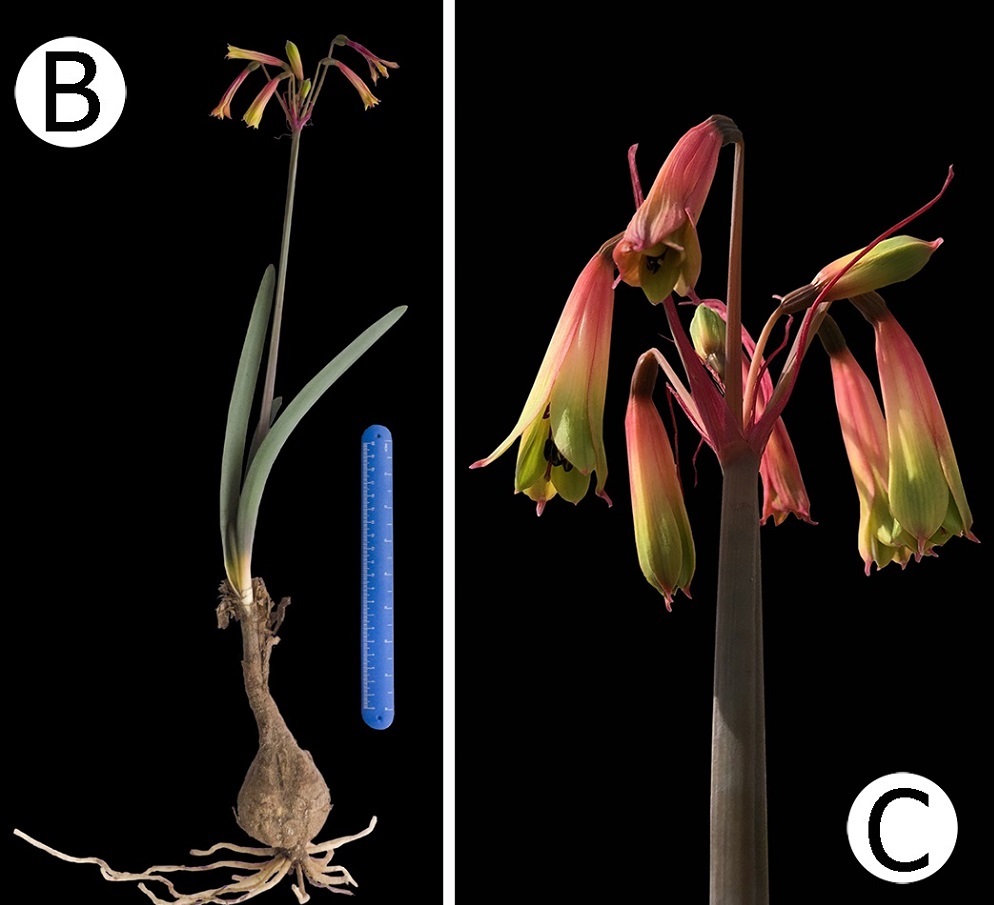
Hieronymiella peruviana.
 A, Habit. B, Flower, lateral view. C, Longitudinal section of flower showing inner and outer tepals, stamens and gynoecium. D, Dorsal and lateral view of stamens. E, Style. F, Fruits. G, Front view of dehiscent fruit. H, Seed.
Drawn by N. Sánchez.


Hieronymiella peruviana.
A, Habitat with rocky soil and pumice stone. B, Habit. C, Inflorescence. D, Flower, frontal view. E, Flower, lateral view. F, Fruits. G, Mature capsule and seeds.
 (Photos A, F, G: H. Huaylla et al. 4813, MOQ; B, C, D, E: O. Llalla & A. Manchego 68, MOQ).

Hieronymiella peruviana Huaylla, Slanis & Llalla sp. nov. 

Diagnosis. Hieronymiella peruviana is similar to H. bedelarii, differing by having weakly spatulate external tepals and flat appendages on the winged staminal filaments which take the form of crossed sickles ( vs. lanceolate external tepals and broad appendages on the winged staminal filaments which take the form of lobes with a thick edge).  


Hibert Huaylla, Alberto C. Slanis and Olimpia Llalla-Cordova. 2024. Hieronymiella peruviana (Amaryllidaceae, Amaryllidoideae): A New Species and A New Generic Record for the Flora of Peru [Una nueva especie y primer registro del género para la flora del Perú]. Darwiniana, Nueva Serie. 12(1); 149–155. DOI: doi.org/10.14522/darwiniana.2024.121.1209