Showing posts with label Harvard Papers in Botany. Show all posts

Monday, May 5, 2025

[Botany • 2024] Encyclia tuluaensis (Orchidaceae: Laeliinae) • A New Species from a tropical dry forest in the Department of Valle del Cauca, Colombia


Encyclia tuluaensis J.S. Moreno, Tamayo-Cen, & Carnevali, 

in Moreno, Tamayo‑Cen, Carnevali, Ocupa-Horna et Castaño. 2024, 

Abstract
 Encyclia tuluaensis is a newly discovered orchid species, endemic to the tropical dry forests of Valle del Cauca, Colombia, a region characterized by high biodiversity and significant conservation relevance, primarily due to extensive habitat loss. This species was identified through comprehensive morphological analysis of cultivated specimens at the Juan María Céspedes Botanical Garden, in the municipality of Tuluá, Valle del Cauca. Initially, the species, which we hypothesize belongs to the Andean clade, was misidentified as Encyclia betancourtiana during the first collection due to its superficial similarity. However, detailed morphological analysis ultimately revealed significant differences, leading to its recognition as a new species. The species exhibits a range of distinctive floral and vegetative features, including three apical leaves, a pronounced fold in the central lobe of the lip, and marked color changes from anthesis to senescence. This discovery underscores the taxonomic complexity and biodiversity within the genus Encyclia, emphasizing the need for continued taxonomic and ecological research. Encyclia tuluaensis is part of the Andean species complex and is currently only known from its type locality. It requires particular conservation efforts due to its restricted distribution and the vulnerability of its habitat, which is threatened by deforestation, agricultural expansion, and urban development. 

Keywords: systematics, taxonomy, tropical dry forest, Andean clade

CDP of Encyclia tuluaensis J.S. Moreno, Tamayo-Cen, & Carnevali.
 A, habit and growth; B, flower C, dissected perianth; D, lip, column, and ovary; E, column, lateral, dorsal, and ventral view; F, anther cap and pollinia. LCDP by J. S. Moreno, based on the holotype.
 
Encyclia tuluaensis J.S. Moreno, Tamayo-Cen, & Carnevali.
A, inflorescence; B, capsules in two stages of maturation. On the left, the immature ovary with dark brown color, and on the right, the mature ovary with black-purple color. Both show a verruculose (warty) surface; C, front view of the flower from anthesis to senescence, showing the progression from initial colors to aged appearance and a detailed view of the lip showing the color transition from initial vivid hues to the final coloration as the flower ages. Photographs by J. S. Moreno.


Encyclia tuluaensis J.S. Moreno, Tamayo-Cen, & Carnevali. sp. nov.

Encyclia tuluaensis is most similar to E. betancourtiana, distinguished by its lip with lateral lobes that are oblongelliptic (vs. oblong and rounded), and a mid-lobe that is transversely subquadrate-rhomboid (vs. obovate in the new species).


Juan Sebastián Moreno, Iván Tamayo‑Cen, Germán Carnevali, Luis Ocupa-Horna, and Alejandro Castaño. 2024, Encyclia tuluaensis (Orchidaceae: Laeliinae), A New Species from a tropical dry forest in the Department of Valle del Cauca, Colombia. Harvard Papers in Botany. 29(2):279-288
DOI: 10.3100/hpib.v29iss2.2024.n6  www.huh.harvard.edu/pdf-downloads

Monday, December 23, 2024

[Botany • 2024] Malaxis susanae (Orchidaceae: Malaxidinae) • A New Species of Malaxis with white flowers from Colombia


Malaxis susanae Sierra-Ariza, J.S. Moreno, & Chinchilla, 

in Sierra-Ariza, Moreno et Chinchilla, 2024. 
 
Abstract
Malaxis susanae from the Colombian Andes is described and illustrated as a new species of orchid. It resembles Malaxis carpinterae (Schltr.) Ames, but differs by the flowers that have a white (vs. green) lip and the disc cavity with the margin inconspicuously raised (vs. conspicuously raised in a retuse margin) at the apex. Notes on its distribution, habitat, floral phenology, etymology, related taxa, and conservation assessment are provided.

Keywords: Andes orchids, Malaxis caracasana, Malaxis carlos-parrae, Malaxis excavata, Malaxis lobulata, Malaxis pittieri 

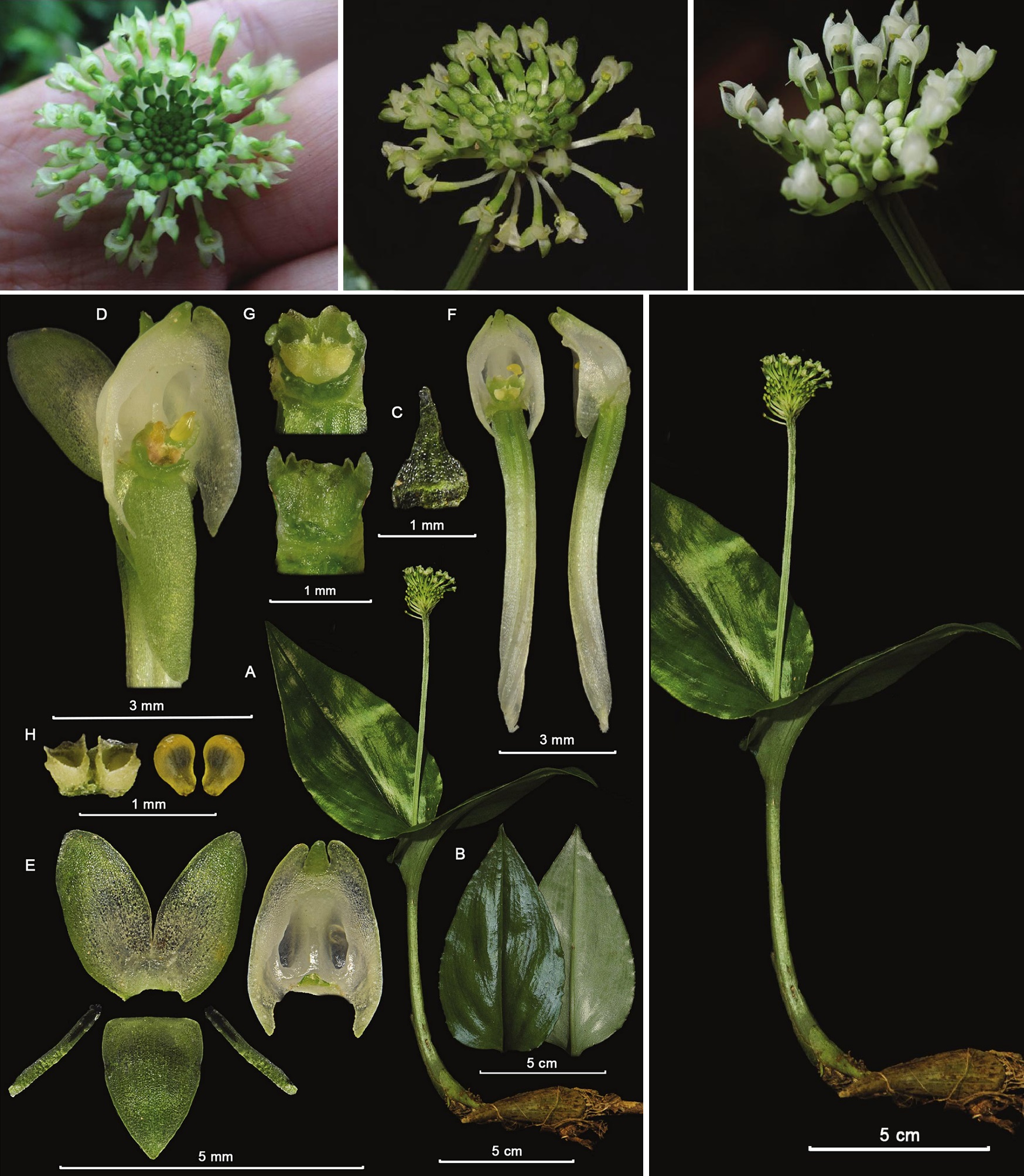
Lankester Composite Digital Plate of Malaxis susanae Sierra-Ariza, J.S. Moreno, & Chinchilla.
 A, Habit; B, leaves; C, floralbract; D, flower, oblique view; E, Dissected perianth (lip to the right); F, Pedicel and ovary, lip and column, frontal (left) and lateral(right) views; G, Column, dorsal (top) and ventral (bottom) views.; H, operculum (left) and pollinia (right).
LCDP by M. A. Sierra-Arizafrom the holotype (sierra ariza & albino Bohórquez 99, TOLI) 

Flowers of Malaxis susanae Sierra-Ariza, J.S. Moreno, & Chinchilla. from left to right:
front, oblique, lateral and back views.
By M. A. Sierra-Ariza from the holotype (sierra ariza & albino Bohórquez 99, TOLI) 


Comparison of flowers of Malaxis susanae Sierra-Ariza, J.S. Moreno, & Chinchilla from different locations in Colombia.
A,Valle del Cauca Department, 2 May 2015 by C. Alzate; B, Tolima, 18 December 2018 by M. A. Sierra-Ariza; C, Santander, 24 September2018 by H. López.
Prepared by M. A. Sierra-Ariza. 

Malaxis susanae Sierra-Ariza, J.S. Moreno, & Chinchilla, sp. nov. 

The new species is similar to Malaxis carpinterae (Schltr.) Ames, but is distinguished from it by the flowers that have a white (vs. green) lip, and the disc cavity that has an inconspicuously raised margin (vs. conspicuously raised in a retuse margin) at the apex.

Eponymy: Named in honor of María Susana Muhamad González, a distinguished Colombian political scientist and environmentalist, who currently serves as the Minister of Environment of Colombia. She is celebrated for her unwavering commitment to the care, restoration, and conservation of Colombia’s environment. In 2023, she was recognized by euters Impact as one of the top 25 female leaders globally in the fight against climate change. Additionally, in 2024, the omen Economic orum honored her as the oman of the Decade in Colombia for her exceptional efforts. Her achievements include securing significant resources to combat deforestation in the Amazon and leading Colombia’s successful bid to host CP16 on biodiversity in 2024.


Mario Alexei Sierra-Ariza, Juan Sebastián Moreno, and Isler F. Chinchilla. 2024. A New Species of Malaxis (Malaxidinae: Orchidaceae) with white flowers from Colombia. Harvard Papers in Botany. 29(1), 147-152. (30 June 2024) DOI: doi.org/10.3100/hpib.v29iss1.2024.n16

Malaxis susanae de los Andes colombianos es descrita e ilustrada como una nueva especie de orquídea. Se asemeja a Malaxis carpinterae (Schltr.) Ames, pero se diferencia por tener flores con el labio blanco (en comparación con verde) y la cavidad del disco con el margen discretamente elevado (en comparación conspicuamente elevado en un margen retuso) en el ápice. Se proporcionan notas sobre su distribución, hábitat, fenología floral, etimología, taxones relacionados y evaluación de conservación.

🌍 ¡Increíbles noticias desde la COP16!🌿
.... 🌱✨
- 🌟 Pleurothallis petroana, en honor a nuestro presidente Gustavo Petro
- 🌟 Pleurothallis franciana, en homenaje a nuestra vicepresidenta Francia Márquez
- 🌟 Malaxis susanae, en reconocimiento a nuestra Ministra de Ambiente y Desarrollo Sostenible, Susana Muhamad 
Además, la cuarta especie, Pleurothallis cop-biodiversitatis,  fue nombrada en conmemoración de la histórica #COP16 celebrada en Cali en 2024. 📅✨


Monday, December 2, 2024

[Botany • 2023] Lepanthes carrizosana (Orchidaceae: Pleurothallidinae) • A New Species from the Southwestern Andes in Colombia


Lepanthes carrizosana Gal.-Tar., Zuluaga & J.S. Moreno, 

in Moreno, Galindo-Tarazona et Tróchez, 2023.

 Abstract  
A new species of Lepanthes from the southwestern Andes of Colombia is described, illustrated and compared with morphologically similar species. The new species was found in two localities in the municipality of San José del Salado, in the department of Valle del Cauca, where several new species have been found and described in the past several years.

KEYWORDS: Colombia, Dagua, Lepanthes, ORCHIDACEAE, San José del Salado, sistemática, Valle del Cauca, 

Lepanthes carrizosana Gal.-Tar., Zuluaga & J.S. Moreno.
A, Habit and plant; B, Flower; C, Dissected perianth; D, Lip, column and ovary; E, Lip expanded; F, Pollinia and anther cap.
Drawing by J. S. Moreno based on the holotype.

. In-situ photographs of Lepanthes carrizosana Gal.-Tar., Zuluaga & J.S. Moreno.
 A, Flower; B, Flower from the side; C, Habit and plant.
In-situ photographs by R. Galindo-Tarazona.

Lepanthes carrizosana Gal.-Tar., Zuluaga & J.S.Moreno, sp. nov. 

Lepanthes carrizosana is most similar to Lepanthes darioi Luer & R.Escobar. It can be distinguished by having a pubescent, obovate, bilaminate lip with cuneate connectives (vs. narrowly ovate lip and oblong connectives), and a small appendix with a pair of minute apical lobes that come from a slightly short pubescent, concave base (vs. broadly triangular appendix held directly below the stigma).

Eponymy: The name of the new species honors Julio Carrizosa Umaña, a scientist, environmentalist and thinker with a great vision of the connection between environmental institutionalism and strategies aimed at sustainable development in Colombia. He was the Director of the Institute of Environmental Studies of the National University of Colombia from 1993 to 1998. He currently coordinates the Natural Parks Committee of the Colombian Academy of Exact, Physical, and Natural Sciences. He has been designated a full member of the Colombian Society of Engineers, a full member of the Geographical Society of Colombia, vice president of the Colombian Society of Ecology in 1978, an honorary member of the Cartographic Society of Colombia and the Association of Fisheries Researchers, president of the Environment Committee of the Pan-American Institute of Geography and History between 1973 and 1976, and corresponding member of the Ecuadorian Institute of Natural Resources.


Juan Sebastián Moreno, Robinson Galindo-Tarazona, and Alejandro Zuluaga Tróchez. 2023. Lepanthes carrizosana, A New Species of Lepanthes (Orchidaceae: Pleurothallidinae) from the Southwestern Andes in Colombia. Harvard Papers in Botany. 28(1); 89-92. DOI: doi.org/10.3100/hpib.v28iss1.2023.n11 (30 June 2023)  

Se describe, ilustra y compara una nueva especie de Lepanthes del suroeste de los Andes occidentales de Colombia con especies morfológicamente similares. La especie nueva fue encontrada en el municipio de San José del Salado en el departamento del Valle del Cauca donde se han encontrado y descrito varias especies nuevas en los últimos años.

Colombia, Dagua, LepanthesORCHIDACEAE, San José del Salado, sistemática, Valle del Cauca


Monday, August 26, 2024

[Botany • 2023] Stenostephanus purpureus (Acanthaceae: Justicieae: Isoglossinae) • A New Species from Costa Rica and Panama—Overlooked for More than 150 Years


 Stenostephanus purpureus 

in Daniel et Kriebel, 2023.

 Abstract  

Comparative studies of macromorphological and palynological characters of plants representing Stenostephanus silvaticus from southern Mexico and southern Central America reveal that those from the two geographically isolated regions represent different taxa. Stenostephanus purpureus is described as a new species from Costa Rica and Panama. It differs from S. silvaticus of Chiapas, Oaxaca, Tabasco, and Veracruz, Mexico by numerous characters, including: pyramidal inflorescences with rachises, dichasial peduncles, and floral pedicels glabrous; corollas blue-purple to purple with both lips recoiled; and pollen subspheroidal with a fossulate interapertural band of exine bearing a medial row of gemmae and baculae. We provide a description of S. purpureus and a key to, images of, and map showing the distributions of both species.

KEYWORDS: Stenostephanus silvaticus, pollen, nototriby/sternotriby/pleurotriby


Thomas F. Daniel and Ricardo Kriebel. 2023. Stenostephanus purpureus (Acanthaceae: Justicieae: Isoglossinae), A New Species from Costa Rica and Panama—Overlooked for More than 150 Years. Harvard Papers in Botany. 28(2); 655-662. DOI: doi.org/10.3100/hpib.v28iss2.2023.n3

Los estudios comparativos de caracteres macromorfológicos y palinológicos de plantas que representan a Stenostephanus silvaticus del sur de México y el sur de Centroamérica revelan que las de las dos regiones geográficamente aisladas representan taxones diferentes. Stenostephanus purpureus se describe como una especie nueva de Costa Rica y Panamá. Se diferencia de S. silvaticus de Chiapas, Oaxaca, Tabasco y Veracruz, México por numerosos caracteres, entre ellos: inflorescencias piramidales con raquis, pedúnculos bicaisales y pedicelos florales glabros; corolas azul-púrpura a púrpura con ambos labios retraídos; y polen subesferoidal con una banda interapertural fosulada de exina que lleva una fila medial de yemas y báculas. Proporcionamos una descripción de S. purpureus y una clave, imágenes y un mapa que muestra las distribuciones de ambas especies.

Friday, May 3, 2024

[Botany • 2023] Aphanandrium narupayacuensis • The Reinstatement of Aphanandrium (Acanthaceae), A New Species from Ecuador and Four New Combinations


Aphanandrium narupayacuensis Cornejo, Wassh. & Exe,

in Cornejo, Wasshausen, Exe et Johnson, 2023. 

Abstract
 Aphanandrium, a genus of herbs and shrubs in the Acanthaceae from the Neotropics, is reinstated based on a previous phylogenetic study, and the following new combinations are herein presented: Aphanandrium grandifolius, A. harlingii var. harlingii, A. harlingii var. longifolius, and A. nitidus. Also, Aphanandrium narupayacuensisa distinctive new species from the lowlands of northeastern Ecuador, is formally described and illustrated, and its relationship to morphologically closely related species is discussed. 

Keywords: Ecuador, Narupayacu, Neriacanthus, Neotropics


Aphanandrium narupayacuensis Cornejo, Wassh. & Exe.
A, habit; B, terminal leafy branch, abaxial view; C, inflorescence; D, close-up of swollen distal part of corolla tube; E, F, flowers at anthesis; G, longitudinal section of corolla, lateral view; H, floral bract, calyx, and base of corolla tube; I, fruits nearly to maturity attached to the rachis of infructescence, lateral view.
A–I are based on the type. 
Photographs A, B, G, and H by X. Cornejo; C, D, E, F, and I, by N. Exe.


Xavier Cornejo, Dieter Wasshausen, Nolan Exe and Mia Johnson. 2023. The Reinstatement of Aphanandrium (Acanthaceae), A New Species from Ecuador and Four New Combinations. Harvard Papers in Botany. 28(1);  31-36. 

Friday, January 12, 2024

[Botany • 2023] Bulbophyllum parex (Orchidaceae: Epidendroideae) • A New Species of Bulbophyllum sect. Xiphyzusa from the Andean Region of Colombia


 Bulbophyllum parex J. Alvarez-Diaz & J.S. Moreno, 

in Sierra-Ariza, Alvarez Diaz et Moreno, 2023.

Abstract
A new species of Bulbophyllum, section Xiphyzusa, found in the Andean region of Colombia, in the department of Huila, is described and illustrated. The species is discussed in relation to its morphologically similar and closest relatives. Information on its distribution, ecology, and habitat is provided.

KEYWORDS: Huila, section Xiphyzusa, systematics, taxonomy, 

 Bulbophyllum parex J. Alvarez-Diaz & J.S. Moreno.
A, Habit; B, Flower; C, Dissected perianth; D, Lip and column lateral view; E, Column; F, Anther and Pollinia.
Illustration by A. J. S. Moreno based on the plant that served as the holotype.

 Bulbophyllum parex J. Alvarez-Diaz & J.S. Moreno.
A, Habit; B, Flower; C, Dissected perianth; D, Lip and column lateral view; E, Column; F, Anther.
LCDP by M. A. Sierra-Ariza, based on the holotype.

Bulbophyllum parex J.Alvarez-Diaz & J.S.Moreno sp. nov.

Bulbophyllum parex is morphologically closest to Bulbophyllum bidentatum (Barb.Rodr.) Cogn., from which it differs in having lanceolate petals with a ciliate margin (vs. ovate-lanceolate petals with a lacerate-ciliate margin), the labellum with slightly ciliate lateral lobes (vs. to entire lateral lobes), and the middle lobe oblong-elliptic (vs. linear-ligulate).

Etymology: The specific epithet, parex, is given in gratitude to Parex Resources company, for their financial and logistic support in the process of studying and publishing the new species.


Mario Alexei Sierra-Ariza, Jose Armando Alvarez Diaz and Juan Sebastián Moreno. 2023. A New Species of Bulbophyllum (Orchidaceae) from the Andean Region of Colombia. Harvard Papers in Botany. 28(1); 129-135. DOI: 10.3100/hpib.v28iss1.2023.n16
 
Se describe e ilustran una nueva especie para el género Bulbophyllum sección Xiphyzusa encontrada en la región andina de Colombia, en el departamento del Huila. La especie se discute con las especies morfológicamente más cercanas y se proporciona información sobre su distribución, ecología y hábitat.

Monday, December 18, 2023

[Botany • 2023] Columnea blancoi (Gesneriaceae) • A New Species from the Central Pacific Region of Costa Rica


Columnea blancoi J.E. Jiménez, Chinchilla et Kriebel,
 
in Jiménez, Chinchilla et Kriebel, 2023.

Abstract
We describe and illustrate a new species of Columnea from the Central Pacific region of Costa Rica. Columnea blancoi sp. nov. is morphologically similar to Columnea canarina, from Panama which it can be distinguished by having stems that are flaky and sericeous distally, ovate bracts, entire, green and shorter calyx lobes, yellow corolla that is glandular-pilose externally, with a marginal purple-red line 1–2 mm wide on all lobes internal and externally, and a shorter ventral corolla lobe and style. A taxonomic description, illustrations, a distribution map, conservation status, and comments on how C. blancoi differs from other morphologically related species are provided.


José Esteban Jiménez, Isler F. Chinchilla and Ricardo Kriebel. 2023. Columnea blancoi (Gesneriaceae), A New Species from the Central Pacific Region of Costa Rica.  Harvard Papers in Botany. 28(1); 51-59. DOI: 10.3100/hpib.v28iss1.2023.n6

Describimos e ilustramos una nueva especie de Columnea de la región del Pacífico Central de Costa Rica. Columnea blancoi sp. nov. es morfológicamente similar a Columnea canarina, de Panamá la que se distingue por tener tallos escamosos y seríceos distalmente, brácteas ovadas, los lóbulos del cáliz enteros, verdes y más cortos, la corola amarilla, glandular-pilosa externamente y con una línea rojo-púrpura marginal de 1–2 mm de ancho en todos los lóbulos interna y externamente, y el lóbulo ventral de la corola y el estilo más cortos. Además, se proporciona su descripción taxonómica, ilustración, mapa de distribución, estado de conservación y comentarios de cómo difiere C. blancoi de especies morfológicamente relacionadas.
 

Thursday, August 31, 2023

[Botany • 2023] Vochysia wilsonii (Vochysiaceae, sect. Ciliantha) • A New Species from the Colombian Amazon Forest


Vochysia wilsonii Marc.-Berti, J.M. Vélez. & Aymard,

in Marcano-Berti, Vélez-Puerta et Aymard-Corredor, 2023.

Abstract
A new species of Vochysia, V. wilsonii (section Ciliantha, subsection Ferruginea), is described, and its morphological relationships with other similar Vochysia species are discussed. Vochysia wilsonii is found in wet forests over sandstone tabletop outcrops (“Mesetas”) and white sand soils in the Araracuara (“medio río Caquetá”) and Chiribiquete areas, a megadiverse region in the Colombian Guayana Shield, Caquetá department. This new species is a tree up to 25 m tall, and shares features with four species (Vochysia biloba, V. casiquiarensis, V. sabatieri, and V. vismiifolia). However, it differs in the size and shape of the leaves, stipules, inflorescence, cincinni, spur, spurred sepal, flower, central petal and stamen, as well as in its pubescence size and shape. An updated key of 45 Colombian species of Vochysia is provided.

 Keywords: Wet forest, Sandstone outcrops, Araracuara, Medio Río Caquetá, Vochysia, Vochysiaceae 

 Holotype of Vochysia wilsonii Marc.-Berti, J.M. Vélez & Aymard (Duivenvoorden, Matapí & Restrepo 2723, COAH [4950]).

Vochysia wilsonii Marc.-Berti, J.M. Vélez. & Aymard, sp. nov. 

 Vochysia wilsonii resembles V. biloba, V. casiquiarensis, V. sabatieri and V. vismiifolia, but can be differentiated from these species by having leaves obovate to obovateelliptic, 7.0–14.2 × 4.2–6.0 cm, apex emarginated, truncate to truncate-emarginate, short mucronate, base obtuse, lateral veins 24–29, at a 50˚– 60˚ angle with the midrib, stipules triangular, inflorescences 16–19 cm long, cincinni 3-flowered, rarely 2- or 4-flowered, spurred sepal 1.3–1.4 cm long, spur 6.5–7 mm long, subsigmoidal, and stamen glabrous dorsally, laxly pubescent on internal surface.

Etymology: Vochysia wilsonii is named after Wilson Rodríguez, a most enthusiast Colombian botanist, with an extraordinary knowledge of the floras of the Amazon and Orinoco river basins, of neotropical ferns, and, more recently, of Vochysiaceae.

 Common names: The name “Peraikz” (Uitoto) was recorded on the specimen Sastre & Raichel-Dolmatoff 4956.


Luis B. Marcano-Berti, Jorge M. Vélez-Puerta and Gerardo A. Aymard-Corredor. 2023. A New Species of Vochysia (Vochysiaceae, section Ciliantha, subsection Ferruginea) from the Colombian Amazon forest. Harvard Papers in Botany. 28(1); 77–84.  77  HUH.harvard.edu 

NUEVA ESPECIE AMAZÓNICA DE VOCHYSIA ES NOMBRADA EN HONOR AL CURADOR DEL HERBARIO AMAZÓNICO COLOMBIANO
Resumen. Una nueva especie de Vochysia, V. wilsonii (section Ciliantha, subsection Ferruginea) es descrita y sus relaciones morfológicas con sus especies afines son discutidas. Vochysia wilsonii se encuentra en los bosques sobre mesetas en los afloramientos de arenisca y en suelos de arenas blancas de Araracuara (medio río Caquetá) y Chiribiquete, una región megadiversa del escudo guayanés colombiano, en el departamento del Caquetá. Esta nueva especie es un arbol de hasta 25 m de altura, que presenta similitudes morfológicas con cuatro especies (Vochysia biloba, V. casiquiarensis, V. sabatieri and V. vismiifolia). Sin embargo, esta difiere en la pubescencia, tamaño y forma de sus hojas, estípulas, inflorescencias, cincinos, espolón, cáliz espolonado, flores, el pétalo central y el estambre. Se incluye una clave actualizada de las 45 especies de Vochysia presentes en Colombia.
  Palabras clave: Bosques húmedos, afloramientos de arenisca, Araracuara, Medio Rìo Caquetá, Vochysia, Vochysiaceae

Wednesday, March 8, 2023

[Botany • 2020] Euphorbia shehbaziana (Euphorbiaceae) • A New Species from Kurdistan Iraq


Euphorbia shehbaziana S.A. Hama & S.A. Ahmad, 

in Hama & Ahmad, 2020.

 Abstract 
Euphorbia shehbaziana is described and illustrated as a new species from Kurdistan Iraq, and its distinguishing characters from its nearest relatives, E. denticulata and E. craspedia, are discussed.

KEYWORDS: Euphorbia, Iraq, Gmo Mt., Kurdistan

Euphorbia shehbaziana S.A. Hama & S.A. Ahmad.
A, plant; B, cyathium; C, fruit; D, seed with caruncle. Photographs by Saman A. Ahmad based on the holotype.


Euphorbia shehbaziana S.Y. Hama and S.A. Ahmad, sp. nov.

 Euphorbia shehbaziana is readily distinguished from its nearest woody relatives by having entire leaves, 3- to 5-rayed umbels, denticulate glands, bracteate male flowers, and rugose seeds.

Etymology: Euphorbia shehbaziana is named in honor of our mentor and friend Dr. Ihsan A. Al-Shehbaz (MO) in recognition of his devotion to promoting botany in Kurdistan Iraq.


Sakar Y. Hama and Saman A. Ahmad. 2020. Euphorbia shehbaziana (Euphorbiaceae), A New Species from Kurdistan Iraq. Harvard Papers in Botany. 25(1); 73-74. DOI:  10.3100/hpib.v25iss1.2020.n9

Saturday, February 5, 2022

[Botany • 2021] Capparidastrum estrellae (Capparaceae) • Notes on the Genus Capparidastrum and the Description of A New Species from Northwestern Ecuador


Capparidastrum estrellae Cornejo & N. Mejía-Pazos,

in Cornejo, Mejía-Pazos & Soto, 2021.

Abstract 
The genus Capparidastrum (Capparaceae) is discussed and C. estrellae, a new tree species endemic to northwestern Ecuador, is described and illustrated. Its conservation status is here assessed as endangered. 

Keywords: Capparaceae, Ecuador, Capparidastrum estrellae, endemic 

 
Capparidastrum estrellae Cornejo & N. Mejía-Pazos.
A, raceme bearing globose, snow-white flower buds, lateral view; B, flower at anthesis, lateral view; C, calyx, corolla, fleshy compressed nectary glands and base of filaments, lateral view; D, fruit nearly at maturity; E, mature leaf blade, abaxial view; F, gray bark.
Photographs of the holotype, N. Mejía-Pazos s.n. (GUAY).
 Photographs by Nicanor Mejía-Pazos.

Capparidastrum estrellae Cornejo & N. Mejía-Pazos, sp. nov.

Etymology: the epithet estrellae of this taxonomic novelty honors Dr. Eduardo Estrella Aguirre (1941–1996), an Ecuadorian researcher, founder of the Ecuador National Museum of Medicine and the great discoverer and editor of the long-lost work Flora Huayaquilensis by Juan Tafalla, a botanical masterpiece and the first flora of present Ecuador from the colonial period, in which the most common species of Capparaceae from coastal Ecuador were documented with splendid handmade, natural-sized illustrations. 

Habitat and distribution: known from the type in the vicinity of San Miguel de los Bancos toward Saloya, a lower montane secondary wet forest, in which individuals of Capparidastrum estrellae are scattered forest elements at 1230 m and may persist as solitary individuals in open areas. On the basis of field photographs sent by Jaime West to the first author, it is most likely that a second population of this taxonomic novelty occurs at 500 m on the same western side of Pichincha Province.


 Xavier Cornejo, Nicanor Mejía-Pazos and Mónica Armas Soto. 2021. Notes on the Genus Capparidastrum (Capparaceae) and the Description of C. estrellae, A New Species from Northwestern Ecuador. Harvard Papers in Botany. 26(1); 101–104. DOI: 10.3100/hpib.v26iss1.2021.n4

Resumen. Se comenta el género Capparidastrum (Capparaceae), y se describe e ilustra Capparidastrum estrellae, una nueva especie de árbol endémica del noroccidente de Ecuador. El estado de conservación de Capparidastrum estrellae aquí asignado es en peligro. 
Palabras claves: Capparaceae, Ecuador, Capparidastrum estrellae, endémica