Showing posts with label Blattodea. Show all posts

Tuesday, June 16, 2026

[Entomology • 2026] Pseudocapritermes novus • A New Species of Soil-dwelling Termites (Blattodea: Termitidae: Mirocapritermitinae) from the Indian Subcontinent


Pseudocapritermes novus Rituparna, Baraik & Rajmohana, 

in Sengupta, Baraik, Rajmohana, Debnath, Dinesh et Chinu, 2026. 

Abstract
The present study reports a new species, Pseudocapritermes novus Rituparna, Baraik & Rajmohana sp. nov. from West Bengal, India. Species description followed an integrative taxonomic approach by including a mitochondrial 16S rRNA genetic sequence with comprehensive morphological characteristics of the soldier caste. Additionally, the first mt 16S rRNA gene sequence for the recently identified Pseudocapritermes kunjepu Mathew, 2020, is presented in the study. Digital photos of the new species are also included, along with an identification key to the soldier castes of all species of the genus reported from the Indian sub-continent. Association of Pericapritermes semarangi (Holmgren, 1913) with the new species is also recorded in the study.
 
Keywords: Inquiline, mitochondrial 16S rRNA, molecular phylogeny, Pericapritermes, Pseudocapritermes, taxonomy


Pseudocapritermes novus Rituparna, Baraik & Rajmohana sp. nov., Soldier:
A. General habitus, lateral view; B. Postmentum; C. Mandibles; D. Head capsule, dorsal view; E. Head capsule, ventral view; F. Labrum marked with an arrow (the extended process of the anterolateral corner of the labrum is broken on the right side); G. Antennae.

Pseudocapritermes novus Rituparna, Baraik & Rajmohana sp. nov. 

  
Rituparna Sengupta, Balmohan Baraik, Rajmohana K., Rupam Debnath, K. P. Dinesh and Ipe Chinu. 2026. Description of A New Species of Soil-dwelling Termites (Blattodea: Termitidae: Mirocapritermitinae) from the Indian subcontinent. The Journal of Insect Biodiversity and Systematics. DOI: 10.48311/jibs.12.03.537 [13 May 2026] 

Tuesday, October 7, 2025

[Entomology • 2025] Nocticola umedai • A New macropterous Species of the Genus Nocticola Bolívar, 1892 (Blattodea: Nocticolidae) from Japan


Nocticola umedai 
Yanagisawa & Ohgita, 2025


Abstract
In this study, we describe the macropterous forms of Nocticola uenoi uenoi Asahina, 1974 and Nocticola uenoi kikaiensis Asahina, 1974, which have previously not been described in detail, and describe a new species in the genus Nocticola umedai sp. nov. Yanagisawa & Ohgita, collected in Nagasaki Prefecture, Japan. Two forms of this species were identified, namely, a yellowish macropterous form with yellow body color and reduced compound eyes, and a brownish macropterous form with brown body color and developed compound eyes. The yellowish macropterous form can be distinguished from similar species with respect to 1) development of both tegmina and wings of male; 2) L4C long and hook-like; 3) L1 left posterior corner long and spine-like with corrugated and right side with rounded square base and long spine extending from posterior margin, whereas the brownish macropterous form 1) sharply pointed L4C apex; 2) supraanal plate close to quadrangle; 3) subgenital plate asymmetrical; 4) L1 with long projections on either side. We also provided an updated version of the key to macropterous Nocticola previously presented by Lucañas and Maosheng (2023).

Keywords: cockroach, taxonomy, morphology, Nocticola uenoi uenoiNocticola uenoi kikaiensis

Nocticola umedai sp. nov.
A, B (holotype, OMNH TI 549 / OMNH_OI N000010669); C, D (paratype, OMNH_OI N000010677);
E, F, I, J (paratype, OMNH_OI N000010676), G, H (paratype, OMNH_OI N000010678).
 A, dorsal view of male; B, ventral view of male; C, dorsal view of female; D, ventral view of female; E, head of male; F, head of male side view; G, head of female; H, head of female side view; I, tegmen of male; J, wing of male.

Male of brownish macropterous form Nocticola umedai sp. nov. (paratype, OMNH_OI N000010679).
 A, dorsal view; B, head; C, head side view; D, pronotum; E, forefemur; F, tegmina; G, wing; H, supra-anal plate; I, subgenital plate; J, living individual.

 
Shizuma YANAGISAWA  and Shotaro OHGITA. 2025. New Macropterous Species of the Genus Nocticola Bolívar, 1892 (Blattodea: Nocticolidae) from Japan, and Description of Macropterous Form of N. uenoi subspecies. Japanese Journal of Systematic Entomology. 31(1); 158-166. DOI: doi.org/10.69343/jjsystent.31.1_158
 facebook.com/JpnSocSystEnt | twitter.com/JpnJsystEnt

Sunday, May 25, 2025

[Arachnida • 2024] Vigdisia praesidens, gen. et sp. nov. • A perilous Malagasy triad: A Spider and An Ant compete for Termite Food

 
 Vigdisia praesidens Agnarsson, Kuntner, Yu & Gregorič, 

in Gregorič, Yu, Ravelojaona, Agnarsson et Kuntner, 2024.

ABSTRACT
Ants and termites are insect groups that make up most of the insect biomass in tropical ecosystems. Due to their social structure and abundance, they are some of the most bountiful prey available to other invertebrates such as spiders. However, ants and termites possess dangerous defense strategies, thus limiting their accessibility to general predators. Here, we report on an unexpected finding of a three-way predator-prey-kleptoparasite interaction in Madagascar among a termite Nasutitermes sp. (prey), a previously unknown theridiid spider Vigdisia praesidens gen. nov., sp. nov. (predator), and an ant Pheidole spinosa (kleptoparasite). Our field observations suggest that the spiders are able to detect a damaged termite nest from a distance to disperse onto it and prey on its residents. Kleptoparasitic ants also arrive on the scene to steal from the spiders their termite prey. Both the spider and the ant seem to possess some degree of behavioural prey specialisation for Nasutitermes termites. The here described ecological interaction warrants further study to better understand the exploitation of signals by such phylogenetically diverse arthropods.

KEYWORDS: Heterospecific competition, opportunistic predation, prey specialisation, kleptoparasitism, alarm signals, stenophagy, spider web

 Vigdisia praesidens with two termites wrapped. 
Camp Mantella, Marojejy National Park, Madagascar, 30. March 2022. 

Family Theridiidae Sundevall, 1833. 
Subfamily Spintharinae Simon, 1894.

Vigdisia Agnarsson, Kuntner, Yu & Gregorič, new genus

Vigdisia praesidens Agnarsson, Kuntner, Yu & Gregorič, new species

Etymology: The genus name, feminine in gender, honors Vigdís Finnbogadóttir, former president of Iceland (1980-1996) and the first democratically elected female pre-sident in the world. Vigdís shares the spider ́s elegance and wits.  
 

Matjaž Gregorič, Kuang Ping Yu, Jeremia Ravelojaona, Ingi Agnarsson and Matjaž Kuntner. 2024. A perilous Malagasy triad: A Spider (Vigdisia praesidens, gen. and sp. nov.) and An Ant compete for Termite Food. New Zealand Journal of Zoology. DOI: doi.org/10.1080/03014223.2024.2373185 [14 Jul 2024]
https://www.newspeciespodcast.net/all-episodes/a-new-malagasy-spider-with-matja-gregori

Thursday, April 17, 2025

[Entomology • 2025] Nocticola baiguensis, N. cordiformis & N. appendiculata • Three New Species of the Cockroach Genus Nocticola Bolívar, 1892 (Blattodea: Corydioidea: Nocticolidae) from China


Nocticola baiguensis
Nocticola cordiformis 
Nocticola appendiculata 

Li, Liu, Chen, Wei, Yue & Qiu, 2025  

Abstract
Three new species of Nocticola Bolívar, 1982 from Guangxi Province, China are described: Nocticola baiguensis sp. nov., Nocticola cordiformis sp. nov., and Nocticola appendiculata sp. nov. Morphological features associated with the wings, the specialized abdominal tergum, and genitalia of these new species are described and illustrated in detail. A key to the recorded Nocticola species from China is provided in this paper.

Key words: Cave cockroach, epigean, identification key, new species, Nocticola, taxonomy
 
Habitats of Nocticola baiguensis sp. nov. from China 
A, B external environment of the Baigu Cave
C, D N. baiguensis sp. nov. found on stone, surrounded by some animal feces E N. baiguensis sp. nov. found on rotting branch F nymphs of Nocticola baiguensis sp. nov.

Habitats of Nocticola cordiformis sp. nov. from China
A, B habitats of holotype specimen of N. cordiformis sp. nov. C adult of N. cordiformis sp. nov. on wood.
Habitats of Nocticola appendiculata sp. nov. from China
A habitats of N. appendiculata sp. nov. B nymphs and an adult of N. appendiculata sp. nov. on wood C N. appendiculata sp. nov., side view D female and male of N. appendiculata sp. nov. mating.


 Ting-Ting Li, De-Xing Liu, Jian Chen, Xiao-Ya Wei, Qiao-Yun Yue and De-yi Qiu. 2025. Three New Species of the Cockroach Genus Nocticola Bolívar, 1892 (Blattodea, Corydioidea, Nocticolidae) from China. ZooKeys 1232: 267-284. DOI: doi.org/10.3897/zookeys.1232.136907 

Saturday, October 26, 2024

[PaleoEntomology • 2024] Alderblattina simmsi • A New Cockroach (Blattodea: Rhipidoblattinidae) from the Toarcian (Lower Jurassic) of Alderton Hill, Gloucestershire, UK, and the earliest likely occurrence of aposematic colouration in Cockroaches


Alderblattina simmsi 
 Swaby, Coe & Ross, 2024
 

Abstract
We describe the seventh valid species of cockroach, Alderblattina simmsi gen. et sp. nov., from insect-rich strata recording the Toarcian Oceanic Anoxic Event (T-OAE). The T-OAE represents a period of extreme global warming and environmental change that drove palaeoecological pressures and evolutionary changes in marine and terrestrial ecosystems. Here, for the first time, we present evidence that this event may also be the driver for the evolution of aposematic colouration, a predator deterrent, in cockroaches. The specimen, an isolated compressed tegmen, was collected at Alderton Hill, Gloucestershire, UK, and is assigned to a new genus and species, based on the following unique combination of characteristics: small forewing; 15 branches of R and 11 branches of M + CuA; strong cross-vein between R and M; intercalaries; and two well-defined subspherical maculae (spots) and colouration at the wing tip. Alderblattina simmsi is assigned to the family Rhipidoblattinidae Rohdendorf, primarily based on its small size and the presence of branched anal veins in the clavus. The colouration present on A. simmsi represents the first recorded likely occurrence of aposematism in cockroaches, and provides evidence for the evolution of colour patterning in Blattodea.

Keywords: Alderblattina simmsi, Blattodea, Rhipidoblattinidae, Alderton Hill, Toarcian Oceanic Anoxic Event, aposematic colouration


SYSTEMATIC PALAEONTOLOGY
Order BLATTODEA Brunner Von Wattenwyl, 1882
Superfamily CALOBLATTINOIDEA Vršanský, 2000
Family RHIPIDOBLATTINIDAE Rohdendorf, 1949
Type genus: Rhipidoblattina Handlirsch, 1906.
Type species: Mesoblattina geikiei Scudder, 1886, p.454.

Diagnosis: Small cockroaches with a curved radius, intercalaries and a clavus with bifurcating anal veins.


Genus Alderblattina nov.
 
Derivation of name: The genus is named after Alderton Hill, the locality from which the specimen was derived.
 
Alderblattina simmsi sp. nov.

Derivation of name: The species is named after geologist Michael J. Simms, who originally collected the specimen while working in the field with Edmund A. Jarzembowski in January 1984.

Diagnosis: Small forewing; 15 branches of R and 11 branches of M + CuA; strong cross-vein between R and M; two subspherical maculae (spots) in the medial area and colouration at wing tip; A1 terminates on CuP.


Emily J. Swaby, Angela L. Coe and Andrew J. Ross. 2024. A New Cockroach (Blattodea, Rhipidoblattinidae) from the Toarcian (Lower Jurassic) of Alderton Hill, Gloucestershire, UK, and the earliest likely occurrence of aposematic colouration in Cockroaches. Papers in Palaeontology. DOI: doi.org/10.1002/spp2.1598


Friday, June 28, 2024

[Entomology • 2019] Laevifacies quadrialata • A New Genus and A New Species in the Subfamily Polyzosteriinae (Blattodea: Blattidae) from China


Laevifacies quadrialata 
 Liao, Wang & Che, 2019


Abstract
Laevifacies quadrialata gen. et sp. nov. is described from Hainan Province, China based on morphological data. COI data (DNA barcodes) is utilized to confirm the sexual dimorphism occurring in Laevifacies quadrialata gen. et sp. nov. Melanozosteria nitida Brunner von Wattenwyl, 1865, is reported from Guangxi Province, China. A key to the Chinese Polyzosteriinae is provided.

Keywords: Blattaria, cockroaches, Laevifacies, Melanozosteria, molecular identification, morphology

Laevifacies quadrialata sp. nov.
A–F, I–K male holotype A in dorsal view B in ventral view C pronotum, in dorsal view D head, in ventral view E femur, in ventral view F tibia, in ventral view I fore tarsus, in ventral view J mid tarsus, in ventral view K hind tarsus, in ventral view.
G–H female paratype G in dorsal view H in ventral view.
Scale bars: 5 mm (A–B, G–H); 1 mm (C–F, I–K).

Laevifacies gen. nov.
 
Laevifacies quadrialata sp. nov.  

Generic diagnosis: Body small to medium, thinner in male, thorax slightly broader than abdomen. Surface smooth and shining. Pronotum slightly semicircular, vertex barely exposed. Male with vestigial tegmina and hind wings on mesonotum and metanotum respectively, both nearly triangular; female only with vestigial tegmina, its shape similar to that of male, without hind wings. Legs strong but short, coxae with punctation, front femora Type A2. Mid and hind metatarsus with strong spines, claws symmetrical. Cerci strong, short and symmetrical. Styli long and symmetrical. Supra-anal plate in male short, triangular; subgenital plate broad and short, slightly quadrilateral and symmetrical. L1 divided into two parts, L3 bifurcated, one branch short, the other one long, R1 nearly claw-like and R2 large, hooked.

Etymology: The name Laevifacies is derived from two Latin words laevis and facies, referring to the smooth and shining surface of terga. The gender of Laevifacies is feminine.


 Shuran Liao, Zongqing Wang and Yanli Che. 2019. A New Genus and A New Species in the Subfamily Polyzosteriinae (Blattodea, Blattidae) from China. ZooKeys. 852: 85-100. DOI: 10.3897/zookeys.852.33325

Sunday, June 16, 2024

[Entomology • 2024] A Taxonomic Revision of the South American Trilobite Cockroaches of Parahormetica (Blattodea: Blaberidae), with Description of Parahormetica museunacional sp. nov. from the Atlantic Forest


Habitus of alive specimens of Parahormetica.
 [a] male of Parahormetica cicatricosa, [b] male of P. monticollis,  
[c] female Parahormetica museunacional sp. nov., [d-h] P. bilobata 
 
Polizeli & Pinto, 2024

Abstract
The taxonomically intricate genus of trilobite cockroaches, Parahormetica Brunner von Wattenwyl, 1865, is revised based on a comparative morphological analysis. The goals of this study are to review the nomenclature, propose hypotheses about specific delimitation, and provide diagnoses to allow identification of the taxonomic units in the genus. Based on the revised status of Parahormetica, we transferred Parahormetica hylaeceps Miranda-Ribeiro, 1936, and Parahormetica punctata Saussure, 1873, to the genus Bionoblatta Rehn, 1940. Therefore, the genus includes now four species of giant cockroaches which are predominantly distributed on the Atlantic Forest: Parahormetica bilobata (Saussure, 1864), Parahormetica cicatricosa Saussure, 1869, Parahormetica monticollis (Burmeister, 1838), and Parahormetica museunacional sp. nov. (holotype male deposited in DZUP: Brazil, Paraná). Diagnoses, key, distribution maps, images of living, non-type, and type specimens are made available. Our results make clear that the status and limits among Brachycolini genera pending a full revision.

Keywords: Araucaria Forest, Blattaria, Blaberinae, New species, Systematics, Zetoborinae


Habitus of alive specimens of Parahormetica.
 a Male of Parahormetica cicatricosa, Cubatão municipality, state of São Paulo (photo C. A. M. Raposo); b male of Parahormetica monticollis, Olaria municipality, state of Minas Gerais (photo R. M. da Silva);
c female Parahormetica museunacional sp. nov., Buri municipality, state of São Paulo (photo J. H. Grau); d female of Parahormetica bilobata from Curitiba municipality, state of Paraná (photo A. P. Pinto);
e–f female of Parahormetica bilobata during the beginning (e) and end (f) of the ootheca production process (photos L. Polizeli); g–h nymphs of Parahormetica bilobata in early stadia (g; photo LP) and late stadium (h; photo A. P. Pinto)


Leonardo Polizeli and Ângelo Parise Pinto. 2024. A Taxonomic Revision of the South American Trilobite Cockroaches of Parahormetica Brunner von Wattenwyl 1865 (Blattodea: Blaberidae), with Description of Parahormetica museunacional sp. nov. from the Atlantic Forest.  Neotropical Entomology. 53, 277–303. DOI: 10.1007/s13744-024-01129-6


Sunday, March 24, 2024

[Entomology • 2021] Bundoksia sibuyania (Blattodea: Blattidae) • A New sexually dimorphic Cockroach from the Philippines


Bundoksia sibuyania Lucañas, 2021
Bundoksia rufocercata (Shelford, 1910) 
 

ABSTRACT
A new blattid genus, Bundoksia gen. nov. is described based on the Philippine species, Cartoblatta rufocercata (Shelford, 1910). Bundoksia rufocercata comb. nov. is proposed and redescribed, and a new species, B. sibuyania sp. nov. is described. The new genus possesses some characters present from Archiblattinae and Blattinae. A key is provided for Archiblattinae and sexually dimorphic Blattinae genera.
 
KEYWORDS: Archiblattinae, Blattinae, new combination, new genus, new species, sexual dimorphism


Cristian C. Lucañas. 2021. Bundoksia gen. nov. (Dictyoptera: Blattodea: Blattidae), A New sexually dimorphic Cockroach from the Philippines. Journal of Natural History. 55(15-16); 1009-1020. DOI: 10.1080/00222933.2021.1928317 

Monday, December 25, 2023

[Entomology • 2023] Engelitermes zambo • Mitochondrial Phylogenetics Position A New Afrotropical Termite Species into its own Subfamily, the Engelitermitinae (Blattodea: Termitidae)


Engelitermes zambo
Arias, Hellemans, Kaymak, Akama, Bourguignon, Roisin, Scheffrahn & Šobotník, 2023


Abstract
While new species of termites are described every year, the description of species distant from every known termite species is rare. In this paper, we describe one such species, Engelitermes zambo sp.n., an African Termitidae belonging to an entirely new lineage of termites for which we create a new subfamily, Engelitermitinae subfam.n. The subfamily status of Engelitermitinae was supported by termite phylogenetic trees, including sequences from the four existing samples of E. zambo sp.n., which, albeit with low bootstrap supports, placed Engelitermes gen.n. on a long branch sister to Forficulitermes, the two of which formed the sister group of a clade comprising Cubitermitinae, Nasutitermitinae, Syntermitinae and all other Termitinae. The sister relationship between Engelitermes gen.n. and Forficulitermes is further supported by the similar gut structure of their workers. In contrast, the soldiers of Engelitermes gen.n. resemble those of Cephalotermes. Our phylogenetic analyses, including all clades of Termitinae, call for a global taxonomic revision of the Termitinae subfamily names. Finally, our study highlights that new unique termite lineages are still awaiting to be described.


Engelitermitinae subfam.n.

Engelitermes zambo sp.n.


Johanna Romero Arias, Simon Hellemans, Esra Kaymak, Pierre D. Akama, Thomas Bourguignon, Yves Roisin, Rudolf H. Scheffrahn and Jan Šobotník. 2023. Mitochondrial Phylogenetics Position A New Afrotropical Termite Species into its own Subfamily, the Engelitermitinae (Blattodea: Termitidae). Systematic Entomology. DOI: 10.1111/syen.12607

Scientists from FTA described a new termite subfamily, the discovery is published in a prestigious journal
  
• Engelitermes zambo sp.n. (Blattodea: Termitidae: Engelitermitinae subfam.n.) is described from worker, soldier and imago stages.
• Four samples of E. zambo sp.n. exist, all closely related and placed on a long branch rooted within polyphyletic Termitinae.
• Although Engelitermes shows closest affinities to Forficulitermes using mitochondrial genomes, other markers reveal different branching patterns, and Engelitermes, thus, deserves creating a new monospecific subfamily.

Monday, May 22, 2023

[Entomology • 2021] Nocticola baumi • The First Nocticola Bolivar 1892 (Blattodea: Nocticolidae) from New Guinea


Nocticola baumi
Lucañas, Bláha, Rahmadi & Patoka, 2021

 
Abstract
A new species of highly troglobitic cockroach, Nocticola baumi n. sp., is described from limestone caves of Papua Province, Indonesia. The new species is the first Nocticola reported in New Guinea island and differs from other known Nocticola spp. by the combination of the following characters: compound eyes and ocelli absent, tegmina fully developed extending beyond the abdomen, hind wings absent, legs extremely long. The discovery of the genus on New Guinea bridges the gap between Oriental and Australian distribution of the genus and stresses the unknown diversity of the genus.

Keywords: Blattodea, Nocticola baumi, cave cockroach, new species, troglobitic 


Nocticola baumi n. sp.


Cristian C. Lucañas, Martin Bláha, Cahyo Rahmadi and Jiří Patoka. 2021. The First Nocticola Bolivar 1892 (Blattodea: Nocticolidae) from New Guinea.  Zootaxa. 5082(3); 294-300. DOI: 10.11646/zootaxa.5082.3.7
  https://www.frov.jcu.cz/cz/fakulta/aktualne/novoguinejske-deja-vu


Saturday, March 18, 2023

[Entomology • 2023] Trichopsenius huaxiensis • Discovery of the Termitophilous Genus Trichopsenius Horn, 1877 (Coleoptera: Staphylinidae: Aleocharinae) from China with Description of A New Species


Trichopsenius huaxiensis 
Jiang, Huang & Chen, 2023


Abstract
The termitophilous genus Trichopsenius Horn, 1877 is recorded from China for the first time. A new species, Trichopsenius huaxiensis sp. nov. is described; it was collected in a nest of the termite genus Reticulitermes Holmgren from a dead and flattened pine tree.

Keywords: Guizhou, rove beetles, termites, termitophily, Trichopseniini

Habitus of Trichopsenius huaxiensis sp. nov., male
A dorsal view B lateral view.
Scale bars: 0.5 mm (A, B).

Habitat of Trichopsenius huaxiensis sp. nov.
A, B adults with workers and larvae of Reticulitermes sp.
C environment where Trichopsenius huaxiensis sp. nov. was found.

 Trichopsenius huaxiensis Jiang, Huang & Chen, sp. nov.
 
Diagnosis: Body reddish brown with elytra and lateral lobe of tergite IX darker. Pronotum transverse with anterior margin M-shaped at middle. Surface of visible sternites and tergites finely covered with short setae and modified with a row of long setae at posterior margin. Median lobe of aedeagus with apical lobe knife shaped; left paramere with apical lobe thin and strongly sinuous; right paramere with apical lobe curved and weakly sinuous, with a thin seta at base.
....


Etymology: The species is named after its type locality, Huaxi District (Guiyang City, Guizhou, China).

Biological notes: All adults of the new species were collected in November 2022, they were found in a dead and flattened pine tree where host termites were living (Fig. 5). There were obvious communications between the new species and its host termites after laboratory observation, including antennal touch at least. No attack behavior from their host termites was observed.
 

 Ri-Xin Jiang, Xiu-Dong Huang and Xiang-Sheng Chen. 2023. Discovery of the Termitophilous Genus Trichopsenius Horn, 1877 (Coleoptera, Staphylinidae, Aleocharinae) from China with description of A New Species. ZooKeys. 1152: 35-43. DOI: 10.3897/zookeys.1152.99290


Tuesday, March 7, 2023

[Entomology • 2023] Nocticola pheromosa • A New macropterous Nocticola Bolivar, 1892 (Blattodea: Nocticolidae) from Singapore


Highlights: 
• The delicate cockroach genus Nocticola is reported for the first time in Singapore.
• The new species of fully-winged Nocticola sp. is described and is compared with the Bornean species.
• This represents the nineth known fully-winged species of the genus.
• A key for known macropterous species of Nocticola is provided.

Abstract
A new epigean Nocticola Bolivar, N. pheromosa n. sp., is described from Singapore. This serves as the first record of the genus in Singapore. The new species closely resembles N. adebratti Roth in Roth & McGavin, 1994 in terms of macroptery and the shape of the ocelli but differs in terms of wing venations and male genital structure. Nocticola adebratti Roth from Borneo is redescribed. A key to known macropterous Nocticola is provided.
 
Keywords: Cockroach, Epigean, Macroptery, New genus record


Nocticola pheromosa n. sp.

Etymology: named after the Lissome Ultra Beast, Pheromosa, from the Pokemon Franchise. Pheromosa is a cockroach-like Pokemon, where its design and colour may have been inspired by the American cockroach (Periplaneta americana (L.)) that has molted.


Cristian C. Lucañas and Foo Maosheng. 2023. A New macropterous Nocticola Bolivar, 1892 (Blattodea: Nocticolidae) from Singapore. Journal of Asia-Pacific Entomology. 26(2); 102062. DOI: 10.1016/j.aspen.2023.102062


Sunday, February 13, 2022

[Entomology • 2022] Bundoksia longissima • A New Species of Bundoksia Lucañas, 2021 (Blattodea: Blattidae) from China with Comments on Its Subfamilial Placement, based on Morphological and Molecular Data


Bundoksia longissima Li & Che,

in Li, Luo, Zhang, Wang & Che, 2022
 Photographed by Lu Qiu.

Abstract
One new species of Bundoksia Lucañas, 2021 from China is described. We construct a haplotype network from 21 COI sequences to display the relationships amongst populations of Bundoksia longissima sp. nov., mainly from Hainan Island, Yunnan Province and Guangxi Province, China. For the first time, we provide the details of female genitalia in addition to the known external morphology and male genitalia of the genus. Six molecular markers (12S, 16S, 18S, 28S, COI and COII) from a total of 38 samples, including three samples of Bundoksia longissima sp. nov., are used to reconstruct phylogenetic trees using Maximum Likelihood (ML) and Bayesian Inference (BI) to assess the phylogenetic affinities of Bundoksia. Photographs of the morphology and a key to the three Bundoksia species are also provided.

Keywords: Bayesian Inference, cockroaches, DNA barcodes, haplotype network, Maximum Likelihood

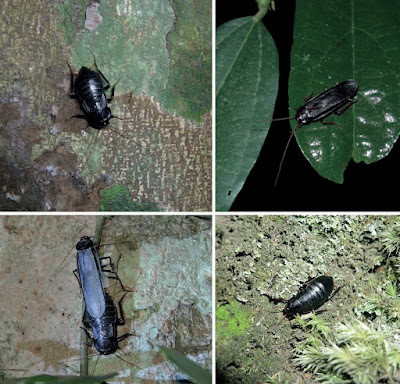
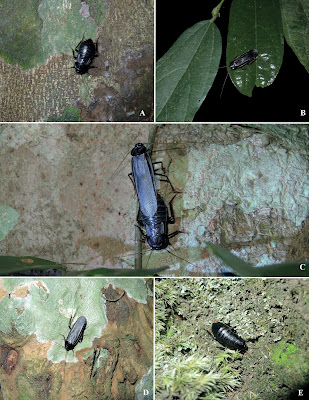
Habitats of Bundoksia longissima Li & Che, sp. nov.
A female on tree trunk B male on tree leaf C mating on tree trunk (A–C from Jianfengling, Ledong, Hainan)
D male on tree trunk (Xishuangbanna Tropical Botanical Garden, Yunnan)
E nymph on the moss-covered ground (Daweishan, Pingbian, Yunnan).
 Photographed by Lu Qiu.

Bundoksia longissima sp. nov.

Diagnosis: Bundoksia longissima sp. nov., differs from the two known species, B. rufocercata (Shelford, 1911) and B. sibuyania Lucañas, 2021 by the following characteristics: 1) pronotum: with slightly thickened lateral margin; 2) mid- and hind- femur with only distal spines on ventral margin; 3) the first abdominal tergite unspecialised. In addition, Bundoksia longissima sp. nov. can be distinguished from B. rufocercata as follows: pronotum black and female tegmina triangular in the former, whereas pronotum with yellow orange marking and female tegmina quadrate in B. rufocercata.
 
Etymology: The scientific epithet is derived from the Latin word longissimus, referring to the long and narrow body.

Ecology: According to our collecting information, Bundoksia longissima is active at night to forage and mate. It is distributed mainly on tree trunks, a few on leaves (Fig. 4). Once frightened, the female will emit an acidic liquid (lemon smell), whose specific components have not been analysed.


 Yong Li, Xinxing Luo, Jiawei Zhang, Zongqing Wang and Yanli Che. 2022. A New Species of Bundoksia Lucañas, 2021 with Comments on Its Subfamilial Placement, based on Morphological and Molecular Data. ZooKeys. 1085: 145-163. DOI: 10.3897/zookeys.1085.72927