Showing posts with label Journal: Naturwissenschaften. Show all posts

Sunday, December 11, 2016

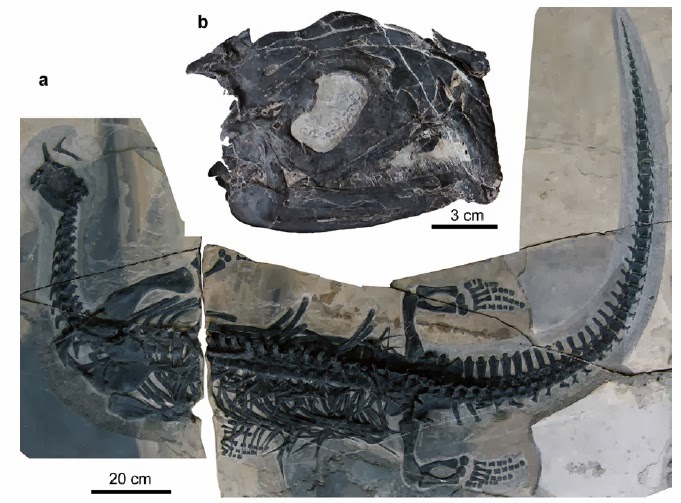
[Paleontology • 2016] Litorosuchus somnii • A New Armored Archosauriform (Diapsida: Archosauromorpha) from the Marine Middle Triassic of China, with Implications for the Diverse Life Styles of Archosauriforms Prior to the Diversification of Archosauria


 Litorosuchus somnii 
 Li, Wu, Zhao, Nesbitt, Stocker & Wang, 2016  


Abstract
Reptiles have a long history of transitioning from terrestrial to semi-aquatic or aquatic environments that stretches back at least 250 million years. Within Archosauria, both living crocodylians and birds have semi-aquatic members. Closer to the root of Archosauria and within the closest relatives of the clade, there is a growing body of evidence that early members of those clades had a semi-aquatic lifestyle. However, the morphological adaptations to a semi-aquatic environment remain equivocal in most cases. Here, we introduce a new Middle Triassic (245–235 Ma) archosauriform, Litorosuchus somnii, gen. et sp. nov., based on a nearly complete skeleton from the Zhuganpo Member (Ladinian [241–235 Ma]) of the Falang Formation, Yunnan, China. Our phylogenetic analyses suggest that Litorosuchus is a stem archosaur closely related to the aberrant Vancleavea just outside of Archosauria. The well-preserved skeleton of L. somnii bears a number of morphological characters consistent with other aquatic-adapted tetrapods including: a dorsally directed external naris, tall neural spines and elongate chevrons in an elongated tail, a short and broad scapula, webbed feet, long cervical vertebrae with long slender ribs, and an elongated rostrum with long and pointed teeth. Together these features represent one of the best-supported cases of a semi-aquatic mode of life for a stem archosaur. Together with Vancleavea campi, the discovery of L. somnii demonstrates a growing body of evidence that there was much more diversity in mode of life outside Archosauria. Furthermore, L. somnii helps interpret other possible character states consistent with a semi-aquatic mode of life for archosauriforms, including archosaurs.

Keywords: Adaptation; Morphology; Phylogeny; Reptile; Semi-aquatic


Systematic paleontology
Diapsida (Osborn 1903).
Archosauromorpha (von Huene 1946) sensu (Benton 1985).

Archosauriformes (Gauthier et al. 1988).

Litorosuchus somnii gen. et sp. nov.

Etymology: From Latin litoralis, indicating the coastal region where the archosauriform may have lived and Greek soukhos crocodile. From Latin somnium —“dream” in reference to a dream the first author (Li) had the day after he searched for a name for the animal, in which he saw an archosauriform wandering on the beach.


Holotype: IVPP V 16978, a nearly complete skull and skeleton embedded in a slab of limestone with much of its right lateral side exposed.

Locality and horizon: Jiyangshan, west of Huangnihe River, southeast Fuyuan County, Yunnan Province, China; Zhuganpo Member of the Falang Formation, Late Middle Triassic (Ladinian (241–235 Ma)) (Chen 1985).

Diagnosis: A medium-sized reptile (snout to tip of the tail length = ∼2.0 m), differing from other non-archosaur archosauriforms in having the following unique combination of character states: premaxilla bearing only two anteriorly positioned teeth with a short diastema anterior to and a long diastema posterior to the teeth, respectively; posterodorsal (maxillary) process of the premaxilla long and extending just posteriorly; nasal process of the premaxilla extending posteriorly beyond the posterodorsal margin of the external naris; large caniniform tooth in each tooth-bearing bone (shared with V. campi); midline length of the snout (measured from anterior edge of the orbit to the anterior tip of the premaxilla) more than twice that of the post-snout region (shared with species of Chanaresuchus, Q. mixtus, and D. fuyuanensis); T-shaped prefrontal with an elongate and bar-like descending process extending as ventrally as the lacrimal; lacrimal excluded by the prefrontal from the orbit; interfenestral region of the skull roof very narrow, less than one fifth of interorbital width; body completely covered by variously shaped osteoderms in certain regions (e.g., spine-like dorsal osteoderms on caudal vertebrae 10 to 13); tail long, about 60 % of the total length; vertical ridge present on the lateral surface of the neural spine of caudal vertebrae 9 to 35; cervical ribs slender and elongate; astragalus-calcaneum contact a simple butt joint, calcaneal tuber nearly absent. Asterisks denote autapomorphies.


Chun Li, Xiao-chun Wu, Li-jun Zhao, Sterling J. Nesbitt, Michelle R. Stocker and Li-Ting Wang. 2016.  A New Armored Archosauriform (Diapsida: Archosauromorpha) from the Marine Middle Triassic of China, with Implications for the Diverse Life Styles of Archosauriforms Prior to the Diversification of Archosauria.
The Science of Nature [Naturwissenschaften].  103: 95. DOI: 10.1007/s00114-016-1418-4


Wednesday, July 27, 2016

[Paleontology • 2011] Manidens condorensis • A Middle Jurassic Heterodontosaurid Dinosaur from Patagonia and the Evolution of Heterodontosaurids


Manidens condorensis  
Pol, Rauhut & Becerra, 2011
 
 DOI:  10.1007/s00114-011-0780-5 


Abstract
Heterodontosauridae is a morphologically divergent group of dinosaurs that has recently been interpreted as one of the most basal clades of Ornithischia. Heterodontosaurid remains were previously known from the Early Jurassic of southern Africa, but recent discoveries and studies have significantly increased the geographical and temporal range for this clade. Here, we report a new ornithischian dinosaur from the Middle Jurassic Cañadón Asfalto Formation in central Patagonia, Argentina. This new taxon, Manidens condorensis gen. et sp. nov., includes well-preserved craniomandibular and postcranial remains and represents the only diagnostic ornithischian specimen yet discovered in the Jurassic of South America so far. Derived features of its anatomy indicate that Manidens belongs to Heterodontosauridae, as the sister taxon of Heterodontosaurus and other South African heterodontosaurids. The presence of posterior dentary teeth with high crowns but lacking extensive wear facets in Manidens suggests that this form represents an intermediate stage in the development of the remarkable adaptations to herbivory described for Heterodontosaurus. The dentition of Manidens condorensis also has autapomorphies, such as asymmetrically arranged denticles in posterior teeth and a mesially projected denticle in the posteriormost teeth. At an estimated total length of 60–75 cm, Manidens furthermore confirms the small size of basal heterodontosaurids.

Keywords: Ornithschia; Gondwana; Jurassic; Cañadón Asfalto Formation; Heterodontosauridae


Systematic palaeontology

Dinosauria Owen, 1842
Ornithischia Seeley, 1887

Heterodontosauridae Kuhn, 1966

Manidens condorensis gen. et sp. nov.

Etymology: The genus name Manidens, from manus (Latin, hand) and dens (Latin, tooth), refers to the similarity of the posteriormost tooth to the human hand. The specific epithet condorensis refers to the nearby village of Cerro Cóndor, Chubut Province, Argentina.


Fig. 2 Anatomical details of the craniomandibular and dental remains of  Manidens condorensis gen. et sp. nov. 
a Photographs of preserved cranial and mandibular elements of the holotype (MPEF-PV 3211) superimposed on a skull reconstruction in lateral view. b Reconstruction of the skull and mandible in lateral view. c Photograph of right lower jaw and associated elements of the holotype (MPEF-PV 3211). d Interpretative drawing of right lower jaw in lateral view (right maxilla, left lower jaw and other bones shaded in grey); dashed areas represent broken surfaces and dotted areas represent sediment. e – h SEM images of posterior mandibular tooth in mesial (e) and bucal (f – i) views corresponding to MPEF-PV 3810 (e), MPEF-PV 3811 (f) and holotype MPEF-PV 3211 (g – i). ad anteriormost denticle mesially offset, afo antorbital fossa, an angular, at anterior teeth of left dentary, ca caniniform, cr crenulations, d dentary, dc denticles, dv dorsal vertebra, f frontal, g glenoid fossa, jb jugal boss, m maxilla, mc mesial cavity, n nasal, po postorbital q quadrate, qj quadratojugal, sq squamosal, sa surangular, saf anterior surangular foramen. Scale bars indicate 10 mm (a – d), 1 mm (e – g), 0.5 mm (h) and 0.1 mm (i)

Holotype: MPEF-PV 3211 (Museo Paleontológico Egidio Feruglio, Trelew, Argentina), partial associated skeleton, including most elements of the skull and lower jaws, cervical, dorsal and sacral vertebrae, left scapula and coracoids, and almost complete pelvic girdles.
Referred material: MPEF-PV 1719, 1786, 1718, 3810, 3811 isolated posterior teeth, from the same locality and horizon as the holotype.

Locality and horizon: Queso Rallado locality within the Cañadón Asfalto Formation, 2.3 km west of the village of Cerro Cóndor, Chubut Province, Argentina. The bone-bearing layer is a silicified mudstone within a series of lacustrine mudstones and limestones (Rougier et al. 2007b). Further locality information is given in the Electronic supplementary material (ESM) and stratigraphic information can be found in Rougier et al. (2007b). GPS coordinates of this locality are deposited in the MPEF collections and are available upon request. The age of the Cañadón Asfalto Formation is usually given as Callovian–Oxfordian (e.g. Silva Nieto et al. 2002), but recent U–Pb radioisotopic age determinations (Cabaleri et al. 2010) and palynological research (Volkheimer et al. 2008) indicates that it is probably considerably older, with dates ranging from 171 ± 5 to 167 ± 4 Ma (Aalenian–Early Bathonian; Salani 2007; Cabaleri et al. 2010).

Diagnosis: Small heterodontosaurid (estimated body length of approximately 50–60 cm) with the following autapomorphies: jugal with strongly developed, dorsally placed lateral boss; dorsal part of the postorbital process of the jugal very slender and flexes abruptly posteriorly at the beginning of the articular facet for the postorbital; forebrain facet on the ventral surface of the frontal enlarged and with significantly raised margins; posterior teeth with asymmetric arrangement of denticles and with a mesial concavity in which the distal margin of the preceding tooth is lodged; posteriormost dentary tooth “hand-shaped”, with only one or two mesial denticles, the most anterior of which diverges mesially from the mesial margin of the crown; presence of small crenulations along the cutting margin of each denticle.

Fig. 1 Preserved elements of Manidens condorensis gen. et sp. nov.
Outline reconstruction of the skeleton, indicating preserved elements, with photographs of selected skeletal elements of the type specimen (MPEF PV 3211). a Pelvic girdle, lateral. b Schematic drawing of pelvic girdle. c Dorsal vertebrae, lateral. d Cervical vertebrae, lateral. e Quadrate, anterior. f Temporal (lateral) and occipital (posterior) skull elements. f Schematic drawing of temporal and occipital region. il illium, is ischia, j jugal, or occipital region of the braincase, pb pubis, po postorbital, pod postorbital depression, pp preacetabular process, sq lateral shelf of the squamosal. Dashed areas represent broken surfaces and dotted areas represent sediment. Scale bars indicate 10 mm (a, b, f, g), 2 mm (c, d) and 1 mm (e) 


Diego Pol, Oliver W. M. Rauhut and Marcos Becerra. 2011. A Middle Jurassic Heterodontosaurid Dinosaur from Patagonia and the Evolution of Heterodontosaurids.
 Naturwissenschaften. 98 (5): 369–379. DOI:  10.1007/s00114-011-0780-5
ResearchGate.net/publication/50937445_A_Middle_Jurassic_heterodontosaurid_dinosaur_from_Patagonia_and_the_evolution_of_heterodontosaurids


Sunday, June 19, 2016

[Paleontology • 2013] Yulong mini • Chicken-sized Oviraptorid Dinosaurs from central China and their Ontogenetic Implications


Yulong mini  
Lü, Currie, Xu,Zhang, Pu & Jia, 2013


Abstract
Oviraptorids are a group of specialized non-avian theropod dinosaurs that were generally one to 8 m in body length. New specimens of baby oviraptorids from the Late Cretaceous of Henan Province are some of the smallest individuals known. They include diagnostic characters such as the relative position of the antorbital fenestra and the external naris, distinct opening in the premaxilla anteroventral to the external naris, antorbital fossa partly bordered by premaxilla posterodorsally, lacrimal process of premaxilla does not contact the anterodorsal process of the lacrimal, parietal almost as long as frontal; in dorsal view, posterior margin forms a straight line between the postzygapophyses in each of the fourth and fifth cervicals; femur longer than ilium. They also elucidate the ontogenetic processes of oviraptorids, including fusion of cranial elements and changes in relative body proportions. Hind limb proportions are constant in oviraptorids, regardless of absolute body size or ontogenetic stage. This suggests a sedentary lifestyle that did not involve the pursuit of similar-sized prey. The functional implications for bite force and therefore dietary preferences are better understood through the study of such small animals. The comparison of the measurements of 115 skeletons indicates that oviraptorids maintain their hind limb proportions regardless of ontogenetic stage or absolute size, which is a pattern seen more commonly in herbivores than in carnivores. This may weakly support the hypothesis that oviraptorids are herbivores rather than active carnivores.

Keywords: Baby oviraptorid, Yulong, Late Cretaceous, Henan Province


Fig. 1: a Photograph and b line drawings of  Yulong mini  (HGM 41HIII-0107).
cv cervical vertebrae, d dentary, fe femur, fi fibula, h humerus, il ilium, mt metatarsals, o orbital, po postorbital, rd radius, ul ulna, ti tibia.    DOI:10.1007/s00114-012-1007-0

Systematic paleontology

Oviraptorosauria Barsbold 1976
Oviraptoridae Barsbold 1976

Yulong mini gen. et sp. nov.

Etymology: Generic name derived from “Yu”, the abbreviated name for Henan Province, and “long” from Chinese, meaning dragon. The specific name refers to the small size of known specimens.

Holotype: Henan Geological Museum HGM 41HIII-0107, an exceptionally well-preserved skeleton with a skull and lower jaws.

Referred specimens: HGM 41HIII-0108, nearly complete skull with lower jaws; HGM 41HIII-0109, well-preserved skull, lower jaws and partial postcranial skeleton; HGM 41HIII-0110, partial skull, lower jaws and a few cervical centra; HGM 41HIII-0111, one complete left ilium.

Type locality and horizon: Qiupa Town, Luanchuan County, Henan Province; Upper Cretaceous, Qiupa Formation (Bureau of Geology and Mineral Resources of Henan Province 1989; Lü et al. 2007).

Diagnosis: Oviraptorid with the following characters: posterodorsal corner of the antorbital fenestra and the anteroventral corner of the external naris at the same level (similar conditions in Citipati osmolskae [MPC-D 100/978] and Citipati sp. [MPC-D 100/42]); distinct opening in the premaxilla anteroventral to the external naris; antorbital fossa partly bordered by premaxilla anterodorsally; lacrimal process of premaxilla does not contact the anterodorsal process of the lacrimal; parietal almost as long as frontal; in dorsal view, posterior margin forms a straight line between the postzygapophyses in each of the fourth and fifth cervicals; femur longer than ilium.


Lü, J.; Currie, P. J.; Xu, L.; Zhang, X.; Pu, H.; Jia, S. 2013. Chicken-sized Oviraptorid Dinosaurs from central China and their Ontogenetic Implications. Naturwissenschaften. DOI:10.1007/s00114-012-1007-0


Thursday, June 19, 2014

[Paleontology • 2014] Mercuriceratops gemini • A New chasmosaurine from northern Laramidia expands Frill Disparity in ceratopsid Dinosaurs


Mercuriceratops gemini (center) compared to horned dinosaurs Centrosaurus (left) and Chasmosaurus (right), also from the Dinosaur Park Formation of Alberta, Canada

Abstract
A new taxon of chasmosaurine ceratopsid demonstrates unexpected disparity in parietosquamosal frill shape among ceratopsid dinosaurs early in their evolutionary radiation. The new taxon is described based on two apomorphic squamosals collected from approximately time equivalent (approximately 77 million years old) sections of the upper Judith River Formation, Montana, and the lower Dinosaur Park Formation of Dinosaur Provincial Park, Alberta. It is referred to Chasmosaurinae based on the inferred elongate morphology. The typical chasmosaurine squamosal forms an obtuse triangle in dorsal view that tapers towards the posterolateral corner of the frill. In the dorsal view of the new taxon, the lateral margin of the squamosal is hatchet-shaped with the posterior portion modified into a constricted narrow bar that would have supported the lateral margin of a robust parietal. The new taxon represents the oldest chasmosaurine from Canada, and the first pre-Maastrichtian ceratopsid to have been collected on both sides of the Canada–US border, with a minimum north–south range of 380 km. This squamosal morphology would have given the frill of the new taxon a unique dorsal profile that represents evolutionary experimentation in frill signalling near the origin of chasmosaurine ceratopsids and reinforces biogeographic differences between northern and southern faunal provinces in the Campanian of North America.

Keywords: Chasmosaurinae, Mercuriceratops gemini, Campanian, Judith River Formation, Dinosaur Park Formation, Laramidia


 Ryan, M. J.; Evans, D. C.; Currie, P. J.; Loewen, M. A. 2014. A New chasmosaurine from northern Laramidia expands Frill Disparity in ceratopsid Dinosaurs. Naturwissenschaften. 101(6); 505-512 doi: dx.doi.org/10.1007/s00114-014-1183-1

The dinosaur with a ‘wings’ on its HEAD http://dailym.ai/UcycK8 via @MailOnline

Monday, February 17, 2014

[Paleontology • 2014] Atopodentatus unicus • A New Marine Reptile from the Triassic of China, with a highly specialized Feeding Adaptation


Atopodentatus unicus
illustration: Julius Csotonyi | csotonyi.com


Abstract
The Luoping fauna (Anisian, Middle Triassic) is probably the oldest of Triassic faunas in Guizhou–Yunnan area, China. The reptilian assemblage is comprised of ichthyosaurs, a number of sauropterygians (pachypleurosaur-like forms), saurosphargids, protorosaurs, and archosauriforms. Here, we report on a peculiar reptile, newly found in this fauna. Its dentition is fence or comb-like and bears more than 175 pleurodont teeth in each ramus of the upper and lower jaws, tooth crown is needle-like distally and blade-shaped proximally; its rostrum strongly bends downward and the anterior end of its mandible expands both dorsally and ventrally to form a shovel-headed structure; and its ungual phalanges are hoof-shaped. The specializations of the jaws and dentition indicate that the reptile may have been adapted to a way of bottom-filter feeding in water. It is obvious that such delicate teeth are not strong enough to catch prey, but were probably used as a barrier to filter microorganisms or benthic invertebrates such as sea worms. These were collected by the specialized jaws, which may have functioned as a shovel or pushdozer (the mandible) and a grasper or scratcher (the rostrum). Our preliminary analysis suggests that the new reptile might be more closely related to the Sauropterygia than to other marine reptiles.

Keywords: Diapsida, Bottom-filter feeding, Middle Triassic, Yunnan, China


 Cheng, L.; Chen, X. H.; Shang, Q. H.; Wu, X. C. 2014. A New Marine Reptile from the Triassic of China, with a highly specialized Feeding Adaptation. Naturwissenschaften. doi: dx.doi.org/10.1007/s00114-014-1148-4


Thursday, January 23, 2014

[Paleontology • 2013] Mongolarachne jurassica • A Giant Spider from the Jurassic of China reveals Greater Diversity of the orbicularian Stem Group


Mongolarachne jurassica
(Selden, Shih & Ren, 2011)

A large female spider, Nephila jurassica, was described from Middle Jurassic strata of north-east China and placed in the modern genus Nephila (family Nephilidae) on the basis of many morphological similarities, but, as with many ancient fossils, the single specimen lacked synapomorphies of the family (Selden et al. 2011). In order to test the placement within the nephilid phylogenetic tree, Kuntner et al. (2013) calibrated the molecular phylogeny using N. jurassica in three different scenarios based on inferred mitochondrial substitution rates. They concluded that N. jurassica fitted better as a stem orbicularian than a nephilid. Now, a giant male spider has been discovered at the same locality that yielded N. jurassica. The two sexes are considered conspecific based on their similar morphological features, size, and provenance. The male cannot be accommodated in Nephilidae because of its pedipalp morphology, so the new genus Mongolarachne and family Mongolarachnidae are erected for the species. Comparison with possibly related families show that Mongolarachnidae is most likely on the orbicularian stem, close to other cribellate orbicularians (e.g., Deinopoidea), which suggests a greater diversity of cribellate orbicularians during the Middle Jurassic.

Keywords: Araneae, Chelicerata, Deinopoidea, Hypochiloidea, Mesozoic, Orbiculariae

The largest known fossil spiders (left: male, right: female) belong to a newly described species of extinct arachnids, Mongolarachne jurassica.
photo: Paul Selden

male Mongolarachne jurassica

Systematic palaeontology

Order Araneae Clerck, 1757
Suborder Opisthothelae Pocock, 1892
Infraorder Araneomorphae Smith, 1902

Family Mongolarachnidae fam. nov.
Etymology from the genus Mongolarachne gen. nov.

Mongolarachne gen. nov.
Etymology from the Inner Mongolia Autonomous Region, where the fossils were discovered, and the Greek άράχνη (L. arachne), a spider.

Mongolarachne jurassica (Selden, Shih and Ren, 2011) comb. nov.


Selden, P. A.; Shih, C.K.; Ren, D. 2013. A Giant Spider from the Jurassic of China reveals Greater Diversity of the orbicularian Stem Group. Naturwissenschaften. 100 (12): 1171–1181.
doi: 10.1007/s00114-013-1121-7.
Selden, P. A.; Shih, C.K.; Ren, D. 2011. A golden orb-weaver spider (Araneae: Nephilidae: Nephila) from the Middle Jurassic of China. Biology Letters. 7 (5): 775–8. doi: 10.1098/rsbl.2011.0228
 Kuntner, M; Arnedo, M. A.; Trontelj, P.; Lokovše, T; Agnarsson, I. 2013. A molecular phylogeny of nephilid spiders: Evolutionary history of a model lineage. Molecular Phylogenetics and Evolution. 69 (3): 961–979. doi: 10.1016/j.ympev.2013.06.008

Biggest Spider Fossil Now Has a Mate — But It's Complicated

Sunday, January 5, 2014

[PaleoMammalogy • 2011] บีเวอร์สยาม | Steneofiber siamensis • First Castorid (Mammalia, Rodentia) from the middle Miocene of Southeast Asia


 “บีเวอร์สยาม” Steneofiber siamensis
reconstruction by Namosaurus

Abstract
Today and in the Tertiary, the geographical distribution of castorids is limited throughout all of the northern continents. Fossils of the Castoridae genus Steneofiber are abundant in many localities of Eurasia from the late Oligocene to Pliocene period. Recently, Steneofiber fossils were discovered in two localities of northern Thailand, Mae Moh and Chiang Muan coal mines, in layers of late middle Miocene age. These discoveries represent the first records of castorids from Southeast Asia and correspond to their southernmost known range. The focus of this study is to describe this new Thai species of Steneofiber and to define its wear stages from the molar occlusal surfaces by using micro-CT scan analysis. The CT scan technique permits the analysis of the virtual occlusal surface changes from wear, allowing easier comparison to related species of Steneofiber cheek teeth without destroying the teeth. The new species, Steneofiber siamensis n. sp., can be distinguished from the other species of Steneofiber by several distinct characters, longer mesostriid on p4, presence of premesostria and metastria on P4, which are smaller than most of the other known species. The occurrence of this new castorid also supports a subtropical to tropical paleoclimate for these two localities of northern Thailand.
Keywords: Steneofiber, Castoridae, Micro CT scan, Late middle Miocene, Thailand


Steneofiber siamensis fossils discovered from the late middle Miocene of Mae Moh and Chiang Muan coal mines, northern Thailand

Systematic Paleontology

Class MAMMALIA Linnaeus 1758
Order RODENTIA Bowdich 1821

Family CASTORIDAE Hemprich 1820
Subfamily CASTORINAE Hemprich 1820

Genus Steneofiber Geoffroy 1833

Steneofiber siamensis
Suraprasit, Chaimanee, Martin & Jaeger 2011

Type locality: “I”coal layer, Mae Moh coal mine, Lampang province, Thailand.
Etymology: In relation to its geographical origin, Siam being the former name of the Kingdom of Thailand


Suraprasit, K., Y. Chaimanee, T. Martin, and J. -J. Jaeger. 2011. First Castorid (Mammalia, Rodentia) from the middle Miocene of Southeast Asia. Naturwissenschaften. 98(4):315-28. DOI: dx.doi.org/10.1007/s00114-011-0769-0 

บีเวอร์สยาม หลักฐานการเปลี่ยนแปลงสภาพภูมิอากาศโลกในอดีต
by กันตภณ สุระประสิทธิ์ | http://geothai.net/gneiss/?p=3023

Friday, December 20, 2013

[Paleontology • 2013] Acheroraptor temertyorum • A New dromaeosaurid (Dinosauria: Theropoda) with Asian Affinities from the latest Cretaceous of North America


Acheroraptor temertyorum, the new Hell Creek dromaeosaurid. Closely related to the Asian genus Velociraptor, this theropod approached Deinonychus in size and lived alongside Tyrannosaurus and Triceratops. "I worked closely with Dr. David Evans to restore the life appearance of the animal," here shown pissing off a Tyrannosaurus for beating it to the carcass of a Triceratops, and also snacking on a scavenging mammal.

Evans, Larson and Currie (2013) DOI: 10.1007/s00114-013-1107-5

Abstract
Dromaeosaurids from the Maastrichtian of North America have a poor fossil record and are known largely from isolated teeth, which have typically been referred to taxa based on more complete material from earlier Campanian strata. An almost complete maxilla with well-preserved dentition and an associated dentary from the Hell Creek Formation of Montana are used to establish a new dromaeosaurid taxon in the latest Maastrichtian, immediately prior to the end-Cretaceous extinction event. Acheroraptor temertyorum gen. et sp. nov. is differentiated from other dromaeosaurids on the basis of a hypertrophied postantral wall that projects posteriorly into the antorbital fenestra, a maxillary fenestra positioned low in the antorbital fossa and directly posterior to the promaxillary fenestra, and distinctive dentition with marked apicobasal ridges. The new material allows a dromaeosaurid from the Maastrichtian of North America to be placed within a phylogenetic framework for the first time. Phylogenetic analysis suggests Acheroraptor is a velociraptorine that is more closely related to Asian dromaeosaurids, including Tsaagan and Velociraptor, than it is to Dromaeosaurus, Saurornitholestes, or any other taxon from North America. As part of the Lancian Tyrannosaurus–Triceratops fauna, A. temertyorum is the latest occurring dromaeosaurid. Its relationships and occurrence suggest a complex historical biogeographic scenario that involved multiple, bi-directional faunal interchanges between Asia and North America during the Late Cretaceous.

Keywords: Dromaeosauridae, Theropoda, Cretaceous, Biogeography


Acheroraptor

Evans, D. C., D. Larson, and P. J. Currie. 2013. A New dromaeosaurid (Dinosauria: Theropoda) with Asian Affinities from the latest Cretaceous of North America. Naturwissenschaften. 100 (11): 1041-1049. doi: dx.doi.org/10.1007/s00114-013-1107-5 


Tuesday, November 19, 2013

[Paleontology • 2001] Liaoningosaurus paradoxus • A juvenile ankylosaur from Yixian Formation of Liaoning, China


Liaoningosaurus paradoxus

Abstract
Juvenile ankylosaur specimens are very rare. A new ankylosaur, Liaoningosaurus paradoxus gen. et sp. nov., is described based on a beautifully preserved juvenile ankylosaur specimen from the famous Yixian Formation of Liaoning, China. Liaoningosaurus has a large bony plate (somewhat shell-like) shielding the abdomen. This discovery represents the first record of such a structure among dinosaurs. Although it has a number of distinct features seen in the family Ankylosauridae, a cladistic analysis placed Liaoningosaurus in the sister-family Nodosauridae. The 'intermediate' status of this taxon between the two ankylosaur families further supports the monophyly of Ankylosauria. This finding also documents the smallest known ankylosaur specimen and first complete nodosaurid specimen from Asia.

Liaoningosaurus paradoxus

Xu, X., Wang, X.-L., and You, H.-L. 2001. A juvenile ankylosaur from China. Naturwissenschaften. 88(7): 297-300.

Thursday, August 1, 2013

[Paleontology • 2011] Decuriasuchus quartacolonia • Associated skeletons of a new middle Triassic "Rauisuchia" from southern Brazil


Life reconstruction of Decuriasuchus quartacolonia

Decuriasuchus quartacolonia
França, Ferigolo & Langer 2011

Abstract
For more than 30 million years, in early Mesozoic Pangea, “rauisuchian” archosaurs were the apex predators in most terrestrial ecosystems, but their biology and evolutionary history remain poorly understood. We describe a new “rauisuchian” based on ten individuals found in a single locality from the Middle Triassic (Ladinian) Santa Maria Formation of southern Brazil. Nine articulated and associated skeletons were discovered, three of which have nearly complete skulls. Along with sedimentological and taphonomic data, this suggests that those highly successful predators exhibited some kind of intraspecific interaction. Other monotaxic assemblages of Triassic archosaurs are Late Triassic (Norian-Rhaetian) in age, approximately 10 million years younger than the material described here. Indeed, the studied assemblage may represent the earliest evidence of gregariousness among archosaurs, adding to our knowledge on the origin of a behavior pattern typical of extant taxa.

Keywords: Santa Maria Formation, Archosauria, Rauisuchia, Behavior, Middle Triassic

Skulls of D. quartacolonia

Marco Aurélio G. França, Jorge Ferigolo and Max C. Langer. 2011. Associated skeletons of a new middle Triassic "Rauisuchia" from Brazil. Naturwissenschaften. 98 (5): 389–395. 

Wednesday, July 31, 2013

[Paleontology • 2013] Batrachomimus pastosbonesis • A new neosuchian crocodyliform with Asian affinities from the Jurassic of northeastern Brazil


Batrachomimus pastosbonensis 
Montefeltro, Larsson, França & Langer 2013
Batrachomimus 
a new genus of neosuchian crocodyliform from the Late Jurassic of northeastern Brazil

Batrachomimus, a crocodyliform with 1 m in length found in Maranhão
illustration by Rodolfo Nogueira


Abstract
Phylogenetic relationships near the origin of extant crocodylians are weakly supported, and this lack of resolution makes for poor estimates of taxonomic and morphological diversity. Previously known taxa are found throughout the Cretaceous in Laurasia and at a few sites from Brazil, Australia, and northern Africa. Here, we report Batrachomimus pastosbonensis gen. et sp. nov. from the Late Jurassic of northeastern Brazil, which is deeply nested within Neosuchia and associated to the Cretaceous Asian paralligatorids. The new taxon predates all other members of Paralligatoridae and its immediate sister group (including Eusuchia) by 30 million years. A nearly complete skull, osteoderms, and limb bones were recovered, and autapomorphies of B. pastosbonensis include a scalloped lateral margin of the rostrum in dorsal view, unsculpted alveolar margin at the caudalmost portion of the maxilla, blunt lateral prongs on the jugal at the base of the postorbital bar, hourglass shaped choanae, and pterygoid choanal septum extended between the palatal shelves of the palatines. The crocodyloid-like skull proportions and the slender, conical teeth suggest an amphibious and piscivorous life history to this 1 m long animal.

Keywords: Jurassic, Neosuchia, Crocodyliformes, Palaeobiogeography, Pastos Bons Formation, Maranhão


Etymology: The genus name Batrachomimus means "batrachian mimic" in Greek, a reference to the holotype specimen originally being identified as that of a temnospondyl, a type of prehistoric amphibian that vaguely resembles modern batrachians - frogs and toads. In addition to being considered a temnospondyl, the holotype was thought to have come from the Pedra de Fogo Formation, which dates back to the Permian, a time when temnospondyls were the dominant form of large semi-aquatic animals. The genus name also alludes to crocodyliforms replacing temnospondyls as semi-aquatic predators during the Jurassic.


Montefeltro, F. C.; Larsson, H. C. E.; França, M. A. G.; Langer, M. C. 2013. A new neosuchian with Asian affinities from the Jurassic of northeastern Brazil. Naturwissenschaften. doi: dx.doi.org/10.1007/s00114-013-1083-9


Researchers from USP, Ribeirão Preto describe first alligator Jurassic Brazilian

Researchers from the Laboratory of Paleontology, Faculty of Philosophy, Sciences and Letters of Ribeirão Preto (FFCLRP) USP, just published the description of the first Jurassic tetrapod fossils collected in Brazil. The material was discovered in May 2012 in the state of Maranhão, and it is a crocodiliforme (group of living alligators and crocodiles, as well as some of their extinct relatives) called Batrachomimus pastosbonesis.

..................

Monday, July 30, 2012

[Paleontology • 2002] Hatzegopteryx thambema • A new Giant azhdarchid pterosaur with a robust skull from the terminal Cretaceous of Transylvania (western Romania)


Art: Fall down mountains, just don't fall on me

Abstract
A new giant pterosaur, Hatzegopteryx thambema, nov.gen., nov.sp., from the Maastrichtian Densuy-Ciula Formation of Romania is remarkable for its very large size (estimated wing span S12 m) and for the robustness of its large skull, which may have been nearly 3 m long. The stout skull bones contrast with the usually thin and slender skull elements of other pterosaurs, and raise the question of how the weight of the skull was reduced in order to make flight possible. The answer probably lies in the very peculiar internal structure of the bones, which consists of a dense network of very thin trabeculae enclosing small alveoli. This structure is reminiscent of expanded polystyrene and, like it, probably combined strength with lightness.


Derivatio nominis: Generic name from the Hatzeg (or Hat¸eg) basin of Transylvania, where the type specimen was collected, and pteryx, Greek for wing. Specific name from thambema, Greek for monster, alluding to the monstrous size of this pterosaur


Buffetaut, E., Grigorescu, D., and Csiki, Z. 2002. A new giant pterosaur with a robust skull from the latest Cretaceous of Romania. Naturwissenschaften. 89(4): 180-184. 

Buffetaut, E., Grigorescu, D. and Csiki, Z. 2003. Giant azhdarchid pterosaurs from the terminal Cretaceous of Transylvania (western Romania), Geological Society, London, Special Publications 217: 91-104. DOI: 10.1144/​GSL.SP.2003.217.01.09