Showing posts with label Anatidae. Show all posts

Friday, August 15, 2025

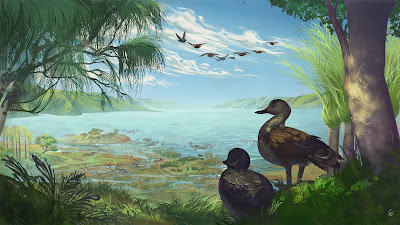
[PaleoOrnithology • 2025] Tadorna rekohu • Ancient DNA and Morphometrics reveal A New Species of extinct insular Shelduck (Anatidae: Tadorninae) from Rēkohu Chatham Islands, Aotearoa New Zealand


  Tadorna rekohu 
Rawlence, Lubbe, Adams, Shepherd, Cole, Knapp, Llamas, Wood, Mitchell & Tennyson, 2025

 Rēkohu shelduck  ||  DOI: doi.org/10.1093/zoolinnean/zlaf069
Artwork by Sasha Votyakova
 
Abstract
The Rēkohu Chatham Islands, 785 km east of mainland Aotearoa New Zealand, exhibit high levels of species endemism. Prior to human settlement, the islands supported a rich waterfowl fauna comprising at least eight anatid species. Here we describe a new extinct duck from Holocene fossil bone deposits on the Chatham Islands. Geometric morphometric analyses and phylogenetic analysis of complete mitogenomes confirm that the Rēkohu shelduck (Tadorna rekohu sp. nov.) was the sister-taxon to the pūtangitangi paradise shelduck Tadorna variegata (Gmelin, 1789) from mainland New Zealand. The ancestors of the Rēkohu shelduck colonized the Chatham Islands around 390 000 years ago during the Late Pleistocene. Comparatively short, robust wing bones and long leg bones indicate that the species was flight-reduced relative to their mainland congener. The presence of Rēkohu shelduck bones in early Moriori midden deposits suggests its extinction was due to over-hunting prior to the later European and Māori settlement of the islands in the 19th century.

dispersal, island evolution, New Zealand, palaeogenetics, Pleistocene, Tadorna


Artistic reconstruction of a female Rēkohu shelduck (Tadorna rekohu) showing the darker plumage common in birds isolated on islands.
Artwork by Sasha Votyakova, © Te Papa CC BY 4.0

Systematic palaeontology
Anseriformes Wagler, 1831
Anatidae Leach, 1819
Tadorninae Reichenbach, 1849
Tadornini Reichenbach, 1849

Tadorna Boie, 1822

Tadorna rekohu Rawlence, Lubbe, Adams, Shepherd, Cole, Knapp, Llamas, Wood, Mitchell, Tennyson sp. nov.
Common name: Rēkohu shelduck

Type locality: Maunganui, Chatham Island.

Etymology: After the Moriori name for the Chatham Islands, New Zealand, where T. rekohu formerly occurred. The name was gifted by the Hokotehi Moriori Trust, who represent the Indigenous people of Rēkohu Chatham Islands.

Diagnosis: A species of Tadorna with different proportions to T. variegata and differing from T. variegata in the following osteological features and allometries:

Cranium: The skull of T. rekohu is longer and has a smaller interorbital width.
Humerus, ulna, radius, and carpometacarpus: The humeri of T. rekohu are on average shorter, with more robust proximal and distal ends. The ulnae and carpometacarpi are on average shorter in T. rekohu, and the proximal radius width is on average larger in T. rekohu.

Humerus to femur ratio: The femur of T. rekohu is longer relative to the humerus total length. The ratio of mean humerus to femur length in T. rekohu ranges from 1.92 to 1.96 (associated skeletons) compared to 2.00–2.11 and 2.02–2.18 in female and male T. variegata, respectively.
Femur and tarsometatarsus: The femora and tarsometatarsi of T. rekohu are longer on average.


Nicolas J Rawlence, Pascale Lubbe, Amy L Adams, Lara D Shepherd, Theresa L Cole , Michael Knapp, Bastien Llamas, Jamie R Wood, Kieren J Mitchell and Alan J D Tennyson. 2025. Ancient DNA and Morphometrics reveal A New Species of extinct insular Shelduck from Rēkohu Chatham Islands. Zoological Journal of the Linnean Society. 204(3); zlaf069. DOI: doi.org/10.1093/zoolinnean/zlaf069 [25 July 2025]

Friday, June 27, 2025

[PaleoOrnithology • 2024] Chloephaga dabbenei • Pleistocene Record of Chloephaga Eyton, 1838 (Anseriformes: Anatidae) in the Argentine Pampas, with the Description of A New Species


Chloephaga dabbenei 
Agnolín, Álvarez Herrera & Tomassini, 2024


The genus Chloephaga Eyton, 1838, consisting of four species that breed in Patagonia, encompasses anatids endemic to South America. Despite their prominence in the present-day avifauna, these species have left behind a limited fossil record. The aim of the present contribution is to describe Chloephaga fossils coming from Middle Pleistocene levels (San José Sequence) cropping out at Bajo San José site, southwestern Buenos Aires Province, Argentina. The specimens are referred to three different taxa, including a new species, Chloephaga dabbenei n. sp., a smaller but indeterminate taxon, which is also probably a new species, and the extant species C. picta (J.F.Gmelin, 1789). The newly described species is notably large, falling within the upper size range observed in males of C. picta. The tarsometatarsus is straight-shafted with poorly divergent distal trochleae, features that are correlated with cursorial habits, that are absent in other members of Chloephaga. The co-occurrence of three species of the genus Chloephaga is registered nowadays in the Argentine Patagonia and in the southeast of Buenos Aires Province, when they migrate during the winter season.

Keywords: Sheldgoose, Tadorninae, fossil diversity, Buenos Aires Province, Quaternary, new species


Chloephaga dabbenei sp. nov.


Federico Lisandro AGNOLÍN, Gerardo P. ÁLVAREZ HERRERA and Rodrigo TOMASSINI. 2024. Pleistocene Record of Chloephaga Eyton, 1838 (Anseriformes: Anatidae) in the Argentine Pampas, with the Description of A New Species. Comptes Rendus Palevol. 23(18); 241-255. DOI: 10.5852/cr-palevol2024v23a18 [21 June 2024]


Wednesday, March 12, 2025

[PaleoOrnithology • 2024] Paakniwatavis grandei • A new Paleogene fossil and a new dataset for Waterfowl (Aves: Anseriformes) clarify phylogeny, ecological evolution, and Avian Evolution at the K-Pg Boundary


Paakniwatavis grandei 

Musser & Clarke, 2024 

Abstract
Despite making up one of the most ecologically diverse groups of living birds, comprising soaring, diving and giant flightless taxa, the evolutionary relationships and ecological evolution of Anseriformes (waterfowl) remain unresolved. Although Anseriformes have a comparatively rich, global Cretaceous and Paleogene fossil record, morphological datasets for this group that include extinct taxa report conflicting relationships for all known extinct taxa. Correct placement of extinct taxa is necessary to understand whether ancestral anseriform feeding ecology was more terrestrial or one of a set of diverse aquatic ecologies and to better understand avian evolution around the K-T boundary. Here, we present a new morphological dataset for Anseriformes that includes more extant and extinct taxa than any previous anseriform-focused dataset and describe a new anseriform species from the early Eocene Green River Formation of North America. The new taxon has a mediolaterally narrow bill which is rarely found in previously described anseriform fossils. The matrix created to assess the placement of this taxon comprises 41 taxa and 719 discrete morphological characters describing skeletal morphology, musculature, syringeal morphology, ecology, and behavior. We additionally combine the morphological dataset with published sequences using Bayesian methods and perform ancestral state reconstruction for select morphological, ecological and behavioral characters. We recover the new Eocene taxon as the sister taxon to (Anseranatidae+Anatidae) across all analyses, and find that the new taxon represents a novel ecology within known Anseriformes and the Green River taxa. Results provide insight into avian evolution during and following the K-Pg mass extinction and indicate that Anseriformes were likely ancestrally aquatic herbivores with rhamphothecal lamellae..


Photograph (A) and line drawing (B) of the holotype specimen of Paakniwatavis grandei (FMNH PA725). Bone is unfilled. Extremely crushed bone and bone margin is delimited with dashed margins.
Anatomical abbreviations: prx, premaxilla; max, maxilla; jug, jugal; orb, orbital margin; rmf, rostral mandibular fenestra; scl, scleral ossicles; mnd, mandible; rde, radiale; cmc, carpometacarpus.


Photograph (A) and line drawing (B) of the holotype specimen of Paakniwatavis grandei (FMNH PA725). Extremely crushed bone and bone margin is delimited with dashed margins.
Anatomical abbreviations: prx, premaxilla; orb, orbital margin; mnd, mandible; cvt, cervical vertebrae; tvt, thoracic vertebrae; syn, synsacrum; pyg, pygostyle; cor, coracoid; scp, scapula; fur, furcula; str, sternum; rbs, ribs; hum, humerus; uln, ulna; rad, radius; rde, radiale; cmc, carpometacarpus; mII:1, phalanx 1 of manual digit II; mtII:2, phalanx 2 of manual digit II; ili, ilium; fem, femur; tbt, tibiotarsus; tmt, tarsometatarsus; mtI, metatarsal I; I:1, phalanx 1 of pedal digit I; II:1, phalanx 1 of pedal digit II; III:1, phalanx 1 of pedal digit III; IV:1, phalanx 1 of pedal digit IV.

Systematic paleontology
AVES Linnaeus, 1758 
NEOGNATHAE Pycraft, 1900 
ANSERIFORMES Wagler, 1831 

Paakniwatavis grandei, gen. et sp. nov.

Etymology: Paakniwatavis references Paakniwat, used by the Shoshoni tribe indigenous to the region of the recovery site and means “Water Spirit”. The Water Spirits are dangerous supernatural beings that lure people to their death with child-like cries. The name references the aquatic ecology of this taxon. The species honors Dr. Lance Grande, who collected the holotype specimen, in recognition of his leading research on the faunas of the Green River Formation.


 Grace Musser and Julia A. Clarke. 2024. A new Paleogene fossil and a new dataset for waterfowl (Aves: Anseriformes) clarify phylogeny, ecological evolution, and avian evolution at the K-Pg Boundary. PLoS ONE. 19(7): e0278737. DOI: doi.org/10.1371/journal.pone.0278737
https://www.biorxiv.org/content/10.1101/2022.11.23.517648v1.full


Thursday, May 16, 2024

[PaleoOrnithology • 2022] Annakacygna hajimei & A. yoshiiensis • A New Genus for Two remarkable Flightless Swans (Aves: Anatidae: Cygnini) from the Miocene of Gunma, central Japan: With A Note on the Birds’ food niche shift and Specialization of Wings for parental care actions


ANNAKACYGNA, gen. nov.
Annakacygna hajimei and A. yoshiiensis 

Matsuoka & Hasegawa, 2022

Abstract
 A new genus and two new species of flightless fossil Cygnini (Aves: Anatidae), Annakacygna hajimei and A. yoshiiensis are described from the horizon of about 11.5 Ma of the Miocene Haraichi Formation, Annaka Group of Gunma, central Japan. The type specimen of A. hajimei (GMNH-PV-678) is the associated skeleton of an adult bird. Osteological features of A. hajimei indicate that this large anatid bird belongs to tribe Cygnini as it possesses the diagnostic features of the tribe such as the long neck and long pelvis with dorsally swelling ala postacetabularis illi. Annakacygna were a group of flightless birds characterized by the distally small wing elements, large body, and pachyostotic bones. In addition, the autapomorphies of Annakacygna indicate that this bird was an animal with the body plan that specialized in breeding behavior, or sex appeal in a broad sense, and uniquely developed the filter feeding with its large head. In a sense, Annakacygna acquired remarkable evolutionary forms for two essential biological activities, eating and reproduction, is the “ultimate bird” ever exist. A. yoshiiensis, known only from the distal end of tibiotarsus (GMNH-PV-1685), was a gigantic species and showed the diversification within this unique genus in the sea of Miocene Japan. 

Key Words: Miocene, Annaka Group, Cygnini, Flightless bird, Annakacygna


  The skeleton of Annakacygna hajimei.
In standing and wing folded posture. The white elements/parts were not found in the fossil.

Class AVES Linnaeus, 1758 
Order ANSERIFORMES Wagler, 1831 

Family ANATIDAE Leach, 1820 
Subfamily ANSERINAE Vigors, 1825 
Tribe CYGNINI Vigors, 1825

ANNAKACYGNA, gen. nov.

 Type Species— Annakacygna hajimei, sp. nov. 
Included Species— Type species and A. yoshiiensis, sp. nov. 

 Diagnosis— Large-sized anatid with a relatively big head and relatively reduced pectoral skeleton that is characterized by the combination of the following osteological features: craniumwide fossa temporalis, presence of "pseudo-sagittal crest", presence of salt gland impression; lacrimal- unfused to the frontal of ...

Etymology— Combination of Annaka, the city name of type locality, and cygna, the feminine of Latin cygnus, swan.


ANNAKACYGNA HAJIMEI, sp. nov.
Etymology— After local paleontologist Mr. Hajime Nakajima, in recognition of his outstanding contributions to vertebrate paleontology of Gunma. 
  
ANNAKACYGNA YOSHIIENSIS, sp. nov.
Etymology— After the name of type locality town, Yoshiimachi


MATSUOKA Hiroshige and HASEGAWA Yoshikazu. 2022. Annakacygna, A New Genus for Two remarkable Flightless Swans (Aves, Anatidae, Cygnini) from the Miocene of Gunma, central Japan: With A Note on the Birds’ food niche shift and Specialization of Wings for parental care actions. Bull. Gunma Mus. Natu. Hist. (26); 1-30 www.gmnh.pref.gunma.jp/research/no26/
  twitter.com/albertonykus/status/1518579679850029063


Wednesday, March 30, 2022

[PaleoOrnithology • 2022] Manuherikia primadividua • A New Species of Manuherikia (Aves: Anatidae) provides evidence of Faunal Turnover in the St Bathans Fauna, New Zealand


Manuherikia primadividua
Worthy, Scofield, Salisbury, Hand, De Pietri, Blokland & Archer, 2022

Artwork by Tom Simpson

Abstract
The St Bathans Fauna is a highly diverse non-marine vertebrate assemblage derived from the lower Miocene (19–16 Ma) Bannockburn Formation exposed in Central Otago, New Zealand. Deposited in palaeolake Manuherikia, remains of waterfowl dominate the avian assemblage, which, with eight known species in four genera, is one of the more diverse globally. Here we describe Manuherikia primadividua nov. sp., the fourth species in the genus. The stratigraphic distribution of fossils assignable to M. primadividua nov. sp. and a previously known species of Manuherikia, M. lacustrina, allow for the recognition of two distinct biozones within the Bannockburn Formation. Fossils of Manuherikia lacustrina are shown to be restricted to beds in the lower 26 m of the Bannockburn Formation in the Manuherikia River Section while fossils of the new species only occur in beds higher than 34 m in this section. This zonation allows correlation of the disparate sites in nearby Mata Creek with the stratigraphy in the Manuherikia River Section. This is the first such biostratigraphical zonation recognised in the fossil-bearing horizons at St Bathans; all other vertebrates have distributions spanning the stratigraphical range of both species. We tentatively correlate this vertebrate zonation with the previously identified pollen zonation, namely the Casuarinaceae Zone and its overlying Asteraceae-Chenopodiaceae or Chenopodipollis chenopodiaceoides Zone. This transition marks a relatively minor environmental change towards drier and more seasonal climates that appears to have driven the palaeoecological replacement of M. lacustrina by M. primadividua nov. sp. in palaeolake Manuherikia.

 Keywords: Early Miocene, Fossil birds, New Zealand, St Bathans Fauna, Biostratigraphical zonation


Manuherikia primadividua nov. sp.

 
Trevor H. Worthy, R. Paul Scofield, Steven W. Salisbury, Suzanne J. Hand, Vanesa L. De Pietri, Jacob C. Blokland and Michael Archer. 2022. A New Species of Manuherikia (Aves: Anatidae) provides evidence of Faunal Turnover in the St Bathans Fauna, New Zealand. Geobios. 70; 87-107. DOI: 10.1016/j.geobios.2021.08.002 

Thursday, March 10, 2022

[PaleoOrnithology • 2022] Miotadorna catrionae • A New Species of Large Duck (Aves: Anatidae) from the Miocene of New Zealand


Miotadorna catrionae 
 Tennyson, Greer, Lubbe, Marx, Richards, Giovanardi & Rawlence, 2022 

Catriona’s Shelduck  ||  DOI: 10.3390/taxonomy2010011  

Abstract
We describe a new species of extinct duck, Miotadorna catrionae sp. nov. (Anatidae, Tadornini, Tadorninae), based on a right humerus from the Miocene lacustrine deposits of St Bathans, Otago, New Zealand. Principal component analysis reveals that the new taxon is distinguished by its large size and relative proportions. This is the eighth and largest species of duck described from the St Bathans fossil assemblage and further underscores the global importance of this site for understanding anatid evolution.

Keywords: Tadornini; Miotadorna catrionae sp. nov.; fossil; shelduck; lacustrine; Bannockburn formation

Right holotype humeri of Miotadorna catrionae sp. nov. (NMNZ S.47273, left) and Miotadorna sanctibathansi (NMNZ S.42794, right) in different views:
 (A) caudal, (B) cranial, showing features referred to in the text. Measurements (in mm) for individual bone sections in (B) are as follows: i, 33.0; ii, 31.8; iii, 23.0; iv, 21.4; v, 33.3; total = 142.5.


SYSTEMATICS
Class Aves Linnaeus, 1758
Order Anseriformes Wagler, 1831

Family Anatidae Leach, 1819
Subfamily Tadorninae Reichenbach, 1849: Shelducks

Tribe Tadornini Reichenbach, 1849

Genus Miotadorna Worthy, Tennyson, Jones, McNamara and Douglas, 2007

Miotadorna catrionae sp. nov. Tennyson, Greer, Lubbe, Marx, Richards, Giovanardi and Rawlence

Holotype: NMNZ S.47273, right humerus.

Type locality: Mata Creek Site 9, St Bathans, Central Otago, 44° 52.8288′ S, 169° 50.4162′ E. NZ Fossil Record File Number H41/f0122. Bannockburn Formation, late early–earliest middle Miocene (Burdigalian–Langhian global stage, Altonian local stage), 18.7–15.9 Ma. 

Etymology: After N.J.R.’s mother Catriona Drummond (1954–2020) who inspired his love of natural history.
Suggested English vernacular name: Catriona’s Shelduck.

Diagnosis: Shelduck characterized by a robust humerus (142.5 mm long) with a wide proximal and a narrow distal end. Differs from all other anatid humeri from St Bathans in its larger size, which is comparable to that of a small goose, such as the Egyptian goose (Alopochen aegyptiaca) (e.g., NMNZ OR.29470: humerus length 142.2 mm). It specifically differs from Miotadorna sanctibathansi—the largest previously described anatid from St Bathans—in having a longer, more tapered humerus with a wider proximal end but a similar-sized distal end (Figure 2B, Appendix A). Resembles M. sanctibathansi in having an elongate shaft, a prominent capital shaft ridge directed towards the ventral side of a markedly elevated dorsal tubercle, a relatively narrow dorsal pneumotricipital fossa that does not undercut the humeral head, an elongate deltoid crest that extends well distal of the bicipital crest, and in having the attachment of the superficial pronator muscle located cranial of centre on the ventral face.


 Alan J. D. Tennyson, Liam Greer, Pascale Lubbe, Felix G. Marx, Marcus D. Richards, Simone Giovanardi and Nicolas J. Rawlence. 2022. A New Species of Large Duck (Aves: Anatidae) from the Miocene of New Zealand. Taxonomy. 2(1); 136-144. DOI: 10.3390/taxonomy2010011  

Something old, something new: meet St Bathans newest fossil duck


Monday, July 31, 2017

[PaleoOrnithology • 2017] Ancient DNA and Morphometric Analysis Reveal Extinction and Replacement of New Zealand's Unique Black Swans, Cygnus sumnerensis


The skeleton of the poūwa, Cygnus sumnerensis (Forbes, 1890) 

Rawlence, Kardamaki, Easton, et al. 2017.
 Ancient DNA and Morphometric Analysis Reveal Extinction and Replacement of New Zealand's Unique Black Swans.  Proceedings of the Royal Society B.  DOI:  10.1098/rspb.2017.0876 
Abstract

Prehistoric human impacts on megafaunal populations have dramatically reshaped ecosystems worldwide. However, the effects of human exploitation on smaller species, such as anatids (ducks, geese, and swans) are less clear. In this study we apply ancient DNA and osteological approaches to reassess the history of Australasia's iconic black swans (Cygnus atratus) including the palaeo-behaviour of prehistoric populations. Our study shows that at the time of human colonization, New Zealand housed a genetically, morphologically, and potentially ecologically distinct swan lineage (Cygnus sumnerensis, Poūwa), divergent from modern (Australian) C. atratus. Morphological analyses indicate C. sumnerensis exhibited classic signs of the ‘island rule’ effect, being larger, and likely flight-reduced compared to C. atratus. Our research reveals sudden extinction and replacement events within this anatid species complex, coinciding with recent human colonization of New Zealand. This research highlights the role of anthropogenic processes in rapidly reshaping island ecosystems and raises new questions for avian conservation, ecosystem re-wilding, and de-extinction.

KEYWORDS:  ancient-DNA, Australia, black swan, Chatham Islands, Cygnus atratus, Cygnus sumnerensis, Q1 extinction, island rule, New Zealand, Poūwa, recolonization

The skeleton of the extinct poūwa.
Jean-Claude Stahl / Museum of New Zealand Te Papa Tongarewa 
The mounted bones of an extinct poūwa.
Photo: Museum of New Zealand Te Papa Tongarewa


Nicolas J. Rawlence, Afroditi Kardamaki, Luke J. Easton, Alan J. D. Tennyson, R. Paul Scofield and Jonathan M. Waters. 2017. Ancient DNA and Morphometric Analysis Reveal Extinction and Replacement of New Zealand's Unique Black Swans.
 Proceedings of the Royal Society B.  DOI:  10.1098/rspb.2017.0876