Showing posts with label Pseudopimelodidae. Show all posts

Tuesday, May 7, 2024

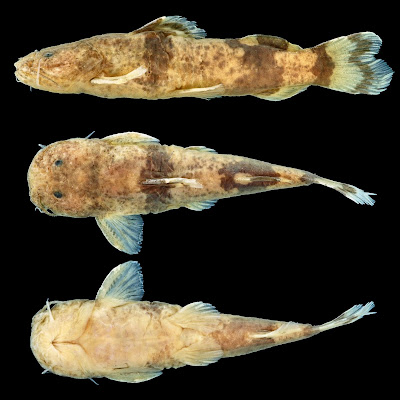
[Ichthyology • 2024] Microglanis lucenaiThe Barcode Trap—Description of A New Species of Microglanis (Siluriformes: Pseudopimelodidae), with A Review of the Status of Microglanis cibelae


Microglanis lucenai
 Albornoz, Bartzen & Malabarba, 2024


Abstract
In a recent study based on the generalized mixed Yule coalescent method for delimiting species, a threshold of 2% genetic distance using cytochrome c oxidase subunit I sequences was used to delimit the species of Microglanis. That action resulted in assembling several populations of Microglanis from Atlantic coastal rivers between Rio Grande do Sul and São Paulo states as a single species, Microglanis cottoides, including Microglanis cibelae as a junior synonym. We reexamined these populations and found three species diagnosed by their morphology and that constitute separate mtDNA lineages, including a new species. The synonym of M. cibelae and M. cottoides is reviewed and refuted based on morphological and molecular evidence. M. cibelae and the new species are sympatric and occasionally syntopic in the Tramandaí, Mampituba, and Araranguá river basins. The new species is distinguished from M. cibelae and M. cottoides by the anterior margin of the posttemporosupracleitrum narrow articulated with the epioccipital, the short mental and maxillary barbels, and depressed head and body.

Keywords: barcode, biodiversity, catfish, GMYC, Microglanis cottoides, Neotropical

 
Microglanis lucenai 


Pablo Lehmann Albornoz, César Sá Bartzen and Luiz R. Malabarba. 2024. The Barcode Trap—Description of A New Species of Microglanis, with A Review of the Status of Microglanis cibelae (Siluriformes: Pseudopimelodidae). Journal of Fish Biology. DOI: 10.1111/jfb.15764

Thursday, August 31, 2023

[Ichthyology • 2023] Rhyacoglanis benineiDescription and Phylogenetic Position of A New Species of Rhyacoglanis (Siluriformes: Pseudopimelodidae) from the Jamanxim River Basin


 Rhyacoglanis beninei
Crispim-Rodrigues, Silva, Shibatta, Kuranaka & Oliveira, 2023 


Abstract
In this study, a new species of Rhyacoglanis is described from the Jamanxim River basin, Tapajós River basin. The new species differs from congeners based on the combination of the following diagnostic characters: two oblique dark bands formed by an agglomerate of melanophores on the predorsal region; dorsal confluence between the dark subdorsal and subadipose bands in large juveniles and adults; ventral confluence between the dark subadipose and caudal peduncle bands; body without conspicuous dark brown spots; complete dark band on caudal peduncle; body with three dark bands; a thin dark caudal-fin band; pectoral-fin spine with anterior serrae distributed along the entire margin; the posterior tip of the post-cleithral process reaching vertical through the base of the dorsal-fin spine; and hypural 5 free of hypural 3 and 4 and pointed caudal-fin lobes. Additionally, our molecular phylogenetic results using ultraconserved elements (UCEs) corroborate the new species as Rhyacoglanis and sister to an undescribed species of Rhyacoglanis from the Xingu River basin. Moreover, as pointed out in previous studies, we confirm Cruciglanis as a sister group to Pseudopimelodus plus Rhyacoglanis.

Keywords: Amazon basin; Bumblebee catfishes; Phylogenomic; South America region; Pseudopimelodinae

 Rhyacoglanis beninei, holotype, MZUSP 127014, 59.1 mm SL, from córrego Jussara, an affluent of Jamanxim River, Tapajós River basin. Scale bar = 10 mm.


   A. Habitat of Rhyacoglanis beninei in córrego Jussara;
B. A rock where specimens of R. beninei were associated;
C. Paratype of R. beninei just after capture.
Photos: Gabriel S. Costa e Silva.

Rhyacoglanis beninei, new species
 
Diagnosis. Rhyacoglanis beninei can be diagnosed from all congeners by two oblique dorsal dark brown bars on the predorsal region (Fig. 2) (vs. absent). Additionally, R. beninei is distinguished from some congeners by having a dorsal confluence between the dark subdorsal and subadipose bands in large juveniles and adults (> 28 mm SL) (vs. lack dorsal confluence in R. paranensis, R. annulatus, R. varii, and R. rapppydanielae); ventral confluence between the dark subadipose and caudal peduncle bands (vs. lack ventral confluence in R. annulatus, R. epiblepsis, R. paranensis, R. seminiger, and R. rapppydanielae); body without conspicuous dark brown spots (vs. conspicuous dark brown spots in R. epiblepsis and R. rapppydanielae); complete dark band on caudal peduncle (vs. caudal peduncle-band with a unpigmented central region in R. annulatus); body with three dark bands (vs. two dark bands in R. seminiger); a thin dark caudal-fin bands (vs. large caudal-fin bands in R. paranensis and R. epiblepsis); pectoral-fin spine with anterior serrae distributed along the entire margin (restricted to the proximal half in R. pulcher and R. seminiger); posterior tip of the post-cleithral process reaching vertical through the base of the dorsal-fin spine (vs. not reaching in R. epiblepsis and R. rapppydanielae); hypural 5 free of hypural 3 and 4 (vs. hypurals 4 and 5 fused in R. rapppydanielae); pointed caudal-fin lobes (vs. rounded lobes in R. epiblepsis).

Etymology. Rhyacoglanis beninei is named in honor of Ricardo Cardoso Benine, Professor at Universidade Estadual Paulista “Júlio de Mesquita Filho”, in recognition of his dedication and remarkable contributions to the knowledge of Neotropical freshwater fishes.

Pigmentation of oblique dark bars in the predorsal region of  Rhyacoglanis beninei. 
A. MZUEL 23049, 29.6 mm SL; B. LBP 32145, 32.9 mm SL; C. LBP 32145, 37.3 mm SL; D. MZUEL 23049, 42.6 mm SL; E. LBP 32145, 50.2 mm SL. Scale bars = 10 mm.

Variation pattern of dark body bands in  Rhyacoglanis beninei.
 A. MZUEL 23049, 42.6 mm SL; B. LBP 32145, 29.8 mm SL; C. LBP 32163, 27.0 mm SL; D. LBP 32163, 42.9 mm SL. Scale bars = 10 mm.


Jefferson Luan Crispim-Rodrigues, Gabriel de Souza da Costa e Silva, Oscar Akio Shibatta, Mariana Kuranaka and Claudio Oliveira. 2023. Description and Phylogenetic Position of A New Species of Rhyacoglanis (Siluriformes: Pseudopimelodidae) from the Jamanxim River Basin.  Neotrop. ichthyol. 21(3); DOI: 10.1590/1982-0224-2023-0051  

Tuesday, February 21, 2023

[Ichthyology • 2023] Rhyacoglanis varii • A New species of Rhyacoglanis (Siluriformes: Pseudopimelodidae) from the upper rio Tocantins Basin, northern Brazil


 Rhyacoglanis varii 
 Shibatta & Souza-Shibatta. 2023.

 
Abstract
A new species of Rhyacoglanis from the upper rio Tocantins basin is described based on morphological and molecular data. The new species differs from the congeners by its color pattern, caudal fin shape, hypural bones fusion pattern, pectoral-fin spine shape, and barcode sequence of cytochrome oxidase subunit I (COI). In this study, two putative monophyletic groups of Rhyacoglanis are proposed based on morphology, one consisting of species with a short post-cleithral process and caudal fin with rounded lobes, Rhyacoglanis epiblepsis and R. rapppy-danielae, and the other with a longer post-cleithral process and caudal fin with pointed lobes, R. annulatus, R. paranensis, R. pulcher, R. seminiger, and the new species described herein.

Keywords: Biodiversity; Bumblebee catfish; Ostariophysi; Systematics; Taxonomy

Holotype of Rhyacoglanis varii, MZUEL 22317, 67.1 mm SL,
rio do Peixe, upper rio Tocantins basin, Goianésia, state of Goiás, Brazil.

Rhyacoglanis varii, new species
   
Diagnosis: Rhyacoglanis varii is easily distinguished from congeners (except for R. pulcher) by the color pattern, with the dark brown vertical bar below the dorsal-fin base not confluent with a dark brown bar below the adipose-fin base (vs. broadly confluent in R. seminiger), the subdorsal dark brown bar becomes abruptly thinner ventrally (vs. broader in R. paranensis), dark brown spots sparsely distributed on the body (vs. dense in R. epiblepsis and R. rapppydanielae), and a solid dark brown bar on caudal peduncle (vs. becoming light brown inside, resembling a circle, in R. annulatus). Rhyacoglanis varii has the posterior tip of the post-cleithral process reaching vertical through the base of the dorsal-fin spine (vs. not reaching in R. epiblepsis and R. rappydanielae). Rhyacoglanis varii differs from R. paranensis by the longer distance of anus to anal-fin origin (mean = 11.4±0.8% vs. 10.0±1.4% SL), maxillary barbel length (mean = 79.6±5.8% vs. 74.8±8.7% SL), and caudal peduncle depth (mean = 9.5±0.5% vs. 8.8±0.5% SL); minor posterior nostril to eye distance (mean = 4.8±0.9% vs. 6.7±1.3% SL), body depth (mean = 18.2±1.5% vs. 21.4±2.6% SL), and postcleithral process length (mean = 12.9±1.1% vs. 13.9±1.2% SL). Rhyacoglanis varii differs from R. pulcher and R. seminiger by the shape of the pectoral-fin spine, with anterior serrae distributed along the entire margin (vs. restricted to the proximal half).

 Rhyacoglanis varii coloration in life, MZUEL 6039, paratype, 46.1 mm SL,
rio do Peixe, upper rio Tocantins basin, Goianésia, state of Goiás, Brazil.

A. Panoramic view of Rhyacoglanis varii type locality, rio do Peixe, Goianésia, state of Goiás, Brazil;
B. Bottom with rocks, pebbles, and sand where specimens were collected;
C. Blue arrow indicating water flow and pointing to a specimen beneath rocks.

Etymology. The species name varii honors the ichthyologist Richard P. Vari (1949–2016) for his outstanding contributions to the systematics of Neotropical fishes.


Oscar Akio Shibatta and Lenice Souza-Shibatta. 2023. New species of Rhyacoglanis (Siluriformes: Pseudopimelodidae) from the upper rio Tocantins Basin.   Neotrop. ichthyol. 21(1); DOI: 10.1590/1982-0224-2022-0075   
 

Resumo: Uma nova espécie de Rhyacoglanis da bacia do alto rio Tocantins é descrita com base em dados morfológicos e moleculares. A nova espécie difere das congêneres por seu padrão de colorido, forma da nadadeira caudal, padrão de fusão dos ossos hipurais, forma do espinho da nadadeira peitoral e sequência de código de barras do citocromo oxidase subunidade I (COI). Neste estudo, dois possíveis grupos monofiléticos de Rhyacoglanis são propostos com base na morfologia, constituídos por espécies com o processo pós-cleithral curto e nadadeira caudal com lóbulos arredondados, Rhyacoglanis epiblepsis e R. rapppydanielae, e o outro com o processo pós-cleithral mais alongado e nadadeira caudal com lóbulos pontiagudos, R. annulatus, R. paranensis, R. pulcher, R. seminiger, e a nova espécie aqui descrita.

Palavras-chave: Bagrinho; Biodiversidade; Ostariophysi; Sistemática; Taxonomia

Tuesday, December 7, 2021

[Ichthyology • 2021] Rhyacoglanis rapp-pydanielae • A New Species of Rhyacoglanis (Siluriformes: Pseudopimelodidae) from rio Tocantins basin, northern Brazil


Rhyacoglanis rapp-pydanielae 
 Shibatta, Rocha & de Oliveira, 2021


Abstract
A new species of Rhyacoglanis is described from the rapids of Jatobal, Pará State, Brazil. This species differs from the congeners by fusing hypurals 3, 4, and 5 (vs. hypural 5 free). It also differs from the other species, except for Rhyacoglanis epiblepsis, by the color pattern with numerous dark spots on the body, short post-cleithral process, rounded pectoral and caudal fins, and incomplete lateral line. This species is known only from the type locality, which is currently flooded by the Tucuruí reservoir.

Keywords: Biodiversity; Bumblebee catfish; Ostariophysi; Systematics; Taxonomy


Rhyacoglanis rapp-pydanielae, holotype, INPA 8060, 37.5 mm SL, rio Tocantins, state of Pará, Brazil.

Rhyacoglanis rapp-pydanielae, new species

Diagnosis. Rhyacoglanis rapp-pydanielae is diagnosed from congeners by presenting the hypural bones 3, 4, and 5 fused (vs. hypural 5 free; Fig. 5). The new species also differs from its congeners, except for Rhyacoglanis epiblepsis, by the short post-cleithral process, with only a tiny visible tip after the opercular membrane (vs. elongated, more than half length visible after opercular membrane; Fig. 2), body scattered with numerous dark brown spots of diameter approximately equal to that of the eye (vs. few dark brown spots or absent), rounded pectoral and caudal fins (vs. pointed fins), and incomplete long lateral line (vs. complete). Rhyacoglanis rapp-pydanielae is distinguished from R. epiblepsis by the more tapered shape of the caudal peduncle’s dark brown band and the thin caudal fin’s dark brown band.

Geographical distribution. Rhyacoglanis rapp-pydanielae is known only from the type locality, Jatobal rapids, lower rio Tocantins basin, Pará, Brazil (Fig. 6). Unfortunately, collectors did not determine the exact geographic localization. However, the coordinates 04º28’26.5”S 49º27’18.24”W were recovered with Google Maps to Jatobal, Goianésia do Pará municipality, state of Pará.

 
 Etymology. The specific name rapp-pydanielae is a homage to the Brazilian ichthyologist Lucia H. Rapp Py-Daniel for her outstanding contribution to Neotropical fishes’ systematics. She is the founder and current curator of the fish collection at Instituto Nacional de Pesquisas da Amazônia (INPA), whose scientific importance is recognized by the national and international communities.


Oscar A. Shibatta, Marcelo S. Rocha and Renildo R. de Oliveira. 2021. New species of Rhyacoglanis (Siluriformes: Pseudopimelodidae) from rio Tocantins basin, northern Brazil.   Neotrop. ichthyol. 19(4); DOI: 10.1590/1982-0224-2021-0083 

Resumo: Uma nova espécie de Rhyacoglanis é descrita das corredeiras de Jatobal, estado do Pará, Brasil. Essa espécie difere das congêneres pela fusão dos hipurais 3, 4 e 5 (vs. hipural 5 livre). Também difere das demais espécies, exceto de Rhyacoglanis epiblepsis, pelo padrão de colorido com inúmeras pintas escuras no corpo, processo pós-cleitral curto, nadadeiras peitoral e caudal arredondadas, e linha lateral incompleta. Essa espécie é conhecida apenas da localidade tipo, que atualmente se encontra inundada pelo reservatório de Tucuruí.

Palavras-chave: Bagrinho; Biodiversidade; Ostariophysi; Sistemática; Taxonomia

Friday, September 24, 2021

[Ichthyology • 2021] Phylogenomics of the Bumblebee Catfishes (Siluriformes: Pseudopimelodidae) using ultraconserved elements


Representatives of genera of Pseudopimelodidae:
Microglanis (a, b); Batrochoglanis (c, d); Cephalosilurus (e, g); 
Lophiosilurus (f, h); Pseudopimelodus (i, k); and Rhyacoglanis (j, l)

in Silva, Melo, Roxo, ... et Oliveira, 2021. 
 
Abstract
Neotropical catfishes of the family Pseudopimelodidae comprise 53 species allocated to seven genera widely distributed in South America from northwestern Colombia and Venezuela to Argentina and Uruguay. Intergeneric relationships based on morphology-based phylogenies are conflicting, and the interspecific relationships remain incipient. We conducted the first molecular phylogeny of the family by analyzing sequence data from ultraconserved elements (UCEs) of the genome for 33 specimens of Pseudopimelodidae and 19 related taxa. Phylogenetic relationships were accessed by concatenated matrices using Bayesian inference and, maximum likelihood, and the coalescent approach by a species tree analysis. The phylogeny with 868 UCE loci and 906,689 bp strongly support the monophyly of Pseudopimelodidae, and the arrangement of two major subclades herein classified as subfamilies Pseudopimelodinae and the newly proposed Batrochoglaninae. Pseudopimelodinae is composed by Cruciglanis sister to Pseudopimelodus and Rhyacoglanis, whereas the new subfamily Batrochoglaninae is composed by Cephalosilurus and Lophiosilurus as sister to Batrochoglanis and Microglanis. Pseudopimelodinae is supported by five morphological synapomorphies and Batrochoglaninae supported by three such synapomorphies. The results of this study will surely guide future research aiming to delimit and describe species within the monophyletic groups.


Representatives of genera of Pseudopimelodidae:
Microglanis (a, b); Batrochoglanis (c, d); Cephalosilurus (e, g); Lophiosilurus (f, h); Pseudopimelodus (i, k); and Rhyacoglanis (j, l)


CONCLUSIONS: 
This study represents the most taxon-rich phylogenetic analysis of Pseudopimelodidae to date with representatives of all genera and 36% of the species diversity. Our results support the recognition of two major clades at the subfamilial level, Pseudopimelodinae and Batrochoglaninae. Although our analysis provides strong support for intergeneric relationships, an increased species-level coverage is needed to test the monophyly of Pseudopimelodus and to better delimit widely distributed taxa such as B. villosus, M. cottoides, and M. poecilus. The relationships will guide future research aiming to delimit species in well-resolved monophyletic groups as defined herein.


Gabriel S. C. Silva, Bruno F. Melo, Fábio F. Roxo, Luz E. Ochoa, Oscar A. Shibatta, Mark H. Sabaj and Claudio Oliveira. 2021. Phylogenomics of the Bumblebee Catfishes (Siluriformes: Pseudopimelodidae) using ultraconserved elements. Journal of Zoological Systematics and Evolutionary Research. DOI: 10.1111/jzs.12513

Monday, December 12, 2016

[Ichthyology • 2016] Microglanis nigrolineatus • A New Species (Pseudopimelodidae) from northwestern Argentina


Microglanis nigrolineatus 
Terán, Jarduli, AlonsoMirande & Shibatta, 2016  

 paratype [CI- FML6595from Quebrada Colorada stream, Bermejo River basin, Salta province, Argentina

Microglanis nigrolineatus, new species, is described from streams of Bermejo River basin, northwestern Argentina. It is distinguished from all congeners by a combination of characters including a unique coloration pattern: a thin dark line that runs along middle body from vertical line through dorsal-fin origin to end of adipose fin, delimiting two dark-brown areas ending in a dark blotch crossing entire body depth just anterior to caudal-fin origin and dorsal region of head uniformly dark, lacking a paler area on nuchal region. Also, thorn serrae on anterior margin of pectoral-fin spine are short.


Fig. 1. Microglanis nigrolineatus, CI-FML 6596, holotype, 32.5 mm SL; Argentina: Salta province: Quebrada Colorada stream, Bermejo River basin. 

Fig.2.Microglanis nigrolineatus, CI- FML6595, paratype, 43.6mm SL; live specimen, before fixation; Argentina: Salta province: Quebrada Colorada stream, Bermejo River basin.  

Fig. 5. Type locality: Quebrada Colorada stream, Bermejo River basin, Salta, Argentina. May 2015. 

Fig. 4. Northwestern Argentina, showing the distribution of Microglanis nigrolineatus, type locality at Quebrada Colorada stream, Bermejo River basin. , paratype localities. 


Terán, Guillermo E., Lucas R. Jarduli, Felipe Alonso, J. Marcos Mirande and Oscar A. Shibatta. 2016. Microglanis nigrolineatus, A New Species from northwestern Argentina (Ostariophysi: Pseudopimelodidae). Ichthyological Exploration of Freshwaters. 27(3);  193-202


Microglanis nigrolineatus, nueva especie, se describe de arroyos de la cuenca del Río Bermejo, Noroeste de Argentina. Esta nueva especie se distingue de los congéneres por una combinación de caracteres que incluyen un patrón de coloración único: una delgada línea oscura que atraviesa longitudinalmente la parte media del cuerpo, que va desde la aleta dorsal hasta el final de la adiposa delimitando dos áreas pardo oscuras que terminan en una mancha negra que atraviesa toda la altura del cuerpo justo anterior a la aleta caudal, y la región dorsal de la cabeza uniformemente oscura, sin un área más clara en la región nucal. Además, los ganchos en el margen anterior de la espina pectoral son cortos.


"Microglanis nigrolineatus, a new species from northwestern Argentina (Ostariophysi: Pseudopimelodidae)"
Guillermo E. Teran, Lucas R. JarduliFelipe Alonso, J. Marcos Mirandeand Oscar A. Shibatta.
Ichthyol. Explor. Freshwaters, Vol. 27, No. 3, pp. 193-202, 6 figs., 2 tabs., November 2016. ISSN 0936-9902
Artículo completo (versión preliminar): https://goo.gl/HpS9Xv

Monday, October 3, 2011

[Ichthyology • 2010] Microglanis minutus • A new catfish (Pseudopmelodidae) from the rio Barra Seca basin, southeastern Brazil


Microglanis minutus
Family: Pseudopmelodidae

New species of bumblebee catfish described

Brazilian ichthyologists have described a new species of bumblebee catfish in the genus Microglanis from southeastern Brazil.

Felipe Ottoni, José Mattos and Maria Barbosa name the new catfish Microglanis minutus in the most recent issue of the journal Vertebrate Zoology.

Microglanis minutus is a member of the M. parahybae species group, and is distinguished from all members of this species group in having mottled or relatively faint bands on the pectoral and anal fins, an emarginate caudal fin that is lightly mottled and with narrow vertical dark brown bands across the central portions of the lobes, dark brown saddles on the trunk, an irregular dark blotch on the caudal peduncle, the adipose fin with a dark saddle beneath it that does not extend ventrally to the anal fin as a continuous bar, the lateral line not reaching the vertical through the origin of the adipose fin, a distinct bony point on the tip of the pectoral spine, a wider head, the absence of a dark band on the distal portion of the anal fin, and a light oval spot below the dorsal spine.

The new species is known from the Barra Seca river drainage in southeastern Brazil, and is named after its comparatively small size (Latin minutus = small).


Ottoni, F.P., Mattos, J.L.O. & Barbosa, M.A. 2010. Description of a new species of Microglanisfrom the rio Barra Seca basin, southeastern Brazil (Teleostei: Siluriformes: Pseudopmelodidae). Vertebrate Zoology. 60 (3): 187–192. : http://www.vertebrate-zoology.de/vz60-3/01_Vertebrate_Zoology_60-3_Ottoni.pdf