Showing posts with label Struthioniformes. Show all posts

Thursday, June 27, 2019

[PaleoOrnithology • 2019] Pachystruthio dmanisensis • A Giant early Pleistocene Bird from eastern Europe: Unexpected Component of Terrestrial Faunas at the Time of early Homo arrival


Pachystruthio dmanisensis

in Zelenkov, Lavrov, Startsev, et al, 2019
  DOI: 10.1080/02724634.2019.1605521
Illustration: Andrey Atuchin

ABSTRACT
Giant birds, comparable in size to elephant birds and moa, have never been reported from Europe. Here, we describe a femur from the lower Pleistocene of the north Black Sea area (Crimea) that is referred to Pachystruthio dmanisensis, comb. nov., a giant bird with an estimated body mass of about 450 kg. This value makes this extinct bird one of the largest known avians (comparable to Aepyornis maximus) and the only bird of such giant size in Europe and the Northern Hemisphere in general. In contrast to very large insular birds, Pachystruthio dmanisensis was a good runner, which may be explained by its coexistence with large carnivoran mammals. Pachystruthio dmanisensis and associated assemblage of fossil mammals are shared with the Dmanisi locality in Georgia (∼1.8–1.7 Ma); thus, this giant bird was likely a typical component of eastern European faunas at the time of early hominin arrival. We suggest that Pachystruthio dmanisensis, together with early Homo and a variety of mammals, reached the northern Black Sea region via the southern Caucasus and Anatolia, because the older (Pliocene) finds of this fauna are known from Georgia and Turkey.


Illustration: Andrey Atuchin 

SYSTEMATIC PALEONTOLOGY
Order ?STRUTHIONIFORMES

Family INCERTAE SEDIS

Genus PACHYSTRUTHIO Kretzoi, 1954 

?PACHYSTRUTHIO DMANISENSIS (Burchak-Abramovich and Vekua, 1990), comb. nov.

FIGURE 2. Fossil femora of an extinct giant bird from the Crimean Peninsula (eastern Europe), with that of an average Recent ostrich for comparison.
A, C, E, F, Pachystruthio dmanisensis, comb. nov., specimen PIN 5644/56, from Taurida Cave, Crimean Peninsula (early Pleistocene);
B, D, Struthio camelus, osteological collection of PIN 1741-1. A, B, cranial view; C, D, caudal view; E, lateral view; F, proximal view.
 Abbreviations: cf, caput femoris; cl, condylus lateralis; cm, condylus medialis; ct, crista trochanteris; faa, facies articularis antitrochanterica; fop, fossa poplitea; fp, foramen pneumaticum; li, linea intermuscularis; sic, sulcus intercondylaris; sp, sulcus patellaris; tfi, trochlea fibularis.

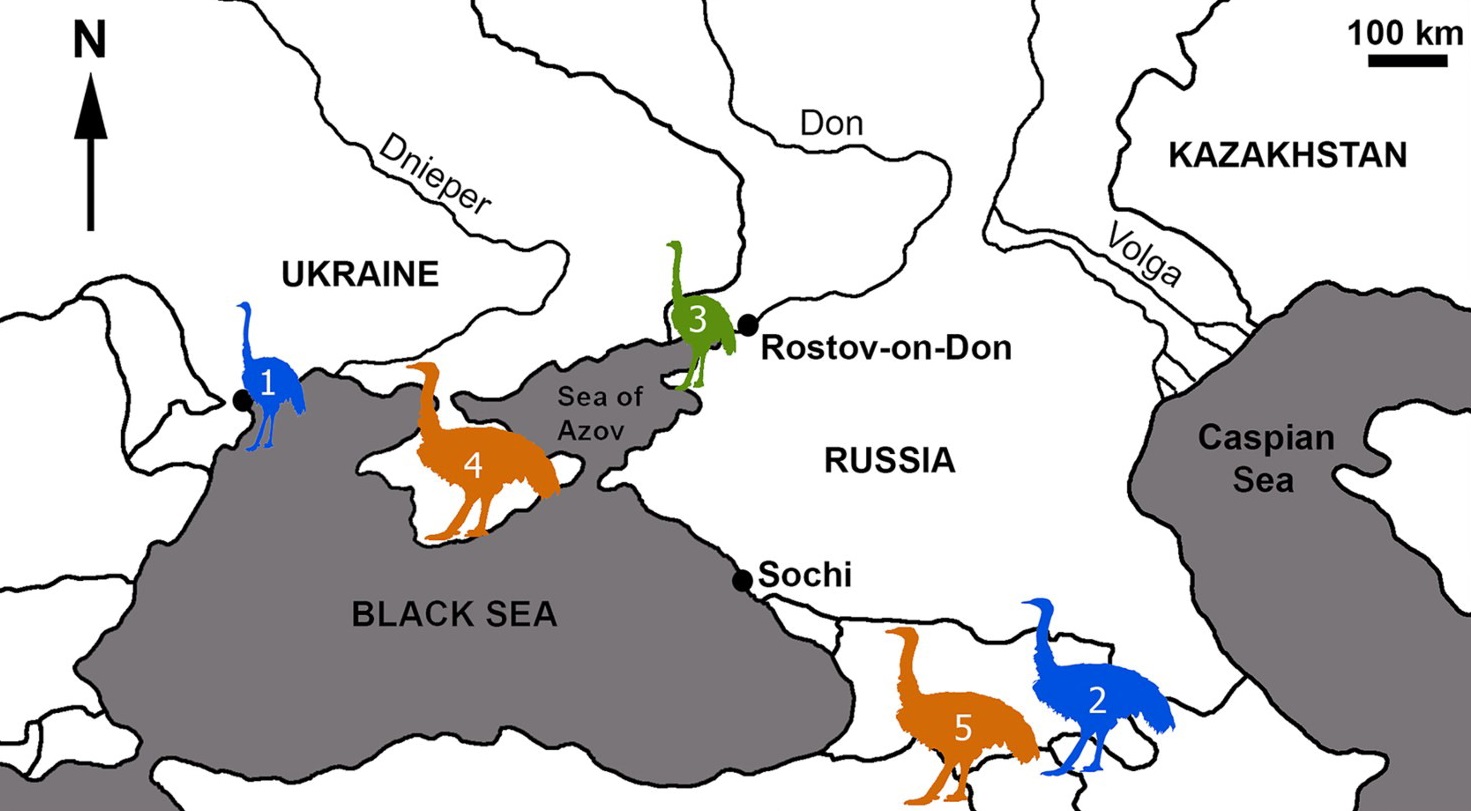
FIGURE 3. Map showing distribution of bony remains of the giant species of Pachystruthio (large ostrich silhouettes) and smaller Struthio ostriches (small ostrich silhouettes) in the Black Sea region in the Pliocene (5.3–2.6 Ma; blue), Gelasian (2.6–1.8 Ma; green), and Calabrian (1.8–0.8 Ma; brown). Pachystruthio from Hungary (Kretzoi, 1954) is not shown. Localities: 1, Odessa catacombs (early Pliocene); 2, Kvabebi (late Pliocene); 3, Liventsovka (Gelasian); 4, Taurida Cave (Calabrian); 5, Dmanisi (Calabrian).


 Nikita V. Zelenkov, Alexander V. Lavrov, Dmitry B. Startsev, Innessa A. Vislobokova and Alexey V. Lopatin. 2019. A Giant early Pleistocene Bird from eastern Europe: Unexpected Component of Terrestrial Faunas at the Time of early Homo arrival. Journal of Vertebrate Paleontology.  e1605521 DOI: 10.1080/02724634.2019.1605521
Half-tonne birds may have roamed Europe at same time as humans  theguardian.com/science/2019/jun/27/half-tonne-birds-roamed-europe-humans 


Thursday, September 27, 2018

[PaleoOrnithology • 2018] Vorombe gen. nov. • Unexpected Diversity within the Extinct Elephant Birds (Aves: Aepyornithidae) and A New Identity for the World's Largest Bird


Vorombe titan  (Andrews, 1894)

in Hansford & Turvey, 2018 
DOI: 10.1098/rsos.181295  
Illustration: Jaime Chirinos   twitter.com/JamesHansford5

Abstract
Madagascar's now-extinct radiation of large-bodied ratites, the elephant birds (Aepyornithidae), has been subject to little modern research compared to the island's mammalian megafauna and other Late Quaternary giant birds. The family's convoluted and conflicting taxonomic history has hindered accurate interpretation of morphological diversity and has restricted modern research into their evolutionary history, biogeography and ecology. We present a new quantitative analysis of patterns of morphological diversity of aepyornithid skeletal elements, including material from all major global collections of aepyornithid skeletal remains, and constituting the first taxonomic reassessment of the family for over 50 years. Linear morphometric data collected from appendicular limb elements, and including nearly all type specimens, were examined using multivariate cluster analysis and the Bayesian information criterion, and with estimation of missing data using multiple imputation and expectation maximization algorithms. These analyses recover three distinct skeletal morphotypes within the Aepyornithidae. Two of these morphotypes are associated with the type specimens of the existing genera Mullerornis and Aepyornis, and represent small-bodied and medium-bodied aepyornithids, respectively. Aepyornis contains two distinct morphometric subgroups, which are identified as the largely allopatric species A. hildebrandti and A. maximus. The third morphotype, which has not previously been recognized as a distinct genus, is described as the novel taxon Vorombe titan. Vorombe represents the largest-bodied aepyornithid and is the world's largest bird, with a mean body mass of almost 650 kg. This new taxonomic framework for the Aepyornithidae provides an important new baseline for future studies of avian evolution and the Quaternary ecology of Madagascar.


 Systematic Palaeontology
Order Struthioniformes Latham, 1790 

Family Aepyornithidae Bonaparte, 1853 

Genus Aepyornis Geoffroy Saint-Hilaire, 1851 
Aepiornis Geoffroy Saint-Hilaire, 1851, p. 52 
Epiornis Muller and Baldamus, 1851, p. 48 
Epyornis Bonaparte, 1853, p. 139 

Type species: Aepyornis maximus Geoffroy Saint-Hilaire, 1851 (by monotypy).

Recognized species: Aepyornis maximus Geoffroy Saint-Hilaire, 1851; Aepyornis hildebrandti Burckhardt, 1893
.....

Genus Mullerornis Milne-Edwards and Grandidier, 1894
Flacourtia Andrews, 1895, p 23 

Type species: Mullerornis betsilei Milne-Edwards and Grandidier, 1894; designated by Richmond.

Recognized species: Mullerornis modestus (Milne-Edwards and Grandidier, 1869)


 Vorombe titan (Andrews, 1894)

Illustration: Jaime Chirinos 

Genus Vorombe gen. nov.
Etymology: From the Malagasy for ‘big bird’ (neuter).

Type species: Aepyornis titan Andrews, 1894

 Vorombe titan (Andrews, 1894)
Aepyornis titan Andrews 1894, p. 18 
Aepyornis ingens Milne-Edwards and Grandidier, 1894, p. 124


Figure 7.  Vorombe titan , femur (NHMUK A439), Itampolo (Itampulu Vé), Madagascar; part of syntype series.


James P. Hansford and Samuel T. Turvey. 2018. Unexpected Diversity within the Extinct Elephant Birds (Aves: Aepyornithidae) and A New Identity for the World's Largest Bird. Royal Society Open Science. DOI: 10.1098/rsos.181295

After decades of conflicting evidence, scientists at @ZSLScience have put the ‘world’s largest bird’ debate to rest. The extinct Vorombe titan has taken the title at over 3 metres tall and weighing up to 800kg:   zsl.org/science/news/zsl-names-world’s-largest-ever-bird-–-vorombe-titan … #elephantbirds #birds  

Team names world's largest ever bird—Vorombe titan  phys.org/news/2018-09-team-world-largest-birdvorombe-titan.html via @physorg_com