Showing posts with label Sphaerodactylidae. Show all posts

Monday, January 27, 2025

[Paleontology • 2022] Geiseleptes delfinoi • A New Gecko (Squamata: Gekkota) from the Eocene of Geiseltal (Germany) implies long-term persistence of European Sphaerodactylidae


 Geiseleptes delfinoi    
Villa, Wings & Rabi, 2022


Abstract
Gekkota (geckos and pygopods) constitute a diverse and early diverging clade of squamates, but their highly fragmentary fossil record allows only limited insights into their evolutionary history. Even long-known classic Palaeogene Lagerstätten, such as the Eocene Messel and Geiseltal, remained uninformative for gecko evolution. Here we describe an articulated near-complete crown-gekkotan skull from the Eocene of Geiseltal. The skull represents one of the most complete and oldest fossil geckos from the Cenozoic and warrants the naming of a new taxon, Geiseleptes delfinoi gen. et sp. nov. Parsimony analysis of an expanded morphological dataset that comprehensively samples fossil geckos recovers at least two lineages in the Palaeogene of Europe: Gekkonidae and Sphaerodactylidae. Further clades may have been present but require further support. The new species, together with several other European extinct taxa, belongs to the extant clade Sphaerodactylidae. Published molecular phylogenies imply a European dispersal from Africa for the clade, and G. delfinoi constrains the timing of this event to no later than the middle Eocene. Within Sphaerodactylidae, several Eocene, Oligocene and Miocene species form the stem-lineage of the extant Mediterranean-endemic Euleptes europaea of which G. delfinoi is the oldest representative. We here define the new clade Euleptinae for this group. Euleptine geckos had an unusually long evolutionary history in Cenozoic Europe and may represent one of the very few vertebrate clades with a persistent presence since the early Palaeogene, indicating extreme adaptability. As the oldest known crown-sphaerodactylid, G. delfinoi represents an important fossil calibration for divergence dating analyses of geckos.

Keywords: Palaeogene, Europe, phylogeny, Sphaerodactylidae, lizard, gecko


 Geiseleptes delfinoi gen. et sp. nov. 


Andrea Villa, Oliver Wings and Márton Rabi. 2022. A New Gecko (Squamata, Gekkota) from the Eocene of Geiseltal (Germany) implies long-term persistence of European Sphaerodactylidae. Papers in Palaeontology. 8(3); e1434. DOI: 10.1002/spp2.1434  
  phys.org/news/2022-06-history-european-geckos.html

Tuesday, October 29, 2024

[Herpetology • 2024] Pseudogonatodes fuscofortunatus • Morphology and Molecular Systematics support A New Species of Pseudogonatodes (Gekkota: Sphaerodactylidae) from Venezuela with a remarkable telescoped skull


Pseudogonatodes fuscofortunatus  
 Schargel, Hernández-Morales, Daza, Jowers, Montes-Correa, Freitas, Sullivan, Gamble & Rivas. 2024

Photograph by Luis A. Rodríguez J. 

Abstract
We describe a new species of miniaturized gecko (genus Pseudogonatodes) from the Peninsula de Paria in northeastern Venezuela. Externally, the new species resembles Pseudogonatodes furvus and Pseudogonatodes manessi, from the Sierra Nevada de Santa Marta in Colombia and the Central Coastal Range in Venezuela, respectively; however, it differs from these species in terms of molecular genetic data (12S rRNA, 16S rRNA, and c-mos), osteological characters, and scale counts. The new species is unique in skull osteology, and we adopt the term ‘telescoped’ from the literature to describe the overlap of bones in the snout, in particular the premaxilla fully separating the nasal bones and contacting the frontal bone. The new species is also the only known species of Pseudogonatodes with fused parietal bones. Using molecular data, we present the first phylogeny of Pseudogonatodes, including six of the nine species in the genus. The new species is sister to P. manessi, which is consistent with biogeographical patterns in the mountainous areas of northern Venezuela. The phylogenetic results also indicate that Pseudogonatodes guianensis is non-monophyletic and raise the possibility of resurrecting the name Pseudogonatodes amazonicus. However, large sampling gaps in Amazonia prevent us from rigorously assessing species limits and proposing a taxonomic change.

gecko, micro-computed tomography scan, montane forests, Peninsula de Paria, reptile, skeleton, sphaerodactyl, taxonomy


 Telescoped patern of the skull of Pseudogonatodes fuscofortunatus  (MBLUZ 1292, top), compared with Pseudogonatodes manessi (KU 182740, botom). Arrows indicate the facets that support each dorsal bone.
Colours are as follows: purple, premaxilla; cobalt blue, nasal; light blue, frontal; green, parieta

 Specimens of Pseudogonatodes from northern South America in life.
A, Pseudogonatodes fuscofortunatus female (presumably) paratype (MBLUZ 1293), Cerro El Olvido, Venezuela. B, Pseudogonatodes manessi, female, Rancho Grande, Parque Nacional Henri Pitier, Venezuela (MHNLS 17984).
C, Pseudogonatodes furvus, male topotype, Sierra Nevada de Santa Marta, Colombia (CBUMAG:REP:00767). D, Pseudogonatodes manessi, young specimen, from La Cumbre, Municipio Bruzual, Sierra de Aroa, Venezuela; this individual would represent the westernmost limit of the species.
E, view of Cerro Azul from Cerro El Olvido, two of the highest mountains with humid forests at the eastern end of the Paria Peninsula, Venezuela. F, undergrowth with abundant decomposing organic mater and rocks, an environment where P. fuscofortunatus lives.
Photographs: Luis A. Rodríguez J. (A), Eric N. Smith (B), Andrés C. Montes-Correa (C), Alberto Navas and Edward Camargo (D), and Gilson Rivas (E, F)


Walter E. Schargel, Cristian Hernández-Morales, Juan D. Daza, Michael J. Jowers, Andrés Camilo Montes-Correa, Mayke De Freitas, Kathryn A. Sullivan, Tony Gamble, Aaron M. Bauer and Gilson A. Rivas. 2024. Morphology and Molecular Systematics support A New Species of Pseudogonatodes (Squamata: Gekkota: Sphaerodactylidae) from Venezuela with a remarkable telescoped skull. Zoological Journal of the Linnean Society. 202(2); zlae120. DOI: doi.org/10.1093/zoolinnean/zlae120

Thursday, March 7, 2024

[Herpetology • 2024] Pseudogonatodes quihuai • A New Dwarf Gecko of the Genus Pseudogonatodes (Squamata: Sphaerodactylidae) from the eastern slope of the Andean Cordillera de Mérida in northern South America


Pseudogonatodes quihuai
  Rojas-Runjaic, Koch, Castroviejo-Fisher & Prudente, 2024

 
Abstract
Pseudogonatodes is a poorly known genus of small bodied, diurnal, ground-dwelling geckos widely distributed in northern South America. No additional species have been described in over two decades. Herein we describe a new species from the eastern slope of the Cordillera de Mérida in the Venezuelan Andes. The new species is readily diagnosable morphologically from the other seven recognized species of Pseudogonatodes by having a single postnasal scale—a putative autapomorphy. Furthermore, it is characterized by a unique combination of phenotypic characters that includes granular dorsal scales, three large postrostrals, five to six loreals, mental U-shaped, four to six postmentals, 26–29 ventrals between anterior levels of fore- and hind limbs, third lamella under fourth toe not distinctly enlarged, and subcaudal pattern 1’1”. In addition to characterizing the external morphology, we present a description of the skull, based on 3D digital models reconstructed from high resolution computed microtomography scans. The discovery of this new species highlights the still underestimated diversity of this group of Neotropical dwarf geckos and underscores the need for further studies on its systematics and taxonomy.

Reptilia, Gekkota, lizard, Neotropics, new species, osteology, reptile, Venezuela


Pseudogonatodes quihuai


Fernando J. M. Rojas-Runjaic, Claudia Koch, Santiago Castroviejo-Fisher and Ana L. C. Prudente. 2024. A New Dwarf Gecko of the Genus Pseudogonatodes (Squamata: Sphaerodactylidae) from the eastern slope of the Andean Cordillera de Mérida in northern South America.  Zootaxa. 5418(4); 301-327. DOI: 10.11646/zootaxa.5418.4.1

Tuesday, September 12, 2023

[Herpetology • 2023] Clarifying A Male Color Morph of Sphaerodactylus macrolepis Günther, 1859 and Resolving the Taxonomic Confusion on Saint Croix


Sphaerodactylus macrolepis Günther, 1859

in Griffing, Keating, Pinto, Nielsen et Gamble, 2023. 
 
Abstract
Many species of sphaerodactyl gecko exhibit sexual dichromatism. In particular, dichromatism plays an important role in intersexual signaling for Sphaerodactylus. Furthermore, some species exhibit polymorphism in male color and pattern. Here, we describe a regional male color morph of Sphaerodactylus macrolepis from St. Croix. After generating both mitochondrial and nuclear phylogenies, we found that individuals with the St. Croix-specific yellow/orange head morph are part of the S. macrolepis clade. This distinct color morph likely contributed to the turbulent taxonomic history of the S. macrolepis species group. Given the documented diversity of the color patterns in this group and that sexual signals evolve rapidly, we suggest S. macrolepis is an excellent group to study the ecological and evolutionary consequences of dichromatism and polymorphism.

Keywords: Reptilia, dichromatism, gecko, sexual dimorphism, Sphaerodactyl, Sphaerodactylidae, Virgin Islands


Aaron H. Griffing, Shannon E. Keating, Brendan J. Pinto, Stuart V. Nielsen and Tony Gamble. 2023. Clarifying A Male Color Morph of Sphaerodactylus macrolepis Günther, 1859 and Resolving the Taxonomic Confusion on Saint Croix.  Zootaxa. 5343(3); 273-280. DOI: 10.11646/zootaxa.5343.3.3


Thursday, August 25, 2022

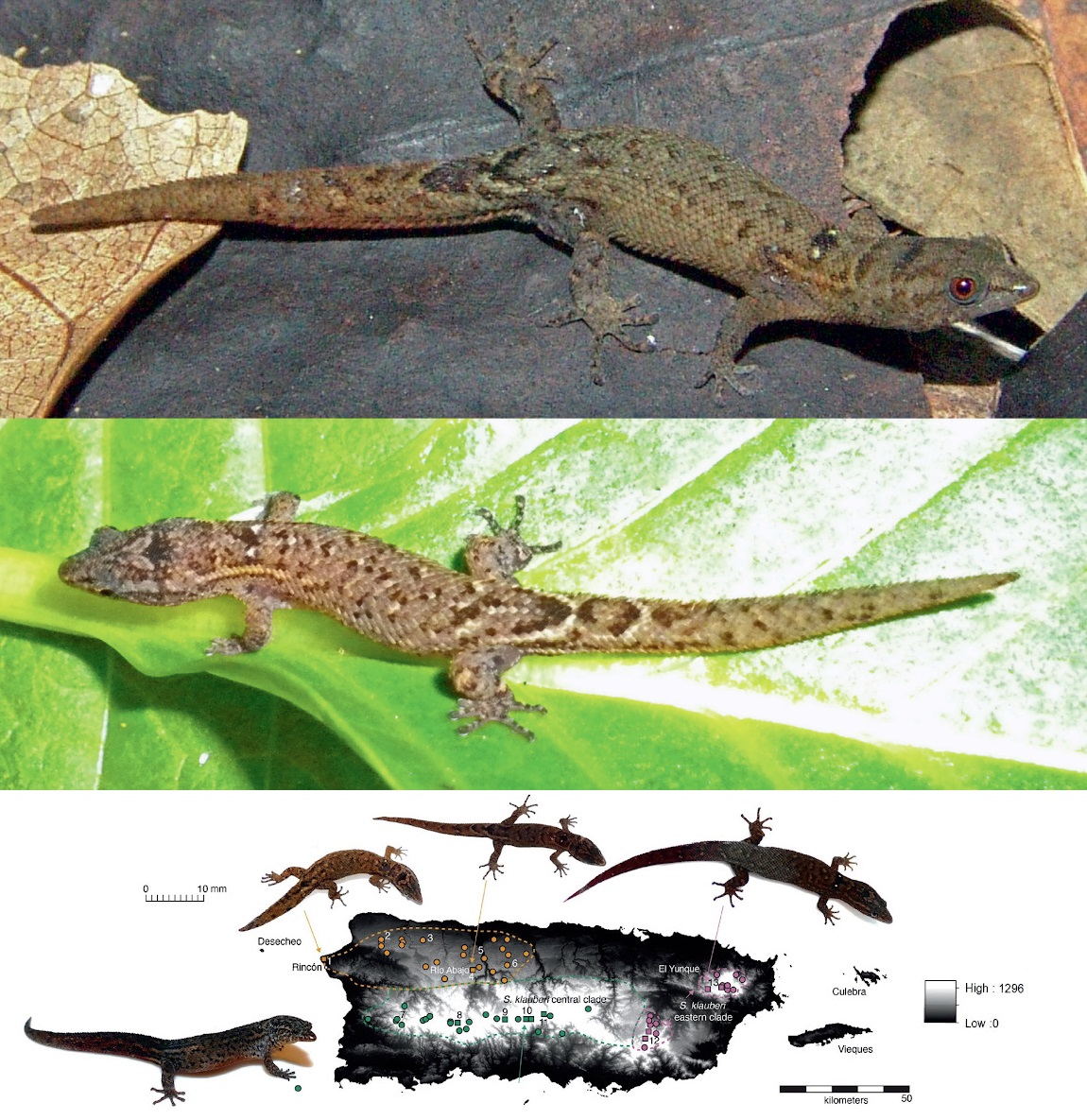
[Herpetology • 2022] Sphaerodactylus verdeluzicola • A New Species of Sphaerodactylus (Gekkota: Sphaerodactylidae) from the Northwest Limestone Region of Puerto Rico


 Sphaerodactylus verdeluzicola
 Díaz-Lameiro, Villamil, Gamble, Pinto, Herrera-Martínez, ... et Daza, 2022


Abstract
Advances in both morphological and molecular techniques have uncovered many lineages across the tree of life, and Neotropical vertebrates are no exception. Sphaerodactylus geckos (Sphaerodactylidae) are abundant and important components of the Neotropical herpetofauna, but few studies have thoroughly investigated them using a combination of morphology and modern molecular genetic methods. Here, we combine morphological and genetic data to describe a new species of Sphaerodactylus from the northwestern karst region of Puerto Rico. The new species is compared to other closely related and sympatric species of Sphaerodactylus. Morphological analysis shows that the combination of small body size (median SVL = 21.5 mm), lepidosis, skull morphology, and coloration of the head differentiates the new species from its closest relatives, including the related species, Sphaerodactylus klauberi. Comparing sequences of the mitochondrial 16S rRNA gene showed a genetic distance between S. klauberi and the new species of 5.1–5.6%, which is similar to genetic distances among other recognized gecko species. This is the first new species of Sphaerodactylus to be described from Puerto Rico in nearly a century, highlighting the continued need to evaluate and chronicle biological diversity even in well-studied regions.

Proposed distribution of Sphaerodactylus verdeluzicola, new species.
 Orange symbols represent the proposed distribution of the new species; green and pink symbols denote distribution of S. klauberi. Circles indicate records from museum databases (Sphaerodactylus klauberi in GBIF Secretariat, 2020). Scale bar in mm applies to all pictures of geckos. Museum specimens were examined to confirm if they match the description of the new species. Squares indicate visited localities. 1) Rincon, 2) Isabela, 3) Camuy, 4) Bosque Estatal de Río Abajo, 5) Arecibo, 6) Florida, 7) Maricao, 8) Adjuntas, 9) Toro Negro, 10) Divisoria, 11) Orocovis-Villalba, 12) Bosque Estatal de Carite, 13) El Toro trail.

Live coloration of Sphaerodactylus verdeluzicola.
Above, a male specimen from Bosque Estatal de Río Abajo.
Below, a female specimen from Rincon.


Sphaerodactylus verdeluzicola, new species 
English Common Name: Puerto Rican Karst Gecko 
Spanish Common Name: Salamanquita de Monte y Mar

Etymology.— Specific epithet verdeluzicola is derived from the Spanish phrase ‘‘verde luz’’ with the suffix -cola to indicate that it is a Sphaerodactylus gecko dwelling in the place where the green light shines. The name is a tribute to the song Verde Luz, considered by some the second national anthem of Puerto Rico, by singer-songwriter Antonio Caba´n Vale ‘‘El Topo.’’ The song expresses a sentiment of longing for the homeland, while in the diaspora, and praises the natural wonders of Puerto Rico, such as the exquisite beaches, its karst terrain, and the emerald light emanating from the mountains and the sea—scenery that correlates with this gecko’s habitat. Furthermore, Antonio Caba´n Vale grew up in the town of Moca in northwestern Puerto Rico, which is within the current distribution of S. verdeluzicola.


Alondra M. Díaz-Lameiro, Catalina I. Villamil, Tony Gamble, Brendan J. Pinto, Alexandra Herrera-Martínez, Richard Thomas, Justin M. Bernstein, James E. Titus-McQuillan, Stuart V. Nielsen, Eliacim Agosto-Torres, Alberto R. Puente-Rolón, Fernando J. Bird-Picó, Taras K. Oleksyk, Juan Carlos Martínez-Cruzado and Juan D. Daza. 2022. A New Species of Sphaerodactylus (Gekkota: Sphaerodactylidae) from the Northwest Limestone Region of Puerto Rico. Ichthyology & Herpetology, 110(3); 449-465. DOI: 10.1643/h2020123

Las filogenias moleculares han elucidado múltiples linajes en el árbol de la vida, incluyendo varios vertebrados neotropicales. Las salamanquitas del género Sphaerodactylus (Sphaerodactylidae) son abundantes y forman una parte importante de la herpetofauna neotropical. Este género ha sido investigado recientemente utilizando métodos moleculares modernos. En este artículo se describe una nueva especie del género Sphaerodactylus, procedente de la región kárstica del noroeste de Puerto Rico. Los individuos de la nueva especie fueron comparados con especies afines y simpátricas. El análisis morfológico muestra que la combinación entre el tamaño corporal, escamación, morfología del cráneo y coloración cefálica, distinguen a la especie nueva de otras especies cercanas filogenéticamente, incluyendo su especie hermana Sphaerodactylus klauberi. Al comparar secuencias del gen mitocondrial 16S rRNA se observó una distancia genética de 5.1–5.6% entre la especie nueva y S. klauberi, dicha distancia es similar a la que existe entre otras especies descritas de salamaquitas. Ha pasado casi un siglo desde que la última especie de Sphaerodactylus de Puerto Rico fue descrita, ésto resalta la necesidad de seguir evaluando y catalogando la biodiversidad, inclusive en áreas que han sido investigadas a profundidad.

Wednesday, February 24, 2021

[Herpetology • 2020] Gonatodes machelae • A New Diurnal Gecko in the Genus Gonatodes (Squamata: Sphaerodactylidae) from Margarita Island, Venezuela


Gonatodes machelae 
Rivero-Blanco & Schargel, 2020


Abstract
We describe a new species of diurnal gecko, Gonatodes machelae sp. nov., from Cerro El Copey, Margarita Island, Venezuela. The new species is distinguished from all congeners by a combination of the following characters: small size, subcaudal pattern C (1’1’’), typically three lateral scale rows on the digits, and aspects of coloration. The new species exhibits polychromatism similar to what has been described in some other species of Gonatodes. It is found in humid forests and shrublands from about 450 m to 900 m above sea level.

Keywords: Reptilia, Caribbean, Gekkota, Reptilia, endemic, taxonomy


Figure 2. Individuals in life of Gonatodes machelae sp. nov. from Cerro El Copey, Margarita Island, Venezuela.
An adult male with dark markings on the head (top), an adult male without dark markings on the head (middle), and an adult female (bottom).
Photos by W. Schargel.

Figure 1. Photos of the head in dorsal (top left) and ventral (top right) views and of the left hand (bottom left) and left foot (bottom right) of the holotype of Gonatodes machelae sp. nov. The scale sutures on the anterior portion of the ventral view of the head were accentuated with black lines.

Figure 4. Habitat of Gonatodes machelae sp. nov. in Cerro El Copey, Margarita Island, Venezuela (top). Juvenile specimen of G. machelae found inside the tank bromeliad Glomeropitcarnia erectiflora.
Photos by G. Rivas.

Gonatodes machelae sp. nov.

Etymology. The new species is dedicated by Carlos Rivero-Blanco to Machela, wife for 53 years and counting, in recognition to her support while studying different species of Gonatodes in the field, including the new species in Cerro El Copey. 


Carlos Rivero-Blanco and Walter E. Schargel. 2020. A New Diurnal Gecko in the Genus Gonatodes (Squamata: Sphaerodactylidae) from Margarita Island, Venezuela. Zootaxa. 4729(3); 429–439. DOI: 10.11646/zootaxa.4729.3.9

Resumen: Describimos una nueva especie de gecko diurno, Gonatodes machelae sp. nov. proveniente del Cerro El Copey, Isla de Margarita, Venezuela. La nueva especie se diferencia de todas las especies en el género por la combinación de los siguientes caracteres: tamaño pequeño, patrón subcaudal C (1’1’’), típicamente tres hileras de escamas laterales en los dígitos, y en aspectos de su coloración. La nueva especie exhibe un policromatismo similar al que ha sido descrito en algunas otras especies de Gonatodes. Se encuentra en bosques y matorrales húmedos en elevaciones desde 450 a 900 m sobre el nivel del mar.
 

Friday, January 31, 2020

[Herpetology • 2020] Gonatodes chucuri • A New Species of the Genus Gonatodes (Squamata: Sauria: Sphaerodactylidae) from the western flank of the Cordillera Oriental in Colombia


Gonatodes chucuri 
Meneses-Pelayo & Ramírez, 2020
photo: Jose Vieira

Abstract
We describe a new sphaerodactylid lizard of the genus Gonatodes from the western flank of the Cordillera Oriental, Santander Department, Colombia based on morphological and molecular data. The new species is distinguished from all congeners by having a medium body size, by the absence of both a supraciliary spine and of clusters of distinctly enlarged conical scales on the sides and by having a subcaudal scale pattern (1’1”) and a cryptic dorsal color pattern in both sexes. Additionally, we describe for the first time the hemipenial morphology for a species of the genus. The new species increases the number of Gonatodes known from Colombia to eight and is the only known species of the country, as well as the second known mainland species of the genus not exhibiting sexual dichromatism.

Keywords: Reptilia, Molecular phylogenetics, morphology, hemipenial, taxonomy, sexual dichromatism


Gonatodes chucuri


 Elson Meneses-Pelayo and Juan P. Ramírez. 2020. A New Species of the Genus Gonatodes (Squamata: Sauria: Sphaerodactylidae) from the western flank of the Cordillera Oriental in Colombia, with Description of Its Hemipenial Morphology. Zootaxa. 4729(2); 207–227. DOI: 10.11646/zootaxa.4729.2.4  


Monday, December 23, 2019

[Herpetology • 2019] The Sprightly Little Sphaerodactyl: Systematics and Biogeography of the Puerto Rican Dwarf Geckos Sphaerodactylus (Gekkota, Sphaerodactylidae)


Sphaerodactylus from Puerto Rico and islands on the Puerto Rican Bank. Sphaerodactylus macrolepis species complex (excluding S. parvus). Sphaerodactylus macrolepis (square); S. grandisquamis (circle); S. inigoi (diamond).

in Daza, Pinto, Thomas, ... et Gamble. 2019.

Abstract
Studies of the Caribbean herpetofauna (amphibians and reptiles) have made significant contributions to our knowledge of evolutionary patterns and processes. A prerequisite for these studies are accurate taxonomies and robust phylogenetic hypotheses. One notable Caribbean radiation lacking such data are dwarf geckos of the genus Sphaerodactylus. Systematics of the Puerto Rican Sphaerodactylus have been turbulent since the initial species descriptions and no molecular phylogenies exist that include complete or near-complete taxon sampling. Here, we combine a multi-locus molecular phylogeny with extensive morphological information to investigate the current diversity of Sphaerodactylus geckos from the Puerto Rican Bank, with a large number of species from Hispaniola as an outgroup. In particular, we focus our efforts on resolving the taxonomy of the Sphaerodactylus macrolepis Günther species complex. We find S. macrolepis sensu lato (currently two nominal species with nine subspecies) is made up of at least four diagnosable species within two clades: (1) the sister species Sphaerodactylus macrolepis sensu stricto from the Virgin Islands (including St. Croix) and Culebra, and S. parvus King from islands in the northern Lesser Antilles; and (2) all other Sphaerodactylus macrolepis subspecies from Puerto Rico, Vieques, and Culebra. We resurrect Sphaerodactylus grandisquamis Stejneger from synonymy to refer to all subspecies from Puerto Rico and elevate the subspecies Sphaerodactylus inigoi Thomas & Schwartz for geckos from Vieques and western Culebra. The resulting phylogeny and revised taxonomy will be a useful tool for subsequent research into Sphaerodactylus conservation and evolution.

Keywords: Reptilia, biogeography, Caribbean, Hispaniola, lizard, morphology, Puerto Rico, taxonomy, species delimitation, Squamata, Virgin Islands

Sampling localities and approximate distributions for select species of Sphaerodactylus from Puerto Rico and islands on the Puerto Rican Bank. Different shaped symbols are used for each species.
A. Sphaerodactylus macrolepis species complex (excluding S. parvus). Sphaerodactylus macrolepis (square); S. grandisquamis (circle); S. inigoi (diamond).


Phylogeny and biogeography of sampled Sphaerodactylus geckos.

Sphaerodactylus parvus King, 1962
Sphaerodactylus macrolepis sensu stricto Günther, 1859
Sphaerodactylus inigoi comb. nov. Thomas & Schwartz, 1966

Sphaerodactylus grandisquamis grandisquamis Stejneger, 1904
Sphaerodactylus grandisquamis guarionex comb. nov. Thomas & Schwartz, 1966
Sphaerodactylus grandisquamis ateles comb. nov. Thomas & Schwartz, 1966
Sphaerodactylus grandisquamis mimetes comb. nov. Thomas & Schwartz, 1966
Sphaerodactylus grandisquamis spanius comb. nov. Thomas & Schwartz, 1966
Sphaerodactylus grandisquamis stibarus comb. nov. Thomas & Schwartz, 1966


A Checklist to the Sphaerodactylus of Puerto Rico and Nearby Islands

Sphaerodactylus beattyi Grant, 1937
Sphaerodactylus beattyi beattyi Grant, 1937
Sphaerodactylus beattyi seamani Thomas & Schwartz, 1966

Sphaerodactylus gaigeae Grant, 1932

Sphaerodactylus grandisquamis Stejneger, 1904
Sphaerodactylus grandisquamis grandisquamis Stejneger, 1904
Sphaerodactylus grandisquamis guarionex Thomas & Schwartz, 1966
Sphaerodactylus grandisquamis ateles Thomas & Schwartz, 1966
Sphaerodactylus grandisquamis mimetes Thomas & Schwartz, 1966
Sphaerodactylus grandisquamis spanius Thomas & Schwartz, 1966
Sphaerodactylus grandisquamis stibarus Thomas & Schwartz, 1966

Sphaerodactylus inigoi Thomas & Schwartz, 1966

Sphaerodactylus klauberi Grant, 1931

Sphaerodactylus levinsi Heatwole, 1968

Sphaerodactylus macrolepis Günther, 1859

Sphaerodactylus micropithecus Schwartz, 1977

Sphaerodactylus monensis Meerwarth, 1901

Sphaerodactylus nicholsi Grant, 1931

Sphaerodactylus parthenopion Thomas, 1965

Sphaerodactylus roosevelti Grant, 1931

Sphaerodactylus townsendi Grant, 1931


Juan D. Daza, Brendan J. Pinto, Richard Thomas, Alexandra Herrera-Martinez, Daniel P. Scantlebury, Luis F. Padilla García, Rajesh P. Balaraman, Gad Perry and Tony Gamble. 2019. The Sprightly Little Sphaerodactyl: Systematics and Biogeography of the Puerto Rican Dwarf Geckos Sphaerodactylus (Gekkota, Sphaerodactylidae). Zootaxa. 4712(2); 151–201. DOI:  10.11646/zootaxa.4712.2.1

Tuesday, October 1, 2019

[Herpetology • 2019] Phylogenetic Differentiation and Taxonomic Consequences in the Saurodactylus brosseti species complex (Squamata: Sphaerodactylidae), with Description of Four New Species


 Saurodactylus splendidus 
Javanmardi, Vogler & Joger, 2019


Abstract
We divide Saurodactylus brosseti into five species, based on molecular and morphological characteristics. Phylogenetic analysis of two mitochondrial markers (ND4 and 12S rRNA) reveals five separately evolving lineages (clades) in the S. brosseti species complex. Each can be assigned to a particular geographical range within the distribution area in Morocco: North, South, Anti-Atlas, East and Southeast. A dichotomous key for all species within the genus Saurodactylus is presented. Despite the high level of color pattern variation among and within the northern, southern, Anti-Atlas and eastern clades, the southeastern lineage shows a unique coloration which is not found in other clades. The ecological traits of the southeastern clade seem to differ from those of the other four lineages since it is basically associated with Acacia species. Like the relictual ecosystem characterized by these trees, it appears to be highly threatened by extinction.

Keywords: Reptilia, Saurodactylus splendidus sp. nov., S. harrisii sp. nov., S. slimanii sp. nov., S. elmoudenii sp. nov., phylogeny, species complex, taxonomy


Saurodactylus slimanii sp. nov. Joger & Javanmardi, 2019 (Eastern clade)

Derivatio nominis: We name this new taxon in honor of Tahar Slimani, who initiated the collaboration between our laboratories and accompanied us on a number of successful field trips in Morocco. The patronym was latinized as Slimanius and then placed into the masculine genitive singular.


Saurodactylus elmoudenii sp. nov. Joger, Vogler & Javanmardi, 2019 (Anti-Atlas clade)

Derivatio nominis. This taxon is named in honor of our dear colleague, El Hassan El Mouden. The name was latinized as El Moudenius and then placed into the masculine singular genitive.


Saurodactylus harrisii sp. nov. Joger, Javanmardi & Vogler, 2019 (Southern clade)

Derivatio nominis. We name this taxon in honor of David James Harris, who initiated the first comprehensive study on the genetic differentiation of Saurodactylus brosseti, during which this and two other clades were discovered. The patronym was latinized as Harrisius and then placed into the masculine genitive singular.

Saurodactylus splendidus sp. nov. in its natural habitat (type locality, Icht).
Photo by S. Vogler.

Saurodactylus splendidus sp. nov. Javanmardi, Vogler & Joger, 2019 (Southeastern clade) 

 Derivatio nominis. The name refers to the contrasting pattern of these beautiful geckos.  


Soheila Javanmardi, Sven Vogler and Ulrich Joger. 2019. Phylogenetic Differentiation and Taxonomic Consequences in the Saurodactylus brosseti species complex (Squamata: Sphaerodactylidae), with Description of Four New Species. Zootaxa. 4674(4); 401–425. DOI: 10.11646/zootaxa.4674.4.1

Thursday, December 28, 2017

[Herpetology • 2017] Teratoscincus sistanense • A New Species of Frog-eyed Gecko, Genus Teratoscincus Strauch, 1863 (Squamata: Sphaerodactylidae), from southeastern Iran


Teratoscincus sistanense  
Akbarpour, Shafiei, Sehhatisabet & Damadi, 2017


Abstract
Herein we describe a new species of Teratoscincus Strauch, 1863 from remote desert areas of the Sistan and Baluchistan Province in southeastern Iran. Based on morphological characters, this species, Teratoscincus sistanense sp. n., has a close relationship with T. microlepis and is distinct from all other members of its genus by the number of small scales around the midbody. We provide information about the ecology, biology and conservation of this new species. A comparison with the other three Iranian species of Teratoscincus and an updated key to this genus in Iran are presented.

Keywords: Sistan and Baluchistan province, morphology, identification key


Figure 1.  Teratoscincus sistanense sp. n. in its natural habitat, Niatak River in Sistan and Baluchistan Province, southeastern Iran, July 2009 (photo: M. E. Sehhatisabet).

 Teratoscincus sistanense

Etymology. The specific epithet is a patronym for Sistan and Baluchistan Province, southeastern Iran. 

Habitat. Teratoscincus sistanense inhabits flat terrain with a hot and dry climate. The soil texture of the habitat is sandy, with various degrees of compaction, ..... The species was observed to be active only at night. Several species of lizards (Teratoscincus bedriagai, Ophiomorous tridactylus, Eremias persica, Trapelus agilis, Eremias fasciata) and snakes (Echis carinatus and Lytorhynchus ridgewayi) occur sympatrically or syntopically with T. sistanense sp. n. 

Distribution. Teratoscincus sistanense sp. n. is known only from the type and paratype localities in Zabol County, Sistan and Baluchistan Province, southeastern Iran.


Morteza Akbarpour, Soheila Shafiei, Mohammad Ebrahim Sehhatisabet and Ehsan Damadi. 2017. A New Species of Frog-eyed Gecko, Genus Teratoscincus Strauch, 1863 (Squamata: Sphaerodactylidae), from southeastern Iran. Zoology in the Middle East. 63(4); 296-302.  DOI: 10.1080/09397140.2017.1388490

Thursday, July 27, 2017

[Herpetology • 2017] Gonatodes rayito • A New Species of Gonatodes (Squamata: Sphaerodactylidae) from the western versant of the Cordillera de Mérida, Venezuela


Gonatodes rayito 
SchargelRivas, García-Pérez, Rivero-Blanco, Chippindale & Fujita, 2017


Abstract

Gonatodes rayito sp. nov. is described from the western versant of the Cordillera de Mérida, Venezuela. Like most species of Gonatodes the new species is sexually dichromatic and is one of only a few in the genus in which individuals have a conspicuous, pale middorsal stripe. The new species is similar to, and has been confused in the past with, G. petersi and G. vittatus. It differs from both species in several aspects of color pattern, and also from G. vittatus in size and scale counts. The validity of Gonatodes rayito sp. nov. is also strongly supported by a phylogenetic analysis using a fragment of the ornithine decarboxylase nuclear gene.

Keywords: Gonatodes rayito sp. nov., Gonatodes petersi, Gonatodes vittatus, lizard, gecko, Gekkota, taxonomy, Reptilia, Squamata, Sphaerodactylidae

Male Gonatodes rayito sp. nov. (MCNG 2231, holotype); 
Female Gonatodes rayito sp. nov. (MCNG 2237)
photos: Juan E. García-Pérez

FIGURE 4. Male specimens of Gonatodes rayito sp. nov. (top, photo of the holotype by JEGP);
G. vittatus (middle, photo by Marcial Quiroga-Carmona) from Valencia, Carabobo;
and G. petersi (bottom, photo by JEGP) from Finca El Deseo, Zulia. All localities are in Venezuela

FIGURE 5. Female specimens of Gonatodes rayito sp. nov. (top, photo of MCNG 2237 by JEGP),
 G. vittatus (middle, photo by Marcial Quiroga-Carmona), from Valencia, Carabobo;
and G. petersi (bottom, photo by JEGP), from Finca El Deseo, Zulia. All localities are in Venezuela.

Gonatodes rayito sp. nov. 

 Gonatodes petersi Donoso-Barros: Esqueda (2004) [two specimens, ULABG 4726, 4741, from near Santa Apolonia, Mérida, Venezuela] 
Gonatodes vittatus (Lichtenstein): Rivas et al. (2006) [in part, specimens from Mérida] 
Gonatodes v. vittatus (Lichtenstein): Rivero-Blanco (1967) [specimens of G. v. vittatus reported in sympatry with G. albogularis in “Sur del Lago” are likely G. rayito based on locality. The two live specimens of G. v. vittatus pictured from “La Azulita” are also G. rayito]

Etymology. The specific name is the Spanish word meaning “little lightning” or “little ray”, a name informally coined by the late naturalist Dr. Richard Schargel for individuals of this species as well as of G. petersi and G. vittatus. The name refers to the notion that, because males of this group of species have a conspicuous middorsal white stripe, when they flee they resemble a “little white lightning.” Richard kept many species of Gonatodes in captivity and also helped support the first author on his research on the genus.


Walter E. Schargel, Gilson A. Rivas, Juan E. García-Pérez, Carlos Rivero-Blanco, Paul T. Chippindale and Matthew K. Fujita. 2017. A New Species of Gonatodes (Squamata: Sphaerodactylidae) from the western versant of the Cordillera de Mérida, Venezuela.
Zootaxa. 4291(3); 549–562.  DOI: 10.11646/zootaxa.4291.3.7

Resumen: Gonatodes rayito sp. nov. es descrita de la vertiente oeste de la Cordillera de Mérida, Venezuela. Al igual que la mayoría de las especies de Gonatodes, la nueva especie es sexualmente dicromática y es una de las pocas en el género en que los individuos poseen una línea vertebral clara conspicua. La nueva especie es similar a, y ha sido confundida en el pasado con, G. petersi y G. vittatus. Se diferencia de ambas especies en varios aspectos en el patrón de la coloración, y también de G. vittatus en el tamaño y en conteo de escamas. La validez de Gonatodes rayito sp. nov. es también corroborada por un análisis filogenético en el que se usó un fragmento de un gen nuclear (ODC, por sus siglas en inglés).