Showing posts with label mythology. Show all posts

Tuesday, July 15, 2025

[Botany • 2025] Habenaria diwata (Orchidaceae: Orchidoideae) • A New Species from Mount Malinao, Albay Province, Luzon Island, Philippines


Habenaria diwata R.Bustam., J.Collantes & M.R.B.Altamirano,

in Altamirano, Collantes et Bustamante, 2025.
Gardens’ Bulletin Singapore. 77(1);

ABSTRACT
 A new species, Habenaria diwata R.Bustam., J.Collantes & M.R.B.Altamirano
(Orchidaceae: Orchidoideae), is described from Mount Malinao, Luzon Island, Philippines.
Habenaria diwata most closely resembles the Taiwanese species H. tsaiana T.P.Lin in having
bipartite petals with an entire posterior lobe and a tripartite labellum with an entire mid-lobe
and subdivided side lobes, but differs by its shorter lateral sepals (9–11 mm long vs 12.5–13.5
mm long in H. tsaiana), anterior petal lobes that are mostly entire, with the lower margin
lacerate or unequally bifid at the apex (vs subdivided into two segments), shorter labellum
base (1 mm vs 1.5–2 mm) and labellum side lobes subdivided into two filiform segments (vs
subdivided into three filiform segments). Differences of H. diwata from a similar Philippine
species, H. lingulosa Ames, are briefly discussed. This discovery raises the current number
of recognised Habenaria species in the Philippines to 22. Illustrations and information on its
distribution, habitat, phenology, and proposed conservation status are provided.

Keywords. Bicol Region, endemic, Habenaria sect. Medusaeformes, mossy forest, terrestrial
orchid

Habenaria diwata R.Bustam., J.Collantes & M.R.B.Altamirano.
A. Flowering plant, upper part. B. Basal part showing stem and roots. C. Ventral view of perianth and column. D. Lateral view of flower. E. Dissected perianth with ventral view of sepals, petals and labellum. F. Floral Bract. G. Lateral view of column and ovary. H. Lateral view of spur. I. Ventral view of column. J. Pollinaria.
From the holotype, PTI-SLP1 27. (Photos: J.P.R. Collantes)


Habenaria diwata R.Bustam., J.Collantes & M.R.B.Altamirano, sp. nov. 

Habenaria diwata most closely resembles the Taiwan endemic H. tsaiana T.P.Lin in its bipartite petals with an entire posterior lobe and a tripartite labellum with an entire midlobe and subdivided side lobes. Habenaria diwata differs by its shorter lateral sepals (9–11 mm long vs 12.5–13.5 mm long in H. tsaiana), anterior petal lobes that are mostly entire, lacerate or unequally bifid at the apex (vs subdivided into two segments), shorter labellum base (1 mm vs 1.5–2 mm), and labellum side lobes subdivided into two filiform segments (vs subdivided into three filiform segments). Detailed morphological differences between the species are presented in Table 1.

Etymology. The specific epithet refers to Philippine mythology and folklore deities who guard the natural world (Landa, 1968). The pale, whitish green flowers are reminiscent of the ghostly white female representations of diwata in popular culture, while the dormancy in its life cycle in turn echoes the ephemeral nature of these spiritual beings. 


Altamirano, M.R.B., Collantes, J.P.R. & Bustamante, R.A.A. 2025. Habenaria diwata (Orchidaceae: Orchidoideae), A New Species from Mount Malinao, Albay Province, Luzon Island, Philippines. Gardens’ Bulletin Singapore. 77(1); 101 - 112.


Tuesday, September 5, 2023

[Ichthyology • 2023] Iniistius bakunawa • A New Species of Razor Wrasse (Teleostei: Labridae) from the Philippines and Western Australia


Iniistius bakunawa
 Sorgon, Tea, Meren & Nañola, 2023

 RAFFLES BULLETIN OF ZOOLOGY. 71 
Eclipse-spot Razor Wrasse  ||  twitter.com/FishGuyKai

Abstract. 
Iniistius bakunawa, new species, is described on the basis of nine specimens consisting of the holotype and six paratypes collected from fish markets in the islands of Panay, Cebu, Bohol, and Jolo in the Philippines, and two paratypes from the Dampier Archipelago, Western Australia. The new species is distinctive in having a pale yellowish to jade green body with a large concentric black and white ellipsoid ocellus on the posteriormost edge of its dorsal fin. Aside from live colouration details, the new species is readily diagnosed from congeners in having the following combination of characters: 7 horizontal rows of scales on cheek; gill rakers 4–6 + 8–11 = 12–17; gill rakers short, bearing teeth; and tubed lateral line scales 23–26. Assignment of the new species to the genus Iniistius is accompanied with a brief discussion of the currently inadequate diagnosis of the genus from Xyrichtys.

Key words. coral reefs, fish markets, Labridae, Novaculini, taxonomy, systematics 

Iniistius bakunawa, new species, KAUM-I. 80684, paratype, 172.0 mm SL, Panay Island, Philippines. Freshly dead specimen showing colouration in life
 Photograph by H. Motomura 

Iniistius bakunawa, new species, A–C, freshly dead specimens showing colouration in life; and D–F, X-rays.
A, USNM 435404, paratype, 162.4 mm SL, Cebu Island, Philippines; B, USNM 437745, paratype, 155.1 mm SL, Panay Island, Philippines; C, USNM 437747, paratype, 158.8 mm SL, Panay Island, Philippines;
D, CSIRO H 1488-1, paratype, 129.8 mm SL, off northwest Dampier Archipelago, Western Australia; E, CSIRO H 1506-1, paratype, 144.5 mm SL, off northern Dampier Archipelago, Western Australia; F, KAUM-I. 80684, paratype, 172.0 mm SL, Panay Island, Philippines.
Photographs by J.T. Williams. X-rays provided by K. Parkinson.

Iniistius bakunawa, new species 
Eclipse-spot Razor Wrasse

Iniistius sp. (Fukui, 2017): 184 (colour photograph of specimen from Panay Island, Philippines [reproduced here in Fig. 1A; KAUM-I. 80684]).

Diagnosis. A species of Iniistius distinct from all congeners based on the following combination of characters and live colouration details: 7 horizontal rows of scales on cheek; gill rakers 4–6 + 8–11 = 12–17; gill rakers short, bearing teeth; pored lateral line scales 19–20 + 4–6 = 23–26; 2 scales dorsoanteriorly on opercle; body yellowish to jade green; posteriormost dorsal fin with a large black centred white ellipsoid ocellus.

Etymology. The specific epithet is given after Bakunawa, a serpentine or draconic figure in Visayan mythology believed to be responsible for causing an eclipse by devouring the moon. The common name is given after the black centred white ellipsoidal ocellus on the posterior dorsal fin. The name bakunawa is treated as a noun in apposition. 
Species of Iniistius are known by a variety of common names, including razor wrasse, cleaver wrasse, and razorfish. The first two names are sometimes used for other novaculin species in the genera Novaculops and Xyrichtys, whereas razorfish is sometimes used for Centriscus and Aeoliscus (Sygnathiformes; Centriscidae; also known as shrimpfish). To maintain consistent terminology with other members of the Novaculini and to avoid confusion with the Centriscidae, we recommend razor wrasse as the preferred common name when referring to species in the genus Iniistius.
 

Kent Elson S. Sorgon, Yi-Kai Tea, Jasmin C. Meren and Cleto L. Nañola Jr. 2023. Iniistius bakunawa, A New Species of Razor Wrasse (Teleostei: Labridae) from the Philippines and Western Australia. RAFFLES BULLETIN OF ZOOLOGY. 71; 511–519.

Friday, August 25, 2023

[PaleoEntomology • 2023] Qiongqi crinalis • A New Genus and A New Species of Trigonidiidae (Orthoptera: Grylloidea) from north Myanmar Amber


Qiongqi crinalis
 Yuan, Ma & Gu, 2023


Abstract
We present the description of a new genus and new species of Trigonidiidae, Qiongqi crinalis gen. et sp. nov., found in amber deposits at Noije Bum, near Tanai in the Hukawng Valley of northern Myanmar. Its lateralized eyes, short clypeus, exposed mandible, and extremely dense setae entirely covering the body, provides us with new knowledge on the morphology of Trigonidiidae. Additionally, a key to species of fossil Trigonidiidae in amber was provided.

Keywords: new species, morphology


 Photograph of Qiongqi crinalis gen. et sp. nov.
 A. habitus in dorsal view; B. habitus in ventral view; C. head in dorsal view; D. thoracic legs.
 Scale bars: 0.5mm.

Order Orthoptera Olivier, 1789
Suborder Ensifera Chopard, 1920
Infraorder Gryllidea Laicharting, 1781

Superfamily Grylloidea Laicharting, 1781
Family Trigonidiidae Saussure, 1874

Genus †Qiongqi gen. nov.
Chinese name: 穷奇蟋
Type species: †Qiongqi crinalis sp. nov.

Diagnosis. Body covered with numerous strong setae and hairs; compound eyes laterally compressed; clypeus short and mandible exposed; protibia with one apical spur; tympana absent; metatibia with seven subapical spurs (inner three and outer four), terminal with six apical spurs; metabasitarsi serrulated; tegmen and wings absent (Fig. 2).

Etymology. The generic name is taken from the Chinese words ‘qiongqi’, one of the four ancient beasts in Chinese mythology, to describe its fierce head appearance (Figs. 1C, 2B). 

Qiongqi crinalis sp. nov. 
Chinese name: 多毛穷奇蟋

Etymology. The specific epithet is from the Latin ‘crinalis’, meaning body covered with numerous strong setae and hairs. 


Wei Yuan, Li-Bin Ma and Jun-Jie Gu. 2023. A New Genus and A New Species of Trigonidiidae (Orthoptera: Grylloidea) from north Myanmar Amber. Zootaxa. 5330(1); 141-146. DOI: 10.11646/zootaxa.5330.1.9 

Sunday, January 15, 2023

[Diplopoda • 2023] Spirobolus akamma • Taxonomic Assessment of A Threatened Large Millipede Endemic to the Southern Ryukyu Islands, Japan: A New Species of Spirobolus (Spirobolida: Spirobolidae) from the Yaeyama Islands


Spirobolus akamma
 Kato, Takano, Nakano & Shimano, 2023

 
Abstract
The taxonomic status of millipedes of the genus Spirobolus Brandt, 1833, referred to as “Yaeyama-maruyasude” from the Yaeyama Islands, Ryukyu Islands, Japan, was unresolved. We assess the taxonomic status of these Yaeyama Spirobolus sp. using an integrated morphological and molecular approach, and describe them as a new species, Spirobolus akamma sp. nov., for which partial sequences of the nuclear 28S ribosomal RNA, mitochondrial cytochrome c oxidase subunit I, and 16S ribosomal RNA markers are provided. This new species differs from continental China and Taiwan endemic congeners in anterior gonopod morphology (in having an elongate and subtriangular coxa, and a pentagonal mesal sternal process), posterior gonopod morphology (in having a coronoid prefemoral endite with rounded distal end, and an elongate telopodite), and in having four serrations on the cyphopod lateral flange.

Keywords: Myriapoda, Juliformia, arboreal, threatened species, SEM images


Spirobolus akamma sp. nov., holotype male (KUZ Z4329; B–D).
 B, dorsal view; C, lateral view; D, ventral view.

Spirobolus akamma sp. nov., an individual from near the Mariudo Waterfall, Iriomote Island.
(photograph taken by N. Sawada)

Taxonomy 
Family Spirobolidae Bollman, 1893 
Genus Spirobolus Brandt, 1833 

Spirobolus akamma sp. nov. 
[Japanese name: Yaeyama-maruyasude]

Diagnosis. The new species is characterized by the following combination of characteristics: coxa of anterior gonopods long and subtriangular; mesal sternal process of anterior gonopods pentagonal; prefemoral endite of posterior gonopods coronoid, distal end rounded, with mesal margin lacking notch; telopodite of posterior gonopods more than 2× longer than prefemoral endite; lateral flange of cyphopods with 4 serrations.

Etymology. The specific name akamma is derived from the Yaeyama folk tale “赤馬” (Akamma means “red horse” and is the name of the horse beloved by the protagonist), and thus is treated as indeclinable.

 
 Taiga Kato, Mitsuo Takano, Takafumi Nakano and Satoshi Shimano. 2023. Taxonomic Assessment of A Threatened Large Millipede Endemic to the Southern Ryukyu Islands, Japan: A New Species of Spirobolus (Diplopoda: Spirobolida: Spirobolidae) from the Yaeyama Islands. Species Diversity. 28(1); 23-30. DOI: 10.12782/specdiv.28.23 

Thursday, December 1, 2022

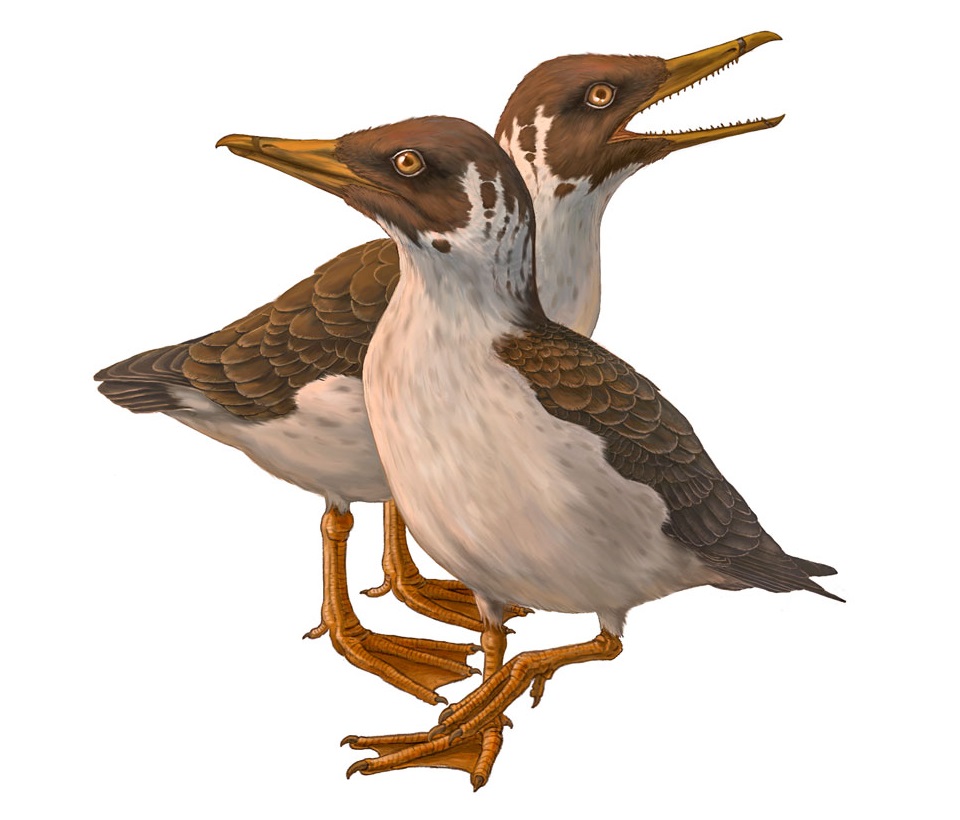
[PaleoOrnithology • 2022] Janavis finalidens • Cretaceous Ornithurine Supports A neognathous Crown Bird Ancestor (Ornithurae: Ichthyornithes)


Janavis finalidens
Benito, Kuo, Widrig, Jagt & Field, 2022

artwork by Phillip Krzeminski.

Abstract
The bony palate diagnoses the two deepest clades of extant birds: Neognathae and Palaeognathae. Neognaths exhibit unfused palate bones and generally kinetic skulls, whereas palaeognaths possess comparatively rigid skulls with the pterygoid and palatine fused into a single element, a condition long considered ancestral for crown birds (Neornithes). However, fossil evidence of palatal remains from taxa close to the origin of Neornithes is scarce, hindering strong inferences regarding the ancestral condition of the neornithine palate. Here we report a new taxon of toothed Late Cretaceous ornithurine bearing a pterygoid that is remarkably similar to those of the extant neognath clade Galloanserae (waterfowl + landfowl). Janavis finalidens, gen. et sp. nov., is generally similar to the well-known Mesozoic ornithurine Ichthyornis in its overall morphology, although Janavis is much larger and exhibits a substantially greater degree of postcranial pneumaticity. We recovered Janavis as the first-known well-represented member of Ichthyornithes other than Ichthyornis, clearly substantiating the persistence of the clade into the latest Cretaceous. Janavis confirms the presence of an anatomically neognathous palate in at least some Mesozoic non-crown ornithurines suggesting that pterygoids similar to those of extant Galloanserae may be plesiomorphic for crown birds. Our results, combined with recent evidence on the ichthyornithine palatine, overturn longstanding assumptions about the ancestral crown bird palate, and should prompt reevaluation of the purported galloanseran affinities of several bizarre early Cenozoic groups such as the ‘pseudotoothed birds’ (Pelagornithidae).


Avialae Gauthier, 1986 sensu Benito et al. 2022

Ornithurae Haeckel, 1866

Ichthyornithes Marsh, 1873 sensu Benito et al. 2022

Janavis finalidens, gen. et sp. nov.

Locality and age: CBR-Romontbos Quarry, Eben-Emael, Liège, Belgium. Valkenburg Member (67–66.9 million years ago), Maastricht Formation, late Maastrichtian, Late Cretaceous. Additional details regarding the locality and stratigraphic setting are provided in the Supplementary Information.

Diagnosis: Janavis is distinguished from other known Euornithes, and from Ichthyornis in particular, by the greater degree of pneumaticity of its thoracic vertebrae and ribs, especially the presence of large ventral pneumatic openings in the anterior thoracic vertebrae and fenestrated ventrolateral tubercles on the fifteenth presacral vertebra (Fig. 1b and Extended Data Figs. 1 and 3). It is also distinguished by the complete absence of an acromion process on the scapula (Extended Data Fig. 2d) and, most obviously, by its much larger size (maximum length of the Janavis humerus is 134.8 mm; maximum length of the longest known Ichthyornis humerus, YPM 1742, is 71.5 mm).

Etymology: Janavis from the Roman god Janus and the Latin avis for bird. In Roman mythology, Janus is the god of beginnings, endings and transitions, reflecting transitional aspects of the morphology of Janavis (combining plesiomorphic features such as teeth with a neognath-like palate) as well as its temporal provenance (deriving from the uppermost Cretaceous, making it one of the youngest non-neornithine avialan fossils in the world). The specific epithet finalidens, from the Latin finalis (adj.), meaning ending or final, and dens, for teeth, reflects the fact that the specimen is among the latest-known toothed avialans, which appear to have died out in the end-Cretaceous mass extinction shortly after Janavis lived.


Juan Benito, Pei-Chen Kuo, Klara E. Widrig, John W. M. Jagt and Daniel J. Field. 2022. Cretaceous Ornithurine Supports A neognathous Crown Bird Ancestor. Nature. 612; 100–105. DOI: 10.1038/s41586-022-05445-y

Sunday, August 28, 2022

[Herpetology • 2022] Hynobius oni • A New Species of Lotic Breeding Salamander (Caudata: Hynobiidae) from Shikoku, Japan


Hynobius oni 
Kanamori​, Nishikawa, Matsui & Tanabe, 2022


Abstract
 
Background: Hynobius hirosei is a lotic-breeding salamander endemic to Shikoku Island in western Japan. Significant allozymic and morphological differences have been found among the populations of this species; however, the degree and pattern of intraspecific variation have not been surveyed using a sufficient number of samples.

Methods: For the taxonomic revision of H. hirosei, we conducted genetic and morphological surveys using samples collected throughout the distribution. Phylogenetic analysis using the cytochrome b region of mitochondrial DNA and population structure analysis using single nucleotide polymorphisms were conducted to evaluate the population structure within the species and the degree of genetic differentiation. Subsequently, a morphological survey based on multivariate and univariate analyses was performed to assess the morphological variation.

Results: Genetic analyses revealed three genetic groups (Tsurugi, Central, and Nanyo) within H. hirosei, with the Nanyo group distributed allopatrically from the others, and the Tsurugi and Central groups distributed parapatrically with the formation of a hybrid zone between them. The Nanyo group was morphologically distinguishable from the remaining samples, including the topotype of H. hirosei, based on a smaller body size and several ratio values of characters to snout-vent length, longer axilla-groin distance, shorter tail length, shorter internarial distance, longer upper eyelid length, and larger medial tail width. These results support the notion that the Nanyo group is an undescribed species. However, the remaining genetically differentiated groups could not be divided in the present study. Herein, we described the Nanyo group as a new species.
 

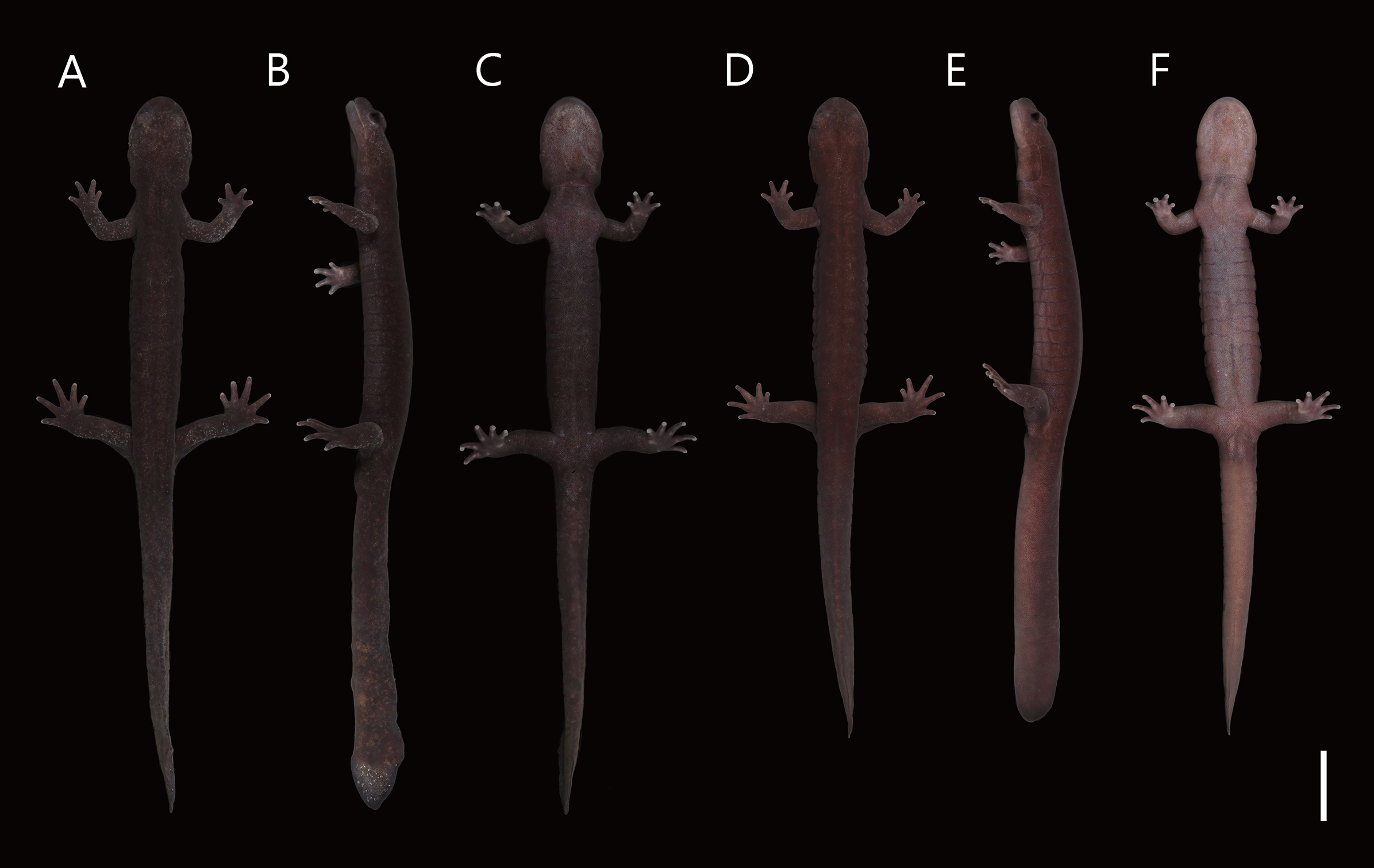
 Live male topotype of Hynobius hirosei (KUHE 62827; A–C)
and male holotype of Hynobius oni (KUHE 62785; D–F).
(A, D) Dorsal views. (B, E) Lateral views. (C, F) Ventral views.
Scale bar shows 20 mm.


Figure 5: Live individual (KUHE 61096) of Hynobius oni.

Hynobius oni sp. nov.
(Japanese name: Nan-yo-sanshouo)

Diagnosis: A large-sized species (adult SVL 73.6–87.5 mm in males) of the lotic-breeding Hynobius, breeding in montane streams; dorsum uniformly dark reddish brown and immaculate in adult; tips of fore- and hindlimbs adpressed on body scarcely meeting (overlap of −2.0 to 0.0 costal folds in males); fifth toe well developed; ova large, pigmentless; egg sacs relatively long and crescent in shape, with distinct whiptail structure on free end; larvae lack claws on their tips of fingers and toes; most similar to H. hirosei, but distinct based on its smaller body size, longer axilla-groin distance, shorter tail length, shorter internarial distance, longer upper eyelid length, and larger medial tail width. Hynobius oni is genetically closer to H. sematonotos than H. hirosei based on mtDNA; however, H. oni has no large markings on the body, in contrast to many silvery spots on H. sematonotos, and a larger SVL than H. sematonotos.

 Habitat of Hynobius oni in the type locality.

Etymology: The specific name is derived from the “Oni” in Japanese, which is a traditional Japanese demon. The habitats of the new species are areas where prior generations believed that the Oni and Ushi-oni, which is a type of Oni, occurred. The type locality is located in the Oni-ga-jo Mountains, which is considered to be the castle of the Oni.

Conclusions: 
In the present study, the actual genetic population structure and degree of genetic divergence within Hynobius hirosei, which has been reported to have large genetic intraspecies divergence, were evaluated using mtDNA and nuDNA markers (SNP). Phylogenetic analysis using mtDNA revealed three divergent lineages, including the Tsurugi, Central, and Nanyo groups (genetic distance: 6.9–10.3% in cyt b). Further, STRUCTURE analysis using SNP revealed that the Nanyo group is genetically isolated from the other groups and the Tsurugi and Central groups form hybrid zones. Morphological analyses also revealed that the Nanyo is distinct from the other groups. Collectively, these results strongly indicate that Nanyo group is a distinct species, and is referred to as H. oni sp. nov. in this study.

  
Sally Kanamori​, Kanto Nishikawa, Masafumi Matsui and Shingo Tanabe. 2022. A New Species of Lotic Breeding Salamander (Amphibia, Caudata, Hynobiidae) from Shikoku, Japan. PeerJ. 10:e13891. DOI: 10.7717/peerj.13891

Wednesday, July 6, 2022

[Paleontology • 2022] Psammophis odysseus • First Occurrence of Psammophis (Serpentes) from Europe witnesses Another Messinian Herpetofaunal Dispersal from Africa – Biogeographic Implications and A Discussion of the Vertebral Morphology of Psammophiid Snakes


Psammophis odysseus
Georgalis & Szyndlar, 2022


Abstract
We here describe abundant new snake material from the late Miocene (MN 13) of Salobreña, Spain. Vertebral morphology suggests a referral of the specimens to the extant psammophiid Psammophis, documenting the first occurrence of this genus in Europe. The diversity and disparity across the vertebral morphology of different psammophiid genera are discussed. We identify vertebral features that could diagnose Psammophis and therefore enable the recognition of the genus in the fossil record. A comparison of the new Spanish form with other taxa is conducted. We provide a detailed review of the psammophiid fossil record. Material previously described from the middle Miocene of Beni Mellal, Morocco is here tentatively referred to as ?Psammophis sp., an action that renders that occurrence as the oldest (probable) record of the genus and Psammophiidae as a whole, providing thus a potential calibration point. On the other hand, Eastern European Pliocene material that had been previously supposedly referred to Psammophis is here discarded as being rather fragmentary, not affording any more precise determination. The two psammophiid genera Psammophis and Malpolon appear almost simultaneously in the European fossil record (MN 13), with the former achieving only a short-lived and apparently geographically limited distribution in the continent, while the latter still exists in its modern herpetofauna. We assess biogeographic implications of the new find, suggesting a direct dispersal event from northwestern Africa to the Iberian Peninsula during the late Miocene, facilitated by the Messinian Salinity Crisis.

Keywords: biogeography, Messinian Salinity Crisis, Psammophiidae, Serpentes, vertebral morphology


 Systematic paleontology
Squamata Oppel, 1811
Serpentes Linnaeus, 1758
Alethinophidia Nopcsa, 1923

Caenophidia Hoffstetter, 1939
Colubroides Zaher, Grazziotin, Cadle, Murphy, Cesar de Moura-Leite and Bonatto, 2009
Colubriformes Zaher, Grazziotin, Cadle, Murphy, Cesar de Moura-Leite and Bonatto, 2009
Elapoidea Vidal, Delmas, David, Cruaud, Couloux and Hedges, 2007

Psammophiidae Bourgeois, 1968

Psammophis Boié in Fitzinger, 1826


Psammophis odysseus sp. nov.

Type locality. Late Miocene (MN 13, Messinian) of Salobreña, Andalusia, Spain.

Etymology. From the Greek mythical hero Odysseus (Ὀδυσσεύς), who, in Homer's “Odyssey” (Ὀδύσσεια), extensively traveled and wandered the seas for 10 years on his way back home after the fall of Troy; during his long voyage, Odysseus visited multiple places but never settled permanently in any of them, eventually finally reaching his homeland Ithaca. The name alludes to the dispersal of Psammophis from northwestern Africa to Iberia, which could potentially have even included also some overseas rafting, as well as its temporary only “stay” in the “new land” of Europe. Gender is masculine.


CONCLUSION: 
We describe a new species of psammophiid snakes, Psammophis odysseus sp. nov., based on abundant vertebral material from the late Miocene (MN 13) Salobreña, Spain. This represents the first documented occurrence of Psammophis in Europe, adding to the considerably poor diversity of psammophiids in the continent. A thorough discussion of the vertebral morphology and intracolumnar variation of extant psammophiids is provided, coupled with detailed figuring of selected extant taxa. We identify vertebral features that could serve as diagnostic for Psammophis.

The fossil record of psammophiid snakes is thoroughly reviewed. Taking into consideration the age, geographic location, and faunal composition of Salobreña, we imply that Psammophis odysseus sp. nov. most likely dispersed from northwestern Africa to Iberia, taking advantage of the environmental perturbations of the Messinian Salinity Crisis, but the genus eventually did not manage to settle in Europe and became subsequently extinct from the continent.

 
Georgios L. Georgalis and Zbigniew Szyndlar. 2022. First Occurrence of Psammophis (Serpentes) from Europe witnesses Another Messinian Herpetofaunal Dispersal from Africa – Biogeographic Implications and A Discussion of the Vertebral Morphology of Psammophiid Snakes. The Anatomical Record. DOI: 10.1002/ar.24892  

Wednesday, June 29, 2022

[Arachnida • 2022] Raveniola yangren • A New Troglobiontic Spider (Araneae, Nemesiidae) from Hunan, China


Raveniola yangren Lin & Li, 

in Lin, Yan & Li, 2022. 

Abstract
Background: 
Troglomorphism is rare known in Mygalomorphae. Only three troglomorphic mygalomorphs have been recorded in China: Raveniola beelzebub Lin & Li, 2020, R. lamia Yu & Zhang, 2021 and Sinopesa gollum Lin & Li, 2021.

New information: 
A new troglobiontic species of the genus Raveniola is described from China: R. yangren sp. n. (female) from Hunan. Photos and morphological description of the new species are given. This new species has elongated appendages and degenerated eyes in order to adapt to the cave environment. It can be distinguished by the stubby, unbranched spermathecae from other Raveniola.

Keywords: Asia, diagnosis, taxonomy, type

Raveniola yangren sp. n., holotype female.
A habitus, dorsal, B same, ventral, C labium and sternum, D spinnerets, E ocular area, F leg I. Arrow shows scopula on tibia.

Raveniola yangren sp. n., live.
 A paratype, B holotype, in situ.


Raveniola yangren Lin & Li, 2022, sp. n.

Diagnosis: The females of Raveniola yangren sp. n. resemble R. beelzebub Lin & Li, 2020 and R. lamia Yu & Zhang, 2021 by total reduction of eyes and the pale colouration (Fig. 2A, B and E). However, the new species can be distinguished by the spermathecae unbranched (vs. branched in R. beelzebub, other Raveniola spp. from China, see Fig. 3C) and the ratio of the length of spermathecae to the width is almost 2:1 (Fig. 3A and B) (vs. 8:1 in R. lamia, see Fig. 3C-6).

Etymology: The species is named after Yangren, a blind god who had hands with eyes in the palm in place of his normal eyes in Chinese traditional culture; noun in apposition.

Distribution: Known only from the type locality (China, Hunan).

Biology: Habitat under stones in the cave.


 Ye-Jie Lin, Xunyou Yan and Shuqiang Li. 2022. Raveniola yangren sp. n., A New Troglobiontic Spider from Hunan, China (Araneae, Nemesiidae). Biodiversity Data Journal. 10: e85946. DOI: 10.3897/BDJ.10.e85946


Monday, April 18, 2022

[Ichthyology • 2022] Parascorpaena poseidon • A New Species of Parascorpaena Bleeker, 1876 (Teleostei: Scorpaenidae) from Taiwan


Parascorpaena poseidon 
 Chou & Liao, 2022

Photographed by Yuan-Huan Yu.

A new species of scorpionfish, Poseidon’s scorpionfish Parascorpaena poseidon, is described on the basis of ten specimens collected from southwestern Taiwanese waters ranging from Penghu to Chufongbi, Pingtung. The morphological and molecular analyses reveal the new species is clearly separated from the two similar species, P. aurita and P. mossambica. Parascorpaena poseidon is distinguished from congeners by the following combination of characters: three equal-sized suborbital spines without ridge; supraocular tentacle absent or very short; pectoral-fin rays 15–16 (usually 16); pored lateral-line scales 22–26 (usually 22–23); longitudinal scale rows 43–47; pre-dorsal-fin scale rows 2–3 (usually 3); 10–12 scale rows between 6th dorsal-fin spine base and lateral line; 10–12 scale rows between the last dorsalfin spine base and lateral line; total gill rakers 15–16, gill rakers on hypobranchial 2–3; ratio of 11th and 12th dorsal-fin spine 60%–81% (mean 73%); blackish spots randomly distributed on all fins; absence of a distinct black blotch on spinous dorsal fin in male; body size relatively large.

  Key words: Cycloid scales, DNA barcoding, Lacrimal spine, Rocky reefs, Supraocular tentacle.


Underwater photography of Parascorpaena poseidon sp. nov. (ASIZP0080981, 103.0 mm SL).
Taken in a tide pool of Longmen, Penghu at 1 m depth.
Photographed by Yuan-Huan Yu.

Parascorpaena poseidon Chou and Liao sp. nov. 
Common name: Poseidon’s scorpionfish

Diagnosis: Parascorpaena poseidon sp. nov. can be distinguished from other congeners by a combination of characters: three equally-sized suborbital spines without ridge (Fig. 4); supraocular tentacle absent or very short; pectoral-fin rays 15–16 (usually 16) (Table 1); pored lateral-line scales 22–26 (usually 22–23); longitudinal scale rows 43–47; pre-dorsal-fin scale rows 2–3 (usually 3); 10–12 scale rows between 6th dorsal-fin spine base and lateral line; 10–12 scale rows between last dorsal-fin spine base and lateral line; total gill rakers 15–16, gill rakers on hypobranchial 2–3; ratio of 11th and 12th dorsal-fin spine 60%–81% (mean 73%) (Fig. 5); blackish spots randomly scattered on all fins (Figs. 1, 2); spinous dorsal fin without a distinct black blotch in male; body size relatively large, largest recorded specimen 127.0 mm SL.


Drawing of suborbital spines in lateral view of (A) Parascorpaena poseidon sp. nov. (DOS00182, 108.3 mm SL) and (B) P. mossambica (DOS08024, 83.8 mm).

Etymology: The new species is named after Poseidon, the Greek god of the Sea. A noun in apposition. In allusion to the three equally-sized suborbital spines without ridge similar to the trident of Poseidon. 

Distribution and habitat: The new species is currently known only from southwestern Taiwan ranging from Penghu to Chufongbi, Pingtung. This species mainly inhabits rocky reefs that records in depth of 1 m based on the living individual (Fig. 3). 


CONCLUSIONS:
 In the present study, a new species of the genus Parascorpaena is described based on morphological and molecular approaches. Parascorpaena poseidon sp. nov. can be distinguished from other congeners by the following characters: three equally-sized suborbital spines without ridge; supraocular tentacle absent or very short; pectoral-fin rays usually 16; longitudinal scale rows 43–47; pre-dorsal-fin scale rows usually 3; 10–12 scale rows between last dorsal-fin spine base and lateral line; blackish spots randomly scattered on all fins; spinous dorsal fin without a distinct black blotch in male; body size relatively large, the largest recorded specimen 127.0 mm SL. This species is currently known from southwestern Taiwan.

 
Tak-Kei Chou and Te-Yu Liao. 2022. A New Species of Parascorpaena Bleeker, 1876 (Teleostei: Scorpaenidae) from Taiwan. Zoological Studies. 61: 9. DOI: 10.6620/ZS.2022.61-09
zoolstud.sinica.edu.tw/Journals/61/61-09.pdf

Saturday, April 17, 2021

[Chilopoda • 2021] Scolopendra alcyona • A New Amphibious Species of the Genus Scolopendra Linnaeus, 1758 (Scolopendromorpha, Scolopendridae) from the Ryukyu Archipelago and Taiwan


Scolopendra alcyona Tsukamoto & Shimano 

in Tsukamoto, Hiruta, Eguchi, Liao & Shimano, 2021. 
Halcyon Giant Centipede | 琉神大百足 || U-Ryukyu.ac.jp
 
Abstract
In Japan and Taiwan, five valid species of the genus Scolopendra Linnaeus, 1758 have been described: S. morsitans Linnaeus, 1758, S. subspinipes Leach, 1816, S. mutilans Koch, 1878, S. japonica Koch, 1878, and S. multidens Newport, 1844. Recently, an undetermined species was found in the Ryukyu Archipelago and Taiwan. Using molecular phylogenetic analyses with mitochondrial COI and 16S rRNA and nuclear 28S rRNA and 18S rRNA genes as well as conventional morphological examination, we successfully discriminated this sixth species as an independent lineage from S. subspinipes, S. mutilans, and other named congeners from East and Southeast Asia. Therefore, the species was described as Scolopendra alcyona Tsukamoto & Shimano, sp. nov. Several situational evidences suggest that this species prefers streamside environments and exhibits amphibious behavior.

Keywords: Myriapoda, Chilopoda, molecular phylogeny, morphology, semi-aquatic


Scolopendra alcyona Tsukamoto & Shimano, sp. nov., found underwater at the upper reach of ... River, Kume-jima Island (by H. Sato; specimen not collected).


Scolopendra alcyona Tsukamoto & Shimano, sp. nov.

[New Japanese name: Ryûjin-ômukade (琉神大百足); 
new English name: Halcyon Giant Centipede]

Etymology. This epithet “alcyona” derived from the name of a Greek mythological figure, “Alcyone”. In one version of the story, Alcyone was turned into a common kingfisher (halcyon bird) by Zeus ( Gresseth 1964). This epithet is a metaphor for halcyon bird-like jade green legs seen in the Okinawa-jima Island population, and its amphibious behavior.

 Habitat of Scolopendra alcyona Tsukamoto & Shimano, sp. nov. in Kume-jima Island


Sho Tsukamoto, Shimpei F. Hiruta, Katsuyuki Eguchi, Jhih-Rong Liao and Satoshi Shimano. 2021. A New Amphibious Species of the Genus Scolopendra Linnaeus, 1758 (Scolopendromorpha, Scolopendridae) from the Ryukyu Archipelago and Taiwan. Zootaxa. 4952(3); 465–494. DOI: 10.11646/zootaxa.4952.3.3

国内で143年ぶりのオオムカデの新種発見!渓流に潜む、翡翠色に輝く国内最大のオオムカデ〜日本初、世界で3例目の半水棲ムカデ、沖縄の4地域と台湾から発見され、沖縄の故事にちなみリュウジンオオムカデ(琉神大百足)と命名〜