Showing posts with label Author: Scherz. Show all posts

Tuesday, June 24, 2025

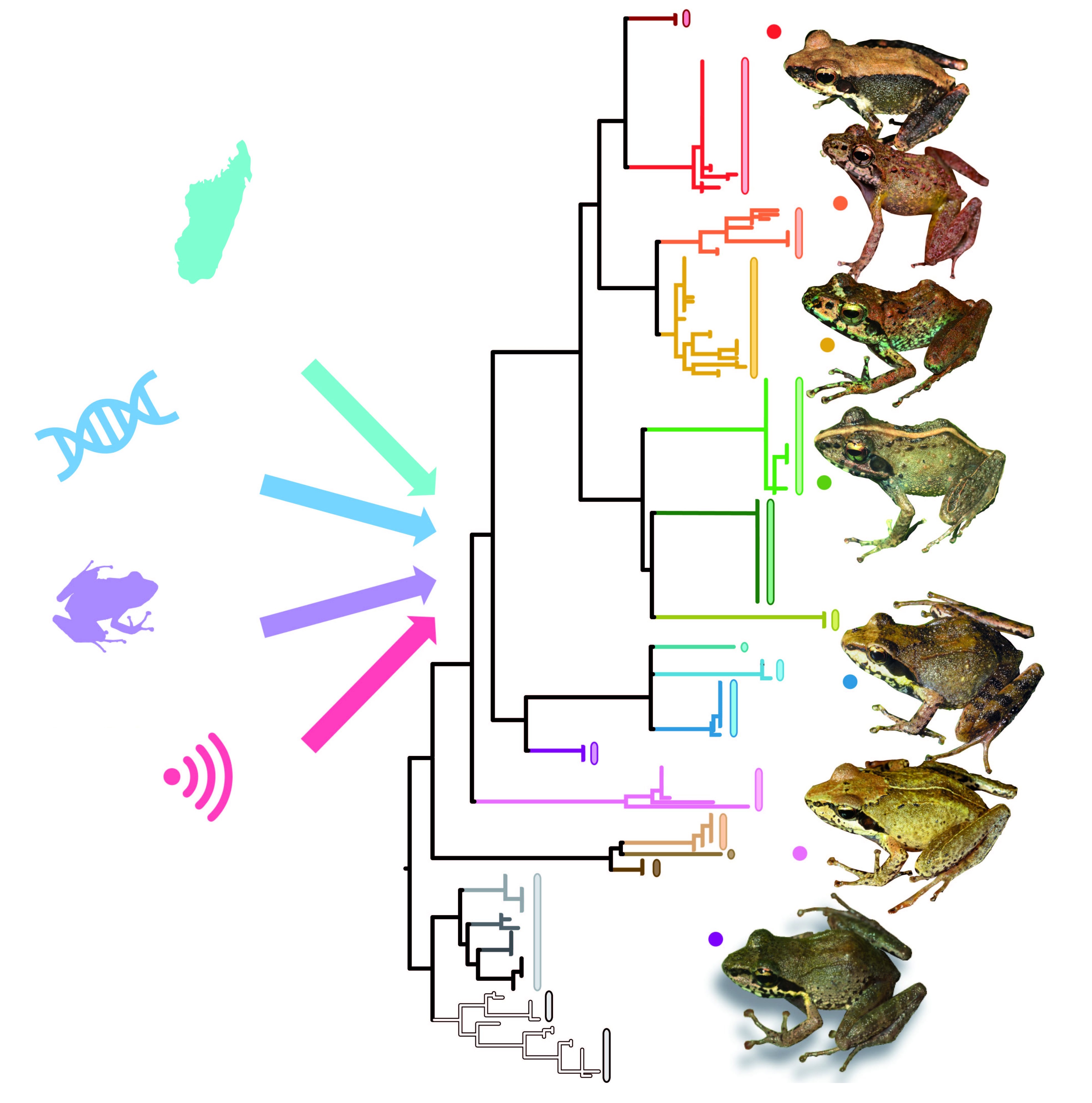
[Herpetology • 2025] Guibemantis sioka • A New Species of mantellid frog of the Genus Guibemantis (Anura: Mantellidae) from south-eastern Madagascar


Guibemantis sioka
Hutter, Andriampenomanana, Basham, Glaw, Masotti, Lambert & Vences, 2025


Abstract
We describe a new species of arboreal mantellid frog of the genus Guibemantis (classified in the subgenus Guibemantis) from Madagascar. The new species, Guibemantis sioka sp. nov., is morphologically similar to G. depressiceps but differs by a high uncorrected genetic distance greater than 6% in the mitochondrial 16S rRNA gene from all other related species, and by a conspicuous dark-light marbling of the flanks, relatively large hands, and the structure of its advertisement calls from its closest relatives. Single individuals of the new species have been found at each of three high-elevation sites (1210–1650 m a.s.l.) in the Southern Central East and South East of Madagascar (Ranomafana National Park, Ivohiboro Reserve, and Andohahela National Park). If this apparent rarity was confirmed by future studies, it would stand in stark contrast to other Guibemantis which are often observed in large breeding aggregations.

Amphibia, Anura, Ranomafana, Maharira, new species, Guibemantis sioka sp. nov., taxonomy


Guibemantis sioka sp. nov.

 
Carl R. HUTTER, Zo F. ANDRIAMPENOMANANA, Edmund W. BASHAM, Frank GLAW, Matteo D. MASOTTI, Shea M. LAMBERT and Miguel VENCES. 2025. A New Species of mantellid frog of the Genus Guibemantis from south-eastern Madagascar.  Zootaxa. 5647(3); 260-274. DOI: doi.org/10.11646/zootaxa.5647.3.3 [2025-06-16]

Sunday, February 23, 2025

[Herpetology • 2025] A Preliminary Assessment of the Diversity in the Frog Genus Anilany (Anura: Microhylidae: Cophylinae) with Description of Anilany karsticola, A New Species from western Madagascar


Anilany karsticola
Petzold, Glaw, Mullin, Rakotoarison, Raselimanana, Crottini, Orozco-terWengel, Köhler, Prötzel, Vences, Hofreiter & Scherz, 2025 

SALAMANDRA. 61(1) 

Abstract
 The cophyline microhylid frog genus Anilany was established as a monotypic genus in 2016 for the miniaturised species Anilany helenae (Vallan, 2000), from the type locality Ambohitantely, a patch of rainforest surrounded by savannah in central Madagascar. Fieldwork conducted over the past two decades identified three unexpected populations from Bemaraha, Mahajanga, and Beanka from limestone caves near sea level in arid western and northwestern Madagascar, which were assigned to the genus Anilany based on diagnostic morphological features. We generated new data for specimens of the Ambohitantely, Bemaraha, and Mahajanga populations to test if all three populations belong to one or multiple species, studying their genetic variability based on mitochondrial (16S rRNA, COI) and nuclear (BDNF, RAG-1) genes, as well as morphological and osteological data. We identify several previously unknown diagnostic characters of the skeleton of Anilany compared to its closest relatives, Rhombophryne and Stumpffia, but no skeletal features that can be used to reliably distinguish among Anilany populations. Based on concordant genetic and morphological differences, we formally describe the population from the limestone karsts of Tsingy de Bemaraha National Park, formerly considered candidate species Anilany sp. Ca14, as a new species, Anilany karsticola sp. n. It can be distinguished from other Anilany lineages by larger size and shorter relative tibia length, uncorrected p-distances in DNA sequences of the 16S gene amounting to 2.6% and a lack of allele sharing in the analysed fragments of the nuclear genes BDNF and RAG-1. More data, especially advertisement call recordings and additional specimens, are required from other locations for a more thorough assessment of the genus and the distribution of its species.

Key words. Amphibia, Anura, Anilany karsticola sp. n., citizen science, iNaturalist, molecular genetics, morphology, osteo­logy, systematics.


Anilany karsticola sp. n. from Tsingy de Bemaraha National Park in life:
(a, b) adult female holotype ZSM 21/2006 (FGZC 711) in dorsolateral (a) and ventral (b) views;
(c, d) paratype ZSM 22/2006 (FGZC 712) in dorsolateral (c) and ventral (d) views;
(e–g) paratype UADBA-A 25660 (FGZC 713) in dorsolateral (e) and ventral (f) views, with a closeup of the hand (g) illustrating expanded digits only present on fingers 3 and 4;
(h, i) paratype UADBA-A 25663 (FGZC 714) in dorsolateral (h) and ventral (i) views.

Anilany karsticola sp. n. 

Diagnosis: The new species is assigned to the genus Anilany on the basis of its small size combined with expanded terminal discs and T-shaped terminal phalanges, short parasphenoid, broad, angled postchoanal vomers, absence of a neopalatine, and close genetic afnities with A. helenae. It can be distinguished from populations of its only described congener, A. helenae, by larger adult body size (adult SVL 15.7–17.4 mm vs. 13.8–15.0 mm Ambohitantely and 12.7 mm Mahajanga) and relative shorter tibia length (TIBL/SVL 0.42–0.46 vs. 0.48 Ambohitantely and 0.47– 0.50 Mahajanga). Furthermore, A. karsticola sp. n. is distinguished from all other genetic lineages of Anilany by the ... 

Etymology: The species epithet karsticola is a first-declension noun derived from the German word ‘Karst’ (a craggy limestone formation), and the Latin lexical suffix ‘-cola’ meaning ‘inhabitor’, in refection of ecology of this species, which has only been found in and near caves in limestone karst within the Tsingy de Bemaraha National Park. The species name is considered as a noun in apposition.

Anilany cf. helenae specimens from Anjajavy:
(a) a putatively adult specimen in dorsolateral view showing contrasting chevron patterning dorsally, and visible expansion of terminal finger discs, typical of this genus. This specimen was observed in dry coastal forest (b); (c) an adult specimen in posterodorsolateral view, showing the dark dorsal chevron and expanded finger discs. Tis specimen was observed in a cave (d), above which was forest like that shown in (b).
Photographs by Justin Gerlach


Petzold, A., F. Glaw, K. E. Mullin, A. Rakotoarison, A. P. Raselimanana, A. Crottini, P. Orozco-terWengel, J. Köhler, D. Prötzel, M. Vences, M. Hofreiter and M. D. Scherz. 2025. A Preliminary Assessment of the Diversity in the Frog Genus Anilany (Microhylidae: Cophylinae) with Description of A New Species from western Madagascar. SALAMANDRA. 61(1); 70-94. 

Tuesday, February 18, 2025

[Herpetology • 2016] Reconciling Molecular Phylogeny, Morphological Divergence and Classification of Madagascan Narrow-mouthed Frogs (Amphibia: Microhylidae)


(A) Stumpffia tetradactyla (Nosy Boraha); (B) Anilany helenae (Ambohitantely); 
(C) Stumpffia’ sp. Ca34 (Tsaratanana); (D) Stumpffia’ sp. Ca15 (Manombo).

in Scherz, Vences, Rakotoarison, Andreone, Köhler, Glaw & Crottini, 2016.

Highlights: 
• A new phylogeny of Cophylinae provides strong support for previous genus-level relationships.
• Phylogenetic relationships are corroborated by new osteological data.
• Description of a new genus endemic to Madagascar: Anilany gen. nov.
• Cophyla and Platypelis are morphologically similar sister genera.
• Stumpffia and Rhombophryne are ecomorphologically distinct sister genera.

Abstract
A recent study clarified several aspects of microhylid phylogeny by combining DNA sequences from Sanger sequencing and anchored phylogenomics, although numerous aspects of tree topology proved highly susceptible to data partition and chosen model. Although the phylogenetic results of the study were in conflict with previous studies, the authors made several changes to the taxonomy of Madagascar’s cophyline microhylids. We re-analysed part of their data together with our own molecular and morphological data. Based on a supermatrix of 11 loci, we propose a new phylogeny of the Cophylinae, and discuss it in the context of a newly generated osteological dataset. We found several sample misidentifications, partially explaining their deviant results, and propose to resurrect the genera Platypelis and Stumpffia from the synonymy of Cophyla and Rhombophryne, respectively. We provide support for the previous genus-level taxonomy of this subfamily, and erect a new genusAnilany gen. nov., in order to eliminate paraphyly of Stumpffia and to account for the osteological differences observed among these groups. Deep nodes in our phylogeny remain poorly supported, and future works will certainly refine our classification, but we are confident that these will not produce large-scale rearrangements.

Keywords: Cophylinae; Anilany gen. nov; CophylaPlatypelisRhombophryneStumpffia

 Representatives of Stumpffia and Stumpffia-like clades.
(A) S. tetradactyla (Nosy Boraha; holotype, ZFMK 52547); (B) Anilany helenae (Ambohitantely; ZSM 370/2005); 
(C) Stumpffia’ sp. Ca34 (Tsaratanana; ZSM 636/2014); (D) Stumpffia’ sp. Ca15 (Manombo; ZMA 20172).


 Mark David Scherz, Miguel Vences, Andolalao Rakotoarison, Franco Andreone, Jörn Köhler, Frank Glaw and Angelica Crottini. 2016. Reconciling Molecular Phylogeny, Morphological Divergence and Classification of Madagascan Narrow-mouthed Frogs (Amphibia: Microhylidae).  Molecular Phylogenetics and Evolution. In Press.  DOI:  10.1016/j.ympev.2016.04.019 
 Researchgate.net/publication/301285050_Classification_of_Madagascan_Microhylidae

Friday, October 18, 2024

[Herpetology • 2024] Boophis janewayae, B. kirki, B. picardi, etc. • Communicator Whistles: A Trek through the Taxonomy of the Boophis marojezensis Complex (Anura: Mantellidae) reveals Seven New, morphologically cryptic Treefrogs from Madagascar


Boophis archeri, Boophis burnhamae,  
Boophis janewayaeBoophis picardi,   
Boophis kirki

Vences, Köhler, Hutter, Preick, Petzold, Rakotoarison, Ratsoavina, Glaw & Scherz, 2024 

Abstract
The Malagasy stream-breeding treefrog species Boophis marojezensis contains bioacoustically and genetically highly divergent populations. Some of these populations have been defined as candidate species and emit somewhat bizarre advertisement calls consisting of multiple whistle-notes. We here enable a long-overdue taxonomic revision of this species complex by applying a museomics approach to sequence DNA from the holotype of B. marojezensis. Based on an integrative approach that combines divergence levels in mitochondrial DNA and in three nuclear-encoded genes, morphological data, and bioacoustic comparisons, we conclude that eight different species exist in this complex, seven of which are formally described herein as new. Although morphological differences between species are small and mainly separate small-sized from larger-sized species, conclusive evidence for the new species comes from their sympatric and sometimes syntopic occurrence without haplotype sharing in three nuclear genes and under maintenance of bioacoustic differences. Uncorrected genetic divergences in the mitochondrial 16S rRNA gene are >3% in almost all cases, and in some cases up to 8%. In reference to the otherworldly sounds by which these frogs fill Malagasy rainforests, some of them reminiscent of sounds of technical equipment in the fictional “Star Trek” universe, we here name and describe the seven new species in honor of fictional captains of starships, namely B. kirki sp. nov., B. picardi sp. nov., B. siskoi sp. nov., B. janewayae sp. nov., B. archeri sp. nov., B. pikei sp. nov., and B. burnhamae sp. nov. The majority of these species occur in northern Madagascar, where up to three species can occur in immediate geographical proximity, e.g., B. marojezensis, B. burnhamae sp. nov. and B. pikei sp. nov. at different elevations in the Marojejy Massif. South of 16°S latitude, only B. janewayae sp. nov., B. picardi sp. nov., and B. kirki sp. nov. are found, with the latter extending southwards to Ranomafana National Park. Our study confirms the existence of numerous morphologically cryptic and microendemic species among Madagascar’s amphibians, some of which are known only from unprotected sites and require adequate conservation management.

Keywords: Bioacoustics, Boophis archeri sp. nov., Boophis burnhamae sp. nov., Boophis janewayae sp. nov., Boophis kirki sp. nov., Boophis picardi sp. nov., Boophis pikei sp. nov., Boophis siskoi sp. nov., cryptic species, integrative taxonomy, molecular genetics, museomics, systematics

Individuals of Boophis marojezensis in life.
A Male holotype (ZFMK 57401) from Marojejy (low elevation). B Male paratype (ZSM 567/1999, previously ZFMK 57402).
C Individual from Masoala probably assignable to this species (not sequenced). D Male from Masoala (ZSM 250/2016, FGZC 5439).
 
Boophis siskoi, Boophis pikei
Boophis archeri, Boophis burnhamae


 Miguel Vences, Jörn Köhler, Carl R. Hutter, Michaela Preick, Alice Petzold, Andolalao Rakotoarison, Fanomezana M. Ratsoavina, Frank Glaw amd Mark D. Scherz. 2024. Communicator Whistles: A Trek through the Taxonomy of the Boophis marojezensis Complex reveals Seven New, morphologically cryptic Treefrogs from Madagascar (Amphibia: Anura: Mantellidae). Vertebrate Zoology. 74: 643-681. DOI: doi.org/10.3897/vz.74.e121110

Tuesday, September 3, 2024

[Herpetology • 2024] Platypelis saikamavo • A New Species of colorful Platypelis (Anura: Microhylidae) from the Tsaratanàna and Bemanevika massifs in northern Madagascar


Platypelis saikamavo
 Rakotoarison, Vences, Andreone, Crottini, Glaw, Scherz & Raselimanana, 2024  

 
Abstract
Frogs of the genus Platypelis are known to have their center of species richness in the mountain massifs of northern Madagascar. We here formally describe a new species of Platypelis from this region. Platypelis saikamavo sp. nov. has been known for over 20 years but its taxonomic identity has only recently been robustly clarified as a result of ongoing taxonomic revisions of other Platypelis species. The new species is known from rainforest on the Tsaratanàna Massif and Bemanevika, at elevations of 1000–1530 m above sea level. It is characterized by an isolated phylogenetic position and is genetically highly divergent, with an uncorrected pairwise distance ≥4.5% in the mitochondrial 16S rRNA gene to all other nominal species of Platypelis. It has a unique combination of morphological and chromatic character states such as a relatively large body size of 28–31 mm in snout–vent length, distinct superciliary tubercles, and bright yellow color around the forelimb insertion and on the posterior abdomen where this color extends in the form of flash marks onto the inguinal region.

Amphibia, Anura, Cophylinae, yellow flashmarks, narrow-mouthed frog


Platypelis saikamavo sp. nov.  


Andolalao Rakotoarison, Miguel Vences, Franco Andreone, Angelica Crottini, Frank Glaw, Mark D. Scherz and Achille P. Raselimanana. 2024. A New Species of colorful Platypelis (Amphibia: Microhylidae) from the Tsaratanàna and Bemanevika massifs in northern Madagascar.  Zootaxa. 5501(1); 171-180. DOI: doi.org/10.11646/zootaxa.5501.1.8

Friday, July 28, 2023

[Herpetology • 2023] Blommersia bara • Integrative Revision of the Blommersia wittei complex (Anura: Mantellidae), with Description of A New Species of Frog from western and north-western Madagascar


Blommersia bara
Vences, Multzsch, Köhler, Crottini, Andreone, Rakotoarison, Scherz & Glaw, 2023


Abstract
Frogs of the Blommersia wittei complex are widespread in western and northern Madagascar, and are one of two clades of the family Mantellidae that have colonized the Comoran island of Mayotte. Based on a comprehensive set of DNA sequences of the mitochondrial 16S rRNA gene and the nuclear-encoded RAG1 and SACS genes, integrated with morphological and bioacoustic data, we here analyze the genetic differentiation of populations of this complex across Madagascar. We confirm that a candidate species named B. sp. Ca5 in previous studies represents a genetically well-defined evolutionary lineage distributed over much of western Madagascar, which we describe herein as Blommeria bara sp. nov. based on its molecular and bioacoustic differentiation. Blommersia wittei occurs across northern Madagascar but its type locality Ambanja, at the lower Sambirano river, is very close to the range of another, newly discovered microendemic lineage that was only found at two sites along the upper Sambirano river (here named as candidate species B. sp. Ca12). The B. wittei complex thus provides an example of a clade of closely related Malagasy frogs that contains species widespread over hundreds of kilometers, as well as extreme microendemics. For a full resolution of this species complex, more data need to be collected on the geographical contact among these two lineages, on the morphology and bioacoustics of B. sp. Ca12, and on the north-eastern populations of B. wittei at Sambava, which are weakly differentiated in mitochondrial genes but differ in bioacoustics and possibly in the extent of foot webbing.

Keywords: Amphibia, Anura, Mantellidae, Blommersia bara sp. nov, microendemism, species delimitation

Blommersia bara sp. nov. (= B. sp. Ca5) in life.
(A, B): Male holotype zSM 31/2004 (FgzC 47) from Isalo indorsolateral and ventral view. (C) Individual from Ankarafantsika displaying egg-guarding behavior. (d) Female paratype zSM13/2006 from tsingy de Bemaraha. (E) Additional individual (not clearly referable to a voucher) from tsingy de Bemaraha.

Blommersia bara sp. nov,

Diagnosis. A species of the genus Blommersia in the subfamily Mantellinae of the family Mantellidae based on presence of intercalary elements between penultimate and ultimate phalanges of fingers and toes (verified by external examination), occurrence in Madagascar, relatively small body size (male SVl < 27 mm), presence off emoral glands in males and absence of femoral gland rudiments in females, head distinctly longer than wide, and molecular phylogenetic relationships.

Etymology. Named after the Bara people, the ethnic group living in the area of Madagascar that includes the type locality of the new species, the Isalo Massif. the name is used as a noun in apposition. 


Miguel Vences, Malte Multzsch, Jörn Köhler, Angelica Crottini, Franco Andreone, Andolalao Rakotoarison, Mark D. Scherz and Frank Glaw. 2023. Integrative Revision of the Blommersia wittei complex, with Description of A New Species of Frog from western and north-western Madagascar. Zootaxa. 5319(2); 178-198. DOI: 10.11646/zootaxa.5319.2.2

Tuesday, June 20, 2023

[Herpetology • 2023] Guibemantis pulcherrimus • A New Species of Pandanus-dwelling Frog (Anura: Mantellidae) from northern Madagascar related to Guibemantis pulcher


 Guibemantis (Pandanusicola) pulcherrimus
 Vences, Hutter, Glaw, Rakotoarison, Raselimanana & Scherz, 2023

 
Abstract
Populations of phytotelmic frogs from northern Madagascar assigned to Guibemantis (Pandanusicola) pulcher are known to differ genetically from populations further south in the eastern rainforest belt of the island, but to date, their status has not been analyzed in depth. We combined molecular genetic data with an examination of color pattern to clarify the taxonomy of these frogs. DNA sequences of both mitochondrial and nuclear-encoded genes were consistently differentiated between the northern populations and those occurring further south. Uncorrected pairwise distance in the 16S rRNA gene was 3.7‒4.3% and thus at a level usually characterizing distinct frog species in Madagascar. Furthermore, the northern specimens were characterized by more and smaller purplish-brown spots on their green dorsal surface, and a less distinct brown patch on the flanks. Although fully conclusive evidence for the species status of the northern lineage from bioacoustic differences, sympatric occurrence or narrow hybrid zone is currently lacking, such species-level distinctness is currently the most likely hypothesis. We therefore name the northern populations as Guibemantis (Pandanusicola) pulcherrimus sp. nov. The new species is known from Makira (type locality) and Bemanevika, and specimens morphologically assignable to this taxon have also been recorded from Masoala, Marojejy and Anjanaharibe-Sud.

Keywords: Amphibia, Anura, Mantellidae, northern Madagascar, phytotelmic anurans, Guibemantis pulcherGuibemantis pulcherrimus sp. nov. 


Miguel Vences, Carl R. Hutter, Frank Glaw, Andolalao Rakotoarison, Achille P. Raselimanana and Mark D. Scherz. 2023. A New Species of Pandanus-dwelling Frog from northern Madagascar related to Guibemantis pulcher. Zootaxa. 5306(1); 97-115. DOI: 10.11646/zootaxa.5306.1.4


Tuesday, May 2, 2023

[Herpetology • 2023] Guibemantis razandry, G. razoky & G. fotsitenda • An Initial Molecular Resolution of the mantellid Frogs of the Guibemantis liber complex (Anura: Mantellidae) reveals Three New Species from northern Madagascar


[A-B, E-F] Guibemantis razandry
[A-H] Guibemantis razoky 

 Koppetsch, Pabijan, Hutter, Köhler, Gehring, Rakotoarison, Ratsoavina, Scherz, Vieites, Glaw & Vences, 2023

Abstract
The small arboreal frog Guibemantis liber (Anura: Mantellidae) has served as an example for the existence of deep conspecific lineages that differ by a substantial amount in mitochondrial DNA but are similar in morphology and bioacoustics and thus are assigned to the same nominal species. During fieldwork in northern Madagascar, we identified additional such lineages and surprisingly, observed close syntopy of two of these at various sites. In-depth study based on DNA sequences of the mitochondrial cytochrome b gene from 338 specimens of G. liber sensu lato from across its range, sequences of four nuclear-encoded markers for 154‒257 of these specimens, a phylogenomic dataset obtained by the FrogCap target capture approach, and additional mitochondrial genes for representatives of most mitochondrial lineages, as well as bioacoustic and morphological comparisons, revealed concordant differentiation among several lineages of the G. liber complex. We identify nine lineages differing by 5.3‒15.5% in cytochrome b and 2.4‒10.1% in the 16S rRNA gene, and find that several of these lack or have only limited allele sharing in the nuclear-encoded genes. Based on sympatric or parapatric occurrence without genetic admixture, combined with differences in bioacoustic and morphological characters, we scientifically name three lineages from northern Madagascar as new species: G. razoky sp. nov., G. razandry sp. nov., and G. fotsitenda sp. nov. Of these new species, G. razoky sp. nov. and G. razandry sp. nov. show widespread syntopy across northern Madagascar and differ in body size and advertisement calls. Guibemantis fotsitenda sp. nov. is sister to G. razandry sp. nov., but appears to occur at lower elevations, including in close geographic proximity on the Marojejy Massif. We also detected subtle differences in advertisement calls among various other mitochondrial lineages distributed in the Northern Central East and Southern Central East of Madagascar, but the status and nomenclatural identity of these lineages require further morphological and bioacoustic study of reliably genotyped individuals, and assignment of the three available names in the complex: Rhacophorus liber Peracca, 1893, Gephyromantis albogularis Guibé, 1947, and Gephyromantis variabilis Millot and Guibé, 1951. We discuss the identity and type material of these three nomina, designate a lectotype for Gephyromantis variabilis from Itremo, and flag the collection of new material from their type localities, Andrangoloaka and Itremo, as paramount for a comprehensive revision of the G. liber complex.

Keywords: Amphibia, Anura, bioacoustics, FrogCap, morphology, Pandanusicola, phylogeography, taxonomy
 
Specimens of Guibemantis razandry sp. nov. in life, in dorsal and ventral views.
A, B Male holotype ZSM 293/2005 (field number FGZC 2851) from Marojejy.
C, D Male specimen from Marojejy, photographed in 2016 (not collected).
E, F Specimen from Bemanevika, probably a (maybe subadult) female, assigned to the species by color pattern only, photographed in 2010 (not collected).

Guibemantis razandry sp. nov.

Diagnosis: This species corresponds to the mitochondrial lineage NE1 as defined herein, and to the candidate species Guibemantis sp. Ca21 according to Perl et al. (2014). It is assigned to the subgenus Pandanusicola of the genus Guibemantis based on presence of intercalary elements between ultimate and penultimate phalanges of fingers and toes (verified by external examination), small body size, moderate to weakly expressed webbing between toes, connected lateral metatarsalia, the presence of both inner and outer metatarsal tubercles, femoral glands in males, absence of nuptial pads, small body size (SVL 24.4‒25.9 mm in reliably sexed males and 22.8 mm in one female), and molecular phylogenetic relationships. Within Pandanusicola, the new species is distinguished from all species except G. liber and G. tasifotsy by femoral glands type 1 (vs. type 2) as defined by Glaw et al. (2000), thus possessing many small gland granules in a relatively diffuse field covering most of the thigh ventrally, and by its probable breeding in open swamps (vs. phytotelmic breeding in Pandanus leaf axils). It can be distinguished from G. tasifotsy by its different brownish color pattern lacking a green dorsal and lateral coloration with a series of distinct white blotches along the lower flanks and its strongly different advertisement call, consisting of a pulsatile note with numerous pulses being largely fused (vs. a trill-like note containing 3–7 distinctly separated pulses). The new species differs from all G. liber lineages occurring in the Northern and Southern Central East of Madagascar by its high DNA divergence, with > 5% uncorrected pairwise distance in the mitochondrial 16S gene and 20 diagnostic positions in the analyzed fragment of the cytochrome b gene (see Appendix 2 for a list of diagnostic sites), as well as probably by a somewhat smaller snout-vent length. For a distinction from the other two new species described herein, see below.

Etymology: The name is derived from the Malagasy word razandry meaning smaller (younger) sibling, and makes reference to the fact that this species is the smaller-sized relative of the syntopic larger-sized species of the G. liber complex described in the following. The name is used as a noun in apposition to the genus name.


Specimens of Guibemantis razoky sp. nov. in life, in dorsal and ventral views.
 A, B Male holotype ZSM 1746/2010 (field number ZCMV 12515) from Bemanevika.
C, D Female paratypes ZSM 1744/2010 (field number ZCMV 12513),
E, F ZSM 1745/2010 (field number ZCMV 12514) from Bemanevika.
G, H Male paratype from Montagne d’Ambre (ZSM 878/2003) (shown in Lehtinen et al. 2012 as G. liber).

Guibemantis razoky sp. nov.

Diagnosis: This species corresponds to the mitochondrial lineages NOR+NCENTR as defined herein. It is assigned to the subgenus Pandanusicola of the genus Guibemantis based on presence of intercalary elements between ultimate and penultimate phalanges of fingers and toes (verified by external examination), moderate to weakly expressed webbing between toes, connected lateral metatarsalia, the presence of both inner and outer metatarsal tubercles, femoral glands in males, absence of nuptial pads, moderately small body size (SVL 26.5‒33.9 mm in males and 29.8‒32.8 mm in females), and molecular phylogenetic relationships. Within Pandanusicola, the new species is distinguished from all species except G. liber, G. razandry, and G. tasifotsy by femoral glands type 1 (vs. type 2) as defined by Glaw et al. (2000), thus possessing many small gland granules in a relatively diffuse field covering most of the thigh ventrally, and by its probable breeding in open swamps (vs. phytotelmic breeding in Pandanus leaf axils). It can be distinguished from G. tasifotsy by its different brownish color pattern lacking a green dorsal and lateral coloration with series of distinct white blotches along the lower flanks, and its different advertisement call, namely a short click-like note of 20–117 ms duration and 2598–3010 Hz dominant frequency (vs. a longer trill-like note of 147–516 ms duration and higher dominant frequency; Lehtinen et al. 2012). The new species differs from all G. liber lineages occurring in the Northern and Southern Central East of Madagascar by its high DNA divergence > 2.4% in the mitochondrial 16S gene, by a larger SVL, and differences in the advertisement call. It differs from G. razandry (described above) by larger SVL, different advertisement call, and a molecular 16S divergence >5.5%. It also differs from G. liber and G. razandry by 3 and 41 diagnostic positions in the analyzed fragment of the cytochrome b gene, respectively (see Appendix 2 for a list of diagnostic sites). For a distinction from the third new species described herein, see below.

Etymology: The name is derived from the Malagasy word razoky meaning larger (elder) sibling, and refers to the fact that this species is the larger-sized relative of the syntopic G. razandry. The name is used as a noun in apposition to the genus name.


Guibemantis fotsitenda sp. nov.

Diagnosis: This species corresponds to the mitochondrial lineage NE2 as defined herein. It is assigned to the subgenus Pandanusicola of the genus Guibemantis based on presence of intercalary elements between ultimate and penultimate phalanges of fingers and toes (verified by external examination), small body size, moderate to weakly expressed webbing between toes, connected lateral metatarsalia, the presence of both inner and outer metatarsal tubercles, femoral glands in males, absence of nuptial pads, small body size (SVL 25.1‒26.0 mm in males; female size unknown), and molecular phylogenetic relationships. Within Pandanusicola, the new species is distinguished from all species except G. liber, G. razandry, G. razoky, and G. tasifotsy by femoral glands type 1 (vs. type 2) as defined by Glaw et al. (2000), thus possessing a large number of small gland granules in a relatively diffuse field covering most of the thigh ventrally, and by its probable breeding in open swamps (vs. phytotelmic breeding in Pandanus leaf axils). It can be distinguished from G. tasifotsy by its different brownish color pattern lacking a green dorsal and lateral coloration with series of distinct white blotches along the lower flanks. The new species differs from all G. liber lineages occurring in the Northern Central East and Southern Central East of Madagascar by its high DNA divergence > 5% in the mitochondrial 16S gene, and probably by a somewhat smaller snoutvent length. Guibemantis razoky (see above) has a larger body size (26.5–33.9 mm in males, vs 25.1–26.0 mm in males of G. fotsitenda). Guibemantis razandry (see above) is the closest relative of G. fotsitenda sp. nov., and no obvious morphological differences between these two species are known, despite their clear divergence in mitochondrial and nuclear-encoded DNA in near-sympatry. The new species differs from G. liber, G. razandry, and G. razoky by 23, 23, and 50 diagnostic positions in the analyzed fragment of the cytochrome b gene, respectively (see Appendix 2 for a list of diagnostic sites).

Etymology: The name is derived from the Malagasy words fotsy meaning white, and tenda meaning throat, referring to the white throat (vocal sac) typical for this and other species of the G. liber complex. The name is used as a noun in apposition to the genus name.


Thore Koppetsch, Maciej Pabijan, Carl R. Hutter, Jörn Köhler, Philip-Sebastian Gehring, Andolalao Rakotoarison, Fanomezana M. Ratsoavina, Mark D. Scherz, David R. Vieites, Frank Glaw and Miguel Vences. 2023. An Initial Molecular Resolution of the mantellid Frogs of the Guibemantis liber complex reveals Three New Species from northern Madagascar. Vertebrate Zoology. 73: 397-432. DOI:  10.3897/vz.73.e94063


Tuesday, February 28, 2023

[Herpetology • 2023] Gephyromantis cornucopia, G. feomborona, G. mitsinjo, etc. • An Endless Harvest: Integrative Revision of the Gephyromantis boulengeri and G. blanci Complexes (Anura: Mantellidae) reveals Six New Species of Mantellid Frogs from Madagascar


in Miralles, Köhler, Glaw, Valero, Crottini, ... et Vences, 2023.
  SALAMANDRA. 59(1) 

Abstract
 The Malagasy genus Gephyromantis contains 51 species of primarily terrestrial or scansorial frogs. Although many species are morphologically weakly divergent from each other, the combination of molecular and bioacoustic evidence has led to a continuous flow of species discoveries in the last years. Previous works have notably shown the existence of numerous additional deep mitochondrial lineages of uncertain status in the nominal subgenus Gephyromantis, some of these considered as confirmed or unconfirmed candidate species, some as deep conspecific lineages. Here we use DNA sequences of one mitochondrial and one nuclear marker, as well as morphological and bioacoustic data, to conduct an integrative revision of the subgenus Gephyromantis. The analyses reveal at least 12 distinct and independent evolutionary lineages belonging to the G. blanci and G. boulengeri species complexes. Evidence for the species status of these lineages included multiple cases of syntopic occurrence without genetic admixture, as well as differences in advertisement calls or morphological differentiation without intermediate forms, suggesting reproductive isolation. We discuss the relevance of these different lines of evidence and describe six new species of Gephyromantis

Key words. Amphibia, Anura, Gephyromantis mitsinjo sp. n., G. kremenae sp. n., G. sergei sp. n., G. mafifeo sp. n., G. feomborona sp. n., G. cornucopia sp. n., bioacoustics, taxonomy, phylogeny.


Overview of the best Maximum Likelihood phylogenetic tree based on the 16S dataset. 

 
Aurélien Miralles, Jörn Köhler, Frank Glaw, Katharina C. Wollenberg Valero, Angelica Crottini, Gonçalo M. Rosa, Louis du Preez, Philip-Sebastian Gehring, David R. Vieites, Fanomezana M. Ratsoavina and Miguel Vences. 2023. An Endless Harvest: Integrative Revision of the Gephyromantis boulengeri and G. blanci Complexes reveals Six New Species of Mantellid Frogs from Madagascar. SALAMANDRA. 59(1): 1–41. 
 isyeb.mnhn.fr/fr/actualites/il-reste-encore-tant-despeces-decouvrir-lexemple-des-grenouilles-de-madagascar-8928


Thursday, December 15, 2022

[Herpetology • 2022] Mantidactylus incognitus , M. riparius, M. manerana, etc. • An inordinate fondness for inconspicuous brown frogs: Integration of Phylogenomics, Archival DNA Analysis, Morphology, and Bioacoustics yields 24 New Taxa in the Subgenus Brygoomantis (Genus Mantidactylus) from Madagascar


New Taxa in the Subgenus Brygoomantis (Genus Mantidactylus) from Madagascar

in Scherz, Crottini, Hutter, Hildenbrand, Andreone, Fulgence, Köhler, Ndriantsoa, ... et Vences, 2022. 
 
Abstract
Malagasy frogs of the subgenus Brygoomantis in the mantellid frog genus Mantidactylus currently comprise 14 described species of mostly brown, riparian frogs. Data from DNA barcoding suggested that the diversity of this subgenus is dramatically underestimated by current taxonomy. We here provide a comprehensive revision of this subgenus. We use hybrid-enrichment based DNA barcode fishing to obtain mitochondrial DNA fragments from the name-bearing type material of 16 of the 20 available names for members of this subgenus, and integrate these into a genetic dataset consisting of 1305 individuals sampled across Madagascar. By thus assigning the nomina to genetic lineages, we can confidently establish synonyms, revalidate old names, and describe the remaining diversity. We take an integrative approach to our descriptions, drawing together genetics, morphometrics and morphology, and bioacoustics for assignment. We also provide a robust phylogenomic hypothesis for the subgenus, based on 12,951 nuclear-encoded markers (almost 10 million base pairs) for 58 representative samples, sequenced using a hybrid-enrichment bait set for amphibians. Those data suggest a division of the subgenus into eight major clades and shows that morphological species complexes are often paraphyletic or polyphyletic. Lectotypes are designated for Rana betsileana Boulenger, 1882; Rana biporus Boulenger, 1889; Rana curta Boulenger, 1882; Mantidactylus ambohimitombi Boulenger, 1918; Mantidactylus tripunctatus Angel, 1930; and Rana inaudax Peracca, 1893. For several other nomina, previous authors had considered a certain syntype as holotype; this has been seen as lectotype designation by implication, which, however, is ambiguous according to the provisions of the International Code of Zoological Nomenclature. Hence, we validate a previous lectotype designation by implication for Limnodytes ulcerosus Boettger, 1880 by explicitly designating the same individual as lectotype. In one other such case, that of Mantidactylus brauni Ahl, 1929, we deviate from previous authors and designate a different specimen as lectotype. We revalidate Rana inaudax Peracca, 1893 as Mantidactylus inaudax (Peracca, 1893) bona species, and Mantidactylus tripunctatus Angel, 1930 bona species. The identities of three further species (M. ambohimitombi, M. biporus, M. tricinctus) are largely redefined based on new genetic data. By designating the lectotype of Rana aluta (MZUT An725.1) as the neotype of Mantidactylus laevis Angel, 1929 we also stabilize the latter nomen (as junior synonym of M. alutus) whose original type material is lost. Based on DNA sequences of its lectotype, we consider Mantidactylus brauni Ahl, 1929 as junior synonym of M. ulcerosus (rather than M. biporus). We formally name 20 new species and four new subspecies: Mantidactylus ambohimitombi marefo ssp. nov., M. ambohimitombi miloko ssp. nov., M. mahery sp. nov., M. steinfartzi sp. nov., M. incognitus sp. nov., M. jonasi sp. nov., M. katae sp. nov., M. kortei sp. nov., M. riparius sp. nov., M. fergusoni sp. nov., M. georgei sp. nov., M. jahnarum sp. nov., M. marintsoai sp. nov., M. grubenmanni sp. nov., M. gudrunae sp. nov., M. augustini sp. nov., M. bletzae sp. nov., M. brevirostris sp. nov., M. eulenbergeri sp. nov., M. glosi sp. nov., M. stelliger sp. nov., M. manerana sp. nov., M. manerana fotaka ssp. nov., and M. manerana antsanga ssp. nov. Based on our taxonomic revision, we discuss (i) the importance of definitive assignment of historical names via archival DNA analysis; (ii) the relevance of the subspecies category to name geographic variation within species; (iii) the value of molecular characters in formal species diagnoses in taxa with substantial individual variation of morphology; (iv) the use of phylogenomic approaches for taxonomy, by confirming that some morphologically similar taxa are not each other’s closest relatives, and in several cases belong to entirely different major subclades within Brygoomantis, thus facilitating lineage diagnosis; and (v) the need to interpret genetic distances in a probabilistic framework rather than using fixed thresholds, where higher distances confer a higher likelihood of genetic incompatibilities across the genome and thus completion of speciation.

Key words: Amphibia, Anura, Mantellidae, Madagascar, FrogCap, target enrichment, museomics, museum genomics, phylogenomics, integrative taxonomy


 Mantidactylus marintsoai sp. nov. in life, in dorsolateral, dorsal and ventral view.
(a) Unsexed adult (tissue THT 204, not collected). (b, c) Adult female (THT282, not collected). (d, e) Adult female (CURSA-A036/2021 = THC354). (f, g) Adult male (holotype CURSA-A033/2021 = THC301). 


Mark D. Scherz, Angelica Crottini, Carl R. Hutter, Andrea Hildenbrand, Franco Andreone, Thio Rosin Fulgence, Gunther Köhler, Serge Herilala Ndriantsoa,   Annemarie Ohler, Michaela Preick, Andolalao Rakotoarison, Loïs Rancilhac, Achille P. Raselimanana, Jana C. Riemann, Mark-Oliver Rödel, Gonçalo M. Rosa, Jeffrey W. Streicher, David R. Vieites, Jörn Köhler, Michael Hofreiter, Frank Glaw and Miguel Vences. 2022. An inordinate fondness for inconspicuous brown frogs: Integration of Phylogenomics, Archival DNA Analysis, Morphology, and Bioacoustics yields 24 New Taxa in the Subgenus Brygoomantis (Genus Mantidactylus) from Madagascar. Megataxa. 7(2); 113–311. DOI: 10.11646/megataxa.7.2.1


Tuesday, June 7, 2022

[Herpetology • 2022] Stumpffia lynnae • An unexpected New Red-bellied Stumpffia (Anura: Microhylidae) from forest fragments in central Madagascar highlights remaining Cryptic Diversity


Stumpffia lynnae 
Mullin, Rakotomanga, Dawson, Glaw, Rakotoarison, Orozco-terWengel & Scherz, 2022


Abstract
The Madagascan endemic subfamily Cophylinae in the family Microhylidae, is an example of a taxonomic group for which much is still to be discovered. Indeed, the cophyline frogs present a large portion of Madagascar’s cryptic and microendemic amphibian diversity, yet they remain understudied. A new red-bellied species of the microhylid frog genus Stumpffia is described from the central plateau of Madagascar. Visual encounter surveys in Ambohitantely and Anjozorobe in 2019 and 2020 identified this previously unknown Stumpffia species, which closely resembles Stumpffia kibomena known from Andasibe in the east. Stumpffia lynnae sp. nov. adds another species to the red-bellied species complex, differing from S. kibomena by genetic differentiation in the mitochondrial 16S rRNA gene (3.6–3.9%) and distinct nuclear RAG1 haplotypes, as well as strongly by its advertisement call. The new species is known from across Ambohitantely Special Reserve and Anjozorobe Angavo protected area, but is known only from one complete specimen and eight individual tissue samples. Based on the rarity of the species, the small number of locations in which it has been found, and its disappearing forest habitat, its IUCN Red List classification is suggested as “Endangered”. This species is the first Stumpffia described from Madagascar’s central plateau, highlighting the importance of conserving the remnant forest fragments in this area and the ongoing need to survey and protect this threatened habitat type.

Keywords: Amphibian, cophyline, DNA barcoding, phylogeny, taxonomy

 Stumpffia lynnae sp. nov.
 the holotype ZSM 1/2022 (KAMU2) from Ambohitantely Special Reserve in life
A, B dorsal lateral view C ventral view D dorsal view.


Images of the additional observed specimens of  Stumpffia lynnae sp. nov. including the calling male (KAMUS371).

 Stumpffia lynnae sp. nov.

Diagnosis: The new species is assigned to the genus Stumpffia based on its morphological and genetic affinities. Within the genus, it is distinguished by the unique combination of the following characters: (1) SVL 15.5–22.2 mm (adults in life), (2) limited digital reduction on the hands and feet such that first finger is reduced; other fingers not reduced and first toe is slightly reduced; other toes not reduced, (3) bright red to orange colouration confined to the ventral surfaces of the legs, posterior abdomen, and ventral arms, (4) absence of red markings on the lower jaw, and advertisement call with (5) inter-call intervals of 3498–5581 ms, (6) call/note duration 163–184 ms, (7) dominant frequency 2027–2044 Hz, and (8) distinct genetic divergence in the mitochondrial and nuclear genome to other known species.
....

Etymology: This species name is a matronym honouring Lynne Mullin, to whom we are pleased to dedicate this attractively colourful species in recognition of the unconditional support she has provided to the first author. The origin of Lynn/e is from Celtic language, with the meaning waterfall, pond, and lake. Given the popular waterfall in the centre of Ambohitantely Special Reserve where this species was first found, this name seems appropriate. The name has further relevance to this beautiful red-bellied frog with the Spanish meaning of the feminine name ‘pretty’. The species epithet is defined as a genitive noun with the ‘e’ removed for easier pronunciation.

Distribution: While just eight individuals were recorded, the six at Ambohitantely were distributed across four fragments (three in addition to the core forest block) including a very small (3.5 ha) fragment at the southern end of the reserve (Fig. 1). This suggests that they are widely distributed across the protected area. Surveys in the two forest fragments at Ankafobe did not detect the species, but this is not surprising given the size of the fragments and the reduced diversity at Ankafobe compared to Ambohitantely (Mullin et al. 2021). However, it cannot be ruled out that this species may exist in relict forest fragments in the area surrounding Ambohitantely Special Reserve, and between Ambohitantely and Anjozorobe. This species’ elevational range (1432–1586 m) is greater than S. kibomena’s range at Andasibe (900–950 m).


 Katherine E. Mullin, Manoa G. Rakotomanga, Jeff Dawson, Frank Glaw, Andolalao Rakotoarison, Pablo Orozco-terWengel and Mark D. Scherz. 2022. An unexpected New Red-bellied Stumpffia (Microhylidae) from forest fragments in central Madagascar highlights remaining Cryptic Diversity. ZooKeys. 1104: 1-28.  DOI: 10.3897/zookeys.1104.82396