Showing posts with label Malvaceae. Show all posts

Saturday, April 4, 2026

[Botany • 2026] Sida conduplicata (Malvaceae) • A New Species from Java, Indonesia


Sida conduplicata H.Sant. & Felayati,

in Santoso, Putra et Felayati, 2026.

 Abstract  
Sida conduplicata H.Sant. & Felayati (Malvaceae) is described as a new species from East Java, Indonesia. It is similar to S. rhombifolia var. maderensis in having a single awn on the mericarp, but differs from it by a set of diagnostic morphological characters such as habit, leaf apex and surface of the mericarp. We provide an identification key to the species of Sida known from Java.
 
Sida conduplicata. — A: Habit. — B: Flowering twig. — C: Leaf (lower surface on the left, upper on the right). — D: Pedicel with calyx. — E: Flower, front view. — F: Schizocarp. — G: Mericarp.
A, B and F photographed at the type locality on 21 January 2025; C–E and G from the holotype.

Sida conduplicata H.Sant. & Felayati, sp. nova  

Etymology. The specific epithet conduplicata refers to the leaves, which are folded up along the midrib.


Heri Santoso, Ferdiansyah Rizky Putra and Themas Felayati. 2026. Sida conduplicata (Malvaceae), a New Species from Java, Indonesia. Annales Botanici Fennici. 62(1); 37-41. DOI: doi.org/10.5735/085.063.0106  (13 March 2026) 

Wednesday, March 25, 2026

[Botany • 2026] Firmiana laotica (Malvaceae) • A New Species from Limestone Karst, Khammouane Province, central Laos and Five New Records for the Flora of Laos


Firmiana laotica Sengthong, Soulad. & Tagane,

in Sengthong, Tagane, Souladeth, Dang, Yamamoto, Souvannakhoummane, Kongxaisavath, Phengmala, Tanaka et Pham, 2026.
 
Abstract
A new species, Firmiana laotica (Malvaceae), and five new records, Justicia oreophila (Acanthaceae), Aganosma wallichii (Apocynaceae), Colebrookea oppositifolia (Lamiaceae), Myristica yunnanensis (Myristicaceae), and Brachytome hainanensis (Rubiaceae) are reported for the flora of Laos. Voucher specimens, photographs, and ecological information in Laos are provided for each species.

Keywords: Central Laos, Firmiana laotica, flowering plants, Nam Kading NPA, Phou Hin Poun NP

Firmiana laotica Sengthong, Soulad. & Tagane.
A, habitat. B & C, habit. D, leafy twig. E, lower leaf surface. F, inflorescence. G, staminate flower. H & I, pistillate flowers. J, young fruits. All photos by Shuichiro Tagane.

Firmiana laotica Sengthong, Soulad. & Tagane, sp. nov. 
ປໍຜາລາວ

  Firmiana laotica is similar to F. fulgens (Wall. ex Mast.) K.Schum., but distinguished by leaf lobe apex (long-acuminate to caudate in F. laotica vs. acute to obtuse F. fulgens), lower leaf surface color (glaucous vs. not glaucous), depth of calyx lobes (lobed (1/3−)1/2 of calyx length vs. lobed 1/3–1/4 of calyx length), and number of stamens (15 in 5 groups of 3 vs. 20 or 25 in 5 groups of 4 or 5).

 
 Anousone Sengthong, Shuichiro Tagane, Phetlasy Souladeth, Van-Son Dang, Takenori Yamamoto, Keooudone Souvannakhoummane, Deuanta Kongxaisavath, Kajonesuk Phengmala, Nobuyuki Tanaka and Quoc Trong Pham. 2026. A New Species and Five New Records for the Flora of Laos. Acta Phytotaxonomica et Geobotanica. 77(1); 23-34. DOI: doi.org/10.18942/apg.202523 
 
ຂໍແນະນຳພືດຊະນິດໃໝ່ຂອງໂລກ ຈາກນິເວດພູຫິນປູນ (ບ້ານກອງລໍ ເຂດປ່າປ້ອງກັນພູໄຮ ແລະ The Rock at Phuphamarn ເມືອງຄູນຄຳ ແຂວງຄຳມ່ວນ)
ມີຊື່ວິທະຍາສາດ Firmiana laotica Sengthong, Soulad. & Tagane
ແລະ ໄດ້ໃຫ້ຊື່ລາວວ່າ ປໍຜາລາວ

Thursday, November 27, 2025

[Botany • 2025] Grewia souladethiana (Malvaceae: Grewioideae) • A New Species from Laos


Grewia souladethiana Phengmala & Tagane, 

in Phengmala, Tagane, Dang, Kongxaisavath, Yamamoto, Souvannakhoummane, Phonepaseuth, Vongthavone, Sengthong, Trong et Yamazaki, 2025. 
ປໍເຫຼືອງສຸລະເດດ | DOI: doi.org/10.11646/phytotaxa.728.1.6 

Abstract
Grewia souladethiana (Malvaceae-Grewioideae) is described and illustrated from Phou Hin Poun National Park, Khammouane Province, in central Laos. The new species grows at the edge of evergreen broad-leaved forest and in open grassland on the foot of limestone hills. To confirm the validity of the new species, diagnostic morphological characters were compared based on literature and herbarium materials at BKF, FOF, KAG an VNM as well as online digitized images. Morphologically it is similar to G. thailandica in having acuminate leaf apex, serrate leaf margin, and axillary inflorescences which are 2‒3-flowered and with erect peduncle, but distinguished by its tree habit, shorter petioles, smaller sepals and petals, and solitary or 2-lobed fruits. A description, photographs, line drawings, vernacular name and preliminary conservation status are provided for it, as well as a key to species of Grewia in Laos is provided.

Endemic, flora, Indochina, limestones, Malvales, Eudicots


Grewia souladethiana sp. nov. Phengmala & Tagane 
ປໍເຫຼືອງສຸລະເດດ  


Kajonesuk PHENGMALA, Shuichiro TAGANE, Van Son DANG, Deuanta KONGXAISAVATH, Takenori YAMAMOTO, Keooudone SOUVANNAKHOUMMANE, Phongphayboun PHONEPASEUTH, Thyraphon VONGTHAVONE, Anousone SENGTHONG, Pham Quoc TRONG and Kaito YAMAZAKI. 2025. Grewia souladethiana, A New Species of Malvaceae from Laos. Phytotaxa. 728(1); 61-68. DOI: doi.org/10.11646/phytotaxa.728.1.6 [2025-11-11]
facebook.com/PhetlasySOULADETH

Wednesday, August 20, 2025

[Botany • 2025] Nototriche antisanensis (Malvaceae: Malvoideae) • A New Species from the high Andes of Ecuador


Nototriche antisanensis E.J. Trujillo, Muriel, Espinel-Ortiz & Romol.,

in Trujillo, Espinel-Ortiz, Romoleroux et Muriel. 2025. 

Abstract
A new species of Nototriche (Malvaceae, Malvoideae) growing in the high Andes of Ecuador is described. Nototriche antisanensis E.J.Trujillo, Muriel, Espinel-Ortiz & Romol. is a cushion plant known only from the Antisana volcano in northeastern Ecuador. Morphologically, it is most similar to N. jamesonii A.W.Hill, but it differs in its cushion habit and vegetative characters, such as indumentum, corolla tube size, stamen head morphology, and the number of mericarps per fruit. Photographs of living plants and a scientific illustration of the new species are provided. In addition, a distribution map, an identification key, and a table comparing the habit, morphology, and distribution of all Nototriche species known from Ecuador are included.

Key words: Antisana, Ecuador, Malvaceae, Nototriche, páramo, taxonomy

Nototriche antisanensis, from the collection E.J Trujillo et al. 41.
A. Habit; B. Leaves in rosette; C. Top view of a flower; D. Fruit.
Photographs by Erick Troncoso-López.

Nototriche antisanensis E.J. Trujillo, Muriel, Espinel-Ortiz & Romol.
A. Habit; B. Leaf; C. Lower surface (left) and upper surface (right) of the sepals; D. Fruit; E. Corolla; F. Isolated mericarp.
(A–C, E. Based on E.J. Trujillo et al. 41 (QCA); D, F. Based on E.J. Trujillo et al. 50 (QCA)). Illustrations by Carla J. Rodríguez.

 Nototriche antisanensis E.J.Trujillo, Muriel, Espinel-Ortiz & Romol., sp. nov.
 
Diagnosis. Nototriche antisanensis is morphologically most similar to N. jamesonii in having both surfaces of the leaf lamina covered by small stellate trichomes, triangular stipules and connate petals but the former differs from the latter in its cushion-forming (vs. prostrate shrubby) habit, dense (vs. lax) rosettes with 3 (vs. 9) lobes, free part of the stipule narrowly triangular with a 6:1 proportion (vs. triangular with a 2:1 proportion), sheath with both faces covered by stellate indumentum (vs. abaxial face glabrous), flowers with corolla tubes 1–2 mm (vs. 2.5–5 mm) long, anthers forming a globose head with a spherical 1:1 proportion, 2–3 × 2–3 mm (vs. elliptic 2:1 proportion, 3–5.5 × 2.2–3 mm); and a fruit with 11 (vs. 10) mericarps.

Etymology. The specific epithet honors the páramos of the Antisana volcano, where this species was found and collected for the first time.


 Emilio J. Trujillo, David A. Espinel-Ortiz, Katya Romoleroux and Priscilla Muriel. 2025. A New Species of Nototriche (Malvaceae, Malvoideae) from the high Andes of Ecuador. PhytoKeys. 261: 1-12. DOI: doi.org/10.3897/phytokeys.261.157043

Monday, April 14, 2025

[Botany • 2025] Somnuekia flaviflora (Malvaceae: Brownlowioideae) • A New Genus and Species from Thailand


 Somnuekia Duangjai, Chalermw., Sinbumr. & Suddee, gen. nov.
Somnuekia flaviflora Duangjai, Chalermw., Sinbumr. & Suddee,
  
in Chalermwong, Duangjai, Sinbumroong, Thananthaisong, Daonurai, Kaewmuan, Poopath, Bhuchaisri, Tangjaipitak, Chantarasuwan, Ngernsaengsaruay, Rueangruea et Suddee, 2025.
ปอศรีสมนึก  ||  DOI: doi.org/10.3897/phytokeys.254.141219

Abstract
Somnuekia is described as a new genus of Malvaceae, currently known only from a few locations in the upper part of Tenasserim in northern and peninsular Thailand. Morphological and molecular phylogenetic analyses, based on plastid DNA sequence regions, support the recognition of this new genus within the Brownlowioideae (Malvaceae). Its distinct phylogenetic position, along with a distinct set of morphological and palynological characteristics, strongly support the recognition of Somnuekia as a new genus. A formal description of Somnuekia flaviflora is provided along with illustrations, photographs, a distribution map and conservation notes. Furthermore, this new genus is compared to other Asian genera within the subfamily.

Key words: Endemic, monotypic, phylogenetic, taxonomy

Somnuekia flaviflora
A habit, fruiting branch and leaf-like bracts B, C leaves B leaf showing adaxial surface C leaf showing abaxial surface and venation D mature flower bud E–K opened flower and its components E opened flower F sepals showing pilose adaxial surface G petals H staminode I stamens: anterior view (left), posterior view (middle) and lateral view (right) J dissected flower with sepals and petals removed, stamens: anterior view (left), posterior view (middle) and lateral view (right) K pistil L mature capsules M mature capsules at splitting stage N carpel in lateral view, split longitudinally to show seed arrangement O mature seeds.
A–C, L–O from Chalermwong et al. 20220317-01 (type) D–K from Sinbumroong & Chalermwong 20190128-01. 
Drawings by W. Bhuchaisri. 
Scale bars: 5 cm (A–C); 1 cm (D, E); 5 mm (F); 1 cm (G); 5 mm (H); 1 mm (I); 5 mm (J); 5 mm (K); 2 cm (L–N); 2 mm (O).

Somnuekia flaviflora
 A flowers and flower bud B–D flowers at different stages of anthesis B early blooming flower with indehiscent anther C blooming flower with dehiscent anther D late blooming flower with dehiscent anther E immature capsules with immature seeds, showing reddish-pink stellate scale covering F mature capsule with mature seeds, showing dark brown stellate scale covering.
Flowers shown in A–C were taken from branches placed in a plastic bag overnight.

Somnuekia flaviflora
A habit B trunk and bark C lower-branch shoot and leaves C1 apical shoot of the lower-branch shoot, showing filiform stipules and trichome covering D terminal bud of upper branch shoot showing scale covering E leaf-like bracts in infructescence F mature flower buds and blooming flower G infructescence with immature and mature capsules H immature capsules with prominent ridges I lateral view of carpel, split longitudinally to show seed arrangement and mature seeds.

Subfam. Brownlowioideae Burret

 Somnuekia Duangjai, Chalermw., Sinbumr. & Suddee, gen. nov.
 
Somnuekia flaviflora Duangjai, Chalermw., Sinbumr. & Suddee

Diagnosis. Somnuekia Duangjai, Chalermw., Sinbumr. & Suddee resembles Pityranthe Thwaites morphologically, but differs from the latter by its unique pollen, having more numerous ovules in each loculus and fruit characters. The detailed distinguishing characters of this new genus and other genera are listed in Table 2.
....


 Porntawat Chalermwong, Sutee Duangjai, Aroon Sinbumroong, Theerawat Thananthaisong, Kunanon Daonurai, Anusara Kaewmuan, Manop Poopath, Wanwisa Bhuchaisri, Kusol Tangjaipitak, Bhanumas Chantarasuwan, Chatchai Ngernsaengsaruay, Sukid Rueangruea and Somran Suddee. 2025. Somnuekia flaviflora (Malvaceae, Brownlowioideae), A New Genus and Species from Thailand. PhytoKeys 254: 221-243. DOI: doi.org/10.3897/phytokeys.254.141219

Tuesday, March 25, 2025

[Botany • 2025] Phragmotheca centinelensis (Malvaceae: Malvoideae or Matisioideae) • A newly-discovered, critically-endangered Canopy Tree Species from a cloud forest in Pacific Ecuador


Phragmotheca centinelensis J.C.Cerón, A.Fernández & J.E.Guevara, 

in Guevara-Andino, White, Pitman, Cerón, Fernández, Navas-Muñoz et Alverson, 2025.  

Abstract
During floristic inventories in remnant cloud forests of the Centinela Ridge of the Chocó Region of Ecuador, where less than 7 km2 of forest patches remain across an area of approximately 500 km2, we recently collected a new species in the genus Phragmotheca Cuatrec. We describe and illustrate this new species and contrast its morphology with known congeneric species. Due to its small range, threatened habitat and active targeting by loggers, this species is assessed as Endangered under IUCN Criterion B1B2ab(I,ii,iii,v).

Key words: Biological collections, Centinela, deforestation, endemism, extinction, Malvatheca clade, Matisieae, Matisioideae

Phragmotheca centinelensis J.C.Cerón, A.Fernández & J.E.Guevara
A trunk B outer bark C inner bark. Photos of the type individual (Cerón et al. 4643) by Andrea Fernández and Juan Carlos Cerón.

Phragmotheca centinelensis J.C.Cerón, A.Fernández & J.E.Guevara
A flowering branch B flower with reflexed, concave-spoon-like petals C campanulate flowering calyx

 Phragmotheca centinelensis J.C.Cerón, A.Fernández & J.E.Guevara, sp. nov.
  
Diagnosis: The new species is morphologically similar to Phragmotheca hydra Fern.Alonso, but differs by its orbicular to oblong-elliptic (vs. orbicular-cordate) leaves with a mixture of long-branched fasciculate hairs and lepidote-stellate scales in the axils of the mid-vein and secondary veins on the abaxial leaf surface (vs. fasciculate hairs only); larger flowers (3.5–5.0 [including the pedicel] × 2.9–3.5 vs. 2.8–2.9 × 2.8–3.0 cm) with glabrous, concave-spoon-like (vs. linear spathulate) petals; longer, glabrous staminal column (2.9–3.6 vs. 1.7 cm and densely covered by stellate hairs); staminal lobes each bearing 6 thecae (vs. 3–4 thecae); glabrous (vs. sparsely covered with long-branched, fasciculate hairs) style; subcapitate (vs. subacute) stigma; narrower, patelliform fruiting calyx (3.3–3.9 vs. 4–4.5 cm in diameter); and ovoid (vs. globose) fruits that are proportionately more slender (5.0–7.0 × 4.0–5.3 vs. 5.2 × 6.0–6.2 cm in diameter).


 Juan Ernesto Guevara-Andino, Dawson M. White, Nigel C. A. Pitman, Juan-Carlos Cerón, Andrea Fernández, Daniel Navas-Muñoz and William S. Alverson. 2025. Phragmotheca centinelensis (Malvaceae, Malvoideae or Matisioideae), A newly-discovered, critically-endangered Canopy Tree Species from a cloud forest in Pacific Ecuador. PhytoKeys. 254: 41-59. DOI: doi.org/10.3897/phytokeys.254.143106

Resumen: Durante inventarios florísticos en los remanentes de bosques nublados de la cordillera Centinela, en la región del Chocó en Ecuador, donde menos de 7 km2 de parches de bosque permanecen en un área de aproximadamente 500 km2, recientemente recolectamos una nueva especie del género Phragmotheca Cuatrec. Describimos e ilustramos esta nueva especie y contrastamos su morfología con las especies congéneres conocidas. Debido a su distribución restringida, hábitat amenazado y la explotación activa por parte de madereros, esta especie se evalúa como En Peligro según el Criterio B1B2ab(i,ii,iii,v) de la UICN.
Palabras clave: Colecciones biológicas, Centinela, deforestación, endemismo, extinción, clado Malvatheca, Matisieae, Matisioideae

Monday, March 24, 2025

[Botany • 2025] Matisia boyacensis (Malvaceae: Malvoideae) • A New Species from the premontane forests of the Cordillera Oriental of Colombia


  Matisia boyacensis Torrejano-M, Paz-Lopez & Fern.Alonso, 

in Torrejano-Munevar, López et Fernández-Alonso. 2025. 

Abstract
The new species Matisia boyacensis (Malvaceae) is described and illustrated. The species is assigned to the Calyculatae section of the genus Matisia and is compared to closely related species. Matisia boyacensis is only known from premontane forest matrices and pastures of Boyacá department, in the Cordillera Oriental of Colombia.

Keywords: Boyacá, Malvoideae, Matisieae, sub-Andean forest, zapote

 Matisia boyacensis Torrejano-M, Paz-Lopez & Fern.Alonso.
A. Flower at anthesis. B. Detail of staminal column apex, staminal branches, androecial units, and stigma. C. Adaxial leaf surface. D. Detail of the adaxial leaf surface. E. Abaxial leaf surface. F. Detail of the abaxial leaf surface. G. Detail of buds. H. Peduncle, fruiting calyx and mature fruit. I. Mature fruits cross section showing the five pyrenes (i.e., the seeds surrounded by densely fibrous endocarp tissue).  

  Matisia boyacensis Torrejano-M, Paz-Lopez & Fern.Alonso.
A. Flower with erect petal. B. Bole and outer bark. C. Erect flower buds. D. Floccose indumentum on the upper side of the leaves, and mature fruit with persistent style.

Matisia boyacensis Torrejano-M, Paz-López & Fern.Alonso, sp. nov. 

Etymology. The epithet boyacensis honors the Boyacá Department, within which its sole currently known locality occurs. This department is home to well preserved montane forest remnants and exhibits high biodiversity. Additionally, the name pays tribute to the local inhabitants of this region.


Andrés Felipe Torrejano-Munevar, Carlos Andrés Paz López and José Luis Fernández-Alonso. 2025. Matisia boyacensis (Malvaceae): A New Species from the premontane forests of the Cordillera Oriental of Colombia. Brittonia. DOI: doi.org/10.1007/s12228-025-09828-z [05 February 2025]

Thursday, March 20, 2025

[Botany • 2025] Grewia kentingensis (Malvaceae: Grewioideae) • A New Species from Taiwan


Grewia kentingensis Y.H.Tseng, Chih Y.Chang & C.Y.Lin,  

in Lin, Chang, Wang, Tzeng et Tseng, 2025.  

Abstract
Grewia kentingensis Y.H. Tseng, Chih Y.Chang & C.Y.Lin, sp. nov., a new species found on elevated coral reefs in southern Taiwan, is described. The species was previously misidentified as G. piscatorum Hance. Grewia kentingensis differs from G. piscatorum in its habit (procumbent vs. erect to ascending shrub), leaf length (<2 cm vs. up to 7 cm), breeding system (gynodioecious vs. trioecious), smaller flower diameter, fewer stamens, and smaller pollen grains. Color photographs, line drawings, and pollen images of the new species are provided. Additionally, a lectotype for G. piscatorum is designated and an identification key for the Grewia taxa of Taiwan is presented.

Key words: Critically endangered, Grewia piscatorum Hance, pollen morphology, southern Taiwan, taxonomy

Grewia kentingensis Y.H.Tseng, Chih Y.Chang & C.Y.Lin. 
A habit B leaves C stipule D bisexual flower E female flower F sepals (bisexual) G sepals (female) H petals (bisexual) I petals (female) J gynoecium (bisexual) K gynoecium (female) L fruit (left: overhead view; right: lateral view).

Grewia kentingensis Y.H.Tseng, Chih Y.Chang & C.Y.Lin. 
A habitat B habit C stipule D leaf blade variation E inflorescence (bisexual) F inflorescence (female) G bisexual flowers H bisexual flower (sepals and petals removed), H' gynoecium (bisexual) I sepals (bisexual) J petals (bisexual) K female flowers L female flower (sepals and petals removed), L' gynoecium (female) M sepals (female) N petals (female) O androgynophore (bisexual) O' androgynophore (female) P ovary (bisexual) P' ovary (female) Q fruit (left: overhead view; right: lateral view) R pyrenes.

Grewia kentingensis Y.H. Tseng, Chih Y.Chang & C.Y.Lin, sp. nov.
Chinese name. kěn-dīng-bǔ-yú-mù (墾丁捕魚木)

Etymology. The species epithet kentingensis refers to the type locality of Kenting in Hengchun Peninsula, Pingtung County, Taiwan.


Chou-Yi Lin, Chih-Yi Chang, Chiu-Mei Wang, Hsy-Yu Tzeng and Yen-Hsueh Tseng. 2025. Grewia kentingensis (Malvaceae, Grewioideae), A New Species from Taiwan. PhytoKeys. 253: 155-176. DOI: doi.org/10.3897/phytokeys.253.141785 


Monday, March 3, 2025

[Botany • 2025] Tilia saxatilis (Malvaceae) • A New Species from limestone areas of Guangxi, China


Tilia saxatilis Z.C.Lu & W.B.Xu,   

in Lu, Chang, Mo, Wu et Xu, 2025.
石山椴  ||  DOI: doi.org/10.3897/phytokeys.251.141836 
 
Abstract
Tilia saxatilis Z.C.Lu & W.B.Xu, a new species was discovered in limestone areas of Guangxi, China. The morphology shows that T. saxatilis is similar to T. tuan Szyszyl., but differs by having leaf blades that are oblong or ovate-oblong, entire margins, fruit ellipsoid, 5-angled, apex acute.

Key words: Malvaceae, morphology, new species, taxonomy, Tilia tuan

Tilia saxatilis sp. nov.
 A habit B winter buds C flowering branches D trunk E fruiting branches F habitat (White circle shows where the new species grow).

Tilia saxatilis sp. nov.
A leaf in abaxial view (Red circle shows tuft domatia in vein axils) B bract in abaxial view C bract and cyme D bract and infructescence E flower in frontal view F flower in lateral view G flower in dorsal view H dissection of flower I fruits J seeds.

 Tilia saxatilis Z.C.Lu & W.B.Xu, sp. nov.
 Chinese name: shí shān duàn (石山椴)

Diagnosis: This new species is similar to Tilia tuan Szyszyl., but differs in having leaf blades that are oblong or ovate-oblong (vs. narrowly ovate or ovate-oblong to ovate-orbicular), margins entire (vs. entire or with a few minute teeth near apex or prominently dentate); fruit ellipsoid (vs. globose or obovoid-globose), 5-angled (vs. not ridged), apex acute (vs. rounded).

Etymology: The specific epithet ‘saxatilis’ refers to the limestone habitats of this new species.


Zhao-Cen Lu, Shi-Li Chang, Ming-Lin Mo, You-Dong Wu and Wei-Bin Xu. 2025. Tilia saxatilis (Malvaceae), A New Species from limestone areas of Guangxi, China. PhytoKeys. 251: 233-240. DOI: doi.org/10.3897/phytokeys.251.141836 

Thursday, August 22, 2024

[Botany • 2024] Ceiba guarani (Malvaceae: Bombacoideae) • A New Species from sub-Andean southern Bolivia and the Sierras of northwestern Argentina


Ceiba guarani  Catari, Angulo & Drawert, 

in Catari, Drawert et Angulo, 2024. 

Abstract
Based on observations made during botanical surveys in the southern sub-Andean of Bolivia, analysis of collected material, review of herbarium material and online databases, we determined that the Ceiba populations of the xeric Bolivian-Tucuman forests, previously identified as Ceiba chodatii, correspond to a new species. Given that the morphological, ecological and distributional characteristics differ from those observed in populations of C. chodatii, we propose Ceiba guarani sp. nov. Our field observations and distribution data from the revised specimens indicate that C. chodatii is naturally restricted to the Chaco plains and a strip of the southern Subandean foothills, whereas Ceiba guarani is distributed mainly in the Subandean ranges.

Keywords: Bolivian-Tucuman forest, Bombacoideae, Chaco, Neotropical flora

Taxonomic details of Ceiba guarani. A: Detail of stamens and stigma. B: Immature fruit. C: Leaf. D: Flower.


Ceiba guarani Catari, Angulo & Drawert sp. nov. 

Calyx campanulate, 30 to 60 mm long. Petals white to pale yellow and pubescent on the outside. Staminal appendages yellow and slightly pilose. Staminal tube divided in the distal third forming free filaments. Petiolules 6 to 18 mm long. 
 
Etymology: The specific epithet guarani is conferred in reference to the Guarani indigenous people. With the name we honor this people who historically and still live in the southern sub-Andean region in the Departments of Chuquisaca, Santa Cruz and Tarija.


Juan C. Catari, Heinz A. Drawert and Alcibiades A. Angulo. 2024. Ceiba guarani (Malvaceae, Bombacoideae), A New Species from sub-Andean southern Bolivia and the Sierras of northwestern Argentina. Bonplandia. 33(2); 257-269. DOI: doi.org/10.30972/bon.3327698

Wednesday, July 24, 2024

[Botany • 2024] Eriotheca paganuccii (Malvaceae: Bombacoideae) • A New endangered Species from Montane Forests in the Atlantic Forest of Bahia, northeastern Brazil


Eriotheca paganuccii Carv.-Sobr., A.C.Mota & Dorr,

in Carvalho-Sobrinho, da Mota et Dorr, 2024. 

Abstract
A new species of Eriotheca (Bombacoideae, Malvaceae) from montane wet forests in the Atlantic Forest of Bahia, northeastern Brazil, is described and illustrated. It is known from only three populations situated between 750 m and 850 m in elevation on mountain summits and categorized as Endangered (EN) based on IUCN criteria. Eriotheca paganuccii is distinct from all congeners by the combination of coriaceous to strongly coriaceous leaves and remarkable few-seeded, globose to subglobose woody capsules that contain scanty kapok and the largest seeds known in the genus to date. The affinities of E. paganuccii to morphologically similar species as well as the importance of obtaining phenologically complete collections are discussed.

Key words: Bahian southern Atlantic Forest, ‘Bombacaceae’, ‘embiruçú’, endemism, plant taxonomy


Eriotheca paganuccii
A vegetative branch from the top of the tree canopy B details of a leaflet also from the top of the tree canopy C leafless branch with umbelliform cymes D flower bud (note the glands on receptacle) E flower at anthesis (note the unilaterally apiculate petals) F staminal tube (detached from the receptacle and slightly pulled up) G gynoecium H globose woody capsules before dehiscence I capsule with one valve detached showing scanty kapok and large seeds J dehisced fruit with marcescent calyx, exposing the columella and remaining kapok after seed dispersal K seeds relative to a fruit valve L angulate, striated seeds; each seed with two plane and one concave sides.
A, B, I–L drawn from J.G. Carvalho-Sobrinho 4040, C–G drawn from J.G. Carvalho-Sobrinho & A.C. Mota 4022.

Habitat and morphological aspects ofEriotheca paganuccii 
A crown of E. paganuccii individuals in the canopy B detail of leaves at the top of the tree canopy showing smaller, more rigid leaves that are comprised of 1–2 leaflets oriented upward C bark of E. paganuccii D leaves with less exposure to the sun that have 5 leaflets, which are larger, less rigid, and patent (not oriented upward) unlike those in the canopy E flower at anthesis F seeds relative to a fruit valve and scanty kapok.

 
Eriotheca paganuccii Carv.-Sobr., A.C.Mota & Dorr, sp. nov.
 
Diagnosis: Similar to Eriotheca obcordata A.Robyns due to its absence of buttresses, obcordate leaflets, oblong to oblanceolate flower buds, oblanceolate petals, and stamens c. 80 in number, but differing in its caducous (vs. often persistent) bracteoles, larger calyces (7 × 7–9 mm vs. 5–5 mm), globose to subglobose (vs. obovoid) capsules, scanty (vs. abundant) kapok, seed number (c. 10 vs. numerous) per fruit, seed size (10–19 mm vs. 5–7 mm) long, and marcescent, lignified calyces that often split into patent lobes (in herbarium collections, at least).


Etymology: The specific epithet honors Luciano Paganucci de Queiroz, a distinguished Brazilian taxonomist who was the first to collect this new species and one of the first to promote and undertake floristic efforts on Serra da Jiboia, Bahia, its type-locality.


Jefferson Carvalho-Sobrinho, Aline C. da Mota, Laurence J. Dorr. 2024. Eriotheca paganuccii (Bombacoideae, Malvaceae), A New endangered Species from Montane Forests in the Atlantic Forest of Bahia, northeastern Brazil. PhytoKeys. 243: 215-230. DOI: 10.3897/phytokeys.243.125708

Tuesday, February 13, 2024

[Botany • 2024] Ceiba camba (Malvaceae: Bombacoideae) • A New Species of Ceiba previously confused with Ceiba speciosa


Ceiba camba Drawert, Angulo & Catari, 

in Drawert, Angulo & Catari, 2024. 

Abstract
Based on the review of herbarium specimens, geo-referenced live images, and field observations, a new species of the genus Ceiba (Malvaceae) is described. Ceiba camba, the new species, has previously been confused with other species in the Ceiba insignis complex, specially with C. speciosa, and went undifferentiated despite having a wide distribution in the lowlands of central-western South America and being quite common. However, the new species here described shows clear visible morphological differences from C. speciosa and the other members of the genus. The main similarities and differences with other morphologically and geographically close species of the C. insignis complex (C. chodatii, C. crispiflora, C. insignis, C. lupuna, C. pubiflora, C. speciosa) are discussed.

Key words: Chiquitania, pink bottle tree, Southwest Amazon, floss silk tree, toborochi 

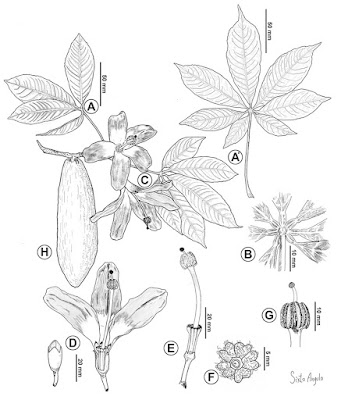
Ceiba camba Drawert, Angulo & Catari.
 A: Trunk in humid habitat (A.A. Angulo et al. 1, paratype, USZ). B: Trunk in dry habitat (A.A. Angulo et al. 3, paratype, USZ). C: Detail of bark and prickles. D: Branch with leaves of 3, 4, 5 and 6 leaflets (A.A. Angulo et al. 5, paratype, USZ). E: Detail of petiolules. F: Seeds. G: Fruit and open capsule. H: Flower (A.A. Angulo et al. 5, paratype, USZ). I: Senescent flower (A.A. Angulo et al. 5, paratype, USZ).
Photos: A.A. Angulo (D, F, G), J.C. Catari (A, B, I) & H.A. Drawert (C, E, H).


Ceiba camba.
 A: Leaves. B: Detail of petiolules. C: Flowers at anthesis. D: Flower-bud and flower. E: Staminal column and appedages. F: Staminal appendages, upper view. G: Collar of anthers, style and stigma. Based on paratype (A.A. Angulo et al. 5, USZ). Drawings by Sixto Angulo.

Ceiba camba Drawert, Angulo & Catari, sp. nov.

It differs from all species of the genus Ceiba by the combination of short and winged petiolules; calyx cylindrical to elongated-campanulate; petals distally pale pink to magenta and basally white to deep yellow; 5 lobed staminal appendages, lobes bifid, scarcely pilose to pilose and whitish, yellow to pinkish; stamens fused into staminal tube; and stigma deep red to carmine.

Etymology:—The specific epithet “camba” is a noun used as a demonym to refer to the inhabitants of the eastern lowlands in Bolivia, mainly in the departments of Santa Cruz, Beni and Pando, and largely coincides with the distribution of the species.


Heinz Arno Drawert, Alejandro A. Angulo and Juan C. Catari. 2024. A New Species of Ceiba (Malvaceae, Bombacoideae), previously confused with Ceiba speciosa.  Phytotaxa. 636(3); 207-219. DOI: 10.11646/phytotaxa.636.3.1
  facebook.com/ColectivoMODOfotovideografia/posts/425594873310796


Resumen A partir de la revisión de muestras de herbario, imágenes en vivo georeferenciadas y observaciones en campo, se describe una nueva especie del género Ceiba (Malvaceae) perteneciente al complejo de Ceiba insignis. Ceiba camba, la nueva especie, hasta ahora ha sido confundida con otras del complejo Ceiba insignis, especialmente C. speciosa, y pasó desapercibida pese a contar con una amplia distribución en las tierras bajas de Sudamérica centroccidental y ser bastante común. Sin embargo, la nueva especie descrita aquí muestra claras diferencias morfológicas visibles con C. speciosa y los otros miembros del género. Se discuten las principales similitudes y diferencias con otras especies del complejo C. insignis (C. chodatii, , C. crispiflora, C. insignis, C. lupuna, C. pubiflora, C. speciosa) morfológica y geográficamente cercanas.
  Palabras clave: árbol botella rosado, Chiquitania, Sudoeste Amazonia, árbol de seda, toborochi

Sunday, January 28, 2024

[Botany • 2024] Helicteres ubonensis (Malvaceae) • A New Species from Thailand


Helicteres ubonensis Chantar. & Kantachot, 

in Kantachot et Chantaranothai, 2024. 
  
Abstract 
A new species, Helicteres ubonensis from Thailand, is described and illustrated. The new key to 12 species of Thai Helicteres is provided.

Keywords: Helicteroideae; Ubon Ratchathani; identification key; new species

Helicteres ubonensis Chantar. & Kantachot.
a. Leaves and capsules; b. lower surface of leaf with stellate hairs (black dots); c. flower; d. seeds (a, b, d: P. Chantaranothai et al. 2021-150, c: C. Kantachot 2020-32, all KKU).
— Drawing by Puntiwa Krachai, 2023

 Helicteres ubonensis Chantar. & Kantachot.
a. Habitat; b. twigs and leaves; c, d. capsule.
 — Photos: Chortip Kantachot

Helicteres ubonensis Chantar. & Kantachot, sp. nov. 

Typical of this species are narrowly elliptic-oblong leaves. Corolla purplish white or pinkish. Capsule pointed as beak at the apex and surface covering with stellate hairs.
 
Etymology. The specific epithet refers to the collections from Ubon Ratchathani province where the species was discovered. 


Chortip Kantachot and Pranom Chantaranothai. 2024. Helicteres ubonensis (Malvaceae), A New Species from Thailand. Blumea - Biodiversity, Evolution and Biogeography of Plants. DOI: 10.3767/blumea.2024.69.01.02