Showing posts with label Hirudinea. Show all posts

Wednesday, March 25, 2026

[Invertebrate • 2026] Helobdella viridoclypus • A New free-living Leech Species (Hirudinea: Rhynchobdellida: Glossiphoniidae) from Chiang Mai, Thailand


 Helobdella viridoclypus
 K, Trivalairat, P. Trivalairat, Raquib & Purivirojkul, 2026

Emerald-charm leech | ปลิงสร้อยมรกต || 
 RAFFLES BULLETIN OF ZOOLOGY. 74

 Abstract
 A new species of glossiphoniid leech, Helobdella viridoclypus, is described from the northern region of Thailand, representing the first record of the genus Helobdella from the country and Southeast Asia. Its characteristics are similar to those of the type species, H. stagnalis, but can be distinguished by its transparent rice-shaped and triannulated body, cephalisation, a single pair of dark eyes, a smooth dorsal surface without papillae, rich darkgreen pigmentation on the dorsum, six pairs of crop caeca with less developed first pair and unbranched second to sixth pairs (posterior caeca), male and female gonopore separated by a single annulus, and a triangular nuchal scute pointed backwards with yellowish-green colouring around the mid-dorsal region. The phylogenetic relationships of H. viridoclypus, new species, are clarified, showing that it is monophyletic within the stagnalis species-complex clade which includes H. adiastola, H. octatestisaca, H. modesta, and the type species H. stagnalis. The new species is a free-living leech that specifically preys on invertebrates and not on humans. 

Key words. Annelida, Glossiphoniidae, Haementeriinae, jawless leech, freshwater, Huai Tueng Thao Reservoir

Order Rhynchobdellida Blanchard, 1894 
Suborder Glossiphoniiformes Tessler & de Carle, 2018 in Tessler et al., 2018 

Family Glossiphoniidae Vaillant, 1890 
Subfamily Haementeriinae Autrum, 1939 

Genus Helobdella Blanchard, 1896

Diagnosis. Small, two eyes, transparent papillae on segment, nuchal gland or scute on dorsum on VIIIa1/a2, gonopores separated by one annulus, compact salivary glands, crop with less developed first pair and unbranched second to sixth pairs of caeca, liquidosomatophagous (Blanchard, 1896; Sawyer, 1986).

 Helobdella viridoclypus, new species, live holotype (ZRC.ANN.1623).
 A, dorsal view; B, ventral view.

Helobdella viridoclypus, new species

Diagnosis. Rice-shaped, transparent body; cephalisation; a pair of large, distinctly separated, dark eyes on somite III; anterior sucker twice as large as prostomium without pits inside; central mouth in anterior sucker; triangular nuchal scute pointed backward with yellowish-green colouring around mid-dorsal region (VIIa1–a3, annuli 11–13); smooth surface without dorsal papillae; rich dark-green pigmentation on dorsum, particularly around crop caeca; lesser or almost absent pigmentation along crop; one male gonopore on XIIa1/XIIa2 (annuli 26/27); one female gonopore on XIIa2/ a3 (annuli 27/28); six pairs of crop caeca with unbranched posterior caeca; maximum body width wider than anterior and posterior suckers by four and two times, respectively.
 
Etymology. The species epithet refers to the description of the nuchal scute on the neck region, which resembles a shield and is a yellowish green colour. 
The following common names are suggested: “Emerald-charm leech” (English), “Pling soi mor ra kot” (ปลิงสร้อยมรกต) (Thai), and “Der Smaragdt-charm Plattegel” (German).


 Krittiya TRIVALAIRAT, Poramad TRIVALAIRAT, Tashfia RAQUIB and Watchariya PURIVIROJKUL. 2026. Helobdella viridoclypus (Hirudinea: Rhynchobdellida: Glossiphoniidae), A New free-living Leech Species from Chiang Mai, Thailand. RAFFLES BULLETIN OF ZOOLOGY. 74: 124–141. [23 March 2026]

Saturday, November 22, 2025

[Invertebrate • 2025] Troglobdella guizhouensis • A New Genus and Species of Cave-dwelling Leech (Hirudinea: Salifidae) from China: Taxonomy, Phylogeny, and mitochondrial Genome Characterization


Troglobdella guizhouensis  Liu & Nakano, 

in K. Liu, Q. Li, Wu, Lin, H. Li, Nakano et Z. Liu, 2025.
 贵州隐洞蛭  ||  DOI: doi.org/10.3897/zse.101.168628 
 
Abstract
Accurate identification of leech species is critical for biodiversity conservation and evolutionary studies. However, due to the ambiguity and variability of some key characteristics, Salifidae remains a rather poorly known group of Erpobdelliformes. In this study, a new genus of salifid leech, Troglobdella gen. nov., is established, and a new species, Troglobdella guizhouensis sp. nov., is described based on specimens collected from a cave in Guizhou Province, Southwest China. Phylogenetic analyses based on mitochondrial cytochrome c oxidase subunit I (COI) and nuclear 18S rRNA gene sequences reveal that Troglobdella guizhouensis represents a distinct lineage within a clade that also includes the troglobiotic species Shibabdella wulingensis Tang & Liu, 2025, and the terrestrial Odontobdella gaowangjiensis Yin & Liu, 2025, both of which are known from Hunan Province. This suggests that cave-related morphologies in Chinese salifid leeches may have evolved independently. The complete mitochondrial genome of the new species was assembled into a circular molecule of 15,732 bp, comprising 13 protein-coding genes, 22 tRNAs, and 2 rRNAs. This study contributes new insights into the taxonomy, systematics, and mitochondrial architecture of cave-adapted leeches.

Key Words: mitochondrial genome, phylogeny, Salifidae, taxonomy, Troglobdella guizhouensis, troglobiont

Taxonomy
Family Salifidae Johansson, 1910

Troglobdella guizhouensis 
 B. The entrance of the cave; C. A leech living in the puddle.

 Troglobdella Liu & Nakano, gen. nov.

 Troglobdella guizhouensis Liu & Nakano, sp. nov.

Diagnosis. Troglobdella guizhouensis can be distinguished from the other salifid genera as well as other species by the following combination of characters: body milky white with no pigments; without eyes; oral sucker well developed, distinctly laterally expanded; mid-body somites six-annulate; gonopores separated by four annuli; testisacs multiple; pharynx strepsilaematous; lacking preatrial loop of male paired ducts; paired atrial cornua conical, curved laterad; atrium short, globular; ovisacs descending to anterior of somite XIV, then turned several times in each of posterior parts, forming globular mass.

Etymology. The genus name Troglobdella is derived from the Ancient Greek “troglos” meaning “cave” and “bdella” meaning “leech” referring to the genus’ trait to subterranean habitats. We suggest the Chinese formal name as “yǐn dòng zhì shǔ” (隐洞蛭属). The species name “guizhouensis” is based Guizhou Province in China, where the species was discovered, with the suffix “-ensis” indicating geographical origin. We suggest the Chinese formal name as “guì zhōu yǐn dòng zhì” (贵州隐洞蛭).


Kaiqing Liu, Qing Li, Heqi Wu, Yiquan Lin, Hexiang Li, Takafumi Nakano, Zichao Liu. 2025. A New Genus and Species of Cave-dwelling Leech from China in the family Salifidae: Taxonomy, Phylogeny, and mitochondrial Genome Characterization. Zoosystematics and Evolution. 101(4): 2123-2132. DOI: doi.org/10.3897/zse.101.168628 

Tuesday, August 16, 2022

[Invertebrate • 2022] Orobdella ibukifukuyamai • A New Sexannulate Species of Orobdella (Hirudinea: Arhynchobdellida: Orobdellidae) from Kii-Oshima Island, Japan


Orobdella ibukifukuyamai 
 Nakano, 2022


Abstract
A large-type sexannulate leech species, Orobdella ibukifukuyamai sp. nov., from Kii-Oshima Island, Japan, is described based on morphologic and molecular data. Phylogenetic analyses using nuclear 18S rRNA, 28S rRNA, histone H3, mitochondrial cytochrome c oxidase subunit I, tRNACys, tRNAMet, 12S rRNA, tRNAVal, 16S rRNA, tRNALeu and NADH dehydrogenase subunit 1 markers showed that O. ibukifukuyamai formed a clade with the sexannulate O. okanoi Nakano, 2016 and O. yamaneae Nakano, 2016 and octannulate O. nakahamai Nakano, 2016, which are endemic to Shikoku island, Japan.

Key Words: Hirudinida, Erpobdelliformes, Japanese Archipelago, molecular phylogeny

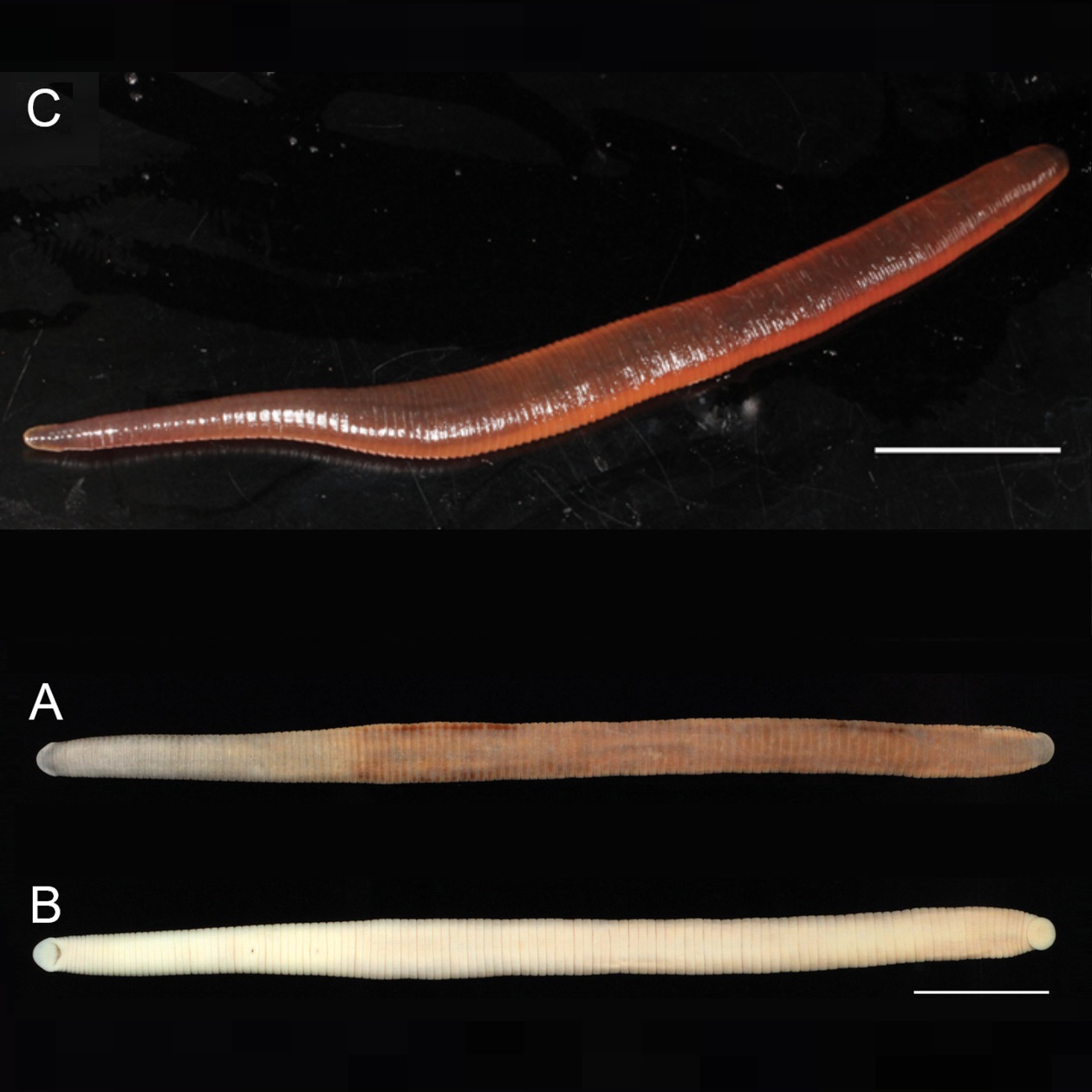
Orobdella ibukifukuyamai sp. nov., holotype, KUZ Z4031.
A. Dorsal view; B. Ventral view; C. Dorsal view of live animal.
Scale bars: 20 mm (same bar for A, B).

Family Orobdellidae Nakano, Ramlah & Hikida, 2012

Genus Orobdella Oka, 1895

Type species: Orobdella whitmani Oka, 1895, 
fixed by subsequent designation (Soós 1966).

 Orobdella ibukifukuyamai sp. nov.
 
Diagnosis: Body length of mature individuals reaching ~15 cm. Somite VII quinquannulate, somites VIII–XXV sexannulate, b1 = b2 < a2 = b5 > c11 = c12 (especially mid-body somites). Male gonopore in slightly anterior to middle of, or in middle of somite XI c12, female gonopore in somite XIII b2/a2, posterior to gastropore, gonopores separated by 1/2 + 8 annuli. Pharynx reaching to somite XIV a2/b5–b5. Gastropore conspicuous, in somite XIII b2/a2. Gastroporal duct thick tubular. Paired epididymides in somites XVI–XVIII, occupying 11–12 annuli. Atrial cornua developed, ovate, without pre-atrial loop. Dorsal surface reddish brown in life.

Etymology: The specific name is dedicated to Mr Ibuki Fukuyama who collected the specimens of the new species.
 

 Takafumi Nakano. 2022. A New Sexannulate Species of Orobdella (Hirudinea, Arhynchobdellida, Orobdellidae) from Kii-Oshima Island, Japan. Evolutionary Systematics. 6(2): 135-142. DOI: 10.3897/evolsyst.6.86308

Saturday, October 26, 2019

[Invertebrate • 2019] Placobdelloides sirikanchanae • A New Species of Glossiphoniid Leech (Hirudinea, Rhynchobdellida) and A Parasite of Turtles from lower southern Thailand


Placobdelloides sirikanchanae (arrows) 
on the Asian leaf turtle (Cyclemys dentata (Gray, 1831)) (left) and the dark-bellied leaf turtle (C. enigmatica Fritz et al., 2008) (right).
 Trivalairat, Chiangkul & Purivirojkul, 2019
ปลิงอาจารย์ประไพสิริ  ||  DOI: 10.3897/zookeys.882.35229

Abstract
 A new species of glossiphoniid leech, Placobdelloides sirikanchanae sp. nov., is reported in the Asian leaf turtle (Cyclemys dentata) and the dark-bellied leaf turtle (C. enigmatica) from Songkhla Province, southern Thailand. The examination of morphological characters revealed that this new species is similar to P. siamensis (Oka, 1917), a common turtle leech species found in Thailand. Placobdelloides sirikanchanae sp. nov. demonstrates distinct morphological characters, with an elongated, narrow body, 13–17 well-developed knob papillae on each annulus, dark brown to greenish dorsal color with a crimson median line, the absence of a scarlet dot, different male and female gonopore distributions, a rough posterior sucker with a random pit distribution, and 104–115 eggs per clutch. The phylogenetic relationships of COI-ND1 genes were clarified and shown to be distinct from those of P. siamensis. Additionally, habitat preferences tended toward low oxygen conditions such as puddles or water patches on rubber plantations.

Keywords: Clitellata, Cyclemys, Glossiphoniidae, Hirudinea, leaf turtle, Songkhla


Placobdelloides Sawyer, 1986
Type species: Placobdelloides multistriata (Johansson, 1909) by original designation.

Genus diagnosis: eyes one pair, esophageal organ, crop caeca seven pairs, mouth pore terminal (Oosthuizen 1979).

Genus distribution: Placobdelloides species can be found in Africa (P. fimbriata (Johansson, 1909); P. jaegerskioeldi (Johansson, 1909); P. multistriata (Johansson, 1909)), Australia and United States, eastward to India (P. fulva (Harding, 1924); P. emydae (Harding, 1920); P. undulata (Harding, 1924); P. horai (Baugh, 1960); P. indica (Baugh, 1960)), Southeast Asia (P. siamensis in China and Thailand; P. okadai (Oka, 1925) in China; P. okai (Soós, 1969); P. stellapapillosa Govedich et al., 2002 in Malaysia and Singapore), and throughout Australia and New Zealand (P. octostriata (Grube, 1866); P. maorica (Benham, 1907); P. bancrofti (Best, 1931); P. bdellae (Ingram, 1957)).

Figure 2. Dorsal surface (upper) and ventral surface (lower) of the live holotype of Placobdelloides sirikanchanae sp. nov.

Placobdelloides sirikanchanae sp. nov.

Material examined: Holotype (ZMKU-ANN-0006), puddle on rubber plantation, Sadao District, Songkhla Province, Thailand , 21 October 2018. Paratypes (nine individuals, ZMKU-ANN-0007 to 0015), same locality data as the holotype. All collected specimens were kept in 70% alcohol and deposited at the Zoological Museum of Kasetsart University (ZMKU), Department of Zoology, Faculty of Science, Kasetsart University on 23 November 2018.

Diagnosis: This species can be recognized from its elongated, narrow body, crimson median dorsal line, rich dark green pigmentation, 13–17 well-developed knob papillae on each annulus, symmetrical dorsal papillae between the left and right body sides, male gonopore on XIa1/a2, female gonopore on XIa3/XIIa1, amorphous salivary glands, smooth surface with random pits inside the anterior sucker, and rugged surface with randomly distributed pits inside the posterior sucker.

Etymology: The species is named in honor of Associate Professor Prapaisiri Sirikanchana, the pioneer aquatic parasitologist of Thailand. The following common names, Sirikanchana’s leech (English), Pling Arjan Prapaisiri (Thai: ปลิงอาจารย์ประไพสิริ), and Sirikanchanas Plattegel (German) are suggested.

Figure 1. Live Placobdelloides sirikanchanae sp. nov. (arrows) on the Asian leaf turtle (Cyclemys dentata (Gray, 1831)) (left) and the dark-bellied leaf turtle (C. enigmatica Fritz et al., 2008) (right): carapace (lower), plastron (upper).

Type host: Dark-bellied leaf turtles (Cyclemys enigmatica).

Additional host: Asian leaf turtles (C. dentata).

Habitat: Placobdelloides sirikanchanae sp. nov. can be found attached on the shell surface, both the carapace and plastron, of C. dentata and C. enigmatica, which inhabit the bottom of enclosed shallow muddy puddles on rubber plantations. In the rainy season, several puddles will be connected due to an increase in the water level. Numerous small vertebrates are present in these puddles, such as small fishes or tadpoles. In the dry season, the puddles will be disconnected as the shallower waters disappear from evaporation. These aquatic ecosystems usually have low oxygen due to decomposition of leaf litter and nonflowing water.


 Poramad Trivalairat, Krittiya Chiangkul and Watchariya Purivirojkul. 2019. Placobdelloides sirikanchanae sp. nov., A New Species of Glossiphoniid Leech and A Parasite of Turtles from lower southern Thailand (Hirudinea, Rhynchobdellida). ZooKeys. 882: 1-24. DOI: 10.3897/zookeys.882.35229


Monday, March 4, 2019

[Invertebrate • 2019] Sinospelaeobdella wulingensis & S. cavatuses • Vampire in the Darkness: A New Genus and Species of Land Leech (Hirudinea: Arhynchobdellida: Haemadipsidae) Exclusively Bloodsucking Cave-dwelling Bats from China


Sinospelaeobdella wulingensis Liu, Huang & Liu

in Huang, Liu, Gong, Wu, Liu, et al., 2019.

Abstract 
Land leeches in the family Haemadipsidae are mostly from the humid tropical rainforest habitats and habitually take blood from the body of human and other animals. In the present study, we report a new species, Sinospelaeobdella wulingensis sp. n., from caves in the northern subtropical Wuling Mountains of central-south China that feeds blood exclusively on cave-dwelling bats. Based on morphological characteristics, COI gene sequence divergence, and phylogenetic analysis, a new genus Sinospelaeobdella gen. n. is established for the new species, to which a previously described species Haemadipsa cavatuses Yang et al., 2009 is transferred as S. cavatuses comb. n. We also provided extended discussion on phylogenetic relationship within the “Tritetrabdellinae” clade uncovered in a previous study, DNA taxonomy, morphological and behavioral adaptions, biogeography, and possible involvement of Sinospelaeobdella gen. n. in bat transmitted diseases of public concerns. 

Key words: Land leeches, Sinospelaeobdella gen. n., Sinospelaeobdella wulingensis sp. n., DNA taxonomy, Phylogeny, Cave-dwelling bats


FIGURE 5. The four stages of life cycle in Sinospelaeobdella wulingensis sp. n. 
 (A, mating behavior; B, external feature of reproductive individual; C, cocoon; D, larva) and
 blood-sucking on the hindfoot of Rhinolophus sinicus (E).

Taxonomy
Family Haemadipsidae Blanchard, 1892

Genus Sinospelaeobdella Liu, Huang, and Liu gen. n.

Etymology: The name for the new genus derives from Σινων (Sinon) , meaning Chinese / China, σπηλαιον (spelaeon), cave, or subterranean, βδελλα (bdella), land leech, Sino-spelaeo-bdella = Sinospelaeobdella.

  Sinospelaeobdella wulingensis Liu, Huang, and Liu, sp. n.

  Etymology: The specific name is derived from the type locality in “Wuling Mountains”, a mountain range stretching from western Hunan Province to eastern Guizhou Province and southeastern Hubei Province of China.


Biology: Sinospelaeobdella wulingensis sp. n. lives on the ceiling of wet karstic caves, a stable microhabitat with an average temperature at 17°C and relative humidity at 91%. ... Both adults and larvae suck blood on hindfoot (Fig. 5E) of several bat species, including Rhinolophus sinicus Andersen, R. pearsonii Horsfield, R. pusillus Temminck, R. macrotis Blyth and Hipposideros armiger (Hodgson).


 Taifu Huang, Zhiwei Liu, Xiaoyan Gong, Tao Wu, Hui Liu, Jiaxin Deng, Youxiang Zhang, Qingzhong Peng, Libiao Zhang and Zhixiao Liu. 2019. Vampire in the Darkness: A New Genus and Species of Land Leech Exclusively Bloodsucking Cave-dwelling Bats from China (Hirudinda: Arhynchobdellida: Haemadipsidae). Zootaxa. 4560(2); 257–272.  DOI: 10.11646/zootaxa.4560.2.2

 刘志霄教授课题组发现洞穴陆生蛭类新属种 JSU.edu.cn/info/1081/11956.htm