Showing posts with label PSU. Show all posts

Wednesday, April 29, 2026

[Invertebrate • 2025] Alloscopus sago & A. jantapasoae • Two New Species of the Genus Alloscopus Börner, 1906 (Collembola: Orchesellidae: Heteromurinae) from southern Thailand


Alloscopus sago Jantarit & Manee, sp. nov.  
   A. jantapasoae Jantarit, Nilsai & Manee, sp. nov.

in Jantarit, Manee, Nilsai, Mitpuangchon et Pimsai, 2025.

Abstract 
Two new species of Alloscopus Börner (Orchesellidae: Heteromurinae) are discovered and described from southern Thailand. The first species, Alloscopus sago Jantarit & Manee, sp. nov. was found in a sago palm forest (Metroxylon sagu Rottb.), a true sago palm species native to Southeast Asia and typically located in lowland freshwater swamps in Phatthalung Province. The second species, A. jantapasoae Jantarit, Nilsai & Manee, sp. nov. was sampled from a dark zone within a cave environment in Trang Province. Both species are characterized by the absence of eyes and mucronal spines, the presence of a PAO, two rows of smooth chaetae on the manubrium, and dental spines. However, they differ in several morphological features, including the number of macrochaetae on the ‘A’ series of the head, Th. II and Abd. IV; labial basis chaetotaxy; the presence of smooth chaetae on tibiotarsi; the number of chaetae on both the anterior and posterior ventral tube; and the number of the inter-teeth on the claw. The discovery of these two new species increases the total number of Alloscopus species recorded in Thailand to six species with a total of 17 recognized species globally. An updated key to the world species of Alloscopus is also provided.   

Key words: Cave, chaetotaxy, Entomobryoidea, sago palm, taxonomy


Alloscopus sago Jantarit & Manee, sp. nov.   
 A. jantapasoae Jantarit, Nilsai & Manee, sp. nov.


 Sopark Jantarit, Nongnapat Manee, Areeruk Nilsai, Natrada Mitpuangchon and Awatsaya Pimsai. 2025. Two New Species of the Genus Alloscopus Börner, 1906 (Collembola, Orchesellidae, Heteromurinae) from southern Thailand. ZooKeys. 1245: 357-381. DOI: doi.org/10.3897/zookeys.1245.148100 


Monday, January 26, 2026

[Invertebrate • 2026] Alloscopus ramanai • A New Collembola Species (Orchesellidae: Heteromurinae) from central Thailand, with complete mitochondrial genome and phylogenetic placement


Alloscopus ramanai  Nilsai, Jantarit & Jaitrong, 

in Nilsai, Jantarit, Jeenthong, Detcharoen et Jaitrong, 2026.

Abstract
Background: Alloscopus is one of the genera within the subfamily Heteromurinae, recently recorded in Thailand and is currently represented by six species from two regions of the country. In the northern part, A. tetracanthus Börner, 1906 and A. thailandensis Mari Mutt, 1985 have been recorded from forested habitats. In the southern part, A. whitteni Jantarit & Sangsiri, 2020, A. namtip Jantarit & Sangsiri, 2020 and A. jantapasoae Jantarit, Nilsai & Manee, 2025 have been reported from a cave habitat, while A. sago Jantarit & Manee, 2025 was recently described from a sago palm forest.

New information: A new species, Alloscopus ramanai sp. nov., is described from central Thailand, based on an integrative taxonomic approach combining morphological and molecular data. The new species closely resembles A. tetracanthus Börner, 1906, sharing several diagnostic characters including a dark red ocular patch and PAO shape and the number of M and S series chaetae on the dorsal head. Additional similarities include the number of spiniform labral papillae, labial basis chaetae, the number of pseudopores on the manubrium, the number of central and lateral macrochaetae on Th.II, the number of central macrochaetae on Th.III and Abd.IV. However, A. ramanai sp. nov. can be clearly distinguished from A. tetracanthus by a unique combination of traits, including the number of lateral macrochaetae on Abd. III and Abd. IV and the number of chaetae on the anterior side of the ventral tube. A detailed diagnosis and illustrations of the new species are provided herein. A key for species of Alloscopus in Thailand is also included. The complete mitochondrial genome of A. ramanai sp. nov. is 14,757 bp in length and comprises 13 concatenated protein-coding genes (PCGs), 22 transfer RNA (tRNA) genes and two ribosomal RNA (rRNA) genes. Phylogenetic analysis, based on mitochondrial genome data, indicates that A. ramanai sp. nov. forms a sister lineage to Alloscopus bannaensis Zhang, 2020. The description of this new species contributes to a more comprehensive understanding of Heteromurinae diversity in Thailand and underscores the need for expanded mitogenomic sampling across Collembola.

Keywords: Entomobryoidea, mitogenome, new species, taxonomy, phylogeny

A Habitus of Alloscopus ramanai sp. nov. (SEM image, upper; wet specimen, lower). Scale bars = 0.5 mm;
B–C The type locality of the new species, a forest plantation of the Natural History Museum of the National Science Museum Thailand (THNHM);
D The localities of Alloscopus recorded in Thailand. 1, A. tetracanthus Börner, 1906 and A. thailandensis Mari Mutt, 1985. 2, A. whitteni Jantarit & Sangsiri, 2020. 3, A. namtip Jantarit & Sangsiri, 2020. 4, A. jantapasoae Jantarit, Nilsai & Manee, 2025. 5, A. sago Jantarit & Manee, 2025.

Alloscopus ramanai Nilsai, Jantarit & Jaitrong, sp. nov.

Diagnosis: Alloscopus ramanai sp. nov. exhibits the morphological similarity to A. tetracanthus Börner 1906, a species reported from Australia, Indonesia, Malaysia, Singapore, Papua New Guinea, India, New Britain, Micronesia and Thailand (Chiang Mai Province). Both species share several morphological characters, including a dark red eye patch with reddish to dark dot pigmentation, a semi-divided PAO, labial basis M1(m)m2rel1l2, four spiniform labral papillae, 4–5 central and 4–5 posterior mac on Th. II, six central mac on Th. III, two central mac on Abd. IV, 0–2 inner unpaired ungual teeth, the presence of teeth on the unguiculus, smooth chaetae on the tibiotarsi, a similar number of chaetae on the manubrium and 4–7 spines on the dens. However, Alloscopus ramanai sp. nov. can be distinguished from A. tetracanthus by the absence of eyes (vs. 1+1), orange dot pigmentation (vs. lack of pigmentation) and the presence of five macrochaetae on the “A” series of the dorsal head chaetotaxy (vs. four). Furthermore, A. ramanai sp. nov. can ...

Etymology: The new species was collected in the vicinity of the Rama 9 Museum, part of the National Science Museum, Thailand, which serves as the locality. The specific epithet ramanai is derived from the name of the Museum and is used as a noun in apposition, honouring the institution.


 Areeruk Nilsai, Sopark Jantarit, Tadsanai Jeenthong, Matsapume Detcharoen and Weeyawat Jaitrong. 2026. Alloscopus ramanai sp. nov. (Orchesellidae, Heteromurinae), A New Collembola Species from central Thailand, with complete mitochondrial genome and phylogenetic placement. Biodiversity Data Journal. 14: e173157. DOI: doi.org/10.3897/BDJ.14.e173157

Thursday, November 27, 2025

[Invertebrate • 2025] Lepidonella sirindhornae • A New Collembola Species (Entomobryidae: Paronellinae) from Southern Thailand


Lepidonella sirindhornae Nilsai & Jantarit,

in Nilsai, Engchuan et Jantarit. 2025. 
 Tropical Natural History. Suppl. 8;  
แมลงหางดีดถ้ำเจ้าฟ้า  || https://li01.tci-thaijo.org/index.php/TNH 

Abstract
The genus Lepidonella is widely distributed across Southeast Asia, South Asia, Papua New Guinea, the Melanesian region, Australia, Africa, and the Americas. To date, only a single species of the genus has been formally recorded from Thailand. However, numerous undescribed species, particularly from southern Thailand, have been reported, indicating a greater diversity than currently recognized. This study presents the first formal description of a Lepidonella species from a cave habitat in the country. Lepidonella sirindhornae Nilsai & Jantarit, sp. nov. is described and illustrated from Tham Phraya Bangsa in Satun Province. The new species is distinguished from its congeners by a unique combination of morphological characters, including labial chaetotaxy formula (M1m2rEL1L2), elongation of antennal length (3.5–5.1 antenna: head ratio), presence of 6+6 eyes and a distinctive number of chaetae on both the anterior and posterior surfaces of the ventral tube. Additionally, this study provides a distribution map of the genus Lepidonella found in Thailand, underscoring the diversity of cave-dwelling species in the region and the need for further taxonomic investigation.

Keywords: cave, Entomobryoidea, Isthmus of Kra, new species, taxonomy


Lepidonella sirindhornae Nilsai & Jantarit, sp. nov.
แมลงหางดีดถ้ำเจ้าฟ้า
 from Tham Phraya Bangsa, Satun Province

Areeruk Nilsai, Ronnaphon Engchuan and Sopark Jantarit. 2025. The Lepidonella sirindhornae sp. nov., A New Collembola species from Southern Thailand.  Tropical Natural History. Suppl. 8;  449-459. 

Wednesday, May 28, 2025

[Phycology • 2025] Rhodogorgon truncata (Rhodophyta: Rhodogorgonales) • A New Red Alga from the west coast of Thailand


Rhodogorgon truncata Muangmai & Draisma,

in Muangmai, Draisma, Gabriel, Schils, Kato et Yoon, 2025. 

ABSTRACT
The recognition of new species is fundamental to understanding biodiversity and biogeography. Through an integrative taxonomic approach, combining morphological and multilocus molecular data, a new red algal species, Rhodogorgon truncata sp. nov. is described from the west coast of Thailand. The new species differs from the two previously described species in the genus, i.e. R. ramosissima and R. flagellifera, by unique morphological features including compressed and stocky thalli with determinate short branchlets along the upper portion, giving it a truncated and verrucose appearance. Our morphological observations revealed the smaller size, compressed shape, and truncated apices of R. truncata in contrast to the cylindrical, irregularly branched thalli of R. ramosissima and R. flagellifera. Phylogenetic analyses suggest that R. truncata is more closely related to undescribed Rhodogorgon specimens from the Indo-Pacific than to the Caribbean R. ramosissima. The discovery of this new species expands the known diversity within the genus Rhodogorgon and suggests greater, as yet undiscovered, species diversity among poorly studied red algae in the Indo-Pacific Ocean.

KEYWORDS: Andaman Sea, New species, Reef algae, Seaweed, Taxonomy


Rhodogorgon truncata sp. nov. Muangmai & Draisma

 
Narongrit Muangmai, Stefano G. A. Draisma, Daniela Gabriel, Tom Schils,Aki Kato and Hwan Su Yoon. 2025. Rhodogorgon truncata sp. nov. (Rhodogorgonales, Rhodophyta), A New red alga from the west coast of Thailand. Phycologia. DOI: doi.org/10.1080/00318884.2025.2491144  [28 Apr 2025]

ค้นพบสาหร่ายหินปูนสีแดงชนิดใหม่ของโลกจากชายฝั่งทะเลอันดามัน 
จังหวัดภูเก็ตและพังงา ประเทศไทย 
.
รองศาสตราจารย์ ดร.ณรงค์ฤทธิ์ เมืองใหม่ อาจารย์ประจำภาควิชาชีววิทยาประมง ร่วมกับ Dr. Stefano Draisma สถานีวิจัยความเป็นเลิศความหลากหลายทางชีวภาพแห่งคาบสมุทรไทย มหาวิทยาลัยสงขลานครินทร์ Dr. Daniela Gabriel, University of the Azores สาธารณรัฐโปรตุเกส Prof. Tom Schils, University of Guam สหรัฐอเมริกา Prof. Aki Kato, Hiroshima University, ประเทศญี่ปุ่น และ Prof. Hwan Su Yoon, Sungkyunkwan University, สาธารณรัฐเกาหลี
.
ค้นพบและตั้งชื่อสาหร่ายหินปูนสีแดงชนิดใหม่ของโลก Rhodogorgon truncata sp. nov. Muangmai & Draisma จากชายฝั่งทะเลอันดามัน จังหวัดภูเก็ตและจังหวัดพังงา 
.
สาหร่ายสีแดงหินปูนชนิดใหม่นี้มีลักษณะคล้ายกัลปังหา (gorgonians) และพบแพร่กระจายบริเวณแนวปะการังทางชายฝั่งทะเลอันดามัน พบได้ที่ระดับความลึกตั้งแต่ 1 เมตร จนถึง 6 เมตร งานวิจัยนี้เป็นส่วนหนึ่งของการสำรวจความหลากหลายทางชีวภาพของสาหร่ายทะเลบริเวณชายฝั่งทะเลของประเทศไทย 


Friday, February 28, 2025

[Mammalogy • 2025] Hipposideros srilankaensis • Taxonomic Revision of the South Asian allies of Hipposideros galeritus Cantor, 1846 (Chiroptera: Hipposideridae)


Hipposideros srilankaensis 
Kusuminda, B. Srinivasulu, Amarasinghe, A. Srinivasulu, C. Srinivasulu & Yapa, 

in B. Srinivasulu, Kusuminda, A. Srinivasulu, Ukuwela, Amarasinghe, Siriwardana, Kaur, Mannakkara, Soisook, Kamalakannan, Yapa et C. Srinivasulu, 2025.
Abstract
Hipposideros galeritus was described in 1846, with subsequent studies suggesting four subspecies across South and Southeast Asia. Our study indicates that the Indian and Sri Lankan populations previously considered subspecies of H. galeritus are, in fact, distinct species in need of taxonomic revisions. Based on the morphometric analysis, structure of the baculum, molecular phylogenetics, and echolocation call analysis, the Indian, Sri Lankan, and Southeast Asian populations of Hipposideros galeritus are distinct. We provide a detailed description of H. brachyotus Dobson, 1874 and describe a new speciesHipposideros srilankaensis sp. nov.—from Sri Lanka. Key morphological differences were found in the noseleaf, ear shape, and cranial features between the Indian (H. brachyotus), Sri Lankan (H. srilankaensis sp. nov.), and Southeast Asian populations (H. galeritus s.l.). Substantial genetic distances were found between H. galeritus populations, suggesting cryptic diversity that is yet to be resolved.

Mammalia, Chiroptera, Hipposideros brachyotusHipposideros srilankaensis, new species, India, Sri Lanka


Hipposideros srilankaensis sp. nov.


Bhargavi SRINIVASULU, Tharaka KUSUMINDA, Aditya SRINIVASULU, Kanishka D. B. UKUWELA, Chamara AMARASINGHE, Sahan SIRIWARDANA, Harpreet KAUR, Amani MANNAKKARA, Pipat SOISOOK, Manokaran KAMALAKANNAN, Wipula Bandara YAPA and Chelmala SRINIVASULU. 2025. Taxonomic Revision of the South Asian allies of Hipposideros galeritus Cantor, 1846.  Zootaxa. 5590(4); 507-530. DOI: doi.org/10.11646/zootaxa.5590.4.3 [2025-02-25]   ශ්‍රී ලංකා පත්නැහැ-වවුලා 

Friday, January 31, 2025

[Mollusca • 2022] Songkhlanaia gen. nov.; Songkhlanaia tamodienica, Sundadontina plugpomenica, Trapezoideus thachiadensis, ... • Diversity and Phylogenetics of Freshwater Mussels (Unionidae) from Southern Thailand with the Description of One New Genus and Five New Species-Group Taxa


 Songkhlanaia gen. nov.; Stamodienica gen. et sp. nov.; 
Sundadontina plugpomenica sp. nov.;
 Monodontina vondembuschiana tapienica ssp. nov.; Mv. thasaenica ssp. nov.
; and 
Trapezoideus thachiadensis sp. nov.
 

in Konopleva, Lheknim, Sriwoon, Kondakov, Tomilova, Gofarov, Vikhrev et Bolotov, 2022. 

Abstract 
Southern Thailand represents a region of unique freshwater biodiversity with many endemic taxa, including a number of freshwater mussel species (Bivalvia: Unionidae). In this study, we recognize 13 taxa in the tribes Contradentini, Rectidentini, Pseudodontini (subfamily Gonideinae), and Indochinellini (subfamily Parreysiinae) that inhabit different localities in the Songkhla Lake, Tapi River, and Tha Taphao River basins. Based on the results of morphological and phylogenetic analyses, we discovered among these mussels six taxa new to science, including one genus, three species, and two subspecies. New taxonomic names are introduced here as follows: Songkhlanaia gen. nov.; S. tamodienica gen. & sp. nov.; Sundadontina plugpomenica sp. nov.; Monodontina vondembuschiana tapienica ssp. nov.; Mvondembuschiana thasaenica ssp. nov. (Pseudodontini); and Trapezoideus thachiadensis sp. nov. (Contradentini). These new taxa confirm the high conservation priority of the Southern Thai freshwater mussel fauna.

Keywords: freshwater mussel fauna; new taxa; phylogenetics; Southern Thailand; Unionidae


 Songkhlanaia gen. nov.; S. tamodienica gen. & sp. nov.; 
Sundadontina plugpomenica sp. nov.; 
Monodontina vondembuschiana tapienica ssp. nov.; Mvondembuschiana thasaenica ssp. nov.; 
 Trapezoideus thachiadensis sp. nov.  


Ekaterina S. Konopleva, Vachira Lheknim, Rujinard Sriwoon, Alexander V. Kondakov, Alena A. Tomilova, Mikhail Y. Gofarov, Ilya V. Vikhrev and Ivan N. Bolotov. 2022. Diversity and Phylogenetics of Freshwater Mussels (Unionidae) from Southern Thailand with the Description of One New Genus and Five New Species-Group Taxa. Diversity. 2023, 15(1), 10. DOI: 10.3390/d15010010   

Tuesday, January 28, 2025

[Invertebrate • 2025] Coecobrya microphthalma • The Thermal Tolerance of Springtails in a Tropical Cave, with the Description of a New Coecobrya Species (Collembola: Entomobryidae) from Thailand


 Coecobrya microphthalma Manee & Jantarit,
 
in Manee, Deharveng, D’Haese, Nilsai, Shimano et Jantarit, 2025. 

Abstract
A new species of Collembola in the genus CoecobryaC. microphthalma sp. nov., is described from a cave environment in Saraburi province, central Thailand. The new species is the second described species of the boneti-group found in the country. It is most similar to C. chompon Nilsai, Lima & Jantarit, 2022, which is also described from a Thai cave. However, the new species is morphologically different from C. chompon in having orange dot pigmentation on its body and a combination of other morphological characteristics such as the number of sublobal hairs on the maxillary outer lobe and the number of medio-sublateral mac on Th. II, Abd. I, Abd. III and Abd. IV and the anterior face of the ventral tube. The morphological comparison of all known boneti species and a key to the world species of Coecobrya of the boneti-group are given. Coecobrya microphthalma sp. nov. was successfully cultured in the laboratory. The thermal tolerance of the new species was studied and tested with seven different temperature experiments (27 °C as a control, 30, 32, 33, 34, 35 and 36 °C). The results showed that C. microphthalma sp. nov. cannot survive at a temperature higher than 32 °C after exposure to the experimental heat for 7 and 14 consecutive days. At 27, 30 and 32 °C, C. microphthalma sp. nov. remained alive and produced eggs, but the duration of egg production and number of egg-laying days significantly declined when the temperature increased (p < 0.001). An interesting aspect of their reproduction concerns temperature. At 32 °C (5 °C above the control temperature), the F1 generation survived, was active and was able to molt to the adult stage. However, specimens were unable to produce the next generation of offspring. For postembryonic development, C. microphthalma sp. nov. required six molts to reach the adult stage. The development rate (from egg to adult) varied and differed significantly between the tested temperatures (p < 0.001). An increase in temperature from the control temperature significantly accelerated the developmental rate from egg to juvenile instars to adult with a statistical significance (p < 0.01). This study is the first attempt that provide information on the impact of increasing temperature on the population dynamics, reproductive capacity and life history of a subterranean tropical Collembola.

Keywords: breeding experiment; cave species; global warming; life history traits; thermal tolerance; taxonomy

 Coecobrya microphthalma sp. nov. 
(A) habitus under microscope; (B) habitus under SEM; (C) head and black eyepatch under slide; (D) head and eye (arrow) under SEM; (E) enlargement of eye under SEM.
Scale bar: (A,B)= 500 μm, (D) = 100 μm, (E) = 10 μm ((A,C): microscope images; (B,D,E): SEM images).

Taxonomy
Class Collembola Lubbock, 1870
Order Entomobryomorpha Börner, 1913

Family Entomobryidae Tömösváry, 1882
Subfamily Entomobryinae Schäffer, 1896

Genus Coecobrya Yosii, 1956

Coecobrya microphthalma sp. nov. Manee and Jantarit, 2025

Remarks. Coecobrya microphthalma sp. nov. belongs to the boneti-group characterized by the presence of eyes. The new species has 1+1 small eyes like six other species of the same group (C. boneti (Denis, 1948), C. sanmingensis Xu and Zhang, 2015, C. indonesiensis (Chen and Deharveng, 1997), C. tukmeas Zhang, Deharveng and Chen, 2009, C. oculata Zhang, Bedos and Deharveng, 2016 and C. chompon). Among Thai cave species, Coecobrya microphthalma sp. nov. is most similar to C. chompon in having relatively long antennae, labial chaetae as mrel1l2, presence of long smooth straight chaetae on antennae, 3 medio-medial mac on Th. II, 3 central mac on Abd. II, 1 central mac and ...

Etymology. Coecobrya microphthalma sp. nov. is derived from the Latin meaning “having small eyes”.


  Nongnapat Manee, Louis Deharveng, Cyrille A. D’Haese, Areeruk Nilsai, Satoshi Shimano and Sopark Jantarit. 2025. The Thermal Tolerance of Springtails in a Tropical Cave, with the Description of a New Coecobrya Species (Collembola: Entomobryidae) from Thailand. Insects. 16(1), 80. DOI: doi.org/10.3390/insects16010080  
(This article belongs to the Section Other Arthropods and General Topics)

Simple Summary: A new species of Collembola, Coecobrya microphthalma sp. nov., is described from a cave in Saraburi province, central Thailand. This species is the second boneti-group member found in the country. It closely resembles C. chompon Nilsai, Lima & Jantarit, 2022 but differs in having orange body dots and distinct morphological traits, such as the number of sublobal hairs and mac on various body segments. A comparison of all boneti-group species globally and a key to their identification are provided. Coecobrya microphthalma sp. nov. was cultured in the laboratory, and its thermal tolerance was tested at seven different temperatures (27 °C as control, 30, 32, 33, 34, 35, and 36 °C). The results showed that it cannot survive above 32 °C after 7 and 14 days of exposure. At 27, 30, and 32 °C, the species remained alive and produced eggs, though egg-laying duration and number of days decreased with higher temperatures. At 32 °C, the F1 generation survived and molted to adulthood, but no further offspring were produced. Development from egg to adult required six molts, with development rates increasing with higher temperatures. This study is the first attempt to examine how temperature affects the population dynamics, reproductive capacity, and life history of a subterranean tropical Collembola.

Wednesday, November 27, 2024

[Entomology • 2024] Eccoptopterus formosanus & E. intermedius • Two New Species of Eccoptopterus Motschulsky, 1863 Ambrosia Beetle (Coleoptera: Curculionidae: Scolytinae: Xyleborini) from Taiwan and Thailand

 
Eccoptopterus formosanus Lin, Sittichaya & Smith,

in Sittichaya, Lin, Smith, Pornsuriya et Cognato, 2024.  

Abstract
Two xyleborine ambrosia beetlesEccoptopterus formosanus sp. nov. and E. intermedius sp. nov. are described from Taiwan and Thailand, respectively, based on DNA sequences (COI and CAD) and morphological characteristics. A key to the Eccoptopterus species of Southeast Asia is provided.

Key words: Ambrosia beetle, molecular, new species, Taiwan, taxonomy, Thailand, xyleborine


 Eccoptopterus Motschulsky, 1863

Eccoptopterus formosanus sp. nov.
A–E holotype female A dorsal view B lateral view C frons D posterolateral view of abdomen E declivital face;
F–I paratype male F dorsal view G lateral view H frons I posterolateral view of abdomen.

 Eccoptopterus formosanus Lin, Sittichaya & Smith, sp. nov.
 
Diagnosis: Female, 2.56−2.64 mm long (mean = 2.61 mm; N = 4), 2.13−2.17× as long as wide (mean = 2.14×; N = 4). Medium body size, declivital armature composed of a pair of major spines on declivital summit and 2–4 minor denticles unevenly spaced on each lateral margin; protibiae slender, broadest at apical 1/3, outer margin armed with six or seven moderated socketed denticles; scutellum broadly linguiform; elytra tapering laterally.

Etymology: Formosa, the former name of Taiwan island, in reference to the collection locality of types. An adjective.

Distribution: Taiwan (Nantou County).

Eccoptopterus intermedius sp. nov.
Holotype, female, A dorsal view B lateral view C posterolateral view D frons E antenna.

 Eccoptopterus intermedius Sittichaya, Lin & Smith, sp. nov.

Diagnosis: Female, 1.70−1.90 mm long (mean = 1.80 mm; N = 6), 2.03−2.38× as long as wide (mean = 2.13×; N = 6). Small body size, declivital armature composed of a pair of major spines at interstriae 3 on declivital summit and four minor spines unevenly spaced on each lateral margin, declivity covered with flattened scale-like setae; protibiae slender, broadest at apical 1/3, outer margin armed with four or five moderated socketed denticles, elytra tapering laterally.

Etymology: L. inter + medius = in the middle. The name refers to the morphological characters of the species which lie between those of E. limbus and E. spinosus. An adjective.

Distribution: Thailand (Chiang Mai, Lamphun, Tak, Ubon Ratchathani provinces).


Wisut Sittichaya, Ching-Shan Lin, Sarah M. Smith, Chaninan Pornsuriya and Anthony I. Cognato. 2024. Two New Species of Eccoptopterus Motschulsky, 1863 Ambrosia Beetle from Taiwan and Thailand (Coleoptera, Curculionidae, Scolytinae, Xyleborini). ZooKeys. 1217: 247-262.  DOI: doi.org/10.3897/zookeys.1217.129707

Wednesday, October 30, 2024

[Botany • 2024] Alysicarpus littoralis (Fabaceae: Desmodieae) • A New Species from southern Thailand


Alysicarpus littoralis Satthaphorn & Leerat., 

in Satthaphorn et Leeratiwong. 2024. 
ถั่วลิสงนาสมุย  ||  www.QSBG.or.th/journal
 
Abstract
Alysicarpus littoralis Satthaphorn & Leerat. (Fabaceae, Desmodieae), a species confined to Samui Island, Surat Thani province, southern Thailand, is described and illustrated as a species new to science. Initially identified as A. vaginalis (L.) DC., the re-examination of morphological characters revealed distinctions of A. littoralis such as the length of inflorescence internode, length of calyx lobes, the colour of corolla and the type of pods at maturity. The newly proposed species is sometimes similar to A. monilifer (L.) DC. And A. ovalifolius (Schumach.) J. Léonard as it exhibits moniliform pods and lax inflorescence, respectively. The conservation status of the new species is assessed as Critically Endangered (CR, B2(bii+ciii)) following IUCN conservation guidelines since populations are surrounded by human disturbances. A morphological description, line drawing and updated key to species of Alysicarpus in Thailand are presented.

Keywords: coastal area, Desmodieae, Papilionoideae, Samui Island, Surat Thani

Line drawings of Alysicarpus littoralis:
 A. habit with inflorescences and infructescences; B. flowers; C. calyx; D. standard; E. wing petal; F. keel petal; G. diadelphous stamens; H. pistil; I. moniliform pod; J. article with reticulation (side view of an article); K. septum between articles (top view of an article); L. seed.
Drawn by J. Satthaphorn from the dried specimen, Leeratiwong 21-1634.

Alysicarpus littoralis:
 A. habit; B. inflorescence with two-tone-coloured corolla; C. close-up flowers; D. moniliform pods.
Photos by C. Leeratiwong.

 Alysicarpus littoralis Satthaphorn & Leerat., sp. nov.

 Type: Thailand, Surat Thani, Ko Samui, Bo Phut, Ban Bo Phut, 20 m alt., 3 Jan. 2021, Leeratiwong 21-1634 (holotype PSU!; isotypes BKF!, KKU!). Figs. 1–2. 

Diagnosis.— Alysicarpus littoralis superficially resembles A. vaginalis in its herbaceous habit, unifoliolate leaves, pseudoracemose inflorescence, valvate calyx and erect loment pods (Fig. 3). However, A. littoralis is distinguishable by longer petiolules (1–1.5 mm long vs ca. 0.3 mm long in A. vaginalis), longer inflorescence internodes (8–12 mm long and lax-flowered vs 2–5 mm long and compact-flowered), longer calyx lobes (3–5 mm long vs 2.3–3 mm long), two-tone-coloured corolla (orangish-yellow standard but pink wings vs monotone-coloured-pink to purple in all petals) and moniliform pods with barrel shaped articles at maturity (vs terete pods with cylindrical articles).

Etymology.— The specific epithet refers to its habitat which can be found in coastal areas.
Vernacular.— Thua lisong na samui (ถั่วลิสงนาสมุย). 


Jiratthi Satthaphorn and Charan Leeratiwong. 2024. Alysicarpus littoralis, A New Species of Alysicarpus (Fabaceae) from Thailand. THAI JOURNAL OF BOTANY. 16 (1): 41–52.  

Thursday, September 19, 2024

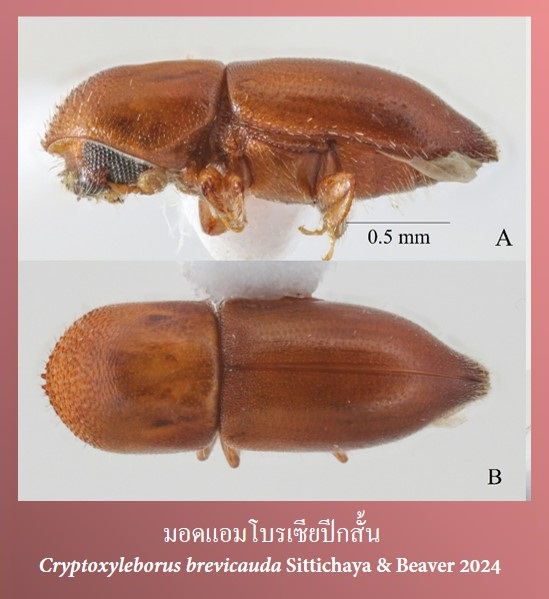
[Entomology • 2024] Cryptoxyleborus brevicauda • A New Species of xyleborine ambrosia beetle (Coleoptera: Curculionidae: Scolytinae: Xyleborini) from Thailand


 Cryptoxyleborus brevicauda
Sittichaya & Beaver, 2024

มอดแอมโบรเซียปีกสั้น  ||  DOI: 10.11646/zootaxa.5506.3.5 
 
Abstract
A new species, Cryptoxyleborus brevicauda Sittichaya & Beaver sp. nov., is described from the South of Thailand. A list of Cryptoxyleborus species found in Thailand with their provincial distributions and habitat types, and a key to Thai species are provided.

Coleoptera, Diversity, Oriental region, Thai fauna, new species, key


Wisut Sittichaya and Roger A. Beaver. 2024. Cryptoxyleborus brevicauda, A New Species of xyleborine ambrosia beetle from Thailand (Coleoptera: Curculionidae: Scolytinae: Xyleborini).  Zootaxa. 5506(3); 396-401. DOI: doi.org/10.11646/zootaxa.5506.3.5

Tuesday, September 10, 2024

[Entomology • 2024] Euwallacea chiangdao, E. plenilunium, etc. • New Species of Euwallacea Hopkins, 1915 Ambrosia Beetles (Coleoptera: Curculionidae: Scolytinae: Xyleborini) from Thailand


Euwallacea chiangdao Sittichaya, Smith & Beaver, E. congruens Sittichaya, Smith & Beaver, 
E. plenilunium 
Sittichaya, Smith & Beaver, and E. sulcatus Sittichaya, Smith & Beaver, 

in Sittichaya, Smith, Beaver et Cognato, 2024.

Abstract
Four new species of Euwallacea Hopkins, 1915, Euwallacea chiangdao Sittichaya, Smith, and Beaver, new species, Euwallacea congruens Sittichaya, Smith, and Beaver, new species, Euwallacea plenilunium Sittichaya, Smith, and Beaver, new species, and Euwallacea sulcatus Sittichaya, Smith, and Beaver, new species, are described from Thailand. Habitus photographs and diagnoses are provided with differential characters to separate them from other Euwallacea species. With the inclusion of the species described and recorded herein, the diversity of Euwallacea is increased to 81 species, of which 17 occur in Thailand. A synoptic list with updated species distributions within Thailand is provided.

KEYWORDS: morphology, Oriental Region, shot hole borer, taxonomy


มอดแอมโบรเซียเชียงดาว Euwallacea chiangdao Sittichaya, Smith, and Beaver, 2024; 
มอดแอมโบรเซียละม้าย Euwallacea congruens Sittichaya, Smith, and Beaver, 2024; 
มอดแอมโบรเซียเดือนเพ็ญ Euwallacea plenilunium Sittichaya, Smith, and Beaver, 2024; 
มอดแอมโบรเซียปีกร่อง  Euwallacea sulcatus Sittichaya, Smith, and Beaver, 2024

 
Wisut Sittichaya, Sarah M. Smith, Roger A. Beaver and Anthony I. Cognato. 2024. New Species of Euwallacea Hopkins, 1915 Ambrosia Beetles from Thailand (Coleoptera: Curculionidae: Scolytinae: Xyleborini). The Coleopterists Bulletin.  78(3):397-407. DOI: doi.org/10.1649/0010-065X-78.3.397
Researchgate.net/publication/383822257_New_Species_of_Euwallacea_Ambrosia_Beetles_from_Thailand


Saturday, July 27, 2024

[Entomology • 2024] Anisandrus bolavenensis • A New Species of ambrosia Beetle (Coleoptera: Curculionidae: Scolytinae: Xyleborini) from Laos


Anisandrus bolavenensis 
 Sittichaya & Smith, 2024

 
Abstract
Background: The ambrosia beetle genus Anisandrus Ferrari, 1867, is a member of the bark and ambrosia beetle subfamily Scolytinae, Tribe Xyleborini. Currently, it is comprised of 40 species of which four species were recorded in Laos.

New information: A new species, Anisandrus bolavenensis sp. nov. is described from the Bolaven Plateau in southern Laos. With the inclusion of the species described and recorded here, the diversity of Anisandrus is increased to 41 species, of which five occur in Laos. New distribution records, a synoptic list and a key to the Anisandrus of Laos PDR are presented.

Anisandrus bolavenensis sp. nov. holotype female
A dorsal view; B lateral view; C postero-lateral view; D pronotum; E frons; F antenna; G pro- and mesotibiae.

Anisandrus bolavenensis sp. nov.

Diagnosis: 
2.4 mm long (n = 1); 1.71× as long as wide. Small and stout species. Pronotal anterior margin slightly angularly projecting, median pair of asperities on anterior margin not prominent; elytral disc broadly convex, strongly shiny, without a saddle-like impression, declivity appears more obliquely sloped as compared to many other Anisandrus species, declivital summit unarmed, declivity flat from interstriae 1–3, declivity unarmed, densely covered with interstrial setae, setae very long, 3–4× as long as interstrial width; striae distinctly impressed; strial punctures shallow, 2× larger than those of disc, striae with fine recumbent, hair-like setae, setae 2–2.5× as long as diameter of punctures, setae pointing inward to declivital medial suture.

This species is similar to A. auco, A. cryphaloides and A. tanaosi. It can be distinguished from ...


Etymology: Bolavenensis, in reference to the collection locality of the holotype, Bolaven Plateau, Lao People's Democratic Republic. Noun in apposition.

Biology: The holotype was collected from a newly fallen (leaves still green) small branch of Symplocos sp. (Symplocaceae).


Wisut Sittichaya and Sarah M. Smith. 2024. Anisandrus bolavenensis sp. nov. (Col.: Curculionidae, Scolytinae, Xyleborini), A New ambrosia Beetle from Laos. Biodiversity Data Journal. 12: e130023. DOI: doi.org/10.3897/BDJ.12.e130023