Showing posts with label Mantellidae. Show all posts

Tuesday, February 17, 2026

[Herpetology • 2026] Boophis samuelsabini • A New Species of Treefrog of the Boophis goudotii group (Anura: Mantellidae) from the isolated Ivohiboro Protected Area in south-eastern Madagascar


Boophis samuelsabini
Basham, Masotti, Jimenez, Razafitsimialona, Andrianatenaina, Rakotoarison, Glaw, Wright & Vences, 2026

 SALAMANDRA. 62(1)

Abstract 
 We describe a new species of treefrog of the Boophis goudotii group from Ivohiboro, a sacred forest in the Southeast of Madagascar and recently established protected area. Based on a molecular phylogeny inferred from DNA sequences of the mitochondrial 16S rRNA gene, Boophis samuelsabini sp. n. is sister to the clade of B. madagascariensis and B. roseipalmatus but differs from these species by genetic distances of 4.8–6.3%. The new species has an advertisement call consisting of various note types similar to its closest relatives, B. madagascariensis and B. roseipalmatus, but is distinguished morphologically from them by smaller body size and presence of a pattern of reticulated dermal folds on the dorsum. This discovery highlights the poor state of exploration of remnant highland forests in the South East of Madagascar which can be expected to harbour additional microendemic species in need of conservation measures. 

Key words. Amphibia, Anura, Mantellidae, Boophis samuelsabini sp. n., Ivohiboro, microendemism

Specimens of Boophis samuelsabini sp. n. in life:
 (A) paratype UADBA-FGZC 12501; (B) individual MA013 (not collected); (C)  individual MA171 (not collected); (D) individual MA171 (not collected); (E) individual MA02 (not collected); (F) individual MA013 (not collected).

Dorsolateral views of three male paratypes, and dorsal and ventral views of one of these paratypes of Boophis samuelsabini sp. n. in life (specimens still uncatalogued and therefore here referenced with their field numbers; will be deposited in ZSM and UADBA).

Boophis samuelsabini sp. n.
 
Diagnosis: The new species differs from all described species in the B. goudotii group by strong genetic differentiation, with pairwise 16S divergence of 5.1–6.3% to all the other species of the group. It further differs from B. goudotii, B. obscurus and B. periegetes by presence of distinct dermal flaps on heels (vs. absence) and from B. goudotii, B. periegetes and syntopic B. obscurus by smaller body size (male SVL as far as known < 40 mm vs. > 50 mm; B. obscurus from some other sites, e.g. Isalo, are smaller but still > 42 mm); from B. axelmeyeri, B. boehmei, B. quasiboehmei, B. popi, and B. rufioculis by absence of red pigment in the iris (vs. presence), and furthermore from B. boehmei and B.  quasiboehmei by reticulated dorsum (vs. smooth) and larger body size (male SVL > 31 mm vs. ...

Etymology: The species name is a patronym honoring Samuel Sabin, son of Andrew Sabin, in recognition of the Sabin family’s support for research and conservation of Madagascar’s herpetofauna. Grammatically, the epithet is the genitive singular of a second-declension masculine noun.


Basham, E. W., M. D. Masotti, B. O. Jimenez, D. Razafitsimialona, G. M. Andrianatenaina, A. Rakotoarison, F. Glaw, P. C. Wright and M. Vences. 2026. New Species of Treefrog of the Boophis goudotii group from the isolated Ivohiboro Protected Area in south-eastern Madagascar. SALAMANDRA. 62(1); 42–52. 


Friday, January 9, 2026

[Herpetology • 2025] Spinomantis lakolosy & S. lavabato • Two New Species of the Spinomantis bertini species complex (Anura: Mantellidae) from south-eastern Madagascar


Spinomantis lakolosy
Spinomantis lavabato

Hutter, Andriampenomanana, Lambert & Vences, 2025  

Abstract
We scientifically name and describe two new species of spiny frog (Mantellidae: Spinomantis) from moderately high elevations in Ranomafana National Park, in south-east Madagascar. This region has been surveyed extensively and has a remarkably high anuran diversity with many undocumented species still being regularly discovered. We describe a previously identified candidate species, S. sp. Ca07, as Spinomantis lavabato sp. nov. and a previously undiscovered species from this region as Spinomantis lakolosy sp. nov.. The new species are morphologically cryptic within the S. bertini complex but can be recognized by a combination of subtle differences in coloration such as a lack or weak expression of sharp dorsolateral color border in both species. Bioacoustically, the new species are quite different from other species in the complex: Spinomantis lakolosy sp. nov. has the longest note duration with a powerful-sounding call that rings like a bell, which can be heard over the sound of rushing water in nearby streams; while S. lavabato sp. nov. differs by having the shortest note duration that is quiet and sounds like a trill. Furthermore, both species are substantially diverged in mitochondrial DNA, with pairwise distances in a fragment of the 16S rRNA marker of 7–9% to all other related species. Furthermore, we identify a lineage for future study in the complex from the nearby high-elevation site Andemaka within Ranomafana National Park that has an intermediate sounding advertisement call between the newly described species; although we cannot formally describe this lineage herein due to unavailability of voucher specimens, this lineage emphasizes the unexpectedly high diversity of sympatric species of the S. bertini complex in the Ranomafana area. Additionally, we identify another lineage from Ambahavala in the Anosy Chain with strong mitochondrial divergence for future study. Our findings also highlight the need for continued inventory work in high elevation rainforests of Madagascar, even in relatively well-studied regions such as Ranomafana National Park.

Key Words: Amphibia, Anura, new species, Ranomafana National Park, Spinomantis lakolosy, Spinomantis lavabato, taxonomy

Ex-situ dorsal-lateral, dorsal, and ventral photographs of (A) female Spinomantis lakolosy (paratype: KU340867, CRH 751; ventral side CRH 678) and (B) male specimen KU340884 (CRH 781) from the divergent population here provisionally assigned to S. lakolosy.

In-situ photographs of the habitat and microhabitat of Spinomantis lakolosy.
 The panels show: (A) the outskirts of the village of Miranony (blue circle) that leads to the primary forest habitat in the top right of the photograph (purple arrow); (B) within the primary forest habitat, the fast-flowing stream where S. lakolosy calls at night; (C) male paratype KU340868 (CRH 752) perched on a rock ledge alongside the stream; and (D) female paratype KU340867 (CRH 751) perched on a small branch alongside a rock ledge.

Spinomantis lakolosy sp. nov.

Spinomantis lavabato
Ex-situ dorsal-lateral, dorsal, and ventral photographs of (A) male (holotype: KU336975, JJW 2336) and (B) female (paratype: KU336978, CRH 118) in life.

Spinomantis lavabato sp. nov.  

 
 Carl R. Hutter, Zo F. Andriampenomanana, Shea M. Lambert and Miguel Vences. 2025. Two New Species of the Spinomantis bertini species complex (Mantellidae) from south-eastern Madagascar. Evolutionary Systematics. 9(2): 285-299. DOI: doi.org/10.3897/evolsyst.9.174833 [29 Dec 2025]

Monday, October 13, 2025

[Herpetology • 2025] Mantidactylus lovei • A New Giant Stream Frog of the Genus Mantidactylus (Anura: Mantellidae) from south-eastern Madagascar


 Mantidactylus lovei
Vences, Ramanamanjato, Miralles & Glaw, 2025 

Abstract 
We revisit the taxonomy of Madagascar's giant stream frogs of the nominal subgenus in the genus Mantidactylus. Based on newly collected material and extending available data sets of mitochondrial and nuclear-encoded DNA sequences, we confirm previous indications that the clade containing two mitochondrial line-ages (previously named as candidate species Mantidactylus sp. Ca66 and Ca67) concordantly differs from the other three nominal species in the subgenus by its phylogenetic position (not strongly supported as sister clade of any of the nominal species), a consistent mitochondrial divergence at a level similar to that found between other species of the subgenus (distances of 2.0-5.2 % in the 16S rRNA gene), and only limited haplotype sharing in three nuclear-encoded gene fragments. Also, the examined specimens for this clade are characterized, in comparison to other representatives of the subgenus, by smaller body size and a more distinct colour pattern on the flanks and the sides of the head, often with alternating light-dark vertical bands on the lips. We conclude that the available evidence is best reflected by recognizing M. sp. Ca66 as new species and we herein formally name it as Mantidactylus lovei sp. nov. In a preliminary way, we also include in this new species the specimens and samples belonging to the mitochondrial lineage M. sp. Ca67, pending further study of these genetically divergent populations. We furthermore provide preliminary evidence from archival DNA analysis confirming that the nomen Rana pigra Mocquard, 1900 is likely a junior synonym of M. guttulatus. 


Miguel Vences, Jean-Baptiste Ramanamanjato, Aurélien Miralles and Frank Glaw. 2025. A New Giant Stream Frog (Genus Mantidactylus) from south-eastern Madagascar (Amphibia, Mantellidae). Spixiana. 47(2):287-300. [August 2025]
https://pfeil-verlag.de/wp-content/uploads/2025/09/47-2_8_ve.pdf
Researchgate.net/publication/395397115_A_new_Mantidactylus_from_SE_Madagascar

Tuesday, June 24, 2025

[Herpetology • 2025] Guibemantis sioka • A New Species of mantellid frog of the Genus Guibemantis (Anura: Mantellidae) from south-eastern Madagascar


Guibemantis sioka
Hutter, Andriampenomanana, Basham, Glaw, Masotti, Lambert & Vences, 2025


Abstract
We describe a new species of arboreal mantellid frog of the genus Guibemantis (classified in the subgenus Guibemantis) from Madagascar. The new species, Guibemantis sioka sp. nov., is morphologically similar to G. depressiceps but differs by a high uncorrected genetic distance greater than 6% in the mitochondrial 16S rRNA gene from all other related species, and by a conspicuous dark-light marbling of the flanks, relatively large hands, and the structure of its advertisement calls from its closest relatives. Single individuals of the new species have been found at each of three high-elevation sites (1210–1650 m a.s.l.) in the Southern Central East and South East of Madagascar (Ranomafana National Park, Ivohiboro Reserve, and Andohahela National Park). If this apparent rarity was confirmed by future studies, it would stand in stark contrast to other Guibemantis which are often observed in large breeding aggregations.

Amphibia, Anura, Ranomafana, Maharira, new species, Guibemantis sioka sp. nov., taxonomy


Guibemantis sioka sp. nov.

 
Carl R. HUTTER, Zo F. ANDRIAMPENOMANANA, Edmund W. BASHAM, Frank GLAW, Matteo D. MASOTTI, Shea M. LAMBERT and Miguel VENCES. 2025. A New Species of mantellid frog of the Genus Guibemantis from south-eastern Madagascar.  Zootaxa. 5647(3); 260-274. DOI: doi.org/10.11646/zootaxa.5647.3.3 [2025-06-16]

Friday, October 18, 2024

[Herpetology • 2024] Boophis janewayae, B. kirki, B. picardi, etc. • Communicator Whistles: A Trek through the Taxonomy of the Boophis marojezensis Complex (Anura: Mantellidae) reveals Seven New, morphologically cryptic Treefrogs from Madagascar


Boophis archeri, Boophis burnhamae,  
Boophis janewayaeBoophis picardi,   
Boophis kirki

Vences, Köhler, Hutter, Preick, Petzold, Rakotoarison, Ratsoavina, Glaw & Scherz, 2024 

Abstract
The Malagasy stream-breeding treefrog species Boophis marojezensis contains bioacoustically and genetically highly divergent populations. Some of these populations have been defined as candidate species and emit somewhat bizarre advertisement calls consisting of multiple whistle-notes. We here enable a long-overdue taxonomic revision of this species complex by applying a museomics approach to sequence DNA from the holotype of B. marojezensis. Based on an integrative approach that combines divergence levels in mitochondrial DNA and in three nuclear-encoded genes, morphological data, and bioacoustic comparisons, we conclude that eight different species exist in this complex, seven of which are formally described herein as new. Although morphological differences between species are small and mainly separate small-sized from larger-sized species, conclusive evidence for the new species comes from their sympatric and sometimes syntopic occurrence without haplotype sharing in three nuclear genes and under maintenance of bioacoustic differences. Uncorrected genetic divergences in the mitochondrial 16S rRNA gene are >3% in almost all cases, and in some cases up to 8%. In reference to the otherworldly sounds by which these frogs fill Malagasy rainforests, some of them reminiscent of sounds of technical equipment in the fictional “Star Trek” universe, we here name and describe the seven new species in honor of fictional captains of starships, namely B. kirki sp. nov., B. picardi sp. nov., B. siskoi sp. nov., B. janewayae sp. nov., B. archeri sp. nov., B. pikei sp. nov., and B. burnhamae sp. nov. The majority of these species occur in northern Madagascar, where up to three species can occur in immediate geographical proximity, e.g., B. marojezensis, B. burnhamae sp. nov. and B. pikei sp. nov. at different elevations in the Marojejy Massif. South of 16°S latitude, only B. janewayae sp. nov., B. picardi sp. nov., and B. kirki sp. nov. are found, with the latter extending southwards to Ranomafana National Park. Our study confirms the existence of numerous morphologically cryptic and microendemic species among Madagascar’s amphibians, some of which are known only from unprotected sites and require adequate conservation management.

Keywords: Bioacoustics, Boophis archeri sp. nov., Boophis burnhamae sp. nov., Boophis janewayae sp. nov., Boophis kirki sp. nov., Boophis picardi sp. nov., Boophis pikei sp. nov., Boophis siskoi sp. nov., cryptic species, integrative taxonomy, molecular genetics, museomics, systematics

Individuals of Boophis marojezensis in life.
A Male holotype (ZFMK 57401) from Marojejy (low elevation). B Male paratype (ZSM 567/1999, previously ZFMK 57402).
C Individual from Masoala probably assignable to this species (not sequenced). D Male from Masoala (ZSM 250/2016, FGZC 5439).
 
Boophis siskoi, Boophis pikei
Boophis archeri, Boophis burnhamae


 Miguel Vences, Jörn Köhler, Carl R. Hutter, Michaela Preick, Alice Petzold, Andolalao Rakotoarison, Fanomezana M. Ratsoavina, Frank Glaw amd Mark D. Scherz. 2024. Communicator Whistles: A Trek through the Taxonomy of the Boophis marojezensis Complex reveals Seven New, morphologically cryptic Treefrogs from Madagascar (Amphibia: Anura: Mantellidae). Vertebrate Zoology. 74: 643-681. DOI: doi.org/10.3897/vz.74.e121110

Friday, May 31, 2024

[Herpetology • 2024] Gephyromantis ampondo, G. bemiray, etc. • Four New Species of Forest-dwelling mantellid frogs from Madagascar allied to Gephyromantis moseri (Anura: Mantellidae)


Gephyromantis ampondo
Vences, Köhler, Scherz, Hutter, Rabe Maheritafika, Rafanoharana, Raherinjatovo, Rakotoarison, Andreone, Raselimanana & Glaw, 2024
 

The Gephyromantis moseri complex, classified in the mantellid subgenus Duboi­mantis, currently contains one species of frog, G. moseri (Glaw & Vences, 2002) from the Andasibe area in the Northern Central East of Madagascar, as well as several genetically divergent populations from the North East that have been provision -ally assigned to the species. We here analyse DNA sequences of one mitochondrial (16S rRNA) and one nuclear-encoded gene (RAG-1), morphology, and advertisement calls of newly collected material of this species complex from various localities in Madagascar. Based on this integrative evidence, in particular concordant nuclear gene differentiation between seven highly divergent (> 4 %) mitochondrial lineages, as well as differences in advertisement call structure, body size and head shape between some of these lineages, we conclude that the G. moseri complex contains several additional species of which four are formally named and described in this study: G. fuscus sp. nov., a rather small-sized species sister to G. moseri, occurring in two sites (Mahasoa and the western part of the Makira Reserve), G. ma­kira sp. nov., a species known from only one available voucher specimen from eastern Makira, G. bemiray sp. nov. from eastern Makira, Masoala, and Ambolokopatrika; and G. ampondo sp. nov. from Marojejy in the North East. Two further lineages for which voucher specimens were not available in the framework of this study are considered unconfirmed candidate species G. sp. Ca19 and G. sp. Ca33,pending the collection of further material. The revision of the G. moseri complex adds to the diversity of Duboimantis and once more demonstrates the existence of secretive or genuinely rare restricted-range species among the Malagasy frogs whose inventory can only be completed by further fieldwork and integrative taxonomic research. 


Gephyromantis ampondo
Gephyromantis bemiray
Gephyromantis fuscus
Gephyromantis makira


Vences M, Köhler J, Scherz MD, Hutter CR, Rabe Maheritafika HM, Rafanoharana JM, Raherinjatovo H, Rakotoarison A, Andreone F, Raselimanana AP, Glaw F. 2024. Four New Species of Forest-dwelling mantellid frogs from Madagascar allied to Gephyromantis moseri (Amphibia, Anura). Spixiana. 46: 297–319. 

Thursday, January 11, 2024

[Herpetology • 2024] Guibemantis ambakoana, G. rianasoa & G. vakoa • Unexpected Diversity and Co-occurrence of phytotelmic Frogs (Anura: Mantellidae: Guibemantis) around Andasibe, one of the most intensively surveyed Amphibian Hotspots of Madagascar, and Descriptions of Three New Species

 
Guibemantis vakoa 
G.  ambakoana
Gabriel, Rothe, Köhler, Rakotomanga, Edmonds, Galán, Glaw, Lehtinen, Rakotoarison & Vences, 2024

 
Abstract
The area around the Malagasy village of Andasibe, which includes Analamazaotra-Mantadia National Park as well as other protected areas, is characterized by very species-rich and well-studied communities of animals and plants, but new species are still regularly discovered. Three species of phytotelmic frogs of the subgenus Pandanusicola in the genus Guibemantis are known from this area, G. flavobrunneus, G. liber, and G. pulcher. Further Pandanusicola frogs from this area have been provisionally assigned to G. bicalcaratus or G. albolineatus, pending detailed taxonomic review. During preliminary exploration of the ecology of these specialized frogs that live and reproduce in the leaf axils of Pandanus screw pines, we noticed the syntopic presence of two differently colored and differently sized Pandanusicola in Andasibe that could not be unambiguously assigned to any known species. A genetic screening revealed that these correspond to yet two further species in the area. Based on our data, seven species of Pandanusicola occur in Andasibe and nearby forests: (1) G. liber, the only non-phytotelmic species of the subgenus in the region; (2) G. flavobrunneus which is the largest species and characterized by a diagnostic yellowish brown dorsal pattern; (3) G. pulcher, characterized by translucent-green color with purplish brown spotting not observed in any other species in the area; (4) G. methueni, a brownish species usually lacking contrasted dorsolateral bands that differs from the other species in the area by emitting a characteristic trill-like advertisement call series (rather than clicks or chirps) and according to our data is widespread along Madagascar’s east coast; as well as three new species: (5) G. ambakoana sp. nov., a brownish species, typically with contrasted incomplete light dorsolateral bands and with single click-like advertisement calls; (6) G. vakoa sp. nov., a species that is equally brownish but lacks contrasted light dorsolateral bands and that has single click-like advertisement calls of very short duration; and (7) G. rianasoa sp. nov., a species that is smaller sized and has less distinct femoral glands than all the others, and emits a short series of soft chirp-like advertisement calls. All these species are genetically highly distinct, with >5% uncorrected pairwise distances in the mitochondrial 16S rRNA gene, and lack of haplotype sharing in two nuclear-encoded genes. The co-occurrence of seven Pandanusicola frogs in a relatively small geographic area is unprecedented in Madagascar and calls for in-depth studies of a possible differentiation in habitat use and life history.

Key words: Amphibia, Anura, Mantellidae, Pandanusicola, Guibemantis rianasoa sp. nov., Guibemantis ambakoana sp.nov., Guibemantis vakoa sp. nov., Pandanus, bioacoustics, phytotelmic breeding, microendemism, sympatry, phylogeny, systematics, taxonomy 


Guibemantis rianasoa sp. nov.


Guibemantis ambakoana sp.nov. 


 Guibemantis vakoa sp. nov.


 Hugh Gabriel, Laila-Denise Rothe, Jörn Köhler, Sandratra Rakotomanga, Devin Edmonds, Pedro Galán, Frank Glaw, Richard M. Lehtinen, Andolalao Rakotoarison and Miguel Vences. 2024. Unexpected Diversity and Co-occurrence of phytotelmic Frogs (Guibemantis) around Andasibe, one of the most intensively surveyed Amphibian Hotspots of Madagascar, and Descriptions of Three New Species.  Zootaxa. 5397(4); 451-485. DOI: 10.11646/zootaxa.5397.4.1

Friday, July 28, 2023

[Herpetology • 2023] Blommersia bara • Integrative Revision of the Blommersia wittei complex (Anura: Mantellidae), with Description of A New Species of Frog from western and north-western Madagascar


Blommersia bara
Vences, Multzsch, Köhler, Crottini, Andreone, Rakotoarison, Scherz & Glaw, 2023


Abstract
Frogs of the Blommersia wittei complex are widespread in western and northern Madagascar, and are one of two clades of the family Mantellidae that have colonized the Comoran island of Mayotte. Based on a comprehensive set of DNA sequences of the mitochondrial 16S rRNA gene and the nuclear-encoded RAG1 and SACS genes, integrated with morphological and bioacoustic data, we here analyze the genetic differentiation of populations of this complex across Madagascar. We confirm that a candidate species named B. sp. Ca5 in previous studies represents a genetically well-defined evolutionary lineage distributed over much of western Madagascar, which we describe herein as Blommeria bara sp. nov. based on its molecular and bioacoustic differentiation. Blommersia wittei occurs across northern Madagascar but its type locality Ambanja, at the lower Sambirano river, is very close to the range of another, newly discovered microendemic lineage that was only found at two sites along the upper Sambirano river (here named as candidate species B. sp. Ca12). The B. wittei complex thus provides an example of a clade of closely related Malagasy frogs that contains species widespread over hundreds of kilometers, as well as extreme microendemics. For a full resolution of this species complex, more data need to be collected on the geographical contact among these two lineages, on the morphology and bioacoustics of B. sp. Ca12, and on the north-eastern populations of B. wittei at Sambava, which are weakly differentiated in mitochondrial genes but differ in bioacoustics and possibly in the extent of foot webbing.

Keywords: Amphibia, Anura, Mantellidae, Blommersia bara sp. nov, microendemism, species delimitation

Blommersia bara sp. nov. (= B. sp. Ca5) in life.
(A, B): Male holotype zSM 31/2004 (FgzC 47) from Isalo indorsolateral and ventral view. (C) Individual from Ankarafantsika displaying egg-guarding behavior. (d) Female paratype zSM13/2006 from tsingy de Bemaraha. (E) Additional individual (not clearly referable to a voucher) from tsingy de Bemaraha.

Blommersia bara sp. nov,

Diagnosis. A species of the genus Blommersia in the subfamily Mantellinae of the family Mantellidae based on presence of intercalary elements between penultimate and ultimate phalanges of fingers and toes (verified by external examination), occurrence in Madagascar, relatively small body size (male SVl < 27 mm), presence off emoral glands in males and absence of femoral gland rudiments in females, head distinctly longer than wide, and molecular phylogenetic relationships.

Etymology. Named after the Bara people, the ethnic group living in the area of Madagascar that includes the type locality of the new species, the Isalo Massif. the name is used as a noun in apposition. 


Miguel Vences, Malte Multzsch, Jörn Köhler, Angelica Crottini, Franco Andreone, Andolalao Rakotoarison, Mark D. Scherz and Frank Glaw. 2023. Integrative Revision of the Blommersia wittei complex, with Description of A New Species of Frog from western and north-western Madagascar. Zootaxa. 5319(2); 178-198. DOI: 10.11646/zootaxa.5319.2.2

Tuesday, June 20, 2023

[Herpetology • 2023] Guibemantis pulcherrimus • A New Species of Pandanus-dwelling Frog (Anura: Mantellidae) from northern Madagascar related to Guibemantis pulcher


 Guibemantis (Pandanusicola) pulcherrimus
 Vences, Hutter, Glaw, Rakotoarison, Raselimanana & Scherz, 2023

 
Abstract
Populations of phytotelmic frogs from northern Madagascar assigned to Guibemantis (Pandanusicola) pulcher are known to differ genetically from populations further south in the eastern rainforest belt of the island, but to date, their status has not been analyzed in depth. We combined molecular genetic data with an examination of color pattern to clarify the taxonomy of these frogs. DNA sequences of both mitochondrial and nuclear-encoded genes were consistently differentiated between the northern populations and those occurring further south. Uncorrected pairwise distance in the 16S rRNA gene was 3.7‒4.3% and thus at a level usually characterizing distinct frog species in Madagascar. Furthermore, the northern specimens were characterized by more and smaller purplish-brown spots on their green dorsal surface, and a less distinct brown patch on the flanks. Although fully conclusive evidence for the species status of the northern lineage from bioacoustic differences, sympatric occurrence or narrow hybrid zone is currently lacking, such species-level distinctness is currently the most likely hypothesis. We therefore name the northern populations as Guibemantis (Pandanusicola) pulcherrimus sp. nov. The new species is known from Makira (type locality) and Bemanevika, and specimens morphologically assignable to this taxon have also been recorded from Masoala, Marojejy and Anjanaharibe-Sud.

Keywords: Amphibia, Anura, Mantellidae, northern Madagascar, phytotelmic anurans, Guibemantis pulcherGuibemantis pulcherrimus sp. nov. 


Miguel Vences, Carl R. Hutter, Frank Glaw, Andolalao Rakotoarison, Achille P. Raselimanana and Mark D. Scherz. 2023. A New Species of Pandanus-dwelling Frog from northern Madagascar related to Guibemantis pulcher. Zootaxa. 5306(1); 97-115. DOI: 10.11646/zootaxa.5306.1.4


Tuesday, May 2, 2023

[Herpetology • 2023] Guibemantis razandry, G. razoky & G. fotsitenda • An Initial Molecular Resolution of the mantellid Frogs of the Guibemantis liber complex (Anura: Mantellidae) reveals Three New Species from northern Madagascar


[A-B, E-F] Guibemantis razandry
[A-H] Guibemantis razoky 

 Koppetsch, Pabijan, Hutter, Köhler, Gehring, Rakotoarison, Ratsoavina, Scherz, Vieites, Glaw & Vences, 2023

Abstract
The small arboreal frog Guibemantis liber (Anura: Mantellidae) has served as an example for the existence of deep conspecific lineages that differ by a substantial amount in mitochondrial DNA but are similar in morphology and bioacoustics and thus are assigned to the same nominal species. During fieldwork in northern Madagascar, we identified additional such lineages and surprisingly, observed close syntopy of two of these at various sites. In-depth study based on DNA sequences of the mitochondrial cytochrome b gene from 338 specimens of G. liber sensu lato from across its range, sequences of four nuclear-encoded markers for 154‒257 of these specimens, a phylogenomic dataset obtained by the FrogCap target capture approach, and additional mitochondrial genes for representatives of most mitochondrial lineages, as well as bioacoustic and morphological comparisons, revealed concordant differentiation among several lineages of the G. liber complex. We identify nine lineages differing by 5.3‒15.5% in cytochrome b and 2.4‒10.1% in the 16S rRNA gene, and find that several of these lack or have only limited allele sharing in the nuclear-encoded genes. Based on sympatric or parapatric occurrence without genetic admixture, combined with differences in bioacoustic and morphological characters, we scientifically name three lineages from northern Madagascar as new species: G. razoky sp. nov., G. razandry sp. nov., and G. fotsitenda sp. nov. Of these new species, G. razoky sp. nov. and G. razandry sp. nov. show widespread syntopy across northern Madagascar and differ in body size and advertisement calls. Guibemantis fotsitenda sp. nov. is sister to G. razandry sp. nov., but appears to occur at lower elevations, including in close geographic proximity on the Marojejy Massif. We also detected subtle differences in advertisement calls among various other mitochondrial lineages distributed in the Northern Central East and Southern Central East of Madagascar, but the status and nomenclatural identity of these lineages require further morphological and bioacoustic study of reliably genotyped individuals, and assignment of the three available names in the complex: Rhacophorus liber Peracca, 1893, Gephyromantis albogularis Guibé, 1947, and Gephyromantis variabilis Millot and Guibé, 1951. We discuss the identity and type material of these three nomina, designate a lectotype for Gephyromantis variabilis from Itremo, and flag the collection of new material from their type localities, Andrangoloaka and Itremo, as paramount for a comprehensive revision of the G. liber complex.

Keywords: Amphibia, Anura, bioacoustics, FrogCap, morphology, Pandanusicola, phylogeography, taxonomy
 
Specimens of Guibemantis razandry sp. nov. in life, in dorsal and ventral views.
A, B Male holotype ZSM 293/2005 (field number FGZC 2851) from Marojejy.
C, D Male specimen from Marojejy, photographed in 2016 (not collected).
E, F Specimen from Bemanevika, probably a (maybe subadult) female, assigned to the species by color pattern only, photographed in 2010 (not collected).

Guibemantis razandry sp. nov.

Diagnosis: This species corresponds to the mitochondrial lineage NE1 as defined herein, and to the candidate species Guibemantis sp. Ca21 according to Perl et al. (2014). It is assigned to the subgenus Pandanusicola of the genus Guibemantis based on presence of intercalary elements between ultimate and penultimate phalanges of fingers and toes (verified by external examination), small body size, moderate to weakly expressed webbing between toes, connected lateral metatarsalia, the presence of both inner and outer metatarsal tubercles, femoral glands in males, absence of nuptial pads, small body size (SVL 24.4‒25.9 mm in reliably sexed males and 22.8 mm in one female), and molecular phylogenetic relationships. Within Pandanusicola, the new species is distinguished from all species except G. liber and G. tasifotsy by femoral glands type 1 (vs. type 2) as defined by Glaw et al. (2000), thus possessing many small gland granules in a relatively diffuse field covering most of the thigh ventrally, and by its probable breeding in open swamps (vs. phytotelmic breeding in Pandanus leaf axils). It can be distinguished from G. tasifotsy by its different brownish color pattern lacking a green dorsal and lateral coloration with a series of distinct white blotches along the lower flanks and its strongly different advertisement call, consisting of a pulsatile note with numerous pulses being largely fused (vs. a trill-like note containing 3–7 distinctly separated pulses). The new species differs from all G. liber lineages occurring in the Northern and Southern Central East of Madagascar by its high DNA divergence, with > 5% uncorrected pairwise distance in the mitochondrial 16S gene and 20 diagnostic positions in the analyzed fragment of the cytochrome b gene (see Appendix 2 for a list of diagnostic sites), as well as probably by a somewhat smaller snout-vent length. For a distinction from the other two new species described herein, see below.

Etymology: The name is derived from the Malagasy word razandry meaning smaller (younger) sibling, and makes reference to the fact that this species is the smaller-sized relative of the syntopic larger-sized species of the G. liber complex described in the following. The name is used as a noun in apposition to the genus name.


Specimens of Guibemantis razoky sp. nov. in life, in dorsal and ventral views.
 A, B Male holotype ZSM 1746/2010 (field number ZCMV 12515) from Bemanevika.
C, D Female paratypes ZSM 1744/2010 (field number ZCMV 12513),
E, F ZSM 1745/2010 (field number ZCMV 12514) from Bemanevika.
G, H Male paratype from Montagne d’Ambre (ZSM 878/2003) (shown in Lehtinen et al. 2012 as G. liber).

Guibemantis razoky sp. nov.

Diagnosis: This species corresponds to the mitochondrial lineages NOR+NCENTR as defined herein. It is assigned to the subgenus Pandanusicola of the genus Guibemantis based on presence of intercalary elements between ultimate and penultimate phalanges of fingers and toes (verified by external examination), moderate to weakly expressed webbing between toes, connected lateral metatarsalia, the presence of both inner and outer metatarsal tubercles, femoral glands in males, absence of nuptial pads, moderately small body size (SVL 26.5‒33.9 mm in males and 29.8‒32.8 mm in females), and molecular phylogenetic relationships. Within Pandanusicola, the new species is distinguished from all species except G. liber, G. razandry, and G. tasifotsy by femoral glands type 1 (vs. type 2) as defined by Glaw et al. (2000), thus possessing many small gland granules in a relatively diffuse field covering most of the thigh ventrally, and by its probable breeding in open swamps (vs. phytotelmic breeding in Pandanus leaf axils). It can be distinguished from G. tasifotsy by its different brownish color pattern lacking a green dorsal and lateral coloration with series of distinct white blotches along the lower flanks, and its different advertisement call, namely a short click-like note of 20–117 ms duration and 2598–3010 Hz dominant frequency (vs. a longer trill-like note of 147–516 ms duration and higher dominant frequency; Lehtinen et al. 2012). The new species differs from all G. liber lineages occurring in the Northern and Southern Central East of Madagascar by its high DNA divergence > 2.4% in the mitochondrial 16S gene, by a larger SVL, and differences in the advertisement call. It differs from G. razandry (described above) by larger SVL, different advertisement call, and a molecular 16S divergence >5.5%. It also differs from G. liber and G. razandry by 3 and 41 diagnostic positions in the analyzed fragment of the cytochrome b gene, respectively (see Appendix 2 for a list of diagnostic sites). For a distinction from the third new species described herein, see below.

Etymology: The name is derived from the Malagasy word razoky meaning larger (elder) sibling, and refers to the fact that this species is the larger-sized relative of the syntopic G. razandry. The name is used as a noun in apposition to the genus name.


Guibemantis fotsitenda sp. nov.

Diagnosis: This species corresponds to the mitochondrial lineage NE2 as defined herein. It is assigned to the subgenus Pandanusicola of the genus Guibemantis based on presence of intercalary elements between ultimate and penultimate phalanges of fingers and toes (verified by external examination), small body size, moderate to weakly expressed webbing between toes, connected lateral metatarsalia, the presence of both inner and outer metatarsal tubercles, femoral glands in males, absence of nuptial pads, small body size (SVL 25.1‒26.0 mm in males; female size unknown), and molecular phylogenetic relationships. Within Pandanusicola, the new species is distinguished from all species except G. liber, G. razandry, G. razoky, and G. tasifotsy by femoral glands type 1 (vs. type 2) as defined by Glaw et al. (2000), thus possessing a large number of small gland granules in a relatively diffuse field covering most of the thigh ventrally, and by its probable breeding in open swamps (vs. phytotelmic breeding in Pandanus leaf axils). It can be distinguished from G. tasifotsy by its different brownish color pattern lacking a green dorsal and lateral coloration with series of distinct white blotches along the lower flanks. The new species differs from all G. liber lineages occurring in the Northern Central East and Southern Central East of Madagascar by its high DNA divergence > 5% in the mitochondrial 16S gene, and probably by a somewhat smaller snoutvent length. Guibemantis razoky (see above) has a larger body size (26.5–33.9 mm in males, vs 25.1–26.0 mm in males of G. fotsitenda). Guibemantis razandry (see above) is the closest relative of G. fotsitenda sp. nov., and no obvious morphological differences between these two species are known, despite their clear divergence in mitochondrial and nuclear-encoded DNA in near-sympatry. The new species differs from G. liber, G. razandry, and G. razoky by 23, 23, and 50 diagnostic positions in the analyzed fragment of the cytochrome b gene, respectively (see Appendix 2 for a list of diagnostic sites).

Etymology: The name is derived from the Malagasy words fotsy meaning white, and tenda meaning throat, referring to the white throat (vocal sac) typical for this and other species of the G. liber complex. The name is used as a noun in apposition to the genus name.


Thore Koppetsch, Maciej Pabijan, Carl R. Hutter, Jörn Köhler, Philip-Sebastian Gehring, Andolalao Rakotoarison, Fanomezana M. Ratsoavina, Mark D. Scherz, David R. Vieites, Frank Glaw and Miguel Vences. 2023. An Initial Molecular Resolution of the mantellid Frogs of the Guibemantis liber complex reveals Three New Species from northern Madagascar. Vertebrate Zoology. 73: 397-432. DOI:  10.3897/vz.73.e94063


Saturday, March 25, 2023

[Herpetology • 2023] Blommersia dupreezi • Genetic Diversity of the mantellid frog Blommersia blommersae (Anura: Mantellidae), and Description of A New anuran Species from south-eastern Madagascar


Blommersia dupreezi
Vences, Armerding, Köhler & Glaw, 2023
 

ABSTRACT
A range-wide assessment of genetic variation in one mitochondrial (16S rRNA) and one nuclear-encoded (Rag-1) gene fragment of the widespread Madagascar frog Blommersia blommersae revealed the presence of up to 12 deep genetic lineages. Many of these differed by genetic distances >3% in the 16S gene. In the Ranomafana area in the southern central east of Madagascar, two mitochondrial lineages differing by 1.2–1.8% in 16S occurred in close syntopy across multiple sites. A phylogeny of representative samples based on multiple mitochondrial genes supported three main mitochondrial clades within B. blommersae, with lineages from the (i) north, (ii) north and northern central east, and (iii) southern central east, respectively. In addition, one lineage from Sainte Luce in the south-east was sister to all other species of Blommersia, and thus clearly not belonging to B. blommersae, to which it has been tentatively assigned previously. Except for the Sainte Luce population, most of the mitochondrial lineages did not show a concordant and consistent differentiation in Rag-1 and no obvious morphological differences were detected among the lineages. We therefore refrain from taxonomic conclusions for them at this time, although indications exist that the populations from the northern central east and southern central east may show certain differences in relative note duration of advertisement calls, which require further study. However, the Sainte Luce individuals were highly divergent in 16S (>10%) and Rag-1, phylogenetically isolated, and characterised by differences in colour pattern. This lineage represents the most evolutionarily divergent species of Blommersia known to date and is herein formally named and described as Blommersia dupreezi sp. nov.

KEYWORDS: Amphibia, Anura, Mantellidae, Blommersia dupreezi sp. nov., systematics, taxonomy, bioacoustics, Madagascar

Blommersia dupreezi sp. nov. from Sainte Luce. 
Adult female holotype and paratype

 
Miguel Vences, Moritz Armerding, Jörn Köhler and Frank Glaw. 2023. Genetic Diversity of the mantellid frog Blommersia blommersae, and Description of A New anuran Species from south-eastern Madagascar. African Journal of Herpetology. DOI: 10.1080/21564574.2023.2165547 

Tuesday, February 28, 2023

[Herpetology • 2023] Gephyromantis cornucopia, G. feomborona, G. mitsinjo, etc. • An Endless Harvest: Integrative Revision of the Gephyromantis boulengeri and G. blanci Complexes (Anura: Mantellidae) reveals Six New Species of Mantellid Frogs from Madagascar


in Miralles, Köhler, Glaw, Valero, Crottini, ... et Vences, 2023.
  SALAMANDRA. 59(1) 

Abstract
 The Malagasy genus Gephyromantis contains 51 species of primarily terrestrial or scansorial frogs. Although many species are morphologically weakly divergent from each other, the combination of molecular and bioacoustic evidence has led to a continuous flow of species discoveries in the last years. Previous works have notably shown the existence of numerous additional deep mitochondrial lineages of uncertain status in the nominal subgenus Gephyromantis, some of these considered as confirmed or unconfirmed candidate species, some as deep conspecific lineages. Here we use DNA sequences of one mitochondrial and one nuclear marker, as well as morphological and bioacoustic data, to conduct an integrative revision of the subgenus Gephyromantis. The analyses reveal at least 12 distinct and independent evolutionary lineages belonging to the G. blanci and G. boulengeri species complexes. Evidence for the species status of these lineages included multiple cases of syntopic occurrence without genetic admixture, as well as differences in advertisement calls or morphological differentiation without intermediate forms, suggesting reproductive isolation. We discuss the relevance of these different lines of evidence and describe six new species of Gephyromantis

Key words. Amphibia, Anura, Gephyromantis mitsinjo sp. n., G. kremenae sp. n., G. sergei sp. n., G. mafifeo sp. n., G. feomborona sp. n., G. cornucopia sp. n., bioacoustics, taxonomy, phylogeny.


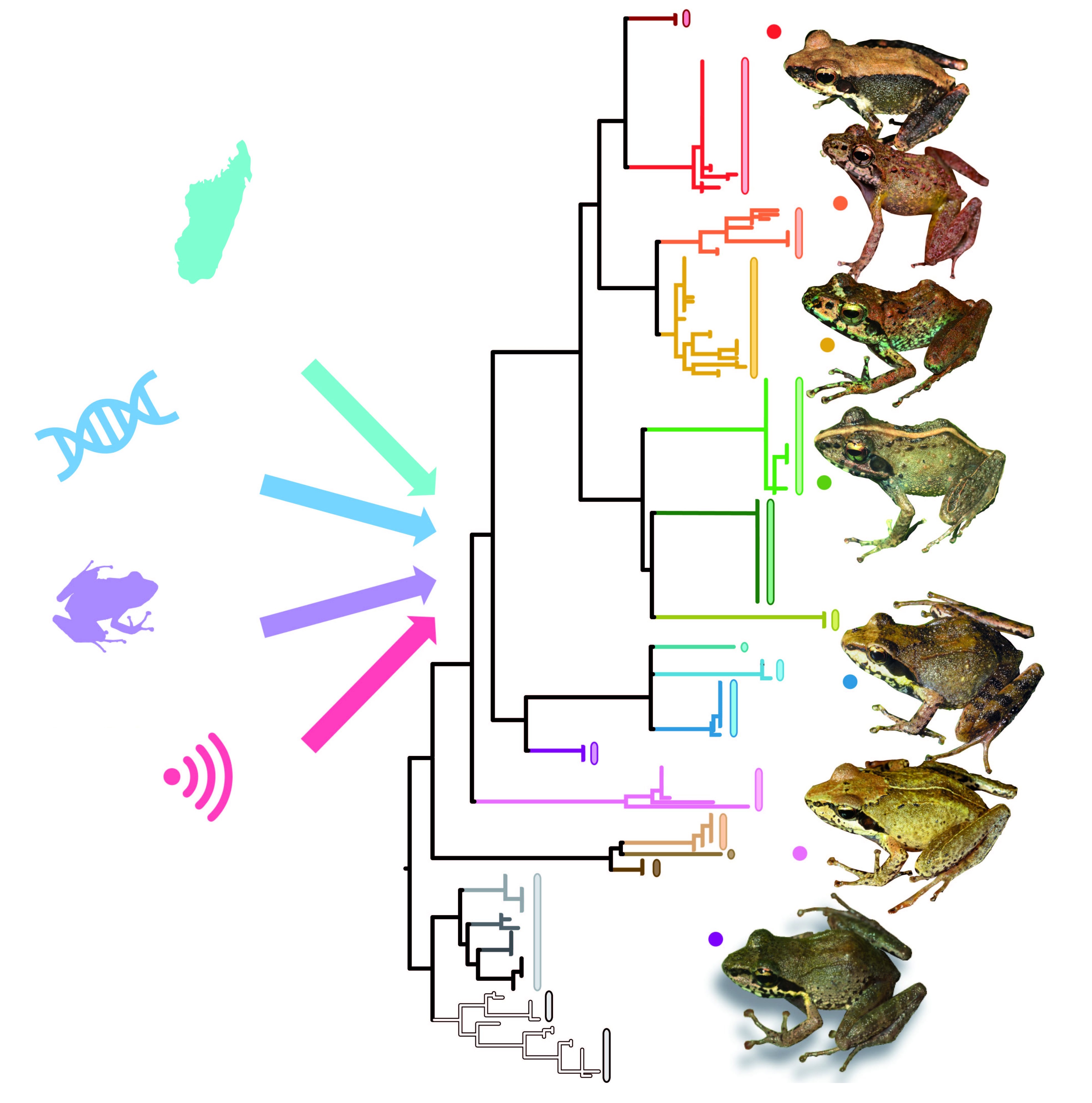
Overview of the best Maximum Likelihood phylogenetic tree based on the 16S dataset. 

 
Aurélien Miralles, Jörn Köhler, Frank Glaw, Katharina C. Wollenberg Valero, Angelica Crottini, Gonçalo M. Rosa, Louis du Preez, Philip-Sebastian Gehring, David R. Vieites, Fanomezana M. Ratsoavina and Miguel Vences. 2023. An Endless Harvest: Integrative Revision of the Gephyromantis boulengeri and G. blanci Complexes reveals Six New Species of Mantellid Frogs from Madagascar. SALAMANDRA. 59(1): 1–41. 
 isyeb.mnhn.fr/fr/actualites/il-reste-encore-tant-despeces-decouvrir-lexemple-des-grenouilles-de-madagascar-8928