Showing posts with label Clariidae - Walking catfish. Show all posts

Friday, January 27, 2023

[Ichthyology • 2023] Horaglanis populiEvolution in the Dark: Unexpected Genetic Diversity and Morphological Stasis in the Blind, Aquifer-dwelling Catfish Horaglanis (Siluriformes: Clariidae)


Horaglanis populi
Raghavan, Sundar, Arjun, Britz & Dahanukar, 2023
 

Abstract
The lateritic aquifers of the southern Indian state of Kerala harbour a unique assemblage of enigmatic stygobitic fishes which are encountered very rarely, only when they surface during the digging and cleaning of homestead wells. Here, we focus on one of the most unusual members of this group, the catfish Horaglanis, a genus of rarely-collected, tiny, blind, pigment less, and strictly aquifer-residing species. A six-year exploratory and citizen-science backed survey supported by molecular phylogenetic analysis reveals novel insights into the diversity, distribution and population structure of Horaglanis. The genus is characterized by high levels of intraspecific and interspecific genetic divergence, with phylogenetically distinct species recovered above a 7.0% genetic-distance threshold in the mitochondrial cytochrome oxidase subunit 1 gene. Contrasting with this deep genetic divergence, however, is a remarkable stasis in external morphology. We identify and describe a new cryptic species, Horaglanis populi, a lineage that is the sister group of all currently known species. All four species are represented by multiple haplotypes. Mismatch distribution reveals that populations have not experienced recent expansions.

KeywordsCryptic species, groundwater, Kerala, molecular ecology, stygobitic, subterranean


Horaglanis populi in life. B Typical laterite rock showing tiny pores. C Homestead lateritic dug-out well in Kerala – habitat of Horaglanis.


Horaglanis populi holotype (KUFOS.F.2022.101, 32.5 mm standard length) in A life and B–F immediately after preservation.
A, B Lateral view; C ventral view; D dorsal view; E lateral view of head; F ventral view of head.

Horaglanis populi, sp. nov. 

Diagnosis: A species of Horaglanis as evidenced by the absence of eyes and pigment, a blood-red body in life, a highly reduced pectoral fin in which only a shortened spine is present, an elongate body with long dorsal and anal fins extending to the base of the caudal peduncle, and four pairs of well-developed barbels. Genetically, Horaglanis populi forms a distinct clade, the sister group to the other three congeners (Fig. 2), from which it differs by a genetic uncorrected p distance of 13.8–17.4% in the COI gene, and between 12.3–14.0% in the cyt b gene. Specifically, H. populi differs from all three known species in the barcoding gene (Supplementary Table S4) in positions 106 (C vs. T), 115 (T vs. C), 142 (T vs. C), 171 (G vs. A), 183 (T vs. C), 216 (A vs. C or T), 234 (C vs. T), 237 (G vs. A), 265 (T vs. G), 270 (C vs. A), 312 (A vs. C or T), 324 (A vs. C), 325 (T vs. C) 330 (G. vs. A or T), 350 (G vs. T), 363 (T vs. G), 421 (C vs. G), 448 (C vs. T), 481 (G vs. T), 489 (C vs. T), 496 (A vs. G), 517 (c vs. T), 528 (G vs. T), 533 (G vs. A), 538 (A vs. C), 539 (A vs. G), 542 (T vs. C), 565 (T vs. A), 576 (G vs. T or C), 597 (A vs. C), 618 (C vs. T), 633 (G vs. A) and 636 (C vs. T).

EtymologyThe species name populi, genitive of the Latin noun populus people, honours the invaluable contributions made by interested members of the public in the southern Indian state of Kerala, helping to document the biodiversity of subterranean and groundwater systems, including the discovery of this new species.


Rajeev Raghavan, Remya L. Sundar, C.P. Arjun, Ralf Britz and Neelesh Dahanukar. 2023. Evolution in the Dark: Unexpected Genetic Diversity and Morphological Stasis in the Blind, Aquifer-dwelling Catfish Horaglanis. Vertebrate Zoology. 73: 57-74. DOI: 10.3897/vz.73.e98367


Monday, November 28, 2022

[Ichthyology • 2022] Clarias monsembulai • A New Species of Air-Breathing Catfish (Siluriformes: Clariidae: Clarias) from Salonga National Park, Democratic Republic of the Congo


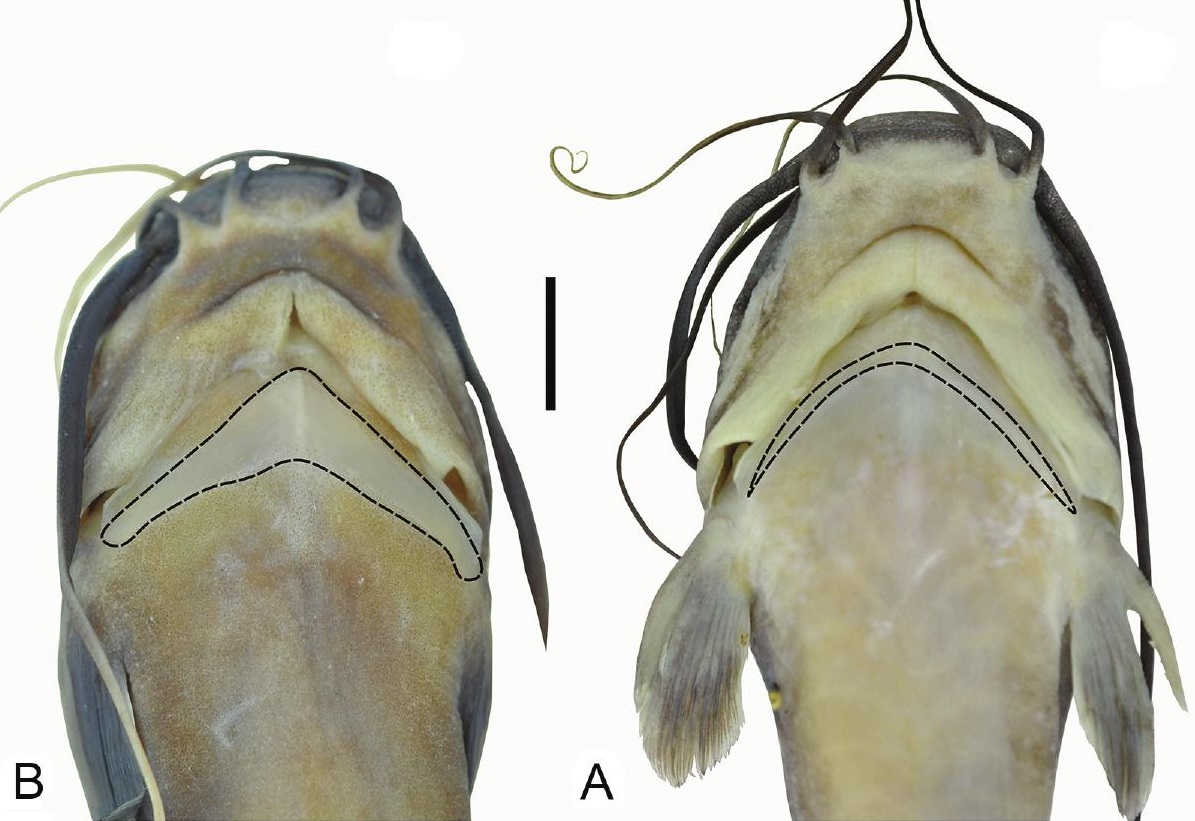
  B, Clarias monsembulai Bernt & Stiassny, 2022
A, Clarias buthupogon Sauvage, 1879
 
 DOI: 10.1206/3990.1 

Abstract
A new species of air-breathing catfish, Clarias monsembulai, is described from Congo River tributaries within and bordering the Salonga National Park (Democratic Republic of the Congo). The new taxon is recognized by its exceptionally long, white barbels, which lend a superficial resemblance to Clarias buthupogon, from which it differs in characters of the cleithrum and pigmentation patterning. We suggest placement of this species into the subgenus Clarioides but note the current dearth of morphological data to unite members of this group. We additionally discuss the validity of the subspecies Clarias angolensis macronema.

Lateral view of Clarias monsembulai new species, holotype AMNH 244176, 226 mm SL. Luilaka River at Ilenge, Salonga National Park. Scale bar = 1 cm.

Exposed cleithrum (demarcated by dashed line) of A, Clarias buthupogon, AMNH 227571, 162 mm SL and B, Clarias monsembulai, AMNH 244162, 183 mm SL. Scale bar = 1 cm

Clarias monsembulai, new species
 
Diagnosis: Clarias monsembulai can be distinguished from all congeners, with the exception of C. buthupogon, by its exceptionally long maxillary barbels (60% of standard length or greater) vs. maxillary barbels less than 60% SL (usually considerably less). It differs from C. buthupogon in the absence of fine, pale spots over the surface of the body and by an exposed bony surface of the cleithrum reaching 14%–20% of head length (vs. cleithrum deeply imbedded in soft tissue with only a narrow bony ridge visible externally). Clarias monsembulai can be further differentiated from C. angolensis, the species with which it shares closest phenotypic similarity, by longer nasal barbels (37%–51% SL vs. 22%–34% SL), longer internal mandibular barbels (29–37% SL vs. 16–27% SL), longer external mandibular barbels (45%–57% SL vs. 24%–40% SL); and by the coloration of maxillary barbels which are white or cream-colored distally over more than half of their length (vs. brown or gray over more than half their length).

Distribution: The species is currently known only from the Momboyo, Luilaka, Salonga, and Yenge river systems within the Cuvette Centrale of the middle Congo River Basin (fig. 6). However additional collecting throughout the region will likely extend this range (E. Decru, personal commun.).

Etymology: Named in honor of Raoul Monsembula Iyaba (professor of biology, University of Kinshasa) for collecting the type series of this species, and in recognition of his substantial contributions to central African ichthyology.  


 Maxwell J. Bernt and Melanie L.J. Stiassny. 2022. A New Species of Air-Breathing Catfish (Clariidae: Clarias) from Salonga National Park, Democratic Republic of the Congo. American Museum Novitates, (3990); 1-20. DOI: 10.1206/3990.1 
  greenpeace.org/africa/en/press/52281/say-hi-to-clarias-monsembulai-new-fish-species-discovered-in-the-congo-river

Sunday, July 30, 2017

[Ichthyology • 2017] Pseudotanganikallabes prognatha • A New Diminutive Genus and Species of Catfish (Siluriformes: Clariidae) from Lake Tanganyika


Pseudotanganikallabes prognatha Wright, 2017

  DOI: 10.1111/jfb.13374 

Abstract

The examination of material representing one of Lake Tanganyika's six previously recognized endemic catfish lineages, has revealed the presence of an additional genus of clariid, described here as Pseudotanganikallabes new genus. This genus is represented by a single species, Pseudotanganikallabes prognatha sp. nov., which is distinguished from all other clariids by its lack of an infraorbital series, the presence of multiple osseous connections between the swim bladder capsules and elements of the neurocranium, the absence of an ethmoid notch, the presence of a very large, egg-shaped occipital fontanelle and the extension of the lower lip beyond the margin of the upper jaw. A combination of additional external and molecular characters serves to further distinguish this taxon from all currently recognized clariid species. Phylogenetic analysis of mitochondrial (cytb) and nuclear (18S-ITS1-5.8S-ITS2-28S) sequence data supports the creation of a new genus for this species, as it appears to represent an independent, monophyletic lineage within the family Clariidae.

Key words: Africa; catfish; Clariidae; Lake Tanganyika; rift lake; taxonomy.


Fig. 4. (a) Dorsal, (b) lateral and (c) ventral views of the holotype of Pseudotanganikallabes prognatha (SAIAB-80226). Scale bar = 1 cm. 

PSEUDOTANGANIKALLABES GEN. NOV. 
Type species: Pseudotanganikallabes prognatha new genus and species.
Content: Pseudotanganikallabes prognatha sp. nov.; monotypic

Etymology: From the Greek pseudo (𝜓𝜀𝜐𝛿ή𝜍), meaning lying or false and the genus Tanganikallabes, in reference to the superficial resemblance between these two genera. Gender: feminine.

Geographical distribution: All known specimens referred to Pseudotanganikallabes were collected on the southeast, Zambian coast of Lake Tanganyika.


PSEUDOTANGANIKALLABES PROGNATHA SP. NOV. 

Etymology: The specific epithet is derived from the prefix pro, in this case meaning anterior to and the Greek gnathos (𝛾ν΄𝛼𝜃o𝜍), meaning jaw, in reference to the distinctive protrusion of the lower jaw of this species. Gender: feminine.

Distribution: Currently known from localities along the southeastern coast of Lake Tanganyika: .... East of Mpulungu.


J. J. Wright. 2017. A New Diminutive Genus and Species of Catfish from Lake Tanganyika (Siluriformes: Clariidae).  Journal of Fish Biology. DOI: 10.1111/jfb.13374