Showing posts with label Integrative Taxonomy. Show all posts

Wednesday, September 24, 2025

[Paleontology • 2025] Joaquinraptor casali • Latest Cretaceous megaraptorid theropod Dinosaur sheds light on megaraptoran evolution and palaeobiology

 
Joaquinraptor casali 
Ibiricu, Lamanna, Alvarez, Cerda, Caglianone, Cardozo, Luna & Martínez, 2025 

Artwork by  Andrew McAfee

Abstract
Recent fossil discoveries have cast considerable light on the palaeobiology of Megaraptora, a group of large-clawed carnivorous theropod dinosaurs known from Cretaceous deposits in Asia, Australia, and especially South America. Nevertheless, many important aspects of megaraptoran morphology and evolution remain poorly understood, due in large part to the fragmentary nature of most fossils of these theropods and the scarcity of anatomically overlapping skeletal elements among the known taxa. Here we report a previously unknown megaraptoran genus and species represented by a partially articulated partial skeleton recovered from an uppermost Cretaceous stratum of the Lago Colhué Huapi Formation of south-central Chubut Province in central Patagonia, Argentina. Pertaining to the derived megaraptoran subclade Megaraptoridae, the taxon is among the most completely represented and latest-surviving megaraptorans. Its stratigraphic occurrence indicates that these dinosaurs likely persisted to the Cretaceous/Palaeogene boundary; moreover, the preservation of a crocodyliform humerus between the dentaries of the new theropod may provide information on megaraptoran dietary preferences and feeding strategies. Megaraptorids appear to have been the apex predators in central and southern Patagonian palaeoecosystems approaching the end of the Cretaceous, in contrast to more northerly areas of South America where these niches were occupied by other non-avian theropod groups.


 Osteology of Joaquinraptor casali gen. et sp. nov.
a Skeletal reconstruction of Joaquinraptor in left lateral view with preserved elements in blue (some reversed from right side) (modified and updated from Lamanna et al.7 [these authors’ Fig. 1e], which was in turn modified by A. McAfee from an original illustration by T.K. Robinson). Right maxilla in lateral (b) and medial (c) views. Skull roof, braincase, and atlantal intercentrum in dorsal (d) and ventral (e) views. f Probable right postorbital in lateral view. g Right quadrate in anterior view. Right and left dentaries in lateral and medial views (right dentary in lateral view and left dentary in medial view in h; opposite in i). j Two articulated middle or posterior caudal vertebrae in right lateral view. k Dorsal rib in anterior view. l Anterior haemal arch in anterior view. m Left scapulocoracoid in lateral view. Left humerus in anterolateral (n), lateral (o), and medial (p) views. Left radius in anterior (q) and lateral (r) views. Left ulna in lateral (s) and posterior (t) views. u Right manual ungual II (=manual phalanx II-3) in lateral view. Left femur in anterior (v) and posterior (w) views. x Distal right tibia in anterior view. y Right pedal ungual III (=pedal phalanx III-4) in medial view. Dashed lines indicate missing areas of scapulocoracoid and femur.

Systematic palaeontology
Saurischia Seeley, 1887 
Theropoda Marsh, 1881 
Tetanurae Gauthier, 1986 

Megaraptora Benson, Carrano, and Brusatte, 2010 
Megaraptoridae Novas, Agnolín, Ezcurra, Porfiri, and Canale, 2013 

Joaquinraptor casali gen. et sp. nov.

Etymology: Joaquín, in tribute to the son of the first author (L.M.I.) and the informal name given to the locality when the skeleton of the taxon was discovered (Valle Joaquín); Latin, raptor, thief. Specific epithet casali in recognition of Dr. Gabriel Andrés Casal for his many contributions to knowledge of the Cretaceous palaeontology and geology of central Patagonia (including the formal recognition and naming of the formation from which this megaraptorid was recovered).


Joaquinraptor casali with an ancient crocodile relative's front leg in its mouth.
Artwork by  Andrew McAfee

 
Lucio M. Ibiricu, Matthew C. Lamanna, Bruno N. Alvarez, Ignacio A. Cerda, Julieta L. Caglianone, Noelia V. Cardozo, Marcelo Luna and Rubén D. Martínez. 2025. Latest Cretaceous megaraptorid theropod Dinosaur sheds light on megaraptoran evolution and palaeobiology. Nature Communications. 16: 8298. DOI: doi.org/10.1038/s41467-025-63793-5 [23 September 2025]


Sunday, July 13, 2025

[Entomology • 2025] Cotesia ginginensis • A New Species of parasitoid wasp (Hymenoptera: Braconidae: Microgastrinae) from Queensland, Australia


Cotesia ginginensis Fagan-Jeffries & Davies,

in Fagan-Jeffries, Davies et Howe, 2025.

Cotesia Cameron, 1891 is the third largest genus of the braconid subfamily Microgastrinae, both in terms of described species  (>320  worldwide)  and  estimated  true  diversity  (1500+  species)  (Fernández-Triana et  al.  2020).  The  genus  is cosmopolitan  and  has  a  broad  host  range,  with  30  different  families  of lepidoptera  recorded  as  hosts,  and  with  many species acting as important biological control agents of pest lepidopterans (Fernández-Triana et al. 2020). The Australian Cotesia fauna was recently reviewed; there are 22 species currently known from the country, including several species introduced for biological control (Fagan-Jeffries et al. 2024; Fagan-Jeffries & Austin 2020).
 
Whilst there are likely to be many undescribed species of Cotesia in Australia and surrounding regions, we take the opportunity to add a single new species to the list of named biodiversity that was collected as part of a citizen science project, Insect Investigators. This citizen science project (insectinvestigators.com.au) ran in 2022 and involved 50 regional schools in Queensland, South Australia, and western Australia (Howe et al. 2025; insectinvestigators.com.au). Students and teachers ran Malaise traps on or near their school property, the samples were sorted and DNA barcoded, and a selection of specimens were sent to taxonomists to identify or include in current taxonomic projects. Two Queensland schools, gin gin State High School and Prospect Creek State School, each caught a single female specimen of a species in the genus Cotesia. Students and teachers at gin gin State High School collaborated with the authors to name the new species in 2023, and we here formally describe the species and raise the number of Cotesia from Australia to twenty-three.
...

Cotesia ginginensis; holotype.
A. lateral habitus B. fore wing C. dorsal head D. dorsal habitus E. anterior head F. T1 g. metanotum and propodeum.

BRACONIDAE Latreille, 1829
MICROGASTRINAE Foerster, 1862

Cotesia ginginensis Fagan-Jeffries & Davies, sp. nov.  

Diagnosis. Cotesia ginginensis can be separated from all other species of Cotesia currently described from Australia and Papua New guinea by the following combination of characters: mesosoma not dorsal-ventrally flattened (i.e., not as in Cotesia nonagriae (olliff, 1893)); fore wing r vein clearly longer than 2rS (r length >1.4 × length of 2rS); centre of the medial band of the mesoscutellar disc smooth; propodeum strongly sculptured with the medial carina clearly distinct for the whole length; T1 slightly broadening posteriorly but not strongly wedge-shaped (i.e., not as in C. ruficrus (Haliday, 1834)); T2 not strongly sculptured and T3 not densely setose (i.e., not as in C. rubecula (Marshall, 1885)).


Eeinn P. FAGAN-JEFFRIES, Emily DAVIES and Andy G. HOWE. 2025. Cotesia ginginensis sp. nov., A New Species of parasitoid wasp (Braconidae: Microgastrinae) from Queensland, Australia.  Zootaxa. 5660(2); 293-296. DOI: doi.org/10.11646/zootaxa.5660.2.11 [2025-07-09]

Friday, May 2, 2025

[Botany • 2025] Begonia dorisiae & B. medinae • Morphological and Molecular analyses revealed Two New Species of Begonia, sect. Baryandra in the Eastern Mindanao Biodiversity Corridor, Philippines

Begonia medinae Bucay, Tandang & K.F.Chung, 

in BucayTandang, Chen, Tsai, Rubite et Chung, 2025.
 
Abstract
Two new species of Begonia section Baryandra from the province of Davao Oriental, part of the Eastern Mindanao Biodiversity Corridor (EMBC), Philippines are described and illustrated. We compared these species with two other species found in EMBC. Begonia dorisiae resembles B. amparoae but is distinct by tomentose hairs with a bulbous base on the petioles and abaxial side of the lamina. Begonia medinae resembles B. elmeri, both of which are the only peltate Mindanao species to date but is distinct mainly on the dense pilose hairs on its lamina, petioles and peduncles. Analyses of the Internal Transcribed Spacer (ITS1, ITS2 and 5.8S gene) sequences of these Eastern Mindanao species, combined with other 45 Philippine sect. Baryandra species and 10 other Asian species support the distinction of the two new species from their congeners. The phylogenetic placement of these plants alongside other Philippine species can further shed light on the intricate biogeographic patterns of Philippine wildlife, especially on areas less studied such as EMBC.

Archipelago, Begoniaceae, island endemicity, orogeny, species radiation, taxonomy, Eudicots

Begonia dorisiae Bucay, Tandang & K.F.Chung.
A. Limestone wall habitat; B. Habit; C-D. Stipules; E. Petiole; F. Petiole close up showing hairs with bulbous base; G. Leaf base; H. Lamina; I. Bracts; J. Inflorescence; K. Staminate flower; L. Anthers; M. Pistillate flower; N. Pistillate flower showing ovary.

Begonia dorisiae Bucay, Tandang & K.F.Chung, sp. nov. 
§ Baryandra

Diagnosis:—Begonia dorisiae resembles B. amparoae, another species in Eastern Mindanao island by its overall foliage size and color and similar male flowers, but differs in having dense, dark brown tomentose hairs on the petioles (vs. sparse red hairs to glabrous in B. amparoae), entire, glabrous leaf margins (vs. denticulate, ciliate margins), tomentose hairs on the abaxial side of lamina (vs. glabrous), rectangular bracts with an inequilaterally acuminate to acute apex (vs. widely ovate, obtuse apex) and crescent shaped capsule wing with rounded apex (vs. rectangular with truncated apex). Other differences are summarized in Table 3.
...

Etymology:—The specific epithet dorisiae is a tribute to broadcaster Doris Bigornia whose name became an informal, yet very useful monicker of the genus Begonia especially for local communities. Many Filipino botanists, particularly in this series of expeditions, find that the easiest way to make citizens remember the genus Begonia is to associate it with ‘Bigornia’. Across different islands and demographics, the best way to capture citizens’ interest when communicating the biology of Philippine Begonia is, in fact, Doris Bigornia.


Begonia medinae Bucay, Tandang & K.F.Chung.
A. Habit; B. Rhizome; C. Stipules; D. Petioles; E. Adaxial leaf surface; F. Abaxial leaf surface; G. Bracts; H. Leaf margin; I. Staminate flower; J. Pistillate flower; K. Ovary; L. Capsule.

Begonia medinae Bucay, Tandang & K.F.Chung, sp. nov. 
§ Baryandra 

Diagnosis:—Begonia medinae resembles B. elmeri, another species originally described in Agusan del Norte, also part of the Eastern Mindanao Biodiversity Corridor. Both species are the only peltate species described from the island to date. However, B. medinae is significantly different from B. elmeri in terms of vestition. A distinctive character of B. medinae is the dense white pilose hairs on the lamina (vs. glabrous to sometimes sparsely ciliate in B. elmeri). Begonia medinae also has the same hairs in the petioles (vs. fulvus hairs), and peduncle (vs. glabrous). Other differences are summarized in Table 4.
...

Etymology:—The specific epithet “medinae” is to acknowledge the Filipino entomologist Dr. Milton Medina who originally observed this Begonia during their biodiversity studies in the area. This also commemorates their efforts in their conservation studies of the Philippine biodiversity, particularly the ecosystems in Davao Oriental province and the whole of Mindanao Island.


Mark Angelo C. BUCAY, Danilo N. TANDANG, Hong-Wun CHEN, Li-Wei TSAI, Rosario R. RUBITE and Kuo-Fang CHUNG. 2025. Morphological and Molecular analyses revealed Two New Species of Begonia sect. Baryandra in the Eastern Mindanao Biodiversity Corridor, Philippines. Phytotaxa. 698(4); 245-256. DOI: doi.org/10.11646/phytotaxa.698.4.4 [2025-05-02]
  facebook.com/philcolsoc/posts/122196806180094735

Monday, April 28, 2025

[Botany • 2025] Begonia gigang (Begoniaceae, sect. Petermannia) • A New Species from Zamboanga Peninsula, Mindanao Island, Philippines


Begonia gigang Mazo & Rubite, 

in Mazo et Rubite, 2025. 

Abstract
A new species of Begonia from Zamboanga del Norte, Mindanao Island, Philippines, is described. Begonia gigang is morphologically similar to Begonia corazoniae but can be distinguished by having smaller leaves which are hirsute on both surfaces, longer panicles and peduncles, shorter pedicels for both staminate and pistillate flowers, and trigonous-ellipsoid ovary. Begonia gigang is assessed as Endangered under the IUCN Red List Categories and Criteria. A detailed description, photographs, and ecological notes, and are provided.

Keywords: Begonia corazoniae, Begonia tinuyopensis, endangered, endemic, taxonomy

Begonia gigang Mazo & Rubite.
A. Habit; B. Leaf adaxial surface; C. Leaf abaxial surface showing leaf margin; D. Stem and stipules; E. Staminate and pistillate flowers, inset 3-tepaled staminate flower; F. Cross-section of the ovary; G. Capsules.
All from K. R. F. Mazo 112.

Begonia gigang
 
Mazo & Rubite, sp. nov.  
Section Petermannia

Diagnosis: A species similar to Begonia corazoniae Naive (Naive et al. 2024) in having lamina with greenish to yellowish spots and variegations on the veins but differs in having smaller leaves (10.0–14.5 × 5–7 cm vs. up to 21 × 10.0–13.3 cm) which are hirsute on both surfaces (vs. glabrous), longer panicles and peduncles (15–23 cm vs. 8–13 cm; 9–12 cm vs. up to 4 cm), shorter pedicels for both staminate and pistillate flowers, and trigonous-ellipsoid ovary (vs. trapezoid to obovoid).

Etymology: The specific epithet is derived from the Subanen dialect refers to the rock formations where the new species was found.
 
 
Kean Roe F. Mazo and Rosario R. Rubite. 2025. Begonia gigang (section Petermannia: Begoniaceae), A New Species from Zamboanga Peninsula, Mindanao Island, Philippines. Webbia. Journal of Plant Taxonomy and Geography. 80(1); 89-94. DOI: doi.org/10.36253/jopt-17444 [2025-04-17]

Sunday, April 27, 2025

[Ichthyology • 2025] Imparfinis arceae • Integrative Taxonomy Reveals a New Species of Imparfinis (Siluriformes: Heptapteridae) from the Upper Xingu River Basin


Imparfinis arceae
 Silva, Sabaj, Carvalho & Oliveira, 2025 


Abstract  
Imparfinis is a genus of small catfishes with 21 valid species broadly distributed throughout the main river basins of the Neotropical region. Here, a new species of Imparfinis is described from the headwaters of the Rio Xingu. The new species is distinguished from its congeners by the presence of a wide dark stripe from snout tip to caudal peduncle sharply contrasting pale underside and aligned with dark stripe centered on dorsal portion of lower caudal-fin lobe, 11–12 gill rakers on the first ceratobranchial, 39 vertebrae, maxillary barbel surpassing vertical through dorsal-fin origin, and absence of short, flexible extension of the anteriormost pectoral, dorsal, and upper caudal-fin rays. In addition, assemble species by automatic partitioning (ASAP) and the Poisson tree processes model (bPTP) analyses support the validity of this new species. Our molecular phylogeny based on the cytochrome c oxidase subunit 1 mitochondrial gene (COI) corroborates the placement of the new species in Imparfinis and its close relationship with I. guttatus. Species delimitation in Imparfinis is discussed.

Imparfinis arceae
Left column: holotype, MCP 55325, 47.9 mm SL.
Right column: ANSP 187252, from top to bottom: 50.5 mm SL; 43.9 mm SL; 40.6 mm SL; 36.9 mm SL.


Imparfinis arceae, new species 

Etymology.—The specific name, arceae, honors Dr. Mariangeles Arce Hernández, Executive Director of the Center for Systematic Biology and Evolution at The Academy of Natural Sciences of Drexel University, for her valuable contributions to studies of the systematics and evolution of catfishes. A genitive noun.
 

Gabriel de Souza da Costa e Silva, Mark Henry Sabaj, Kaylane Rodrigues de Carvalho and Claudio Oliveira. 2025. Integrative Taxonomy Reveals a New Species of Imparfinis (Siluriformes: Heptapteridae) from the Upper Xingu River Basin. Ichthyology & Herpetology. 113(1); 143-153. DOI: doi.org/10.1643/i2023097 (3 April 2025) 

Saturday, September 28, 2024

[Ichthyology • 2024] Lefua nishimurai • Integrative Taxonomy revealed A New Species of Lefua (Cypriniformes: Nemacheilidae) from Fukui Prefecture, central Japan


Lefua nishimurai Katayama, 

in Katayama et Sawada, 2024. 

Abstract
Eight-barbel loaches belonging to the genus Lefua have diverged into seven species in freshwaters of East Asia. Recent studies have discovered a new population in the Kuzuryu River drainage system of Fukui Prefecture, central Japan. Based on the results of the genetic analyses and morphological comparisons, we describe this population as a new species, Lefua nishimurai sp. nov. Body width, interorbital width, orbit diameter, preanal length, snout length, and the newly examined head width greatly contributed to the discrimination between L. torrentis, L. tokaiensis and L. nishimurai sp. nov. The new species can be distinguished from other congeners by combining the following characteristics: 1) eyes positioned dorsally on the head; 2) a narrow conspicuous longitudinal mark between the base of the outer rostral barbel and the eye; 3) small dark spots on the body, dorsal, and caudal fins; 4) a small dorsal fin and eye diameter; and 5) black spots above and below the base of the caudal fin. Based on the phylogenetic relationships of the genus, L. nishimurai sp. nov. is estimated to have diverged early from its common ancestor in central Japan. Understanding the natural history of this new species and implementing conservation measures are crucial because of its narrow, fragmented distribution and presence in vulnerable habitats.

Key Words: endangered species, freshwater fish, inland water, nemacheilid loach, nuclear phylogeny, species richness

Body coloration of the holotype of Lefua nishimurai sp. nov. (LBM 1210059189).
A. Lateral view; B. Dorsal view; C. Ventral view. Scale bar: 10 mm.

 Lefua nishimurai Katayama, sp. nov.
 New Standard Japanese name: Reihoku-nagare-hotoke-dojyô

Diagnosis: Lefua nishimurai sp. nov. can distinguished from all other species of Lefua by combing following features: absence of rhomboid or triangular dark blotches on middle of caudal fin base; absence of black longitudinal stripe on both body sides in mature males; absence of dusky cross bars on dorsal area of body; absence of dusky bar beside dorsal fin base; eyes located dorsally on head; narrow conspicuous longitudinal mark between base of outer rostral barbel and eye; small dorsal fin; small orbit diameter (6.3–11.2% of head length); small value of interorbital width relative to body width (28.1–39.4%); dark spots dorsally and ventrally on caudal fin base; small dark brown spots from snout to caudal peduncle; small dark spots on dorsal and caudal fins (approximately same size as eyes).

Etymology: The specific name is dedicated to Toshiaki Nishimura, who first morphologically distinguished this new species.

Comparison of body morphology and coloration of three Lefua species.
A. Kii-Shikoku Population of L. torrentis (FAKU 211486); B. Sanyo Population of L. torrentis (FAKU 211492); C. Nihonkai Population of L. torrentis (FAKU 211504);
D. L. tokaiensis (FAKU 211510); E. Lefua nishimurai sp. nov. (LBM 1210059189).
Scale bar: 10 mm.


 Yuta Katayama and Naoto Sawada. 2024. Integrative Taxonomy revealed A New Species of Lefua (Teleostei, Nemacheilidae) from Fukui Prefecture, Japan. Evolutionary Systematics. 8(2): 247-260. DOI: doi.org/10.3897/evolsyst.8.131002

Sunday, February 11, 2024

[Herpetology • 2024] Sphaerotheca varshaabhu • A New Species of Burrowing Frog Sphaerotheca Günther, 1859 (Anura: Dicroglossidae) from the suburban landscapes of Bengaluru, India


Sphaerotheca varshaabhu
Deepak, Dinesh, Chetan Nag, Ohler, Shanker, Souza, Prasad & Ashadevi, 2024

Varshaa Burrowing Frog  ||  DOI: 10.11646/zootaxa.5405.3.3

Abstract
Recent resolution of prevailing taxonomic ambiguities in the genus Sphaerotheca and new species discoveries from urban/suburban landscapes highlight the need for attention to non-forested habitats for amphibian conservation. In this paper, we review the status of the members of the genus Sphaerotheca and justify the synonymy of Sphaerotheca magadha as a junior synonym of Sphaerotheca swani. The prospects of resurrection of Sphaerotheca swani (herein preliminarily referred to as Sphaerotheca cf. breviceps [swani]) are discussed. In addition, we describe a new species Sphaerotheca varshaabhu sp. nov. from the suburban region of Bengaluru, India. We employ an integrative taxonomic approach to characterize the new species using molecular phylogeny, genetic distance, morphological characters, and geographical isolation as lines of evidence. We also provide a description of vocal repertoire of Sphaerotheca varshaabhu sp. nov. and provide comparative bioacoustics data for four species. This previously undescribed species from the suburban areas of Bengaluru described herein as Sphaerotheca varshaabhu sp. nov. forms a genetically divergent lineage and its genetic distance varied from 3.6% to 12.2% for 16S rRNA with respect to other species of Sphaerotheca. Our phylogenetic analysis for the genus including the new species confirms the synonymy of one recently described species, resulting in 10 valid species in the genus Sphaerotheca. These results emphasize the need for utilizing an integrative taxonomic approach for uncovering hidden diversity of suburban areas. Given these recent discoveries, we advocate for more robust surveys in human dominated areas, so that these amphibians may receive more attention.

Bengaluru city, Burrowing frogs, Deccan Plateau, new species, bioacoustics, suburban, synonymy


 Sphaerotheca varshaabhu sp. nov. in life from the type locality
A. male; B. female.

Sphaerotheca varshaabhu sp. nov.

Etymology: The specific epithet is derived from the Sanskrit name ‘Varshaabhu’, (Varshaa, rain; Bhu, taking birth) signifying the breeding activity of the species only during the rains. The species epithet is treated as a noun in opposition to the generic name. Suggested common name: “Varshaa Burrowing Frog”.


P. Deepak, K.P. Dinesh, K.S. Chetan Nag, Annemarie Ohler, Kartik Shanker, Princia D Souza, Vishal Kumar Prasad and J.S. Ashadevi. 2024. Discovery and Description of A New Species of Burrowing Frog Sphaerotheca Günther, 1859 (Anura: Dicroglossidae) from the suburban landscapes of Bengaluru, India.  Zootaxa. 5405(3); 381-410. DOI: 10.11646/zootaxa.5405.3.3

Thursday, April 8, 2021

[Crustacea • 2021] Caridina incolor • Integrative Taxonomy uncovers A New Stygobiotic Caridina Species (Decapoda, Caridea, Atyidae) from Guizhou Province, China


Caridina incolor 
 Feng, Chen & Guo, 2021


Abstract
Collecting much-needed information on the taxonomy, distribution, and ecology of cave-dwelling shrimp is vital for addressing the urgent challenges in conservation biodiversity in fragile cave ecosystems. Caridina incolor sp. nov., a new atyid shrimp from an underground stream of Yaoshui Cave, Daqikong scenic area, Libo County, Guizhou Province, southwestern China is described based on morphology and DNA analysis (mitochondrial COI). Caridina incolor sp. nov. differs from epigean congeners by its smaller eyes which range from reduced to completely blind; colorless body and appendages; long stylocerite and sixth abdominal segment; and relatively large eggs. In comparison to other cave species, Caridina incolor sp. nov. presents a long rostrum and stylocerite; slender sixth abdominal segment; and unique shape of the appendix masculina. Data on the habitat, ecology, and levels of threat are provided and suggest that it should be categorized as Critically Endangered (CR) under the current IUCN criteria.

Keywords: Caridina, COI, conservation biodiversity, freshwater biodiversity, southwestern China, speleology, taxonomy

Figure 1. Type locality and schematic diagram of the cave of Caridina incolor sp. nov.
A Yaoshui Cave is located near Libo County and is marked by the red dot B the sampling point of shrimp C the sampling point of fish D side view of the cave E plan view of the cave F a pool in a weak light zone G river in the dark zone.

Figure 5. Habitats, variable features, and live coloration of Caridina incolor sp. nov.
 A surrounding environment of Yaoshui Cave during the dry season B same site during the rainy season C–E variable rostrum and eye size in life F ovigerous female in life.

Caridina incolor 

Diagnosis: Body and appendages without coloration, translucent. Rostrum slender, slightly elevated at base, reaching to base of 3rd segment of antennular peduncle to end of scaphocerite; straight, slightly sloping downwards, sometimes with tip turned upwards; rostral formula 6–10+11–27/4–15. First pereiopod carpus 0.83–0.91 × as long as chela, 2.3–2.7 × as long as high; chela 2.2–2.5 × as long as broad; fingers 1.1–1.4 × as long as palm. Second pereiopod carpus 1.3–1.4 × as long as chela, 5.4–5.6 × as long as high; chela 2.4–2.6 × as long as broad; fingers 1.6–1.8 × as long as palm. Third pereiopod propodus 3.8–4.0 × as long as dactylus, 13.6–14.4 × breadth, with 8–11 thin spines on the posterior and lateral margins. Fifth pereiopod propodus 4.0–4.7 × as long as dactylus, 17.6–20.5 × breadth, with 17–20 thin spines on the posterior and lateral margins, dactylus terminating in one claw, with 50–55 spinules on flexor margin. Endopod of male subrectangular, slightly wider proximally, length 0.39–0.46 × exopod length, 2.0–2.2 × proximal breadth, ending broadly rounded; inner margin slightly concave, bearing spine-like setae, outer margin slightly convex, proximally 1/3 bearing nearly equal length short spine-like setae, distally 2/3 bearing nearly equal length long spine-like setae, and top bearing nearly equal length stout spine-like setae; appendix interna well developed, arising from distal 1/3 of endopod, beyond the end of endopod, distally with cincinulli. Appendix masculina rod-shaped and gradually tapering into a triangular tip, reaching about 0.48–0.51 × length of endopod, with numerous long spined setae on proximal and distal regions; endopod reaching about 0.76–0.79 × length of exopod; appendix interna well developed, reaching about 0.58–0.78 × length of appendix masculina, with cincinulli distally. Uropodal diaeresis with 10–12 movable spinules. Females carry 10–15 eggs, size of undeveloped eggs (without eyespots) 0.83–0.88 × 1.18–1.26 mm.

Etymology: Caridina incolor sp. nov. is named after the colorless and transparent body color.


 Shuo Feng, Qing-Hua Chen and Zhao-Liang Guo. 2021. Integrative Taxonomy uncovers A New Stygobiotic Caridina Species (Decapoda, Caridea, Atyidae) from Guizhou Province, China. ZooKeys. 1028: 29-47. DOI: 10.3897/zookeys.1028.63822


Tuesday, March 16, 2021

[Herpetology • 2021] Phyllodactylus cleofasensis • A New Species of Leaf-toed Gecko (Phyllodactylidae, Phyllodactylus) from María Cleofas Island, Nayarit, Mexico


Phyllodactylus cleofasensis 
 Ramírez-Reyes, Barraza-Soltero, Nolasco-Luna, Flores-Villela & Escobedo-Galván, 2021


Abstract
We describe a new species of leaf-toed gecko of the genus Phyllodactylus from María Cleofas Island, the smallest island of Tres Marías Archipelago, Nayarit, México. Genomic, phylogenomic, and morphological evidence support that the new species presents a unique combination of diagnostic characters. Morphologically, the new species has a high number of tubercles, head to tail (mean 47), longitudinal ventral scales (mean 61), and third labial–snout scales (mean 26). Gene flow tests revealed the genetic isolation of insular populations from mainland counterparts. In addition, we confirmed the non-monophyly of P. homolepidurus and P. nolascoensis, and we show that the taxon P. t. saxatilis is a complex; therefore, we propose taxonomic changes within the saxatilis clade. The discovery of this new insular endemic species highlights the urgency of continued exploration of the biological diversity of island faunas of Mexico.

Keywords: Endemic gecko, genomics, insular species, morphological traits, Tres Marías Archipelago


Figure 7. Dorsal view of Phyllodactylus cleofasensis sp. nov., in life.
(Photo by Armando H. Escobedo-Galván).

Phyllodactylus cleofasensis sp. nov.
  
Phyllodactylus tuberculosus (in part) Wiegmann 1835 (Stejneger 1899)
Phyllodactylus lanei (in part) Smith 1935 (Zweifel 1960)
P. tuberculosus saxatilis (in part) Dixon 1964 (McDiarmid et al. 1976; Casas-Andreu 1992; Woolrich-Piña et al. 2016)

Common name: María Cleofas leaf-toed Gecko, Salamanquesa de la Isla María Cleofas.

Diagnosis: Phyllodactylus cleofasensis is a species of medium to large body size. Snout-vent length of P. cleofasensis measured during fieldwork ranged from 44.8 to 77.0 mm (mean 59.5 mm). Concerning body size, P. cleofasensis differs (in mean size) from P. magnus (73.03), P. nolascoensis (56.29), P. partidus (55.12) and P. saxatilis (65.44). Phyllodactylus cleofasensis has a white venter, variable dorsal coloration, and a greater number of paravertebral dorsal tubercles (mean 47.89). Three meristic characters mainly differentiate P. cleofasensis from the rest of the species of the saxatilis clade (P. saxatilis, P. nolascoensis, P. partidus, P. homolepidurus and Phyllodactylus sp.) (Table 3): paravertebral dorsal tubercles from head to tail (mean 47.89); number of scales across the snout, starting from the 3rd labial scale (mean 26.5); and number of longitudinal ventral scales from an imaginary line of the forelimbs to the cloacal opening (mean 61). Phyllodactylus cleofasensis has the highest values of the mentioned characters, while the rest of the studied species presented lower counts compared to other Phyllodactylus species in Mexico (Tables 2 and 3). The new species has the second highest mean number of dorsal tubercles after P. delcampi (63.4). Other Phyllodactylus species have fewer mean dorsal tubercles (P. paucituberculatus, 28.7; P. duellmani, 37.1; P. bordai, 32.9; P. davisi, 41.6; P. muralis, 33.1; P. homolepidurus, 35.9; P. xanti, 37; P. lanei, 32.4; P. papenfussi, 33.2; P. isabelae, 32.3; P. lupitae, 28.8; P. rupinus, 28; P. benedettii, 28.8; and P. kropotkini, 28.4). Regarding the number of scales crossing the snout, P. cleofasensis has a very similar number of scales to P. muralis (26.1) and P. lupitae (25.5); lower counts occur in P. unctus (21.7), P. paucituberculatus (19.5), P. duellmani (19.9), P. delcampi (21), P. bordai (19.4), P. davisi (23.7), P. muralis (26.1), P. homolepidurus (22.5), P. xanti (16.5), P. lanei (21.6), P. papenfussi (17.8), P. isabelae (21.1), P. rupinus (20.6), P. benedettii (22), and P. kropotkini (20.2). Concerning ventral scales, P. cleofasensis has a mean of 61, similar to three species of the lanei clade (or clade I), namely, P. lupitae (61.5), P. rupinus (62) and P. lanei (62.86). The rest of the Phyllodactylus in Mexico have less than 61 scales: P. kropotkini (60), P. benedettii (59.71), P. xanti (58.75), P. angelensis (56.75), P. davisi (55.5), P. magnus (55.3), P. partidus (55.2), P. saxatilis (55), P. santacruzensis (54), P. muralis (53.9), P. isabelae (53.85), P. nolascoensis (52.75), P. homolepidurus (52.5), P. bordai (51.91), P. bugastrolepis (51.57), P. duellmani (48.75), P. paucituberculatus (48.66), and P. unctus (48.5).

Etymology: Specific epithet is taken from the type locality María Cleofas Island, with the Latin suffix -ensis meaning, “originating from.” Specific epithet is masculine, in agreement with the gender of Phyllodactylus.
 
Figure 2. Vegetation typed on María Cleofas Island
A scrub forest B small area of Rhizophora mangle C tropical sub-deciduous, and D deciduous forest.


 Tonatiuh Ramírez-Reyes, Ilse K. Barraza-Soltero, Jose Rafael Nolasco-Luna, Oscar Flores-Villela and Armando H. Escobedo-Galván. 2021. A New Species of Leaf-toed Gecko (Phyllodactylidae, Phyllodactylus) from María Cleofas Island, Nayarit, Mexico. ZooKeys. 1024: 117-136. DOI: 10.3897/zookeys.1024.60473

Wednesday, January 6, 2021

[Herpetology • 2020] Leptobrachella bashaensis • A New Species of the Genus Leptobrachella Smith, 1925 (Anura, Megophryidae) from Guizhou, China


 Leptobrachella bashaensis 
Lyu, Dai, Wei, He, Yuan, Shi, Zhou, Ran, Kuang, Guo, Wei & Yuan, 2020
 
岜沙掌突蟾  ||  DOI: 10.3897/zookeys.1008.56412

Abstract
Asian leaf-litter toads of the genus Leptobrachella represent charismatic anuran diversification with 80 species, of which 25 are from China. Recent new discoveries suggest that the diversity of this genus is underestimated. Here, we describe a new species of LeptobrachellaLeptobrachella bashaensis sp. nov. from the Basha Nature Reserve, Congjiang County, Guizhou Province, China. The new species is distinguished from its congeners by the following suite of morphological traits: small body size (SVL 22.9–25.6 mm in six adult males and 27.1 mm in one adult female); head longer than wide; dorsal skin slightly shagreened with small tubercles; creamy-white chest and belly with irregular black spots; distinct ventrolateral glands forming a white line; finger webbing and fringes absent; toe webbing rudimentary and lateral fringes narrow; iris bicolored with bright orange in upper half and silver in lower half; dorsal surface of tadpole head dark brown with small, brown, irregular spot, air sac-shaped bulges on both sides of body. The new species differs from all known congeners by an uncorrected p-distance of >5.3% of the 16S rRNA gene fragment examined, and the phylogenetic analysis clusters the new species with L. maoershanensis and L. laui. At present, the new species is only known from a small range of montane evergreen secondary forests in Basha Nature Reserve approximately 900 m elevation. Its natural history and conservation status are discussed.

Keywords: Integrated taxonomy, morphology, tadpole, vocalization


Figure 3. Holotype of  Leptobrachella bashaensis sp. nov. (GIB196403) in life 
A frontolateral view B lateral view C iris coloration D W-shaped marking 
E dorsal view of thighs F posterioventral view of thighs G ventral view H throat view.


Leptobrachella bashaensis sp. nov.
 
Diagnosis: The new species is assigned to the genus Leptobrachella on the basis of the following characters: small size, rounded fingertips, presence of an elevated inner palmar tubercle not continuous to the thumb, presence of supra-axillary, femoral and ventrolateral glands, vomerine teeth absent, tubercles on eyelids, and pale vertical bar present on anterior tip of snout (Dubois 1980, 1983; Ohler et al. 2011; Rowley and Cao 2009; Rowley et al. 2013). Leptobrachella bashaensis sp. nov. is distinguished from its congeners by a combination of the following morphological characters: (1) small size (SVL 22.9–25.6 mm in six adult males and 27.1 mm in one adult female), (2) head longer than wide, (3) externally distinct tympanum, (4) dorsal skin slightly shagreened with small tubercles and irregular brown stripes, (5) distinct dark spots on the flank, (6) creamy-white chest and off-white belly with irregular black spots, (7) grey-pinkish to dark brownish-violet ventral skin of limbs with numerous whitish speckles, (8) distinct ventrolateral glands, forming a distinct white line, (9) finger webbing and fringes absent, (10) toe webbing rudimentary and lateral fringes narrow, (11) longitudinal ridges under toes and not interrupted at the articulations, (12) a distinctly bicolored iris, typically bright orange in upper half, fading to silver in lower half.

Etymology: The specific epithet, “bashaensis”/Basha Zhang Tu Chan (岜沙掌突蟾 in Chinese), refers to the location where the specimens were collected, Basha Nature Reserve of Guizhou Province, China.


Figure 7. Paratypes of  Leptobrachella bashaensis sp. nov. in life (GIB196404).

Figure 8. Habitat at the type locality of  Leptobrachella bashaensis sp. nov., Basha Nature Reserve, Congjiang, Guizhou province, China.

Natural history: All specimens were collected at night in small streams in Basha Nature Reserve approximately 900 m elevation (Fig. 8). Calling males were found along the streams, perching on large rocks, in rocky crevices, or under dead wood. Insect-like calls could be heard in June. The breeding season of this species is likely to occur from June to July, as females collected during these months were gravid, and males were heard calling only from June to the beginning of July. During both surveys, the number of males observed was much greater than females (males:females = 12:1).


Jing-Cai Lyu, Liang-Liang Dai, Ping-Fan Wei, Yan-Hong He, Zhi-Yong Yuan, Wen-Li Shi, Sheng-lun Zhou, Si-yu Ran, Zhong-Fan Kuang, Xuan Guo, Gang Wei and Guo Yuan. 2021. A New Species of the Genus Leptobrachella Smith, 1925 (Anura, Megophryidae) from Guizhou, China. ZooKeys. 1008: 139-157. DOI: 10.3897/zookeys.1008.56412

Wednesday, December 23, 2020

[Herpetology • 2021] A Phantom on the Trees: Integrative Taxonomy Supports A Reappraisal of Rear-fanged Snakes Classification (Dipsadidae: Philodryadini)


Chlorosoma dunupyana 
Melo-Sampaio, Passos, Martins, Jennings, Moura-Leite, ... et Souza, 2021

photo: Germán Chávez  twitter.com/GermnChvez4
 
Abstract
The Neotropics harbour a spectacular amount of biodiversity, but many of these species remain to be discovered and placed into the tree of life. In the neotropical snake genus Philodryas, the systematics of these rear-fanged snakes has been controversial and debated in recent years. Here, we combine published datasets with new morphological (scale microdermatoglyphics, osteology, pholidosis and genital features) and molecular (mitochondrial and nuclear) data to reassess the phylogenetic positioning of rear-fanged snakes within the tribe Philodryadini. We identified putative synapomorphies and pronounced morphological variation in hemipenial features. Our results suggested a need to reclassify many species in order to clarify some relationships within the Philodryas radiation. We also redefined Philodryadini by resurrecting three genera and naming a newly discovered species.

Keywords: Male genitalia, Microdematoglyphics of dorsal scales, Molecular phylogeny, Osteology, Philodryadinii systematics, Soft anatomy


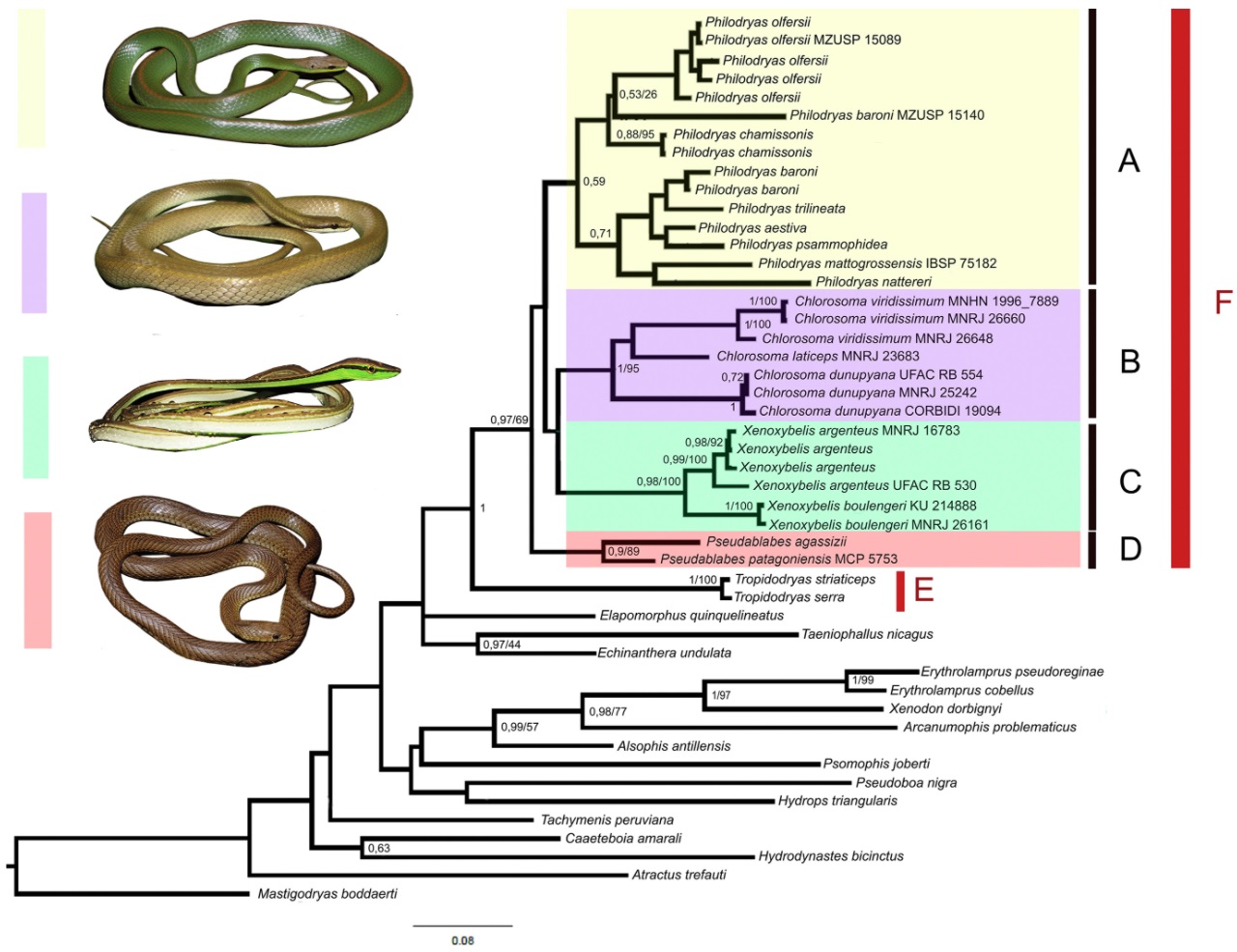
Fig. 1. Phylogenetic relationships of Xenodontinae snakes estimated under a Bayesian framework based on six genes. Posterior probabilities and bootstrap values are separated by slash respectively. Clade A: Philodryas; Clade B: Chlorosoma viridissimum + C. laticeps and C. dunupyana; Clade C: Xenoxybelis; Clade D Pseudablabes; Clade E: Tropidodryadini; Clade F: Philodryadini.
 
Order Squamata Oppel, 1811

Family Dipsadidae Bonaparte, 1838
Subfamily Xenodontinae Bonaparte, 1838

  Genus Pseudablabes Boulenger, 1896 status revalidated

Pseudablabes agassizii (Jan, 1863)
Pseudablabes patagoniensis (Girard, 1858) comb. nov. 

We tentatively include Pseudablabes arnaldoi (Amaral, 1932) comb. nov. in this genus based on overall external similarities (e.g., colour pattern, pholidosis and general habitus), but mainly by sharing unique similarities of hemipenial morphology (Fig. 2).


Fig. 3. Live specimens of Chlorosoma:
 Chlorosoma laticeps [Photo: Arthur Abegg] 
& C. viridissimum (UFAC-RB 359) from Rio Branco, Acre, Brazil.


 Genus Chlorosoma Wagler, 1830 status revalidated
 
Chlorosoma viridissimum (Linnaeus, 1758)
Chlorosoma laticeps (Werner, 1900) comb. nov.

 Genus Xenoxybelis Machado, 1993 status revalidated

Xenoxybelis argenteus (Daudin, 1803) 
Xenoxybelis boulengeri (Procter, 1923)

Chlorosoma dunupyana sp. nov., Adult male paratype (CORBIDI 19094).

Fig. 8. Dorsal (A), lateral (B) and ventral views (C) of the holotype of Chlorosoma dunupyana sp. nov. (UFAC-RB 345) from Parque Zoobotânico, Rio Branco, Acre, Brazil.

Chlorosoma dunupyana sp. nov. 
Taeniophallus brevirostris
(non Peters 1863) Silva et al., 2012:169.

 Etymology: From the Panoan speakers Katukina/Kashinawa Indigenous words dunu (= snake) + pyanã (= venomous) (see Souza et al. 2002), used herein in reference to well-developed Duvernoy’s gland and rear-fang in the posterior portion of maxillary of the newly discovered snake.


Paulo R. Melo-Sampaio, Paulo Passos, Angele R. Martins, W. Bryan Jennings, Julio C. Moura-Leite, Sérgio A. A. Morato, Pablo J. Venegas, Germán Chávez, Nathocley M. Venâncio and Moisés B. Souza. 2021. A Phantom on the Trees: Integrative Taxonomy Supports A Reappraisal of Rear-fanged Snakes Classification (Dipsadidae: Philodryadini).  Zoologischer Anzeiger.  290; 19-39. DOI: 10.1016/j.jcz.2020.10.008