Showing posts with label Ocean Science Foundation. Show all posts

Thursday, April 9, 2026

[Ichthyology • 2021] Lethrinus mitchelli • A New Species of Emperor Fish (Acanthuriformes: Lethrinidae) from Milne Bay Province, Papua New Guinea


Lethrinus mitchelli
Allen, Victor & Erdmann, 2021


Abstract 
A new species of emperor fish, Lethrinus mitchelli, is described on the basis of three specimens, 109.4–111.3 mm SL, collected from 20 m at the East Cape region of Milne Bay Province, Papua New Guinea. It is similar to the sympatric relatives L. semicinctus and L. rubrioperculatus, but differs in color pattern and has a narrower cheek (cheek height 3.2–3.6 in head length vs. 2.4–2.9). Other diagnostic features include head length (2.7 in SL) greater than body depth (3.0–3.1 in SL); the snout excluding the lip 1.3–1.4 in cheek height; the snout profile nearly straight, without a prominent hump, and about 55° to the upper jaw; conical lateral jaw teeth; the interorbital area nearly flat or convex; the fourth dorsal-fin spine longest; lateral-line scales 47; transverse scale rows below and above the lateral line 15 and 4.5 rows; and a fully-scaled area adjacent to the prominent bony spine at the posteriormost margin of the opercle (excluding fleshy flap). The new species has a distinctive color pattern: brown dorsally, whitish ventrally, with a broad, brown, posteriorly tapering band on the midlateral body, partially split anteriorly by a relatively broad, ascending diagonal white band. Lethrinus mitchelli is 6.11% sequence divergent (pairwise) in the mtDNA COI marker from its nearest relative, L. semicinctus, also from the East Indies. A table of COI divergences among mtDNA lineages assigned to 27 of the 28 known species of Lethrinus shows a set of distinctly different lineages, from 3.32% to 20.85% divergent from each other (minimum interspecific distances). 

Key words: taxonomy, ichthyology, phylogenetics, coral reef fishes, Indo-Pacific, DNA barcodes, mtDNA COI 

Lethrinus mitchelli n. sp.
blotchy pattern on rubble bottom, about 200 mm SL, East Cape Region, Milne Bay Province, Papua New Guinea
 preserved holotype, 110.1 mm SL, East Cape Region, Milne Bay Province, Papua New Guinea.
photos: G.R. Allen.

Lethrinus mitchelli n. sp.
[upper] about 200 mm SL, East Cape Region, Milne Bay Prov., Papua New Guinea; 
[lower] blotchy pattern on rubble bottom, about 200 mm SL, East Cape Region, Milne Bay Province, Papua New Guinea.
photos: G.R. Allen


 Allen, G.R., Victor, B.C. and Erdmann, M.V. 2021. Lethrinus mitchelli, A New Species of Emperor Fish (Teleostei: Lethrinidae) from Milne Bay Province, Papua New Guinea. Journal of the Ocean Science Foundation. 38, 66–77. DOI: doi.org/10.5281/zenodo.5172763 

Thursday, July 10, 2025

[Ichthyology • 2025] Eviota vader • A New western Pacific Dwarfgoby (Gobiiformes: Gobiidae) from Papua New Guinea


Eviota vader
 Greenfield, Erdmann & Ichida, 2025


Abstract 
A new species of dwarfgoby, Eviota vader, is described from McLaren Fjord, Tufi, Papua New Guinea. The new species is characterized by a distinctive purplish-black coloration not found on any other species of dwarfgoby. In addition to the unusual color, it is diagnosed by the combination of a complete cephalic sensory-canal pore system, a dorsal/anal fin-formula of 8/7, some branched pectoral-fin rays, the fifth pelvic-fin ray present, and no dark occipital spots or any dark spots at the base of dorsal or caudal fins. The species is apparently endemic to the Tufi region of Papua New Guinea, a location known to have microendemic species. 

Key words: taxonomy, ichthyology, coral-reef fishes, gobies, new species, microendemic, Tufi, black dwarfgoby 


Eviota vader, holotype, CAS 249349, 11.5 mm SL, male,
Tufi, Papua New Guinea
anesthetized and underwater, (photo reversed) (M.V. Erdmann).
preserved holotype, (D.W. Greenfield).

Eviota vader, n. sp. 
Black Dwarfgoby  

Diagnosis. A species of Eviota distinguished from all congeners by a combination of a complete cephalic sensory-canal pore system (pattern 1), a dorsal/anal fin-ray formula 8/7, some pectoral-fin rays branched, fifth pelvic-fin ray present, no dark occipital spots or any dark spots at the base of dorsal or caudal fins, and a broad and fringed male urogenital papilla. Entire body and fins purplish black.

Etymology. The specific epithet is derived from the fictional dark figure Darth Vader in the Star Wars movie franchise (Fig. 3), referring to the fact that it is the darkest of all described dwarfgobies. It is treated as a noun in apposition.
 

David W. Greenfield, Mark V. Erdmann and Nesha K. Ichida. 2025. Eviota vader, A New western Pacific Dwarfgoby from Papua New Guinea (Teleostei: Gobiidae). Journal of the Ocean Science Foundation. 43, 39–44. DOI: 10.5281/zenodo.15786577https://oceansciencefoundation.org/josf43c.html

Friday, June 13, 2025

[Ichthyology • 2025] Prionotus pictus • A New endemic Species of Searobin (Scorpaeniformes: Triglidae) from the Galapagos Islands, Ecuador


Prionotus pictus 
 Victor, 2025


A new endemic searobin, Prionotus pictus n. sp., is described from the Galapagos Archipelago in Ecuador. The prior literature generally assumed that all Prionotus searobins in the archipelago were Prionotus miles, discovered by Charles Darwin on San Cristobal (Chatham Island) and described as endemic by Jenyns (1842). However, almost all underwater photographs from the islands, and surprisingly few museum specimens (three out of dozens), prove to be a quite different-appearing and colorful species. The new species is the island sister species to Prionotus albirostris which is found on deeper trawling grounds along the continental shelf, from Baja California to Peru. The second species found in the Archipelago, Darwin's Prionotus miles, is uncommonly observed, rarely photographed underwater, and so far accounts for only a handful of the hundreds of searobins photographed in Galapagos. The COI mtDNA sequence (DNA barcode) of P. miles shows that it is an island sister species of continental Prionotus stephanophrys (4.87% sequence divergent), which it resembles in a number of basic features, in particular the smooth and gently sloping head and body shape and relatively shorter pectoral fins. A review of the original P. miles holotype and other museum specimens show that P. miles has been inadequately described and guidebooks typically amalgamate and combine characters of the two species, and almost all use photographs of P. pictus to illustrate P. miles. Prionotus pictus is distinguished from P. miles (and P. stephanophrys) by a concave, sharply sloped, duck-billed head profile with more prominent head spines; longer, colorful, and prominently spotted pectoral fins; a triangular spinous dorsal-fin outline with the second spine longest following a stout and serrated first spine of almost the same length; no black blotches on the distal fourth or fifth dorsal-spine membranes; thicker, prominently banded, free pectoral (walking) rays; and a variety of head, fin, and body markings. The new species differs from continental P. albirostris in having a rounded snout (vs. squared off) and distinctive colorful and contrasting patterns (hence pictus meaning 'painted'). It is notable that a large, conspicuous, and relatively common new endemic fish species has eluded recognition for this long.

Key words: taxonomy, ichthyology, tropical eastern Pacific Ocean, coral-reef fishes, marine biogeography, gurnard, Painted Searobin, DNA barcoding, Charles Darwin, Leonard Jenyns
 
Prionotus pictus n. sp.
 Tagus Cove, Isla Isabela, Galapagos Archipelago, Ecuador (Carlos J. Estape).
colorful pattern, Galapagos Archipelago, Ecuador (Roger Uzun, shutterstock.com).

Prionotus pictus n. sp.
 juvenile, Tagus Cove, Isla Isabela, Galapagos Archipelago, Ecuador (Frank Krasovec).
newly settled juvenile, Tagus Cove, Isla Isabela, Galapagos Archipelago, Ecuador (William Bensted-Smith).

Prionotus pictus, n. sp. 
Painted Searobin, Gallineta Pintada

Diagnosis. Dorsal-fin rays X,12; anal-fin rays 11; pectoral-fin rays 14 plus three ventral free rays; pelvic-fin rays I,5; first dorsal fin nearly triangular, first three spines about equal in length, second spine longest, first spine slightly shorter, third spine slighly shorter than second, anterior margin of first spine with pronounced serrations; membranes without a black spot or ocellus specifically on fourth or fifth membranes; pectoral fins fan-shaped semicircular when expanded and long, usually reaching to last third of second-dorsal-fin base or beyond when flat (but variable); snout concave, sharply rising, duck-billed profile, eyes protruding well above profile, snout broadly rounded from dorsal view, no prominent rostral extensions or spiny edges to lachrymal plate; nasal cirrus present, about twice length of nasal opening, no supraocular cirrus; mouth relatively small, lower jaw subterminal and without a knob; head with prominent bony plates, ridges and granulations; head spines comprising preocular, postocular, sphenotic, pterotic, parietal, nuchal, opercular, preopercular (without a supplemental spine), and a cleithral (humeral) spine over pectoral fin (rostral, preorbital, and suborbital spines absent and no postfrontal groove); scales ctenoid and small, about 48 pored lateral-line scales, about 94 vertical rows of lateral scales, nuchal and opercular-flap scales present, ventral scales extend forward just past level of anterior insertion of pelvic fins. Color pattern from common brownish orange pattern to blotched in colors varying from brown to red, to a darker, almost black-and-white pattern; often bright orange ventrally; white patches like splashed paint on head and body in individual unique patterns; a line of prominent white spots highlighting some of the pored lateral-line scales; lip markings a variety of spots and bars (not a simple three dark bands on a white background, at front, middle and corner of jaw); pectoral fin with irregular spot pattern, clearest on common color form, with small rounded spots concentrated on fifth through tenth membranes, becoming reticulations on distal lowermost rays; a thick blue margin on lower 10 rays; pectoral-fin base around origin of rays with an irregular pattern (not discrete rounded spots); caudal fin with dark bars, one at base and a distal wide bar often splitting into two (dark fish can have a black striped pattern); free pectoral-fin rays thick and prominently banded. Juvenile with brown mottled color pattern and relatively longer pectoral fins, reaching past end of second dorsal fin. Newly settled juvenile uniform orangish with two prominent black-edged white saddles along dorsal midline in front of and behind soft-dorsal-fin base; gill rakers short spiny tubercles in two rows of 11, inner and outer, on lower limb of first arch.

Etymology. The species name pictus, Latin for painted, refers to the variegated patterns and colors and individual distribution of colors, with white markings as if splashed with paint. The epithet is considered a masculine adjective.


Benjamin C. VICTOR. 2025. Prionotus pictus, A New endemic Species of Searobin from the Galapagos Islands, Ecuador (Teleostei: Triglidae). Journal of the Ocean Science Foundation. 43, 12-38. DOI: 10.5281/zenodo.15596906
 

Wednesday, December 27, 2023

[Ichthyology • 2023] Tomiyamichthys elliotensis • A New Species of Shrimpgoby (Gobiiformes: Gobiidae) from Lady Elliot Island, Queensland, Australia


Tomiyamichthys elliotensis
Allen, Erdmann & Dudgeon, 2023


A new species of gobiid fish, Tomiyamichthys elliotensis, is described from Lady Elliot Island at the southern end of Australia’s Great Barrier Reef, on the basis of 6 specimens, 32.6–52.7 mm SL. Diagnostic features include a sail-like first dorsal fin without filamentous elements; 10 segmented dorsal and anal-fin rays; 17 or 18 pectoral-fin rays; scales all cycloid, 78–84 lateral and 18–24 transverse scale rows, no prepectoral scales; and a cephalic sensory-canal pore system containing pores B’, C, D, E, F, G, H’, M’, N and O’. The fish is overall whitish with a midlateral row of 4 large, ovate, brown spots; diagonal yellow-orange bands on the first dorsal fin; a brown stripe along the mid-second-dorsal fin; several yellow-orange stripes along the anal fin; and bluish pelvic fins with yellow fin rays. Among the 6 species of Tomiyamichthys that have mtDNA COI sequences, interspecific divergences range from 14.4% to 21.5% and the new species is 18.3% different in COI sequence from its putative nearest relative Tomiyamichthys oni. The habitat of the new species consists of relatively flat, sandy bottoms exposed to periodic strong tidal currents in 15–24 m depths.

Key words: taxonomy, ichthyology, coral-reef fishes, gobies, western Pacific Ocean, DNA barcoding, T. oni.
 

Tomiyamichthys elliotensis, n. sp. 
Lady Elliot Shrimpgoby

Diagnosis. Dorsal-fin elements VI-I,10, no dorsal-fin spine elongated, longest spine 1.0–1.3 in HL; analfin elements I,10; pectoral-fin rays 17–18 (usually17); lateral scale series 78–84; scales entirely cycloid; scales absent on cheek, opercle, predorsal, and pectoral-fin base; gill opening extending to about level of posterior edge of preopercle; caudal fin rounded, about equal to head length or 3.2–3.6 in SL; pattern of cephalic sensory-canal pores consisting of B’, C, D, E, F, G, H’, M’, N and O’ pores; gill rakers poorly developed, 2 + 4–6; color in life overall whitish with midlateral row of 4 large, ovate, brown spots, 5 or 6 diagonal yellow-orange bands on first dorsal fin, brown stripe along middle of second dorsal fin, several yellow-orange stripes along anal fin, and bluish pelvic fins with yellow fin rays; largest specimen, female holotype, 52.7 mm SL.

Etymology. The new species is named for the type location, Lady Elliot Island on the Great Barrier Reef.


 Gerald R. Allen, Mark V. Erdmann and Christine L. Dudgeon. 2023. Tomiyamichthys elliotensis, A New Species of Shrimpgoby (Teleostei: Gobiidae) from Lady Elliot Island, Queensland, Australia. Journal of the Ocean Science Foundation. 40, 57-69. DOI: 10.5281/zenodo.8404548

Monday, February 13, 2023

[Ichthyology • 2023] Coradion calendula • A New Butterflyfish (Teleostei: Chaetodontidae) from Australia


Coradion calendula Matsunuma, Motomura & Seah, 2023

Coradion chrysozonus Cuvier 
(ex. Kuhl & Van Hasselt) in Cuvier & Valenciennes, 1831 

in Matsunuma, Matsumoto, Motomura, Seah & Jaafar, 2023. 

Abstract 
The new butterflyfish, Coradion calendula, is described on the basis of 44 specimens collected off Western Australia, the Northern Territory, and north Queensland, Australia. The new species is most similar to Coradion chrysozonus, with which it shares IX dorsal-fin spines, a single ocellated spot on the soft-rayed portion of the dorsal-fin, and a single dark band on the frontal surface of the thorax. The new species is distinguished from C. chrysozonus by slightly higher ranges of dorsal-fin soft rays 28–32, mode 29 (vs. 27–30, mode 28) and anal-fin soft rays 20–22, mode 21 (vs. 18–21, mode 20); an orange band on the caudal peduncle in fresh specimens (lost after preservation) with a saddle-like blackish dorsal streak (vs. a broad brown -to-black circumpeduncular band in both fresh and preserved specimens); a sharply pointed pelvic fin with an almost straight posterior contour when spread (vs. a rounded pelvic fin with an expanded posterior contour); and a dark band on each interopercle joining on the ventral midline, with their anterior margins forming a sharply pointed “V” in ventral view (vs. separated by a relatively wide interspace). Despite well-defined morphological and coloration differences, the mtDNA difference between the two species was relatively low, 0.8–1.9% (mean 1.3%) and 2.9–7.5% (mean 4.8%) pairwise sequence difference in COI and control region genes, respectively. Morphological and colorpattern characters and mtDNA lineage were not concordant in some specimens from northern Australia, where the two species overlap, suggesting that the two species hybridize at their common biogeographic borders. 

Key words: taxonomy, ichthyology, morphology, coral-reef fishes, mtDNA, biogeography, western Pacific Ocean.

Underwater or aquarium photographs of Coradion chrysozonus (A–E) and Coradion calendula sp. nov. (F).
A: Wagmag Bay, Raja Ampat, Indonesia, by Lesley Clements, inaturalist.org; B: Bitung, Sulawesi Utara, Indonesia, by Mark Rosenstein, modified from inaturalist.org; C, D: Great Barrier Reef, Australia, by Yi-Kai Tea; E: KAUM-I. 167700, 79.8 mm SL, Arthur Paches, Great Barrier Reef, Australia, by Fenton Walsh;
F: Exmouth, WA, Australia, by Kristin Anderson, inaturalist.org.

Coradion calendula, sp. nov. Matsunuma, Motomura & Seah 
Orange-tailed Coralfish

Diagnosis. A species of Coradion distinguished from all congeners by a combination of dorsal-fin rays IX, 28–32 (mode 29); anal-fin rays III, 20–22 (mode 21); a single ocellated spot on soft-rayed portion of dorsal fin; no ocellated spot on anal fin; band on caudal peduncle usually orange when fresh (obscured in preserved specimens) with a short, saddle-like, blackish dorsal streak; a sharply pointed pelvic fin with an almost straight posterior contour when spread (most obviously in large specimens >10 cm SL); and a dark band on each interopercle joining on ventral midline with anterior margins forming a sharply pointed “V” in ventral view.

Etymology. The specific name calendula is treated as a noun in apposition, being the generic name of plants in the daisy family Asteraceae (often known as marigolds), alluding to the characteristic orange band on the caudal peduncle of the new species.
 
Coradion calendula sp. nov. collected by bottom trawl off WA, Australia (specimens not retained). A: vicinity of Bigge Island, Kimberly; B: off Karratha, North West Shelf. ©Chris Dowling.

Photographs of fresh specimens of Coradion calendula sp. nov. (A–C) and C. chrysozonus (D–F).
 A: CSIRO H8224-20, holotype, 87.8 mm SL, Western Australia; B: CSIRO CA3049, paratype, 81.2 mm SL, Western Australia; C: NSMT-P 121516, paratype, 155.9 mm SL, Western Australia;
D: KAUM-I. 56030, 86.9 mm SL, Philippines; E: KAUM-I. 132465, 95.0 mm SL, Singapore; F: KAUM-I. 79809, 110.3 mm SL, Malaysia.
Photos by John Pogonoski (CSIRO) (A), CSIRO (B) and Far Seas Fisheries Research Laboratory, Japan (C).


 M. Matsunuma, T. Matsumoto, H. Motomura, Y.G. Seah and T.N.A.M. Jaafar. 2023. Coradion calendula, A New Butterflyfish from Australia (Teleostei: Chaetodontidae).  Journal of the Ocean Science Foundation. 40, 1-285.oceansciencefoundation.org/josf40a.html

Monday, November 21, 2022

[Ichthyology • 2022] Galeus friedrichi • A New Sawtail Catshark (Carcharhiniformes: Pentanchidae) from the Philippines


Galeus friedrichi  

A new species of sawtail catshark, Galeus friedrichi n. sp., is described from the Philippines. The new species is separable from other western Pacific Galeus species by the absence of saddle or blotch markings, a large size, >50 cm TL, 40 monospondylous vertebrae, and 83 precaudal vertebrae. All regional Galeus, other than Galeus sauteri, can be distinguished by having a marking pattern made up of a series of dark to light saddle or blotch patterns beneath the dorsal fins and on the caudal fin. Galeus sauteri can be separated from G. friedrichi n. sp. by its relatively small adult size, <50 cm TL, and fewer precaudal vertebrae (73–76 vs. 83). The two other large regional species, G. longirostris and G. nipponensis are presently known only from Japan and Taiwan. The new species is the third Galeus species, after G. sauteri and G. schultzi, documented from the Philippines.

Key words: taxonomy, ichthyology, Chondrichthyes, elasmobranch, western Pacific Ocean. 

Galeus friedrichi n. sp.
holotype, CAS-ICH 247314, adult male, 534 mm TL, lateral view, after preservation.
paratype, CAS-ICH 247315, juvenile male, 455 mm TL , lateral view, after preservation.

Galeus friedrichi n. sp. holotype, CAS-ICH 247314, adult male, 534 mm TL, ventral view of head.

Galeus friedrichi, n. sp. 
Philippines Sawtail Catshark

Diagnosis. A large slender Galeus species distinguished from all regional congeners by a combination of an absence of saddle or blotch patterns on body and caudal fin (except G. sauteri); large size, exceeding 50 cm TL (except G. longirostris and G. nipponensis); a higher count of monospondylous vertebrae (40) (except G. longirostris and G. nipponensis); and 83 precaudal vertebrae.

Distribution. Known only from the type specimens caught off off Sikayab-Bukana, Dapitan City, Zamboanga del Norte, Philippines at a depth of 550 m.

Etymology. The new species is named in honor of Jürgen Friedrich, a European philanthropist and co-founder of the JAF Foundation (Switzerland), in recognition of his commitment to marine conservation, research, and advocacy.


David A. Ebert and Jessica J. Jang. 2022. Galeus friedrichi (Carcharhiniformes: Pentanchidae), A New Sawtail Catshark from the Philippines. Journal of the Ocean Science Foundation. 39, 45–53. 

Tuesday, September 29, 2020

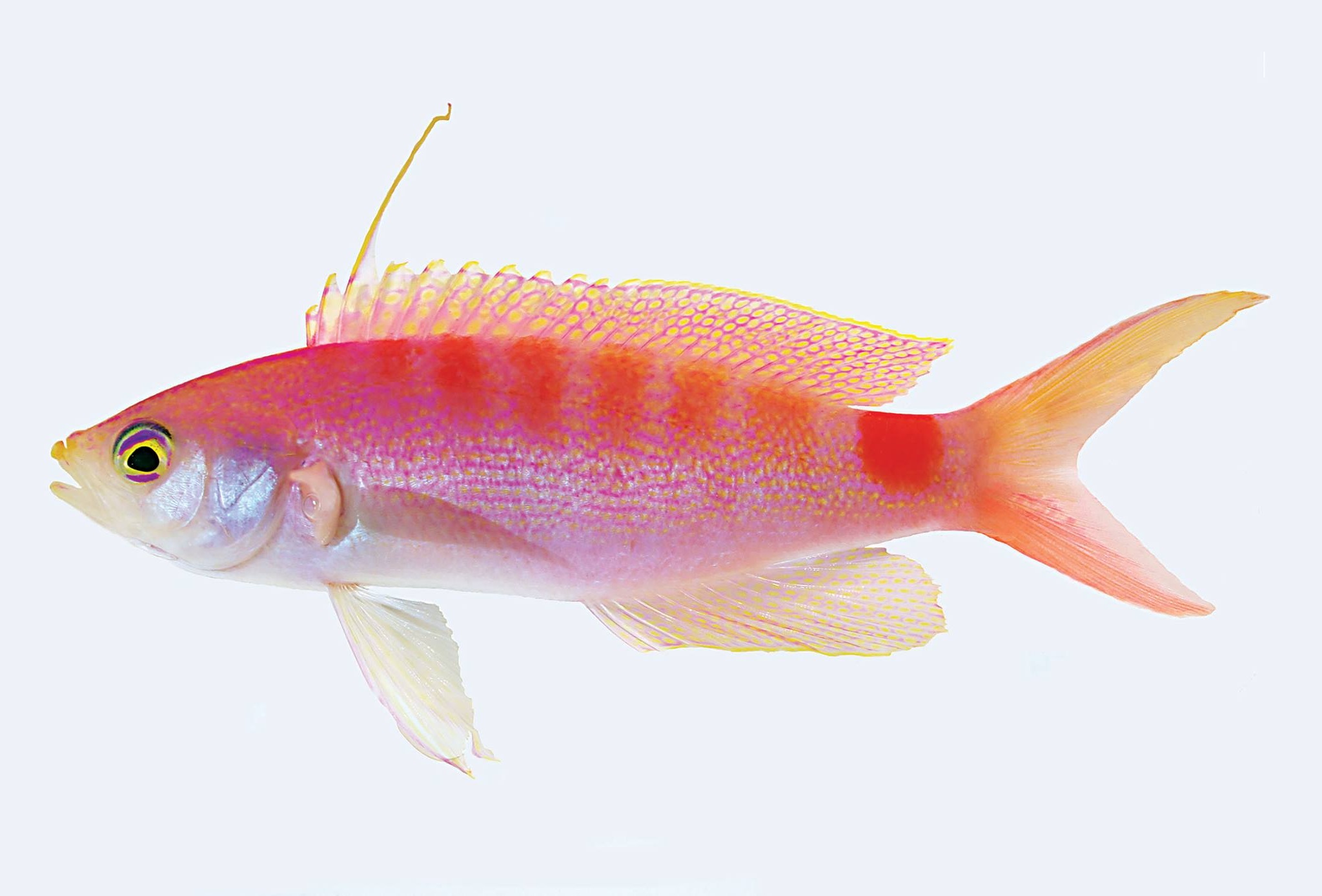
[Ichthyology • 2020] Pseudanthias timanoa • A New Fairy Basslet (Serranidae: Anthiadinae) from New Caledonia, South Pacific


Pseudanthias timanoa  
Victor, Teitelbaum & Randall, 2020


Abstract
A new fairy basslet, Pseudanthias timanoa n. sp., is described from 21 specimens, 50.0-79.1 mm SL, collected recently from New Caledonia, in the southwestern corner of the tropical Pacific Ocean. The new species is typically found on deep coral-reef slopes, at depths of 50-100 m. One of many slender, brightly colored fairy basslets found throughout the Indo-West Pacific Ocean, P. timanoa is part of the Pseudanthias lori species complex. It is distinguished from its congeners by the live color pattern, which is bright reddish pink with a series of 7 red-orange bars along the upper body followed by a deeper-red rectangular saddle on the caudal peduncle. Mature males develop a greatly elongated third dorsal-fin spine, up to about 1.5 times head length and long, trailing caudal-fin filaments. The sequence of the mtDNA barcode marker COI for the new species is 10.3% divergent (p-distance) from the nearest relative in the Barcode of Life Database, P. lori, from the Coral Sea and Philippines. The new species appears in the aquarium trade as the Sunrise Anthias. With this discovery, there are now 16 species of Pseudanthias documented from New Caledonia.

Key words: taxonomy, ichthyology, coral-reef fishes, DNA barcoding, goldies, Sunrise Anthias.


Pseudanthias timanoa, fresh paratype, male, 55.1 mm SL, SIO 20-17, from aquarium trade with caudal filaments eroded, collected from Dukati Reef, New Caledonia.
photo: Benjamin C. Victor

Pseudanthias timanoa, Victor, Teitelbaum & Randall 
Sunrise Anthias 

Pseudanthias timanoa with incorrect authorship “Randall, 2014”, a nomen nudum until the present description, Laboute & Grandperrin 2016: 217, fig. a single photograph (without any description in the text, and based on no description, publication, or collected specimen). 

 Diagnosis. A species of Pseudanthias with dorsal-fin elements X,15 or 16 (most 16), third spine greatly elongated in mature males, up to about 1.5 times head length, 2.2 in SL, up to three times length of next spines; anal-fin elements III,7; pectoral-fin rays 18 or 19 (most 19); caudal fin deeply lunate with filamentous tips in mature males (eroded away in aquarium specimens), maximum caudal concavity 3.1 in SL in intact paratype; body elongate, body depth 3.4 (3.2–4.0) in SL; head and body reddish pink with 7 red-orange bars along upper body followed by a deeper-red, saddle-like rectangle on caudal peduncle.


Pseudanthias timanoa (top) New Caledonia (Richard Bajol); 
Pseudanthias lori (middle) Cenderawasih Bay, W. Papua Province, Indonesia; 
Pseudanthias flavoguttatus (bottom) Tanimbar Islands, E. Banda Sea, Indonesia (both Gerald Allen).


Figure 6. Pseudanthias timanoa, school underwater at 74 m, New Caledonia (Pierre Laboute).

 Figure 7. Pseudanthias timanoa, two males and a female (at upper right), with a P. lori at lower left foreground and a P. flavicauda at lower right, about 90 m, New Caledonia (Patrick Plantard).


Etymology. The new species is named timanoa, a euphonious amalgamation of the second author’s three children’s names: Timothée, Maëlle, and Noa. The specific epithet is treated as a noun in apposition.

 
Benjamin C. Victor, Antoine Teitelbaum and John E. Randall. 2020. Pseudanthias timanoa, A New Fairy Basslet from New Caledonia, South Pacific (Teleostei: Serranidae: Anthiadinae). Journal of the Ocean Science Foundation. 36, 6-15. DOI: 10.5281/zenodo.4050419


Friday, July 31, 2020

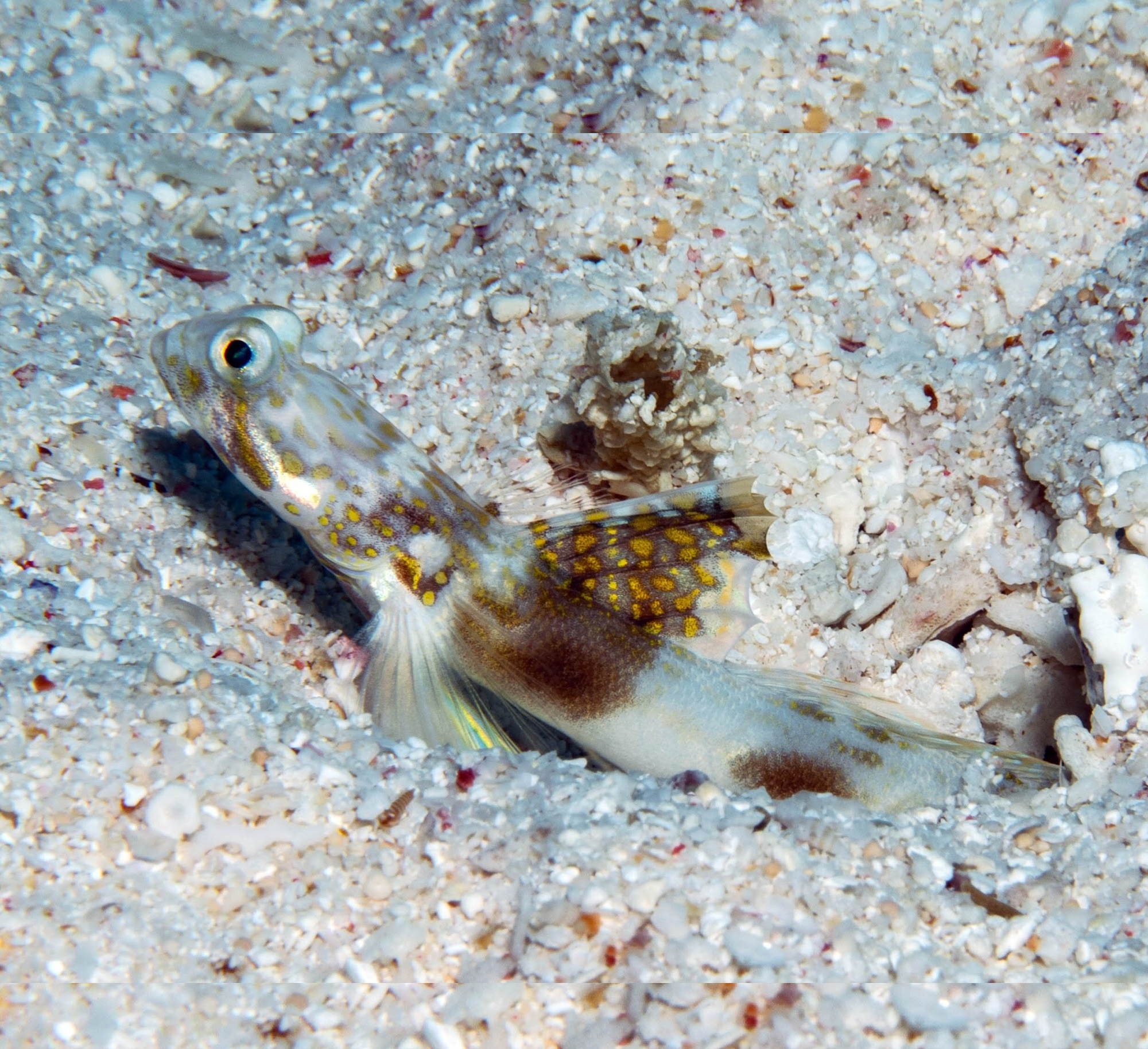
[Ichthyology • 2020] Vanderhorstia vandersteene • A New Species of Shrimpgoby (Pisces: Gobiidae) from Papua New Guinea


Vanderhorstia vandersteene
 Allen, Erdmann & Brooks, 2020


Abstract
A new species of gobiid fish, Vanderhorstia vandersteene, is described from the East Cape region of Milne Bay Province, Papua New Guinea on the basis of five specimens 17.5-32.2 mm SL. Diagnostic features include dorsal-fin elements VI-I,10-12; the fourth dorsal-fin spine filamentous, reaching the base of about the fifth to seventh segmented dorsal-fin ray when adpressed; anal-fin rays I,11; pectoral-fin rays 16-18; lateral scales 35-37; transverse scales 10; body scales mostly ctenoid, except cycloid scales anterior to the level of about the second-dorsal-fin origin, as well as on the pectoral-fin base, prepelvic region, and the lower side between the pectoral-fins and pelvic fins; scales absent on the head, including medially and anteriorly on the predorsal region; the caudal fin lanceolate with an elongate, median filament; color in life light neon blue with a wavy yellow-orange stripe from the upper operculum to the upper caudal-fin base, prominent yellow-orange bars, bands, and spots on the head and upper sides, a pair of yellow stripes on the second dorsal fin, and yellow streaks and bands on the caudal fin. We include a key to the Vanderhorstia species with low lateral-scale counts (less than 45).


Vanderhorstia vandersteene, freshly collected paratype, female, 27.2 mm SL, East Cape region, Milne Bay Province, Papua New Guinea (Mark V. Erdmann). 

Vanderhorstia vandersteene, live holotype, male, 32.2 mm SL, East Cape region, Milne Bay Province, Papua New Guinea (Mark V. Erdmann).

Vanderhorstia vandersteene, live paratype, female, 27.2 mm SL, East Cape region, Milne Bay Province, Papua New Guinea (Mark V. Erdmann). 

Vanderhorstia vandersteene
, n. sp. 
Electric Shrimpgoby

Diagnosis. Dorsal-fin elements VI-I,10–12, fourth dorsal-fin spine filamentous, reaching base of about fifth to seventh segmented dorsal-fin ray when adpressed; anal-fin elements I,11; pectoral-fin rays 16–18; lateral scales 35–37; transverse scales 10; body scales mostly ctenoid, except cycloid scales anterior to level of about second dorsal-fin origin, on pectoral-fin base, prepelvic region, and lower side between pectoral and pelvic fins; scales absent on head, including medially and anteriorly on predorsal region; caudal fin lanceolate with an elongate median filament; color in life light neon blue with wavy yellow-orange stripe from upper operculum to upper caudal-fin base; prominent yellow-orange bars, bands, and spots on head and upper sides; a pair of yellow stripes on second dorsal fin and yellow streaks and bands on caudal fin.


Etymology. The new species is named vandersteene, which is treated as a noun in apposition for the combined surnames of Rob Vanderloos and Roger Steene, two highly esteemed underwater photographers who have contributed greatly to our knowledge of the reef fishes of Milne Bay and who have been loyal diving companions over the course of three decades of exploration of the region. It is a pleasure to name this stunning new species in their honor.

Distribution and habitat. The new species is currently known only from the type locality, situated on the East Cape Peninsula of Milne Bay Province, Papua New Guinea, about 28 km northeast of the town of Alotau. The habitat consists of a relatively steep outer reef slope with fish occupying burrows on black volcanic sand/ rubble substrates. About 20 individuals were observed in an area that occupied about 600 m2 . Solitary individuals were encountered that were invariably associated with an unidentified snapping shrimp of the genus Alpheus that share the burrows, a symbiotic relationship found in all Vanderhorstia spp.


Gerald R. Allen, Mark V. Erdmann and William M. Brooks. 2020. Vanderhorstia vandersteene, A New Species of Shrimpgoby (Pisces: Gobiidae) from Papua New Guinea. Journal of the Ocean Science Foundation. 35, 65-75. DOI: 10.5281/zenodo.3959464

Monday, August 5, 2019

[Ichthyology • 2018] Pomacentrus bellipictus • A New Microendemic Species of Damselfish (Pisces: Pomacentridae) from the Fakfak Peninsula, West Papua, Indonesia


 Pomacentrus bellipictus 
Allen, Erdmann & Hidayat, 2018


Abstract
A new species of damselfish, Pomacentrus bellipictus, is described from 13 specimens, 37.7-67.9 mm SL, collected at the Kokas area of the Fakfak Peninsula, a portion of the Bird's Head Peninsula of western New Guinea (West Papua Province, Indonesia). It is distinguished from most similar species in the western Pacific Ocean by having 14 instead of 13 dorsal-fin spines. It also possesses a unique facial coloration consisting of highly contrasted blue areas around the mouth and onto the isthmus, below the eye, and along the margin of the preopercle. The only other species of Pomacentrus from the region with 14 dorsal spines that are also drab-brown when alive, P. fakfakensis and P. opisthostigma, are clearly distinguished on the basis of adult and juvenile color patterns and also show different habitat preferences. In addition, P. opisthostigma is distinguished from the other two species by fewer lateral-line scales (usually 15-17 vs. usual 18-19) and more gill rakers on the first arch (26-29 vs. 18-21). The three species co-occur in the Kokas area, but occupy different habitats: Pomacentrus bellipictus inhabits rocky, wave-washed shorelines in about 1-2 m depth, while the other two species occur in deeper water. The new species is apparently endemic to the small area around the Fakfak Peninsula, where several other microendemic reef fish species have been described.

Key words: taxonomy, systematics, ichthyology, microendemic, coral-reef fishes, Indo-Pacific Ocean, Fakfak, Bird’s Head Peninsula.

Figure 3. Pomacentrus bellipictus n. sp., underwater photographs of adult, approx. 60 mm SL, Kokas District, West Papua Province, Indonesia (M.V. Erdmann).

Pomacentrus bellipictus, n. sp.
Bluemouth Demoiselle

Diagnosis. Dorsal-fin elements usually XIV (rarely XIII),12–14 (usually XIV,14); anal-fin elements II,12–15 (usually 14–15); pectoral-fin rays 17–19 (rarely 19); tubed lateral-line scales 17–19 (usually 18); total gill rakers on first arch 18–20 (rarely 20); body depth 1.8–2.0 (mean 1.9) in SL; scales absent on preorbital and suborbital; lower margin of suborbital series with 4–12 serrae; color in life mainly dark brown, nearly black, with contrasting blue areas around mouth (including isthmus), below eye, and along margin of preopercle; iris of adult mostly dark gray with a narrow bronze ring around pupil.

Etymology. The species is named bellipictus (Latin: war-painted) with reference to its facial coloration and belligerent behaviour towards divers. The specific epithet is a masculine compound adjective.

Figure 6. Fuum Islet (foreground), the type locality of Pomacentrus bellipictus. Type specimens were collected from the mostly shaded area adjacent to the rocky shoreline (M.V. Erdmann).


Gerald R. Allen, Mark V. Erdmann and Nur I. Hidayat. 2018. Pomacentrus bellipictus, A New Microendemic Species of Damselfish (Pisces: Pomacentridae) from the Fakfak Peninsula, West Papua, Indonesia. Journal of the Ocean Science Foundation. 30, 1-10. oceansciencefoundation.org/josf30a.html


Wednesday, June 5, 2019

[Ichthyology • 2019] Luzonichthys kiomeamea • A New Species (Serranidae: Anthiadinae) from A Mesophotic Coral Ecosystem of Rapa Nui (Easter Island)


Luzonichthys kiomeamea 
 Shepherd, Pinheiro, Phelps, Perez-Matus & Rocha, 2019


Abstract
A new species in the anthiadine genus Luzonichthys Herre, 1936 is described from a specimen collected at a depth of 83 m in a mesophotic coral ecosystem at Rapa Nui (Easter Island). Luzonichthys kiomeamea n. sp. can be distinguished from the 7 other valid Luzonichthys species by anal-fin and pectoral-fin counts, the number of lateral-line scales, the number and arrangement of gill rakers, and coloration pattern. Mitochondrial DNA sequencing shows that the new species is more than 11% divergent in the COI sequence (and about equally distant) from Luzonichthys waitei, L. seaver, L. earlei (Hawai’i), and L. aff. earlei (Coral Sea). Given the isolation of the island, and the uniqueness of its fish fauna, we suspect that the new species is endemic to the mesophotic reefs of Rapa Nui.

 Key words: taxonomy, ichthyology, coral-reef fishes, endemism, South Pacific, Splitfin Anthias, Chile

Figure 1. Luzonichthys kiomeamea, sp. n., holotype, CAS 244640, 45.7 mm SL, shortly after death (L.A. Rocha).

Luzonichthys kiomeamea, n. sp. 
Rapa Nui Splitfin

Diagnosis. Dorsal-fin elements X,16; anal-fin elements III,7; pectoral-fin rays 22; lateral-line scales 64; gill rakers 12+26; body moderately elongate, depth 4.8 in SL; head length 3.6 in SL; snout 4.1 in HL; caudal fin forked and without filaments, length 4.3 in SL; caudal-fin concavity 6.3 in SL; pectoral-fin length 4.0 in SL; pelvic-fin length 5.0 in SL; color in life: body orange-red dorsally, silver-magenta ventrally, with alternating magenta, red, and orange lines along sides of body; dorsal fin yellow-orange with red-orange spots (Fig. 1).

Etymology. The specific epithet is from the Rapa Nui name; the phrase kio-meamea means “red fish that takes refuge in a cave”. Treated as a noun in apposition.

 Distribution and habitat. The new species is currently known only from Rapa Nui. The holotype was collected at a depth of 83 m in a rocky patch reef surrounded by a large sandy area (Fig. 4). It was caught by hand using hand nets and transported alive to the surface in a perforated-plastic collecting jar.

Figure 4. Luzonichthys kiomeamea in its natural habitat, 83 m, Hanga Piko, Rapa Nui (Easter Island), Chile (L.A. Rocha).


Bart Shepherd, Hudson T. Pinheiro, Tyler Phelps, Alejandro Perez-Matus and Luiz A. Rocha. 2019. Luzonichthys kiomeamea (Teleostei: Serranidae: Anthiadinae), A New Species from A Mesophotic Coral Ecosystem of Rapa Nui (Easter Island). Journal of the Ocean Science Foundation. 33; 17-27. OceanScienceFoundation.org/josf33c.html 

Wednesday, April 3, 2019

[Ichthyology • 2019] Eviota gunawanae • A New Microendemic Dwarfgoby (Teleostei: Gobiidae) from the Fakfak Peninsula, West Papua, Indonesia


Eviota gunawanae Greenfield, Tornabene & Erdmann 

in Greenfield, Tornabene, Erdmann & Pada, 2019.
 Journal of the Ocean Science Foundation. 32

Abstract
A new species of dwarfgoby, Eviota gunawanae, with a cephalic sensory-canal pore pattern lacking only the IT and NA pores and with the AITO pore positioned far forward and opening anteriorly, is described from the Fakfak Peninsula in the Bird’s Head Seascape of western New Guinea, West Papua Province, Indonesia. It has a dorsal/anal-fin-ray formula of 8/7, 16 unbranched pectoral-fin rays, the fifth pelvic-fin ray present, very long anterior tubular nares, a distinctive double black spot at the caudal-fin base, and no narrow horizontal line of melanophores crossing the pectoral-fin base. In life, it has a maroon stripe down the midline of the body, with elongate white spots above it posteriorly and two white lines over the abdomen. E. gunawanae is most closely related to E. tetha. The new species appears to represent the eighth known microendemic fish species from this remote reef location in West Papua, highlighting the biodiversity conservation importance of the Fakfak Peninsula’s reefs.

Key words: taxonomy, systematics, ichthyology, coral-reef fishes, gobies, endemism, microendemism, phylogenetics, Bird’s Head Seascape, conservation, Eviota tetha

Eviota gunawanae n. sp.
underwater photograph, Fakfak, West Papua Province, Indonesia

 (photos: M.V. Erdmann). 


Eviota gunawanae, n. sp. Greenfield, Tornabene & Erdmann
Tiene’s Dwarfgoby

Diagnosis. A species of Eviota with a cephalic sensory-canal pore pattern lacking only IT and NA pores and with AITO pore positioned far forward and opening anteriorly; very long anterior tubular nares; dorsal/anal-finray formula 8/7; 16 unbranched pectoral-fin rays; fifth pelvic-fin ray about 10% length of the fourth pelvic-fin ray; a black spot at caudal-fin base in two joined parts extending anteriorly past end of hypural plate; top of head with scattered melanophores, sometimes arranged in lines, but not as a single line of melanophores extending posteriorly from PITO pore back onto nape. In life, a maroon stripe down midline of body with elongate white spots above stripe posteriorly and two white lines over abdomen.

Etymology. The species is named in honor of Dr. Tiene Gunawan, one of Indonesia’s foremost marine conservationists who has dedicated the past two decades to expanding the marine protected area network of West Papua and formulating policies to protect the biodiverse marine ecosystems contained therein. Dr. Gunawan also helped plan and launch the marine biodiversity survey of the Fakfak coastline that led to the discovery of this species.

Distribution and habitat. Currently known only from Karas Island in the Fakfak Regency, West Papua Province, Indonesia. It is presumably more widespread along the poorly-explored Fakfak coastline, but unlikely to be found in the very well-surveyed Raja Ampat Islands to the north. The species was found in a relatively unusual deepwater-reef environment consisting of large foliose and plating corals on a gentle slope from 35–55m depth, exposed to moderate currents but otherwise protected from wave energy.
  

David W. Greenfield, Luke Tornabene, Mark V. Erdmann and Defy N. Pada. 2019. Eviota gunawanae, A New Microendemic Dwarfgoby from the Fakfak Peninsula, West Papua, Indonesia (Teleostei: Gobiidae). Journal of the Ocean Science Foundation. 32; 57–67. DOI: 10.5281/zenodo.26167