Showing posts with label Author: Souvann.. Show all posts

Wednesday, March 25, 2026

[Botany • 2026] Firmiana laotica (Malvaceae) • A New Species from Limestone Karst, Khammouane Province, central Laos and Five New Records for the Flora of Laos


Firmiana laotica Sengthong, Soulad. & Tagane,

in Sengthong, Tagane, Souladeth, Dang, Yamamoto, Souvannakhoummane, Kongxaisavath, Phengmala, Tanaka et Pham, 2026.
 
Abstract
A new species, Firmiana laotica (Malvaceae), and five new records, Justicia oreophila (Acanthaceae), Aganosma wallichii (Apocynaceae), Colebrookea oppositifolia (Lamiaceae), Myristica yunnanensis (Myristicaceae), and Brachytome hainanensis (Rubiaceae) are reported for the flora of Laos. Voucher specimens, photographs, and ecological information in Laos are provided for each species.

Keywords: Central Laos, Firmiana laotica, flowering plants, Nam Kading NPA, Phou Hin Poun NP

Firmiana laotica Sengthong, Soulad. & Tagane.
A, habitat. B & C, habit. D, leafy twig. E, lower leaf surface. F, inflorescence. G, staminate flower. H & I, pistillate flowers. J, young fruits. All photos by Shuichiro Tagane.

Firmiana laotica Sengthong, Soulad. & Tagane, sp. nov. 
ປໍຜາລາວ

  Firmiana laotica is similar to F. fulgens (Wall. ex Mast.) K.Schum., but distinguished by leaf lobe apex (long-acuminate to caudate in F. laotica vs. acute to obtuse F. fulgens), lower leaf surface color (glaucous vs. not glaucous), depth of calyx lobes (lobed (1/3−)1/2 of calyx length vs. lobed 1/3–1/4 of calyx length), and number of stamens (15 in 5 groups of 3 vs. 20 or 25 in 5 groups of 4 or 5).

 
 Anousone Sengthong, Shuichiro Tagane, Phetlasy Souladeth, Van-Son Dang, Takenori Yamamoto, Keooudone Souvannakhoummane, Deuanta Kongxaisavath, Kajonesuk Phengmala, Nobuyuki Tanaka and Quoc Trong Pham. 2026. A New Species and Five New Records for the Flora of Laos. Acta Phytotaxonomica et Geobotanica. 77(1); 23-34. DOI: doi.org/10.18942/apg.202523 
 
ຂໍແນະນຳພືດຊະນິດໃໝ່ຂອງໂລກ ຈາກນິເວດພູຫິນປູນ (ບ້ານກອງລໍ ເຂດປ່າປ້ອງກັນພູໄຮ ແລະ The Rock at Phuphamarn ເມືອງຄູນຄຳ ແຂວງຄຳມ່ວນ)
ມີຊື່ວິທະຍາສາດ Firmiana laotica Sengthong, Soulad. & Tagane
ແລະ ໄດ້ໃຫ້ຊື່ລາວວ່າ ປໍຜາລາວ

Sunday, January 11, 2026

[Botany • 2026] Melastoma calcicolum & M. souladethianum (Melastomataceae) • Two New Species from Limestone Karst, Khammouane Province, central Laos


ເອນອ້າຂຸນກອງແລງ |  Melastoma calcicolum Souvann. & Tagane sp. nov.
ເອນອ້າເພັດຊົມພູ |  M. souladethianum Souvann. & Nob.Tanaka, sp. nov.

in Souvannakhoummane, Tanaka, Souladeth, Tagane, Dang, Yamamoto, Yamazaki, Pham, Phonepaseuth, Vongthavone, Phengmala, Kongxaisavath et Sengthong, 2026.  

Abstract
Two new species, Melastoma calcicolum Souvann. & Tagane sp. nov. and M. souladethianum Souvann. & Nob.Tanaka sp. nov. (Melastomataceae), are described from limestone karst habitats in Khammouane Province, central Laos. Descriptions, photographs, distribution, habitat, phenology, and initial conservation statuses of both newly described species are given. A key to the species of Melastoma in Laos including currently reported species is provided. These discoveries result from extensive fieldwork conducted between 2022 and 2025 in protected areas including Phou Hin Poun National protected area and Phou Pha Marn area. M. calcicolum sp. nov. is distinguished from M. saigonenese by its terete twigs, narrow lanceolate leaves, spaced penicillate emergences on the hypanthium, stalk of emergences on hypanthium shorter, glabrous sepals, and longer styles, while M. souladethianum sp. nov. differs from M. pellegrinianum by its terete branches, small inflorescences with 2–4 flowers, and sparsely bristled hypanthium with strigose hairs. Both species are currently known only from their type localities, occurring in exposed limestone areas, and are preliminarily assessed as Endangered and Critically Endangered based on IUCN criteria due to their restricted distributions and small population sizes. These findings highlight the high botanical diversity and endemism of Laos’s limestone ecosystems and underscore the importance of continued botanical exploration in the region.

Keywords: Limestone flora, Myrtales, new description, new taxa, Southeast Asia
 
Melastoma calcicolum Souvann. & Tagane sp. nov.
 A. Habit. B. Abaxial leaf surface. C. Close-up of flower bud showing the penicillate emergences. D. Horizontal cross-section of ovary. E. Lateral view of flower. F. Top view of flower. G. Vertical cross-section of flower bud. H. Flower bud. I. Vertical cross-section of the flower with petals removed. J. Petals. K. Long stamens. L. Short stamens. M. Pistil. N. Bottom view of hypanthium showing the 5 sepals.
Photos from holotype (Tagane et al. Z1704) 
A, C by S. Tagane; B, D, G–N by K. Souvannakhoummane and E–F by P. Phonepaseuth.

Melastoma calcicolum Souvann. & Tagane sp. nov.

Diagnosis: Similar to Melastoma saigonense (Kuntze) Merr., but differs in its terete young twigs  (vs.  (sub)quadrangular), narrower leaves (ovate-lanceolate to lanceolate, length/width ratio 2.8–4.1 vs. ovate to elliptic, length/width ratio 1.8–2), penicillate emergences spaced apart (vs. densely covered by penicillate emergences), stalk of emergences on hypanthium 1–1.5 mm long (vs. 3–5 mm long), glabrous sepals except for ciliate margins (vs. outer surface densely covered with bristles), and longer styles (20–25 mm long vs. 15–20 mm long).

Etymology: The specific epithet refers to the limestone habitat.

Vernacular name: ເອນອ້າຂຸນກອງແລງ En R Khoun Kongleng (meaning: ʻKhoun Kongleng's Melastomaʼ).


Melastoma souladethianum Souvann. & Nob.Tanaka, sp. nov.
A. Habit. B. Abaxial leaf surface. C–D. Flowers. E. Petals. F. Hypanthium & pistil. G. Vertical cross-section of hypanthium showing ovary. H. Flower bud. I. Lateral view of young fruits. J. Top view of young fruit. K. Short stamens. L.  Long stamens. M. Lateral view of mature dry fruit. N. Top view of mature dry fruit. O. Vertical cross section of mature dry fruit.
C–L from holotype (Tagane et al. Z1213) and A–B; M–O paratype (Tagane et al. Z1915)
Photos by K. Souvannakhoummane.

Melastoma souladethianum Souvann. & Nob.Tanaka sp. nov. 

Diagnosis: Similar to Melastoma pellegrinianum (H.Boissieu) Karst.Mey., but it differs in having terete young branches (vs. quadrangular in M. pellegrinianum), inflorescences with 2–4 flowers (vs. more than 15), hypanthia sparsely covered in bristles with sparse strigose hairs (vs. bristles without strigose hairs).

Etymology: The specific epithet honors Dr. Phetlasy Souladeth, curator of the FOF herbarium of the National University of Laos, who led our field trips and is an excellent plant taxonomist. She has greatly contributed to elucidating the flora of Laos and has described more than 30 new species and recorded over 100 species to Laos’ flora.

Vernacular name: ເອນອ້າເພັດຊົມພູ En R Phetsomphou (meaning: purple diamond’s Melastomaʼ).


Keooudone SOUVANNAKHOUMMANE, Nobuyuki TANAKA, Phetlasy SOULADETH, Shuichiro TAGANE, Van-Son DANG, Takenori YAMAMOTO, Kaito YAMAZAKI, Quoc Trong PHAM, Phongphayboun PHONEPASEUTH, Thyraphon VONGTHAVONE, Kajonesuk PHENGMALA, Deuanta KONGXAISAVATH and Anousone SENGTHONG. 2026. Two New Species of Melastoma L. (Melastomataceae) from Limestone Karst, Khammouane Province, central Laos. European Journal of Taxonomy. 1034(1); 1-13. DOI: doi.org/10.5852/ejt.2026.1034.3141 [2026-01-08]
facebook.com/PhetlasySouladeth/posts/25405484335746080

Friday, April 18, 2025

[Botany • 2025] Lysionotus calcicola • A New Species from Limestone Karsts in north and central Laos, supported by morphological and molecular evidence [Studies on the Gesneriaceae in Laos II]


Lysionotus calcicola Phonep., Soulad. & Souvann.,

in Souvannakhoummane, Phonepaseuth, Souladeth, Lanorsavanh, Tagane et Tanaka, 2025. 
ດອກງາຊ້າງຫີນ  ||  DOI: doi.org/10.1002/njb.04620 
 
Abstract
A new species of Gesneriaceae, Lysionotus calcicola Phonep., Soulad. & Souvann., is described and illustrated based on morphological and molecular evidence. This species is distributed in limestone karsts in the Luangprabang, Vientiane and Khammouane provinces in northern and central Laos. The new species can be distinguished from the hitherto known species in the genus by its deciduous shrubby habit, up to 2 m tall, and oldest stems with 4-rounded edges and longitudinal grooves, but young branches non-grooved, which are considered to be an adaptation to the severe environment in limestone karst and cliffs. ML tree based on ITS showed that the new species form a well-supported clade (94%), sister to the remaining Lysionotus species. Information on its distribution, ecology, phenology, vernacular name, and a provisional conservation assessment are provided.

keywords: Didymocarpoideae, flora of Laos, Indochina, Phou Pha Marn PPA, taxonomy

Lysionotus calcicola Phonep., Soulad. & Souvann.
 (A) Habit, (B) flower lateral view, (C) flower top view, (D) corolla opened out showing stamens and staminodes, (E) stamens and staminodes, (F) calyx, (G) pistil, (H) fresh fruit, (I) seeds.
Drawn from Souladeth et al. PPM034(FOF) by K. Souvannakhoummane.

Lysionotus calcicola Phonep., Soulad. & Souvann.
 (A-B) Habitat and habit, (C) 4-angled stem, (D) cross section of stem, (E) arrangement of leaves, (F) flower, font view, (G-H) inflorescences, (I) corolla opened out, (J) stamens and base of corolla tube, (K) calyx opened (L) pistil, (M) young fruit with calyx, (N) seeds.
 Photos from Souladeth et al. PPM034 (FOF). (A–F) and (L) by P. Phonepaseuth, (G–K) by K. Souvannakhoummane, (N) by D. Kongxaisavath.

Lysionotus calcicola Phonep., Soulad. & Souvann. sp. nov.  

Diagnosis: A species similar to Lysionotus chingii Chun ex W.T.Wang of China in having papery leaves, glabrous peduncles, white funnel-shaped corollas, and subulate seed appendages, but distinguished by its 4-rounded-angled and longitudinally grooved stems (versus terete), sparsely puberulent lamina (versus glabrous), corolla sparsely short glandular hairy on both surfaces (versus glabrous on outer surface), and sparsely glandular hairy pistil (versus glabrous). For further comparison see Table 2.
...


Etymology: The specific epithet refers to the Latin word ‘calcicola' meaning ‘growing on calcareous substrate', which is the habitat where this plant is found.

Vernacular name: Dok Nga Xang Hin (ດອກງາຊ້າງຫີນ), proposed here. ‘Dok Nga Xang' in Laos refers to a given name for the genus Lysionotus, and ‘Hin' refers to limestone karst, the type of habitat where this plant is found.


Keooudone Souvannakhoummane, Phongphayboun Phonepaseuth, Phetlasy Souladeth, Soulivanh Lanorsavanh, Shuichiro Tagane and Nobuyuki Tanaka. 2025. Studies on the Gesneriaceae in Laos II: Lysionotus calcicola, A New Species from Limestone Karsts in north and central Laos, supported by morphological and molecular evidence. Nordic Journal of Botany. DOI: doi.org/10.1002/njb.04620 [17 April 2025]

Wednesday, October 30, 2024

[Botany • 2024] Perilimnastes aura (Melastomataceae: Sonerileae) • A New Species from Dak Cheung Plateau, Sekong province, Southern Laos


Perilimnastes aura  

in Souvannakhoummane, Lamxay, Lanorsavanh et Liu. 2024. 

Abstract
Perilimnastes aura, a species found in Sekong province, Laos, is described as new. Its habit and morphology of leaves, inflorescences, flowers, and capsules match all diagnostic features of Perilimnastes. It most closely resembles P. suberalata in the quadrangular stems, unequal leaves, and glabrescent, oblanceolate to broadly elliptic leaf blade, but differs in the acute leaf apex (vs. acuminate), 1–3-flowered inflorescence (vs. 1-flowered), quadrangular hypanthium (vs. obtusely quadrangular) and broadly triangular, 1.8–2.2 mm long calyx lobes (vs. linear, 8–10 mm long). Information on habitat, ecology, and a preliminary assessment of the conservation status are also provided for the new species.

Phyllagathis, new description, new taxa, evergreen mountains, taxonomy, Eudicots


Perilimnastes aura sp. nov.


Keooudone Souvannakhoummane, Vichith Lamxay, Soulivanh Lanorsavanh and Ying Liu. 2024. Perilimnastes aura (Sonerileae, Melastomataceae), A New Species from Dak Cheung Plateau, Sekong province, Southern Laos. Phytotaxa. 670(1); 77-82. DOI: doi.org/10.11646/phytotaxa.670.1.8

ພືດຊະນິດໃຫມ່ຂອງໂລກ, ຖີ່ນກຳເກີດຈາກພູພຽງດັກຈຶງ, ແຂວງເຊກອງ. 

Saturday, June 15, 2024

[Botany • 2024] Microchirita argostemmiflora, M. flavofusca, M. magniflora • Three New Species from Khammouane Karst [Studies on the Gesneriaceae in Laos I]


ດອກລະຄັງຫວງ  ||  Microchirita magniflora Souvann. 

in Souvannakhoummane et Lanorsavanh, 2024. 
Photos by K. Souvannakhoummane.

Abstract
 Three new species of Microchirita from the Khammouane Karst are here described as part of studies on the family Gesneriaceae in Laos. The description, habitat, phenology, vernacular name, initial IUCN assessment, illustration, and photographs of the new taxa are provided.

Keywords: Hin Nam No National Park, limestone flora, new taxa, taxonomy


Microchirita argostemmiflora Souvann. & Lanors.:
A. habit; B. flower, front view; C. flower, back view; D. anthers.
    All from LP140. Photos by K. Souvannakhoummane & S. Lanorsavanh.

Microchirita argostemmiflora Souvann. & Lanors., sp. nov. 

Similar to Microchirita personata C.Puglisi in the habit, but differing in the inflorescence 2–6-flowered (vs more than 10-flowered), corolla lobes rotate (vs personate), anthers yellow, papillose (vs white, glabrous).

Etymology.— The specific epithet refers to the flowers resembling the flower of Argostemma (Rubiaceae).
Vernacular name.— ດອກປີ່ນຂາວ [Dok Pin Khao].


Microchirita flavofusca Souvann. & Lanors.:
A. habitt; B. flower, front view, and slightly back view; C. inflorescence withflowers and young fruits; D-E. dissected corolla tube showing anthers and staminodes; F. calyx and pistil; G. young fruit.
  All from LP139. Photos by S. Lanorsavanh.

Microchirita flavofusca Souvann. & Lanors. sp. nov.

Similar to Microchirita glandulosa C.Puglisi in having bracts fused at the base, but differeng in the stem glabrous (vs stem sparsely glandular hairy), calyx tube 2.5–4 mm, hairy only outside (vs 1.5 mm, hairy on both sides), corolla 3–3.5 cm long, light yellow with brown-red patch (vs 15–18 mm, white), filaments minutely glandular (vs glabrous). It is also similar to M.magnifloraSouvann., but differing by calyx sparsely eglandular pubescent, remote serrate with glandular margin (vs densely glandular pubescent, with some stellate hairs, and entire margin), corollalightly yellow with brown-red patch inside (vs corolla dark purple, granite grey patch near mouth with yellow inside).

Etymology.—The  specific epithet refers to the yellow flower with brown-red patch.
 Vernacular  name.— ດອກລະຄັງເຫຼືອງ [Dok  La  Khang Leung].


Microchirita magniflora Souvann.:
A. habit; B. flowers; C. flower, side view; D. calyx and pistil; E. dissected corolla tube showing anthers and staminodes; F. anthers.
 All from PMHNN0209. Photos by K. Souvannakhoummane.

Microchirita magniflora Souvann., sp. nov.

Similar to Microchirita involucrata (Craib) Yin Z.Wang in the habit and morphology of flower form, but differing in bracts fuse at the base (vs free), calyx covered by glandular hairs with some stellate hairs outside (vs only glandular hairs), corolla 35–40 mm long, yellow inside throat (vs 18–21 mm long, not yellow inside), filaments minutely glandular (vs glabrous).

Etymology.— The specific epithet refers to large flowers.
Vernacular name.— ດອກລະຄັງຫວງ [Dok  La  Khang Louang].

 
Keooudone Souvannakhoummane and Soulivanh Lanorsavanh. 2024. Studies on the Gesneriaceae in Laos I: Three New Species of Microchirita from Khammouane Karst. Tropical Natural History. 24(1); 2024), 60–69. li01.tci-thaijo.org/index.php/TNH/article/view/259309
 

Tuesday, May 7, 2024

[Botany • 2021] Sonerila erectifolia & S. souvannii (Melastomataceae) • Two New Species from Laos


Sonerila erectifolia Phonep., Soulad. & Tagane, 
Sonerila souvannii Phonep. & Soulad., 
 
in Phonepaseuth, Souladeth, Souvannakhoummane, Vongthavone et Tagane2021. 

ABSTRACT
Two new species of Sonerila Roxb. (Melastomataceae), S. erectifolia Phonep., Soulad. & Tagane sp. nov. from southern Laos, and S. souvannii Phonep. & Soulad. sp. nov. from central Laos, are described and illustrated. Comparisons with morphologically similar species are presented, along with ecological information and preliminary conservation status. A key to the species of Sonerila in Laos is also provided.
 
Keywords: Bolaven Plateau, flora, Indochina, taxonomy, Vientiane Capital

Class Magnoliopsida Brongn.
Order Myrtales Juss. ex Bercht. & J.Presl.
Family Melastomataceae Juss.

Genus Sonerila Roxb.


Sonerila erectifolia Phonep., Soulad. & Tagane sp. nov.
A. Habitat (on open moss-covered bedrock). B. Close-up of plant (left: pink flowers, common; right: white flowers, rare). C. Habit. D. Inflorescence (left: pink flowers; right: white flowers). E. Young fruits. F. Top view of young fruit. G. Cross sections of young fruit. H. Rhizome. I. Upper surface of lamina. J. Lower surface of lamina.
 Photos by P. Phonepaseuth on 17 September 2020.

Sonerila erectifolia Phonep., Soulad. & Tagane sp. nov.

Diagnosis: Sonerila erectifolia sp. nov. is similar to Sonerila violifolia in its scorpioid or subumbelliform inflorescence, but it differs in the length of stem (ca 1 cm long in S. erectifolia sp. nov. vs 10–18 cm long in S. violifolia), the venation of the leaves (2 veins running from the base of lamina vs pinnately veined with 2–3 lateral primary veins), hairiness of leaves (sparsely covered with whitish hairs on veins abaxially vs glabrous), the length of the petiole (6–10 cm long vs 1–7 cm long), and number of flowers per inflorescence (5–12(–18) flowers vs 1–9 flowers). For further comparison see Table 1.

Etymology: The specific epithet refers to the plant having erect leaves.
Vernacular name: ຊີດິນໃບຕັ້ງ [ʻSeedin Baitungʼ 
(meaning: ʻSonerila with erect leavesʼ)]


Sonerila souvannii Phonep. & Soulad. sp. nov. 
A. Habit. B. Front view of flower. C. Petals. D. Hypanthium and style, with portion of pedicel. E. Cross section of ovary. F. Stamens. G. Style and stigma. H. Capsule. I. Rachis and minute bracts.
Line drawings from holotype (Phonepaseuth P012) by K. Souvannakhoummane.

Sonerila souvannii Phonep. & Soulad. sp. nov.
A. Habitat (on sandstone rock). B. Habit. C. Petiole densely covered withvillous hairs. D. Rhizome and stem with rudimentary leaves. E. Flowers. F. Inflorescence (scorpioid cyme). G. Lateral view of flower. H. Back view of flower. I. Longitudinal section of fruit. J. Top view of fruit. K. Cross section of fruit. L. Infructescence of the last season.
Photos by P. Phonepaseuth on 12 September 2020.


Sonerila souvannii Phonep. & Soulad. sp. nov.

Diagnosis: Sonerila souvannii sp. nov. is similar to S. cardamomensis, described from Cambodia, in its acaulescent habit and in the shape of its leaves, but it differs in the shape of its rhizome (cylindrical in S. souvanii vs bulbous in S. cardamomensis), larger leaves (8–10 × 6–9 cm vs 1–4 × 0.9–2.7 cm), petiole length and color (8–15 cm long and light green vs 0.4–2.5 cm long and reddish brown), greater number of flowers per cyme (20–25 vs 5–11), and petal length and pubescence (9–10 × 6–7 mm and glabrous vs 5.5–6 × 3.5–4 mm with glandular trichomes on midveins abaxially). Sonerila souvannii sp. nov.is also similar to S. dongnathamensis from Thailand in the shape of its inflorescences, but differs in the rhizome shape (cylindrical vs globose), the shape of the leaf base (cordate vs obtuse to rounded), pedicel length (10–25 mm long vs 1–4 mm long), the number of flowers per cyme (20–25 vs 5–12), and in the length and outline of the petals (9–10 × 6–7 mm, acute vs 3–5 × 3–4 mm, acuminate with long seta).The new species is also related to S. tuberosa from Cambodia, but distinguished in the rhizome shape (cylindrical vs slightly bulbous), the shape of the leaf base (cordate vs very broadly ovate to orbicular), pedicel length (10–25 mm long vs 5–6 mm long), the number of flowers per cyme (20–25 vs 4–8), and in the length and outline of the petals (9–10 × 6–7 mm, acute vs 5 × 2.7 mm, elliptic, apiculate, pink) (Table 2)

Etymology: The specific epithet honours Keooudone Souvannakhoummane (Centre for Development and Environment), a plant taxonomist who has greatly contributed to our understanding of plant diversity in Laos through the description of many new species in various families for the flora of Laos.
Vernacular name: ຊີດິນສຸວັນ [ʻSouvan’s Seedinʼ 
(meaning: ʻSouvan’s Sonerilaʼ)].

 
Phongphayboun Phonepaseuth, Phetlasy Souladeth, Keooudone Souvannakhoummane, Thyraphon Vongthavone and Shuichiro Tagane. 2021. Two New Species of Sonerila Roxb. (Melastomataceae) from Laos. European Journal of Taxonomy. 755(1), 136-148. DOI: 10.5852/ejt.2021.755.1403


Wednesday, December 20, 2023

[Botany • 2023] Globba amicitia (Zingiberaceae: Globbeae) • A New Species from Phou Khao Khouay National Protected Area, Bolikhamxay Province, Laos


Globba amicitia Sangvir. & Souvann., 

in Souvannakhoummane, Lanorsavanh et Sangvirotjanapat, 2023.
ດອກຮ່ວງເຂົ້າມິດຕະພາບ || DOI: 10.20531/tfb.2023.51.2.14 
ดอกเข้าพรรษามิตรภาพ ||   facebook.com/SireePark 
Photographed by K. Souvannakhoummane & S. Lanorsavanh.

Abstract
Globba amicitia (Zingiberaceae: Globbeae), a new species from Laos is described and illustrated. This species is morphologically most similar to G. larsenii, a species from Thailand, in having erect inflorescences and entirely yellow flowers without spots, but easily recognizable by its sessile cincinni and puberulent lateral staminodes. A proposed IUCN Red List assessment and notes on distinguishing characters are provided. A key to species of Globba subgenus Globba in the Indo-Chinese region is included.

Keywords: Cambodia, gingers, Globba larsenii, Indo-China, South-East Asia, Vietnam


Globba amicitia Sangvir. & Souvann.
 (Lanorsavanh & Souvannakhoummane KS2224),
A. habit; B–C. flower front and side views; D. indumentum on lateral staminodes; E. dissection of flower; F. fruit. 
ov=ovary, ca=calyx, dcl= dorsal corolla lobe, lcl= lateral corolla lobe, ls=lateral staminode, lb=labellum, ft=floral tube, nt=nectar tube, fi=filament, at=anther (front and back views)  
Photographed: A & E by K. Souvannakhoummane; B–D, F by S. Lanorsavanh.

Globba amicitia Sangvir. & Souvann., sp. nov.
 (subgenus Globba).

Morphologically similar to Globba larsenii (Fig. 3) in its erect inflorescence, dark reddish brown peduncle, and yellow‐orange flower without spots on the labellum, but differs by sessile cincinni (versus prolonged cincinni in G. larsenii), puberulent lateral staminodes (versus glabrous lateral staminodes),and small plant size, about 15–25 cm tall (versus 30–80 cm tall)(Table 1).

Etymology.— Latin, ‘amicitia’ refers to the friendship between Lao and Thai cultures, and also to the collaboration between Lao and Thai botanists.

Vernacular name.— ດອກຮ່ວງເຂົ້າມິດຕະພາບ (Dok Houang Khao Mitthaparb) (Proposed here).
 

Keooudone Souvannakhoummane, Soulivanh Lanorsavanh and Sunisa Sangvirotjanapat. 2023.Globba amicitia (Zingiberaceae: Globbeae), A New Species from Phou Khao Khouay National Protected Area, Bolikhamxay Province, Laos. THAI FOREST BULL., BOT. 51(2): 157–163. DOI: 10.20531/tfb.2023.51.2.14  

ดร.สุนิสา แสงวิโรจนพัฒน์ โครงการจัดตั้งสถาบันอุทยานธรรมชาติวิทยาสิรีรุกขชาติ มหาวิทยาลัยมหิด ร่วมด้วย อ.แก้วอุดอน​ สุวันนะกุมมาน และ อ.สุลิวัน​  หล้าหน่อสะหวัน จากภาควิชาชีววิทยา คณะทรัพยากรธรรมชาติ มหาวิทยาลัยแห่งชาติลาว ร่วมกันศึกษาพืชวงศ์ขิง สกุลดอกเข้าพรรษา Globba  จากป่าสงวนแห่งชาติภูเขาควาย แขวงบอลิคำไซ ประเทศลาว และได้รายงานเป็นพืชชนิดใหม่ของโลก โดยให้ชื่อว่า Globba amicitia Sangvir. & Souvann. ซึ่ง amicitia หมายถึง มิตรภาพ เป็นการสะท้อนถึงความร่วมมือทางวิชาการของนักพฤกษศาสตร์ของประเทศลาวและไทย 
ดอกเข้าพรรษามิตรภาพ มีช่อดอกเรียวยาว ช่อดอกย่อยสั้นมาก ดอกสีเหลืองล้วน มีรยางค์อับเรณู 4 อัน ซึ่งเป็นลักษณะเด่นที่ใช้ในการจำแนกชนิดได้ ปัจจุบันเป็นพืชเฉพาะถิ่นของลาว และพบที่ภูเขาควายเท่านั้น การประเมินสถานะการอนุรักษ์ในธรรมชาติ (IUCN Red List) ถูกจัดอยู่ในระดับความเสี่ยงขั้นวิกฤติต่อการสูญพันธุ์ (CR – Critically endangered species) เนื่องจากประชากรมีขนาดเล็ก ถือเป็นพืชในวงศ์ขิงอีกชนิดหนึ่งที่ควรอนุรักษ์อย่างเร่งด่วน 


Saturday, November 4, 2023

[Botany • 2020] Stemona fimbritepala (Stemonaceae) • A New Species from northern Laos


 Stemona fimbritepala Rakarcha, Pongamornkul & Thammar., 

in Rakarcha, Pongamornkul, Thammarong, Maknoi et Souvannakhoummane, 2020. 

ABSTRACT
Stemona fimbritepala (Stemonaceae), a new species from northern Laos, is described and illustrated. It is morphologically similar to S. hirtella and S. kerrii but clearly differs in longer peduncle, longer tepals, longer petaloid outgrowth of the connective and fimbriate margin of inner tepals. A detailed description, distribution, ecology, etymology, preliminary conservation status and photographs of this species are provided. A key to discriminate between the three hairy species is presented.

Keywords: fimbriate, new taxon, Stemonaceae, Stemona fimbritepala, taxonomy

 Stemona fimbritepala Rakarcha, Pongamornkul & Thammar.:
A. habit; B. part of twig showing adaxial surface of leaves; C. idem, showing abaxial surface of leaves; D. younger flower, showing yellowish-green bodies; E. mature flower; F. fruit.
Photos by W. Pongamornkul.


Sarayut Rakarcha, Wittaya Pongamornkul, Woranart Thammarong, Charun Maknoi and Keooudone Souvannakhoummane. 2020. Stemona fimbritepala (Stemonaceae), A New Species from northern Laos. Thai Forest Bulletin (Botany). 48(2), 206-211.  DOI: 10.20531/tfb.2020.48.2.14

Tuesday, December 27, 2022

[Botany • 2022] Capparis phatadke • A New Species from Bolikhamxai Province [Studies on the Genus Capparis L. (Capparaceae) in Lao PDR. VI]


Capparis phatadke Fici, Lanors., Lamxay & Souvann., 

in Fici, Lanorsavanh, Lamxay & Souvannakhoummane, 2022. 
 
Abstract
A new species of CapparisC. phatadke, is described and illustrated from the Bolikhamxai Province, central Lao PDR. The new species is characterized by lianous habit, brown-reddish indumentum, straight stipular thorns, laminar bracts, large flowers arranged in terminal corymbs or subumbels, long filaments and large ovary. It is so far known from a single locality, where has been observed in mixed deciduous forest and secondary forest in a limestone area. Its ecology and phenology are discussed, and its conservation status is assessed.

Keywords: Bolikhamxai Province, Capparis sect. Monostichocalyx, endemism, Indo-Pacific area, plant taxonomy

Capparis phatadke. Flowering branch.
Photo by S. Lanorsavahn.

Capparis phatadke.
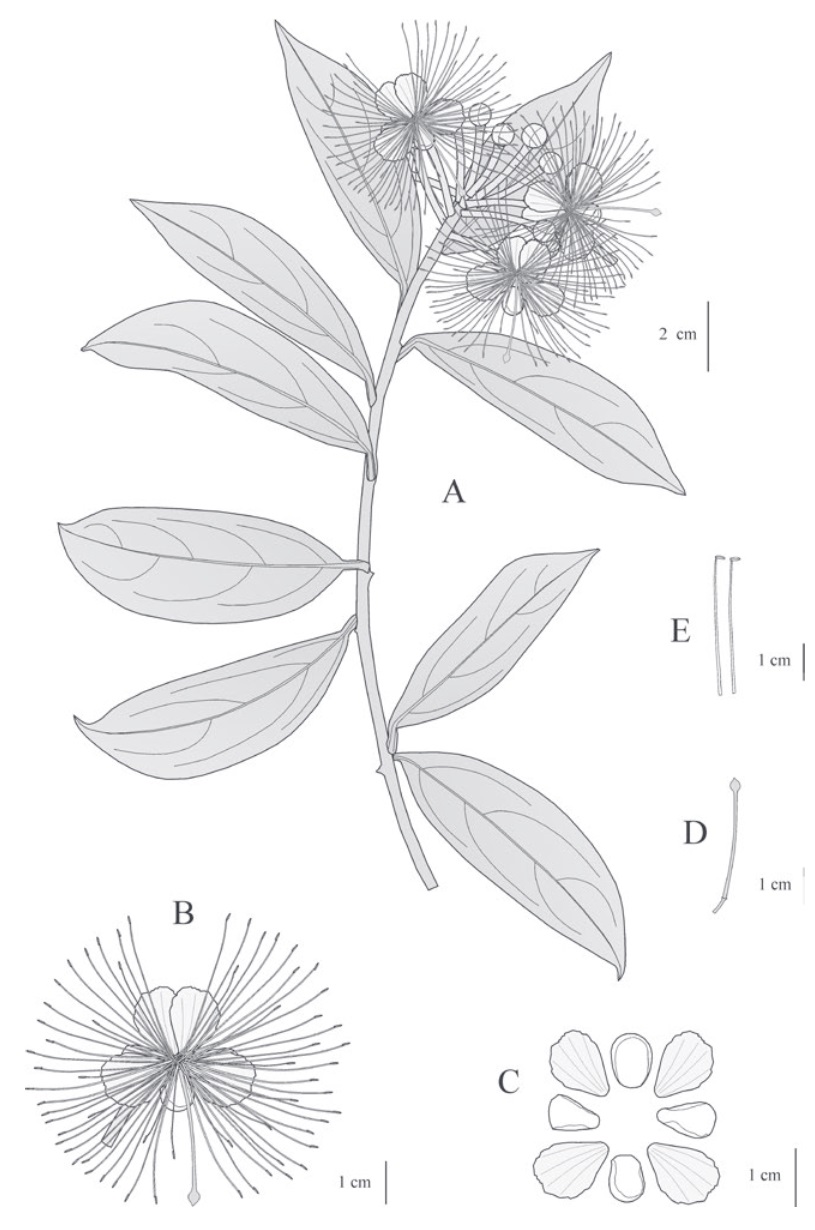
(A) Flowering branch. (B) Flower. (C) Dissected flower showing sepals and petals. (D) Gynophore and ovary. (E) Stamens.
 All from Lanorsavanh et al. LP123 (holotype). Drawn by S. Fici.

Capparis phatadke.
(A) Leaves, adaxial side (above) and abaxial side (below). (B) Flower buds. (C) Flowers. (D) Gynophore and ovary.
Photos by S. Lanorsavahn

Capparis phatadke Fici, Lanors., Lamxay & Souvann., sp. nov. 

Diagnosis Differs from Capparis trinervia Hook. f. & Thom-son var. trinervia in the longer, foliaceous bracts, sepals outside glabrous, pubescent at the base, longer filaments and larger ovary.

 Etymology: The new species is named after Pha Tad Ke, the first botanical garden in Laos, involved in plant conservation and in educational programs on the flora of the country and its ethnobotanical uses.


Silvio Fici, Soulivanh Lanorsavanh, Vichith Lamxay and Keooudone Souvannakhoummane. 2022. Studies on the Genus Capparis L. (Capparaceae) in Lao PDR. VI: A New Species from the Bolikhamxai Province. Webbia. Journal of Plant Taxonomy and Geography 77(2); 271-275. DOI:  10.36253/jopt-13377 
ພືດຊະນິດໃໝ່ຂອງໂລກ 


Friday, October 28, 2022

[Botany • 2022] Croton nagaoi (Euphorbiaceae) • A New Species from southern Laos


Croton nagaoi Tagane, Soulad. & Souvann., 

in Tagane, Souvannakhoummane & Souladeth, 2022. 
ເປົ້າ​ດົງ  ||  DOI: 10.11646/phytotaxa.570.2.1 
 
Abstract
Croton nagaoi (Euphorbiaceae) is described based on a specimen collected from the basin of the Bolaven Plateau, southern Laos. It is most similar to Croton thorelii Gagnep. of Laos, Cambodia, Thailand and Vietnam in size and shape of lamina, short petioles less than 1 cm long, and basal glands lateral on the abaxial midrib base, but different in having densely stellate hairy lower leaf surface (vs. very sparsely pubescent and glabrescent in C. thorelii), smaller sepals and petals of staminate flowers (sepals and petals ca. 2.2 mm long vs. 3 mm long and 2.5 mm long, respectively), and the presence of petals in pistillate flowers (vs. absent). Morphological descriptions, photographs, vernacular name, and preliminary conservation status are provided for C. nagaoi.

Keywords: Angiosperms, flora of Laos, Indochina, Malpighiales, taxonomy

Croton nagaoi Tagane, Soulad. & Souvann.
 A. branches; B. staminate flower with a bracteole; C. petals (outside); D. stamens, back view; E. stamen, front view; F. stamen, lateral view; G. fruit; H. seed.
All from Tagane et al. L2459 (KAG [KAG128559]). 
Scale bars: A = 3 cm, B–F = 1 mm, G = 8 mm, H = 5 mm. 
Line drawing by K. Souvannakhoummane.

Croton nagaoi Tagane, Soulad. & Souvann.
A. Flowering branch; B. portion of abaxial leaf surface; C. base of leaf showing basal gland lateral on base of midrib; D. stellate hairs on lower leaf surface; E. inflorescence consisting of staminate flowers; F. staminate flower; G. petal of staminate flower; H. stamen; J. fruit; K. pistillate flower, lateral view, showing sepals and petals; L. petals of pistillate flower; M. stigma; N. seed.
All from Tagane et al. L2459. Scale bars: D = 0.5 mm, G, H, L, M = 1 mm, N = 5 mm. 
Photographs by S. Tagane.

Croton nagaoi Tagane, Soulad. & Souvann., sp. nov. 

Most similar to Croton thorelii Gagnepain (1921: 560) of Laos, Cambodia, Thailand and Vietnam in size and shape of lamina, short petioles less than 1 cm long, and basal glands lateral on the abaxial midrib base, but distinguished from it by its lower leaf surface densely covered with persistent yellowish-cream stellate hairs (vs. very sparsely pubescent and glabrescent in C. thorelii) (Fig. 4), and the presence of petals in pistillate flowers (vs. absence).
...

Etymology:—The species epithet is dedicated to the excellent Nagao Natural Environment Foundation (http:// www.nagaofoundation.or.jp/e/) that has promoted nature conservation in Asia-Pacific countries since its establishment in 1989. Thanks to their support, we could have intensive field surveys on the Bolaven Plateau, which resulted in a better understanding of the flora of Bolaven and the discovery of more than 18 new species including the new species of Croton described in this study and 65 new country records (e.g. Souladeth et al. 2020, Tagane et al. 2020, Souvannakhoummane et al. 2021, Vongthavone et al. 2021). 

Vernacular name:— ເປົ້າ​ດົງ Pao Dong (suggested here; ‘Pao’ refers to the genus Croton and ‘Dong’ refers to the forest area).

 
Shuichiro Tagane, Keooudone Souvannakhoummane and Phetlasy Souladeth. 2022. Croton nagaoi, A New Species of Euphorbiaceae from southern Laos. Phytotaxa. 570(2); 102-108. DOI: 10.11646/phytotaxa.570.2.1

Monday, June 20, 2022

[Botany • 2021] Begonia glabritepala, B. lanxangensis, B. viriditenebris, etc. • Seven New Species and Seven New Records of Begonia L. (Begoniaceae) in the Flora of Laos


(A) Begonia glabritepala Souvann. et Lanors. 
(B) B. heteracantha Souvann. et Lanors. 
(C) B. lanxangensis Souvann. et Aver. 
(D) B. parviglandulosa Souvann. et Lanors. 
(E) B. pseudobrandisiana Souvann. et Lanors.
(F) B. tripartifolia Souvann. et Lanors. 

in Souvannakhoummane, Lanorsavanh & Averyanov, 2021. 
Photographs by S. Lanorsavanh (A, B, D–F) and K. Souvannakhoummane (C).

Abstract
New species of Begonia L. in the flora of Laos presented in this paper were mainly found in the course of botanical surveys made in Hin Nam No National Protected Area, Nam Phouy National Protected Area, Khammouane Karst Forest, and Phou Khao Khouay National Protected Area.Additionally, herbaria presently available in Laos (HNL, FOF, NUoL, FRC), living plants, and alcohol preserved material at Pha Tad Ke Botanical Garden and the data accessible online at BM, E, K, LE, NY, P, and PE Herbaria were critically studied. The study conducted during 2012–2019 reveals seven new species for science and seven species newly recorded for the flora of Lao PDR. 

Species described as new for science are: Begonia glabritepala (found in Khammouane Province; it is most close to B. pierrei but differs in glabrous outer tepals of staminate flowers, pistillate flowers, capsules, petioles, peduncles and pedicles), B. heterocantha (found in Sainyabuli Province; most close to B. depingiana but differs in reddish purple, glandular pubescent abaxial leaf surface, glandular pubescent pedicel, and outer tepals of pistillate flowers sparsely white glandular pubescent), B. lanxangensis (found in Vientiane Province; most close to B. paleacea but differs in elongate tubers, ovate-lanceolate, obscurely asymmetrical to symmetrical leaves, and glabrous pedicels), B. parviglandulosa (found in Vientiane Province; most close to B. martabanica but differs in smaller habit, reniform-cordate leaves and glandular indumentum on peduncle, pedicle and capsules), B. pseudobrandisiana (found in Khammouane Province; most close to B. brandisiana but differs in pistillate flowers with five elliptic-oblanceolate tepals), B. tripartifolia (found in Khammouane Province; most close to B. tricuspidata but differs in leaves palmate triangular-ovate, with deeply lobed lacerate margin, pistillate flower of five tepals, and ovary with unequal wing), and B. viriditenebris (found in Khammouane Province; most close to B. sinuata but differs in single leaf, indumentum of bristle hairs and reddish or bronzy green adaxial leaf surface, and three styles). 

The following species discovered and recorded for the flora of Laos at first are: B. hatacoa (known in Nepal, Bhutan, NE India, Myanmar, Thailand, and Vietnam), B. hemsleyana (China, Vietnam), B. labordei (NE India, Myanmar, S China, Vietnam), B. longifolia (tropical zone from NE India to Indonesia), B. minuscula (Vietnam), B. parvula (S China), and B. subperfoliata (Myanmar, Thailand, S Vietnam). Descriptions and line drawings are provided for all newly described species. Photographic illustrations, data on phenology, habitat, and notes on morphological variations and relations are given for all studied species.

Keywords: local endemism, new species, plant diversity, plant taxonomy, Indochine

Begonia glabritepala Souvann. et Lanors.: 
A – Flowering plant in natural habitat, flowers and capsule.
B. heteracantha Souvann. et Lanors.: 
B – Flowering plant in natural habitat, flower and capsules.

B. lanxangensis Souvann. et Aver.: 
C – Flowering plants in natural habitat.
B. parviglandulosa Souvann. et Lanors.: 
D – Flowering plants in natural habitat, pistillate flowers and capsule.

B. pseudobrandisiana Souvann. et Lanors.:
E – Flowering plant in natural habitat, inflorescence and pistillate flower.
B. tripartifolia Souvann. et Lanors.: 
F – Flowering plant in natural habitat and flowers.

Photographs by S. Lanorsavanh (A, B, D–F) and K. Souvannakhoummane (C).

Begonia glabritepala Souvann. et Lanors., sp. nov. 
(B. sect. Reichenheimia (Klotzsch) A. DC.)

Diagnosis. The species is similar to B. pierrei Gagnep. in habit but differs in having glabrous outer tepals of staminate flowers, pistillate flowers, capsules, petioles, peduncles, and pedicles (vs. all mentioned plant parts pilose) (Fig. 1, 2A).

— The specific epithet refers to glabrous tepals.

Distribution. This species is endemic to Hin Nam No National Protected Area (Khammouane Province, Boualapha District). 

Ecology and phenology. Wet rock crevices in humid places of limestone deciduous forest. Flowers from August to October, fruits in October. 

Vernacular name. Som Saeng Pha (hill begonia).


Begonia heterocantha Souvann. et Lanors., sp. nov.
 (B. sect. Lauchea (Klotzsch) A. DC.) 

Diagnosis. This species is close to B. depingiana Y. H. Tan et H. B. Ding in its tuberiferous habitus, distichous alternate leaves, and 3-locular ovary (Hong-Bo et al., 2020b). From mentioned species, it differs in reddish purple, glandular pubescent abaxial leaf surface (vs. abaxial surface light green, densely white villous), glandular pubescent pedicel (vs. pedicel puberulous), and outer tepals of pistillate flowers sparsely white glandular pubescent (vs. tepals almost glabrous, light pinkish) (Fig. 2B, 3).

— The specific epithet refers to dorsal wing of capsule that looks like broad spine.

Distribution. Endemic to Nam Phouy National Protected Area (Sainyabuli Province, Thongmixai District). 

Ecology and phenology. Wet sandy soil in deciduous forest mixed with bamboo. Flowers in September, fruits in October. 

Vernacular name. Som Koung Khao Dang (white speckled begonia).


 Begonia lanxangensis Souvann. et Aver.:
A -Flowering plant; B -staminate flower, frontal view; C, DPistillate flowers, frontal and side views; E -Ovary, cross section; F -Style and stigmatic bands; G -Anthers, lateral, dorsal and ventral views.
Scale bars: A -2 cm; B-F -1 cm; G, H -1 mm. 
Drawn by K. Souvannakhoummane.

Begonia lanxangensis
Souvann. et Aver., sp. nov. 
(B. sect. Monophyllon A. DC.) 

Diagnosis. This species is closest to B. paleacea Kurz in having inflorescences arising from the base of the leaves, but it differs in having elongate tubers (vs. tubers globose), ovate-lanceolate, obscurely asymmetrical to symmetrical leaves (vs. leaves distinctly asymmetrical, ovate to orbiculate), and glabrous pedicels (vs. pedicels glandular pubescent) (Fig. 2C, 4).

— The species epithet refers the old name of Lao PDR, which means “Kingdom of million elephants”, as well as Phou Khao Khouay National Protected Area is one of a few elephant habitats still existing in the country.

Distribution. Known only from type locality at Phou Khao Khouay National Protected Area (Vientiane Province). 

Ecology and phenology. Moist mossy rocks in seasonally dry evergreen forest mixed with bamboo on the hill slopes. Flowers in May – June. 

Vernacular name. Som Koung Lane Xang (million elephant begonia).


Begonia parviglandulosa Souvann. et Lanors., sp. nov. 
(B. sect. Parvibegonia A. DC.)

Diagnosis. The plant is most similar to B. martabanica A. DC. but differs in smaller habitus, reniform-cordate leaves (vs. leaves ovate), peduncle, pedicle and capsules with glandular hairs (vs. pubescent with simple hairs) (Fig. 2D, 5).

— The specific epithet refers characteristic glandular indumentum.

Distribution. Endemic of Phou Khao Khouay National Protected Area (Vientiane Province).

 Ecology and phenology. Moist mossy rocks in seasonally dry evergreen forest mixed with bamboo near stream. Flowers in July – October, fruits in October – November.

Vernacular name. Som Koung Noi (weed begonia).


Begonia pseudobrandisiana Souvann. et Lanors., sp. nov. 
(B. sect. Reichenheimia (Klotzsch) A. DC.) 

 Diagnosis. The new species is similar to B. brandisiana Kurz but differs in pistillate flowers having five tepals (vs. pistillate flowers with two tepals), outer pairs of tepals of both staminate and pistillate flowers elliptic-oblanceolate (vs. tepals orbiculate) (Fig. 2E, 6).

— The specific epithet refers to the superficial similarity of the new species with Begonia brandisiana.

Distribution. This species known only from Tham Nang Ene Cave Preserved Area (Khammouane Province, Thakheak District). 

Ecology and phenology. Rock on limestone hills covered by deciduous forest in association with Globba sp., Zingiber sp., Impatiens sp., and Argostemma sp. Flowers in June – August, fruits in July – September. 

Vernacular name. Som Koung Bai Dok Thong (butea leaf begonia).


Begonia tripartifolia Souvann. et Lanors., sp. nov. 
(B. sect. Reichenheimia (Klotzsch) A. DC.) 

Diagnosis. The species is similar to B. tricuspidata C. B. Clarke from B. sect. Alicida C. B. Clarke but differs in having leaves palmate triangular-ovate, with deeply lobed lacerate margin (vs. leaves ovate with almost entire or crenate margin), pistillate flower with five tepals (vs. pistillate flowers with four tepals), ovary with unequal wings, dorsal wing smaller, triangular, lateral wings broadly lunate (vs. ovary with subequal wings) (Fig. 2F, 7).

— The specific epithet means deeply lobed, mainly tripartite leaves.

Distribution. Endemic of Mahaxay Karst Area (Khammouane Province, Mahaxay District). 

Ecology and phenology. Limestone rocks on wet slopes in open forest or scrub in association with Microchirita sp., Argostemma sp., and Adiantum sp. 

Vernacular name. Som Koung Bai Seak (deeply lobe-leaved begonia).


Begonia viriditenebris Lanors. et Souvann.: 
A – Flowering plant, flowers and capsule.
B. hatacoa Buch.-Ham. ex D. Don: 
B – Flowering plant in natural habitat and staminate flowers.

 B. hemsleyana Hook. f.: 
C – Flowering plants in natural habitat and pistillate flowers.
B. labordei H. Lév.: 
D – Inflorescence with staminate and pistillate flowers.

B. longifolia Blume: E – Pistillate flower.
B. minuscula Aver.: 
F – Flowering plants in natural habitat, inflorescences and rhizomes.
Photographs by S. Lanorsavanh (A, C–D) and K. Souvannakhoummane (B, E–F).

  Begonia viriditenebris Lanors. et Souvann.:
A -Flowering plant; B, C -Pistillate flowers, frontal and side views; D, E -Staminate flowers, frontal and side views; F -Ovary, cross section; G -Style and stigmatic bands, side view; H -Stamens, dorsal and side views; I -Capsule, lateral view.
Scale bars: A -2 cm; B-F, I -5 mm; G-H -1 mm. 
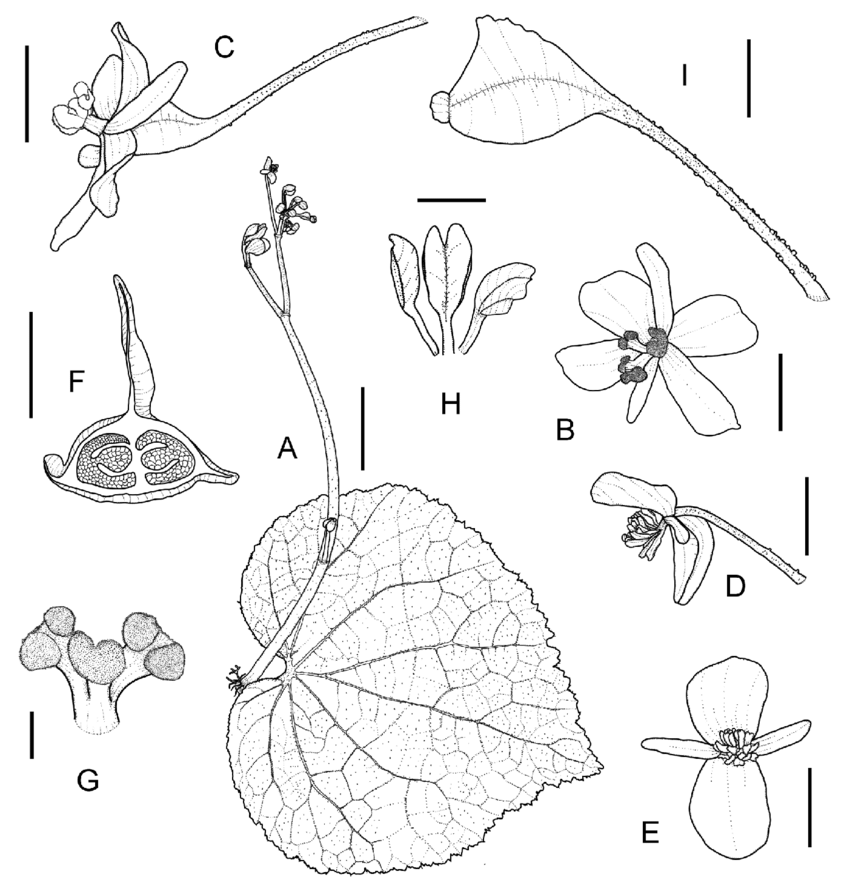
Drawn by K. Souvannakhoummane.

Begonia viriditenebris Lanors. et Souvann., sp. nov.
 (B. sect. Parvibegonia A. DC.) 

 Diagnosis. This new species is similar to B. sinuata Wall. ex Meisn. but differs in single leaf, indumentum of bristle hairs and reddish or bronzy green adaxial leaf surface (vs. two-three leaves, indumentum of stellate hairs and dark green adaxial surface of leaf), three styles (vs. two styles), and glandular hairy pedicels (vs. pedicels with stellate hairs) (Fig. 8, 9A).

— The specific epithet means the bronzy-green leaf color.

Distribution. Endemic to Tham Nang Ene Cave area (Khammoune Province, Thakheak District). 

Ecology and phenology. Wet limestone and granite rock in association with Asplenium sp., Adiantum sp., Globba sp., and Zingiber sp. Flowers in June – August, fruits in September – October. 

Vernacular name. Som Koung Tham (cave begonia).
 

Keooudone Souvannakhoummane, Soulivanh Lanorsavanh and Leonid V. Averyanov. 2021. Seven New Species and Seven New Records of Begonia L. (Begoniaceae) in the Flora of Laos. Turczaninowia. 24(2); 99-119. DOI: 10.14258/turczaninowia.24.2.12